Category Archives: Arts, Culture & Entertainment

Poem for Dilip Kumar my tribute to the legend: Prasoon Joshi

Celebrated writer-lyricist Prasoon Joshi, who penned a special poem for the launch of Dilip Kumar’s autobiography, says it was his way of paying tribute to the living legend.

Prasoon Joshi
Prasoon Joshi

The autobiography, “The Substance and The Shadow” compiled by Udaya Tara Nayar, was launched at a glittering ceremony here Monday evening.

At the event, actor-filmmaker Aamir Khan recited the poem as Joshi was unable to be present because he’s in Cannes for a prior work commitment.

Through the poem, Joshi portrayed Dilip Kumar as a masterpiece fit for his persona. Prior to penning it, the writer spent quality time having long discussions with Dilip Kumar’s wife Saira Banu and author Udaya Tara Nayar to capture the right essence of the actor’s personality.

In a statement, Joshi said: “It’s a tribute to the legend in my words. For me, writing this is an honour because on one hand there is greatness of Dilip sahab, and on another, it was recited by an unmatchable craftsman of our times, Aamir Khan on whose request I wrote the poem.”

It is an experience that the acclaimed writer will always cherish.

Dilip Kumar’s autobiography chronicles the life of the actor, who was born in Peshawar as Yusuf Khan. In the book, he has spoken candidly about his journey, his acting career in Bombay (now Mumbai), and his struggle and success in Hindi cinema.

The momentous night of the book launch saw several faces from the Bollywood fraternity gracing the event. While Karan Johar hosted the mega book launch, veteran actress Vyjayanthimala along with Madhuri Dixit and Priyanka Chopra lit the inaugural lamp.

This was followed by Bollywood veterans Amitabh Bachchan and Aamir Khan unveiling the autobiography.

While the Big B went on to read a passage from the autobiography, Aamir recited the words penned down by Joshi.

source: http://www.timesofindia.indiatimes.com / The Times of India / Home> Entertainment> Hindi> Music / IANS / June 11th, 2014

Book Review of CM Naim’s The Muslim League in Barabanki

Muslim League in Barabanki

K Babar

K Babar reviews Indian-American scholar C M Naim’s new collection of essays

The Muslim League in Barabanki
C. M. Naim,
City Press, 2013. Pp.126. ISBN: 9789698380984. Rs.350

The title of this slim volume refers to the first and longest essay in this collection of eleven pieces by the Indian-American scholar and translator Choudhri Mohammed Naim. Most of the essays are reprinted and revised editions of short articles that have appeared over the years in various publications, and which reflect, as Naim himself puts it, his “engagement with India and Indian Muslims”.

The first essay revolves around Naim’s Partition experiences, as well as those of his family. The young Naim and his friends tramped through their town, hoisting a Muslim League flag and chanting inciting slogans while tearing down Congress flags en route to school, determined to stir controversy by refusing to sing the national anthem. But once there the kindliness of a teacher, coupled with bribery consisting of an extra packet of laddu, dampened the enthusiasm of the youths, and they stood by placidly while the national anthem was sung.

The recounting of this incident is a universal reminder of the nature of much of protest. A reminder of the image of the youngster who proudly partakes in some protest march or other, only to stutter or stare blankly when quizzed about what it is he is marching for (or against). And once one has become suspicious of the authenticity of these part-time protesters, one wonders about their true motivations. Is it for the feeling of empowerment that they march through the streets, waving flags and shouting and domineering? Is it a form of release, an outlet, or just entertainment, a change from routine boredom? I wonder how many of these youths would follow the protesting practices of one of the most prominent of all 20th century Indians and refrain from eating not only laddu but anything at all.

Pakistani journalists should take note of Naim’s analytical style

Perhaps the young Naim was at heart ambivalent about Partition, for he later admits to a perpetual fluctuation of sentiment, ranging from pride at the achievement of Pakistan, to regret at the painful divisions it caused between friends and even families. His voice is an honest one, never flinching from uncertainties or complexities.

This is reflected in the remaining essays of this book, which are dominated by Naim’s deconstructions of the vitriolic and intolerant declamations by various Indian Muslim organizations and media outlets towards unorthodox groups such as the Ahmadis. This he does with a lot of skill, undermining the arguments of the opposing side by unearthing historical and religious examples of usually unquestioned authority that directly challenge the supposed Muslim orthodoxy that is being propagated by its self-appointed defenders. In short, his activity consists of picking apart prejudices, revealing fallacies, and pointing out self-contradictions as manifested in newspaper reports, websites, and other media. In addition to highlighting ignorance and hypocrisy, these tasks seem geared towards ensuring that disputes are civilized, that monolithic and oversimplified constructions of Islam and history are not allowed to prevail without opposition, and that those who would use sectarian means for political ends are exposed as being inappropriate leaders in either sphere. A relatively simple analysis of what is being said by whom and in what context is often more than enough to accomplish these goals.

An extra packet of laddus dampened the enthusiasm of the youths

It is always instructive when a linguist takes the time and effort to illustrate the way in which language is used and abused to promulgate an agenda, hidden or otherwise. As a teacher and translator of Urdu with significant credits to his name, Naim performs his duties with diligence. It would be appropriate for Pakistani journalists and scholars to take note of the admirably analytical style of Naim and apply similar precision to their own writings and that of their contemporaries. The only flaw in this book is that it could use some editing to compensate for grammatical errors, untranslated Romanizations of Urdu words, and a somewhat jarring style in the initial sections of the first essay. These relatively minor quibbles aside, one looks forward to seeing more of Naim’s work being published in Pakistan. For instance, his annotated translation of the Zikr-i Mir, the autobiography of the 18th century poet Mir Muhammad Taqi ‘Mir’, which was published by Oxford University Press in India, should be reprinted here, it being a valuable primary source document for the Mughal period.
- See more at: http://www.thefridaytimes.com/tft/muslim-league-in-barabanki/

P.S.

The above article from The Friday Times is reproduced here for educational and non commercial use ( The Friday Times, March 20th, 2014 )

source: http://www.sacw.net / South Asian Citizens Web / Home Page> Special Dossiers> Compilations> Partition of  1947> Book Review / April 07th, 2014


LMGC moves alumnae to restore Khursheed Manzil

Lucknow :

After financial assistance from Ministry of Culture towards conservation of the magnificent Khursheed Manzil, the La Martiniere Girls’ College looks up to its alumni to contribute towards converting the historical structure into a museum. The conservation work began in mid-June.

In the general body meeting of the La Martiniere Girls’ Alumni Association held recently, the school management had asked alumni to contribute towards renovation of Khursheed Manzil.

Principal Farida Abraham said “a museum is being prepared to preserve all old records and documents so that students present and past can relate more closely with the college’s glorious past.” Public will get a closer look at the antique remnants of this 200-year-old landmark, she added.

The grand museum will spread across three rooms comprising staff dining hall, drawing room and verandah, and would be adjacent to the principal’s office. The museum will exhibit the treasure trove of the historic college.

In an attempt to restore the pristine glory, the college had approached Union ministry of culture with a proposal. In May, the ministry sanctioned Rs 48 lakh. The total project outlay is around Rs 3 crore.

Conservation architect Ashish Srivastava said “the building was in a shambles. During excavation work, the college found pottery, good collection of books and paintings, picture plates dating back to pre-Independence years and other documents like shield, comments by old Martinians, etc.”

The college also plans to set the clock back. A drawbridge that led to the building in the past will be put in place so that visitors get a feel of the 18th century castle. This structure was witness to some stubborn fighting during the first War of Independence in 1857.

source: http://www.timesofindia.indiatimes.com / The Times of India / Home> City> Lucknow / by Isha Jain, TNN / September 09th, 2014

A brand ambassador for palliative care

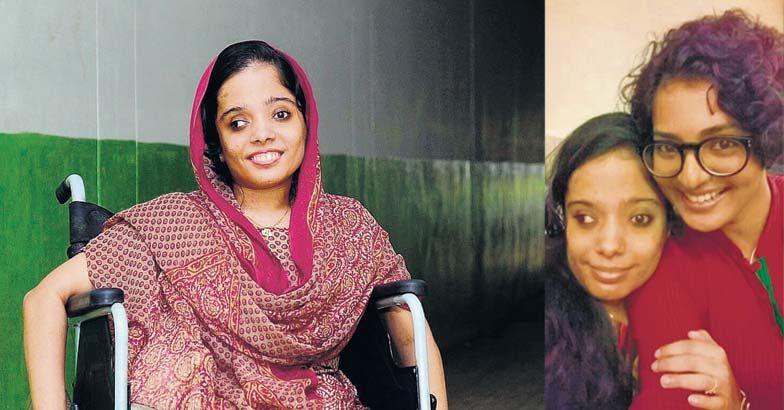
Wheelchair-bound Baby Fatima is the inspiration behind Saira of 'Bangalore Days'. Insert : Fathima with Parvathy (R)
Wheelchair-bound Baby Fatima is the inspiration behind Saira of ‘Bangalore Days’. Insert : Fathima with Parvathy (R)

Remember Saira of ‘Bangalore Days’? The character of Saira, who vanquishes the handicaps of the body using sheer willpower, is based on a real life character who caught Anjali Menon’s attention at a ward in the Kozhikode Medical College. Baby Fatima, a wheelchair-bound young girl who went to each patient, made them smile and consoled them, was the real life inspiration behind Saira.

Baby Fatima, like Saira, is also fast becoming a rage in the campuses. Fatima is visiting campuses to garner support of the students for the palliative care work in connection with the ‘Becoz I Care’ campaign jointly conducted by the Institute of Palliative Medicine and Students in Palliative Care.

Even though not a radio jockey like Saira in ‘Bangalore Days’, Fatima, too, has the gift of gab. The palliative care workers contend that once Fatima speak a few words to them, any patient will be able to forget their woes. Ask Fatima how she came to possess such boundless positive energy, and she will wax eloquent about her family and her childhood.

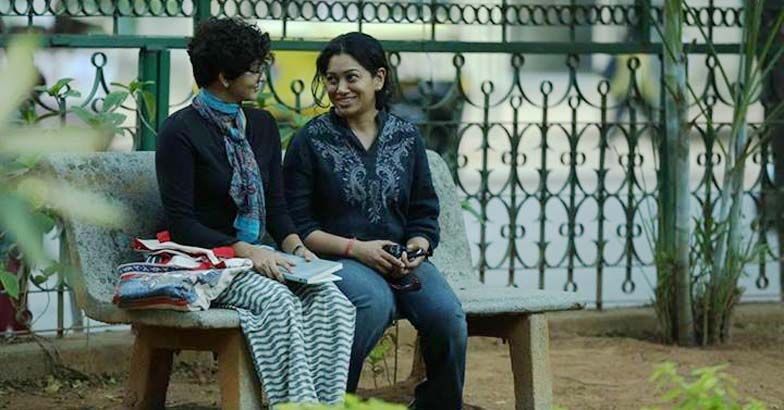
Parvathy (L) with Anjali Menon (R) during the making of the movie, 'Bangalore Days'
Parvathy (L) with Anjali Menon (R) during the making of the movie, ‘Bangalore Days’

Fatima grew up with her ‘moothumma’ Malappuram Kottappadiyil Kiliyamannil Mumtaz Usman’s family as the pampered lone sister of moothumma’s four sons. It was not as a handicapped child that the family treated her. Having been raised in such a way as to instill confidence in her, proved to be her strength, according to Fatima.

Fathima is a second year BSW student now, though she has not gone to school or college for studies. She studied from home. It was as part of the ‘Becoz I Care’ campaign that Fathima had her first glimpse of a campus, giving her immense joy.

BSW was a natural choice for her as social service is her ambition in life. Soon after completing Class 10, Fathima took the lead to meet up with palliative care workers and became part of their activities.

Apart from all these activities, the entrepreneur in Fatima has launched a designer clothes boutique in her own home. Fatima’s muthumma Jamal Ayesha accompanies her to the Medical College every morning, where patients await the girl, who has been a regular presence there for the past five years with a beaming smile and soothing words of care.

Life +ve Becoz I Care campaign is about each student reaching the brochures and registration forms of palliative care to ten households. The goal is to make the kind-hearted souls who are willing to set aside Rs 3 daily (Rs 1000 annually) as members in the ‘Tracks We Live’ project. The palliative care workers will then be able to deliver one time painkillers to one patient at Rs 3. The project aims at alleviating the pain of a patient using one person’s donation.

For registration form visit: www.instituteofpalliativemedicine.org
Phone: 82816 64752

source: http://www.english.manoramaonline.com / OnManorama / Home> Lifestyle> Health / by Kapil Raj / Friday – July 25th, 2014

Speech by the President of India, Shri Pranab Mukherjee at the release of a set of eight commemorative postage stamp of Indian musicians

It gives me great pleasure to release this set of commemorative postage stamps today.

As we pay tribute to eight of the greatest music maestros of contemporary India, we celebrate their life and work and their matchless legacy. These eight maestros are, without a doubt, among the tallest luminaries in the history of world music. They have not only achieved personal perfection but have made extraordinary contributions, in their respective fields, to the development and evolution of the schools of music in which their talents were nurtured and honed. Their contribution and its enrichment of our cultural heritage cannot be quantified or estimated. It is infinite in its resonance and their names will be mentioned with great reverence. Their music will be cherished by the young and old, for many decades to come.

I congratulate the Department of Posts for their initiative in bringing out these stamps. As these travel, pasted on letters and parcels and as they are added to the collections of stamp collectors and music connoisseurs and as they are used by people across the continents, these stamps will inform and remind all who see them of a golden era in musical achievements, a high point in the history of shastriya sangeet in India.

At this juncture, when we Indians, as a people, we are deeply involved with so many things, political processes and economic growth and development, while also facing the challenges of a globalized world, it is comforting and invigorating to pause and reflect on our unique cultural heritage. Music, in its pure form, is spiritual nourishment for our souls. It is at the core of our cultural and secular heritage. Our classical music, which has its origin in the Vedas, is said to be a gift of God himself; it is Nadabrahma, the sound of God, the music that pervades the universe.

Although one cannot sum up the achievements of these gifted souls in just a few words, I would like to pay homage by recalling a few aspects of their outstanding contribution to Indian music.

Ustad Ali Akbar Khan made his debut at the age of 13 at a music conference in Allahabad in 1936. His mastery of the sarod and his brilliant compositions gave him the title of a ‘national treasure’. As a performer and as a teacher, he popularized Indian classical music – not only in India but also in Europe and in the USA.

Pundit Bhimsen Joshi had developed the khayal form of singing. He was best known for his popular renditions of devotional music. He was a classicist by training and temperament but evolved an approach that sought to achieve a balance between “traditional values and mass-culture tastes”.

Smt. D. K. Pattammal, who started her training at the age of only four years, went on to become a legend in Carnatic Music. She achieved the highest levels in her field of music . Along with Smt. M S Subbalakshmi and Smt. M L Vasanthakumari, she was considered one of the “Female Trinity of Carnatic Music”. Her perfect rendering of Ragam Tanam-Pallavi , a composition that had all along been a domain of male artists, earned her the title of “Pallavi Pattammal”.

Smt. Gangubai Hangal, another child-prodigy, made her debut in the 1924 session of the Indian National Congress in the august presence of Mahatma Gandhi, Jawaharlal Nehru, Sarojini Naidu and Maulana Abul Kalam Azad. She fought prejudice and opposition to make music her career and remained committed to classical music for 75 years – until her last concert in 2006 .

Pundit Kumar Gandharva is remembered for his creation of new ragas and for bringing the spotlight to the music of Madhya Pradesh. His legacy includes his amazing experimentation with Nirguni bhajans and folksongs.

Pt. Mallikarjun Mansur of the Jaipur-Atrauli Gharana had set new standards through his mercurial improvisations in both melody and metre – without ever losing the emotional content of the songs that he rendered.

Pundit Ravi Shankar, will forever be remembered for the heights that he conquered as a legendary sitar player and composer of Hindustani classical music. He popularized the sitar in all parts of the world with his brilliant performances and creative compositions. His use of unconventional rhythmic cycles and unique compositions remain unrivaled to this day.

Ustad Vilayat Ali Khanwho introduced Indian music to the world along with Ravi Shankar and Ali Akbar Khan was another of the greatest pioneers of Indian classical music. He is undoubtedly one of the most influential musicians of the 20th century.

Ladies and Gentlemen, ours is a generation that had the privilege of knowing and witnessing the awe-inspiring performances of these eight brilliant artistes. Future generations will marvel at their genius. Many among us have been blessed with the opportunity to have personally known and experienced their uncommon prowess.

I, personally, do fervently believe that the music of India in all its diversity is one of the greatest gifts to human civilization.

I congratulate Department of Posts for bringing out these Commemorative Postage Stamps: by honouring these great legendary figures the country is honouring itself.

These stamps will be placed in the newly opened Museum of the Rashtrapati Bhavan where visitors from the different parts of India and abroad will be able to see them from this weekend onwards .

I wish you success in this and your future initiatives.

Jai Hind.

***SH/AK / Release ID :109276)

source:  http://www.pib.nic.in / Press Information Bureau, Government of India / Home> President’s Secretariat / September 03rd, 2014 – english release
After eight years, Indiranagar road renamed after a legend

KareemKhanMPO08sept2014

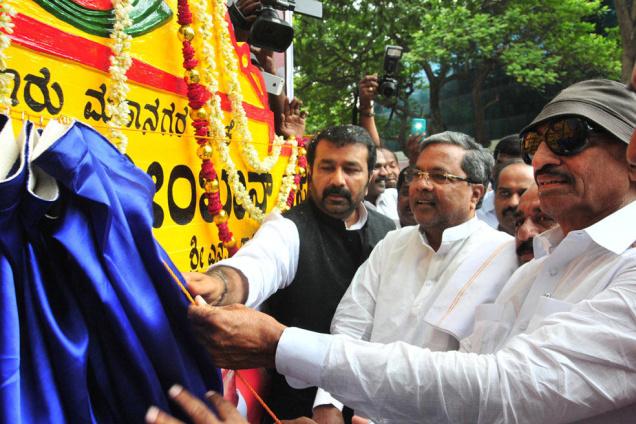
After a delay of eight years, the 100-foot Road in Indiranagar was renamed after folklore expert and freedom fighter S.K. Kareem Khan on Sunday.

Chief Minister Siddaramaiah, while recollecting the contribution of Kareem Khan, said he was a multifaceted personality who refused to take the government pension given to freedom fighters. “He was a towering personality who rose above caste, creed and religion.”

Posters

A large section of the road was dotted with huge banners and posters featuring the dignitaries invited for the renaming ceremony. At the 12th Main junction, posters and banners had covered every little space.

Bruhat Bangalore Mahanagara Palike (BBMP) officials conceded that permission was not granted to any person, organisation or political party to put up the hoardings.

The BBMP has been claiming for the past few weeks to have launched a drive to remove illegal publicity materials after the Upalokayukta lambasted the civic body over this. Till August 21 — the deadline fixed for the removal of flexes, banners, buntings and posters — the BBMP had removed 14,720 illegal publicity materials across the city.

However, with the BBMP citing pressure from politicians and shortage of personnel, the Upalokayukta has given the civic body three months to rid the city of all illegal publicity materials. Officials have been directed to submit an action-taken report every month.

‘Institute award’

Kannada Chaluvali Vatal Paksha leader Vatal Nagaraj urged the government to institute an award after Kareem Khan with a purse of Rs. 5 lakh. He also drew the attention of Mr. Siddaramaiah to the plight of Kannadigas in Talavadi, a border village, and urged him to speak to Tamil Nadu Chief Minister Jayalalithaa on the matter.

source: http://www.thehindu.com / The Hindu / Home> News> Cities> Banglaore / by Special Correspondent / Bangalore – September 01st, 2014

Eminent Sanskrit scholar, Dr. Naheed Abidi, calls on PM

Dr. Naheed Abidi, an eminent Sanskrit scholar from Varanasi, today called on the Prime Minister, Shri Narendra Modi, and presented two books written by her.

Dr. Abidi has translated the works of several Persian scholars into Hindi and Sanskrit, with the objective of spreading this knowledge among the people of India.

The Prime Minister appreciated her work.

SC
(Release ID :109435)

source: http://www.pib.nic.in / Press Information Bureau, Government of India / Home> Prime Minister’s Office / September 08th, 2014

‘Cylinders’ from scrap dealer reveal treasure trove of sound recordings

Mumbai :

The Customs office in Dadar has in its safekeeping a box containing a rare treasure, and it did not come from a seizure of illegal goods. Commissioner of Customs and Central Excise Amar NathSharma claims to have unearthed the oldest and rarest sound recordings in Indian history dating back to 1899. His cache of 200-odd ‘brown wax cylinders’ introduces the voice of Ustad Alladiya Khan, the founder of the Jaipur-Atrauli gharana, and Pandit V D Paluskar who founded the Gandharva Mahavidyalay, “artistes whom no living Indian has heard”.

Cylinders are hollow wax rolls about six inches in length that are played on a phonogram. The phono was invented by Thomas Edison but fell into disuse with the entry of the circular disc in 1902.

The collection includes ‘Vande Mataram’ in the voice of Rabindranath Tagore, which was recorded by Tagore’s friend Hemendra Bose in the wake of the Partition of Bengal in 1905. Vignettes of the fabled courtesan from Calcutta, Gauhar Jaan, a Parsi theatre artiste from Jaipur named Miss Allah Bandi, as well as doyens like Peara Sahab figure prominently on the list. Particularly relevant to Maharashtra are the founding fathers of the Marathi ‘sangeet natak’ like Pt Bhaurao Kolhatkar, Pt Bhaskarbuwa Bakhle and Bal Gandharva. Dadasaheb Phalke has spoken about the making of ‘Raja Harishchandra’ as well.

Sharma says, “India has no archive that documents the history of sound recording, be it classical or film music, but it is commonly understood that recording began in 1902 after the advent of the disc that is played on the gramophone. However, we have found wax cylinders dating back to 1899, and these are played on a phonogram.” He bought the phono from a shop in Chor Bazaar.

The officer’s quest for old discs began two decades at roadside stalls. He sourced a few cylinders from private collectors over the years, and began documenting the ones he had for a book. Then, as if by divine hand, last December he chanced upon a cache of 200 cylinders at a kabadiwallah (scrap dealer’s) stall. “I will not say where the shop is located or how much I paid. But it wasn’t much because few people know the actual worth of these cylinders. In fact, the kabadiwallah thought they were textile rolls. This turned out to be the biggest treasure of the earliest and rarest Indian recordings. We were fortunate that the name of the singer and the year of recording was inscribed upon a few,” he says. Some cylinders were wrapped in cotton. Sharma, his wife Abha and daughter Anukriti sat down to clean each one with a brush, taking care to not use any chemical since that could damage the soft wax.

Reacting to the find, vocalist Kishori Amonkar, a doyen of the Jaipur-Atrauli gharana told TOI, “I am interested to hear the recording to identify if it is indeed Ustad Alladiya Khan. My mother (Moghubai Kurdikar) was his disciple, so I can tell his style right away. I do know that the Maharaja of Kolhapur Shahu Maharaj had recorded Ustadji on a ‘bangle’, and if this is indeed the original it is extraordinary. But I have been disappointed before. I was in Rotterdam once, and someone offered to play me a recording of Ustadji. I heard it and knew at once it wasn’t him.”

Sharma has transferred the recordings to a CD and is willing to put them to the test.

source: http://www.timesofindia.indiatimes.com / The Times of India / Home> City> Mumbai / by Bella Jaisinghani, TNN / September 05th, 2014

Moonamidangal Bags DC Award

Kottayam :

‘Moonnamidangal’, by K V Manikantan bagged the DC Kizhakkemuri Birth Centenary Memorial Novel Award. The award by DC Books is given to the best novel by a debutant writer below 40 years of age.

The award was handed over to Manikantan by writer N S Madhavan at a function held in Kannur as part of the 40th anniversary celebrations of DC Books on Monday.

‘Moonnamidangal’ was selected by a judging committee constituting C V Balakrishnan, Benyamin and Panampilly Aravindaksha Menon from 147 entries.

The books selected for publishing are ‘1920 Malabar’ written by Hakkim Cholayil, ‘Thiru Mugal Beegam’ by Lathalakshmi, ‘Bhoopadathil Ninnum Kuzhichedutha Kurippukal’ by P Jimshar and ‘Karikkottakkari’ by Vinoy Thomas.

source: http://www.newindianexpress.com / The New Indian Express / Home> States> Kerala / by Express News Service  / September 02nd, 2014

Courage personified

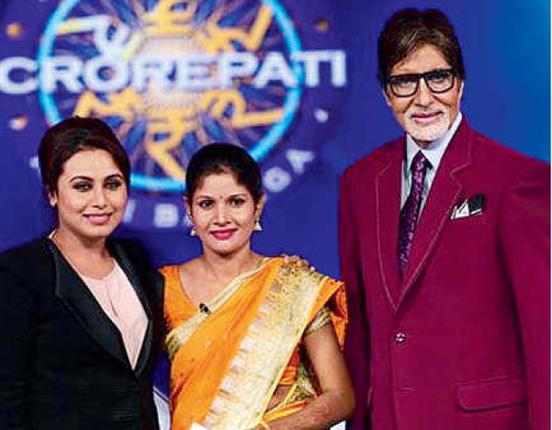
Recently seen on Kaun Banega Maha Crorepati, Fatima Khatoon provides a shining example of an individual’s strength to herald a change

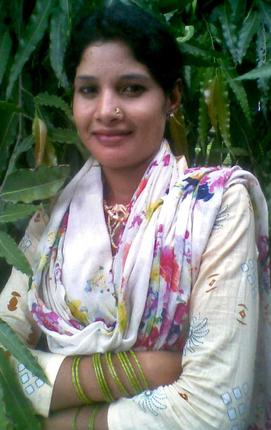
BLAZING SPIRITFatima Khatoon

“Arrest the customers who visit brothels; the men who sell the girls and those who procure them and force them into the trade, as they are the real culprits,” says Fatima Khatoon, an activist who took a stand against these social maladies at a tender age. She adds: “The hapless girls should not be punished. They require help and compassion to start life afresh.”

The comment is profound and more so as it comes from a person who is illiterate and was married into a household indulging in the sex trade. Born in a nomadic family in Nepal, Fatima entered matrimony at the age of nine.

“Being constantly on the move, childhood marriages of girls were prevalent in my community to ensure security and safety for them,” she explains, though she faults her parents “who should have checked the antecedents of my in-laws before marrying me off.”

Settling with her husband in Araria in Bihar, it took her more than one-and-a-half-years to realise that the womenfolk in the house, including her four sisters-in-law, were part of the trade. Her mother-in-law ran the business with the help of her four sons. This kept the kitchen pot boiling.

“Being young and lonely I used to speak to the girl inmates though my sisters-in-law never conversed with me. It is only through them I became aware of the facts,” says Fatima. The other three girls in the house were purchased. “They were duped by persons on the pretext of marriage, love or jobs and sold at the brothel,” she explains.

“My heart went out to them as I perceived they were experiencing a slow death every day,” says Fatima. Despite being young, she talked to them and decided to help them escape.

“I gave them clothes and helped them find the way. I also told them to raise an alarm in case anybody tried to stop them.” Severe reprisal followed, with Fatima locked up for three days without food and water till a family member warned that she may die. “After this, I was not allowed to step outside and was never left alone.”

Her kindled spirit received a jolt when she learned that her playmate, Afsana, daughter of an aged sex worker, was compelled to join, when she was visiting her mother. “I was close to Afsana and therefore, deeply hurt. I vowed that I will fight this trade and put an end to it,” she comments. Initially it was difficult but she managed to convince her sisters-in-law who have since left this trade.

Associated since 2004 with Apne Aap Women Worldwide (AAWW), a grassroots organisation working in India to end sex trafficking, Fatima is pleased to talk about the work of the AAWW team in her village. She claims, “A vast majority of the families there indulged in this trade and so far almost all have given it up, barring seven.”

Fatima intends to use the Rs.25 lakh won by her last week in Kaun Banega Maha Crorepati to raise her six children and build a home for them. Apart from this is, she plans to build a shelter for distressed women.

BLAZING SPIRITFatima Khatoon;  seen with Amitabh Bachchan and Rani Mukerji on “Kaun Banega Maha Crorepati”
BLAZING SPIRITFatima Khatoon; seen with Amitabh Bachchan and Rani Mukerji on “Kaun Banega Maha Crorepati”

Applauded by Amitabh Bachchan and Rani Mukerji, the crusader hopes her participation in the quiz show will inspire girls to keep up their spirit and courage to achieve their dreams and ambitions.

Arrest the customers who visit brothels; the men who sell the girls and those who procure them and force them into the trade, as they are the real culprits

source: http://www.thehindu.com / The Hindu / Home> Features> MetroPlus / by S. Ravi / August 26th, 2014