Category Archives: Arts, Culture & Entertainment

Racing ahead

Alisha Abdullah is one of India's very few women bike racers. / by Special Arrangement / The Hindu
Alisha Abdullah is one of India’s very few women bike racers. / by Special Arrangement / The Hindu

Champion racer Alisha Abdullah is in top gear as she dons new roles

“The guys, after every race, used to put me down. I would be one among the last. They would tell me that I am a girl and that I couldn’t do it, say things like girls should get married. I took it up as a challenge. And with every race I worked hard and I improved my position,” says Alisha Abdullah. She went on to prove the ‘guys’ wrong.

One of India’s very few professional women bike racers Alisha inched her way up, competing with men, to be one among the best in the circuit. “Today guys come up to me asking me for tips for the track.” She is also a car racer. She recently won the Toyota Vios Cup, a street car race held in Thailand, where she competed with the best women racers in Asia. “These women are much stronger and tougher racers and I won competing against them.” She says over phone from Chennai where she is based. She said she is scheduled to visit the city for the inauguration of Lap 47, a performance studio for vehicles.

At a time when little girls dreamt of becoming princesses or at least a Miss Universe, Alisha was on the race track wanting to be a biker like her father, R.A. Abdullah, a seven-time national biking champion. Go-karting, bikes and car racing…the petite Alisha has done it all – won prizes and broken records. At 13 she won the national go-karting championship and the best Novice Award in the open class of Formula car racing. She was all of 15 when she got to bike racing.

It is not easy being a professional car or bike racer ‘irrespective of gender’, she says. “As a racer you have to extremely alert. There are many things you need to monitor – check if the RPM is going down or if there is some other suspicious blip and this at speeds exceeding 160 kmph.” A profession which demands physical and mental strength, it keeps her on her toes constantly. She works out intensely, “focussing on strength training than cardio. I never do any cardio. The physical demands of car and bike racing are different. For the former, neck and lower back are the areas of focus. And I train only with men because, I mean no offense, but their workouts are much more intense when compared to how women workout. I can do between 50 to 60 push-ups in a minute.”

With all talk of RPM, bikes, cars and racing tracks one would think this is all the 25 year-old does. She is consumed by it but there is more to her. She is a model and an actor too. She debuted in the recently released Tamil film Irumbu Kuthirai. She plays the villain’s (a biker) girlfriend. “The story was based on bike-racing and, like everything else in my life; I wanted to do a role different from the usual run-of-the-mill characters.” This was a guest role, soon she is to start shooting for a yet-to-be named project she is the lead actor, “I play a psycho.”

Any offers from the Malayalam film industry? “None yet!”

Films and racing, isn’t the plate loaded? “No. My role model is Danica Patrick, she is an actor and a car racer. She is married, has a family and multi-tasks. It’s not that I am doing a 100 things. Just two things and that’s fine.”

She is a car racer, model and actor, too. / by Special Arrangement / The Hindu

Films and modelling are an aside, her focus is racing. She plans to start an academy for racing for women at Chennai. Her dream is fuelled by a desire to see more women competing in motor sport. “There are so many talented sportswomen, but almost none in motorsport. I want to change that trend. And if a man wants to come he can come wearing a wig!” she signs off.

source:  http://www.thehindu.com / The Hindu / Home> Features> MetroPlus> Society / by Shilpa Nair Anand / August 31st, 2014

Firag Gorakhpuri remembered

Gorakhpur:

Birth anniversary celebrations of Urdu poet Firaq Gorakhpuri were held at several places in the city on Thursday.

Members of Chitragupt Sabha garlanded the statue of Firaq Gorakhpuri in Daudpur and also organized a seminar in the evening in the conference hall of Chitragupt Mandir.

Social worker Ashok Srivastava garlanded the statue of Firaq. A seminar and a mushaira were also held.

Raghupati Sahai, known by his pen name, Firaq Gorakhpuri, was born on August 28, 1896 in Miyan Bazaar area in Gorakhpur. Azim Farooqi, a research scholar of Urdu, said: “People remember Firaq as a great Urdu poet but very few know that he was a freedom fighter too. He left his position of deputy collector and became member of Congress and went jail in 1920 along with Jawaharlal Nehru. He also contested in election with Shibbon Lal Saxena Party in 1952 against Mahant  Digvijay  Nath, the then head priest of Gorakhnath temple.”

Chitragupt Sabha president Atul Srivastava said: “Bahut pehle se un qadmon ki ahat jaan lete hain, Tujhe ai zindagi hum door se pehchan lete hain. Firaq Gorakhpur was a genius and great poet. Firaq Sahab is known for Urdu poetry but he was also English lecturer in Allahabad University. He passed ICS examination but resigned and joined freedom struggle. He was awarded Gyanpeeth Award, Sahitya Academy Award and Padam Bhushan Award in 1969 for his creation ‘Gule Nagma’.”

Pravir Arya of Madan Mohan Malviya Technical University said: “He was a prolific writer of Urdu and English. He added Gorakhpur in his name. We can proudly say that we belong to the place where Firaq used to live. He gave an international recognition to Gorakhpur.”

Speaking on the style of Firaq’s writing, poet Mohammad Husain Qayal said: “Firaq was an institution in himself. He has command over Urdu, Persian, Hindi and English. He was a great poet but a loner as his personal grief is reflected in his poetries. He had a troubled married life and his children also died.”

source: http://www.timesofindia.indiatimes.com / The Times of India / Home> City> Varanasi / by Arjumand Bano, TNN / August 28th, 2014

LINK TO THE PAST – Ancient map of Bidar unearthed in London

Historian and painter Rehman Patel says illustrations on the political and social history of India are included on either side of the map. / The Hindu

The map is included in an atlas produced by Colonel Jean Baptiste Gentil, Military Adviser to the Nawab of Awadh Shuja-ud-Daula

In exciting news for historians, an ancient atlas, which includes a map of Bidar, prepared by French officer Colonel Jean Baptiste Gentil, Military Adviser to the Nawab of Awadh Shuja-ud-Daula (1763 to 75), was found tucked away in the India Office Library at London. The map shows Bidar, which was once a capital city of the Bahamani Kingdom and an educational centre with historical importance.

Historian and painter Rehman Patel, who reproduced the map, said that in the interests of preserving the historic post and throwing more light about the history of the Bidar and its cultural heritage, the State government should put pressure on the Union government to bring it back to India and place it in Bidar.

Illustrations

He added that Col. Gentil had utilised the services of local artists to produce a series of illustrations on the political and social history of India.

Dr. Patel pointed out that illustrations were included on either side of the map. They reveal the representatives of different Sufi orders and thick forests with drawings of wild animals. These drawings also include Bidri craftsman and the different wares that were produced in Bidar. The bespectacled artisan at the bottom left of the page is portrayed as engraving a floral pattern on the side of a globular huqqa, with his wife and pet parrot looking on.

The illustration is reinforced by having a caption: ‘Fabrique de Beder ou on incruste en or et argent’ (Beder workshop for inlaying in gold and silver).

At the bottom right corner, there is a drawing of the types of wares produced: ‘vases incrustes’, or ‘inlaid vessels’. These include a globular huqqua on a stand, a bell-shaped huqqua, spittoons, boxes, a ewer and wash basin.

Reference to Bidriware

Dr. Patel said so far, the earliest unambiguous reference to Bidriware was in the Chahar Gulshan, written in Persian in 1759 AD. This includes a statistical account taken, on internal evidence, from an earlier compilation of about 1720 AD.

Book II of the Chahar Gulshan is ‘an account of five Subhas (administrative divisions) of Deccan’, one of the five being Bidar, referred to by its Bahmani and Mughal names. A manuscript in the British Library has the following passage: ‘The subah of Mohammadabad called Zafarabad (Bidar).

Bidar was also known from an illustration in an atlas produced in Faizabad, Uttar Pradesh in (1770 AD) under the Nawab of Awadh (Oudh) Shuja-ud-Daula, who ruled from 1754-75 AD. During this period, Bidar was under the control of Muhammad Ghauth Saif-ud-Daula, but he died shortly after his appointment, and his brother Saif Jang Najm-ud-Daula Bahadur became the governor in his place.

Dr. Patel said that enquiries at the office of the Deputy Commissioner in Bidar revealed that the district administration did not have a copy of the manuscript and the atlas produced by Col. Gentil.

source: http://www.thehindu.com / The Hindu / Home> News> National> Karnataka / by T. V. Sivanandan / Gulbarga – September 01st, 2014

INDIA ON WAX – Record discs that helped defeat the British empire: Tagore sings ‘Bande Mataram’

During the freedom struggle, recordings of patriotic speeches and songs helped rally support.

PhonographKOLKATA01sept2014

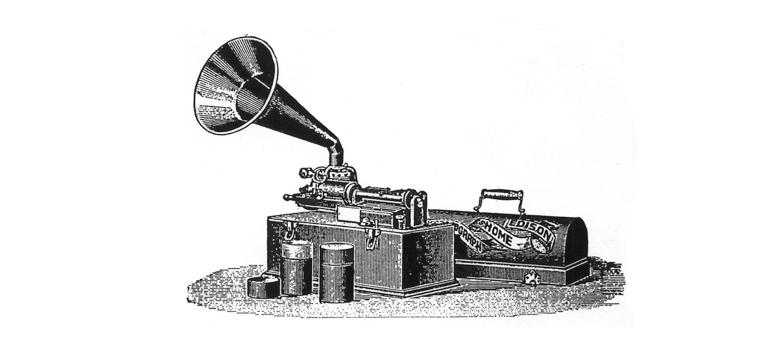
Between 1877 and 1878, Thomas Alva Edison submitted patent applications for the phonograph in many countries, including British India. It is not known when these patents were granted, but it is known that in December 1878, the first phonograph recording was demonstrated in Kolkata.

For the next 30 years, recordings on the phonograph cylinder became quite popular, remaining so even in the early years of disc records.

Many members of royal families and wealthy people bought cylinder phonograph machines and recorded musicians and religious personalities. The Maharajah of Khetri recorded Swami Vivekananad’s speeches and discourses much before he went to America and gave his famous talks on religion. The internet is full of versions of his celebrated speeches.

TagoreAdsKOLKATA01sept2014

During agitations against the partition of Bengal in 1905, H Bose recorded many political speeches and songs, such as Bande Mataram, both on phonographs and disc records, and they became very popular. But his factory and shops were sealed, machines and discs destroyed ruthlessly by police. As a result, nothing has survived today except a very short piece from Bande Mataram, sung by Tagore.

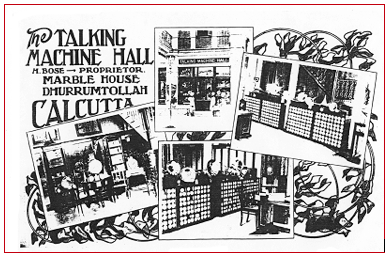
Hemendra Mohan Bose (1864-1916) opened the Talking Machine Hall in Kolkata, a shop where one could get one’s voice recorded. Bose was a sound recording expert and also had an agency to sell Edison and Pathe brand phonograph machines. Many great writers, poets and political leaders would visit him and he would record their recitations and speeches.

A 1906 catalogue lists several cylinder recordings of Rabindranath Tagore. Unlike disc records, cylinders could not be reproduced for sale. Most of these cylinders have been lost. Some museums have broken or damaged copies of cylinders as artefacts but no audible sound can be extracted from them.

Recording experts from Beka, a German company, were in Kolkata in November 1907. The British government went about destroying all nationalistic material, whereas the German company was the first to record a political speech right under the nose of the British.

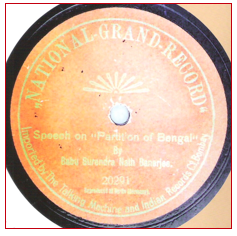
The National Grand Record label had a saffron disc with a rising sun as the logo. On it was recorded a speech by Babu Surendranath Banerjee, on the partition of Bengal. The flipside of this unusual 78-rpm disc has a speech on Bande Mataram.

DiskKOLKATA01sept2014

The man responsible for producing this disc was Sir Abdul Halim Guznavi, a political leader and agent for the Beka record company in Kolkata. Only few copies have survived. We have the image of the label only but no access to the audio file of this historically important recording.

We welcome your comments at letters@scroll.in.
source: http://www.scroll.in / Scroll.in / Home> All News / by Suresh Chandvankar / August 15th, 2014


Conservation work on at Mughal-era jharna

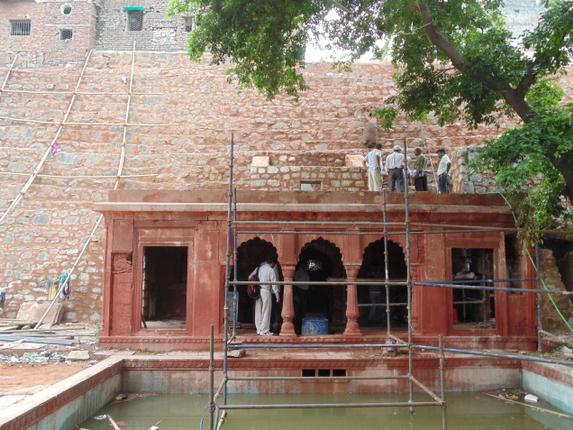
Restoration work by INTACH and the Delhi Government on in full swing at the jharna site at the Mehrauli Archaeological Park in the Capital. / by Special Arrangement / The Hindu

In six months from now, Delhiites will be able to see a jharna at the Mehrauli Archaeological Park.

Historically, the jharna, located behind Qutub Minar at Jahaz Mahal, earned its name from the waterfall created by a drainage of surplus water called Hauz-e-Shamsi during the Mughal period.

It is now under conservation and restoration by INTACH, in consonance with the Delhi Government.

INTACH Delhi chapter director (projects) Ajay Kumar says: “We are actually strengthening the ‘building’ of the jharna by using traditional materials like choonagursheera and surkhi, and trying to peel off, very carefully in a scientific manner, the whitewash this building got every year during Phool Walon Ki Sair [which begins from here]. There has been no renovation, conservation or restoration of this building for nearly 500 years.”

Restoration work by INTACH and the Delhi Government on in full swing at the jharna site at the Mehrauli Archaeological Park in the Capital. / by Special Arrangement / The Hindu

Mr. Kumar is also trying to consolidate the area around the jharna, as there is an open ground and a water tank close by. Earlier, the water tank had five steps, but now only two steps remain and it the tank filled with garbage. There are also some semi-collapsing pavilions around and ‘missing links’ in the old pillars.

Historical ‘links’

The architectural, constructional and historical ‘links’ to the jharna have interesting ‘routes’ through which water used to originate. From Hauz-e-Shamsi, the water used to flow till the Qutub. It used to cover an alley of 30 metres to 40 metres. This alley is not visible anymore as various constructions have covered it.

Close to the drainage point at Lado Sarai there existed a flower hub. Presently, the hub has evolved into a flower market. Close to a location called Jamali Kamali, there was a depression with water in it.

“It was like a lake and it was used by the bird,” says Mr. Kumar.

In 1638, Thomas Madcaff, the Resident General of India and a lover of Indian architecture and farms, bought a 1,000 acre plot there and converted the depression into a boat house. He modified the space with landscaping and named it Dil Kusha.

The jharna restoration will take six months to complete, but water recharge in the jharna might see the light of the day anytime soon. “My job is to strengthen the building. To recharge water in it, I require more helping hands and interest from government departments like the DDA, MCD and the Urban Development Department,” he added.

As for the source of water, there is a pipe that comes to the jharna. The other way, Mr. Kumar added, is to pump water artificially.

source: http://www.thehindu.com / The Hindu / Home> News> Cities> Delhi / by Rana Siddiqui Zaman / New Delhi – September 01st, 2014

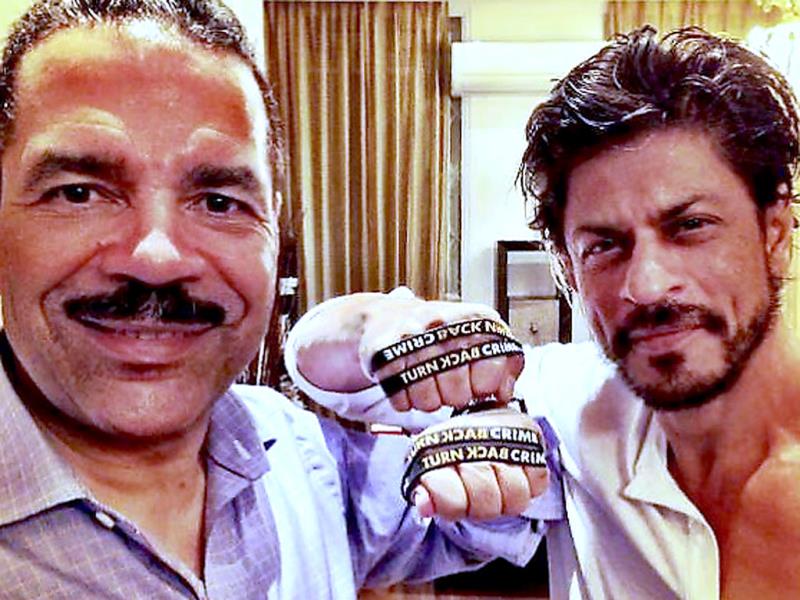
Shah Rukh Khan roped in as Interpol Turn Back Crime ambassador

Bollywood actor Shah Rukh Khan has been roped in as an ambassador for Interpol’s Turn Back Crime campaign to promote awareness on how everyone can play a role in preventing crime.

ShahRukhMPOs01sept2014

SRK, said to be the first Indian to be made an ambassador for the global campaign, is lending his voice to help spread the message that all of society benefits when citizens respect law and fight crime. “It’s a very special honour to be a part of Interpol’s Turn Back Crime campaign as an ambassador,” said Shah Rukh.

“As Mahatma Gandhi once said, ‘I shall not fear anyone on Earth. I shall fear only god. I shall not bear ill will toward anyone. I shall not submit to injustice from anyone. I shall conquer untruth by truth. And in resisting untruth, I shall put up with all suffering, if I have to. We all should believe in this maxim and in whatever way possible resolve not to let unjust people who might threaten us with criminal activity make us fear them. Because I believe we can, we should, and we must stand together against the few who commit crimes against any human being, in whatever form or guise these crimes might take,” Shah Rukh said in a statement.

Shah Rukh Khan joins actor Jackie Chan as an ambassador for the campaign, which has already garnered support from public figures including footballer Lionel Messi, Formula 1 racing drivers Fernando Alonso and Kimi Raikkonen in addition to law enforcement agencies around the world.

Interpol’s Turn Back Crime campaign is aimed at raising public awareness that organised crime is often involved in seemingly unrelated crimes. Drug trafficking, human trafficking, counterfeiting, cyber crime, kidnapping, crimes against children and corruption in sport are in fact often interconnected, with profits from one crime area used to fund another.

The Turn Back Crime campaign is aimed at helping the public better understand these issues and empowering them not to be duped by criminals when buying products or using the internet.

“Shah Rukh Khan has dedicated his life to making films which reflect the highest level of professionalism and commitment to bringing joy into the lives of hundreds of millions of filmgoers in India and around the world,” said Interpol secretary general Ronald K. Noble. “We are honoured to have him as an ambassador for Interpol’s global Turn Back Crime campaign and we look forward to seeing how he puts his artistic talents behind this campaign,” the Interpol chief said.

The Turn Back Crime campaign is also reaching out to companies and policy-makers in a bid to form a united front against contemporary crime challenges, and to support the ongoing activities of the global law enforcement community.

source: http://www.hindustantimes.com / Hindustan Times / Home> Entertainment / IANS, Lyons (France) / August 28th, 2014

FORSAKEN BY HISTORY – Fazlul Huq’s actions directed history at many levels

First Person Singular – A.M.
FazlulHuqMPOs29aug2014

The significance of the year 1937 as a major milestone in the colonial history of India is often either brushed aside or missed altogether. The British parliament had, a couple of years ago, passed the new Government of India Act promising Indians limited self-governance and suggesting a federal structure of administration for the Indian empire. Provincial elections were ordered in 1937 all over ‘British India’ so that people’s representatives, though elected on the basis of restricted franchise, could still wield some power. The Indian National Congress, despite its reservations over the provision of the act, participated in the polls and, as was only to be expected, had a cakewalk victory in most of the ‘general’ constituencies everywhere; it also succeeded in electing its candidates from an impressive number of constituencies reserved for the scheduled castes and tribes. The All India Muslim League, presided over by Mohammed Ali Jinnah, did much below its expectations. Even in the provinces where Muslims constituted a clear majority of the electorate, its performance was none too impressive. In Punjab, it was defeated by the Unionist Party put together by Sikander Hyat Khan, representing the landowning interests, who became the prime minister (this was the nomenclature used in the 1935 Act) of the province. In Bengal, A.K. Fazlul Huq’s Krishak Praja Party prevailed over the League in a majority of the constituencies reserved for the Muslim community. His party lacked an overall majority in the provincial assembly; it nonetheless emerged as the largest single party. The Indian National Congress claimed the second place, the Muslim League was a not too impressive third. In Sind, it was a rag-bag coalition of regional parties which formed the provincial government, the Muslim League was isolated. In the North-West Frontier Province, given the popularity of Khan Abdul Gaffar Khan and his brother, Khan Sahib, the Congress did tremendously well; it won seats which fell short of a majority by just one; the Muslim League failed in its mission to capture the province. It was only the Indian National Congress in the rest of the country, including the United Provinces, the Central Provinces, Bihar, Assam, Orissa, as well as the Madras and Bombay Presidencies.

Jawaharlal Nehru was the Congress’s president that year. At his direction, the Congress set down two conditions for joining a coalition with others for forming a government in a province where it would be unable to form a ministry on its own: (a) the Congress would not enter into alliance with any ‘communal party’ and (b) even where it chose to form a coalition with another party to form the government in any province, the prime minister must be only from the Congress; it would supposedly be demeaning for the great national party to take orders from a prime minister who belonged to a nondescript political formation.

What was ironical was that in its anxiety to keep the Muslim League out of power in the NWFP, the Congress did not hesitate to breach immediately the first of these conditions and agreed to accommodate the sole Hindu Mahasabha legislator in the state assembly, Mehr Chand Khanna, in the ministry it formed. When it came to Bengal, the party’s high command, so-called, was adamant in sticking to principles. Fazlul Huq, having successfully snubbed the Muslim League in the just-held polls, was most reluctant to have any truck with the League and was keen to have the Congress as his partner. He sent a formal proposal to the Congress authorities inviting the party to form a coalition with the KPP and join the ministry he would form as the province’s prime minister. Sarat Chandra Bose, elected leader of the Congress in the Bengal assembly, was eager to respond affirmatively to Fazlul Huq’s invitation. His request to do so was contemptuously turned down by the high command. Poor Fazlul Huq had no alternative but to approach his erstwhile sworn enemy, the League, to join his ministry. The League responded with great alacrity; the KPP-Muslim League coalition regime took charge of the provincial administration in Bengal. The course of history changed in Bengal from that point onwards.

Fazlul Huq’s KPP had a clear-cut programme to protect the interests of the rural masses. Once installed in office, Fazlul Huq wasted no time in implementing the pledged promises to relieve the peasantry of the burden of unbridled exploitation by big landlords and loan sharks. A legislation imposed ceilings on land cess charged by intermediaries. Of far greater relevance was the introduction of a separate legislation concerning rural indebtedness. It either considerably reduced or even squashed altogether the burden of land cess charged by intermediaries in the recovery of past loans. Fazlul Huq did not quite stop here. He decided to set up a commission — the Floud Commission — to introduce major land reform all over the province. A further measure, perhaps of equal, if not greater, significance, was an order which, taking into account the denominational distribution of the province’s population, reserved 54 per cent of job opportunities in the provincial government henceforth for members of the Muslim community.

This series of measures had a tremendous impact on all sections of the Muslims in Bengal whose support for Fazlul Huq soared. The reaction of Hindus and the Indian National Congress was, perhaps not totally surprisingly, to the contrary. The prospect of losing the opportunity of making easy money by increasing exploitation of the rural poor disturbed the thinking process of the Hindu gentry and middle-class Hindus; the additional, very real, possibility of shrinkage in opportunities to enter government service further alienated them from Fazlul Huq and his administration.

Ignoring advice for restraint, the Congress launched a virulent campaign depicting Huq as an arch communalist. It was conveniently forgotten that, barely a couple of years ago, the same Fazlul Huq had made the Congress happy by taming the League in the polls. The news media in Calcutta, both English and Bengali, owned by Hindu fat cats, were full of reports, often concocted, of how much sections of the Hindu community were suffering in different parts of the province under the tyranny unleashed by the coalition government. Fazlul Huq withstood the calamity for a while. He was a man of emotions though. At one point he decided that enough was enough, if he was dubbed communal for being a friend of the poor, he would rather turn into a full-fledged communalist. He liquidated his own party and joined the Muslim League, along with the bulk of the KPP legislators. He, so to say, handed on a platter the crucial province of Bengal, with its huge density of Muslim population, to Mohammed Ali Jinnah.

The rest of the story is well known. Huq was persuaded to move at the League’s annual session in 1940 the resolution demanding the creation of Pakistan. The League reaped what Huq’s KPP had sown in Bengal. Muslim masses all over the country were bowled over by reports of what the League had supposedly done for poverty-stricken Muslims in the eastern province. Their loyalties got swiftly transferred to the League. Jinnah begun to roar like a real lion. Pressure was unbearable on Muslim politicians who till then had kept their distance from the League. Sikander Hyat Khan could read the signs, and capitulated in Punjab and joined the League too. It was the same story in the rest of the country. Only Abdul Gaffar Khan’s NWFP refused to bend all the way.

Since at heart Fazlul Huq, besides abhorring Jinnah’s overwhelming ways, could not reconcile himself to the League’s exceedingly aggressive communal stances, he soon fell out with the League leadership. He tried to form an alternative government in Bengal by parting with the League. Most of his former supporters were, however, no longer with him. Even so, Huq succeeded in scraping together a majority in the provincial assembly with the help of Sarat Chandra Bose, who too had now broken with the Congress following Subhas Chandra Bose’s expulsion. What raised a furore was Huq’s seeking and receiving support from the Hindu Mahasabha leader, Shyama Prasad Mookherjee. This latest move by Fazlul Huq unnerved the British rulers. They had been happy when he merged his party with the Muslim League, which kept the Congress out of power in Bengal. The Congress was turning increasingly hostile. Mahatma Gandhi was threatening to launch the Quit India Movement, and the spreading influence of the League was considered a good antidote by the foreign masters. That apart, the Second World War was reaching a critical stage. Subhas Chandra Bose had disappeared from the country and had surfaced in Berlin. And now his elder brother, Sarat Bose, was Fazlul Huq’s choice for the post of home minister in the new ministry he was proposing to form. This could not be allowed to happen, for the home department handled many sensitive and confidential matters. Sarat Bose was arrested under the Defence of India Act before he could be sworn in. A shaky new ministry anyway took office with Huq as prime minister. It did not last long because of more desertions by his past followers who did not like his associating with Mookherjee. Huq’s self-styled Progressive Coalition government soon collapsed and the Muslim League got back to power. Huq was by now a totally isolated figure; his soliciting the support of the Hindu Mahasabha leader added grist to the anti-Huq propaganda by the League, which succeeded in establishing absolute control over the Muslims in Bengal. It was equally true elsewhere in the country. In the provincial elections held in 1946 after the war was over, barring the NWFP, it was the Muslim League, and only the Muslim League, triumphing in nearly all the constituencies reserved for Muslims. The country got partitioned barely a year later. The League was almost a non-entity in 1937; it could divide the country exactly a decade later.

The Congress could infringe its principles in the NWFP in 1937, but would not do so in Bengal; it instead, made a gift of Fazlul Huq to the Muslim League. This individual, Huq, in that sense played the most important role in settling the destiny of the sub-continent. He is nevertheless a forgotten person as much in India as in Pakistan. What is even more astonishing, his name is barely mentioned these days in Bangladesh too. What remains under layers of oblivion is the fact that the Bangladeshi national ethos was created by the emergence of a self-assured Muslim middle class in Bengal, which in turn was the direct consequence of the measures introduced by Fazlul Huq on assumption of office in 1937. The reforms initiated by Huq emancipated an impressive percentage of the rural as well as urban Muslim masses, offering them opportunities to get educated, provided them with jobs, and thereby created a substantive middle class full of pride and self-confidence. It is this class which, in spite of its mistrust of the Bengali Hindu exploiters, had a deep attachment for their mother tongue, Bengali, in spite of its Hindu roots. The constituents of this class had been shapers of mass opinion in East Pakistan, and have continued in that role in Bangladesh. The national consciousness built around pride for their own language would not accept their mother tongue to be treated with contempt in Pakistan, where they — Bangladeshis — made up the nation’s majority. Resistance grew and grew and was compounded by rising resentment against the oppressive domination of their land and people by West Pakistanis both in civil as well as military administration. The parentage of this Bangladeshi national ethos belongs to Fazlul Huq. History however is habituated to bypass those who create history.

source: http://www.telegraphindia.com / The Telegraph, Calcutta / Front Page> Opinion> Story / Tuesday – August 26th, 2014

Admin steps in to restore Moti Jheel

Agra :

The district administration has initiated steps to restore the Moti Jheel that is located behind Fatehpur Sikri fort complex, following the directions from the central government.

The project is aimed at rediscovering the beauty of this Mughal lake by preventing encroachments and settlements around it. The union tourism ministry wants the water body to be restored near the Unesco heritage site (Sikri fort complex) so as to promote tourism in the area.

Speaking on this aspect, district magistrate Pankaj Kumar said, “The Moti Jheel is a massive project. So, in the meantime we plan to build a pond nearby the fort. The biggest obstacles that would make the task of reviving the Jheel quite difficult, are the settlements and farm lands, surrounding it.”

“The work for constructing the pond will start in the next 15 to 20 days. As far as the Jheel is concerned, we have two options – either we compensate the villagers and ask them to vacate the land or convince them for the same. We are looking in to the matter,” Kumar added.

Sources said kumar recently conducted an inspection of the area along with a team of revenue and irrigation department officials to identify the area, where once this lake existed. The officials were asked to demarcate the lake area with the help of old maps. They were also directed to file a report on the size and appropriate depth of the lake.

The project has been gathering dust for the last two years, but revived once again during the visit of union tourism minister Shripad Naik, who instructed the ASI and the local administration to look into the feasibility of restoring the Moti Jheel.

An ASI official said, “It is the responsibility of the administration to restore the lake. There are historical evidences about the Jheel and about its tributaries. No doubt, it will take time to acquire land before restoration work can starts.”

source: http://www.timesofindia.indiatimes.com / The Times of India / Home> City> Agra / Aditya Dev, TNN / August 25th, 2014

Honouring the icons of Telangana

The recent decision of the Telangana government to rename the Acharya N G Ranga Agricultural University after Telangana ideologue Prof. Jayashankar, led to a great hue and cry from the Andhra coterie. Surprisingly, the most vociferous protests came from TDP leaders as the party was responsible for putting an end to the great leader’s record run of six terms in parliament. The party had hailed its candidate Lal Jan Basha  as a ‘giant killer’ in the 1991 elections when the late Guntur MP had trounced Ranga, inflicting on him the worst ever defeat. Public memory is short and even the party’s own leaders seem to have forgotten the tirade unleashed by their brethren against the feeble senior parliamentarian, then in his nineties.

Egyptian Pharaohs, it is said, made a habit of striking off references from stelae (commemorative markers) in order to establish their legitimacy and superiority over their predecessors. Despite such measures, neither the identity nor the legacy of those targeted could be erased absolutely. The legacy of N G Ranga too, cannot be obliterated by a mere change in the appellation of an institution commemorating the great man, especially when the divided assets of the university which remain with the Andhra state will continue to bear his name. Telangana needs to recognize and perpetrate the memory of its own icons and hence the tendency to claim a right to naming institutions based in the region. Those still upset about the change need to reconsider their stand in view of recent developments on the national front. It is reported that the Centre is seriously mulling over the proposal of renaming over 650 public schemes which bear the names of Nehru-Gandhi family members. Given its agenda of making the nation ‘Congress mukt’, the BJP government in all likelihood will go far beyond rechristening welfare schemes and target public institutions and infrastructure projects too. Already questions have been raised regarding the naming of the Shamshabad airport after Rajiv Gandhi and hundreds of other similar objections are bound to be raked up in the future. While one cannot deny the sycophancy of succeeding generations of Congress workers, who have honed the art of groveling at the feet of the Gandhi clan to perfection, a total whitewash of the family legacy would be a great injustice as both Nehru and Indira have indisputably contributed immensely to the nation.

Changing names of streets, institutions and buildings is nothing new either for Hyderabad or the country. The process began immediately after independence when replacing British era names with Indian ones was considered essential in asserting the hard earned freedom from the colonial rule. But even then, there was generally a distinction based on individual contributions which ensured that dedications to benefactors of India were left unchanged. That should have been the defining criteria for determining change, but unfortunately bigotry very often tainted decisions and resulted in unjustified sidelining of some very eminent personalities whose contributions to society are indisputable. As a result, while the Nizam was acceptable as the titular head after merger of Hyderabad with the Indian Union, the only street in the city named after him was not. The Shahrah-e Osmani thus became Jawaharlal Nehru Road, leaving one wondering as to why it could not renamed Raj Parmukh Marg if assertion of swaraj was the sole reason prompting change.

The Kutub Khana-e Asafia, which was designated the State Central Library, had evolved out of the personal collection of rare books and manuscripts donated by renowned litterateur Syed Hussain Bilgirami – Imadul Mulk. Years later, the manuscript collection was separated to form the Oriental Manuscripts Library which should have rightfully been named after the late Nawab. The Telangana government can as yet set right the lapse if it is serious about honouring icons from the city’s past.

With the legacy of N G Ranga having been handed over to rightful heirs, it is hoped that a similar action follows with regards to Potti Sriramulu. The move will be perfectly justified as the exemplary services of renowned Telugu poet and scholar Devulapalli Raemanuja Rao, the moving force behind the Sahitya Akademi and the Saraswat Parishad of erstwhile AP, remain unacknowledged. Among just a few others who need to be honored without further delay are world renowned archaeologist Ghulam Yazdani (by renaming the Archaeology Museum after him instead of YSR who made no contributions to the field whatsoever), Mahabalwant Raja Umapati Rao of Domakonda for contributions to Persian language, Maharaja Sir Kishen Pershad for promotion of syncretic culture, Ravi Narain Reddy and Raj Bahadur Goud for spearheading the Telangana Armed Struggle, P M Reddy and Babar Mirza for pioneering aviation (strong contenders if the airport is to be renamed), and Abdur Razzak Lari for his resolute defense of Golconda against the Mughals.

(The writer is a well-known conservation activist)

source: http://www.timesofindia.indiatimes.com / The Times of India / Home> City> Hyderabad / Sajjad Shahid / August 24th, 2014

Kalam Stresses on Importance of Family in Nation Building

New Delhi :

Economic growth or military strength alone won’t make India strong, a truly sustainable society, at the heart of which is the family, is very much necessary, argues former President A P J Abdul Kalam in his new book.

Kalam and celebrated Jain thinker late Acharya Mahapragya in the book “The Family and the Nation” say that only a strong and happy family can lead to a strong and noble nation.

In writing the book, the ideas of the two authors were shaped by their interaction during the past few decades with millions of countrymen hailing from different walks of life.

“Each interaction enhanced our experience and added to our understanding of the development of a noble family, a noble society and a noble nation,” they write.

While embarking on this journey of writing a book, we realised the magnitude of connectivities involved and the extent of our society’s evolution during the last few centuries,” they say.

“It is true that all of us realise that today’s world is a connected one. Technology and travel have nearly made the world a global village. The world has to become a federation of nations.

A nation is a federation of states, social groups, families and individuals. So what is needed is a situation of live and let live.

“One’s needs, aspirations, accomplishments are all important. But there has to be a concept of a noble nation, where the welfare of the whole nation as a whole is ingrained in the thinking and actions of its people.

This is the need of the hour. How do we achieve this idea of a noble nation,” the authors ask.             According to them, their visualisation of a noble nation is two-fold.

“One is internal, concerned with the individual and encompassing the family, community and society. Another concerns enterprise and covers the issues of livelihood, business, distribution of wealth and respect for individual property and rights,” they say.

The authors do not offer any new theory or postulate any new concept but draw from the heritage of our civilization.

“The bottom line is that a citizen with a value system respects the family, respects society, and thereby respects the nation. Furthermore, the person is conscious that he or she is a part of the world family.

“The operational line is the prosperity of people with adequate earning capacity. We call such a nation a developed nation. Economic prosperity and an embedded value system would promote a peaceful and prosperous society and thereby the evolution of a happy nation,” they write.

The book, published by HarperCollins India, stresses on the values that make for a truly sustainable society, at the heart of which is the family. For it is not economic growth or military strength alone that will make India strong.

Sustainable success comes from values, and these can sustain a society and a nation even in times of hardship. The book expresses an ideal by which Indian society may prosper and speaks of how spirituality can help create a noble nation and a better world. It provides a valuable counterpoint to the modern-day emphasis on consumerism and the philosophy of more is better, highlighting the sanctity of the natural world and its great power to evoke human creativity and love.

The two writers bring their vast experience to bear on this important subject. As the authors put it, it’s only a strong and happy family that will lead to a noble nation, one that can be a true fulfilment of 5,000 years of India’s civilization.

source: http://www.newindianexpress.com / The New Indian Express / Home> Nation / by PTI / August 26th, 2014