Category Archives: Arts, Culture & Entertainment

And the State Film Awards Go To…

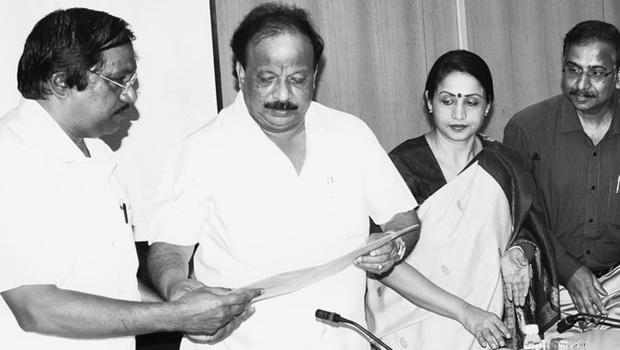
Chairman of the State Film Awards selection committee, K C N Chandrashekhar (left), handing over the list of winners to Information Minister Roshan Baig on Monday

Bangalore :

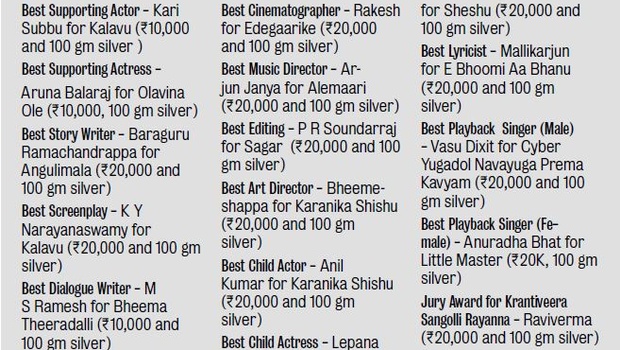
The state film awards for 2012 were announced on Monday. The Best Actor award goes to Darshan for his role in Kranti Veera Sangolli Rayanna and Nirmala Chennappa has been adjudged the Best Actress for her role in Tallana.

Announcing the winners, K C N Chandrashekhar, the chairman of the State Film Awards selection committee, said 58 films vied for the top honours of 2012.

He said M Bhaktavatsala has been chosen for the Dr Rajkumar Award and Chi Dattaraj for the Puttanna Kanagal Award. The Dr Vishnuvardhan Award will be bestowed on senior actor Rajesh. All these awards carry a purse of `2 lakh and a gold medal.

And the Top Films Are

Tallana, directed by N Sudarshan, has been chosen as the best film of the year, followed by P Sheshadri’s Bharath Stores and D Suman Kumar’s Edegaarike. While the winning film gets a cash prize of `1 lakh and 50 gm gold, the second and the third best films will get `75,000 and `50,000, respectively, in addition to 100 gm silver.

C Lakshman’s Karanika Shishu has been adjudged the best movie with a social concern. Naganna’s Kranthi Veera Sangolli Rayanna and K Shivaram Krista’s Little Master have been chosen as the best entertainment and children’s movie,  respectively. Santosh’s directorial effort Alemari has been chosen as the best debut film while Umesh Naik’s Konchavaram has been chosen as the best regional movie.

‘Awards Will be Given on Time’

ActorsBF27aug2014

Information Minister Roshan Baig said from next year onwards, the awards will be given for the same year.

“We are yet to constitute a selection committee for 2013. Awardees will be finalised soon. The date for the 2012 award ceremony will be fixed after consulting CM Siddaramaiah,” he said.

source: http://www.newindianexpress.com / The New Indian Express / Home> States> Karnataka / by Express News Service / August 26th, 2014

New Chiefs Appointed to Academies

Bangalore :

The Department of Kannada and Culture has appointed heads and members to various academies.

M S Murthy (Bangalore) has been appointed the Chairman of Karnataka Lalithakala Academy, B A Mohammed Hanif (Dakshina Kannada) is the new chairman of Karnataka Beary Sahitya Academy while Kolkada Girish (Madikeri) has been appointed as the Chairman of Arebhashe Samskruthi Sahitya Academy and Biddatanda S Thammaiah has been appointed the Chairman of Kodava Sahitya Academy.

Members Named

For Karnataka Lalithakala Academy, B L Chauhan, Mahalingappa, Prabhu Urs, B K Badigera, Vishweshwari Tiwari, Devarishi, C Chikkanna, Krishna Devadiga, T H Shanmukappa, Khasim I Kansavi, Sharanappa B H, Wajid Sajid, Vedamurthy, Bargur Markandeya and C Rajashekar have been appointed the members.

source: http://www.newindianexpress.com / The New Indian Express / Home> States> Karnatkaka / by Express News Service / August 14th, 2014

City Girl Gets a Pat at World Women’s Congress for Her Stirring Speech on Muslim Girls’ Literacy

Hyderabad :

Seventeen-year-old Sayyeda Salima Asra took up the mantle of increasing the literacy rate among Muslim girls in the country, which stood as low as 50 per cent and lower than the national female literacy rate of 54 per cent.

The Hyderabadi’s presentation and exposition on the ‘Indian Perspective of Muslim Minority Girls’ Education’ won her accolades from over 1,000 delegates from across the world. She spoke at the World Women’s Congress which was held at the University of Hyderabad between August 17 and 22.

Asra, a second year student of the Home Science College at Saifabad, was the youngest speaker among a galaxy of speakers drawn from the academia, women’s rights groups, industry, politics and other spheres of society.

Undeterred by the deafening silence, the 17-year-old Hyderabadi in her 12-minute talk, took the audience by surprise and received a standing ovation after her address.

Asra’s talk was far from dry statistics and abstract analysis of the problem and primarily focused on a first hand account of the issue. Her narration of the experience of visiting two Madarsas in the city reflected the issue in its crude form and brought to the fore the appalling conditions under which Muslim girls pursue their education.

According to Asra, it is not the principles of Islam which prevent girls to pursue education but personal thoughts of some leaders and preachers who manipulate texts leading to utter chaos.

“In his first revelation of Allah to prophet Mohammed, God said Islam and theory and practice always should promote knowledge. Seeking of knowledge is incumbent upon every Muslim. It never discourages women from obtaining knowledge,” she said.

Asra considers the Indiansation of Islam largely responsible for the low literacy rate among Muslim girls.

“Although Islam in its true sense never had any caste system, the increased intervention of extraneous forces brought the system into the community. This changed the attitude of people and only aggravated the issue,” the 17-year-old pointed out. Continuity in policy-making is important to tackle the problem, according to Asra. “There are many schemes to address the issue. The problem is that a political party, which comes to power after few years, wants to undo what its predecessor has done. This is hurting the cause of Muslim girls’ education,” the Hyderabadi concluded.

source: http://www.newindianexpress.com / The New Indian Express / Home> Cities> Hyderabad / by Express News Service / August 25th, 2014

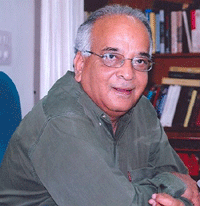
Modern architect of Jamia Prof Mushirul to deliver lecture on campus

The Department of History and Culture, Jamia Millia Islamia is going to organize a lecture on Partners in Freedom: Jamia Millia Islamia by Professor Mushirul Hasan on August 26 at 11.00 AM in the Seminar Room, Department of History and Culture, Jamia.

Professor Mushirul Hasan (JMI Photo)

Professor Hasan is the former Vice-Chancellor of Jamia and has a distinguished place among historians. As VC of Jamia from 2004 to 2009 he played a crucial role in opening many centres. Many existing buildings and the beautification of the campus happed during his tenure. Many call his the modern architect of Jamia.

He received his education at Aligarh Muslim University and Cambridge University. He is also the recipient of Padma Shree. He is the author of many important books on Indian history. He has written extensively on the Partition of India, on communalism, on the histories of Islam in South-Asia and on the role played by the Muslim community in the freedom struggle and in the process of nation-building. Also, he served as the Vice-Chairman of Indian Institute of Advanced Study, Shimla and Director General of National Archives of India apart from other numerous responsibilities as Member of Professional/Learned Bodies/Societies.

Despite all his achievements and numerous contributions in building Jamia what it is today he had to take VRS, sparking debate whether he was forced to quit.

source: http://www.okhlatimes.com /Okhla Times / Home> JMI> OT Campus Reporter – JMI / OT –  August 25th, 2014

‘ The mosque Noor Jehan created was never prayed in’

Feisal Alkazi, author of Srinagar: An Architectural Legacy talks to Payel Majumdar about Kashmir’s multi-racial architectural heritage, its existence as a periphery kingdom, and its 777 gardens.

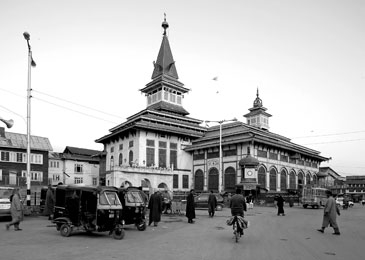
Khanqah-i-Muallah, with its traditional Kashmiri pagoda-style spire

Could you tell me how this book came about?

A. I have been in and out of Srinagar for the Rajiv Gandhi Foundation, that runs a rehabilitation programme for children whose parents have been killed by terrorists. I ran a project called “Discovering Kashmir” with them over a period of three-four years. This was my first set of trips to Kashmir, and I became interested in its heritage, its unique history, its sections of Buddhism, Hinduism and Islam. Then INTACH’s Delhi office got in touch with me about writing this particular book because of my background, based on the listings (what INTACH does is list about 500 buildings, a group of architects go around and write a description.) They felt a self-directed guide book based on these listings had great potential.

Q. History is often looked upon as a dry subject. Do you think this is something that needs to be addressed within our education system?

A. With young people, my work has primarily been about making history come alive. I have worked a lot on heritage education, and I think it is very important that we stop teaching history as a lot of dates to cram up. Very often when I work with young people, I start with, “What in your house is 50 years old?” Then they start thinking, woh bartan hai, woh kursi hai. This is how we start with personal histories, and then we arrive at the history of a nation. Heritage education is about looking back at our roots, because we have this collective sense of what makes us Indian, whether it is something as simple as tandoorichicken or cricket. So what is it that we perceive as being Indian, and ourselves? How is someone who lives in Jaipur, different from someone who lives in Delhi, different from someone who lives in Srinagar? Every place has its own unique stamp. And I’ve done this exercise for 25 years.

Q. Three aspects of Kashmiri architecture that fascinates you?

A. One, that so much of Kashmiri architecture was done without cement. You can’t think of any building these days without cement. And if you think of the buildings there — sufi shrines like Khanqah-i-Muaallah or the other sufi shrines, they structure the building in a way that the weight of it keeps it down, using deodar logs with bricks, and building a whole structure without concrete. Another aspect of the traditional structure is that all buildings are earthquake proof, for it is a seismic zone. They use these diagonal members, like how they use in Simla — very rarely do you have buildings where horizontal and vertical beams aren’t in use. And then there are these very specific features — how they use papier mache in the decoration of walls, or the idea of the balcony — the dub — which is always wooden. These structures have been there since the 15th-16th century. You might replace the knobs, but essentially the structures are unchanged. You have those Maharaja bricks as well, which you see in the Old Delhi.

Q. How are gardens a crucial aspect of Kashmiri architecture?

A. Kashmir held a strategic position for the Mughal Empire because the main cities were Delhi, Agra and Lahore. All the early Mughals never built palaces, because they lived inshamianas. Theirs was a moving, transient culture. When the Emperor annually moved out of Delhi, 65% of the population moved with him. 2,00,000-3,00,000 people were on the move and there would be two travelling tented cities, one that the Emperor would stay at for the night, and one that would be set up ahead for the next halt.

{
When the Emperor moved out of Delhi, 65% of the population moved with him. 2,00,000-3,00,000 people were on the move.

There is no flat land in Kashmir where you can pitch tents for these many people. To accommodate the Emperor’s entourage the gardens came up with pavilions and palace tents. There is the whole structure of the Red Fort in the royal gardens of Kashmir—Diwaan-i-khaas, a diwaan-i-aam, a zenana, a mardaana. There would be two or three pavilions — like the one in black marble in Shalimar Garden ­— around which colourful tents would be pitched. They say that there were 777 gardens around the Dal lake. And Dal Lake was never the centre of the city. Gardens would be built because the soil is so fertile, that everything thrives in it under Kashmiri weather. The Mughals had come from Bukhara and Samarkhand, which also have prominent gardens. The very idea is crucial to Mughal architecture as a whole.

Q. How have the different rulers influenced different styles of architecture, and how have these architectural styles come together?

A. Architecture anywhere is an outcome of what is locally available as building material. Say, if in your vicinity there is a particular kind of tree, which becomes the building material, then you are limited by the height of that tree, the durability of that tree. For instance, for those khatamband ceilings in Kashmir, you use pine which is very thin, like plywood, that can be replaced, while the exteriors last forever.

So structures that come up traditionally reflect the surroundings completely and are built for that time. Kashmir was never the centre of an empire, it was the periphery of an empire. As a result, being on the periphery, too much of the architecture did not change. And when the Dogras came, in the last 110 years — when they bought it from the British for 75,00,000, they brought in a lot of British influences — the similarity of the Gothic arches, specific style of building, use of repetition, and the Kashmiri architecture since then is sometimes a combination of that and older traditions. There was hardly any Mughal influence on residential architecture. The Mughals created those pavilions in the gardens and created the gardens, one gateway and a couple of mosques. And really, the mosque Noor Jehan created was never prayed in, whether it was because it was built in stone, built by a woman, or by someone who wasn’t perceived to be Kashmiri.

Q. Are there ongoing efforts in Kashmir by the locals to preserve their architectural heritage proactively?

A. Certainly, the local INTACH chapter has done quite a bit. They have done a beautiful conservation job on the Aali Masjid. The government has stepped in as well to restore the temples in Martand; so yes, there is an interest in keeping that style of architecture alive. But builders come into question, and suddenly things change when money comes in from other parts of the world, which influences the whole thing. When Hazratbal was built in the ’60s, they decided to use a dome, which is a West Asian influence. A dome is not suitable for a place where it snows, marble is not a good for Kashmir which has three months of winter. But there were political pressures there, which decided not to use traditional Kashmriri three-tiered pagoda roof but build something that looked like it was out of the Middle East.

source: http://www.sunday-guardian.com / The Sunday Guardian / Home> Artbeat / by Payel Majumdar / August 23rd, 2014

Tributes paid to Shehnai maestro

Varanasi :

Rich tributes were paid to Shehnai maestro Bharat Ratna Late Ustad Bismmillah Khan on his 8th death anniversary observed at Dargah-e-Fatman on Thursday.

A music lover and a fan of Ustad, Narendra Gupta from Delhi, paid tributes to him by reading Sunderkand of Ramcharitmanas and Hanuman Chalisa beside his grave. Gupta visits the city every year on birth and death anniversary of Ustad. Some music lovers also paid a musical tribute to him on the occasion.

They were disappointed to see that the grave of Ustad could not take a shape of a maqbara yet, and a music academy after his name also seemed to be a distant dream. A series of promises were made by the government after the death of Shehnai maestro but none of them have been fulfilled yet.

source: http://www.timesofindia.indiatimes.com / The Times of India / Home> City> Varanasi / TNN / August 22nd, 2014

India-Born Author Brings Mirza Ghalib’s Treasure to Americans

Washington: 

India-born author Surinder Deol has penned a new English translation of Mirza Ghalib’s works to bring the famous Urdu poet to North Americans as also those South Asians who have lost touch with their native languages.

Author Deol, who worked as a World Bank staffer for nearly 25 years before turning a poet and novelist, says he undertook the task “with the objective of bringing Ghalib to those North American readers who have found Persian poets like Rumi and Hafiz interesting to read.”

“That is a very large audience. And if I succeed in getting their attention, then my job is done. But I also feel that my book is useful for South Asian readers too,” Mr Deol told IANS in an interview.

Published by Penguin-Random House imprint Partridge, Deol’s 378 page free verse translation of Ghalib’s entire Urdu divan titled “The Treasure: A Modern Rendition of Ghalib’s Lyrical Love Poetry” was released last week.

It’s not easy to understand Ghalib even for those who have a normal level of proficiency in Urdu, Deol said, but “My book makes life easy for everyone.”

“If you have high school level understanding of English, you can read the whole book and get the true essence of Ghalib’s poetry without any difficulty.”

“The younger generation of Indians in the US and other foreign countries who do not read Urdu or Hindi scripts or can’t speak the language can now enjoy India’s most loved poet in a language that they speak every day,” he said.

Mr Deol said he was quite satisfied with the result of his efforts to bring Ghalib to American readers as also Indians abroad, but the key factor will be how people react to his work

“Most importantly, I have used a language that is poetic but it is not archaic. Look at the reason why Americans love Rumi in Coleman Barks’ translation. It is simple, direct, and touches you at a deep personal level as you read it.”

Asked what inspired him to translate Ghalib, who is considered “untranslatable”, Mr Deol said “Because I loved Ghalib, I wanted to see his work made available in a good English translation so that he gets the recognition as a great world poet.”

“Since I was very impressed with Coleman Barks’ free verse rendering of Rumi, I thought of using the same technique for Ghalib.

“My idea was to apply this technique on 15-20 compositions or ghazals as a creative experiment.”

“But you know Ghalib’s poetry is like red wine that he cherished so much. You start this work and you get intoxicated and you can’t leave it.” Mr Deol said.

“The task got harder as I proceeded but by then I had become an addict.

That took two solid years of my life. But I have no regrets.”

“A book like this takes much longer to find acceptance but I’m very hopeful that my rendition of Ghalib will one day become a popular text for ordinary readers as well as for students of oriental literature,” Mr Deol said.

“The Treasure” is available on amazon.com internationally and on FlipKart in India.

source: http://www.ndtv.com / NDTV / Home> Sections> Diaspora / Indo-Asian News Service / August 24th, 2014

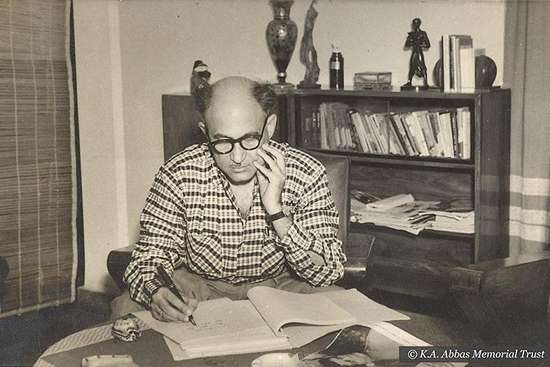
CENTENARY LECTURE – ‘A Communicator Of Ideas’

KhwajaAhmedAbbasMPOs24aug2014

That’s how Khwaja Ahmad Abbas described himself. Who was he? Why was he what he was? What social and ideological impulses motivated him? Why is his vision of continuing relevance?

Full text of the Khwaja Ahmad Abbas Centenary Lecture delivered by the vice president, titledLiterature, Art And Social Awareness, on Saturday, June 7, 2014

Khwaja Ahmad Abbas was a low profile yet iconic personality of an earlier period of independent India. I deem it a privilege to be invited by the Centenary Celebration Committee to talk about him and his work.

Abbas lived and worked at a critical period in the history of modern India. His ideas relating to the evolution of consciousness on societal matters, as it emerged in the independence struggle and in early decades after 1947, remain of relevance to all those who care about the less fortunate segments of society and who attach value to the concepts of creativity and artistic freedom.

Some initial questions would be in order. Who was Khwaja Ahmad Abbas? Why was he what he was? What social and ideological impulses motivated him? Why is his vision of continuing relevance?

Social etiquette no longer encourages mention of lineage, except of a certain kind. Thus it would suffice to say that Khwaja Ahmad Abbas’s genes exhibited scholarly traditions worthy of citation in any company. He has recorded for posterity his effort as a student in Aligarh to board a train just to talk to Jawaharlal Nehru in his railway compartment; the conversation— somewhat halting— ended with a request to sign the autograph book. A hurried inscription followed:

“Live dangerously. Jawaharlal Nehru”.

He took this to heart and described his relationship with Nehru as “a long love affair”.

Abbas, in his own words, was “a communicator of ideas”. He did this as a journalist, short story writer, a novelist, a film critic and film script writer. He is considered one of the pioneers of Indian parallel or neo-realistic cinema having penned films like Neecha Nagar, Jagte Raho, Dharti Ke Lal, Awara, Shri 420, Mera Naam Joker, Bobby and Henna.

As a journalist, his columns ‘Last Page’ and ‘Azad Qalam’ commenced in 1935 in Bombay Chronicle and continued in Blitz till his death in 1987. Each was a pithy commentary on contemporary happening and had a wide following. His retort in early 1963 to US Senator Richard Russell’s uncharitable criticism of India was characteristic of his passion for causes Indian.

A 16 minute documentary film made by Khwaja Ahmad Abbas in 1968 added a footnote to our legal history. Titled A Tale of Four Cities, it contrasted the life of luxury of the rich in Calcutta, Bombay, Madras and Delhi, with the squalor and poverty of the poor. Particularly the life of those whose hands and labour helped to build beautiful cities, factories and other industrial complexes. The documentary was silent except for a song which the labourers sang while at work. One minute of the film gave a fleeting glimpse of the red light district of Bombay and this was required by the Censor Board to be deleted for a ‘U’ certificate.

In the first case of the kind in the Supreme Court of India, it was argued on behalf of Abbas that pre-censorship of films is offensive to freedom of speech and expression and that the rules relating to it were vague, arbitrary and indefinite. The Bench, headed by Chief Justice Hidayatullah, allowed the petition on the ground that treatment of motion pictures must be different from other forms of art and expression. He held that the clarifications and assurances given in the hearings by the Solicitor General and procedural safeguards accepted by the Government “will make censorship accord with our fundamental law.” This, in effect, curtailed government’s arbitrary exercise of censorship powers.

Interestingly enough, Abbas had written a letter to Gandhi ji in 1939 requesting him to reconsider his views on cinema being included amongst other evils like gambling, sutta, and horse racing:

“You are a great soul, Bapu. In your heart there is no room for prejudice. Give this little toy of ours, the cinema, which is not so useless as it looks, a little of your attention and bless it with a smile”.

Some of the short stories of Khwaja Ahmad Abbas, written in Urdu and published in English translation a few years back, allow the present generation to appreciate the depth and diversity of his talent as a story writer. They are reflective of his social awareness. A reviewer has observed that reading them is a sobering exercise and remind one of another India “when idealism of nation-building was more in evidence though often found bleeding on the jagged edges of poverty and deprivation, resistant feudalism, inequalities and the divides of caste and religion.”

Khwaja sahib attached particular importance to his literary work. This was summed up in his Will

“If you wish to meet me after I am gone just pick up one of the seventy odd books I wrote or view the films I have produced or written the scripts for. If you are not allergic to yellowing news-print then go to library and read any of the hundreds of columns I have written. I WILL BE THERE with you.”

In an age when being ‘progressive’ was considered almost synonymous with being dubbed ‘communist’, Abbas consciously drew a line. This is summed up in a passage in his Autobiography:

One of the persistent legends in Indian politics is that I am a communist, or at least a hidden communist, a fellow traveller or a stooge of the communists. All kinds of people seem to believe it— except the communists who think I am an un-regenerated ‘petite bourgeoise’.”

He recalls Nehru’s amusement at his distinction between communists, ex-communists and anti-communists in ascending order of undesirability and goes on relate his expulsion (rescinded nine years later) from the Progressive Writers Association and the Indian People’s Theatre Association and the ideological debate relating to conformity and dissent.

It is evident that Abbas was a passionate advocate of causes, not an adherent to ideological conformity. He summed up the social responsibilities of an intellectual succinctly:

‘To mirror life, realistically but also critically, so that things can improve. The improvement of man, I think, is the greatest mission of a writer, or an intellectual or a creative artist. If he disregards the mission, he cannot be a good writer’.

An appreciation of Abbas the story writer was done by Mulk Raj Anand in a very long letter to him in 1947. Its concluding section was definitive and bears citation in full:

‘The strength of your short stories, my dear Abbas, lies in the fact that you have grasped the weaknesses of your characters and strengths. You seem to have an uncanny, instinctive awareness of the dark side of the ‘moon’ coupled with a passion for the light. And if the moon may in this context stand for the land of our heart’s desire, our India, then surely you have brought to it the only kind of love which can redeem its present wretchedness and stretch out to its unexplored future. So that if there is a message in your stories it seems to me this: ‘you cannot love India merely for its strengths but you also have to love it for its weaknesses.’

It is his qualities as a writer that propelled Abbas to the world of films, initially as a critic and subsequently as a script writer and film maker. In each of these fields, his contribution was seminal. His work reflected his deep commitment to the ideals of socialism, secularism and nationalism. Through the medium of cinema, he highlighted relevant social and political issues of the day, such as poverty, communalism, casteism and the rural-urban divide.

His work remains one amongst the most impressive pieces of realism and social commentary. He could be rightly described as one the pioneers of what was later called ‘art films’ or ‘parallel cinema’. He was perhaps the most prominent progressive voice in Indian commercial films. As social activist John Dayal put it, “he identified social relevance and critical realism as the mainstays of any cinema, particularly of cinema of an emerging tradition like India’s.”

As a director, producer and script-writer, Abbas saheb was acclaimed by the public and critics alike. The older generation recalls his partnership with the legendary Raj Kapoor. Some of his films won the Nargis Dutt Award for National Integration. Another won the prestigious Palme d’Or at Cannes. Shehar Aur Sapna, depicting the struggle for survival in the brutalized environment of an urban slum, won the National Film Award for Best Feature Film. Yet another,Saat Hindustani, propagating patriotism and an aggressive secularism, will be best remembered for introducing the future superstar, Amitabh Bachchan to the Indian public.

The list of some of his epoch-making, socially sensitive, films is long and diverse. This promotion of social awareness is what distinguishes him as a writer and film maker. He would have subscribed, but without being doctrinaire, to what Munshi Premchand said in 1936:

“We shall consider only that literature as progressive which is thoughtful, which awakens in us the spirit of freedom and of beauty, which is creative, which is luminous with the realities of life; which moves us; which leads us to action and which does not act like a narcotic; which does not produce in us a state of intellectual somnolence— for if we continue to remain in that state it can only mean that we are no longer alive.”

Khwaja Ahmad Abbas subscribed in his life and work to an approach that was catholic rather than sectarian, and modernist rather than obscurantist. He revelled in India’s cultural heterogeneity and celebrated it in his life and work. We find in his autobiography a delectable description of his film crew’s journey in a freight train and singing three songs: Jana gana mana, Saare jahan se achcha and Dekhna hai zore kitna baazu-e-qaatil main hai.

The celebration of his centenary is to be viewed as part of our societal obligation to transmit the best and noblest in our tradition to the next generation.

source: http://www.outlookindia.com / Outlook / Home> Books> Arts & Entertainment > Essays / by Hamid Ansari / June 10th, 2014
Shruti Haasan felt like a princess in Shehla Khan’s creation

She walked the ramp Saturday at the Lakme Fashion Week Winter-Festive show in a pink long skirt with silver lace work and a pink crop top. She accessorised her appearance with pearl bangles. (Source: Express Photo by Dilpi Kagda)

SUMMARY

Pink is not Shruti Haasan’s favourite colour, but she loved donning designer Shehla Khan’s creation.
_______________________________________________________________________

Pink is not Shruti Haasan’s favourite colour, but she loved donning designer Shehla Khan’s creation in the same shade and says that she felt like a Victorian princess.

She walked the ramp Saturday at the Lakme Fashion Week Winter-Festive show in a pink long skirt with silver lace work and a pink crop top. She accessorised her appearance with pearl bangles.

“This is not my colour. I don’t wear pink, but this outfit is amazing. It makes me feel so feminine. I am feeling like a Victorian princess in this attire,” Shruti told reporters post the show.

A melange of western and Indian designs, the clothes with bolder embroideries and embellishment in silver and gold, looked elegant and glamorous.

“I have used colours like aesthetic floral, pink… These collections are more for festive season with heavier work on embellishments,” said Khan who presented skirts, dresses, off shoulder long gowns among others.

source: http://www.indianexpress.com / The Indian Express / Home> Entertainment> Bollywood / Indo-Asian News Service / Mumbai- August 24th, 2014

Touch to reach Kashmir

She is the first Kashmiri to develop an app and is now popularly known as the ‘Android girl’

MehvishMPOs24aug2014

Mehvish Mushtaq (23) Founder of projectDial Kashmir
A . If there is paradise on earth, it is here, it is here, it is here…said Amir Khusrow, Sufi musician, poet and scholar about Kashmir.

Eons ago Kashmir conjured up images of beauty — Dal Lake, boat houses and snow capped mountains. But now, Kashmir has become synonymous with turmoil.

That’s why Mehvish Mushtaq is like a breath of fresh air. She is the first Kashmiri to develop an Android app — Dial Kashmir, which has become an almost mandatory application to have on one’s smartphone in Kashmir that has a population of around five million. She says she created the app with an aim to facilitate communication processes within the Kashmiri society.
Is there a lane that leads to your house that is water logged because a pipe burst, and you are clueless as to how to get in touch with the local municipal department? There’s a fire that needs to be put out? You need to contact a hospital or a newspaper office or get a gas cylinder delivered? These might seem like simple tasks in a city like Bangalore. But in a conflict-ridden Kashmir such problems take on a different hue. Step in Dial Kashmir, which is now into its fifth version, with Mushtaq working on the sixth.
Mushtaq who graduated in Engineering (Computer Science) describes herself as a tech savvy person. “Technology has always fascinated me.” In the winter of 2013, she did an online course on Android application development. As a part of the course, she was supposed to make an app. “I decided to develop something that would be useful to the local people,” she says. “The fact that whenever someone needed a contact number of a particular service, the process to obtain the information was not easy; sometimes the official sites were broken and sometimes you couldn’t find the number at all. All this motivated me to create the app.”
Dial Kashmir (a name suggested by her best friend) caters specifically to the Kashmir region. It gives users extensive information such as addresses, phone numbers and email ids of essential and commercial services in various sectors. In addition to that it also includes features such as prayer timings, railway timings, a flashlight, pin codes, ISD code etc. The app first become operational on February 28, 2013.
Mushtaq, now known as the Android girl, has been getting “appreciative” mails from all over the country. She says the app has not contributed much “materially. But the success gave me confidence and made me more outspoken.” And a new beginning and something to rejoice — for everyone who is bombarded with news about a troubled Kashmir at the other end.

source: http://www.bangaloremirror.com / Bangalore Mirror / Home> Columns> Work / by Sudha Pillai, Bangalore Mirror Bureau / August 22nd, 2014