Former MLC and senior Congress leader Yusuf Qureshi passed away here on Friday. He was 71.
Born on August 23, 1943, in a business family, Yusuf Qureshi joined the Congress the Congress party in 1969. He served as the Chairman of AP State Minorities Commission for three years from March 27, 2006. He was an Executive Member of APCC since 2001 till date. He also served as the General Secretary of APCC during 1982-84.
Yusuf Qureshi was member of AP Legislative Council from 1982-85 and was made the chairman of AP State Wakf Board during 1994-97. He extensive toured different countries including UK, USA, Afghanistan, Russia and Turkey. He was considered to be close to the Nehru-Gandhi family.
His wife Dr Saleha Qureshi is a distinguished Gynacologist and former Commissioner of Medical Services, Govt of AP. His son Imtiaz Qureshi is an entrepreneur and daughter Dr Seema, is a general physician practising in the USA.
Qureshi sahab was chairman minorities commission when Mecca masjid bomb blast took place and he was appointed by the most powerful chief minister Dr Ys Rajeshakar Reddy and he inquired and gave an antiGovt and anti police report which proved the more than 200 Muslims youths were held illegally by police and torcherd .
For the first time in Indian history Muslims youths were given compensation by governement and all this credit goes to Mr Qureshi in fact his report was instrumental in getting and now no Muslim boys are held illegally by police any more .
Prominent personalities visited the house to pay their last respects. (INN)
source: http://www.siasat.com / The Siasat Daily / Home> Hyderabad / Friday – August 15th, 2014
Less than a week ago, gynaecologist Laila Beegum supervised the birthing of a set of identical twins to a couple from Kodinhi village, now known globally for the high number of multiple births. The twin babies born on August 7 this year took the total number of such deliveries witnessed by her to 452.
Though the total number of twins in the village has now crossed 500, the mystery behind the phenomenon is yet to be unravelled.
Located close to Tirurangadi town in Malappuram district, Kodinhi village, with its high twinning rate, garnered global media attention around six years ago. At Kodinhi, twins account for 42 per 1,000 live births while the global average of twinning is reportedly around six per 1,000.
Brazil’s Candido Godoi and Nigeria’s Igbo-Ora have witnessed similar birth phenomenon. Attempts by several scientists and organisations to find the secret behind the high twinning rate have failed to bear fruit.
Recently, Dr N K Sribiju, public health consultant, Taluk Hospital, Tirurangadi, approached the state government seeking permission to conduct a genetic study on the local populace.
“Surely, there would be a scientific reason behind the birth of a huge number of twins in such a small area. But, the secret can be revealed only through a detailed genetic and environment study. We are awaiting permission from the ethical committee of the Rajiv Gandhi Centre for Biotechnology at Thiruvananthapuram for the same,” said Dr Sribiju.
Significantly, more than 90 per cent of the couples from Kodinhi who reported twin births conceived normally. “Hence, IVF treatment cannot be considered as a reason for the high rate of twinning in Kodinhi,” Dr Biju said.
Dr Laila, who runs Laila’s Hospital, Chemmad, said multiple births are not just being reported by persons born and brought up here.
“Many women who came to Kodinhi after marrying someone here have also experienced twin birth. So, it could be due to some mysterious element of nature.
“Earlier, we conducted a water test but the results were not conclusive,” Dr Laila added.
Twins and Kins Association (TAKA) of Kodinhi believes that their village has the most density of twins in the world and is planning to approach officials of the Guinness Book to claim a record.
Get-together
“There are families having three pairs of twins and triplets at home. A 90-year-old man here is the eldest among the twins who are alive,” said Bhaskaran Pullani, president, Twins and Kins Association, which is planning to organise a get-together of all Kodinhi twins.
source: http://www.newindianexpress.com / The New Indian Express / Home> States> Kerala / by Santosh Christy / August 17th, 2014
Addressing the youth on the occasion of Independence Day Celebration, Maulana Peer Syed Shabbir Naqshbandi Iftekhari, president All India Religious Leaders Association said that history bears witness that Muslims played remarkable role in Indian Independence and development of country. Even today they pledge to sacrifice everything for their beloved country.
Maulana Peer Syed Shabbir Naqshbandi Iftekhari was addressing flag hoisting ceremony at schools run by Sultan ul Uloom Educational Society. He spoke on Muslims role in freedom struggle.
Siasat news
source: http://www.siasat.com / The Siasat Daily / Home> Hyderabad / Saturday, August 16th, 2014
Phasing out of film projectors has altered cinema-going experience of the younger generation. (Above) The projector room at Batcha theatre (formerly Minerva theatre) in Broadway. Photo: M. Vedhan / The Hindu
As digital projectors slowly replace traditional, analog ones, film projectionists have become obsolete
There was a time when a film projectionist could make or break the fortune of a cinema theatre.
While the hallowed grounds of projection rooms were where celluloid film rolls whirred into action, bringing to the screens movie magic, the projectionist was the gatekeeper who ensured the show went on without a hitch.
But not anymore.
As digital projectors continue to replace the traditional, analog ones in most theatres across the world, film projectionists have simply been made obsolete.
The few, remaining ones in the city, such as 63-year-old P.S. Mohamad Mohideen Khan who has been projecting images for the past 44 years, feel the death of film projection will diminish the awe and magic of cinema.
Mr. Khan, who now works at the second-tier Srinivasa theatre in West Mambalam, developed an interest in the projected image as a child. He says, “As a young boy, I used to pass light through the film and project the image on to a screen.”
He then went on to work at several theatres, most of which, he says, have been turned into ‘car sheds or garages’.
The phasing-out of film projectors altered the cinema-going experience of the younger generation.
“The big bulky projectors could kindle the curiosity of the audience when they entered a cinema hall. Visiting the so-called projector room was a part of the movie-going experience. It is not there anymore,” says Mr. Khan.
He says it was no easy job: a projectionist had to be alert all the time and it involved hard labour.
“It was a tough job, no doubt about that. One had to monitor how the images were projected on the screen all the time. If the carbon arc burnt too close to the film, it could make the images on the screen dark,” he says.
These days, Mr. Khan operates both digital projectors and the analog, British-made Westrex that uses a Zenon bulb.
What does he think of the future of cinema projection? “Where should it go further? It has already come down to pushing a button to play the film,” he says.
source: http://www.thehindu.com / The Hindu / Home> News> Cities> Chennai / by Udhav Nag / August 13th, 2014
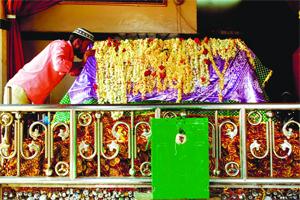
The boy took a lock out of his pocket, fixed it to the grill and turned the key. He closed his eyes, prayed and left. “He has relinquished all his troubles here,” said Nawaz, the khadim-e-dargah (caretaker). “The Pir will now take care of them.” He added that people also consigned ill health and those possessed by spirits to the locks. Everything was possible in the saint’s durbar. All you need is faith.
Faith is what drove Bahadur Khan, the Killedar of the Bangalore Fort, to defend it with his life on March 21, 1791, during the Third Anglo-Mysore War. Like his fellow soldiers, the fort Commandant fought for Mysore and its freedom.
The former Faujdar of the Krishnagiri Fort had been recently shifted to Bangalore under Tipu Sultan’s orders. Tipu himself was busy fighting a determined and desperate General Lord Cornwallis. He trusted that Bahadur Khan, assisted by Muhammad Khan Bakshi and Sayyid Hamid, would be an able protector of the oval Bangalore Fort. The ancient mud structure had been reinforced in stone around 1761 by its erstwhile Killedar, Hazrat Ibrahim Khan, Hyder Ali’s maternal uncle and a Sufi pir of the Shuttari order.
Close to midnight, the English army stealthily attacked the fort. They crept along its walls (now busy KR Road), scaled its ramparts and cut soldiers down quietly by moonlight. A popular conspiracy theory whispers that the Mysorean army was betrayed from within and that the breach blown through earlier by English cannons was deliberately left unguarded. Bahadur Khan and a handful of soldiers fought fiercely till he died of a gunshot through the head. His body was stabbed repeatedly by bayonets.
Approximately 2,000 men lost their lives that night. The prosperous town of Bangalore had been laid siege to earlier, and now the fort had fallen. A victorious Lord Cornwallis commended his bravery and wrote to Tipu asking him where his noble Killedar should be buried. Tipu is said to have wept publicly, and replied that a soldier must be buried where he fell. He requested that the Killedar be handed over to the Muslim population of Bangalore who would ensure that his last rites were attended to appropriately
Bahadur Khan was buried near what is now the KR Market flyover. Flags flutter high over his green domed mausoleum at the corner of Avenue Road and SJP Road. It is revered by local populations and also called ‘The Lock and Key Dargah’ of Hazrath Mir Bahadur Shah Al-Maroof Syed Pacha Shaheed. Other warrior-saints sleep inside the Pete’s labrynthine streets. They create a sacred landscape that is interwoven with this densely commercial area.
The seventy-year-old Killedar was described by historians as a majestic figure, “a tall robust man… with a white beard descending to his middle.” The prophet-like reference only adds to the shrine’s reputation. People of all faiths walk in and out all day. They petition the saint and pray quietly amidst jasmine flowers and incense sticks, while buses ply and frantic commuters run to and fro outside. At dawn, the shrine is surrounded by roses in buckets, as wholesalers from KR Market squat outside its door. Sometimes, I find musicians with harmoniums and percussion instruments singing devotional songs as offerings. There is no courtyard or wall. Its doors remain open for the busy world to take refuge within. The custodian of Bangalore’s historic fortress continues to watch over the city’s population, centuries later.
The writer is a cultural documentarian and blogs at aturquoisecloud.wordpress.com
source: http://www.bangaloremirror.com / Bangalore Mirror / Home> Columns> Other / by Aliyeh Rizvi, Bangalore Mirror Bureau / August 03rd, 2014
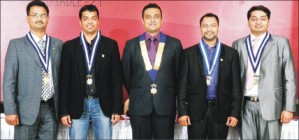
The new team of Mysore Round Table-21 was installed at the AGM held on July 26 at the Pavillion in Windflower Resort and Spa.
(Left:) Vice-Chairman Tr. Murthaza Ali, Secretary Tr. Viren Ranjan, Chairman Tr. Tharun Giri, Immediate Past Chairman Tr. Pulikeshi Wari and Treasurer Tr. Mayur B. Shah.
source: http://www.starofmysore.com / Star of Mysore / Home> General News / August 05th, 2014
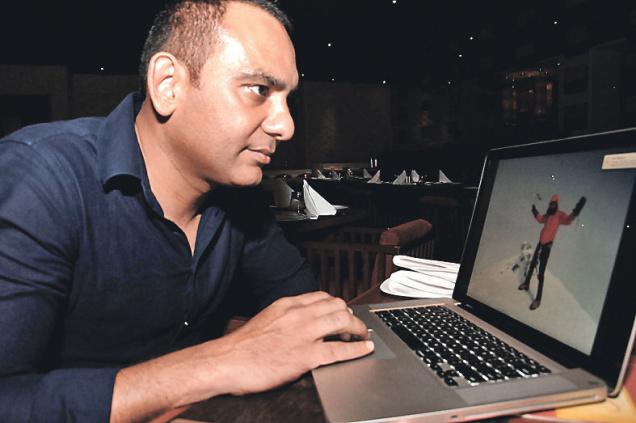
Khasim Raza conquers Mt. Elbrus, wants to climb all ‘Seven Summits’ by 2017. Though the ascent to the base camp which is at an elevation of 10,000 ft by chairlift is easy, it took nine days for his five-member team and guide to scale the mountain.
Vijayawada-born Khasim Raza made big news in the city when he climbed the Khilimanjaro, the highest free-standing mountain in the world. Now he is back in the limelight by conquering Mt. Elbrus the highest mountain in Europe. He plans to climb all ‘Seven Summits’ of the world by 2017.
It is the dream of every mountaineer to climb all seven mountains on the list. Mount Everest is the highest peak with an elevation of 29,020 feet. It is followed by Aconcagua (22,838 ft), McKinley (20,322 ft), Kilimanjaro (19,341 ft), Elbrus (18,510 ft), Vinson (16,050), Puncak Jaya (16,050 ft) and Kosciuszko (7,310). (The names of eight mountains are listed because there are two different lists of the Seven Summits. Mountaineer Bass lists Kosciuszko in his list, but mountaineer Messner lists Puncak Jaya in his list.)
Mr Raza did his schooling in N.S.M. Public School here and went on to become a British citizen.
He now operates with Dubai has his base. His father, owner of Metro Opticals in Gandhi Nagar, is one of the first opticians of the town. Mr Raza’s sights are trained next on Aconcagua, the second highest peak in the list, located in South America.
“Every mountain teaches you something. Kili (the affectionate way he refers to the mountain) taught me how to deal with wind speeds and high altitude, Elbrus taught me about cold. It is all snow and ice there,” he said.
Though the ascent to the base camp which is at an elevation of 10,000 ft by chairlift is easy, it took nine days for his five-member team and guide to scale the mountain. “We lived in accommodation that is similar to a container used for shipping goods. Every alternate day we went out on acclimatisation climbs. Unlike in Kili, the gradients on Elbrus are very steep,” he said. He says the view from the mountain slopes were really breathtaking.
Besides mountaineering, Mr Raza is every inch an adventure junkie. Just a couple of months ago he and some friends went on a cross-country cycling expedition in Cyprus. “I want to share my experiences to inspire youngsters to become more adventures and pursue challenges,” he said.
source: http://www.thehindu.com / The Hindu / Home> News> Cities> Vijayawada / by G. Venkataramana Rao / Vijayawada – August 09th, 2014
Alhaj Taj Pasha (64), retired Assistant Engineer of KEB, resident of Shubhash Nagar in city, passed away at 5.30 pm yesterday at BGS Apollo Hospital after a brief illness. He is survived by wife, a son and four daughters.
He was also the former Director of Muslim Co-Operative Bank Ltd. and former President of KEB Muslim Employees’ Welfare Association.
Namaz-e-Janaza were held today afternoon after Namaz-e-Zohar at Masjid-e-Hayath Sab in Mandi Mohalla.
Mahboob Unnisa (73), wife of Syed Abdul Wajid alias Saleem, former State football player, passed away this morning at her residence in N.R. Mohalla following brief illness.
She leaves behind her husband, a son, two daughters and a host of relatives and friends.
Namaz-e-Janaza will be held at Mubeen Masjid in N.R. Mohalla at 5 pm today followed by the burial at Muslim Burial Grounds near Tippu Circle.
source: http://www.starofmysore.com / Star of Mysore / Home> General News / August 04th, 2014
The University of Mysore has awarded Ph.D in Anthropology to Jalal Jafarpour Bijarboneh for his thesis ‘The Socio-Economic Study among the Shia Muslims in Mysore City’ submitted under the guidance of Dr. H.M. Maralusiddaiah.
K.G. Ramesha has been awarded Ph.D in Anthropology by UoM for his thesis ‘Malekudiya Budakattu Samudayada Kaleda Aaru Dashakagala Samajika mattu Arthika Badalavane’ submitted under the guidance of Dr. Maralusiddaiah.
source: http://www.starofmysore.com / Star of Mysore / Home> In Brief / August 03rd, 2014
This innovator made a kit that frees women in many parts of the world of the threat of infection during childbirth.
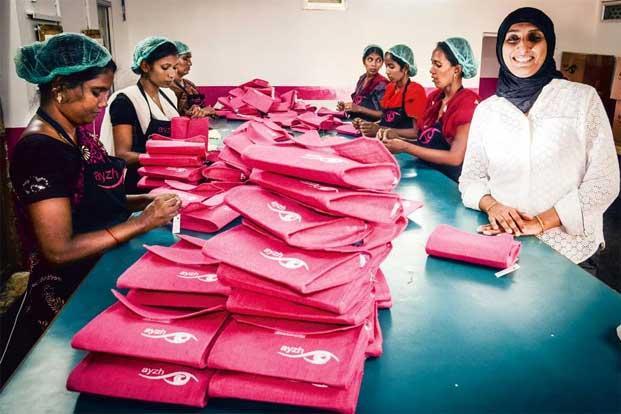
Zubaida Bai at the production facility of ayzh, 30km from Chennai. Photo: Nathan G/Mint
Freedom from risky childbirth | Zubaida Bai
Growing up in Chennai, a young Zubaida Bai wanted to study further after completing class XII. A reasonable request, except that in her family, nobody—male or female—had made it to college. The women in her family were usually married in their teens. Plus, Zubaida’s father did not have the finances to put her through college.
Undeterred, she decided to fight fate.
At 33, Zubaida Bai was the founder-CEO of ayzh (pronounced “eyes”), a low-cost women’s healthcare company based in Chennai and Colorado, US. Her biggest achievement: JANMA, a birthing kit sold and distributed through non-governmental organizations and healthcare companies.
JANMA (birth in Hindi) kits consist of six things: an apron, a sheet, a hand sanitizer, an antiseptic soap, a cord clip and a surgical blade. They meet the World Health Organization (WHO) guidelines of “six cleans” during childbirth—clean hands of the attendant, clean surface, clean blade, clean cord tie, clean towels to dry the baby and wrap it, and clean cloth to wrap the mother. A jute purse in five colours contains the kit and and it can be used as a purse after delivery.
From mundane struggles with a traditional Muslim family to being a successful innovator, Zubaida Bai’s journey has been one about exercising the right to free choice although that involved selling her jewellery to get ayzh off the ground.
Soon after school, Zubaida took a year off, selling retail banking services door-to-door for ABN Amro, cold-calling customers and earning her first pay cheque when she was 17. Soon she was in college, studying mechanical engineering, and went on to become the first graduate in her entire family. After graduation, she dreamt of designing cars, but ended up at auto-parts company Sundram Fasteners. “I was the only girl on the entire floor, all I did every day was change the dimensions on a CAD design or take printouts. I was getting fat from all the thayir saadam (curd rice),” she recalls.
She was soon planning her escape. Scouring the Internet for a master’s degree, she secretly applied to various universities. After an acceptance letter for a fully funded scholarship to an M.Tech programme at Dalarna University, Sweden, arrived, she told her parents. Her father thought this was one of those infamous scams that promised you a job and ended up hiring you as domestic labour. But finally, Zubaida left home.
In the summer of her first semester in college, she took a road trip, was part of a students’ exchange programme, visited Poland and, during a period of self-discovery, she decided to start wearing the hijab, though no one in her family did.
Back in Chennai before her second semester ended and coaxed to meet a potential suitor, Habib Anwar, she feared the worst. “(But) he said that he was looking for an educated girl, who he would like to work rather than sit at home and squabble with his relatives,” says Zubaida.
Anwar supported Zubaida’s plan to study further as well. Soon they were married. Much later, he would be instrumental in providing the necessary support to make ayzh a success.
In 2006, Zubaida gave birth to the first of her three sons, Yasin. It was a painful experience. She needed surgery, was forced to rest for two months and took close to a year to recover fully. In her childhood, she had witnessed the lack of healthcare facilities for her mother, close relatives and community, and the lack of financial resources to pay for these if they did happen to be available.
Sometime in 2009, as part of a master’s in business administration in global social and sustainable enterprises at the University of Colorado, US, Zubaida came to India to research ideas that could be developed into products. She worked with Chennai-based non-profit Rural Innovations Network (RIN), making the JS Milker, a vacuum-driven cow-milking machine, low-cost and commercially viable. In Rajasthan, she met a village dai (midwife) who had just delivered a baby with a grass-cutting sickle.
This was her a-ha moment. She started reading up on institutional childbirth. She stumbled upon a clean birth kit (CBK) while attending a tech event in Denver, US, promoted by the non-profit healthcare organization PATH. The kit had a plastic sheet, a Topaz blade, a piece of thread, a small square of soap, and a plastic coin. All this was wrapped in a box with instructions. She then travelled halfway across the world to Nepal, where a group of women was assembling the kit.
Unimpressed with the quality of the kit, she searched for more samples, but found none that matched her expectations. But she knew she was on to something, and started building her own improved version, using off-the-shelf components and assembling them.
By 2010, she had put together a rudimentary clean birthing kit called JANMA, which she tested in Bangalore, through her gynaecologist. The innovation won the Global Social Venture Competition for business plans at the Indian School of Business, Hyderabad in March 2010, and followed it up by topping the Camino Real Venture Competition at the University of Texas at El Paso, US, later that month.
Zubaida Bai also received a 2010-11 fellowship related to maternal health from Ashoka, an organization which identifies and invests in social entrepreneurs. At one event, she met the who’s who of the world of maternal health. “They were folks who were shaping the future of maternal health. These are people I would have found impossible to meet, especially Wendy Graham, who does research on how clean birth kits prevent infections,” she says. Her interactions confirmed her belief that a product such as JANMA would have a market.
By 2011, they had sold 2,000-3,000 JANMA kits, priced at $2-5 (now around Rs.120-300), in India and had made some inroads into the US.
After the initial success, though, Zubaida Bai hit a wall. Ayzh needed funds for operating costs, scaling up and distribution channels. Forced to return to India after completing her course at the University of Colorado, Zubaida and Anwar had two MBAs and two children between them, and no jobs. Those were trying times.
Even as friends and family advised one of them to get a job, Zubaida and Anwar calculated that they needed $300,000 for one-and-a-half years for ayzh to get off the ground. A social impact firm assured them of $50,000 if they could raise $100,000 and $20,000 if they raised nothing. Everything hung in the balance till the end of 2012, when they were awarded the $80,000 Echoing Green fellowship. They also got a Canadian government grant for another $100,000, while an individual investor put in another $100,000.
This was the turning point. In 2013, they clocked $100,000 in revenue, and sold 50,000 kits in India, Haiti, Laos, Afghanistan and Africa.
The JANMA kit’s relevance is irrefutable. According to the UN, India’s maternal mortality ratio per 100,000 live births reduced by 65%, from 560 in 1990 to 190 in 2013. But that still means 50,000 women die every year in India while giving birth. Seventeen per cent of the women die from preventable infections. More than 300,000 infants in India die the day they are born, according to the report “Ending Newborn Deaths, Ensuring Every Baby Survives”, by the non-profit Save the Children and Joy Lawn, professor at the London School of Hygiene and Tropical Medicine, UK.
Zubaida’s goal for ayzh is three-pronged. She wants women to have power over their health by introducing new products for post-partum haemorrhage, a new-born kit, maternity pad and other innovations in reproductive health and family planning. Instead of creating products from scratch she wants to leverage the ayzh distribution platform to aggregate and sell products already available in the market. And, finally, she wants to launch an innovation lab for low-cost healthcare products, so that an entrepreneur with an idea does not have to go through the same grind that they did.
To realize this ambition they are currently in the process of raising $3 million in funding—a huge sum for a social enterprise selling low-cost products to bottom-of-the-pyramid customers—from social impact investors.
“We want to build a corporate entity, with a group of companies that will focus on women’s health and empowerment. Habib saw his mother struggle doing sewing and embroidery and I saw my mother struggle as well. They always brought in money, but were not appreciated and treated as an asset,” says Zubaida.
Nelson Vinod Moses is a Bangalore-based freelance journalist who writes on social entrepreneurship.
source: http://www.livemint.com / Live Mint & The Wall Street Journal / Home> Lounge> Business of Life> Indulge / Home – Leisure / by Nelson Vinod Moses / Saturday – August 09th, 2014