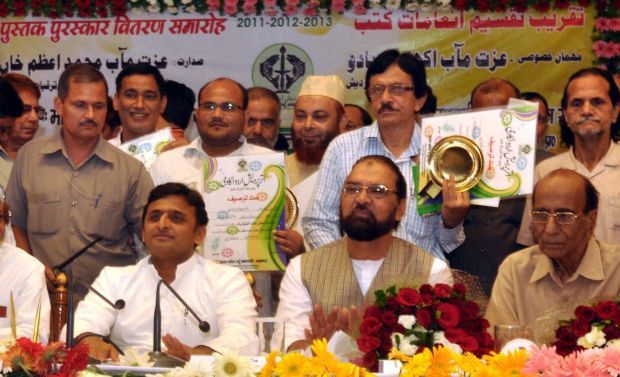
Lucknow: Uttar Pradesh Chief Minister Akhilesh Yadav during the prize distribution ceremony of Urdu Academy at Chief Minister House in Lucknow on Monday (Photo: PTI)
Lucknow:
Uttar Pradesh Chief Minister Akhilesh Yadav today said that Urdu has always connected hearts and when the language is used, it reflects love and affection. Speaking on the occasion of a book prize distribution ceremony of Uttar Pradesh Urdu Academy at his official residence, Yadav said a message of love and brotherhood would reach the society through this event.
Emphasising on importance of languages for the mutual understanding among masses, the Chief Minister said Hindi and Urdu were being used to take the society forward. He said it was the intention of the SP government that both the languages get promoted and compete with English. Referring to the efforts made by the SP government to promote Indian languages, he said the government has started felicitating Hindi, Urdu and Sanskrit scholars.
source: http://www.deccanchronicle.com / Deccan Chronicle / Home> Nation> Politics / Press Trust of India / August 05th, 2014
Mr. Mohammed Zaheeruddin resident of Bandapally, Kortla reached Siasat office and thanked Mr. Zahed Ali Khan Siasat editor.
On the occasion he told that he is greatly obliged to Siasat daily, because due to the encouragement of Mr. Amer Ali Khan news editor his nephew Shaikh Junaid passed SSC with 553 marks from Naunehal School Urdu Medium, Kortla.
He has topped the Urdu medium schools of the state.
He was presented Abid Ali Khan gold medal by Siasat editor Mr. Zahed Ali Khan and is now pursuing B.Tech from Muffakham Jah College Hyderabad with the cooperation of Siasat. He passed B.Tech 2nd year exam with 88 pc marks.
Siasat editor Mr. Zahed Ali Khan, news editor Mr. Amer Ali Khan congratulated him for his excellent performance.
source: http://www.siasat.com / The Daily Siasat / Home> Hyderabad / Sunday – August 03rd, 2014
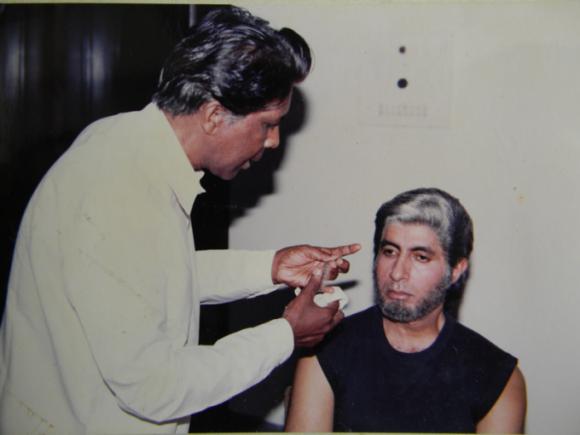
Kabir created hairpieces for many major stars, including Amitabh Bachchan in the 1988 action film Shahenshah / Photo: S Kabir / Siraj Sheikh
SURENDRA’S NATURAL HAIR STUDIO isn’t easy to find. But for the wigged wooden heads marking the entrance, this workshop in a grimy alley off Mumbai’s SV Road looks just like any other. Inside, however, it becomes clear that the studio belongs to one of Hindi cinema’s most sought-after wig makers, Surendra Salvi. The foyer walls are lined with photos of Salvi with actors—everyone from Salman Khan to Prem Chopra—sporting his toupees, beards and moustaches.
Salvi ushered me into a workshop where five uniformed employees created mesh bases for new wigs, and wove hairpieces and hair extensions. Almost all of Salvi’s wigs are made of natural hair, but he uses various amounts of synthetic material for those on tight budgets. “Natural hair is expensive,” he explained. Even-length, pre-sorted hair can cost up to Rs 70,000 per kilogram.
Salvi, a Mumbai native, told me he always wanted to be part of the film industry, though it took some time to break into the business. “First I did clerical work,” he said, “then I fitted car lamps for an auto company. Then I worked in a talcum powder factory. Then I had enough.” In the early 1980s, he started assisting the makeup duo of brothers Anil and Pradeep Pemgirikar by making wigs and beards for extras and body doubles. Over the following decades, he made it big on his own. His hairpieces have been used by Boman Irani in 3 Idiots, Shahrukh Khan in Ra.One, Akshay Kumar in Action Replayy, and many other superstars. When I visited two months ago, Salvi was fashioning wigs for director Anurag Kashyap’s upcoming Bombay Velvet. He also does work for regional films, television commercials, and individual clients.
Pradeep Pemgirikar, Salvi’s mentor, oversaw makeup, wigs and prosthetics for the films of director Manmohan Desai in the 1980s. He now runs Mod Wig Centre from his humble three-room house in Dadar, taking whatever work he gets from the Marathi and south Indian film industries. Pemgirikar, who said his best work was on the 1992 film Khuda Gawah, rued changing trends in the movie business. “Everyone wants a natural look now,” he said, “but in those days, every third character in a Manmohan Desai film had a wig.”
If the 1980s and 1990s had the Pemgirikars, the 1960s and 1970s—when bouffants, pompadours and beehives were all the rage—had S Kabir and Victor Pereira. Kabir came to Mumbai from Kolkata in the 1950s to assist his older brother S Amin, who was then already a makeup man and wig maker of repute. Kabir worked with almost all the leading men of the time, his son Siraj told me, and made wigs for such classics as China Town, Mirza Ghalib, Aandhi, Padosan, Sholay, Shahenshah and Kalicharan. But his most illustrious client was Pran, whose memorable get-ups from Upkar and Zanjeer to Amar Akbar Anthony and Don cemented his reputation as one of Hindi cinema’s greatest character actors.
Kabir passed away in 1994. Siraj is keen to keep his father’s legacy alive, and, with his brother Farooque, now runs the wig studio S Kabir & Sons, established by Kabir in the late 1950s, in Andheri East. “Wig making is an art, but it never gets the respect it deserves,” he said. “Even personal drivers and spot boys who serve chai to actors get mentioned in film credits. We often don’t.” An online search showed S Kabir credited for his work on only three movies, though Siraj claimed he actually worked on between seven and eight hundred films. Siraj also lamented the end of the era when prevailing fashions meant greater demand and profits, and more time to craft great wigs. He remembered being called on to make a hairpiece for Amitabh Bachchan several years ago. “They wanted it in three days,” he scoffed. “Is three days enough time to make a wig?” Sorting hair bought from wholesalers is a gruelling process, and the average wig requires at least five to seven days of work.
Victor Pereira, S Kabir’s contemporary, now lives in Mangalore, near his home town of Moodabidri. Although no longer associated with the film industry, he was happy to talk about his glory days over the phone. Having learned his trade in Mumbai from S Amin, Kabir’s brother, Pereira got his break on the 1969 film The Killers, starring Dara Singh and Helen. Although the film was a dud, he went on to craft all of Helen’s wigs from then on, putting his stamp on her looks in song videos such as ‘Piya tu ab toh aaja’ and ‘Mehbooba mehbooba,’ and films such as The Train and Don. Victor also worked, among others, with Hema Malini, Vyjayanthimala, Sharmila Tagore, Mala Sinha and Rekha. His most challenging project, he said, was director Kamal Amrohi’s 1983 release Razia Sultan. “Kamal Amrohi was such a stickler. Woh ek ek baal dekhte the (He used to check each strand of hair). He told me, ‘Hema Malini rani hai (Hema Malini is a queen). I want the best. Nothing else will do.’”
source: http://www.caravanmagazine.in / The Caravan / Home> Reporting & Essays / The Lede / by Roshini Nair / July 01st, 2014
Mughal carving, as the name suggests, is a tradition that traces back to Persia and was aimed at royal palaces. / By Special Arrangement / The Hindu
Hapur-based Sardar Hussain lends freshness to Mughal wood carving.
Surrounded by eager participants who show off their handiwork, Sardar Hussain has a beatific smile on his weather-beaten, bearded face as he patiently explains the nuances to the youngsters at one of the intensives at the recent SPIC MACAY’s International Convention. That the shilpa guru is the fourth generation craftsman who has mastered the Mughal technique of wood carving and is the recipient of many a National and international recognition (UNESCO Seal Of Excellence Award) for his craft sits easy on his fragile shoulders.
Mughal carving, as the name suggests, is a tradition that traces back to Persia and was aimed at royal palaces. So, the work itself is a smooth marriage of intricate floral patterns on a grand scale. Sardar Hussain’s family began small but over generations, things have changed. He came into prominence when he was conferred the National Award for making wooden blocks in 1981. He says, “Traditionally, we made blocks but soon we realised that it was not a perennial source of income. So, I reinvented the craft by exploring and expanding the vocabulary during the Golden Age Exhibit at the Festival of India in 1985. I manufactured a wooden box and a round block. I used that block as a lid. I tried a similar thing with square boxes and blocks. What I also did is to use brass inlay on the carved works. And viola! a new craft was born.”
Sardar Hussain has a beatific smile on his weather-beaten, bearded face as he patiently explains the nuances to the youngsters at one of the intensives at the recent SPIC MACAY’s International Convention. / by Special Arrangement / The Hindu
Today, Sardar Hussain runs a thriving export business called Sajawat Handicrafts in his hometown in Chhipiwara, Hapur District of Uttar Pradesh. He is assisted by his sons, both also National Award winners. And among their clients are Fab India and CCI. Says Hussain, “We work with designers from these outlets and create articles according to their requirements. That way we are sure of our work reaching customers.” Taking about the craft itself, he says, “The most important aspect here is the finish. The end product is a reflection of your skill and unless that is in places, the piece falls flat.” The wood used is mostly sheesham but the artisan also uses mango wood these days. “The advantage of mango wood is that its texture allows for it t be painted in different colours.”
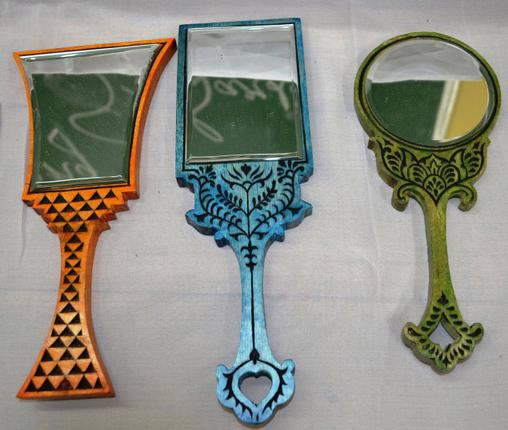
Today, Sardar Hussain’s oeuvre includes jewellery boxes, pen stands, brightly hued hand mirrors, bangle boxes, wall hangings, photo frames and of course, blocks. Though he does workshops off and on, he feels “What is needed today is for the youngsters to take to a craft with sustained interest. And keep at it till they perfect it. That is somehow lacking today.”
And yes, the wizened craftsman has kept pace with technology, thanks to his children. His entrepreneurial venture is accessible on the Internet (sajawathandicraft.com) and he can be contacted at sajawat.handictaft@gmail.com
source: http://www.thehindu.com / The Hindu / Home> Features> Friday Review / by Savitha Gautam / New Delhi – July 31st, 2014
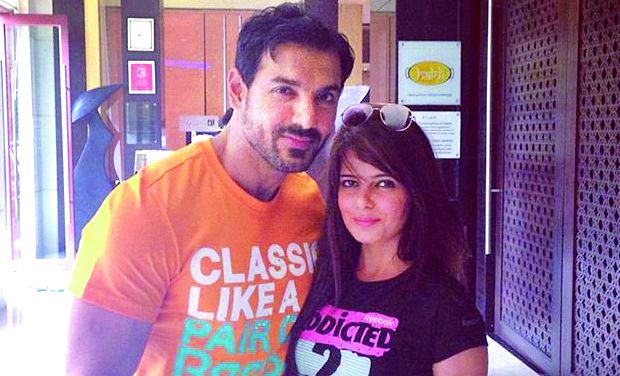
She is spotted with some of the hottest hunks all over the country and biker-actress Alisha Abdullah enhanced that image recently when she and John Abraham bumped into each other in the city.
She even posted a photo online of the two rekindling their friendship, saying it was fantastic to get back in touch with John. “It was a chance meeting. We both ended up being in the same hotel, but a very fortunate coincidence indeed. I know John from nearly five years back when we were both brand ambassadors for a product, and though we have remained friends over time, you know how difficult it is to keep in touch in our industry. However, he was really excited to see me.”
And the bike-crazy duo apparently decided to collaborate on a project. “When he saw me looking fit and glam, John proposed the idea of working together and I was only too happy to agree, I mean, who wouldn’t? John was as warm and friendly as ever. He’s off to Los Angeles now, but we have set up a meeting for the second week of August to get together and brainstorm. The way he has maintained his body over the years is truly awesome, and I was absolutely gushing over him,” Alisha laughs. While shooting for her second movie is about to start, the racer says she’s struggling to balance her film, sport and fashion commitments. “But when the lure of Bollywood comes calling, it’s hard to say no,” she says.
source: http://www.deccanchronicle.com / Deccan Chronicle / Home> Entertainment> Tollywood / DC / Gautam Sunder / July 28th, 2014
‘Dastan-E-Urdu’, a 13-episode miniseries will bring on television for the first time evolution of Urdu over centuries and will aim to break misconceptions about the language among the youth.
The show, which will be aired weekly on Doordarshan National from July 27, will depict the history of the language, how at one point of time, Hindi and Urdu were considered one and what led to that disintegration.
It is produced by filmmaker and Urdu activist Kamna Prasad and directed by Aparna Srivastava Reddy.
“Today’s generation has myths about Urdu and we want to bring clarity to that. They think it is a foreign language and just got adapted in India but that’s not true. It’s an Indian language and its history starts from India,” Prasad told PTI.
The show aims to captures all nuances and aspects of Urdu’s poetic opulence and its universal appeal, by interviewing Urdu experts like eminent lyricist-screenwriter Javed Akhtar, Pt Gulzar Dehlvi and Professor Mushirul Hasan, among others.
“I already knew many of them personally as we keep meeting at Mushairas I organize, in fact Javed Akhtar attends every Mushaira I hold and they are all experts in the field of Urdu, so I spoke with them at length about its history and relevance in today’s scenario,” said Prasad, who has also done the research work for the show.
The producer says series was initially planned to be aired on DD Urdu.
“We first planned for Urdu-loving audience but Doordarshan decided that it should be aired on DD National as the language has national importance and it deserves to reach a wide audience,” Prasad said.
source: http://www.business-standard.com / Business Standard / Home> PTI Stories> National> News / Press Trust of India / New Delhi – July 25th, 2014
Nawazuddin Siddiqui, 39, keeps his life easy, so that he can perform the complex roles on screen. He is sensitive, strong and open and loves his mother the most in the world. While being a theatre actor is his fallback option and security in life, he takes his time to decide on a film, as he knows that an actor like him is not spared for his mistakes.
Nawazuddin Siddiqui
What made you come to Mumbai?
I am from a family of farmers from Budhana near Muzaffarnagar. I studied till Class XII in my village only and did farming all throughout, along with my father. We are eight siblings and I am the oldest. I went to Hardwar to do my B.Sc, but realised that since I had not specialised in any course, I could only manage a job as the chief chemist in a petrochemical factory in Baroda. I then came to Delhi, where someone showed me a play on stage. Before that, I had no interest in acting, but seeing the play, I realised that this is what I wanted to do, as I got fascinated by the chemistry between the actor and the audience. I joined theatre and after doing it for over a year, I joined full- time NSD. I started doing street plays and did that for four years. We used to do four shows on a day. On days when we got shows, we had money, but if we didn’t have a show, we did not have money that particular day. So, I thought that agar bhooka hi marna hai, toh kyun na Bombay jaake maraa jaye? And I shifted to Mumbai in 2001.
We really got to know you from Gangs Of Wasseypur in 2012. What did you do for so many years after coming to Mumbai?
I came here to work in TV, but at that time, things were changing on TV and everything was becoming glossy. So if a dark person like me was taken, they would have had to put a baby light and that would delay production and so, I did not get success even on TV. I then did a few small roles in C-grade films. For the sake of just earning money, I also did a lot of crowd shots in films, but when the camera came to me, I would hide my face so that no one saw me. People would think that he calls himself from NSD and look what he is doing. Even to be a junior artiste, you needed a card, which I didn’t have. One time, I got caught as I didn’t have the card and had to bribe `1,000 to the junior artist coordinator. I did that for three years. I then started doing one-scene roles and hoped that I would get at least two, given that people would say that I did the first one well.
My mother mortgaged her jewellery to educate me
But my struggle continued and for five years, I got only one scene, till in 2009, when I got a role in Peepli Live and then Kahaani. Anurag Kashyap had met me in 2003 when he too was struggling. He had told me then, ‘If I become anything, I will give you a film.’ Post Kahaani, I was in my village when he called and said, ‘I have a role for you that you always wanted to do.’ I heard the narration and he signed me for Gangs Of Wasseypur.
Did you lose hope at any time?
Despite being from NSD, I was not getting work for so many years and I had started feeling irritated with that. Financially, I would survive borrowing money from other theatre actors, even though they too did not have money to lend. If I asked them for `100, they would probably have only `50 to spare and that too, I could not guarantee as to when I could return it. I was a mahir (an expert) at borrowing money. I would return the money, but to do that I would again borrow money from someone else. I always travelled without ticket in trains. I never travelled in buses, as we would need to buy a ticket. So I would walk to the nearest station and then go wherever I wanted to, without a train ticket. We were 4-5 actors sharing a room just 15 feet by 12 feet, which also included a small bathroom and place to cook.
The biggest problem was that if I went to any film office, they would look at me and ask rudely, ‘Haan, kya hai?’ I would say, ‘Actor hoon.’ They would say, ‘Dekhne se toh nahi lagta.’ And that was the biggest problem. And that problem was not just in Mumbai. It had been my problem in the village, where, when I told them that I was going to Mumbai to become an actor they would say, ‘Dikhta toh hai nahi tu actor jaisa yaar.’ So that would always frustrate me and I really felt bad. I would feel angry, but when I looked at myself in the mirror, I would realise that haan yaar, baat toh sahi hai. Despite being insulted so much, I would not have returned to either Delhi or my village, as I had solace that at least in Mumbai, there was anonymity.
When I had no money, I would find out which friend had work and money at that point in time and would go and stay with him for a week. All of us theatre guys did that. I had come to terms with the fact that nothing would happen in my life. Marriage was a distinct thought. Girls would not even befriend me, forget about marriage. And why would they? I had neither money, nor looks and nor was I successful. One thing I had decided was that come what may whether I make it or not, even if I have to continue doing small roles, I will, for the sake of my self-respect, not go back. Even though I never expressed my feelings to anybody, my mother was always confident about me, in fact over-confident. I used to find myself very unlucky in life. But today I feel ki sab der se hua par achcha hua. I don’t believe in destiny. I believe in hard work.
What does working with Salman Khan in Kick mean to you?
I was very excited to work with Salman to the extent in the beginning, I would feel scared that it should not get cancelled. He is such a big star with such a vast reach. Due to working in Kick, my smaller films will be benefited.
Who do you love the most in the world?
My mother. Even though she was uneducated, she always felt that she must educate us. She never interfered and wanted me to do whatever I wanted to. Even when I was leaving the village, she never held me back. She also disciplined us a lot. I have seen her sacrificing a lot for me. She even mortgaged her jewellery for my education. In our side, people are quite aggressive and the attitude there is quite goonda type, so you feel it’s good for your child to get out and she always wanted that for us, even though my parents still live in the village. What she likes the most about me is that I have always been responsible. If she gave me work to do for the cows at 5am, no matter what, be it winters or summers, I would be awake doing that. I was very obedient, responsible and hard-working.
Even though I hated doing farming and wanted to just get out of the village, I would work from 5 in the morning till 5 in the evening. We would go to sleep latest by 8pm. There was electricity in our village only for 2-3 hours a day so all my life, I studied under a lamp. Till today, wherever I am, I get up at 5 in the morning. Whenever I get a gap, I go to my village and spend 10-12 days there. Nothing has changed there. Electricity still comes only for 2-3 hours and I feel angry seeing that but I get a lot of sukoon (solace) there. Everything seems to be at a standstill there just the way you left it, your friends are the same and you just somehow feel that life is okay.
source: http://www.timesofindia.indiatimes.com / The Times of India / and Bangalore Times / Home> Entertainment> Hindi> Bollywood / by Priya Gupta / July 22nd, 2014
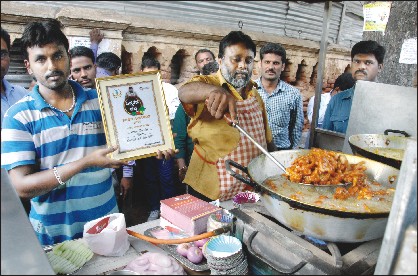
Usman is seen displaying the award presented to him by Zee Kannada while his father Abid is seen preparing the delicious Dry Gobi at the Chat Street on Krishna Vilas Road.
Mysore :
Every Mysorean who has visited the ‘Chat Street’ on Krishna Vilas Road, in front of Devaraja Traffic Police Station, would be familiar with the mouth-watering ‘Dry Gobi’ that is available hot and crispy every day.
People stand in queue to put their hands on the yummy Dry Gobi prepared by Abid and Usman, his son. The father-son duo recently won the ‘Best Street Food Award’ at the ‘Oggarane Dabbi’, cookery competition organised by Zee Kannada, a regional channel.
Abid was previously selling ball-point pens at Shivarampet before preparing and selling Dry Gobi. He has been selling dry gobi since 18 years. Earlier, Abid was selling dry gobi for six years at NR Road before moving to Krishna Vilas Road, now popular as ‘Chat Street’.
Speaking to Star of Mysore, Abid said that it was former Mayor D. Dhruvakumar, who gave him an opportunity to sell Gobi at the Dasara Exhibition Grounds and added that it was because of his help that day he was able to look after his family and it was yielding good results.
Abid also expressed his happiness for his delicacy being awarded the Best Street Food- 2014 by Zee Kannada.
To prepare dry dobi, Abid uses around 15 kg oil and 100-150 kg cauliflower. Earlier, Dry Gobi was being sold at Rs. 10 per plate. But with the rise in prices of essential commodities, it is being sold at Rs. 30 per plate.
The cuisine is so famous that people from across India who visit Mysore come to Chat Street to tickle their taste buds with Dry Gobi. This apart, local MLAs, Corporators and senior officials also visit Abid’s Usman Dry Gobi Stall to taste the delicacy.
Award for Green Leaf Food Court
Zee Kannada “Oggarane Dabbi” has presented the best family restaurant award to Hotel Green Leaf Food Court on Kalidasa Road in city.
The award was presented at a function held in Mysore on July 6. The awards programme was telecast in Zee Kannada Channel on July 12 and 13. It will be telecast once again on July 19 and 20 at 9 pm.
Green Food Court is a 12-year-old venture managed by Pandiyanda Anil Kariappa and team of Mysore. It is known all over the city for excellent quality service and tasty vegetarian delicacies.
source: http://www.starofmysore.com / Star of Mysore / Home> General News / July 18th, 2014
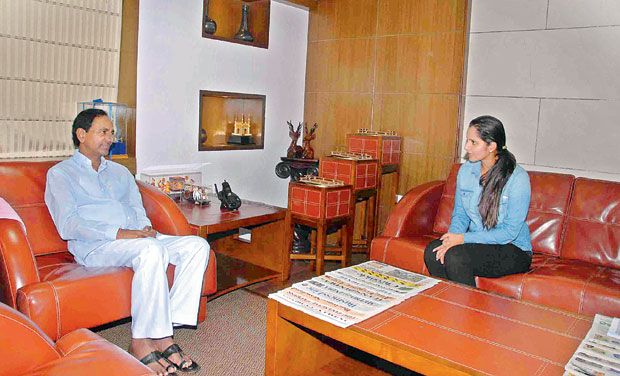
Telangana Chief Minister K Chandrashekar Rao with tennis star Sania Mirza at a meeting in Hyderabad. Photo: PTI
Hyderabad:
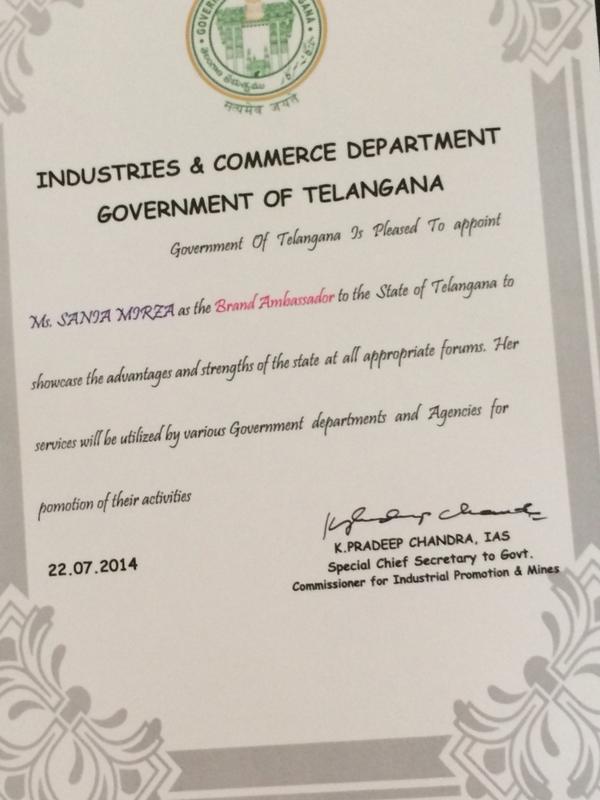
Indian tennis star Sania Mirza was on Tuesday appointed ‘Brand Ambassador’ of Telangana.
She will promote the new “state’s interests” in India and abroad, according to Industrial Infrastructure Corporation Managing Director Jayesh Rajan.
Chief Minister K Chandrasekhar Rao handed over a letter of appointment and also a cheque of Rs one crore to 27-year-old Sania at an interaction session with industrialists here.
“Telangana is proud of Sania who is a true Hyderabadi. She’s now ranked number five in international tennis and we wish she becomes the number one,” the Chief Minister said on the occasion.
Chief Secretary Rajiv Sharma, Special Chief Secretary (Industries) K Pradeep Chandra and other officials were present.
Dr. Maha Jabeen, Administrative Officer, Yuvaraja’s (Autonomous) College, has been appointed as the Principal of the University College of Fine Arts.
She earlier served as Associate Professor and as the Head of Department of Urdu, Maharaja College before being appointed as administrative officer of Yuvaraja College. She is also a renowned Urdu writer and poetess. Dr. Maha Jabeen has represented University of Mysore in numerous seminars and workshops held across the world.
She has authored five books in Urdu language of which one has won the National Award by Government of Uttar Pradesh.
source: http://www.starofmysore.com / Star of Mysore / Home> General News / July 16th, 2014