Category Archives: Arts, Culture & Entertainment

Royal Absurdity

The former rulers of Lakshadweep want their kingdom back…or at least a modest raise in their royalty pension
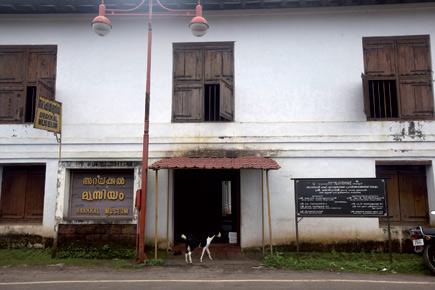
Arakkal museum, Kannur (Photos: RITESH UTTAMCHANDANI)

Once upon a time, a queen lost her kingdom to a foreign invader. Under the terms of surrender, she was allowed to retain her title, inheritable by the seniormost member of the royal family. She was also assured an annual payment to maintain her standard of living. It was a generous sum back then. Then came the passage of time. Sovereigns vanished into history and elected governments came into existence. The royal family didn’t live happily ever after. Their annual pension, a fixed sum, was ravaged by inflation.

It began to look smaller and smaller, until it came to a point where it was not even as much as the monthly salary any of them earned.

And then the family decided to make a calculation. When they were first allotted that sum, how much gold could they have bought with it? And how much would that gold be worth today? This figure, they convinced themselves, was the sum that they should logically be getting.

And so they went to the government and asked for it. Else, they demanded their kingdom back. They will probably not get either.

+++

That, in short, is the story of the Arakkal family that once ruled the city of Cannanore (now Kannur) and Lakshadweep Islands, a reign that lasted five centuries. The trust that governs their affairs recently made the bizarre demand that the Indian government either raise their pension or return Lakshadweep.

I had to wait ten minutes after ringing the bell at the present queen’s residence in Talassery, a town 20 km away from Kannur. A huge house modelled on the original palace that is now a museum of history, it is as silent and empty as any other house along the Malabar coast whose members have left for greener pastures abroad. The queen has three sons, all working overseas, and one daughter. It is the daughter, who looks around 50, who opens the door and welcomes us in. She had been busy with her evening prayers and apologises for making us wait. She and her mother are the only two residents of this palatial house.

I am taken to the queen’s room, where the 92-year-old Sultan Arakkal Adi Raja Sainaba Aishabi, also known as Arakkal Beevi, reclines on a bed. More than three years ago, she had suffered a stroke and never fully recovered. But she welcomes me with a gladdening smile. I have to bend forward to catch the words of her broken voice.

“Journalists often come here,” she whispers, “though I am not well enough to talk. You may get sufficient information from my children. Please don’t forget to have tea and some food before you leave.”

I ask her whether she is aware of the Arakkal royal family trust’s demand. She answers with the same bright smile. It is her daughter who speaks. “She is too old to get into such headaches,” she says.

For centuries, the royal title has been passed along to the seniormost member of the family irrespective of gender. A male king would be called Ali Raja Adi Raja (‘lord of the sea’) and a female, Arakkal Beevi.

According to historians, the Arakkal Dynasty was Kerala’s only Muslim family of rulers. There is no consensus on their origins, but some say their assumption of power dates back to the 13th century.

According to a piece of local lore, the dynasty was founded by a minister of Kolathiri Raja (the then regional ruler) who converted to Islam and became a ruler.

Another says that the Arakkal royal family traces its lineage to Mohemmad Ali, a nephew of Cheraman Perumal (a regional ruler before the region split into different principalities) who is said to have embraced Islam. The only thing certain is that the Arakkal Dynasty had sovereign control of Cannanore that later extended to Lakshadweep islands off the coast of Kerala in the Arabian Sea.

The arrival of European seafaring powers bolstered their kingdom’s trade and commerce. They had a love-hate relationship with the Portuguese, the Dutch and the British. According to Dr A Sreedhara Menon, a scholar on Kerala history, the Arakkal principality of power came to an end in 1790, the year in which St Angelo Fort of Cannanore was stormed by General Abercromby, the then British Army general. Locally known as Kannur Fort, it had been built in 1505 by the Portuguese; it was later owned by the Dutch, who then sold it to the Arakkal king for Rs 1 lakh. The fort is now a tourist destination. The East India Company later forced the then Arakkal Beevi into an agreement under which she had to give up control of Lakshadweep islands. She was allowed possession of Cannanore city, but deprived of any claim to sovereignty. The East India Company pensioned off the Arakkals the same way they did other local kings and chieftains in India.

By 1900, the family had lost every trace of power. In 1905, they had to make another agreement with the British giving up all sovereign claims on Cannanore and Lakshadweep. In return, they were entitled to receive an annual pension, termed malikhana, of Rs 23,000. This is a sum they still get, though from the Government of India, which took over the obligations of the departing British.

+++

On 10 July this year, a decision was taken at a meeting of the royal family trust to press the demand for a raise (or a return ‘surrender’ of their kingdom). “It is not the first time we have made this demand,” says Ali Raja Adi Raja Hameed Hussain, the eldest male member of the royal family. We are at a shop he has in Kannur, where he runs the family business of spice exports. He takes a bundle of papers off a wooden shelf to show us. The stack includes copies of representations submitted to Central and state ministers to raise their malikhana. “We have been demanding a reasonable hike for long,” he says, “This time we decided to make it public through the media.”

While that may be so, why they consider their demand reasonable remains a mystery. India, after all, is a democracy and there is nothing that entitles them to such a payment. “We need money because we want to continue the charity work which had been done by our ancestors,” says Hameed Hussain. But why demand public money for purposes of charity?

“Because we are descendants of a sovereign ruler,” replies Ali Raja Mohammed Rafi, younger son of Arakkal Beevi Sainaba Aishabi, who runs an advertising agency in the UAE. “As per the contract of 1905 with the English East India Company, we are entitled to receive an amount sufficient to maintain the standards of royal living.”

The agreement, a copy of which is with Open, reads: ‘The Government would pay to the Adi Raja and to his heirs and successors a Malikhana of Rs 23,000 per annum in equal monthly installments one half being paid to him during his life and after his death to the head of the family for the time being as a personal grant for the maintenance of his position and dignity and the other half being paid to him and to his heirs and successors as heads of the family.’

Mohemmad Rafi, who is the managing trustee of the royal trust, says that Rs 23,000 was a huge amount in 1905. If calculated in terms of gold, he says, it would have bought 64 kg of the metal in 1905. “Considering the value of gold [now], we should get around Rs 14 crore per annum,” claims Mohemmad Rafi. “We know that is not practically viable and so we are demanding only a reasonable hike in the annual pension.”

+++

This is not the Arakkals’ only family tussle over ancestral property. There is an ongoing dispute with another family of Muslim landowners, the Keyis, over 1.4 million Saudi riyals—about Rs 2.2 crore—said to be lying in the Saudi Arabian government’s treasury. The exact sum cannot be verified, though many believe it to be in the tune of Rs 90 crore. About 150 years ago, a member of the Keyi family, Mayinkutty, is said to have built a guesthouse in Mecca to accommodate Hajj pilgrims from Malabar. In 1971, the Saudi government demolished this structure as part of a development exercise, allotting 1.4 million riyals as compensation to be handed over to the Keyi heirs. At that point, the Arakkal royal family also staked claim to the amount on the grounds that Mayinkutty had married one of their members, Aychi Beevi. “It is beyond dispute that we are the legal heirs of Mayinkutty Keyi and have legitimate claim over that property,” says Mohemmad Rafi.

The Kerala government recently appointed an IAS officer, TO Suraj, to look into the matter and take a final decision. He says that neither family might have any right to it. “In my understanding, the property was dedicated to the Wakf for the welfare of pilgrims,” says Suraj, “The government is trying to attach the property [for use of] the Wakf Board by due process.”

Professor Rajan Gurukkal, a historian and former vice-chancellor of Mahatma Gandhi University, thinks that would be ideal. “It should go to the government and be used for a public purpose,” he says. Gurukkal also thinks that the demand to raise the malikhana has no legal validity. Dr KKN Kurup, a historian of the Malabar region, author of a book on the Arakkal family’s history called Aliraja of Cannanore and former vice-chancellor of Calicut University, terms the demand “absolutely irrational”. He says there is no reason to spend public money on the upkeep of aristocracies and royalties of the past. “The  malikhana was maintained primarily on the condition that they should be loyal to the English East India Company. How can they claim the same even after independence? Does it mean that the Arakkal family is still loyal to the British? What if all the heirs of rulers of princely states make similar demands?”

source: http://www.openthemagazine.com / OPEN Magazine / Home> Open> Feature / by Shahina KK / August 23rd, 2013
A viewfinder on crime

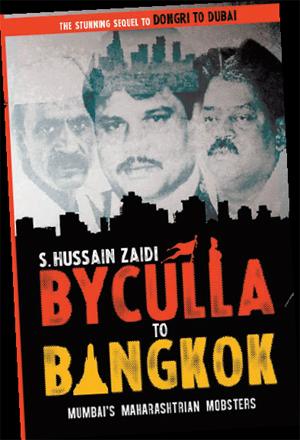
In the hands of a master chronicler, Mumbai’s underworld reveals itself to the world. Hussain Zaidi’s latest book is interesting, to say the least.

Publisher : Harper Collins India Pages: 271,  Price: Rs.299
Publisher : Harper Collins India
Pages: 271, Price: Rs.299

From Byculla to Bangkok by Hussain Zaidi is alternately spine-chilling and moving. As Zaidi takes readers through the inner mechanism of the Mumbai underworld, it becomes obvious how much intense research has gone into the subject. In retrospect, only a seasoned journalist like Zaidi (who was a crime reporter at Mid-Day and Asian Age, among others) could have kept a neutral voice while writing about the underbelly of the city. Byculla to Bangkok takes off from Dongri to Dubai, his previous chronicle on the mafia.

Have you ever feared for your life?

I have never feared for my life during crime investigation. But when I wrote Black Friday in 2001, I feared for my son Ammar’s life. I received a threat over the phone, saying they knew in which school my son was studying. My heart was in my mouth. But I nonchalantly told them in which class and section he was studying and his school timings before hanging up the phone. It was sheer bravado, but I refused to let them know I was scared. Of course, I didn’t send my son to school for a few days, but the next few weeks were hell. I had not even told my wife about the threat. It was a terrible period.

You have documented the Mumbai underworld from the 70s. Have things changed?

Earlier, gangsters were reckless, in it for money, and unafraid of the cops. Post 1998’s MCOCA (Maharashtra Control of Organised Crime Act), they were more cautious. The encounters made them realise that the cops meant business. Those who escaped are lying low in places such as Bangkok and the rest are in prisons in India, if not dead. Currently, the underworld is not as active as in the 90s. They have also gone legit in many businesses.

Are encounter specialists maligned? 

Whatever the excuse, a police encounter is nothing but an extra judicial killing. I do not condone it as it is wrong to take law into your own hands. Within the police force itself, there was a lot of debate on encounters. Most officers gave in because they felt there was no other way. But the fact remains that encounters made the Mumbai mafia very insecure. At one point, gangs found it hard to recruit jobless youths. And the encounter police of Mumbai did wipe out the underworld.

Your book speaks of politicians who recruited the underworld for personal work. Why haven’t you named them?

Knowing is different from proving. Police officers and other sources have told me of these people but I have no evidence that can stand in a court of law. A don like Arun Gawli had 45 cases against him but they were all dropped because of lack of evidence. So, where is the likelihood that my statements will stand?

Are politicians to be blamed for the rise of the underworld?

Politicians are just a cog in the wheel. Criminals and politicians feed off each other. Personally, I feel we should stop voting for corrupt politicians. Voters put corrupt politicians into power. One bad apple will spoil everything. Why should I be responsible for putting a politician into power only to see him/her misuse the powers?

You have written about crimes and criminals. Under different circumstances, do you think gangsters could have contributed to society?

It is the movies that dramatise such situations. All dons entered this field out of choice. If circumstances forced an educated man to be a gangster, then half of our population would be gangsters. There is no excuse for a life of crime.

If not a crime investigator, would you have been a police officer?

In my younger days, I very much wanted to join the IPS. But my family wanted me to do commerce and pursue management. I know for a fact that a good police officer, someone who is smart, intelligent and brave enough to not cow down to political pressure can make a tremendous impact on society. Today, I keep telling my two sons to join the IPS.

source: http://www.bangaloremirror.com / Bangalore Mirror / Home> Entertainment> Lounge / by  Jayanthi Madhukar, Bangalore Mirror Bureau / March 19th, 2014 (20th in Print Edition).

Obituary : Kamala Das

Indian writer and poet who inspired women struggling to be free of domestic oppression.

Kamala Das . Photograph: Other
Kamala Das
. Photograph: Other

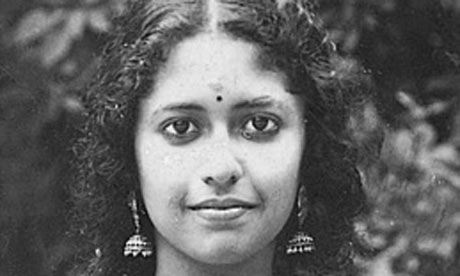
Kamala Das, who has died aged 75, was a renowned Indian poet, novelist, short-story writer, essayist and memoirist. She was also known as Madhavikutty, the pseudonym she used when writing in the Malayalam language. Then there was Ami, the pet name with which she referred to herself in her memoirs. Much later in life, she gave herself yet another name, Suraiyya, to mark her conversion to Islam. Straddling many names was one way in which Das straddled multiple identities.

She was born into a literary family. Her mother, Balamani Amma, was a well-known Malayalam poet and her great-uncle, Nalapat Narayana Menon, was a writer and translator. Das was home-schooled and most of her education came through extensive reading. Her childhood was divided between Punnayurkulam, her ancestral village in Kerala, in the south-west, and the north-eastern city of Calcutta (now Kolkata), where her parents lived. This early lesson in dislocation may have inspired many of her literary themes – the vulnerable child-woman trying to create meaning in an inconstant world; nostalgia for a serene, rural past; the unfair privileges of caste and wealth; and the contradictions of motherhood.

In 1949, when she was 15, she married Madhava Das, a bank official. While still in her teens, she started writing and publishing. Along with other poets of her generation, Das was at the forefront of a new movement in Indian English poetry, a shift in focus from the colonial experience to the personal. However, unlike most of her contemporaries, she was actively writing fiction in her mother tongue at the same time. Throughout her writing career, Das would move adroitly between genres (poetry, fiction, memoir) and languages (English and Malayalam). “I speak three languages, write in two, dream in one,” she wrote in An Introduction, a poem from her first collection, Summer in Calcutta (1965).

She began to break taboos with her early poetry, in which she celebrated her sexuality and advised women to “Gift him what makes you woman, the scent of/ Long hair, the musk of sweat between the breasts,/ The warm shock of menstrual blood, and all your/ Endless female hungers …” (The Looking Glass, from The Descendants, 1967).

In My Story (1976), she recounted the trials of her marriage and her painful self-awakening as a woman and writer. She became an icon for women, in India and elsewhere, struggling to liberate themselves from sexual and domestic oppression. Though it was supposed to be an autobiography (and indeed was provocatively subtitled “the compelling autobiography of the most controversial Indian writer”) Das later admitted that there was plenty of fiction in My Story. Perhaps “biomythography” would have been a fairer description of the book.

Das’s rebellions were more multidimensional than she was given credit for. Her female protagonists were not simply in pursuit of sexual freedom, they were in search of poetry, intimacy and divinity. Characters such as Padmavathi the harlot, who drags her bruised body to a holy shrine, personify the unworldly wisdom with which Das endowed her best female protagonists. She also created several nuanced male characters, for example, the hapless father in the 1991 short story Neypayasam, who shelters his children from their mother’s death.

A prolific writer, Das wrote more than 20 books. These include several collections of short stories and poems as well as six novels and three memoirs. In her later years, she also wrote a syndicated newspaper column, in which she held forth with typical unguardedness. Her topics ranged from religion to politics to the beauty secrets of Nair women. She did not feel compelled to stay on the topic and never shied away from announcing a change of mind or heart. Das’s spontaneity often translated into whimsicality and earned the ire of critics, but it allowed her to explore the paradoxes of life and relationships with emotional honesty.

In the 1980s she dabbled in painting and politics. While she attained some acclaim as an artist, her political career did not take off. She stood unsuccessfully for the Indian parliament in 1984 and later launched a short-lived political party, Lok Seva (public service). One of her final acts of reinvention was her conversion to Islam in 1999, a move especially bold because of her aristocratic Nair lineage. Ten years later, she was laid to rest in the mosque where she had taken her vows.

Her husband predeceased her; she is survived by three sons.

• Kamala Das, poet and writer, born 31 March 1934; died 31 May 2009

source:  http://www.guardian.com / The Guardian / Home> News> World News> Feminism / by Shahnaz Habib / The Guardian / Thursday – June 18th, 2014

Walking through history, learning from women of courage

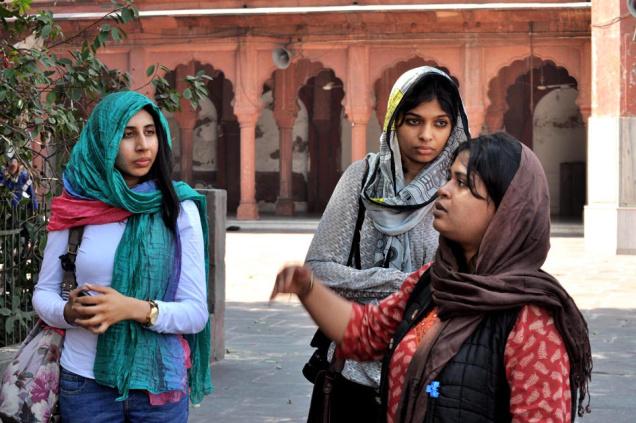
Participants interact at the heritage walk through the Walled City of Delhi on Saturday. / The Hindu

On International Women’s Day, a group of 23 heritage enthusiasts participated in a storytelling walk in the Walled City of Delhi. The walk created awareness about women who stood up for their rights and honour but have long been forgotten.

Barring two men, the rest of the participants were women who satiated their hunger for knowledge by frequently interrupting the host, an excellent raconteur.

Yuveka Singh, who conducted the walk and has experts on archaeology and history in her team, said the walk was conducted after methodical research work and interviewing women living in Old Delhi.

At 10 a.m., the group congregated at the Red Fort main gate. “The two-hour walk was an attempt to know a little more about some fascinating women who are more well known to some of the older residents of the Walled City. We spoke about Razia Sultana because she was far ahead of her times and involved in active politics even before she became the ruler. We wanted the participants, particularly women, to feel that they need to derive inspiration from women of the medieval period and speak up for their rights,” said Ms. Singh, a storytelling expert.

The first visit was to a dilapidated palace of an 18th Century nautch girl, who through her charisma and wit became the ruler of Sardhana.

The group had to pass through labyrinthine streets in the Bhagirath Palace area in Chandni Chowk but a look at the yellowish white edifice, which has nomenclature of erstwhile Lloyd’s Bank Ltd inscribed on it, made them scream with joy. The heritage building is one of the earliest colonial buildings with Greek pillars, which grace its front porch.

Begum Samru’s haveli was the first destination because she played a significant role in saving Delhiites from getting slaughtered by an invading force. “Our visit to Begum Samru’s haveli was a fruitful one as I was able to tell how this courtesan became a ruler of a principality near Meerut. And we also entered the haveli and saw the condition it is in,” said Ms. Singh.

The next destination was the famous Jain temple of Chandni Chowk. This was done to show the syncretic traditions of the Walled City, where Hindus and Muslims have lived peacefully for generations.

The walk concluded with a visit to the Fatehpuri Masjid.

During the walk, participants also learnt about the women in Shah Jahan’s life.

For history enthusiast Jahanara Rabia Raza, the walk gave her an insight into the lives of women who were brave, assertive and not willing to get subjugated by men. “Though I studied History at Delhi University and gave my papers on Razia Sultan, I did not know that the empress used to roam around after covering her countenance with a purdah and smoked hookah with men. She must have had guts to do all that during that period,” she said.

source: http://www.thehindu.com / The Hindu / Home> News> Cities> Delhi / by Madhur Tankha / New Delhi – March 09th, 2014

Shamsi Talab undergoes restoration

Shamsi Talab in Mehrauli after restoration.

ASI encourages residents in Mehrauli to preserve the 700-year-old pond

The Archaeological Survey of India has completed major restoration work at the neglected Shamsi Talab in Mehrauli. It has also encouraged the locals to take the initiative in preserving the pond for future generations.

An ASI Delhi Circle official said: “Over the years, unscrupulous residents have been dumping garbage into this pond. Dumping has led to ugly growth of vegetation. The ASI has set up a team of dedicated workers to clear 30,000 square metres of vegetation. The exercise at Shamsi Talab is now complete.”

Involving the locals in the upkeep of the pond was another objective of the ASI. “It was important to create awareness about the need to maintain Shamsi Talab, built by Sultan Shams-ud-din Iltutmish. Now the RWA has evinced interest in the pond and is already maintaining it,” said a senior ASI official.

Speaking to The Hindu , ASI Additional Director-General B. R. Mani said the objective was to preserve the “700-year-old pond”.

source: http://www.thehindu.com / The Hindu / Home> National> New Delhi / by Madhur Tankha / New Delhi – December 02nd, 2013

Javed Akhtar pens CRPF’s new theme song

The Central Reserve Police Force has now come up with a theme song penned by renowned lyricist Javed Akhtar, composed by Raju Singh and and sung by Javed Ali.

The song was released by President Pranab Mukherjee on Friday to mark the diamond jubilee celebrations of India’s largest paramilitary force. Complimenting Javed Akhtar and the team for their creative effort in capturing through lyrics and composition the sentiments of the CRPF, Mr. Mukherjee said it would inspire each jawan of the force, the President added.

source: http://www.thehindu.com / The Hindu / Home> National> New Delhi / by Special Correspondent / New Delhi – March 04th, 2014

After 2 years,Isa Khan Tomb reopens in new-found glory

SUMMARY

Humayun’s Tomb made news in 2010 when US President Barack Obama and wife Michelle were photographed here,staring at the monument’s majestic elegance.
_________________________________________________________________________

Humayun’s Tomb made news in 2010 when US President Barack Obama and wife Michelle were photographed here,staring at the monument’s majestic elegance. On Thursday,the World Heritage Day,the Humayun’s Tomb complex will return to make news again to announce the unveiling of its most attractive structure,Isa Khan’s Tomb,after a two-year-long restoration.

Isa Khan’s Tomb,part of UNESCO World Heritage Site of Humayun’s Tomb,has a dome that resembles a plump inverted flower. But time and state negligence had robbed this flower of its beauty and fragrance. A 27-month-long conservation drive has attempted to infuse that lost beauty back into the tomb.

The restoration drive was jointly funded and undertaken by the Aga Khan Trust for Culture and the World Monuments Foundation,with help from the Archeological Survey of India. The project is part of a larger urban renewal project in Delhi that includes 50 monuments.

On Thursday,Union Minister for Culture Chandresh Kumari Katoch will open Isa Khan’s Tomb to the public. Almost 2,000 school children will be taken there for a heritage walk and design workshops.

Isa Khan was a noble in the court of Sher Shah Suri in the 16th Century. Suri ruled Delhi between the reigns of Humayun and Akbar.

Isa Khan’s Tomb is a resplendent example of the concept of a garden tomb,which pervaded that era. It combines the garden and the grave,symbolic of life and death.

This tomb is the only historical monument in India which has been restored by a non-government body. A key official of the restoration project said other than returning the mausoleum its lost glory,the project has also successfully achieved its objective of imparting knowledge of traditional architecture and design to the craftsmen who worked on it.

“We got them trained in making tiles in the Central Asian style,where the Mughal and Suri dynasties originated,” he said.

Today,the Mughals are primarily associated with their taste for rich architecture — the Indo-Persian school of architecture. But their love for fruity and floral plantations was legendary. Mughal monuments were designed in the centre of gardens primarily consisting citrus plantations. That same refreshing,tangy citrus scent will burst into the precincts of Isa Khan’s garden tomb again now with the generous re-plantation of this genus.

When restoration was underway in 2011 at this garden tomb,serendipity visited the project team. The monument suddenly had India’s oldest “sunken garden”. The official said,“The idea was to align the tree top-level with the eye level,so that when one stands on the courtyard of the main structure,one sees a carpet of green,giving a ‘sinking’ effect to the encircling vegetation.”

For a monument to achieve the prestigious UNESCO World Heritage Site status,its features must contain an “outstanding universal value”. The Humayun’s Tomb complex made the cut because it is not just the mausoleum of the second Mughal emperor,but an ensemble of 16th Century garden tombs like Bu Halima,Batashewala,Neela Gumbad and others,besides Isa Khan’s tomb.

The restoration project’s staff boasts of an “inclusive approach” undertaken while giving the garden tomb complex a makeover.

“For us,the craftsmen were the project’s centerpiece. We focused on the quality of work and not the traditional dihaari (daily wages) system. We also employed latest technology,like laser scanning and GPRS pointing,to fine tune things. Laser scanning helped to make an error-free structural assessment of the monument and GPRS pointing helped to locate underground archeology,if any,before we started work,” the source said.

Revival of the Garden tomb

On World Heritage Day,Union Minister for Culture Chandresh Kumari Katoch will open the Isa Khan Tomb to visitors,after a 2-year restoration drive

Isa Khan was a noble in the court of Sher Shah Suri in the 16th Century

His mausoleum is an example of the concept of garden tomb,which pervades that era. It combines the garden and the grave,symbolic of life and death

Dome — resembling an inverted plump flower — had weathered owing to time and negligence

Restoration jointly funded,and undertaken by Aga Khan trust for Culture and World Monuments Foundation,with help from ASI

It is the only historical monument in India restored by a non-government body

The project is part of a larger urban renewal project in Delhi which includes 50 monuments

For the project,craftsmen were trained in making tiles in the Central Asian style,where the Mughal and the Suri dynasties originated

Along with a crafts-based approach,latest technology,like laser scanning and GPRS pointing,was used to fine tune the work.

source: http://www.indianexpress.com / The Indian Express / Home> Cities> Delhi / by Ruchika Talwar / New Delhi  / April 18th,  2013

Prachi Desai, Gauhar Khan Turn Showstopper


Gauhar Khan (IANS Photo).

Actress Prachi Desai and Gauhar Khan turned show-stopper at the Lakme Fashion Week here.

Known for her exotic red carpet creations worn by Bollywood stars, Sonaakshi Raaj presented her collection ‘A Broadway Affair’ on day four of the Lakme Fashion Week Summer/Resort 2014 here.

It was a collection of skirts teamed up with cropped tops, high waist pants with bustier, gowns, pre-stitched draped saris with corsets, lacy blouses, halter gold bustier in shades of white, beige, light blue and tomato red.

Wearing a stunning corset and moulded draped sari, Prachi turned the showstopper for Sonaakshi.

Another designer Ken Ferns created a floral fantasy for his garments through his collection called ‘Secret Garden’.

The silhouettes were utterly feminine with cropped tops, pleated shorts, floppy sleeves for asymmetric tunics, maxi skirts teamed with blouses for women. Men’s wear was a line-up of shorts, printed pants, shirts and muscle sleeved tunics.

He made use of colours like blue, white, turquoise, green, pink and lime green.

Ken had Gauhar, who wore a printed corset with a long pencil skirt seductively slit at the back.

source: http://www.newindianexpress.com / The New Indian Express / Home> Entertainment> Fashion / by Anupika Khare – Mumbai / March 15th, 2014

A tryst with history at Safardjung’s Tomb

SUMMARY

The Quest took students of Ramjas School, Pusa Road,on a visit to Safdurjung’s Tomb in New Delhi.
_________________________________________________________________________

Words are not enough to describe the feeling of utter amazement one feels as one steps into Safdurjung‘s Tomb. My first visit to this tomb – aptly described as the last flicker in the lamp of Mughal architecture — was an unforgettable and enriching experience.

The mausoleum is surrounded by lush gardens in Mughal style. The interior of the tomb with Safdurjung‘s cenotaph has a mysterious,yet serene air about it. My friend and I stood there awed by the amazing architecture,utterly captivated by its peaceful charm.

Amidst the city’s noises,there is this one place where you can be at peace. So when it was time to go,I didn’t feel like leaving. One just cannot have enough of its beauty. I look forward to going there again. I’d say it’s a must-visit place for its serenity and architectural value.

n Muskaan Sharma,XII-B

On April 9,our school organised a trip to Safdurjung’s Tomb for the students of Class XII. I was very excited about the trip as I’ve never been there. I did not know anything about Safdurjung so I thought he would be just another historic personality who would have fought many wars. When I arrived at the tomb,I was enthralled by the majestic monument with a white marble dome. It was surrounded by beautiful gardens and fountains. We were told the fountains don’t work due to water shortage in the city. While walking up the steep steps of the monument,one could see the tomb in the centre of a vast hall. One just can’t ignore the beautiful carving on the walls of the monument. We were told that Safdurjung was prime minister of Mughal Emperor Mohammad Shah. Safdurjung’s Tomb was inspired by the Taj Mahal and Humayun’s Tomb. Although the tomb was undergoing renovation, it remained open for general public. It was truly an unforgettable trip. The hard work of the architects is evident in the intricate carvings inside the tomb. This place is definitely worth a visit.

n Chetan Jajodia,XII – BCom. A

Described as ‘the last flicker in the lamp of Mughal architecture’,Safdarjung’s Tomb epitomises beauty and serenity. It was built by Shuja-ud-Daulah in memory of his father,Safdarjung,who served the Mughal Emperor Mohammed Shah as his prime minister. The garden tomb is characteristic of the Indo-Islamic architectural style. The central tomb is the main attraction of the complex. It has a huge dome which gives it an appearance of a ‘maqbara’. The walls of the tomb have fine and elaborate plaster carvings influenced by the pietra dura style. There are four water canals cutting across the garden to form a typical ‘charbagh’. Octagonal towers in the corners add more beauty to the central tomb. The garden is built in the Persian style and one can enter it through a gate with intricate Rajputana carvings on it. The whole tomb is made of red sandstone.

The way the Archaeological Survey of India has tried to preserve this monument is appreciable. But being responsible citizens of this country,we must also help protect and maintain our monuments. I am grateful to my school and The Indian Express for organising this heritage walk. It was truly an enlightening visit. This brush with history was an enriching one.

n Ananya Das,XII Sc A

Safdarjung’s Tomb — once you visit it,the mystique charm of the monument will remain with you for long. This tomb is considered the “the last flicker in the lamp of Mughal architecture in India”. It was built for Safdarjung,the powerful prime minister of Mughal Emperor Muhammad Shah. Safdarjung’s son Shuja-ud-Daulah constructed it in 1754.The fact that the monument is an amalgam of different architectural styles ignited my interest. The tomb has influences of the Humayun’s Tomb and the Red Fort in its design. As soon as I entered the monument,my eyes instinctively went up to the dome and I was mesmerised by the beautiful symmetrical designs. The dome seemed too high for someone to carry out such elaborate and perfect carvings. But the fact that it was done points to the mastery of the craftsmen in those days. The huge gardens,spacious balconies,corridors and the water canals fascinated me. The serene grave of Safdarjung reminded me of the spirit behind the construction of the monument — a son’s reverence,love and gratitude towards his father. The tomb also houses Shuja-ud-Daulah’s wife’s grave. The complex also included the three-domed mosque and three beautiful pavilions.

As we were got ready to leave,I turned again towards the tomb,wanting to get one last look of this magnificent structure. If only I could stand and stare a little longer.

n Apoorva singh,XII

“You employ stone,wood and concrete,and with these materials you build houses and places,that is construction. But when you suddenly touch my heart,you do me good and make me say ‘This is beautiful’,that is architecture.”

Life gets a fresh breath when history rises from its grave. It happened with me April 9,while we were counting our steps to Safdarjung’s Tomb. The tomb built for Safdurjung,the prime minister of Mughal Emperor Muhammad Shah. It was built in 1754 in the Mughal style and is described as “the last flicker in the lamp of Mughal architecture”. Today,it’s in a dilapidated condition,with cracks in the walls and the tomb’s walls turning yellowish grey from white. But though the tomb has lost its pristine beauty,it still gives a mystique feeling. The central tomb has a huge dome. There are four water canals leading to the four corners of the building — one has an ornately decorated gateway while the other three corners have octagonal towers. The canals are four oblong tanks,one on each side of the tomb. On the whole,the tomb has been decorated with cheap material,pointing to the economic conditions of that time. But in spite of this,I realised that the people in those times were full of life.

n Gayatri Chetal,XII Com-B

After tolerating the chaos of Delhi roads on a daily basis,one longs for some quiet time in a serene place. Safdarjung’s Tomb on Lodhi Road is one such place. It was built by Shuja-ud-Daulah after his father’s death in 1754. Safdarjung’s Tomb is a garden tomb with a marble mausoleum. It was built in 1754 in the Mughal style. Its façade is decorated with elaborate plaster carvings. There are four water canals inside the tomb leading towards one ornately decorated gateway and three pavilions with octagonal towers. I would like to thank The Indian Express for giving us the opportunity to learn about our past.

n Harshita Kakar,XII Com-B

My visit to this incredible heritage site was fascinating experience. The Safdarjung’s Tomb was constructed by Shuja-ud-Daulah for his father Safdarjung who was the prime minister of Mughal Emperor Mohammad Shah. The main entrance is a huge decorated gate with arrow silts. The tomb stands majestically surrounded by verdant lawns. The amalgamation of the Indo-Islamic and Hindu styles for the construction of the tomb is highly appreciable. It consists of chattris,minarets and cosmic signs. The way the Archeological Survey of India has tried to preserve the Safdarjung’s Tomb is commendable. I express my heartiest thanks to The Indian Express for giving me a chance to visit this historical place.

n Kashish Chaurasia,XII Com B

Safdarjung’s Tomb was built in 1754 by Nawab Siraj-Ud-Daulah,the son of Safdarjung Mirza Muqim Abul Mausum Khan,the prime minister of Mughal Emperor Mohammad Shah. Safdarjung’s Tomb is a beautiful mausoleum and is counted as a major heritage site in India. It is described as “the last flicker in the lamp of Mughal architecture “ because it reflects the last phase of Mughal architecture. The tomb is enclosed by a tall wall and can be entered through an imposing gateway. There are large pleasant gardens with elegant palm tree-lined paths surrounding it. We could see the remains of the water courses and fountains which had divided the garden up into four squares. The pavilions on the wall are run down and are now used for storage. The tomb stands on a high terrace in the centre of the enclosure. It is a solid square structure built of highly decorated red sandstone with a central marble dome. Apart from Safdarjung’s grave,there is another grave here,that of the wife of Shuja-ud-Daulah. The chambers in the room are surrounded by eight rooms. All the apartments are rectangular in shape except the corner ones that are octagonal in shape.The central chamber is beautifully carved and surrounded by rhombic compartments. The mosque,built in red sandstone on the second storey,was added later.

Safdarjung’s Tomb is a quiet haven in the middle of the city’s din. The tomb is similar to Humayun’s Tomb in its architecture. The environment around the tomb is extremely calming and to visit such a beautiful place is a refreshing experience.

n Namrata Das,XII Sc A

source: http://www.indianexpress.com / The Indian Express / Home> Cities> Delhi / by Express News Service / April 22nd, 2013

Building a ‘shrine’ for art lovers

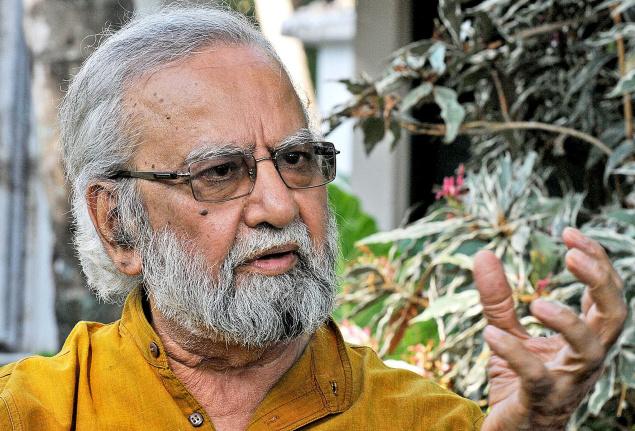
Artist Gulam Mohammed Sheikh during an interaction with The Hindu at Fort Kochi on Monday./  Photo: K.K. Mustafah / The Hindu
Artist Gulam Mohammed Sheikh during an interaction with The Hindu at Fort Kochi on Monday./ Photo: K.K. Mustafah / The Hindu

Gulam Mohammed Sheikh creates images of mystics alongside demons

The idea of the Ram Janmabhumi came to artist Gulam Mohammed Sheikh from a mural in Mattancherry Palace depicting three mothers: Kausalya, Kaikeyi and Sumitra giving birth — a majestic portrayal of motherhood, as he describes it.

The dapper artist, who defies labels, borrowed the image and incorporated it alongside a picture of the Babri Masjid demolition in one of his ‘Shrine’ series of works, shaped like a Rajasthani ‘Kavad’, a portable miniature box-shrine, in the aftermath of the darkest day of Post-independence India.

He was in Kochi on Monday to take part in the ‘Let’s talk’ programme organised by the Kochi Biennale Foundation. In a conversation with The Hindu at Fort Kochi, Mr. Sheikh said the ills that gnawed at Indian society today boiled down to beliefs. Hence you also see demons in his shrine besides great mystic poets like Kabir Das, as if in contrast. “Our great poets have rarely been painted, you know,” points out the art historian, poet and teacher, who exerted a profound influence on the Indian art scene by mentoring several generations of artists who studied Fine Arts at the University of Baroda.

In the early 1960s, when Ratan Parimoo went on an academic sabbatical, then dean N.S. Bendre suggested Mr. Sheikh, still doing his post-graduation, teach in junior classes. He went on to teach art history, which he continued even after his return from the Royal College of Art in London. “Though trained as a painter, I was dabbling in art history as a member of the faculty. I was teaching the ‘story of art’, which was compulsory for students in all fine art disciplines. In a smaller institution, you have instruction at a personal level. It was a great learning experience for me, too, as they were all from different background and faced different types of problems…For a practising painter, the greater challenge was to keep yourself apart and enter into the mind of another artist all the same! But I found the challenge rather fulfilling. I also learnt to articulate myself,” he says.

Beat generation

It was the era of the Beat generation and language was being radicalised. It all came to a point where it hit the wall, appoint of no return. In our case, we were looking up to cinema, film-makers like Fellini, Godard and Bunuel for inspiration and were eager to discover a new idiom for creative expression, he says.

On return to India after hitchhiking across Europe, he saw his old pals doing different things. He went around the country and was struck by the tradition of Indian narrative painting. “I felt that the most traditional art is regional and personal. When you are personal you become confessional.”

Along with Bhupen Khakhar, he stumbled upon the idea of evolving an idiom to contextualise their times. While Khakhar turned to popular art of India to develop his language, Mr. Sheikh fashioned an idiom for ‘wanderlust’.

On an off, Mr. Sheikh dabbed in Guajarati poetry and prose as well. “Poetry and painting can coexist. Some things can only be written while some others can only be painted,” he says, insisting that he is open to all genres. “What is important in a work is how you articulate it.”

Even before magical realism and fragmented narrative found examples in Indian English writings, Khakhar’s and Sheikh’s works explored those.

‘Going Home’, a series on home just happened after his return from England. Based on the notion of home (originally, Surendranagar in Kathiawar where he spent the first 18 years of his life), he realised that ‘home’ was an idea he kept returning to, as it changed continuously. “There are homes; there are homes that you yearn for and those that don’t let you go,” he says.

In modern times, when art became a commodity post-liberalisation and communalism became endemic to society, he offered resistance by way of his works. “You got to retain your sanity, acutely aware as you are that we as a society are capable of destroying ourselves. But it’s a collective battle. In fact, it is a fantastic challenge when all spheres are appropriated by fanatical forces. You don’t do activism. But every artist worth his grain will sympathise with the victim and you gain strength from inside. There’s always a way out,” he says.

source: http://www.thehindu.com / The Hindu / Home> News> Cities> Kochi / by S. Anandan / Kochi – March 18th, 2014