Category Archives: Arts, Culture & Entertainment

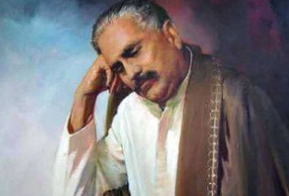
Sada-e-Dilkusha of Iqbal’s Persian poems to be released on Saturday

IQbalMPos05mar2014
Hyderabad :

(Siasat News) Noted Urdu poet, Mr. Muztar Majaz has complied Sada-e-Dilkusha consisting of Iqbal’s Persian poems and translated them from Persian into Urdu.

This book will be released by Mr. Syed Turabul Hasan, IAS (Rtd) at Urdu Hall, Himayathnagar at 7 pm on Saturday 8th March.

Dr. Mohammed Ziauddin Ahmed Shakaib will preside over the function. Mr. Rahimuddin Kamal, Editor of Horizon English Daily will be the guest of honor for this function.

Prof. Fatima Begum, former Head of the Dept. of Urdu of O.U. and Mr. Syed Imtiyaz Uddin will express their opinions on the translated poems by Mr. Muztar Majaz. Mr. Ghulam Yazdani, President of Anjuman Taraqqi-e-Urdu, A.P. will present welcome address.

Dr. Mohammed Shujath Ali Rashed, Deputy Director of Centre for Professional Development of Urdu Medium Teachers of Maulana Azad National Urdu University will conduct the meeting.

He has requested all the invitees, research scholars and Urdu lovers to attend the meeting.

source: http://www.siasat.com / The Siasat Daily / Home> Hyderabad / Tuesday – March 04th, 2014

An unfinished episode

Embark on an adventure with Pheroze Kharegat as he takes us to a place steeped in history and conspiracy. Bara Kaman in Bijapur mesmerises and captivates anyone who looks upon it…

BaraKhambaMPos04mar2014

With an overwhelming number of Mughal monuments in India, we tend to forget that, down South, in Bijapur,Karnataka has a great treasure house of Islamic architecture. Peep into the annals of history and you will be intrigued to know how this obscure  little town in northern Karnataka attracted countless dynasties in its brief thousand years of existence.

Dynasty rules

The mighty Chalukyas led the pack, followed by the Khiljis, the Bahamanis and the Adil Shahis. Bijapur’s ancestry rattles off the veritable who’s who of medieval India. They came here to rule and left their imprints in stone – the Gol Gumbaz unparalleled anywhere in the world, the sombre mausoleums and the lavish mahals.

Of all these, the most mystifying in the unfinished edifice is known as the Bara Kaman, or twelve arches. Arches that are silently crumbling, yet graceful. The unfinished tomb of Ali Adil Shah lies a short distance to the north of the citadel and the Gagan Mahal. The great high basement upon which the building stands is 215 feet square.

The most peculiar characteristic of the building are its arches. They are purely Gothic in outline, being struck from two centres with the curves continued up to the crown. On a raised platform, in the inner enclosure is the tomb of Ali Adil Shah. Standing at a dead end of a lane, located a few km from the present day Bijapur town, the Bara Kaman — as this mausoleum was called, stands in ruins.

There are no domes or pillars; just towering stone walls that curve into arches, built to represent death and immortality, as they tried to reach out to each other. The original plan was to build an edifice of 12 arches arranged both horizontally and vertically around the tomb of the king and his queens. However, barely a couple of arches completed the picture, while the rest of them seemed to have been left undone.
This is the incomplete mausoleum of Ali Adil Shah, Sultan of Bijapur, who ruled from 1656 to 1686. This building is also called as Ali Roza. This is located near to the Bijapur main market.

Family politics

Built in 1672 A D, it was the burial place of Ali Adil Shah II and his queens and members of royalty. But the planning of such a grand monument spelt death for the prince.

Ali Adil Shah was murdered by his father Ibrahim Adil Shah to prevent him from completing Bara kaman. Ibrahim Adil Shah feared that Bara kaman would lessen the popularity of Gol Gumbaz that he had gotten constructed. Bara Kaman has the tombs of Ali Adil Shah, his wife Chand Bibi, his mistress and his daughters.

The architect Malik Sandal, initially raised solid walls in the form of concentric arches and once the entire wall was erected, the inner arches were toppled off and only the outermost arch was left intact. Also iron rings were used to hold the stones in place. They weren’t cemented together.

If the mausoleum had been completed, it would have definitely rivalled the Gol Gumbaz in Bijapur.

As a visitor enters the place, he is bound to be impressed by the huge symmetrical arches. The pillars are built of stone and stand tall. The architectural skill of those who designed and constructed this monument is noteworthy.

It is a fine example of Islamic architecture which is synonymous with grace, beauty and opulence. There is no roof over the structure, a clear indication that work had to be stopped due to unknown reasons.

Massive pillars, with large stones nicely held together, support the arches, which soar to the sky. The arches are interlinked giving a picture of continuity.

The tombs are simple with no decoration and a hemispherical smooth top. Two of the arches are located on a tiered high platform, at a distance from each other, and have an austere look.

A wall at the back of the monument has a small arched opening as a lookout. The entire monument is bereft of any embellishment.

The garden in front is well maintained and the Archaeological Survey of India is looking after the upkeep of the monument, though no entry fee is charged.

It was rather late in the evening, and the sun’s rays filtered through the towering  arches, radiating a soft glow. The cenotaph just stood there throwing no clues as to why it was incomplete.

The only motive available in history is   pride that came between the father and the son. They both tried to surpass each other in terms of massive mausoleums.

source: http://www.deccanherald.com / Deccan Herald / Home> Supplements> Spectrum / Maharaja Features / March 04th, 2014

Salman Khan does a good deed in UP; funds 200 paediatric heart surgeries


Salman Khan IANS
Salman Khan IANS

Salman Khan while in UP to attend the controversial Saifi event organised by the Samajwadi Party, also did some good deeds while in the state.

The actor who joined CM Akhilesh Yadav in Mulayam Singh Yadav’s native village received flak for not being sensitive towards the Muzaffarnagar riot victims.

Besides the Jai Ho actor, Madhuri Dixit, Sidharth Malhotra, Varun Dhawan, Alia Bhat and Elie were among the other Bollywood celebs who were present at the event.

Khan funded 200 paediatric heart surgeries in UP.

Here is his statement,

“Whenever I visit a place for a performance or a promotion, I see it as an opportunity to help the locals in the areas of healthcare or education. In Nagpur, on Sunday, Being Human pledged to fund 100 paediatric cardiac cases in Maharashtra State.

And in Etawah, Being Human, on behalf of all artists who performed yesterday, has committed to fund 200 paediatric heart surgeries in UP (there is already a wait list of 81 children we have received who are being moved to Fortis Hospital Gurgaon and their surgeries will get done by month end and Being Human is in touch with local NGOs and hospitals for their lists also).

We have also contributed Rs25 lakh to the Jawaharlal Nehru Medical College & Hospital for the purchase of an Echo Machine, Pediatric & neo natal ventilator and a portable X-ray machine for their paediatric cardiac ICU.”

source: http://www.dnaindia.com / DNA / Home> Entertainment / Agency: DNA Website, DNA WebTeam / Thursday – January 09th, 2014

Haider Qazmi joins AAP

Known as the tiger of Bhojpuri film industry, Haider Qazmi too has become a member of AAP now. In a recently held event in Delhi he said, ” My fans from Jahanabad wanted me to be a part  AAP and thus I joined. “

Haider has acted in over a dozen films and says he loves his fans from Jahanabad. He also added, “AAP has proved that you need the will to change things and nothing can stop you. I respect and appreciate their agenda and thus I joined them.”

source: bhojpurimedia.com

source: http://www.timesofindia.indiatimes.com / The Times of India / Home> Entertainment> Bhojpuri> Movies / February 25th, 2014

The music maker

ShaanRahmanMPos02mar2014

Learning by trial and error marks Shaan Rahman’s music lessons. His passion gives his music direction.

Shaan Rahman got badly kicked at karate. Taking cue and opting out, he looked for a place where he would be safe, physically. The music class next door appeared alluring. For four Fridays, half an hour each, he pinched the keyboard. Those two hours in toto makes Shaan’s music education. The man behind the anthem-like Muthuchippi…from Thattathin Marayathu, Thira and now Om Shanti Oshana evidently does not believe music can be spoon-fed. Shaan’s music is his solo project, his hard work.

At the appointed time on a scorching Saturday afternoon, Shaan is woken up from his nap for the interview. He admits the appointment skipped his mind, but quickly swaps drowsiness for chirp. Inhibitions are none in Shaan’s narrative. “I don’t know any raga. I studied Western,” he is nonchalant. Tell him it is brave for a music director to say so, Shaan assures, “You can write it.” What about the purists? “I don’t face any,” is his reply.

Shaan, an effortless raconteur, bares all – warts, moles and melody in his music. Humour is his armour and mimicry skill.

Episodes become drama when he narrates them. The story of his first stage show in Dubai when his band Desi Noise sang to speakers switched off and was booed off stage is recounted with wit. “‘How deep is the sea here,’ is what my friend asked. That was our first major performance,” says Shaan. But the boys bounced back the very next day daring to sing a re-mixed version of “Oru madhura kinavin,” much before it appeared so in a recent film, before K.J. Yesudas and drew appreciation.

Music has been a background to Shaan’s childhood. “I would listen to music in a 2 in 1 system and play the keyboard along with it,” he says. He figured out the keyboard through trial and error. “Growing up in the Middle East music was pastime. I never took it seriously. In fact, I wanted to be a pilot, but did not have enough marks,” he quips. Though Shaan veered into sound engineering, music was where he halted in quest of happiness. “I am happy when I compose.”

He arrived at music direction little-by-little, through jingles, a band and albums. If music appears effortless when Shaan talks, he is quick to cut to the unseen hours of hard work. “I would download software and learn using the help menu. But music is essentially the rhythm in you,” he says. A simple belief is his music, “Your music should touch people’s heart. It is in having a fire and passion for it. My music rides on my passion and a good bunch of friends. I will stop the moment passion dies.”

First notes

Though Shaan wanted music, he worked away from hotbeds and continues to do so in Kozhikode. Friends egged on the sound engineer working in Thalassery at vital points. Colleague and now director Mammas prodded Shaan to go beyond sound to a jingle. The first was for a bathing bar produced by the firm Shaan worked for. “I created a jingle and it was fixed. I was like ‘Are you sure? I can re-work,’” recalls Shaan. The jingle took him to Chennai and a music studio for the first time. “My knees were knocking against each other. It was sung and released. Though nobody called me after hearing it,” Shaan says.

“Mammas told me if I could do a 30 second jingle, why not a four-minute song. The song was ‘Sneham’ written and directed by Mammas, our first video.” The video, shown on music channels, eased things at home. Shaan’s parents were beginning to be worried. “Dad is an engineer and mom’s dad was a doctor. We were used to having salaried people around us. Mom would call and I would tell her, ‘Don’t worry, I can see the shore somewhere’,” Shaan says. Post the video, Shaan moved to Kochi, formed the band Desi Noise and shot two more videos. But he still hadn’t broken in. “I was living off my dad,” he says impishly. But Desi Noise won the boys a show in Dubai from which they returned confident and at the airport Shaan met the man who would become his friend and collaborator — Vineeth Sreenivasan. With Vineeth, Shaan would dream music and discuss musicians, A.R. Rahman to be precise. Eventually, it led to Coffee @ MG Road, a video that woke up the young to Malayalam albums. Protagonist Salim Kumar in wacky clothes and a dollar neckpiece singing about the woman he lost stayed in mind, invited counters and won a ticket to fame for its makers. It came trifle before YouTube and going viral was norm. “I called up Vineeth and said, ‘Either we are mad or the world is.’ He told me Kerala loves losers.”

Shaan drifted to films with Pattanathilbhootam, Malarvadi Arts Club and Thattathin Marayathu. Even when he gets together with Vineeth, it is the clear-headed view of what might work that makes their partnership tick. Thattathin Marayathu, they knew, was clichéd, but they banked on its treatment, strictly the music. “Vineeth asked me to create my best songs for it. He wanted the music to be a velvet drape around the story, the kind that will create butterflies in the stomach.” Shaan created songs that whispered into souls and gave a new voice to them too when he realised Muthuchippi in the unlikely voice of Remya Nambeesan. Thattathin Marayathu astounded his parents and won a handful of awards. Shaan treasures music director M. Jayachandran’s words as he gave away the Eenam Swaralaya award to Shaan. “He said ‘Muthuchippi’ was his favourite song of the year and that his own songs that year had not given him the satisfaction this song gave,” says Shaan.

Shaan continues to mostly work with friends in projects he has been part of from initiation. His newest release Om Shanti Oshana directed by Jude Anthany Joseph boasts breezy numbers. Shaan is getting busier though. He is doing music for the Telugu version of Thattathin Marayathu. Mammooty’s Praise the Lord is Shaan’s next release. Also music in the films of a few friends, including Vineeth. As he moves on Shaan says, “The only time I am not confident is when I cannot communicate with the director.”

source: http://www.thehindu.com / The Hindu / Home> Features> Kozhikode MetroPlus / by P. Anima / Kozhikode – February 28th, 2014

Reading it in style

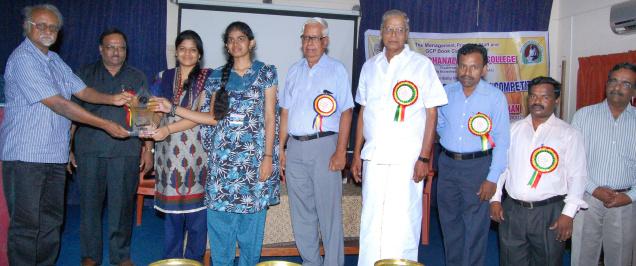
A.J. Rufina Amreen of Cauvery College for Women bagged the first prize in the book review competition held at Urumu Dhanalakshmi College. / The Hindu

Chetan Bhagat ’s ‘Revolution 2020’ was reviewed

The intercollegiate book review competition organised by the GC Pattabiraman Book Club of Urumu Dhanalakshmi College here on Friday brought to the fore the fact that given an opportunity, students can do anything in style.

The 24 book-reviewers from 12 colleges reviewed Robin Sharma’s ‘The Monk Who Sold His Ferrari’, Chetan Bhagat ’s ‘Revolution 2020’, and Shiv Khera’s ‘You Can Win’.

It was evident that the students had closely read the texts and proved their mettle by enthusing the listeners to read the books , said Prof. R. Panchanadhan, Director, Talent Consultancy, chief guest-cum-judge. He congratulated the college for organising the event and gave away the prizes to winners.

A.J. Rufina Amreen of Cauvery College for Women secured the first place winning the cash award of Rs.1,000. The second prize of Rs.750 went to Josephin Shamini of St. Joseph’s College, and the third prize Rs.500 was bagged by A. Vinodhini of Cauvery College for Women.

Cauvery College for Women won the over-all team championship, followed by St. Joseph’s College, and Holy Cross College.

S.Sekar, principal, Urumu Dhanalakshmi College, presided.

source: http://www.thehindu.com / The Hindu / Home> News> Cities> Tiruchirapalli / by Syed Muthahar Saqaf / Tiruchi – March 01st, 2014

CITY MUSINGS : Naye Masjid a point of confluence in Machilipatnam

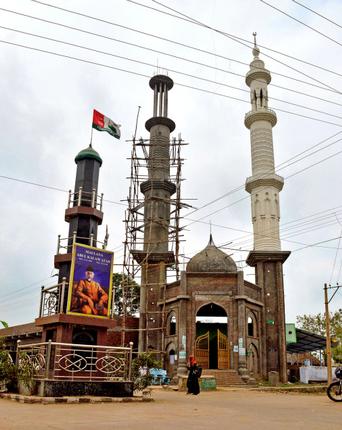
A view of Naye Maszid at Rajpet in Machilipatnam. / Photo: T. Appala Naidu / The Hindu

Renovation of the architectural beauty of 1920s is now under way

Idyllic living conditions help peaceful existence of people from different religious practices in Rajpeta area. This peaceful atmosphere of co-existence justifies it to be called ‘Jewel by the sea’ in the port town.

Renovation of Naye Masjid, an architectural beauty of 1920s, is now underway and it is bound to become the most sought-after location for the people in the town in the coming years. Naye Masjid, with two minars, each standing 108 feet tall, has been the sole sacred place for the estimated 700 families belonging to Muslim Sunni sect.

An integral part

Every resident from five streets around it – Rajpeta, Nooruddinpeta, Varregudem, Pathullahbad and the National College Street – need to pass in front of the Masjid everyday as part of their routine. Having a look at the Masjid has become an integral part of the people’s daily lives, irrespective of their religious practices.

“Construction of Masula’s one of the multi-speciality hospitals is on in our area. People from the entire town will appreciate the beauty of the Masjid when they visit the hospital after it goes functional,” feel the Rajpeta residents. The proud locals claim that renowned educational institutions such as The National College and Krishna University were situated in its vicinity.

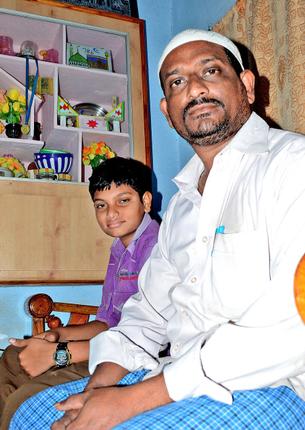
The Committee Secretary Sheik Hussain with his son. / Photo: T. Appala Naidu / The Hindu

“Muslim families in Rajpeta area contribute funds for completion of the ongoing beautification and renovation works of the Naye Masjid. However, people from all other religions take pride in having such a structure,” Naye Maszid Committee Secretary Sheik Hussain told The Hindu.

This landmark construction is visible from majority of the areas in the district headquarters town.

source: http://www.thehindu.com / The Hindu / Home> News> Cities> Vijayawada> City Musings  / by T. Appala Naidu / Machilipatnam – February 17th, 2014

Hussain proves yet again he has a nose for the keyboard

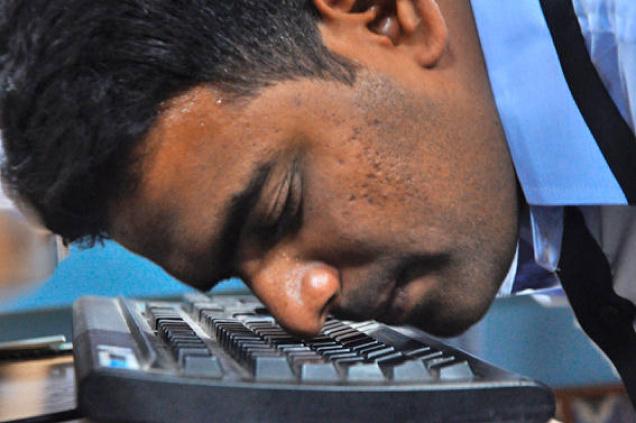
Mohammed Khurshid Hussain currently holds the world record for typing A to Z on a keyboard in 3.43 seconds. - Photo: G. Ramakrishna / The Hindu
Mohammed Khurshid Hussain currently holds the world record for typing A to Z on a keyboard in 3.43 seconds. – Photo: G. Ramakrishna / The Hindu

The youngster types a sentence using his nose in 47.44 seconds, more than half-a-minute faster than the current world record

Mohammed Khurshid Hussain, who holds the Guinness World Records for typing the English language alphabet in 3.43 seconds on a keyboard, attempted to break the record for typing a 103-word sentence in the shortest time, with his nose, here on Thursday.

It was Mr. Hussain’s second attempt to break the world record for typing the sentence ‘Guinness World Records have challenged me to type this sentence using my nose in the fastest time’ with his nose.

According to the Guinness website, the current record holder is an Indian named Neeta, who achieved the feat in one minute and 33 seconds at Guinness World Records Pavilion in Global Village, Dubai, UAE, on November 16, 2008.

Mr. Hussain’s clock stopped at 47.44 seconds when he finished typing the sentence with his nose, more than half-a-minute faster than the current world record.

“This is my second attempt to break the record. A few months ago, I typed the sentence with my nose in 54 seconds, for which I am yet to receive the certificate,” he said.

Mr. Hussain currently holds the world record for typing A to Z on a keyboard in 3.43 seconds.

The feat was achieved on February 2, 2012, according to the Guinness website. He performed the feat in the presence of S. M. Arif, Padmashree and Dronacharya awardee; Mohteshyam Ali, silver medallist at the Mr. World body building championship; Naina Jaiswal, an international table tennis player; and Iftekhar Shareef, who acted as witnesses for the record-breaking attempt.

Heritage marks this mosque

It reminds one of the oldest mosque in Kerala in Calicut, maybe even in India – a quiet nondescript house sitting serenely in one of the most crowded areas in Mangalore called Bunder. We had been searching for it and so understated was it that we were directed to two other mosques before we actually found it.

The Zeenath Baksh Mosque is thousand years old

Maybe we should have asked for Jumma Masjid for that is its other name. We went through bustling alleys and streets, most of whom had their own mosques, new ones with domes of different shades of glistening green domes and minarets.

Finally we reached Bunder. The street was lined with shops selling a plethora of goods ranging from groceries to bicycle parts. By sheer happenstance we asked a particular shop owner where this mosque was and he pointed next door to say” It’s here only”. Here? We were surprised as it seemed like just another house.

It is housed a little inside from the road. We were conspicuous by our presence, my friend and I, for there were hardly any women going in or out. A young man in a kurta pajama and white cap came forward and my friend asked if we could take a picture. He agreed instantly and asked if we would like to come inside. But he said, you will have to cover your heads. We agreed and he took us around , very patiently explaining to us its history.

He said that it was a thousand years old; Islam in Kanara dates back to the twelfth century, as it had become the regional center for thriving international trade with Africa and Arabia. There are purportedly letters from Cairo assumed to be from an Abraham Ben Yiju, a North African Jew who settled here for twenty years.

This was unlike the other fellow traders who came and went intermittently, but ultimately went back to their land of origin. These missives are part of the Genizah documents (so called because they were found in the Genizah which is the back room of a synagogue) prove the existence of trade between Africa and Arabia and India. Author Amitav Ghosh researched these scholarly documents for his story in his brilliant novel “In an Antique Land”.

In a similar fashion, Muslim Arab traders had a cordial relationship with the rulers of the western coastal belt of India. This is attested to also by the writing of Ibn Batuta, the intrepid North African traveller who passed through India in 1342 who estimates that the Muslims in this region amounted to 4000.

The Masjid Zaynath Baksh in Bunder is said to have been established in Mangalore in 644 A.D and was inaugurated in February 644 A.D.

In the seventeenth century, Tipu Sultan renovated the mosque adding beautifully carved rosewood pillars and also a carved ceiling. The mosque was renamed after his daughter Zeenat Baksh. The prayer hall is on a plinth with an open colonnade running around the building under heavy overhanging eaves. The renovation coexists in harmony with the older, more ancient structure.

Men were praying with quiet intensity, some standing with stretched hands and some were sitting and praying. I traced the curlicues  in the carved ornamentation of the pillars, standing solid and reassuring.

There is a pellucid ablution pool at the back and around the building is a cemetery.The façade of the mosque has green pillars supporting it.

Overall it gives the appearance of a dignified house of worship, providing a sacred sanctuary for both the dead and the living.

Maya Jayapal

source: http://www.deccanherald.com / Deccan Herald / Home> Supplements> Spectrum / by Maya Jayapal / February 25th, 2014

Short cut to a story

Seven principles of brain scienceSharmin used them / Photo: BHagya Prakash k. / The Hindu

Chat Sharmin Ali believes that 90 days is all it takes to write a book

She wrote her first book in less than a week and now wants to help other budding novelists do the same. Meet debut novelist, entrepreneur, public speaker, blogger, theatre artist and motivational speaker, Sharmin Ali whose debut novel Y.O.U(You Own Yourself), reflects the author’s determination to bring about a positive change in the lives her readers.

Yet this has not come easily to this multi-faceted, self-possessed young woman who believes in doing things differently, “I had a stammering problem as a child,” she admits adding that the first person whose life she transformed was herself.

An engineer by profession, Sharmin worked in the corporate field for several years before quitting to do theatre.

She went on to co-found a production house, Plain Ice Productions and then decided to write, “I’ve always wanted to write but didn’t know how to put my ideas across. So I started reading a lot of best-sellers and understanding why they worked. After reading 10 of them, I realized I could predict how the eleventh would work. That made it easier for me to write my own and I went ahead and wrote my first non-fiction book is less than a week,” she says.

Her experience with writing her own book made her realize that there was a need to share it with other budding writers, “There are so many out there and I wanted to create something that would make it easier for them,” she says.

This has lead to the creation of her latest product Your-First-Book.com, a formula on how to become a published author in less than 90 days. The CD of the program was launched at the Oxford Bookstore earlier this month.

The product hand holds a budding writer through the journey of writing and includes tips on how to start, how to position yourself, what to write about and how to get published,

“I’ve used the seven principles of Brain Science while creating this product. This will help you create your Magnum opus,” she says adding, “At the end of the day it is attitude not aptitude that matters. You need to just get up and start doing things.”

PREETI ZACHARIAH

source: http://www.thehindu.com / The Hindu / Home> Features> Metro Plus / by Preeti Zachariah / February 21st, 2014