Category Archives: Arts, Culture & Entertainment

On the right note

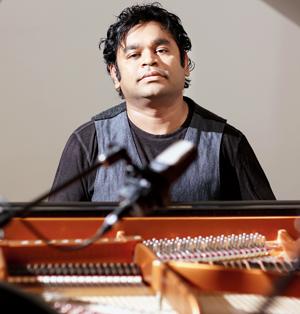
arrahmanMPos17feb2014

AR Rahman on making experimental music with Imtiaz Ali, his two upcoming international releases, Mani Ratnam’s next and a music album that releases later this month.

He’s getting ready to walk the red carpet at the Berlin Film Festival with Highway director Imtiaz Ali and leads Randeep Hooda and Alia Bhatt. “It’s cold here but not freezing, the sun is out,” says AR Rahman, talking to Mirror from the German capital.

Back home, he has surprised many by appearing in the music video of Pataka Guddi with Alia. Is an acting career on the cards? “That’s a different trip. I’d rather continue with my musical journey. There’s so much left to explore” says the maestro.

He points out that the film offered him a lot of creative freedom to experiment with different things before they landed up with the final list of songs. “Even more challenging was the minimalistic background score. There were places where we decided not to have music and let the ambience speak,” he reminisces.

After this road trip through six states, Rahman will set out on The Hundred-Foot Journey based on Richard C Morais’s novel. The Mozart of Madras is looking forward to this adventure drama starring Helen Mirren, Om Puri and Manish Dayal. “I’m a great admirer of the Swedish director Lasse Hallstrom who’s been nominated for the Oscars for My Life as a Dog and The Cider House Rules. His sensibilities are unique. I’m really excited,” he exults. Produced by Steven Spielberg, Oprah Winfrey and Juliet Blake, the film opens on August 8.

Before that, the composer will have another international release on May 16–Walt Disney Pictures’ biographical sports drama, Million Dollar Arm. “I’ve worked with a lot of artistes on this score, collaborated with rappers from the West. It’s in the Slumdog Millionaire genre but goes forward and beyond. It’s based on a true story (of baseball pitchers Rinku Singh and Dinesh Patel discovered by sports agent JB Bernstein after winning a reality show) which made it more interesting,” he says.

For all those who believe that Rahman is on a highway to the West, he points out that there’s the Rajnikanth starrer, the oneof-its-kind Kochadaiyaan – The Legend. “It’s not real live-action and has been in the making for long but I’m proud to be associated with it,” he asserts. He’s also given the nod to Mani Ratnam’s bilingual starring Aishwarya Rai Bachchan.

Confirming the news Rahman says, “It’ll be nice to be working with Mani Sir again on an exciting, young project.”

He’s also given the nod to Imtiaz’s Window Seat starring Ranbir Kapoor and Deepika Padukone. And there’s Shekhar Kapur’s Paani. “I’m glad this ambitious project is in the right hands now, it will happen the way it’s meant to,” he avers.

And if that’s not enough, Rahman will also be releasing an album, Raunaq, on February 27 but won’t divulge detials. You’ll hear it soon,” is all he will say.

With all that’s happening, it’s not surprising his son Ameen would want to stop a music session so his dad could get seven hours of sleep. “Living in a family we tend to take each other for granted till we get a wake-up call like this. Then it’s like wow, this is what a family is about,” he says.

But cruising down the highway of life, as we see in Imtiaz’s upcoming film, can be an eye-opener and a mind-opener. “I’ve been travelling for the last 15 years, not on a truck but on an aeroplane. My kids miss me when I’m away but I don’t mind living out of a suitcase. The UK, US, France, Germany, Iraq… it’s such a thrill meeting people of different cultures, learning about and from them,” he muses. “It’s changed my perception about life, humanity and spirituality.” Jai Ho!

Meanwhile, buzz is, he had objections to Sohail and Salman Khan using the title Jai Ho for their film? Rahman says, “After Slumdog Millionaire, Jai Ho became such a huge hit that I copyrighted the title. I gave an NOC to Sohail and Salman for their film, but if anyone outside India wants to use it, they will need my permission.”

source: http://www.mumbaimirror.com / Mumbai Mirror / Home> Entertainment> Bollywood / by Roshmila Bhattacharya, Mumbai Mirror / February 15th, 2014

The key to her life

Bangalore :

Samreen Gafoor’s fascination with keycards began at the age of six. The 15-year-old, who has travelled extensively, is the proud owner of over 80 keycards. The student of Bishop Cotton Girls’ School has keycards from India, Singapore, Sri Lanka, Chicago, Shanghai among a host of other places. “Actually a lot of them are from the hotels of these places. As a family, we make it a point to go on a vacation every six months. That way I’m lucky that I can add to my collection frequently,” she says. 

SamreenKeyCardsMPos17feb2014

Recalling how she started off, Samreen says, “The first one I got was from Malaysia which has my name on it. I was a kid back then and got excited to see a keycard with my name on it. So I told my parents to keep it even though they didn’t think much of it. But then after every holiday, I would keep the keycard carefully. That’s when they started taking my hobby seriously. In fact, the minute my dad gets back from a trip, I ask him if he has brought me a keycard.”

Any relative or friend visiting the family loves looking at the keycards. In fact, her love for keycards is so popular that the members of her extended family ensure that they bring her back some when they travel. Pointing out to her collection, she smiles, “Whenever anyone travels, the first thing they do on returning is give me the keycard of the hotel they stayed in. My friends do the same.”

So which are her favourites? “Every keycard is special to me. But the ones from Westin Hotel in Gurgaon, The Atlantis in Dubai, Taj Mahal Hotel in Delhi and Ramada in Doha stand out. Actually, I could go on and on,” she says. Samreen, who has a keen interest in art, says that she looks for keycards with intricate art work. Pointing out the difference between her first few keycards and the current ones, Samreen says, “I have noticed that a lot of effort goes into each one. These days, the hotels like to leave a mark on the keycards. For instance, either a photograph of the hotel or a work from it is put on the keycards. Some have paintings on them. A lot of effort goes into making them attractive. They are really worth keeping.”

She further adds, “Some hotels keep changing the designs every few months.” But her biggest disappointment is when she lands at a hotel which doesn’t use keycards. “The first thought that crosses my mind then is ‘how will I add to my collection?’ Thankfully, the metallic and plastic keys are slowly and surely getting phased out,” she says. Samreen points out that her unusual hobby has given her a chance to map her journey. “I remember the places I have been to and learn about them in the process too,” she says. However, she rues that she has not come across anyone else who has a similar interest. “I really wish I knew others who have the same hobby. It would be great to exchange,” she says.

So how does she maintain her large collection? “It actually doesn’t take that much effort because they fit perfectly into a visiting card holder. But before I got this idea, it was quite tough as I used to keep them all in a box,” she says. While many youngsters grow out of their hobbies, Samreen makes sure that the collection, she has had for over ten years, only grows. “Having pursued the hobby for so long, I know that I’m going to be a collector of keycards for a long time to come. Although I don’t have anything in particular that I would like to add to the collection, I just pay attention to whatever comes my way,” she wraps up.

source: http://www.deccanherald.com / Deccan Herald / Home> Supplements> MetroLife / Unique Hobbies / DHNS / by Vidya Iyengar / February 17th, 2014

Holy revival

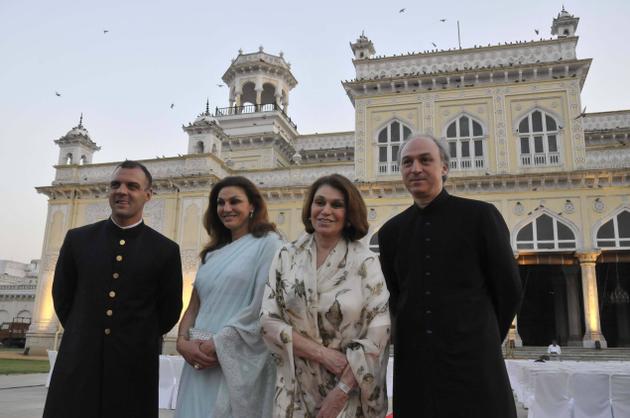
Azam Jah , Shehkar Jah, Princess Esra Jah and Azmet Jah ./ PHOTO: P.V.SIVAKUMAR

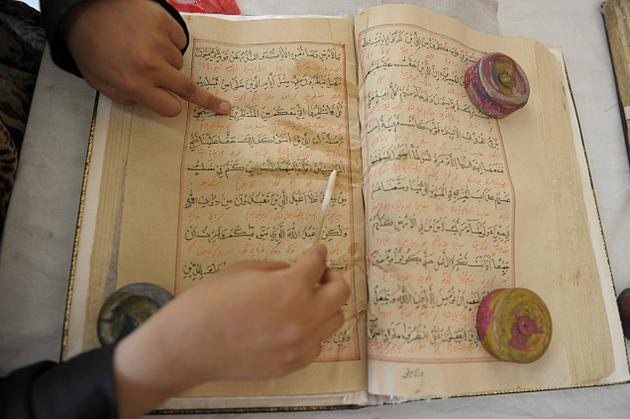
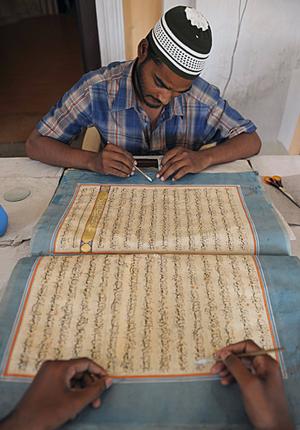
36 restored Nizam-era Qurans complete with precious gold and gem stone ink are on display at Chowmahalla

Today Chowmahalla palace will be teeming with visitors and lovers of history to see the unveiling of numerous Qurans some of which date back to early 1400 A.D. Princess Esra, of the erstwhile royal family, who has been an important part of the revival and restoration of the Qurans says, “It was a Herculean task but worth the sweat and effort. These valuable Qurans couldn’t have been let to rot in the state they were found. Once we discovered the collection we took notice of the work it needed and set out with a serious pace,” she revealed .

A conservator restores an antique copy of the Quran at Chowmahalla Palace in Hyderabad / AFP

Esra adds, “It’s only for the sake of culture and heritage. When I came here as a bride I was shown night pictures of the lanes and areas and I was in awe of the silenceand solitude . My mother used to tell me ‘you will know once you get there,’ and after I came to Hyderabad I realised what it meant to be a part of the royal family,” she smiled. In awe of the grandeur and the luxury as well as the love that people had for the royal family, she felt humbled. “When I returned after years to see the dilapidated state of the things I had touched and felt, including the Qurans, I was grief-stricken; I couldn’t let them rot away. I am sure even the Nizams themselves didn’t know how many of the precious holy book of scriptures they owned. When the final discovery was made, the total number of the Qurans, of all sizes, stood at 36. There are some very tiny ones as well,” she says.

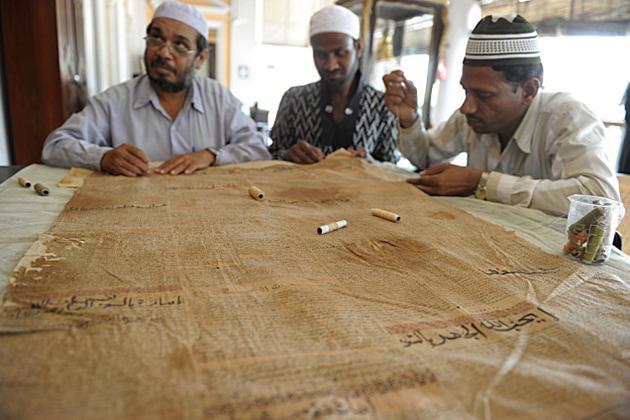
Conservators working on the antique cloth quran / AFP

Esra also speaks with pride of another cloth Quran that was found; the entire Quranwritten on cloth. The cloth’s dimensions stood at 9.5 feet x 5 feet. The Qurans are of immense value not only because of their heritage but also the quality of ink used in them. “Besides gold and silver ink, inks made from powdered gems and semi precious stones were also used. In some Qurans mother-of -pearl has also been used as ink,” informs G. Kishan Rao, director of Chowmahalla Palace.

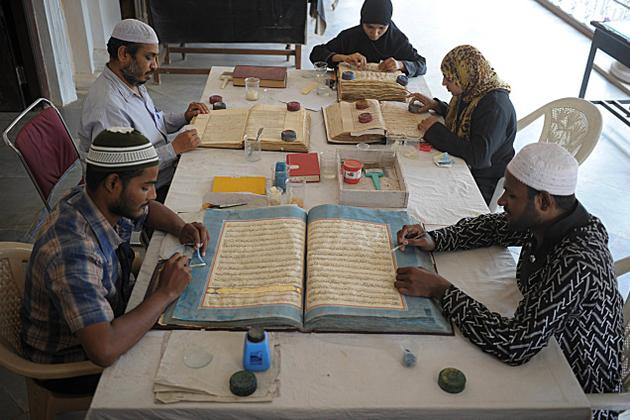
Indian paper conservators restore antique copies of the Quran at Chowmahalla Palace / AFP
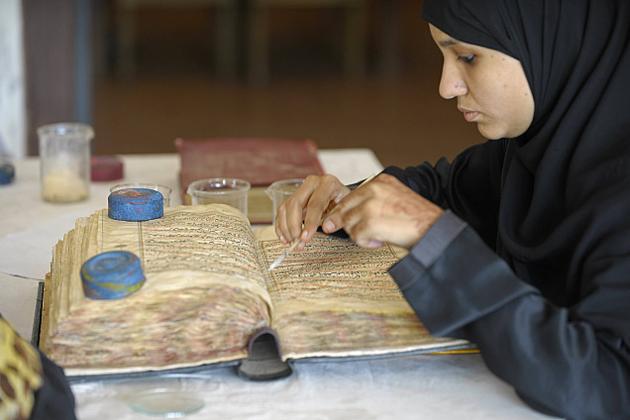
A conservator restores an antique copy of the Quran at Chowmahalla Palace / AFP
Restoration work of the Quran at Chowmahalla Palace / AFP

Since no royal item is permitted to go outside the Palace, specialists from The Indian National Trust for Art and Cultural Heritage (INTACH) have been approached. “They worked continuously for two years to revive the precious books, with Esra’s continual monitoring. The restored Qurans will be displayed in the room opposite the Council Hall in the palace,” informs Kishan Rao.

The Qurans will be unveiled by Esra and Muffakham Jah’s son at Chowmahalla Palace today.

source: http://www.thehindu.com / The Hindu / Home> Features> MetroPlus> Events / by Prabalika M. Borah / Hyderabad – February 06th, 2014

Infosys Prize / Laureates 2013 / Prof. Ayesha Kidwai

Home / Infosys Prize / Laureates 2013 / Prof. Ayesha Kidwai ...      / Prof. Ayesha Kidwai Humanities – Linguistics, 2013
Home / Infosys Prize / Laureates 2013 / Prof. Ayesha Kidwai … /
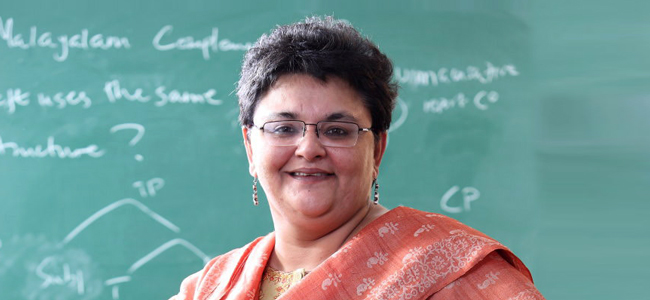
Prof. Ayesha Kidwai
Humanities – Linguistics, 2013

Ayesha Kidwai
Professor, Centre for Linguistics, School of Language, Literature and Culture Studies, Jawaharlal Nehru University, New Delhi

The Infosys Prize 2013 in Humanities – Linguistics is awarded to Prof. Ayesha Kidwai for her exceptional contribution to the field of theoretical linguistics. Her research on syntactic relations in Hindi-Urdu has related wider debates in linguistics to the study of Indian languages and has extended our understanding of India’s linguistic diversity.

Congratulatory Message From The Jury Chair – Amartya Sen

“It’s wonderful for me to have the opportunity of congratulating Prof. Ayesha Kidwai for the extraordinary work she does on theoretical linguistics. India is a country of many languages and she has been able to use her general skills to find ways and means of studying the languages with the kind of international global understanding. That is one of the delights of contemporary linguistics. Totally delighted to be able to count on her being part of the community of scholars that we are honoring through this annual giving of prizes”

Bio

Prof. Ayesha Kidwai completed her M.A. and Ph.D. in Linguistics from Jawaharlal Nehru University. Her research interests include linguistic theory, with particular reference to the (generative) syntax and morphology of Indian languages, philosophy of language, gender and language, the politics of English, and the evolution of language. Her current research interests include the syntax of finite complementation and the properties of adjunction in natural language.

She has authored several papers and a few notable books such as XP-adjunction in Universal Grammar: Scrambling and Binding in Hindi-Urdu, and In Freedom’s Shade, an English translation of Anis Kidwai’s Urdu memoir Azaadi Ki Chaon Mein.

Scope And Impact Of Work

Prof. Kidwai’s research ranges around a wide variety of syntactic topics, united by a preoccupation with the properties and effects of optional displacement operations in Universal Grammar.

Universal Grammar is the radical hypothesis, put forth five decades ago by Noam Chomsky, that the innate human linguistic ability is a domain-specific intelligence that must be modeled as a distinct Faculty of Language. This innate endowment, a system of principles and parametric options, forms the basis for the human knowledge and acquisition of any natural language, and is the source for both the relatedness of and differences between human languages. Prof. Kidwai’s contributions to the field have been the study of the principles and parameters that must be hypothesized to explain the syntactic properties of a number of South Asian languages, including Hindi-Urdu, Bengali, Malayalam, Meiteilon and Santali.

The phenomenon of free word order found in many languages of the world – ‘scrambling’– raises many intriguing questions for Universal Grammar, as such word order variation is apparently optional, and therefore difficult to characterize by grammatical rules. Prof. Kidwai’s work in this intensively studied and debated domain proposes a novel theory of how the referential properties of scrambled noun phrases in Hindi-Urdu may be characterized once the discourse effects of these optional variations are taken into account. These proposals have had important implications for the hypothesized design of Universal Grammar as well as the displacement operations conjectured to be central to it.

Recently, Prof. Kidwai also distinguished herself as an ace translator, having rendered Anis Kidwai’s moving Urdu memoir of the aftermath of partition, Azaadi Ki Chaon Mein, into English, In Freedom’s Shade.

Long Citation

Prof. Ayesha Kidwai is an outstanding theoretical linguist. Her work has earned recognition from leading international experts, as it relates the general theoretical framework of the principles of Universal Grammar to some of the particular syntactic features of Indian languages like Hindi-Urdu, Santali, Meiteilon, Bangla and Malayalam, analyzing these within the structures of human cognitive systems and their general properties.

Central to these achievements is Prof. Kidwai’s work on a wide range of adjunction phenomena. On the intensively studied and debated syntactic phenomenon of ‘scrambling’, her work proposes a novel theory of binding in extensive analytical investigation of Hindi and Urdu.

Prof. Kidwai has helped raise the respectability and significance of the field of theoretical linguistics by providing leadership and mentorship to young linguists in India. She has consistently stressed on the political and cultural importance of the study of India’s linguistic diversity.

source: http://www.infosys-science-foundation.com / Infosys Science Foundation / Home> Infosys Prize / Laureates 2013 / Feb 2014

http://www.infosys-science-foundation.com/prize/laureates/2013/ayesha-kidwai.asp

Play on thumri queen Begum Akhtar

Lucknow :

A play by Nadira Babbar on the life of thumri queen Begum Akhtar and career counselling sessions besides felicitation of ten prominent alumni of the Lucknow University will be the highlights of LU foundation day celebrations this year scheduled on November 25.

The celebrations are being organised jointly by the Alumnae Society and the University of Lucknow. Governor TV Rajeswar and chief minister Mulayam Singh Yadav would attend the function. Justice AS Anand, chairperson, National Human Rights Commission and former Chief Justice of India, would be the guest of honour. Justice Anand is a law graduate of LU.

Giving this information at a press conference on Saturday, LU Alumnae Society president Ram Kumar Bhargava said, “other illustrious alumni to be felicitated are Harish Chandra Gupta, additional defence secretary, (MSc from LU); Kamal Kumar, director, national police academy (MSc from LU); Nadira Babbar, director, Bhartendu Natya Academy (BA from LU); Dr SS Agarwal, former director, SGPGI (KGMC graduate); Gogi Saroj Pal, artist (she did her BFA from LU); Lagan fame writer KP Saxsena (MSc from LU); veteran journalist Seema Mustafa (MA English from LU); Rajendra Prasad, vice-president, American Express-India and subcontinent (a commerce graduate of LU) and Nighat Khan Lodhi, former national football player.

Nadira Babbar will stage the play on November 24 in the evening. Naresh Agarwal, state transport minister will be the chief guest. The main function to felicitate the alumni will be held during the day, a session on career counselling will be held on November 25 evening, which will be addressed by Rajendra Prasad, vice-president, American Express, VV Singh, CEO Reliance Infocom, Parveen Talha, member, Union Public Service Commission and Jayant Krishna, centre head, Tata Consultancy Services. Efforts are also on to invite KK Srivastava and Amrita Das for the counselling sessions as well, Bhargava said.

The Alumnae Society has also proposed to build an alumni house on the university campus for the purpose of coordinating the activities of the society. Vice-chancellor have accepted the proposal and has allotted the land of men’s hostel of academic staff college for the purpose. Chief minister will lay the foundation of the alumni house. Bhargava said that registration for membership of Alumnae Society are open and those who want can contact office-bearers for detail. Others who addressed the press conference included vice-chancellor, Prof SB Singh, pro vice-chancellor Prof MP Singh and AK Srivastava, Alumnae Society general secretary.

source: http://www.articles.timesofindia.indiatimes.com / The Times of India / Home> City> Lucknow> Lucknow University / TNN / November 01st, 2004

Leafy narrative

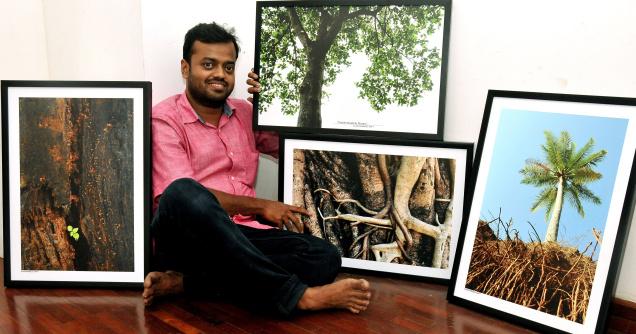
Mohammed Safi with his works / PHOTO: S. RAMESH KURUP / The Hindu

Leaves, often never given a second glance, are the principal characters of Safi’s photographs

Leaves — ever present and taken for granted—are Mohammed Safi’s focus. His photographs capture leaves in all their moods — green and vital; flushed red, crimson and yellow, smelling of autumn; and finally, brown, wrinkled and dying. “Ela Illathe Illa” (Without Leaves, Nothing) — 36 photographs of Safi, a freelance photographer, are on show at the Kerala Lalithakala Akademi Art Gallery.

Noticing leaves

“We might often sit under a tree’s shade and also eat its fruit. But the possibilities of leaves as fine art is often missed upon us,” Safi explains why he zeroed in on leaves. Abundant and everywhere as they are, Safi never went questing for his frames. Instead, they are drawn from everyday life. Images struck him on routine journeys, enticed him to stop, pull out his Nikon D200 and click. And his camera has caught the minute and the mammoth. One show is the photograph of an aging wet bark. But sprouting from its middle are two fresh leaves and glued to it is a rain drop. “When you see such a sight, you realise the poetry in nature. You also become aware of the possibilities of art,” he says.

Safi’s photographs capture poignancy, often arresting the moments between life and death. On show is a low-angle shot of a coconut tree on the edge of a beach, baring all its root. A day later, says the photographer, the tree was uprooted and washed away by the waves.

Most photographs speak of summer and sunshine. A few capture leaves drenched in rain. One frame merely has fallen acacia leaves lying listlessly in still waters. Quite like the dead leaves, imperfect ones — torn and blighted — make Safi’s frames. In a couple of photographs, leaves chipped and eaten at the edges are the centre. So too are trunks cut away at the middle. “Trees are categorised by their resourcefulness. For us coconut and rubber are lucrative. I am constantly instructed to clear the worthless trees in the yard. But I let them grow,” says Safi.

Among his photographs are trees and plants growing on the banks of the Bharatapuzha and those flourishing on clay tile roofs.

Inspiring environment

Safi finds most of his frames in and around Malappuram and Thrissur. A potent environment for him is the Thekkinkkadu maidan in Thrissur with its towering trees. Low-angle shots capture trees and leaves in different seasons giving the frames the feel of a canvas. The clutch of photographs on the maidan shows sweeping branches with full green leaves and so too wet and yellow ones.

The exhibition is on till February 12 from 11 a.m. to 7 p.m. at the Kerala Lalithakala Akademi Art Gallery.

source: http://www.thehindu.com / The Hindu / Home> Features> MetroPlus> Events / by P. Anima / Kozhikode – February 07th, 2014

Hasan Mansur passes away

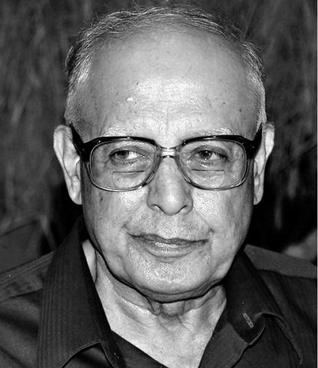
Hasan Mansur
Hasan Mansur

Hasan Mansur, a veteran human rights activist, passed away in Bangalore on Wednesday morning.

Prof. Mansur (1930-2014), who retired as the Head of the Department of English in Bangalore University, was closely associated with People’s Union for Civil Liberties (PUCL) and a host of other human rights initiatives, and fact-finding efforts in Karnataka and elsewhere.

Prof. Mansur was one of the founding members of the Karnataka Civil Liberties Committee (KCLC) in 1984. He went on to work for the PUCL, with which he was associated till the end.

His role at PUCL

In a press release, the PUCL State committee has said that Prof. Mansur played a significant role in broad-basing the concerns of PUCL and taking it beyond the traditional human rights issues to focus attention on violations of socio-economic rights, including the right to housing and the right to water.

Prof. Mansur was also one of the founding members of the Karnataka chapter of the Indo-Pak People’s Friendship Forum and was associated with trade union movements since the 1950s.

Speaking to The Hindu , Ramdas Rao, his colleague at the university and a co-activist in PUCL, said: “I admired Prof. Mansur for the way he brought together literature, politics and human rights.” Recalling his love for literary greats like James Joyce, Pablo Neruda and T.S. Eliot, he said: “He could quote large chunks of Joyce’s Ulysses and Eliot’s Four Quartets and continued to teach to the larger community of his friends even after he retired.”

Prof. Mansur leaves behind his wife, Hasnath Mansur, and a son. Funeral prayers were held at Arab Lane Mosque on Richmond Road on Wednesday evening.

I admired Mansur for the way he brought together literature, politics and human rights: Ramdas Rao

source: http://www.thehindu.com / The Hindu / Home> National> Karnataka / by Special Correspondent / Bangalore – February 13th, 2014

Family first, films later

fahadhNazriyaMPos13feb2014

Fahadh & Nazriya say they are not sure if they will be seen together in a flick

Family is most important for Malayalam actor Fahadh Fazil, who got engaged to teenage sensation Nazriya Nazim recently. To a question if Nazriya will continue to act after marriage, Fahadh said, “My priority is family, but I have no issues if she acts.”

“She understands what I meant. I am not sure if we will act again together,” he added.

On their relationship, he pointed out that it was their families which took the inititaive which eventually led to their marriage. Nazriya also seems confident of her new life after marriage.

“I need no preparation for a new life as his family is similar to mine,” said Nazriya, who added that Fahadh is one of her favourite actors. Nazriya also denied media reports that she was a minor. “No, no, I am 19,” said the actress who began her career as a child artiste. And when asked if the age difference is going to be a problem, Fahadh said: “My parents too have a similar age difference and they are happily married for many years.” Fahadh is the son of legendary Malayalam film-maker Fazil, who launched many stars, including Mohanlal.

But strangely when the master director launched his son in 2001 in the film Kaiyethum Doorath, it miserably failed and many thought that the career of Fahadh in his debut film itself had reached a dead end. Fahadh, however, returned in 2009 to act in Kerala Cafe.

Then came an offbeat film Chappa Kurishu which clicked and since then he has had no reason to look back. Now, the actor is one of the most busiest actors in Malayalam.

source: http://www.bangaloremirror.com / Bangalore Mirror / Home> Entertainment> South Masala / by Agenices / February 11th, 2014

Crafting new designs

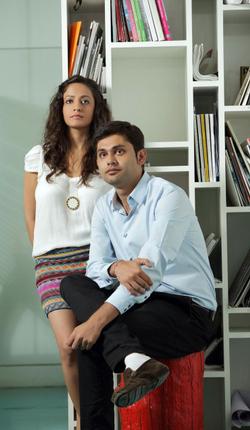
Meet architects Farah Ahmed and Dhaval Shellugar, who love to come up with out-of-the-box ideas

FarahAhmedMPos12feb2014

Farah Ahmed and Dhaval Shellugar are the people behind the Farah And Dhaval Design (FADD) Studio on St. Mark’s Road, which started in 2012. So, what’s new about them?

BarMPos12feb2014

For starters, they like working with offbeat and natural material such as burnt rust cement or bricks. “Cement, when it is waxed, looks so gorgeous that you will be surprised that it is cement,” explains Dhaval.

He adds that he always had a passion for architecture. “My father was into automobile accessories. The products at his store always intrigued me and I would find myself creating something new with the material he had. Then, I decided that I had to study architecture at Rachana Sasand’s Academy of Architecture in Bombay, after which I worked with Sandeep Khosla.”

Farah, on the other hand, was an artist. She says she always had leanings towards design. She studied in the U.S. and the turning point came when “I was gifted a camera which drove me into photography. Strangely it was never about people, but more about landscape and forms and textures. I was so inspired by nature that I found myself always creating an abstract composition.”

The young architect started exhibiting her works and lived as an artist before she interned with Sandeep Khosla, where she met Dhaval and the duo decided to start FADD.

She went on to study at Istitutio Marangoni in Milan. “I feel interior designing is a different manifestation of the same kind of creativity that I used in my art work. The only difference is in architecture, the physical space becomes my canvas,” explains Farah.

Coming to their work they say that Indians are fascinated with new designs. And with the world becoming smaller, resources are always “at our disposal”.

Dhaval says one should also always keep a tab on global trends. “That way you will be in sync with the latest in the market. No, we do not have a signature style for that will just put us and our thinking in a box. It is more like playing with form and function and yet keeping it minimal.”

They talk about the challenges they face in their profession. According to Farah it is “changing people’s set notions about designs. They think if something is expensive then it is classy. That is not always true.”

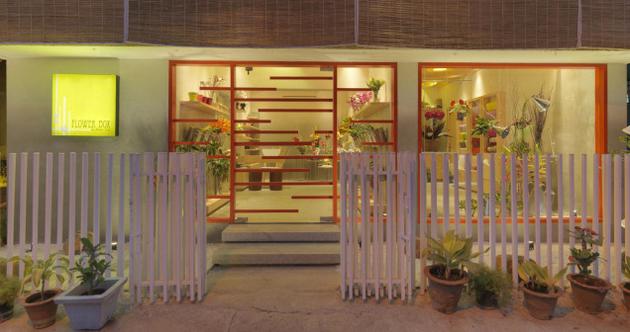
FlowerBoutiqueMPos12feb2014

Dhaval says for him the challenge was designing the florist shop, Flower Box in Indiranagar. “We wanted to create a special look for the flowers, which are so colourful by nature. So we had to create an intensive design that would not kill the beauty of the flowers. We studied Zen and Ikebana and other flower arrangements to come up with something unique for this store.” The duo used shades of white and grey and found that the “flowers simply pop out from the shaded backgrounds”. A Kerala houseboat designed for a business man in Goa is also close to their heart.

For more on the architects, log on to www.faddstudio.com or call 22223661.

This column features those who choose to veer of the beaten track.

SHILPA SEBASTIAN R.

People think if something is expensive then it is classy. That is not always true

source: http://www.thehindu.com / The Hindu / Home> Features> Metro Plus / by Shilpa Sebastian R. / February 12th, 2014