Category Archives: Arts, Culture & Entertainment

Ghizal Mahdi’s resolve in his farewell function in Riyadh

Nehtaur Town, Bijnor, UTTAR PRADESH / Riyadh, SAUDI ARABIA :

Ghizal Mahdi’s friends organised a farewell evening in his honour, on the occasion of his bidding good-bye to Riyadh, KSA, after spending an active social life for around quarter of a century.

The speakers paid rich tributes to Ghizal Mahdi’s immense contribution to the Indian community in Riyadh in general, and the Riyadh chapter of Jamia Millia Islamia Alumni Association in particular.

Speakers spoke very highly about his versatile self, sincerity and commitment towards the community.

Notably, Ghizal Mahdi was a founder member of two chapters of Jamia Millia Islamia Alumni Association (JMIAA) in KSA – Riyadh and Dammam.

He was elected president of the Riyadh chapter in 2014 for two years. The JMIAA-Riyadh Scholarship Program for bright and needy students of Jamia Higher Secondary School was initiated during his presidency. His team also brought out the first directory of Jamia Alumni employed in KSA.

In his farewell speech, Ghizal Mahdi highlighted the need to delve deep to understand the current sensitive situation of our country. He emphasised the importance of reducing socio-economic inequalities, religious and sectional antagonisms, and strengthening the brotherhood, and sharpening the joint struggle for the rights of socio-economically weaker sections and working class; and this is possible only when our thought process and actions are based on oneness of humankind.

Throwing light on his future plans, Ghizal Mahdi told that he would devote himself to the cause of creating health awareness in the countryside – and he would start this programme from his home town Nehtaur, Bijnor, U.P., and along with other activities, this Health Awareness Programme would include – organising medical camps, lectures for creating awareness about health and ailments, designing courses and motivating children to do voluntary service in the field of health, involve teachers and other socially conscious people in the project, launching awareness campaigns among children and youngsters against gutka-chewing, smoking and other harmful substances, establish diabetes centre so that the fast-spreading diabetes can be checked.

The farewell program was conducted by Aftab Nizami. Along with paying tribute to Ghizal Mahdi’s services, the following distinguished people also promised to extend support to the proposed health awareness program:

India Islamic Cultural Centre, Delhi’s Riyadh Branch convener, Murshid Kamal, senior Jamiaites – Baba Salman Azmi, Ex-President JMIAA-Riyadh Aftab Nizami, Ex Vice President JMIAA-Riyadh Ghayasuddin Ahmed, Prof. Anees Ansari, Prof. Afzal Ahmed, Arabic Translator Shahabuddin, religious scholar Shabbeer Ahmed Nadwi, Engr. Ghufran Ahmed, Economist Nisar Khan, Architect Ahmed Shukri, Flight Engineer Ateeq Ahmed, Engr. Anwar Pasha, Gulf Air Staff Neemu Khan, Arif Partapgadhi, Chaudhri Ehsan, Maulana Abdurrehman Alomri, Wasiullah Nadwi, Moosa Raza Amrohi, Shakir Jafri,– and Director Abdurrehman Al Mishari Hospital Dr Musharraf Ali, Dr Hameed and Naqi Ahmed Nadwi.

source: http://www.muslimmirror.com / Muslim Mirror / Home> NRIs / by Naqi Ahmed Nadwi / November 17th, 2021

Tongue of pearls: Mutribi al-Asamm Samarqandi’s ‘Conversations with Emperor Jahangir’

DELHI :

Emperor Jahangir’s inquisitive mind is revealed in his conversations with Mutribi al-Asamm Samarqandi

The 18 decades of the Great Mughals (1526-1707) produced some first-rate literature.

Many fine books came from the rulers themselves, steeped in a tradition of high culture that required them to be literate. The Baburnama, the first memoir/ autobiography of the subcontinent, is as readable today and as modestly written as Julius Caesar’s books (Cicero said of Caesar’s prose that it is unadorned, like a classical statue). The Tuzuk of Jahangir is filled with bombast, vanity and anger, but it is so honest and has so much detail, particularly on the side of his interests as a naturalist, that it is a work of the highest order.

And then there are the works that are smaller but sparkling, like little jewels. One such is the life of Humayun by his sister, Babur’s daughter and Akbar’s aunt, Gulbadan Begum. Written in Persian, as opposed to the Chagatai Turk that Babur wrote in, it is clear and direct, and as thorough a portrayal of Babur and Humayun as what they produced themselves. The story we know of Babur circumambulating the bed of a very ill Humayun and asking, in pagan fashion, to be taken instead of him, is from her book.

Courtly manners

The work we are looking at this time is from a lesser noble, a traveller from Samarqand called Mutribi al-Asamm, who spent time in Jahangir’s court. It is available in translation as Conversations with Emperor Jahangir. The Mughals loved having people over from their ancestral lands, which they would never see again, and lavished them with gifts and honours. Mutribi came to India (Jahangir was based in Lahore) roughly 400 years ago in 1627, when he was 70 and the emperor 58, only a few months away from his death.

Mutribi’s writing reveals a lot about the flowery manner of the court. He visits Jahangir a month after arriving in India and the emperor asks why he has waited this long. Mutribi refers to himself in the text as the “incompetent narrator” and Jahangir as possessing “a tongue of pearls”. At that first meeting, Jahangir gives him a thousand rupees and Noor Jahan (“may her chastity be preserved”) another five hundred, possibly the equivalent of crores in our time.

At their next meeting, Jahangir inquires about the hue of the black stone from which his ancestor Timur’s sepulchre is made in Samarqand. The emperor produces stones which Mutribi compares unfavourably to the original (“it is so bright you can see your face in it”).

Lord bountiful

The transactional manner of the exchanges is apparent from another meeting in which Jahangir asks Mutribi which of the Iraqi thoroughbred horses on display he would like to be given. Mutribi says, “whichever is more expensive,” possibly to make the emperor feel that he is being generous rather than his supplicant greedy. Again, when Jahangir offers him a choice of saddle — velvet or broadcloth — the answer is velvet, because it is more expensive. Jahangir says velvet gets wet easily, to which Mutribi says that the monsoon is far off. The two meet 24 times in two months before Mutribi returns. Towards the end, the following conversation is held:

“The pleasantness of Samarqand was being discussed. The Emperor asked me, ‘Is Samarqand spelled with a ‘q’ or with a ‘k’?’

‘Either way is correct,’ I replied. ‘In Tabari’s history and several other books it is referred to as Samarkand, but in popular usage it has become known as Samarqand. Some say that the name comes from Samar and Qamar, two slaves of Alexander the Great who built the city which was then named for them. Their graves are situated in the main market square of Samarqand.”’

Then Jahangir inquires about an ancestral tomb, asking how much it requires to be maintained. ‘“If you want to do it properly, 10,000 rupees,’ I [Mutribi] said, ‘otherwise 5,000 rupees just to keep it going.’

‘If 10,000 rupees will maintain it,’ he said, ‘then we have decided that in accordance with your information we will send 10,000 rupees, in order that that blessed station be maintained.’

I said, ‘O God, as long as the Sun and the Moon shall be, may Jahangir son of Akbar remain King.’”

Aakar Patel is a columnist and translator of Urdu and Gujarati non-fiction works.

source: http://www.thehindu.com / The Hindu / Home> Books / by Aakar Patel / November 13th, 2021

Meet Rafiq, once a tea vendor, now professor at Kannur University

Echome Village (Panamaram Panchayat), KERALA :

Rafiq Ibrahim has beaten heavy odds to earn a doctorate, spurred by a love of reading, reports M A Rajeev Kumar

Rafiq Ibrahim

Wayanad :

Rafiq Ibrahim used to call Echome, in Panamaram panchayat, a dead village. “During my childhood, I watched with amazement how time stood still there, almost oblivious of the world outside,” says the 34-year-old. 

The son of a tea-shop owner, Rafiq had a difficult childhood, and at times stared at poverty too. But he persevered to get better at life. He sold tea, went as a cleaner in jeeps and worked in a hotel. At one point, he even had to discontinue his studies. Through all that, he kept reading books, and managed to earn a doctorate. On November 6, Rafiq joined the Nileshwar campus of the Kannur University as an assistant professor in the Malayalam department.

“I am not a hero,” Rafiq says. “But the reality should not go unaddressed, as there are thousands of underprivileged people like me.”  Like his father, Ibrahim, his mother, Nabeesa, too did not attend school. Though the conditions at home were not too conducive for studies, both Rafiq and his older sister, Bushara, passed the SSLC examinations. “Though I had a first class, my first thought was to try some manual jobs in the area. Once out of school, boys would work in a jeep as a driver or a cleaner, and girls would be married off. That was how it was in Echome,” he says.

Caught in debt, however, his father had to sell the tea shop and the income of the family dried up. So he went to a friend in Mysuru, at 19, and became a tea vendor. He had joined a BSc course then, and completed the first-year examinations. But he was pulled down by typhoid and had to return home. “As the condition at home remained the same, I went to Wandoor in Malappuram district where I got a job in a hotel at the bus stand,” he recalls. 

Rafiq started reading books and magazines at the book shops there during his free time. “I found that reading keeps me happy, and took a liking to the ideas expressed by great writers,” he says. However, Rafiq lost his job yet again as the hotel eventually had to be closed down after the authorities decided to renovate the bus stand. “During my journey back home, I read an article by Sunil P Ilayidom about politics of identity and class. That instilled a spark in me,”  he says.

Rafiq then worked as a salesman at a footwear shop in Kalpetta. He worked there for two years, and the situation improved as his sister got a teaching job in a parallel college. Encouraged by his friends, he joined the BA Economics course under Calicut University. “During that period, I read plenty of books at the district library in Kalpetta,” he says.

Later, he attempted the entrance examination for the MA Malayalam course at the Sree Sankara Sanskrit University in Kalady with the sole aim of meeting his idol, Sunil P Ilayidom, who was the head of the Malayalam department. “I enjoyed every moment there, and the atmosphere helped me change my outlook as a student and human being,” he says. 

From there, things became a lot easier for Rafiq, going on to complete his MPhil, and earning a doctorate in ‘literary form and cultural history’ under the guidance of Ilayidom. Rafiq says his life is an example of generosity changing fortunes. “All that people require to come up in life is a helping hand at the right time.”

source: http://www.newindianexpress.com / The New Indian Express / Home> Good News / by M A Rajeev Kumar, Express News Service / November 14th, 2021

The Handsomest Star We Never Knew

Peshawar / Calcutta (now Kolkata), BRITISH INDIA :

The Telegraph tells the story of another Pathan from Peshawar who galloped his way into Indian cinema, and then galloped away much too soon.

Gul Hamid / Courtesy, Film Heritage Foundation

Let’s start from the very beginning, a time when celluloid was just opening up to the light of day. And in those first few pages of the history of Indian cinema, one place finds mention again and again — Peshawar.

The city, some say, derives its name from the Sanskrit Purushapura, meaning the City of Men. Perhaps by divine direction, it truly went on to gain a reputation as the city of stars. Prithviraj Kapoor, Raj Kapoor, Dilip Kumar, Vinod Khanna… were all born in Peshawar or nearabouts. Shah Rukh Khan’s clan too belongs there. It was also home to Gul Hamid, a Pathan who shone bright on the silver screen like few stars did.

Born in 1905 in Pirpai village, Hamid was known for his handsome looks. Nasir Shah, whose great grandmother was the actor’s sibling, reveals how a young Hamid galloped into the movies, quite literally. “He was a constable with the British police in Peshawar and was sent to Lahore as part of a contingent to manage a political event — a public address by Gandhiji. This was around 1928-29,” Shah tells The Telegraph over phone from Australia, where he works as an engineer. 

A member of the mounted police, Hamid was ambling on horseback after work when he came upon a film shoot. The director of the unit was the famous A.R. Kardar, and the scene that of an abduction — of the heroine by the villain, also on horseback. Seeing a helpless woman being chased, Hamid — unaware of what shooting really meant — rode his horse straight into it and brought the villain down. “Kardar was struck by the handsome Pathan and talked him into working in his film,” Shah says.

That’s how he debuted in Sarfarosh, a silent film made in 1930. Hamid was also part of the first Punjabi feature film, Heer Ranjha (1932). After working in several films in Lahore, he followed Kardar to Calcutta, which was then one of cinema’s biggest laboratories. He acted in Debaki Bose’s Bengali film Seeta (1934), which became the first Indian talkie to receive international recognition, at the Venice Film Festival. He was also part of Yahudi ki Ladki (1933), directed by Premankur Atorthy. And then, Hamid made his way to Bombay, to another budding industry for some more action.

“I would call him the first real stud of Indian cinema; his appearance was just so perfect,” says Shivendra Singh Dungarpur, filmmaker, archivist and restorer, “…the kind of star, say, John Wayne was in the Westerns of Hollywood.” Dungarpur shares an anecdote from those times. “When Bose saw the astonishingly good-looking man from Peshawar, he wondered what kind of a role would suit him… and thus Hamid got to play the character of a god, as if to justify his looks.”

The film also featured Prithviraj Kapoor as Rama and Durga Khote as Sita.

In fact, the entire story of Hamid’s career — and untimely death — is in many ways quite incredible. The actor died when he was all of 31, after battling Hodgkin’s disease for a few months. But by then he had acted in 14 films, earning for himself the title of Sitar-e-Hind or Star of Hindustan.

Hamid fell in love with and married the Calcutta-born Patience Cooper, his co-star in many films. But he had to keep it a secret from his family back in Peshawar for obvious reasons.

“He was even engaged to a simple, traditional girl of his mother’s choice,” says Shah. His family came to know about the marriage only after Hamid’s death, when his brothers broke open a chest full of letters shared between the two. It was almost like he was living a double life, feels Shah, “His family clearly had no idea of his stature or the big picture.”

The film world in those days was ruled by the trinity of Prithviraj Kapoor, K.L. Saigal and Hamid. “The scenario would be much altered if Hamid hadn’t died so young,” says Dungarpur. And although very little documentation survives, Hamid — given his pairing up with Cooper — was quite the star people were talking about. “I recall seeing magazines from the era with photographs of couples such as them, and Devika Rani and Himangshu Rai,” says he.

Perhaps the most significant of all of Hamid’s films was Khyber Pass (1936), which he also scripted and directed. “It was made in Peshawar; it was his effort to showcase Pashtun culture,” says Shah.

In an interview reminiscing those days — it is available on YouTube — Prithviraj Kapoor talks about Hamid, “Badi khoobiyat thhi usme, bahut pyara admi thha… Woh mujhey bade bhaiyya pukarte thhe (Hamid was a talented man and lovable man, he would address me as big brother).”

As a very sick Hamid lay on his deathbed, Kapoor went to visit his friend one last time. Shah’s grandfather, who was then a little boy, witnessed a conversation between the two that could very well have been lifted straight out of a script.

Kapoor asked, “Gul Hamid, kaise ho… how are you?”

And Hamid answered, “Andar se aag ki tarah garam aur bahar se barf ki tarah thanda (Burning like fire itself from within and as cold as ice on the outside).”

It is said that cinema never again saw an actor with Gul Hamid’s looks.

source: http://www.telegraphindia.com / The Telegraph Online / Home> Culture / by Paromita Kar / October 31st, 2021

G Santha Teacher Memorial Journalism Award 2021 for Kashmir-based journalist Mudassir Kuloo

JAMMU & KASHMIR :

The award has been instituted in the memory of G Shantha, an English teacher hailing from Thalavadi in Kerala’s Alappuzha district. 

Rekha Satheesh from The New Indian Express was the first winner.

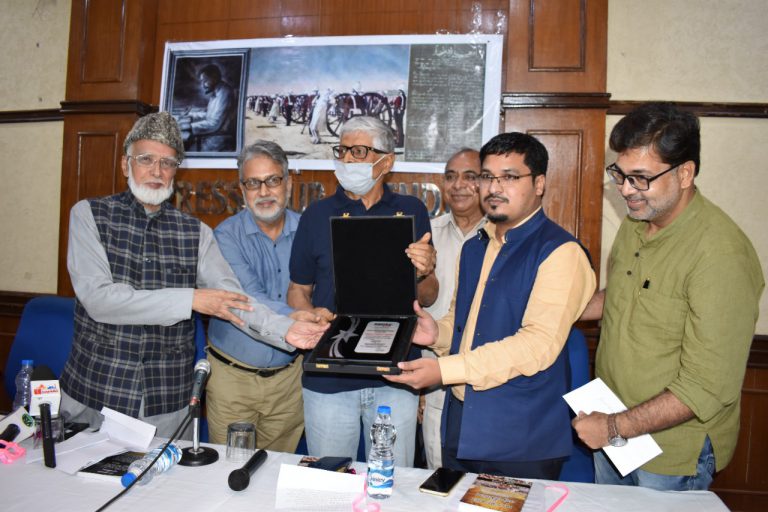
The specially-crafted stone memento made by noted mural artist MS Chandramouli that will be awarded to Mudassir Ahmad (right). (Photos | Special Arrangement)

Bengaluru :

Mudassir Ahmad Kuloo (33), an independent journalist from Kashmir, has been awarded the 5th G Santha Teacher Memorial Journalism Award instituted by the Inspired Indian Foundation (IIF), Bengaluru.

The award will be presented on November 6 in Bengaluru, during the 5th Guru Kalam Memorial Lecture, an annual national event being organised by the IIF to commemorate the birth anniversary of former President Dr APJ Abdul Kalam. The IIF spearheads several missions of Dr Kalam in association with Dr APJ Abdul Kalam International Foundation, Rameswaram.

This year the award carries a specially-crafted stone memento made by noted mural artist MS Chandramouli from Karnataka in addition to Rs 25,000 as a cash component.

The 2021 jury included aerospace and defence scientists, writers, teachers and activists in addition to the trustees of IIF. Mudassir was chosen from a list of three shortlisted Indian journalists.

Mudassir pursued his Masters in Mass Communication and Journalism from University of Kashmir and has been a Senior Correspondent with The Kashmir Monitor for six years. 

His reports have also featured in The Third PoleTRT WorldFirst PostThe TehelkaHuffPostCNBC TV and Dainik Bhaskar among others.

Ashfaq ul Hassan, Editor of The Kashmir Monitor, termed Mudassir as a dependable journalist who covers all possible angles of a story. “His honest, enthusiastic and realistic approach is highly commendable,” Ashfaq noted.

Ishtiyaq Ahmad, Editor of Kashmir Indepth, also hailed Mudassir terming him an extremely intelligent journalist who has always strived to highlight issues of human rights, gender, social justice, environment and health. “A perfect team man who has his ear to the ground” was how Ishtiyaq summed him up.

The award has been instituted in the memory of G Shantha, an English teacher hailing from Thalavadi in Kerala’s Alappuzha district. Born in 1942, she dedicated her career to instilling in her young wards an unshakeable determination to chase their dreams wherever she taught, including at Seethalakshmi Ramaswami College, Trichy, Tamil Nadu, and Devasvom Board College, Thalayolaparambu, Kerala, and Mahatma High School for Girls, Chennithala, Kerala. 

G Shanta passed away in 2007 at the age of 65. She worked selflessly to promote the English language among rural kids. She also found time to write short stories and poetry.

Rekha Satheesh, a Senior Chief Sub-Editor with The New Indian Express, Kochi, was the first recipient of the award in 2016, while Rajeev Kumar Mishra, a Chief Sub-Editor with the Bengaluru edition of Rajasthan Patrika, won the honour in 2017. 

The award went to Jugal Purohit, a Senior Broadcast Journalist with BBC India, in 2018 and in 2019 M Nanjundaswamy a Mysuru -based stringer of Kannada daily Vijay Karnataka, was the recipient.

(Mudassir can be reached at: mudasirkuloo00@gmail.com | Twitter: @MudasirKuloo)

If you have any queries w.r.t. this release, please contact the following: Madhusoodanan A: 9731065269 / Snigdha Jha: 7899778888

source: http://www.newindianexpress.com / The New Indian Express / Home> Nation / by Press Release – Madhusoodanan / November 01st, 2021

Leander Paes and Nafisa Ali join Trinamul Congress in Goa

Kolkata, WEST BENGAL :

While the names of swimmer and activist Ali and Deshprabhu had been doing the rounds, the tennis icon was a surprise for most.

Mamata Banerjee with Leander Paes in Dona Paula, Goa / Telegraph picture

Trinamul chief Mamata Banerjee on Friday inducted celebrities such as Leander Paes and Nafisa Ali and entrepreneur Mrinalini Deshprabhu into her party for its Goa foray, which she formally launched over the course of a busy day of political and PR exercises.

While the names of swimmer and activist Ali and Deshprabhu had been doing the rounds, tennis icon Paes was a surprise for most.

“When, at the age of 14, I went to play tennis for India, Didi (Mamata) was the (junior) Union sports minister. She used to always encourage, always support…. Now, after three decades of tennis, I would like to support the lady who has been going forward with immense courage. She is a real champion to me,” said Paes, 48, a Calcutta boy and now a resident of Goa.

Regarded as one of the greatest players in doubles, he won 18 Grand Slams in men’s and mixed doubles, and a bronze for India in men’s singles at the 1996 Olympics in Atlanta.

“I would like to serve the people by means of politics. I would like to serve the youth of the nation. That is why I have joined Didi,” said Paes. “India is the world’s largest democracy. There cannot be division here on the basis of caste, creed, or religion,” he added.

Now 64, Ali was a Congress candidate against Mamata in Calcutta South in the 2004 Lok Sabha polls. She lost. Ali also had a brief stint with Samajwadi Party before returning to the Congress in 2009.

Mamata Banerjee with Nafisa Ali in Goa / Telegraph picture

“She (Mamata) is such a champion for the cause of protecting the inclusive ethos of India…. It is important, now more than ever, to close the ranks on forces that seek to divide this great nation,” said Ali, a Calcutta girl who was the national swimming champion in the early 1970s, was crowned Miss India in 1976, and went on to act in films.

Sources in Trinamul said Mamata was keen on engaging civil society members in politics in Goa, something she did successfully in Bengal.

The BJP’s Pramod Sawant-led government would seek re-election to the 40-seat Goa Assembly in  February 2022.

The principal Opposition there is the Congress, with the AAP testing waters there for some time.

Last month, Mamata inducted Goa’s former chief minister Luizinho Faleiro, with four decades in the Congress. He is now a national vice-president of Trinamul, helping it not only in Goa but also in several states of the Northeast, which he handled organisationally for the Grand Old Party.

After Faleiro came a number of political leaders from Goa, from various parties there. From the civil society, Trinamul has already managed to get the likes of poet N. Shivdas, filmmaker Tony Dias, environmentalist Rajendra Shivaji Kakodkar, footballer Denzil Franco, and boxer Lenny Da Gama.

source: http://www.telegraphindia.com / The Telegraph Online / Home> West Bengal / by Meghdeep Bhattacharrya, Calcutta / October 30th, 2021

The dying art of hand-painted film posters and an artist who still brings celebs alive through his works

Kolkata, WEST BENGAL :

Equipped with the knowledge of hand-painted posters, in 1981, Mahmood left for Siliguri, a fairly less-competitive market, in search of a job. After an illustrious career, the 65-year-old, locally known as ‘Painter Mahmood’, lives in a nondescript, barely-lit house in Kolkata’s Crematorium Street.

Hand painted by Mehmood Alam on Nalin Sarkar Street. (Express Photo Shashi Ghosh)

There was a time when people would worship film stars, a time when cinemas of all languages would give birth to extraordinary heroes and heroines. If it was Rajesh Khanna, Amitabh Bachchan, Hema Malini and Rekha in Bollywood, their counterparts Uttam Kumar, Shubhendu Chatterjee, Suchitra Sen and Supriya Debi were dominating the Bengali cine world.

While onscreen, dialogues like main aaj bhi phenke hue paise nahi uthata (Amitabh Bachchan in Deewar, 1975) and korbo, albaat korbo, I will go to the top, the top, the top (Uttam Kumar in Nayak, 1966) turned the actors into superstars, off screen, their larger-than-life images would be drawn by the hand-painted cutouts and posters.

Those who have seen the frenzy outside single-screen cinema halls back in those days would remember how fans would garland a hero’s cutout and throw slippers at a villain’s poster.

Painter Mehmood Alam is locally known as ‘Painter Mahmood’. (Express Photo Shashi Ghosh)

With the advent of digital printing, however, the art of hand-painting film posters first took a backseat and then died a natural death and with that people like Mahmood Alam found themselves jobless.

After an illustrious career, 65-year-old Mahmood, locally known as ‘Painter Mahmood’, lives in a nondescript, barely-lit house in Kolkata’s Crematorium Street, which got its name from the now-defunct gas crematorium, the only-of-its-kind in the city. The crematorium and Mahmood have an uncanny similarity — both were celebrated in the past, but now barely manage to attract attention.

Mahmood, arguably the last such artist in Kolkata, was around 17-year-old when he took interest in learning the art of making film posters. “I was still a student back then, at Islamia High School, when studios in Kolkata would offer classes on painting banners and posters. I loved the film world and enjoyed painting too so I learnt the art at a nearby studio.”

Equipped with the knowledge of hand-painted posters, in 1981, Mahmood left for Siliguri. (Express Photo Shashi Ghosh)

Equipped with the knowledge of hand-painted posters, in 1981, Mahmood left for Siliguri, a fairly less-competitive market, in search of a job. Back in those days, much before the murky tales of the industry flooded primetimes of news channels, Bollywood was considered to be a platform for those with a dream.

The superhit movie Andha Kanoon had helped two such dreamers — Rajnikanth, who debuted in Bollywood with this movie, and Mahmood, who made a banner for the movie in Siliguri.

Although there was a brief period of lull for a month, there was no looking back after that one poster, says Mahmood. “After successfully making one poster, I was confident I would find employment and soon, the owner of Jhankar Hall in Siliguri gave me work and provided space in the premises of the hall to set up my own studio. I even had employees to assist me,” boasted Mahmood.

Painter Mehmood Alam has been painting for 65 years (Express Photo Shashi Ghosh)

His fame rose and the words of his artistry spread till Nepal’s Kathmandu. “In those days, Sambhu Pradhan was a big Nepali director. He got in touch with me and asked me to make posters for his films. He even asked me to leave Siliguri and stay in Kathmandu but I refused. However, I started making posters for Nepali films too.”

Talking about the process of making the cutouts and posters, Mahmood said the trick was to make a graph. “We would have a photograph for reference on which we would draw a graph. The same number of grids would be first drawn on a blank poster or a cutout and then the images would be hand-painted,” he said.

alam
Talking about the process of making the cutouts and posters, Mahmood said the trick was to make a graph (Express Photo Shashi Ghosh)

While Mahmood has painted cutouts of almost all actors of that time, his personal favourite was Dilip Kumar. “Nobody matched Dilip sahab. The aura around him was enough to pull the crowd and I loved making his cutouts the most,” he said.

All was well for Mahmood until the turn of the century ushered in a wave of development which did result in a fresh air but left many like Mahmood jobless. “I still tried my best. Shifted to banners and posters of shops but the going was getting tough and finally in 2010, I came back to Kolkata,” he said.

All was well for Mahmood until the turn of the century ushered in a wave of development which did result in a fresh air but left many like Mahmood jobless (Express Photo Shashi Ghosh)

Now, Mahmood finds work only when he is asked to paint a wall with some political graffiti. But no work is small, the artist says. “One day I was painting a graffiti of  Mamata Banerjee on a wall when someone clicked a photograph. I called him near and said why only click the picture of the painting? Don’t you want to show the world who painted it? I don’t know what happened and he said that he will get work for me. After a few days, he came back and said he’s found work for me at a Durga Puja pandal,” he said.

Mahmood is once again back in the limelight after he hand-painted hoardings and posters for the theme-based Durga Puja at Nalin Sarkar Street in north Kolkata this year. Although Mahmood’s works won the puja committee accolades, the painter continues to live a life in penury.

source: http://www.indianexpress.com / The Indian Express / Home> Lifestyle> Art & Culture / by Utsav Basu, Kolkata / October 28th, 2021

Winners Of Dasara And Rajyotsava – Kavya Puraskar And Katha Puraskar

Mysuru (Mysore), KARNATAKA :

A total of 24 poets including four Horanadu Kannadigas and a specially abled have been selected for State-level Dasara and Rajyotsava Kavya Puraskar in the State-level Poetry Contest organised by Akhila Bharatiya Kannada Sahitya haagu Samskrutika Parishat and Gramantara Buddhijeevigala Balaga.

They are as follows:

Horanadu Kannadigas Category:

Seema Kulkarni (Malaysia), S. Nalina Prasad (Mumbai), Ramana Shetty Renjal (Maharashtra) and Divakar   Ballal (Kasargod).

Poetess Category:

Renuka Kodaganji (Bengaluru), Leela-kumari Todikyana (Kodagu), Vasanta Surendranath (Magadi), Divyaja (Bengaluru), Asif Begaum (Kolar), P. Veena (Harihar), Dr. Gurudevi Hulleppanavar Mutt (Belagavi), Indira Shetty (Mysuru) and Nandana P. Shetty     (Dakshina Kannada).

Poets Category:

K. Raveesh M.C. Halli (Chikkamagalur), Pradeep Soranagadde (Shivamogga), Raghuveer Mahalingapura (Bagalkot), D.M. Bhatta Kulave (Uttara Kannada), Dr. K.C. Chandrapakash (Tumakuru), K.T. Adarsh Kappadur (Shivamogga), D.P. Chikkanna (Mandya), M. Shivanna (Hassan) and B. Vijaykumar (Udupi).

Specially Abled Poets:

Poornima Hanumantappa Badigeri (Hassan).

Senior writer and columnist from Belagavi Y.M. Menasinakai and senior writer and social worker from Hassan Jayashri D. Krishna were the jury.

P.A. Meghashree from Kasargod has been selected for the State-level Kavya Puraskar given by Balaga President and journalist Dr. Berya Ramakumar and H.N. Savita couple in the name of their son late B.R. Ullas.

Katha Puraskar

A total of 13 members including two Horanadu Kannadigas and a specially abled have been selected for Dr. K. Shivaram Karanth Katha Puraskar in the State-level Story Contest organised as part of the 120th birth anniversary of Jnanapith Awardee Dr. K. Shivaram Karanth.

Horanadu Kannadigas:

Karunakara S. Shetty (Maharashtra) and Sharada A. Anchan (Navi Mumbai).

Women Writers:

Divya Jagadish (Bengaluru), Sahana Kantabailu (Kodagu), S.L. Varalakshmi Manjunath (Nanjangud), B.R. Nagaratna (Mysuru), Hanchettira Fansy Muttanna (Kodagu) and Prof. Vidyareddy (Belagavi).

Men Writers:

K.G. Bhadrannanavar (Tumakuru), Y.M. Raghunandan (Mysuru), B. Kantappa (Bhadravati) and S.G. Shivashankar (Mysuru).

Specially Abled Writers:

Bandihole Manjunath (Mandya).

Senior writer couple from Mysuru – K. Ramesh and Dr. S. Sudha and senior writer and columnist from Mumbai Dr. G.D. Joshi were the jury.

Both Kavya Puraskar and Katha Puraskar will be presented to the winners during the Sahityotsava to be held in the month of November, according to a press release.

source: http://www.starofmysore.com / Star of Mysore / Home> News / October 25th, 2021

Remembering Majaz Lakhnavi, the Keats of Urdu poetry

Rudauli (British India / Lucknow, UTTAR PRADESH :

Majaz, uncle of lyricist Javed Akhtar, was one of those rare gems whose poetry reflected two most important aspects: romance and revolution.

Born in Rudauli (then in Barabanki, UP) during Diwali celebrations, he was named Asrarul Haque and later took up the name ‘Majaz Lakhnavi’. (Photo: Wikimedia Commons)

Two days ago, a nazm reverberated across Aligarh Muslim University as the institution celebrated its founder’s day on October 17. Alumni across the globe, who proudly address themselves as ‘Alig’, sang: Ye Mera Chaman, Ye Mera Chaman.

The author of this famous nazm, Asrarul Haque, popularly known as ‘Majaz Lakhnavi’, whose poetry still rules the heart of millions, was born on October 19, 1911.

Regarded as the Keats of Urdu poetry, Majaz was one of those rare gems whose poetry reflected two most important aspects: romance and revolution. In an era when legendary Urdu poets as Faiz, Jazbi, Sardar Jafri, Sahir Ludhiyanvi were in their prime, Majaz rose to fame and carved a niche for himself.

Born in Rudauli (then in Barabanki, UP) during Diwali celebrations, he was named Asrarul Haque and later took up the name ‘Majaz Lakhnavi’. He belonged to a zamindar family. At a young age, Majaz had an inclination towards Urdu poetry. His fame came when he reached AMU as a student where he got the company of literary legends as Ali Sardar Jafri, Ismat Chugtai, and others. During one of the mushairas, Majaz, dressed in sherwani, delivered his famous poem:

Khoob Pehchan lo Asrar Hoon Main,
Jinse-Ulfat ka talabghar hoon, Main,
Ishq hi Ishq hai Duniya Meri,
Fitna-e-Aql se Bezar hoon Main,
Ek Lapakta ho Shola ho, Ek Chalti Hui Talwar Hoon Main.

The audience was mesmerised; the silence established that Majaz had arrived on the scene. There was no looking back. Majaz gave his alma mater a famous nazm, which is now the university tarana (anthem).

Majaz’s popularity rose by leaps and bounds and there were more females than males among his admirers. At AMU, girls used to keep his book ‘Aahang’ beneath their pillows. They would commit to keeping ‘Majaz’ as the name of their children.

Himanshu Bajpai, Daastango, who has rendered several daastans on Majaz, recalls one incident: “Once, Ismat Chugtai told Majaz that girls love him and Majaz quickly replied, ‘And they marry a rich person’.”

Truly, Majaz had a failed love life, and the dejection got him admitted to a mental asylum at Ranchi. His addiction to liquor took its toll. Chugtai asked him, “Liquor or wine, who destroyed your life, Majaz?” Witty and humorous as always, he replied, “I have given this right to both of them.”

His poem Awara was also an instant hit.

Shahar ki raat aur main naashaad o nakara phirun
Jagmagati jagti sadko pe awara phirun
Ghair ki basti hai kab tak dar-badar maara phurin
Ai Gham-e-Dil kya karun, Ai Vahshat-e-Dil kya karun.

Majaz had recited this nazm on the request of people at White Baradari in Lucknow, which eventually turned out to be his last public gathering before his demise.

His poetry, as said earlier, had both romance and revolution. Some of his lines for women empowerment are still relevant.

Tere Mathe pe ye anchal bahut hi khub hai lekin,
Tu is aanchal se ek parcham bana leti toh achcha tha.

Bajpai narrates an incident: “Once, famous film actress Nargis came to meet Majaz. She requested for his autograph and Majaz obliged by writing the above lines on her white dupatta. He identified himself with every deprived person — perhaps this brought him closer to the progressive movement.” In his poetry, Majaz had raised the issues of women liberation and feminism, which are still discussed today.

Majaz’s revolutionary couplets, too, ruled the masses. While other poets raised the pitch in their revolutionary couplets, Majaz rendered his lines that could be sung with revolution. ‘Bol, Ari O Dharti Bol, Raj Sinhasan Daanwa Dol‘ is one such poem. It is simply unbelievable to see anyone write on the worldly intricacies so beautifully — ‘Bahut Mushkil hai Duniya ka Sanwarna, Teri Zulfo ka Pencho Kham nahi Hai‘.

Alas, Majaz remained a loner. Josh Malihabadi even advised him to keep a ghadi (watch) with him while drinking, but Majaz laughed it off, saying, “You drink keeping a ghadi, I drink keeping a ghada (pitcher).”

In December 1955, his end came abruptly, after he collapsed in Lucknow, and passed away before reaching Balrampur Hospital. The present generation may recall him as the uncle of Bollywood lyricist Javed Akhtar.

The poet, whose kingdom was in the hearts of millions, is buried in a six-feet grave at Nishatganj graveyard with his own lines from a nazm on the epitaph.

Ab iske baad subah hai aur subah-e-Nau Majaz
Ham par hai khatm Sham-e-Gareebaan-e-Lucknow

source: http://www.indianexpress.com / The Indian Express / Home> Books & Literature / by Faisal Fareed, New Delhi / October 19th, 2021

Former Kerala Jamaat-e-Islami Hind President Expires

Kozhikode, KERALA :

Former Kerala Jamaat-e-Islami Hind President T K Abdullah.

Kozhikode :

Former president of the Kerala Jamaat-e-Islami Hind (JIH),T K Abdullah, passed away today at the age of 92.

He is survived by his wife Kunjamina, sons TK Farooq and TK Iqbal, and daughter Sajida.

A senior Islamic scholar, he was a member of JIH’s Markazi Majlis-e-Shoora, or the Central Advisory Council, the top decision-making body of the Jamaat, from 1972 till now. He was also a member of the Kerala JIH’s State Advisory Council.

A founder member of the All India Muslim Personal Law Board (AIMPLB), he was JIH’s state president from 1972 to 79 and from 1982 to 1984. 

He was also a state executive member of the Ittihadul Ulema.

Abdullah sahib was also the Chief Editor of Islamic Encyclopaedia that Islamic Publishing House, Kozhikode, is publishing.

He was born to a great Islamic scholar Tharakandi Abdurrahman sahib, and Fatima, in 1929 in village Ayencheri in Kozhikode district. 

Abdullah sahib obtained his early education at Vazhakadu Darul Uloom, Thirurangadi Jumma Masjid, Pulikkal Madinathul Uloom and Aliya Arabic College, Kasargod.

He joined Prabodhanam in 1950 and became its deputy chief editor in 1959. When Prabodhanam became a weekly in 1964, he was appointed its first Chief Editor and continued in the same position till 1995.

He, later on, joined the JIH Kerala mouthpiece Bodhanam quarterly journal as the Chief Editor.

When the government banned the Jamaat in 1992 after the demolition of the Babri Masjid, Abdullah sahib was imprisoned along with many other JIH leaders. 

He also helped translate two volumes of Maulana Maududi’s Tafhim-ul-Quran (explanation of the Quran) from Urdu to Malayalam. Besides, he wrote several books, including Nazhikakallukal (Mile Stones) and Iqbaline Kandethal (Finding Iqbal).

In addition, his autobiography was published by the name “Nadannu Theeratha Vazhikal”.

Many of his speeches, articles, and sermons were compiled and published.

source: http://www.indiatomorrow.net / India Tomorrow / Home> Inspiring Personality / October 15th, 2021