Category Archives: Community Involvement / Social Issues

Minority welfare: Bihar govt-run coaching centres help minority students clear exams, get jobs

Patna, BIHAR :

Since 2010, 867 candidates, including 96 girls, have joined the police; 46, including 12 girls, cleared BPSC.
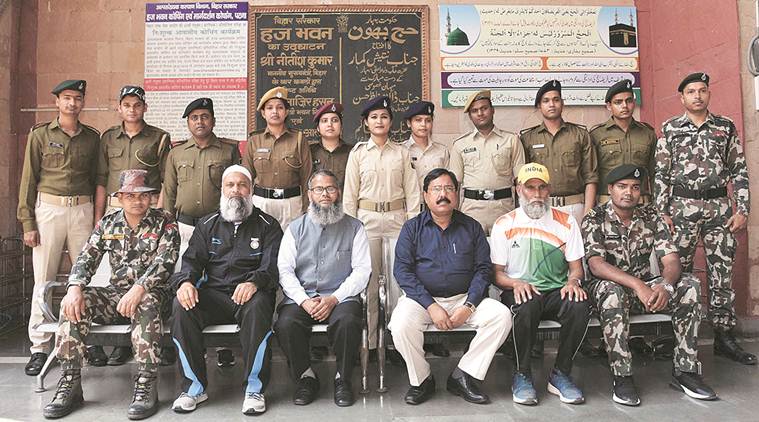
Trainers and successful students at Haj Bhawan coaching centre in Patna. (Express Photo)

Even though Muslims account for 17 per cent of Bihar’s population, according to a senior official, they make up only 2.5 per cent of the state’s police and less than 4 per cent of the other services. A decade ago, these numbers were even lower. And it was to remedy this lack of representation that Bihar’s Minority Welfare Department started a pilot programme to train Muslim students and help them clear different types of public services examinations.

Amir Subhani, Additional Chief Secretary of the Minority Welfare Department, said “As Haj Bhawan had been lying largely unused after pilgrimage season, we came up with the idea of utilising the vast space with a devoted coaching centre for minority boys and girls who needed some kind of motivation to do well in life. Chief Minister Nitish Kumar promptly approved the idea. It is very good to see girls not just coming out of their homes but also showing their increasing preferences for uniformed services. It is a success story under construction. We are trying to replicate it in maximum possible places”.

Since 2010, the Haj Bhawan Coaching and Guidance Cell has been providing almost free coaching to Muslim boys and girls in preparing for prelims, mains and interview stages of competitive examinations in Bihar.
Bihar, Bihar Muslim population, Bihar Minority Welfare schemes, Muslim students, muslims Bihar public services examinations, Nitish Kumar, indian express

 For the first four years, until 2013, it provided coaching only for police services test. Later, it included coaching for BPSC examinations as well. Haj Bhawan Guidance and Coaching Cell, under the nodal agency of Maulana Mazharul Haque Arabic and Persian University, selects Muslims students for training and coaching them in two different ways. One, it screens students that seek its help. Two, it calls deserving students that have cleared one stage or the other in an examination and helps them realise their dream.

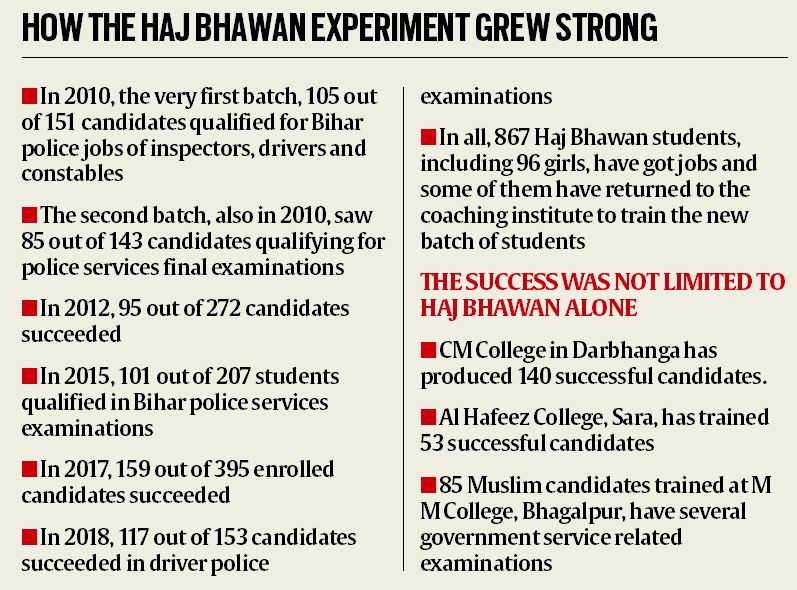
Over the past decade, the Haj Bhawan experiment has gone from strength to strength (see box). What’s more, over the last couple of years, the Minority Welfare Department has been replicating the Haj Bhawan coaching model in other districts such as Darbhanga, Bhagalpur  and Ara. Further, it plans to expand this initiative to at least 10 more districts in the coming 3-4 years to attract Muslims girls and boys from rural areas.

“While a candidate coming for physical training is given free residential, fully centralised air-conditioner set-up, a student coming for mains coaching, has to pay Rs 3,500 per month. The centre has a rich library, two big classrooms and separate prayer halls for boys and girls,” said Mohammed Rashid Hussain, coordinator of Haj Bhawan Coaching and Guidance Cell. He said that Bihar’s Minority Welfare Minister Mohammed Khursheed (also known as Firoz Ahmad) contributes in his personal capacity as well by organising a lunch for students on special occasions.

EXPLAINED

Why was special training needed

Muslims, who account for 17% of Bihar’s population, are grossly under-represented in police and administrative services. Since 2010, the state government has been trying to remedy this by providing coaching facilities to the poor yet deserving students and helping them achieve their dream of serving in the government

The public area of the entire Haj Bhawan centre is under CCTV surveillance. Estimated per capita government cost on a student in one season is about Rs 20,000. But there is no fixed cap on the expenditure as it is a demand-driven scheme.

Most of the students in Haj Bhawan come from economically weak backgrounds. Boys and girls coming to study here have similar tales of poverty, struggle and lack of opportunities. Take, for instance, Akbar Ali who hails from Ara where his father runs a small bicycle repair shop. “I am the first boy from my village to come to Patna,” said Ali.

Students who have benefitted describe the initiative as a slow but silent revolution. Shabana Aazmi from East Champaran, who qualified as a constable in 2016 after receiving coaching, said that since becoming the first policewoman from her village, she is regarded as a role model and, in the last four years, many more girls have started preparing for competitive examinations.

source: http://www.indianexpress.com / The Indian Express / Home> Governance / by Santosh Singh / Patna, March 09th, 2020
Alamgir Masjid Committee offers educational guidance to students

Hyderabad, TELANGANA :

Hyderabad:

Masjid Aalamgir, Shantinagar has provided the best opportunity to the students for the studies.

The managing committee of the masjid has decided to provide space for the students who are preparing for their annual examinations to be held from March to May this year.

This program will be implemented from 2nd March. The students will have the facility to continue their studies after Isha prayer till Fajr. For this purpose a portion of the masjid is being reserved on the 1st floor.

Subject experts belonging to various disciplines especially mathematics, science, English will be available for guiding the students atleast for two hours every day.

In order to inculcate the habit of reading among the students, lectures of eminent scholars will be arranged twice a month.

The objective of this program to provide congenial atmosphere for the students and also to inculcate the habit of hardwork besides offering prayers. As per the rules of the program, the students have to deposit their cell phones with the coordinator.

For further details the students may contact Mr Syed Rahmat at 9133450764.

source: http://www.siasat.com / The Siasat Daily / Home> News> Hyderabad / posted by Sameer / February 27th, 2020

Antulay daughter’s eulogy to parents’ love story when they were 28 and 14

MAHARASHTRA :

AntulayMPOs29feb2020

Mumbai:

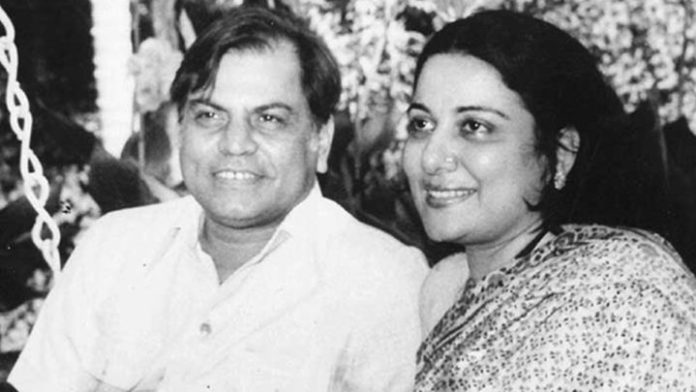
Nearly seven decades after her parents “lived” the love-story of their youth through an exchange of letters, their doting daughter has now published those communication in a book form.

The letters were written by legendary Maharashtra political leader and former Chief Minister and Union Minister, Abdul Rahman Antulay to his home-maker wife Nargis – during their “bethrothal” of four years when she was just 14 and he was all mature at 28 – and also later on after their marriage in May 1959.

Eldest daughter Neelam Mushtaq Antulay had to carry out some major jobs before she could finally compile and create an Urdu and a Hindi book – “Banaam Nargis (‘To Nargis’)”.

First she had to convince her mother to part with them and later painstakingly sift through hundreds of pages of great emotional churning.

“Banaam Nargis” will be released on Saturday at a mega-event by Nationalist Congress President Sharad Pawar and Leader of Opposition in Rajya Sabha Ghulam Nabi Azad, while Chief Minister Uddhav Thackeray will rename the prestigious Anjuman-I-Islam law college in south Mumbai as “Barrister A. R. Antulay College of Law”.

“‘Banaam Nargis’, a collection of entirely personal letters written from a loving boy to his beloved fiance during the conservative era, were more than merely love-letters,” said Neelam.

“I remember from my childhood, how my mother, who treasured a majority of these handwritten letters, (with a fountain pen) — would quietly take them out, read, again and again with a myriad emotions lighting or clouding her face, even after he passed away in December 2014,” Neelam told IANS in a free-wheeling chat on Friday.

She remembers a well known Urdu book, “Zer-e-Lab” – a collection of letters written to renowned Urdu poet Jan Nisar Akhtar — father of equally distinguished son, Javed Akhtar – by his teacher wife, Safiya.

“This got me thinking… Why not highlight my Abbu’s letters to my Ammi? But it took me mountainous efforts to convince my mother before she finally relented over two years ago.

“Today, I consider it my humble tribute to my parents…” Neelam said.

After Nargis parted with her “treasure”, Neelam got down to reading them — around 300 — and many more which she kept aside without even reading, as they were ‘intimately personal’ though her Ammi now had no reservations!

“The letters are clear, concise, to the point.. he wrote prolifically, mostly daily, at times twice daily and posted them… From his bachelor home in Mumbai and Raigad to her parents’ home in Bhiwandi (then called Bhimdi, Thane), unveiling a different era of their lives…,” Neelam says with a heavy heart.

To a query, she points out that “of course, there was a lot of romance” but there was also a lot more.

“He shared with her practically everything… His joys and disappointments, achievements or failures, the highlights or downsides of his blooming legal career after he returned as barrister from Lincoln’s Inn, London, his maiden speech in public life with luminaries like Pandit Jawaharlal Nehru and others present… It opened up a whole new world of my father which I never knew,” said Neelam.

In his inimitable style, Antulay would recount many incidents, anecdotes with references to the then prevalent social, cultural and political events and conveyed a lot more than what he wrote of what was in his heart and mind.

“He ‘lived’ his life with his love (Nargis) through these letters… These pages provide rare glimpses into history… I now feel there was something magical about them…

“Though during their engagement, my mother was too young and many things were beyond her comprehension coming from a highly qualified barrister, but today I understand why she keeps opening the trove to read them again and again,” says Neelam with a smile.

However, Neelam said that her mother was very less “reciprocal” and barely may have replied averaging to 10 per cent – probably one for every 10 letters from her besotted husband!

“But he was never offended and both enjoyed their life, loved their children and brought us all up with dedication and care… Surprisingly, my mother revealed that one day, she destroyed all the letters she had written to him!” said Neelam.

Surprisingly, she is the first member of the family allowed by Nargis to read the letters, described by an editor as “pearls of words and wisdom”.

No other family members – Neelam’s politician husband Mushtaq, sister Shabnam and her husband Justice Amjad Sayed, television personality and upcoming politician brother Naved Antulay, and youngest sister Mubeena and her businessman husband Ejaz Sayed – were allowed access to them.

The earliest of the letters were written by Antulay on 20-10-1957 from ‘Bambai’ (Bombay, now Mumbai) to ‘Bhimdi’, and the last of it was penned by him to Nargis on 22-10-1961 to ‘Bambai’ from London where he was part of a Congress Party delegation.

“I have mostly tried to transliterate the letters in Hindi to retain the special flavour… They are best read in Urdu, followed by Hindi, but any suggestions to translate them in English would kill their very essence,” she laughed.

Neelam is confident that most people “will fall in love with my parents” and learn a lot about life after reading these letters in ‘Banaam Nargis’. (IANS)

source: http://www.indianewengland.com / India New England News / Home> Books / byQuaid Najmi / February 21st, 2020

Maulana Azad: The Voice Behind the Dream for a Unified India

NEW DELHI  :

(This story was first published on 10 November 2017. It has been republished from The Quint’s archives to mark Maulana Azad’s death anniversary.)

“I am an essential element, which has gone into building India. I can never surrender this claim.”

These were the famous words uttered by Maulana Abul Kalam Azad, when he stared at the daunting prospect of Partition. On his birth anniversary, we remember his contribution to the country.

source: http://www.youtube.com / The Quint

Azad was among the many Muslim leaders in India who opposed the Partition of Unified India into Pakistan and Hindustan. As the leader of the All India Congress Committee in 1946, he put forth a Cabinet Mission proposal that advocated a federal structure of government, with autonomy for states. Though the proposal did face a great deal of skepticism, the Working Committee passed it, with even Jinnah agreeing to it for ‘the greater good of Indian Muslims’.

This proposal was certainly considered a breakthrough, as Jinnah and Azad had never enjoyed very good relations, predominantly owing to their opposing stances on Partition. Where one batted for Hindu-Muslim unity under a larger India, the other was vehement on the creation of two separate states. But their souring relations never stopped Azad from attempting to convince Jinnah to consider a ‘unified India’.

For instance, when Jinnah’s clamour for Pakistan grew louder, Azad is known to have sent a telegram insisting on the perils of a two-state ideology. Jinnah is said to have insulted Azad in his response, calling him Congress’ ‘show boy President’.

Don’t you feel that the Congress has made you a show boy President to hoodwink non-Congress parties and other countries of the world? You represent neither Muslims nor Hindus.

Having failed at getting Jinnah to reconsider, Azad then unsuccessfully tried to convince the Congress leaders to wait till a solution could be found. But even Patel, who earlier backed Azad’s proposal, was now vehemently pro-partition. Azad in his autobiography later writes that the party agreed to the Partition as “blindness of Congress leaders to facts, and their anger and frustration clouded their vision.”

According to Azad, as he writes in his autobiography, Nehru too contributed to angering the Muslims, by committing two mistakes which ultimately drove Jinnah to lose faith in the proposal and go through with partition.

The first was when Nehru refused to take two Muslim League leaders as Cabinet Ministers in the UP elections of 1937. The second mistake was when after taking over as the President of the Congress in 1946, he indicated that the earlier Cabinet Mission proposal could be changed, which culminated in Jinnah insisting on the formation of Pakistan.

Maulana had not only opposed Partition as an Indian leader, but also as a Muslim. He was, in fact, of the opinion, that the two-state policy will only “create more problems than solve”.

And true to his word, even today the relations between the two countries are strained at best, despite their shared history.

source: http://www.thequint.com / The Quint / Home> News Videos / November 10th, 2017 / and February 22nd, 2020

Woman from lone Muslim family in zone wins

Rupnagar (aka Ropar) , PUNJAB :

Ropar:

The voters of Nurpur Bedi area set an example by electing Congress candidate Ravena Begum, a Muslim woman, as panchayat samiti member from Takhatgarh zone. She belongs to the lone Muslim family comprising of four voters in the zone.

ROBINSINGH@TRIBUNE.COM
Ropar:

The voters of Nurpur Bedi area set an example by electing Congress candidate Ravena Begum, a Muslim woman, as panchayat samiti member from Takhatgarh zone.

She belongs to the lone Muslim family comprising of four voters in the zone.

Surinder Kaur, sister of AAP local MLA Amarjit Singh Sandoa, who contested as an Independent candidate, finished third by getting 631 votes.

Ravena, who was polled 851 votes, defeated her nearest rival Anju Bala of the BJP, who got 811 votes. Congress leader Brinder Singh Dhillon, who had contested the Assembly elections from Ropar, said the victory proved that the Congress was a secular party.

Speaker Rana KP Singh said Ravena was a hardworking party activist and people voted for her in recognition of her work.  / TNS

source: http://www.tribuneindia.com / The Tribune / Home> Punjab / September 21st, 2018

Kerala’s first Muslim woman panchayat president no more

Nannammukku (Malappuram), KERALA :

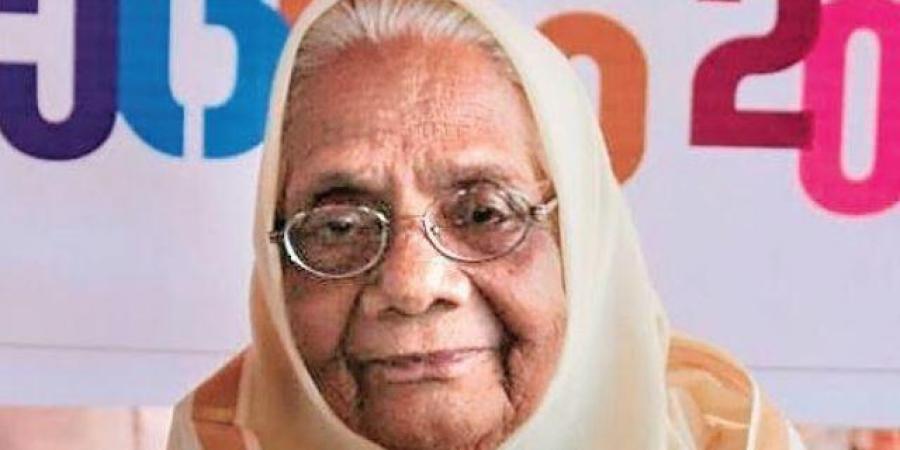
Ayishakutty, 91, the first woman panchayat president from the Muslim community in Kerala, died here on Monday night.

Ayishakutty
Ayishakutty

Malappuram :

Ayishakutty, 91, the first woman panchayat president from the Muslim community in Kerala, died here on Monday night. A native of Nannammukku in Malappuram, Ayishakutty had been undergoing treatment for age-related illnesses and she breathed her last around 11pm.Also known as Ayishakutty Teacher, she became the president of Nannammukku panchayat in 1979. Ayishakutty has been an inspiration to many women as she courageously took up the path of politics and social service at a time when many women, especially from her community, were not allowed to go out of their houses.

Despite warnings not to go out and speak publicly citing gender and religious issues, Ayishakutty chose to get education and interact with people to learn the problems in society. She became the first woman to complete SSLC in Ponnani taluk.  A Congress leader, she is also the first woman panchayat president in Malappuram district. After completing the first term as panchayat president, she served as a member from 1984 to 1991. She became the president of Nannammukku panchayat again in 1995. Apart from being active in politics, she also worked as a teacher at AMLP School, Punnayurkulam, Thrissur.

She is survived by daughters Laila and Jameeela and son-in-law Hamsa. The burial was conducted at the Nannammukku Juma Masjid on Tuesday. Abdul Kareem, the present panchayat president of Nannammukku, said Ayishakutty was a powerful leader who had implemented several development projects in the panchayat. “She had introduced the project to provide land to the landless people in the panchayat. Also, she worked relentlessly to end the drinking water problem and other issues in the agricultural sector in the panchayat,” said Kareem.

She became the president of Nannammukku panchayat in 1979.

source: http://www.newindianexpress.com / The New Indian Express / Home> States> Kerala / by Express News Service / February 26th, 2020

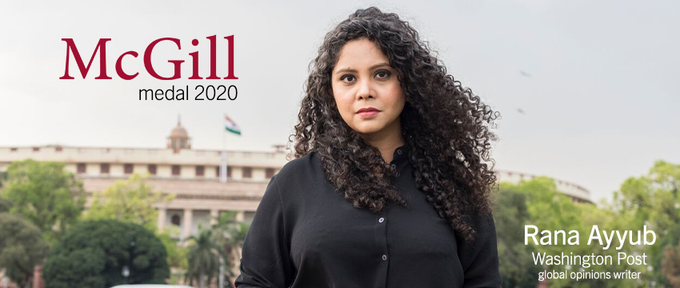
Rana Ayyub gets McGill Medal 2020 for Journalist Courage

Mumbai, MAHARASHTRA / U.S.A :

Ayyub was previously an editor with the investigative magazine Tehelka

RanaAyyubMPOs25feb2020

New Delhi :

Global Opinions Writer at Washington Post and an author Rana Ayyub  on Monday won the 2020 McGill Medal for journalistic courage.

“Ayyub is committed to telling the stories of people who can’t do it on her own, making her an ideal McGill medal recipient,” Sofia Gratas, the McGill Fellow responsible for researching the nomination said.

Ayyub , after winning the award said it was a huge honour for her.”I accept this award on behalf of all journalists who are fighting an unpopular battle to speak the truth,” she tweeted.

@—————————————-

Rana Ayyub

@RanaAyyub

It is a huge honour for me. I accept this award on behalf of all journalists who are fighting an unpopular battle to speak the truth. Thank you @UGAGrady https://twitter.com/UGAGrady/status/1232011103061696514 

UGA Grady College

@UGAGrady

Rana Ayyub (@RanaAyyub), global opinions writer for the @washingtonpost is the recipient of the 2020 McGill Medal for journalistic courage.

She will accept the award at Grady on April 22.

LINK: http://t.uga.edu/5GH


RanaTwitterMPOs25feb2020

____________________________________________________

The Mumbai-based journalist Ayyub will collect the award at The Grady College Of Journalism and Mass Communication, University of Georgia on 22 April.

Ayyub was previously an editor with the investigative magazine Tehelka.

Gujarat Files

She also authored an international bestseller titled of “Gujarat Files : Anatomy of a Cover-Up”, an undercover investigation which exposes the complicity of the PM Modi and Union Home Minister Amit Shah in state-sponsored genocide in the 2002 Gujarat riots .

She has often been the target of the vitriolic abuse that is hurled on her on social media platforms from Hindutva activists.

In 2019, Ayyub was named by Time magazine among ten global journalists who face the maximum threat to their lives.

McGill Medal 

The McGill program is named for Ralph McGill, the late editor and publisher of the Atlanta Constitution. McGill was regarded by many as “the conscience of the South” for his editorials challenging racial segregation in the 1950s and 1960s.

The McGill Medal, now in its twelfth year, is part of the McGill Program for Journalistic Courage at UGA’s Grady College.

source: http://www.siasat.com / The Siasat Daily / Home> News> India / posted by Safoora / February 25th, 2020

Little-known fact: Aurangzeb had more Rajput administrators than Akbar

DELHI , INDIA :

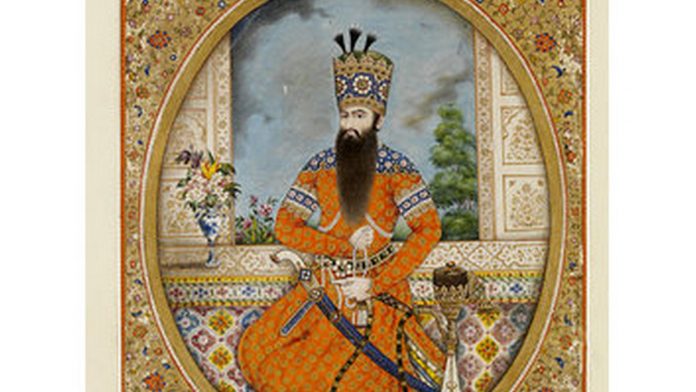
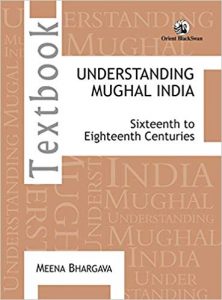
In ‘Understanding Mughal India’, Meena Bhargava writes about how Aurangzeb patronised several Hindu institutions & was supported in the war of succession by Rajputs.

A portrait of Mughal ruler Aurangzeb | Photo: collections.vam.ac.uk/

That Aurangzeb’s orthodoxy and his dedication to his beliefs was personal rather than a matter for political interference is evident in his reactions and responses during the war of succession of 1658, a quadrangular conflict between Dara, Shuja, Aurangzeb, and Murad. Throughout the struggle, Aurangzeb was concerned about Dara’s political manoeuvres. Their individual feelings and religious outlook—which stood in sharp contrast—remained confined to the personal level. Aurangzeb referred to Dara as mushrik (heretic) while Dara called Aurangzeb kotah pyjama (narrow pants), a symbolic attribute of orthodoxy. Both attempted to rally public opinion, but never on religious grounds. In fact, the support that largely came for Aurangzeb was from the Rajputs, notably Rana Raj Singh of Mewar, Raja Jai Singh Kachwaha of Amber, and later, Maharaja Jaswant Singh of Marwar. In this context may be related an interesting nishan that Aurangzeb sent to Rana Raj Singh of Mewar, condemning such kings who practised intolerance that could become the cause of dispute, conflict, and harm to the people, and could ‘devastate the prosperous creations of God and destroy the foundations of the God-created fabric’. Such attitudes of kings, Aurangzeb ordained, deserve ‘to be rejected and cast off’. This document from the Udaipur records is a clear revelation of what Aurangzeb intended as his public policy. It further confirmed that Aurangzeb, in the struggle for succession, did not raise the cry of jihad or Islam in danger, nor did he promulgate a new religious policy contrary to that of his predecessors; neither did Dara claim to be the champion of liberal forces. The issue was not religious or ideological, or whether orthodoxy would triumph or liberalism. It was a question of personal vested interest, political in nature but free from religious connotations, that is: Who would be the emperor of India, Dara or Aurangzeb? It is in such a context that Aurangzeb deserves to be assessed.

Debating Aurangzeb’s leanings—religious orthodoxy or political pragmatism—one needs to ask: Did Aurangzeb really intend, as Jadunath Sarkar suggested, the establishment of dar-ul-Islam or a truly Islamic State in India, the conversion of the entire population to Islam, and the annihilation of dissenters? Or, as Ishtiyaq Husain Qureshi argued, was it rigid adherence to the shari’a and undoing the damage caused by Akbar; or the triumph of Muslim theology, as Shri Ram Sharma asserted? If this was really the case, then the emperor’s personal valour, military skills, and single-minded commitment to achieving territorial expansion and consolidation would stand negated. The biased ideological portrayal of the emperor, regardless of historical accuracy, makes it difficult to explain the increase in the number of Rajput mansabdars in Aurangzeb’s administration as compared to Akbar’s period, and their rise from 24 per cent under Shahjahan to 33 per cent in 1689. Nor can Raghunath Ray Kayastha’s dominance as diwan-i kul be understood rationally. Raghunath Ray not only supported Aurangzeb but also participated in several expeditions of the period. Aurangzeb honoured him with the title of Raja and when Raghunath Ray died in 1664, the emperor, in his obituary written in Ruqa’at-i Alamgiri, remembered him as the greatest administrator he had ever known.

There are well-documented evidences of Aurangzeb’s patronage of various Hindu religious institutions, namely temples, maths, grants to Brahmins and pujaris:

  • Land grants were renewed to the temples at Mathura, Banaras, Gaya, Gauhati, and others, while the emperor is known to have donated ghee for the navadeep in a few temples, including the Mahabateshwar temple at Agra;
  • Gifts were offered to the Sikh gurudwara at Dehradun;
  • Madad-i ma’ash grants, as listed in the Rajasthan documents, were continued to a math of Nathpanthi yogis in pargana Didwana, sarkar Nagor;
  • Grants were also made to Ganesh Bharti faqir and his successors in pargana Siwana with the instructions that the faqir should not be disturbed so he could ‘pray for this sultanat’.
  • The Vrindavan document of 1704 referred to a parwana which sanctioned the rights of Chaitanya gosains who had founded Vrindavan and established pilgrimages in Braj Bhumi, and recognised the right of Brajanand Gosain to receive a fee from the followers of the sect on account of kharj sadir o warid, that is, expenses on guests and travellers from each village. In effect, it was a government levy for the benefit of Brajanand Gosain and his Vaishnavite followers.

From the above description, Aurangzeb’s patronage to temples appears without doubt. And yet some temples were attacked, while others were spared. This aberration in the emperor’s attitude can be explained by only one rationale: it was not iconoclasm, but reprisal for rebellion or political misconduct or disloyalty to the emperor. This exposition can be applied to understand the attack on the Vishwanath temple at Kashi, the Keshav Dev temple at Mathura, and several prominent temples in Rajasthan. In 1669, during a zamindar revolt in Banaras, it was suspected that some of them had assisted Shivaji in his escape from imperial detention. It was also believed that Shivaji’s escape was initially facilitated by Jai Singh, the great-grandson of Raja Man Singh, who had built the Vishwanath temple. It was against this background that Aurangzeb ordered the destruction of that temple in September 1669.

Around the same time, in a Jat rebellion that had erupted in the neighbouring regions of Mathura, a patron of the local congregational mosque was killed, leading to Aurangzeb’s order in 1670 to attack the Keshav Dev temple at Mathura. Temples in Marwar and Mewar were also attacked following the death of Maharaja Jaswant Singh to reprimand and crush the Rathor rebellion and the development of a Sisodia– Rathor alliance. These included temples in Khandela patronised by rebel chieftains; temples in Jodhpur maintained by a former supporter of Dara Shukoh; and the royal temples in Udaipur and Chittor patronised by Rana Raj Singh after the Rana entered into an alliance with the Rathors that signalled the withdrawal of loyalty to the Mughal State. It may be observed that the Rathor rebellion was not a reaction or a protest against the re-imposition of jizya. Instead, this re-imposition, as Abu’l Fazl Ma’muri observed in the context of the suppression of the Satnami revolt and prior to the emperor’s expedition to Ajmer, was meant for ‘the affliction of the rebellious unbelievers’.

MughalBookMPOs24feb2020

This excerpt from Understanding Mughal India: Sixteenth to Eighteenth Centuries by Meena Bhargava has been published with permission from Orient BlackSwan.

source: http://www.theprint.in / The Print / Home>  Page Turner> Book Excerpts / by Meena Bhargava / February 19th, 2020

Have lost one eye, not resolve: Jamia student who won best paper after police lathi-charge

Samastipur, BIHAR   :

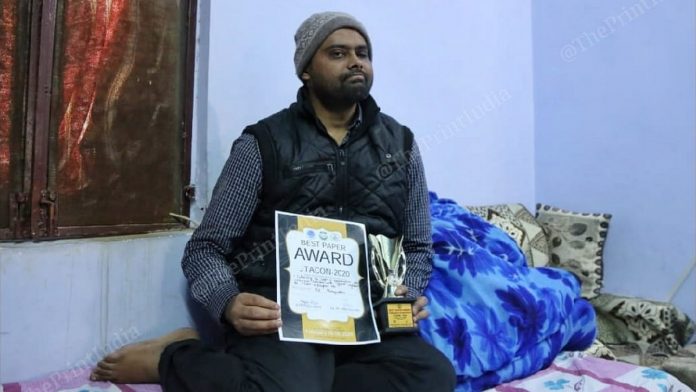
Mohammed Minhajuddin had just submitted his paper when Delhi Police lathi-charged students in the Jamia library on 15 December. He lost his left eye in the incident.

Jamia Millia Islamia law student Mohammed Minhajuddin with the best paper award he won Tuesday | Photo: Manisha Mondal | ThePrint

New Delhi:

Mohammed Minhajuddin, 26, was writing a paper on the theme of human rights and development on 15 December 2019 in the Jamia Millia Islamia library when the Delhi Police barged in and lathi-charged the students. A lathi blow cost law student Minhaj vision in his left eye; doctors say it will never come back.

On Tuesday, over two months after the incident, Minhaj’s paper was named the best paper in its category at the Jamia Teachers’ Association award. The paper, titled ‘Enhancing the scope of opportunities for religious scholars with special reference to Islam’ deals with the intersection of human rights and religion. The deadline for submission was 15 December, and Minhaj had submitted it just minutes before the police lathi-charge.

Since then, life has been a struggle for Minhaj, but he hasn’t lost his resolve to make the best of a bad situation.

“After losing my eyesight, I struggled a lot to prepare for the presentation. I had to work with just one eye, my head constantly aching. It was tough to even concentrate,” Minhaj told ThePrint.

Feeling vindicated

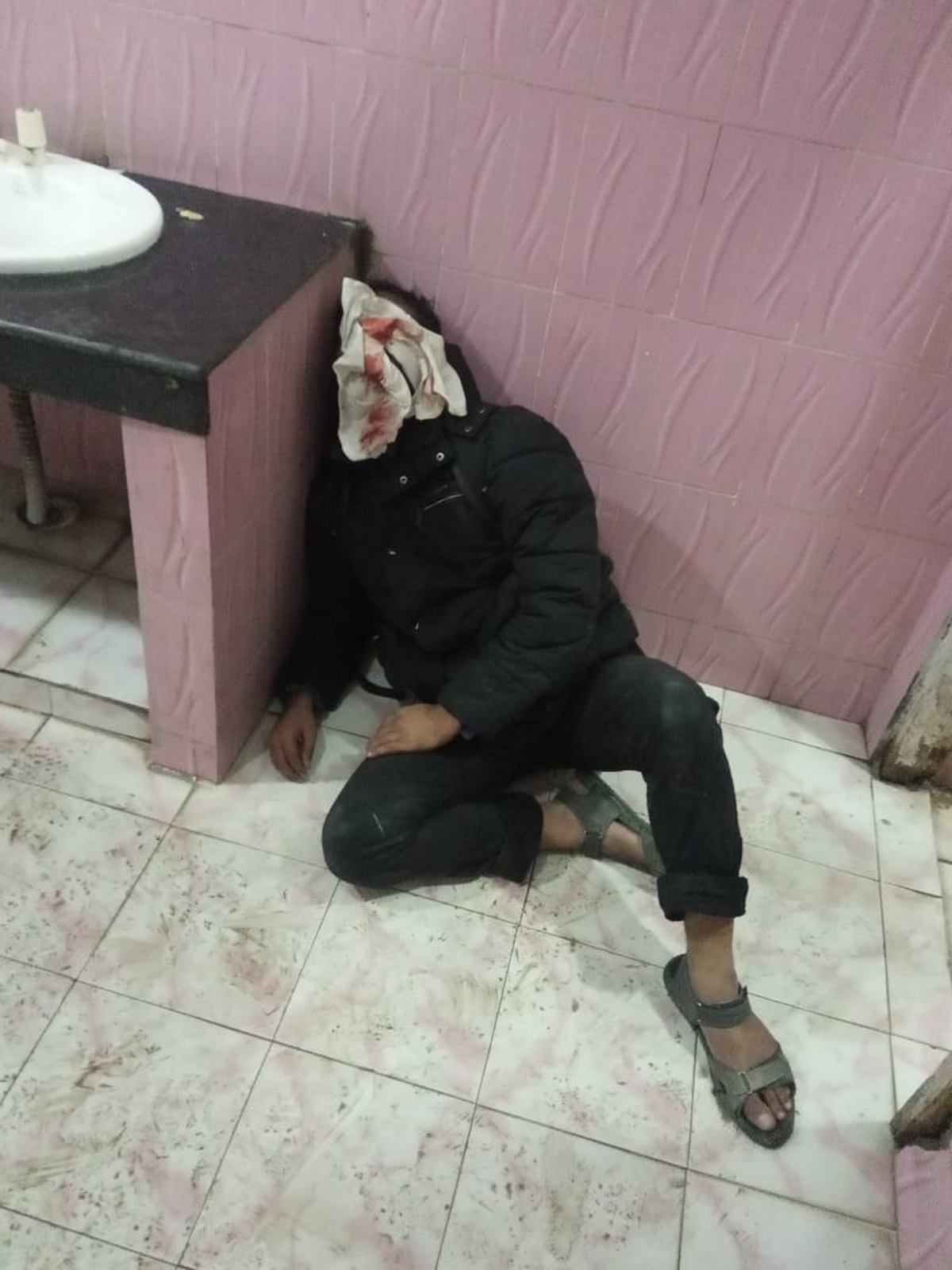
On 15 December, the Delhi Police had entered the Jamia campus amid protests against the Citizenship Amendment Act . A picture of Minhaj lying in a university washroom bleeding from his eye was widely shared on social media, and several students, including him, had alleged that the police lathi-charged students in the library, a claim the police had vociferously denied .

This picture of Minhaj with his face covered by a blood-stained handkerchief was widely circulated on social media after the Delhi Police entered the Jamia Millia Islamia campus on 15 December

However, multiple videos have surfaced  since 16 February, showing policemen beating the students in the library with batons. Today, Minhaj feels vindicated.

“It wasn’t just me. Several students had given testimonies highlighting police brutality in the library. But with these videos out now, there is no scope of lies anymore. The truth is out in the open,” he said, adding that he was offered Rs 5 lakh compensation and some words of sympathy by the Aam Aadmi Party MLA from Okhla, Amanatullah Khan.

After the video showing police beating the students triggered a storm, the Delhi Police too released footage showing  alleged ‘rioters’ entering the library. But Minhaj says the library he was in — the old reading room in the MPhil department — didn’t have any protesters.

“Everyone in this library was a student who had just been studying here. The protesters may have entered another library, not this one,” he said, adding that those who can be seen wearing handkerchiefs on their faces in the video were merely protecting themselves from the tear gas shells fired by the police.

Minhaj is hopeful that with the videos out, policemen will be taken to task.

Not willing to give up on dreams

Minhaj came to Delhi from Bihar’s Samastipur two years ago aspiring to practise law in the capital, and that’s a dream he is not willing to give up on.

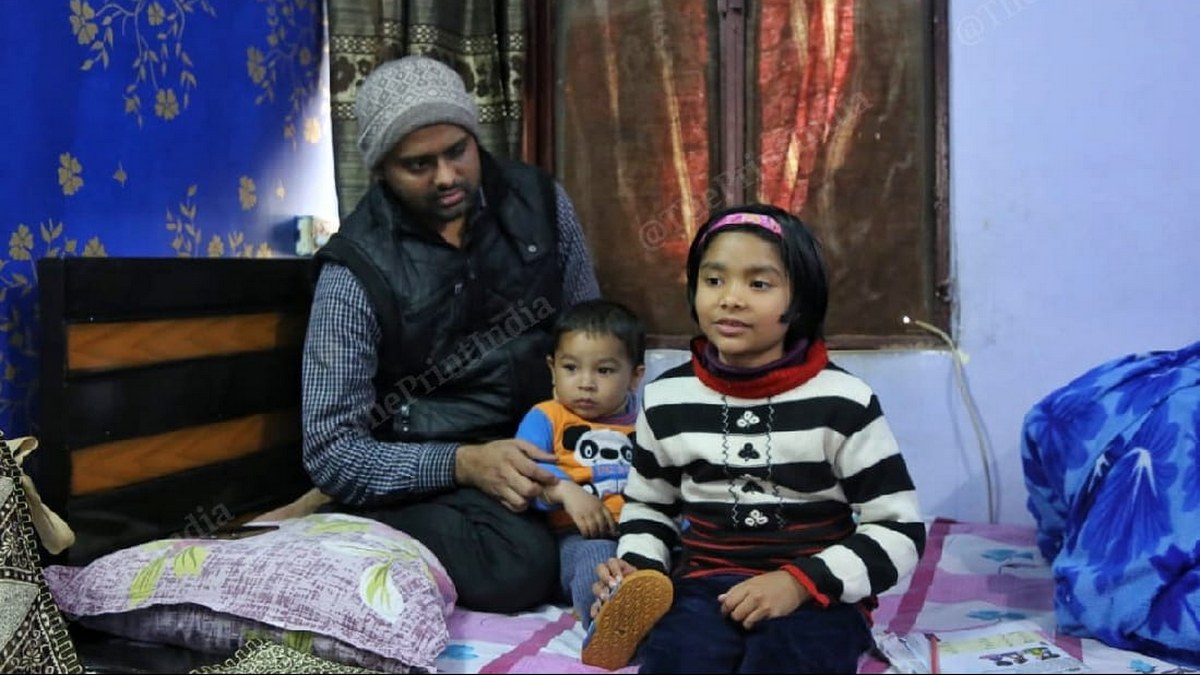
“I know life will be a challenge now. But I can’t give up or fall into despair. I have to keep studying and working towards a better life,” Minhaj said, while playing with his nephew and niece at his sister’s home in Jamia Nagar, where he has been staying since the incident.

Jamia Millia Islamia student Mohammed Minhajuddin with his nephew and niece at his sister’s home in New Delhi | Photo: Manisha Mondal | ThePrint

Minhaj’s father, who is a school teacher at a government school in Samastipur, keeps asking him to come back.

“They (parents) are scared, which I understand. But I can’t leave until I complete my final semester,” said Minhaj, who completed his LLB from Aligarh Muslim University (AMU).

No help from university

Two months on from the life-altering incident, Minhaj isn’t resentful or angry, but disappointed at Jamia Millia Islamia.

“It is the university’s duty and responsibility to keep its students safe. It failed to do so,” he said, adding that Jamia vice-chancellor Najma Akhtar met him once after the incident.

“She said I can submit my treatment bills to the university and they will reimburse it. But my friends say that just reimbursement isn’t enough — I should be given compensation for the physical loss and mental trauma,” he said.

Minhaj has managed to keep his calm through this entire period, but he said his friends are still angry.

“It is my batchmates who took me to the hospital that day. No one from the university administration helped. My friends took me from one hospital to another, as all doctors refused to check on me,” Minhaj said.

Finally, Minhaj got treated at AIIMS, and he has to visit the doctor every two weeks to check on his eye.

“I need to keep going for a check-up to ensure the infection doesn’t spread to the other eye.” he said.

source: http://www.theprint.in / The Print  / Home> India / by Fatima Khan / February 28th, 2020

Three Keralites behind ‘Bandicoot’ win Infosys Gold award

KERALA :

Bandicoot has already made its way into 12 states and the company has also grown to the strength of 100.

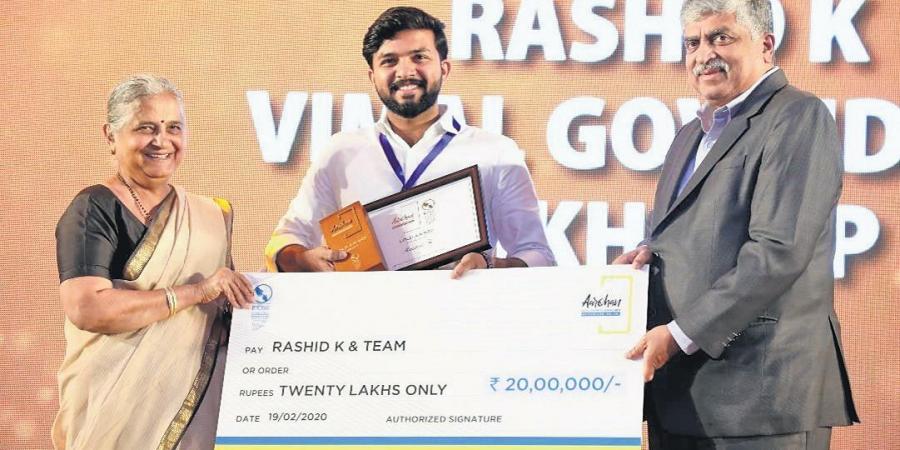
Rashid K, co-founder of Bandicoot, receiving the award on Wednesday

Thiruvananthapuram :

Malayalis Rashid K, Vimal Govind MK and Nikhil NP of startup ‘Genrobotics’ won the gold award instituted by Infosys Foundation. The award was given for their innovation ‘Bandicoot’, a robot developed by the startup. ‘Bandicoot’ is stated to be the world’s first manhole cleaning robot. It’s the second edition of the Aarohan Social Innovation awards.

The innovation won the award in the sustainability category. The award carries a purse of `20 lakh. Other award categories included healthcare, rural development and destitute care. Rashid, Govind and Nikhil are the core founders of Genrobotics and Bandicoot has been designed by nine engineers from Kerala.

After its successful trial in Thiruvananthapuram by clearing manholes filled with plastic and other kinds of waste, it is being used successfully by the Kerala Water Authority for various purposes.“Through our innovation, we aim to eliminate manual scavenging completely from our country. We were able to create awareness with the support of the government and other organisations.”

“We are happy to receive this prestigious award and we hope that we will be able to end manual scavenging in five years,” said Govind, the chief executive officer, Genrobotics.

Bandicoot has already made its way into 12 states and the company has also grown to the strength of 100. “We plan to expand in more states thereby reducing the number of manhole deaths,” according to Govind
“Besides Bandicoot, we are also working on other projects for the welfare of the society,” he said.In  healthcare category, three awards were presented.

Recipients include Partha Pratim Das Mahapatra from Kolkata, who developed a non-invasive, non-contact, portable device to measure human bilirubin, oxygen saturation and haemoglobin levels without drawing blood from the body; Dr Binita S Tunga and Dr Rashbehari Tunga from Bengaluru.

source: http://www.newindianexpress.com / The New Indian Express / Home> States> Kerala / by Express News Service / February 20th, 2020