This is expected to boost the writing of people belonging to Nawayat community from Bhatkal, who use the Persian script to write their unique language ‘Nawaiti’ — a rare language and script.
Karwar :
A 1,000-year-old language is complete only now after a team of software engineers from Mumbai developed three of its characters to crack its Unicode script.
This is expected to boost the writing of people belonging to Nawayat community from Bhatkal, who use the Persian script to write their unique language ‘Nawaiti’ — a rare language and script.
Nawayat is an Indian-Muslim community, which lives in Bhatkal of the Uttara Kannada district.
Mohammed Mohsin Shabandri, a community member, pointed out that due to three missing characters in Unicode fonts, people were not able to write as they pronounced.
“About three years ago, we decided to develop these three characters and called a meeting of Nawaiti-speaking people. After eliciting their opinion and conducting proper research, we finalised three new characters,” he said.
“Nawaiti is an endangered language. Three months ago, we approached a software development firm in Mumbai. After studying the language, they developed phonetic characters and its software, which is called ‘Nawayat language solution’,” he said.
source: http://www.newindianexpress.com / The New Indian Express / Home> States> Karnataka / by Arunkumar Huralimath / Express News Service / January 16th, 2019
Mehmood is an electrician whose business of setting up lights for festivals spans from Janmasthami celebrations in Muzaffarnagar to the famous Nauchandi Mela in Meerut
Prayagraj:
In a sea of saffron, he stands out with his skull cap and gray beard. To the first time visitor, a board reading ‘Mullah Ji Light waale’ (Mullah Ji, the lighting man) at the Kumbh Mela may be an odd sight but to the Sadhus who have gathered at the confluence of the Ganga and the Yamuna , Mohammed Mehmood aka Mullah Ji is a permanent feature of every Kumbh. To some, he is even a friend.
Mehmood is a 76-year-old businessman from Muzaffarnagar in Western UP. In 1986, he acquainted himself with the Sadhus of the Juna Akhara – the largest and one of the fiercest Akharas of the Naga Sadhus; an ancient order of warrior monks. They hired him to set up the lights around their tents. Today, every six years, he travels over 800 kms to Allahabad, now named Prayagraj, and camps out at the Kumbh Mela.
Sandwiched between the tents of the Juna Akhara, he talks of his journey to Kumbh. “I am an electrician. When you come here at night, you will see that the entire area where Sadhus have pitched their tents is dazzling with bright lights of all colours. That is my doing,” he says proudly. Mehmood’s business of setting up lights for festivals spans from Janmasthami celebrations in Muzaffarnagar to the famous Nauchandi Mela in Meerut. ‘Mullah Ji’ had started his business from scratch.
“The first Kumbh I ever attended was the 1986 Kumbh in Haridwar. Apart from the mela that happens in Nashik, I have attended every one. I haven’t kept count of how many Kumbh Melas I have attended, maybe you can do the maths,” he jokes, sipping a cup of tea at his 11th mela.
Naga Baba Sangam Giri, a warrior monk from the Juna Akhara, is Mehmood’s neighbor on the sands in Kumbh. “I have seen him at nearly every Kumbh Mela I’ve been to. I never even bothered to ask him, his real name. For us he is, and will always be, simply ‘Mullah Ji’ – our friend,” he says, adding, “For Hindus, we are gurus. For Muslims, we are Pirs. They (Muslims) worship niraakar (a formless God) and we worship aakar (idol worship). There may be different routes, but we are all going to the same place. There are 25 different ways to get to Allahabad. Everyone takes a different route to the railway station. But eventually, everyone ends up at the railway station.”
Mehmood says he is treated with respect among the Sadhus. The day that stops, he says, that will be his last Kumbh. “The Babas make me feel at home. Sometimes they ask me to sit on their gaddi (padded mattress), but I respect them too much to do that. I read my namaz five times a day in the presence of these Sadhus and they always give me the space,” he said.
If the Sadhus hadn’t treated Mehmood differently, he probably would not have come to Kumbh, he recalls in nostalgia.
Over the last three decades, Kumbh has become an integral part of his life. Will Mullah Ji come back for his 12th Kumbh? “Inshallah! If Allah commands me to, I will come back,” he says.
source: http://www.news18.com / News18 / Home> English> India / by Uday Singh Rana / January 15th, 2019
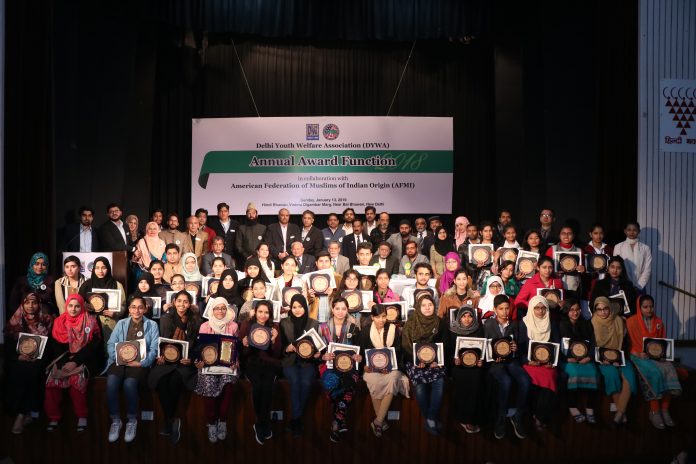
Delhi Youth Welfare Association (DYWA) in collaboration with American Federation of Muslims of Indian Origin (AFMI), organized the DYWA Annual Award Celebration on 13thJanuary 2019 at Hindi Bhawan, Rouse Avenue, New Delhi.
96 students from 15 schools were felicitated with a shields, certificates and cash prizes. Five special awards were also given. Maulana Azad Education Foundation (best government organisation), Society for Promotion of Education (best non-government organization), Shehnaz (best student, class XII), Nikhat Urooj and Iffat Zareen (best students, Urdu Language/Literature in class XII) and Rabea Girls’ Public School (the school with highest number of individual awards in class X & XII).
This was the 28th edition of annual awards.
Various educationists, social activists and political leaders such as Arfa Khanum (Senior Journalist, The Wire), Dr. A.S. Nakadar (Founder Trustee and Former President AFMI), Dr. Aslam Abdullah (Editor, Muslim Observer and Director Islamic Society of Nevada) attended the convention as guests.
Siraj Hussain, former vice chancellor, Jamia Hamdard University, was the chief guest at the event. He shared a few tips on how to become civil servants. “Befriend as many books as you can. And choose best universities to pursue higher education,” he said.
Dr. Nakadar encouraged students to identify their latent talents. “Stop comparing yourself with others. It will make you better person and best among the people,” he said.
Arfa Khanum shared her journey from a small town in Uttar Pradesh to charting a successful career in journalism. “Being in Delhi is a privileged which many of you may have overlooked. You must make use the resources available to you to the optimum. You are the future of India and you would decide what this nation wants,” she said.
Aslam Abdullah underlined the perils of patriarchy. “We ought to treat at par with men. That is a perquisite for us to bring about any change,” he said.
DYWA is a well-known organization of old Delhi and has been working in the field of education for the last 28 years and AFMI (American Federation of Muslims of Indian origin) is a philanthropic charity formed by American Muslims of Indian Origin in the year 1989.
source: http://www.twocircles.net / TwoCircles.net / Home> Education> India News> Indian Muslim> Lead Story / by TCN News / January 15th, 2019
The effort taken by the second-year MBBS student has now garnered attention on social media platforms, under the hashtag #newyearrevolution.
Kochi :
Save more money, travel to new places, wake up early, eat healthy – while New Year resolutions for the majority of us were about making our own lives better, for Mishal Mohammed, it was about saving the lives of 74 children. So, carrying a collection bucket and a poster with the message ‘Save 74 Lives’, this 19-year-old student of Government Medical College, Kozhikode, walked around 15 km on the second day of the New Year to support children suffering from Thalassemia, Diabetes and Wilson’s disease. The effort taken by the second-year MBBS student has now garnered attention on social media platforms, under the hashtag #newyearrevolution.
According to Mishal, the ‘revolution’ has been launched as part of the Imprints project of the College Union Society under which medical aid and treatment are provided throughout the year to 74 children suffering from the disease. “Nearly a year ago, I had conducted a solo trip to the Western and Northern parts of the country. I was stranded in the Himalayas without cash for a couple of days and had to walk several kilometres for help. However, the experience gave me an impetus to explore my own city on foot, “ said Mishal.
Once back in Kozhikode, Mishal decided to put his walking experiment for a better cause. “The entire cost of medical aid for children under the Imprints project comes up to nearly Rs one lakh per month. Since many are unaware of the initiative, I wondered why not use a novel method, walk around the city and raise funds for these children,” he said.
Over the past one week, Mishal has gained supporters from his college and on online platforms. He has been able to cover a total distance of 38 km on foot to JDT Islam College, Focus Mall and Kozhikode Beach and has raised a sum of Rs 30,000 for the project. “So far I have received only positive responses from people. Around Rs 5,000 was collected from online supporters,” said the Kozhikode-native.
In the previous year, the ‘Walk to the Beach’ Challenge started by Mishal had received a huge response with around 200 college students covering the 10 km distance from Government Medical College to Kozhikode beach, on foot. The student is also planning to visit a couple more localities and spread awareness on the Imprints project, on hartal days.Those interested in contributing towards the Imprints project can contact 9567992028 or 9745414085 for further details.
source: http://www.newindianexpress.com / The New Indian Express / Home> Cities> Kochi / by Express News Service / January 12th, 2019
Amidst reports of a few women activists of a Right wing group attempting to enter forcibly the prayer hall of the Nainar Mosque (Vavar Palli) at Erumely, its management has clarified that devotees of all religion, gender and age groups can visit the mosque as part of their pilgrimage to Sabarimala.
P.H. Shajahan, president, Erumely Mahalla Muslim Jamaat, which manages the mosque, said here on Tuesday that they had not imposed any restrictions on the visit of Sabarimala devotees before or after the Supreme Court’s verdict that lifted the ban on women in the 15-50 age group from entering the Sabarimala temple.
“We have been receiving women of all age groups as visitors for a long time and the trend continues even after the recent SC verdict. There is no restriction on them entering the mosque, circumambulating it and providing offerings, as is the tradition,” he said.
A large number of Sabarimala pilgrims visit the mosque throughout the annual pilgrim season, reviving the the local myth of Lord Ayyappa’s friendship with the Muslim youth Vavar. Besides pilgrims, the location has witnessed a huge inflow of tourists, including women, who come to Erumely during the pilgrimage season. It, however, does not permit the entry of Muslim women to the prayer hall.
The other day the police had arrested six people, including three women from Tamil Nadu, while on their way to visit the mosque here. The accused were booked under various Sections, including attempts to promote animosity between different religious groups, and were remanded.
In the face of reports that some women belonging to a Right wing group would attempt to enter the prayer hall here, additional police personnel were posted here to prevent their entry to the prayer room.
source: http://www.thehindu.com / The Hindu / Home> News> States> Kerala / by Staff Reporter / Kottayam – January 08th, 2019
Fellows from the Godrej Culture Lab Leadership Programme examine the role and relevance of Urdu in contemporary culture
A poster by Nasheet Shadani
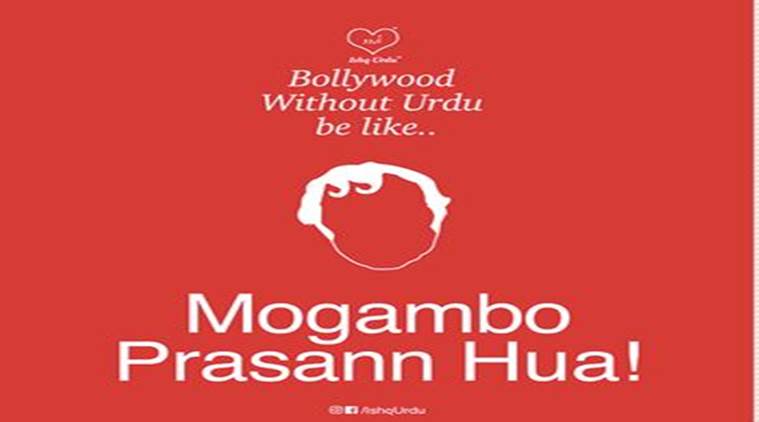
On display today at the Godrej India Culture Lab are posters with lines which might seem oddly familiar. ‘Tu vastu badi hai anandmayi anandmayi…’, reads one, and ‘Jeevan ek yatra hai mangalmayi…’ reads another. It’s not difficult, if one focuses a little and, uses a dictionary (if required) to understand these lines, and neither is it difficult to identify them as what they are — lyrics from well-known Hindi film songs, in which all the Urdu words have been replaced by Sanskrit-origin Hindi words.
Shorn of the original words, these lines present a disconcerting picture, showing us what we would lose without the Urdu words that still make up so much of our culture. And that exactly is the point being made by visual artist Nasheet Shadani in these posters, part of the series of works he calls ‘Bollywood Without Urdu’.
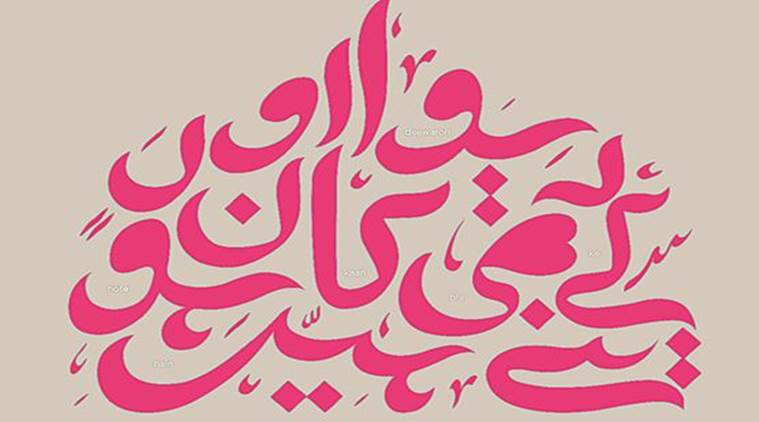
Zeenat Kulavoor’s calligraphy
These works by Shadani are being displayed as part of ‘Urdu Culture Now’, a celebration of contemporary Urdu culture. “Despite Urdu having had such a strong influence, it doesn’t seem to have much presence in Mumbai right now. We wanted to challenge this underrepresentation of the language in the city’s culture and show the different ways in which it is used in contemporary culture,” says Pallavi Khare, a student of Media and Cultural Studies at Tata Institute of Social Sciences, who is one of the curators. Khare, along with six other Humanities students from colleges across the city, is a Fellow in the first batch of the Lab’s Leadership Programme, the first of its kind in the city.
Besides, Shadani’s works, also on display will be graphic designer and typographer Zeenat Kulavoor’s contemporary takes on Arabic calligraphy. The event will also have a panel discussion on ‘Urdu Revival Through the Internet’, featuring lyricist and poet Hussain Haidry, Kulavoor, and executive editor of The Wire Urdu, Mahtab Alam. This will be followed by a Qissabaazi performance by actor and storyteller Danish Husain and an Urdu rock performance by independent musician Winit Tikoo. “There are so many misconceptions about Urdu — that it isn’t an Indian language or that it is all about this old world ‘pehle aap’ culture, and we wanted to challenge that,” says Divya Vaidya, a third year student of architecture from the School of Environment and Architecture. Also available at the event will be a specially curated collection of books by city-based library and book store, Trilogy, as well as a daawat representing Hyderabadi and Lucknowi cuisines.
For the Lab itself, an important reason for hosting the event is to give its Fellows a good grounding in what it takes to be engaged with art and culture in the city. Parmesh Shahani, who heads the Lab, explains that this falls within the larger goal of enabling more people to engage productively with the city’s, and the country’s, culture scene. He explains, “We started the leadership programme for three reasons. The first one was the need to formalise our internship. The second reason, which is more ambitious, is to create a pipeline for people who want to work in culture because in the seven years that we’ve existed, we realised that almost everyone who is currently working in culture has either stumbled onto it or somehow figured out their way in. The third reason comes from a strong impetus we have to innovate. We have a super focused calender of events, but we also try to make some innovations every year. This time, one of the innovations is this programme.”
source: http://www.indianexpress.com / The Indian Express / Home> Lifestyle / by Pooja Pillai / June 08th, 2018
The Central Reserve Police Force on Tuesday said that an assistant commandant of the force, who hailed from Manzgam village in Baramulla district, died fighting Maoists in Jharkhand on Monday.
The force had told Ghulam Jeelani Khan’s family yesterday that he was electrocuted.
“Assistant commandant Gulam Jeelani Khan of 157 battalion sacrificed his life in an anti-Maoist operation in Sinjani, Khunti, Jharkhand. The young officer saved the lives of his fellow soldiers and made ultimate sacrifice in the service of nation while leading his troops from the front”, CRPF wrote on its twitter handle on Tuesday.
An official source said the body was being sent to the officer’s village for last rites.
‘CONFLICTING VERSIONS’
The family of the deceased said they received conflicting reports from the officials of the CRPF about his death.
“At around 8.30pm on Monday, we received a communication from CRPF authorities based in Jharkhand that Jilani died due to electrocution while his team was patrolling in a forest,” said Sajid Khan, cousin of the deceased.
He added: “Another communication from Ranchi control room told us Khan died while he was on a project site.”
A mass communication graduate from Baramulla degree college, Khan was appointed in the CRPF in 2016. He, according to the family, was recently transferred to Jharkhand.
source: http://www.greatekashmir.com / Greater Kashmir / Home / by Altaf Baba, GKNN / January 02nd, 2019
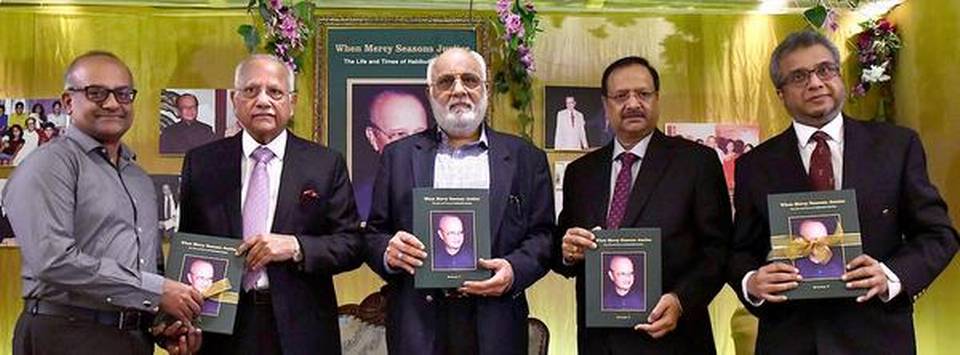
Paying tribute: (from left) Historian V. Sriram, Apollo Hospitals Chairman P. C. Reddy, Prince of Arcot Nawab Mohammed Abdul Ali and Justice R. Sudhakar at the event.
Will include excerpts from the former Advocate General’s memoirs
Jurist Habibulla Badsha was an amazing person and he always did what he thought was right, Dr. Prathap C. Reddy, Chairman, Apollo Group of Hospitals, said on Sunday.
Speaking at the launch of the book ‘When Mercy Seasons Justice’ – The Life and Times of Habibullah Badsha authored by historian V. Sriram, he recalled how they had met in the 1950s as college students.
“It was for an event in which the then Prime Minister Jawaharlal Nehru was to address students. I had chosen the Presidency College grounds and I went to meet their chairman and it turned out to be Badsha, and that was the beginning of a life long relationship,” he recalled. The former Advocate General was also a founder-director of the Apollo Hospitals.
Recalling his long association with Badsha, Prince of Arcot, Nawab Mohammed Abdul Ali said that on many occasions, he had fought cases for free for clients who could not afford any fees.
Chief Justice of the Manipur High Court R. Sudhakar recalled how his guru’s home was always open to friends and family.
He said Badsha and his wife were a couple who should be emulated and added that their home was witness to many an intellectual discussion.
Mr. Sriram said he had used large passages from Badsha’s memoirs in the book. His memoirs reflected the life of the Muslim community and the anguish they felt during Partition.
source: http://www.thehindu.com / The Hindu / Home> News> Cities> Chennai / by Special Correspondent / Chennai – December 31st, 2018
The joint state conference of the Students Islamic Organisation and the Girls Islamic Organisation was held at the Al Jamia al Islamiya at Santhapuram in Malappuram on December 22 and 23. The conference titled ‘the power of faith for a beautiful life’ was inaugurated by Dr Thaha Mateen, national leader of the Jamaat-e-Islami. The chief address was delivered by VT Abdulla Koya Thangal, Kerala assistant amir of the JIH. State leaders of the SIO and GIO spoke at the session presided over by GIO president Afeeda Ahmed. More than 3,000 students from different parts of the state attended the conference.
Several topics were discussed at the conference in various sessions, including ‘liberal cultures and the Islamic life’, the Islamic civilization and contributions to knowledge, the method of Islamic preaching, the future of student politics and ‘art and aesthetics in Islam’. The JIH state secretary Shihab Pookottur, AL Jamia rector Dr Abdussalam Ahmed, MES Engineering College vice-principal Dr Badeeuzzaman, Dr V Hikmatullah etc spoke at the event.
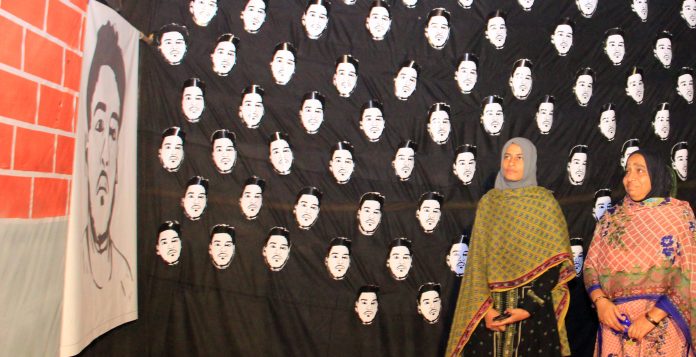
Fatima Nafees, mother of Mohammed Najeeb who has been missing from the JNU, inaugurated the art exhibition titled ‘Oodum Pavum’ arranged at the Conference venue. The exhibition themed ‘defend the racist looks’ was noted for its distinct nature – it had set the rooms of Mohammed Najeeb and Rohit Vemula who had committed suicide in the HCU following caste discrimination by the university authorities, symbolic graves for those killed in state atrocities in Kashmir as well for those killed in mob lynching, representation of the Muslim woman as stereotyped by the mainstream public and media etc. The exhibition was organised by the students of the Al Jamia al Islamiya.
The new leaders of the student organisations were also announced. Salih Kottappally is the new president of the state SIO and Binas TA is the general secretary for the year 2019-20. Afeeda Ahmed is the president of the GIO and Nasreen P Naseer is the general secretary.
source: http://www.twocircles.net / TwoCircles.net / Home> Dalit / by Najima O, TwoCirlces.net / December 28th, 2018
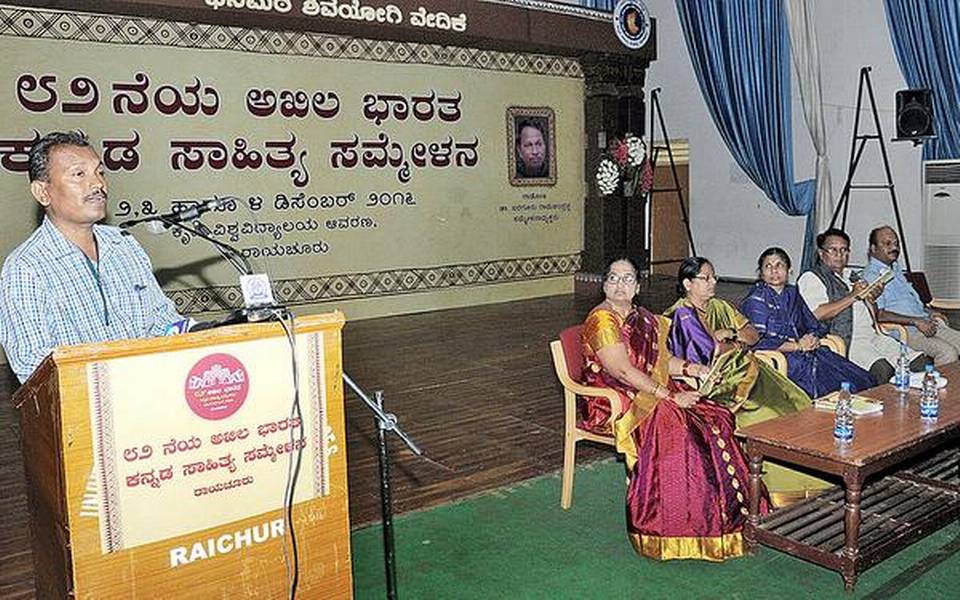
Dastagirsab Dinni, writer, speaking at parallel venue at the 82nd Akhila Bharata Kannada Sahitya Sammelan in Raichur on Sunday.
Terming triple talaq, restrictions on going to masjids, bigamy and other Islamic practices as shackles, Dastagirsab Dinni, a progressive writer, stressed the need for raising voices against Islamic fundamentalistic forces, for women’s liberation.
He was speaking on Muslim sensitivities in literature at a session on multiple dimensions of literature at the 82nd Akhila Bharata Kannada Sahitya Sammelan in Raichur on Sunday. The writer went on to point out prevalent anti-women practices which were indeed not preached by Prophet Mohammed.
“Prophet Mohammed did not oppose women offering prayers at masjids, but our fundamentalists are doing it. Muslim women are increasingly opposing the practice of triple talaq and bigamy practices. Some are even fighting against these anti-women practices in courts. Literature should voice their woes,” he said.
Pointing at the standard approach of fundamentalists towards progressive Muslim writers, Mr. Dinni went on to give a long list of Muslim writers who in one way or the other had to face the wrath of fundamentalism for their radical writing.
“Salman Rushdie, Taslima Nasreen, Sara Abubakar, Safeera, Bhanu Mushtaq and others Muslim writers were under attack from Islamic fundamentalists as they questioned the anti-women and other ill-practices of Islam.
“The attacks indeed gave rise to more resistance rather than curbing the existing opposition,” he said.
He added that Mumtaz Begum, Bolvar Mohammed Kunhi, Fakir Mohammad Katpadi, Ramzan Darga, Jameer Ulha Sharif, Rahamat Tarikere, Abdul Rashid and other Muslim writers have continued to question reactionary practices and resist the attack on freedom of expression.
He called upon young Muslim writers to continue the tradition of questioning fundamentalistic practices in Islam so that the process of emancipation of women could get quickened.
source: http://www.thehindu.com / The Hindu / Home> News> States> Karnataka / by Kumar Buradikatti / Raichur – December 05th, 2016