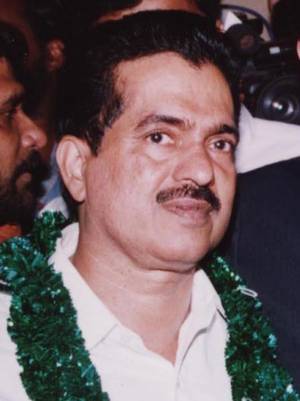
Former Minister for Local Self-Government and an avid advocate of decentralisation of powers K. Kutty Ahmed Kutty is disappointed at the way successive governments handled the Panchayati Raj system.
“Decentralisation of powers has not been implemented as envisaged by the Constitution 73rd and 74th amendment. Power and authority have not been transferred completely to the local bodies as originally conceived by our rulers,” Mr. Kutty told The Hindu from his home at Tanur.
According to him, the panchayats and municipalities functioning as the third tier of the governing system have been reduced to mere ‘development agencies’ to expend the funds sanctioned by the government. “The local self-governments have to seek sanction from the State government for many things, which means that decentralisation of powers and functions has not happened the way it should have,” he said.
Mr. Kutty cited withdrawal of the power to issue licence for opening retail liquor outlets as one instance of the manner in which governments have curtailed the powers and functions of local governments. “This is like clipping the wings of the local self-government,” he said. The powers of local governments to issue investment licences are now vested with the local body secretaries and with the elected councils. “E.M.S. Namboodiripad had sought regulatory powers for the local body governing councils, and not for bureaucrats controlled by the State government,” he said.
“We still have to go a long way. We have not moved an inch after A.K. Antony signed the order giving powers to local self-governments in 29 items. We ought to give more powers to local self-governments managed by our men and women.”
source: http://www.thehindu.com / The Hindu / Home> News> State> Kerala / by Abdul Latheef Naha / April 21st, 2018
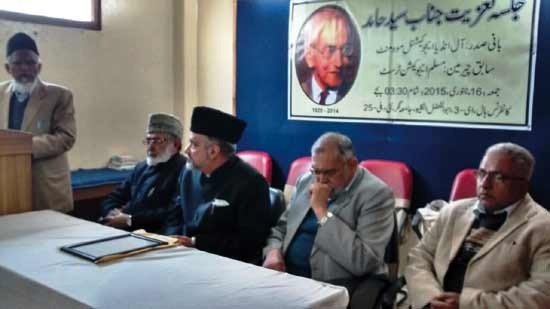
At a condolence meeting jointly organised by All India Educational Movement (AIEM) and Muslim Education Trust (MET), here on 16 January, rich tributes were paid to Saiyid Hamid, the founder-President of AIEM and former Chairman of MET for over a decade. This was one of dozens of such condolence meetings held across India to pay tributes to Saiyid Hamid.
(L to R) Abdul Rashid (speaking), Syyed Mansoor Agha, Dr Syed Farooq, Dr Zafarul-Islam Khan, Masoom Muradabadi
Dr Syed Farooq, patron of AIEM and Chairman of Himalaya Drugs Company, Dr Zafarul-Islam Khan, Editor of the Milli Gazette and President of AIMMM, Parwaz Rahmani, Editor of Urdu bi-weekly “Dawat”, Masoom Moradabdi, Editor of daily Jadeed Khabar, Syyed Mansoor Agha, Senior Urdu journalist and Vice President of AIEM, Abdul Rashid, former Deputy Secretary to Govt. of India and General Secretary AIEM, Mozaffar Ali, Secretary of MET, Rafiq Ahmad, Secretary of Human Welfare Foundation (HWF) and Maualana Ataur-Rahman Qasmi, Director of Shah Waliullah Institute spoke on the occasion.
Presiding over the meeting, Dr Syed Farooq said that the best tribute to the departed soul will be to continue his mission which is far from complete. He was a visionary and a dedicated person, said Dr Farooq. Dr Zafarul-Islam Khan said, after his retirement from civil services, Saiyid Hamid devoted himself fully for the cause of the community. This is rare as there are hundreds of high-ranking Muslim civil servants who are living their own lives after retirement and show no interest in helping their community. Saiyid Hamid was a person of conviction. He greatly valued the capabilities of others.
Parwaz Rahmani said, some of Saiyid Hamid’s actions as the VC of AMU invited criticism but nobody can deny that whatever he said or did was done with sincerity and in good faith. He had a versatile and attractive personality. Maualana Ataur-Rahman Qasmi said Saiyid Hamid was a man of great stature. He always extended a helping hand but never compromised with his principles to oblige anybody.
Masoom Moradabadi said, the character of leadership Saiyid Hamid provided is in contrast to others. He did not rely upon complaining. Instead, he struggled using self-strength and managed to carve a way-out and helped the community. He advised the community to realise their inherent capabilities, mobilise their available resources and stand on their own two feet. Syyed Mansoor Agha said, Hamid Saheb was an education activist and a great admirer of Sir Syed’s vision of education. He believed in an inclusive approach and stressed upon educating the community. He drew our attention towards the importance of health and hygiene and the dire need of social reforms. He was a big votary for promotion of communal harmony. He was a person of knowledge and action and a rare humanist of our times. Underlining Saiyid Hamid’s deep interest in people’s welfare activities, Rafiq Ahmad said, even during his serious illness, he took keen interest in the affairs of HWF and always obliged us with guidance and granted us audience whenever we approached him. Saiyid Hamid was the founder-Chairman of HWF and served in that capacity until his last breath. The HWF is running several charitable institutions including Al-Shifa Hospital and a chain of Scholar Schools including one at AbulFazl Enclave in Delhi.
Concluding the meeting, Mozaffar Ali said, a the first chairman of MET, Saiyid Hamid shaped the mission which is successfully helping thousands of students to receive higher education in spite of financial constraints. The meeting ended after passing a condolence resolution which said Saiyid Hamid was “a visionary who guided Indian Muslims like a beacon for decades to improve their lot, is no more among us.”
source: http://www.milligazette.com / The Milli Gazette / Home> Online News> Special Report / Online February 13th, 2015 / Print issue : 1-15 February 2015
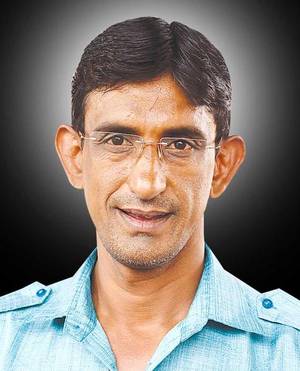
Social worker Syed Osman Azhar Maqsusi has been named to received the 27th Yudhvir Foundation Memorial Award in recognition of his dedication to uplifting the lives of people in marginalised communities by feeding the hungry. The award for this year includes a citation and cash of ₹1 lakh.
Mr. Azhar was only four-years-old when his father, an auto driver, passed away. His mother struggled to care for him and three other siblings. He gave up his studies at the age of 10 and took up odd jobs to support his family. In 2001 he started a Plaster of Paris unit which remains his only source of income even today.
A stray encounter with a hungry woman led Mr. Azhar to start his campaign to feed hungry persons in 2012. This has grown into a daily foodcamp for over 150 hungry mouths. In October 2015 he set up the NGO Sani Welfare Foundation to carry the work further.
Inspired by his example and at times aided by him, free food programmes for over 1,000 people have come up in different cities across India in coordination with local trusts and authorities. Free clinic, free educational academy and a free tailoring centre for needy women have also been set up.
His selfless perseverance has brought dramatic changes in the lives of those he has helped and he remains an inspiration for all of us, said a press release. Member of Parliament Kalvakuntla Kavitha will present the award on April 30 at KLN Prasad Auditorium, FTAPCCI Bhavan, Red Hills.
source: http://www.thehindu.com / The Hindu / Home> News> Cities> Hyderabad / by Special Correspondent / Hyderabad – April 19th, 2018
International artist Wajid Khan, famous for his ‘iron nail art’, is making the tallest statue of Swami Vivekanand in India that would be installed in Uttar Pradesh.
International artist Wajid Khan, famous for his ‘iron nail art’, is making the tallest statue of Swami Vivekanand in India that would be installed in Uttar Pradesh. The statue made of ashtdhatu (alloy) will be 170-feet tall and will be installed either in Lucknow or Agra, said Khan.
He said the statue will be completed in six months. Khan is here to take part in the four-day International Art Festival being organised at the Aligarh Muslim University (AMU).
Though Wajid Khan has not studied in any university or college, he has made a mark for himself by his craftsmanship in metal statue making. He is also making a sculpture for FIFA 2022 to be held in Qatar. The project will take five years to complete.
“A 40-feet statue of Swami Vivekanand is installed in Kolkata and that is his tallest statue. Now, the work on making his 170-feet statue has started in Indore,” said Khan.
“The project is being financed by some businessmen from UP, Delhi and Gujarat. They will decide on the place where the statue will finally be installed. As of now, the first preference is Lucknow and the second is Agra. Due to any reason, if the statue is not installed these cities, the third option will be Delhi,” he added.
“The statue is being made from eight metals including iron, zinc and copper. For the time, the total cost of the statue cannot be revealed,” he said.
Wajid Khan said he is also making a 10×8 ft statue of British Queen Elizabeth, which will be installed at the Royal Palace in London.
Khan has embarked upon a new venture. A proposed retro Bhopal city will be established in 40 acres area in Bhopal and the artist will give it a 2,000 years old look. The project is being financed by some businessmen.
source: http://www.hindustantimes.com / Hindustan Times / Home> Cities> Lucknow / by Pradeep Saxena, Hindustan Times,Aligarh / March 15th, 2018
Islamic scholar Abdul Salam Sullami, 67, died in Sharjah on Wednesday.
His body will be brought to his home at Edavanna, near Manjeri, on Friday. The funeral will take place at the Edavanna Juma Masjid at 4.30 p.m. on Friday.
A leading Mujahid scholar, Sullami wrote several books on Shariat, Koran, and Hadith.
His books on comparative religious study and Madhabs are popular. His commentary on Sahih-ul-Bukhari and translation of Riyad-u-Swaliheen earned him much fame in Kerala .
source: http://www.thehindu.com / The Hindu / Home> News> States> Kerala / by Staff Reporter / Malappuram – February 01st, 2018
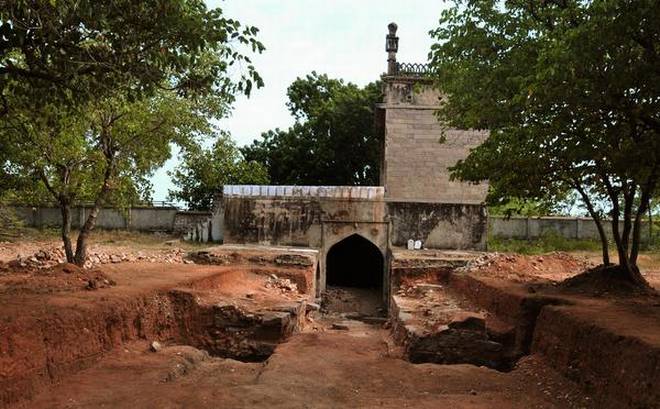
A tunnel hidden below the garden layout at the Qutb Shahi tombs and connecting with Golconda Fort was unearthed during excavations. File | Photo Credit: G. Ramakrishna
ASI wants to ensure medieval relics aren’t destroyed by an expanding golf course
In another instance of modern technology coming to the aid of medieval heritage, the Archaeological Survey of India (ASI) will be using Ground Penetrating Radar (GPR) to map the contours of the area around the Bagh-e-Naya Qila excavated garden inside the Golconda Fort. It has roped in the Indian Institute of Technology-Madras (IIT-M) to carry out the mapping.
This medieval garden in Hyderabad is the only one of its kind still intact. All the others – built during the Qutb Shahi rule (1518-1687) — have either been built over or have disappeared. The contour mapping was necessitated by the impending advance of the Hyderabad Gold Club, which wants to expand its 18-hole course into a 21-hole one by taking over some of the land adjoining the Bagh-e-Naya Qila site. A GPR map would reveal any medieval relics that may lie buried under the ground, and could thus be saved by the ASI.
“The Hyderabad Golf Club, which has built a golf course in the Naya Qila area, wants to add a few more holes on the other side of the garden. We don’t want to lose any more history. We want to ensure that there are no relics of the Bagh-e-Naya Qila underneath and hence we are planning to map the area with GPR. We would have liked to do this with a Light Detection and Radar (LiDAR) but for that we need the permission of the Defence Ministry,” said ASI Superintending Archaeologist Milan Kumar Chauley.
The Naya Qila garden inside Golconda Fort was built by successive rulers of the Deccan and is one of the few symmetrical gardens extant. In 2014, when the ASI excavated the area after diverting the water flow, it discovered water channels, settlement tanks, walkways, fountains, gravity pumps, and a host of other garden relics.
An earlier excavation unearthed gold coins in the area where the golf course has been created. According to author Ali Akbar Husain, the Naya Qila area also has multiple chabootras (raised platforms) which are remains of garden structures that pre-date the Qutb Shahi rule. In the 1940s, the garden was even used for celebrating Basant Panchami.
The team from IIT-Madras will do a preliminary survey to ascertain the path for the contour-mapping. “We have told the IIT-Madras team that the survey and mapping have to be finished before the monsoon sets in. We will do the preliminary study by end of this month and the mapping might be completed in May,” Mr. Chauley said.
While there is a semi-collapsed ‘baradari’ (a gazebo-like structure with many pillars) in the garden, historians believe that another baradari might lie buried in the ground. GPR uses electromagnetic radiation in the microwave frequency for imaging sub-surface area.
source: http://www.thehindu.com / The Hindu / Home> News> Cities> Hyderabad / by Serish Naninsetti / Hyderabad – April 17th, 2018
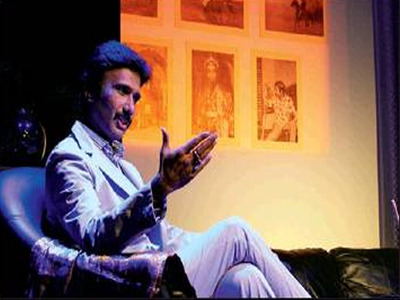
Mohammad Ali Baig in a scene from ‘Under an Oak Tree’ in London
Hyderabad :
A play based on a Hyderabadi palace set in the mid-19th century has taken centre stage in London. The play’s premier attracted connoisseurs of theatre and enthusiasts of Hyderabadi history, drama and heritage.
“Under an Oak Tree”, presented by Hyderabadi theatre revivalist Mohammad Ali Baig, is based on the story of a boy born in the 19th century Ahmed Bowla Bagh Palace built by Nizam V Nawab Afzal Jah Bahadur. The play was produced by Qadir Ali Baig Theatre Foundation. The premiere show was sold out one week before the play was staged.
“The hour-long bio-play retraces the protagonist’s journey from the seclusion of a 19th century palace spread over 100 acres with a 100-horse stud farm, to the glitzy world of advertising and ultimately, to the intense spotlight of theatre, getting him one of the highest civilian honours of the country. The play aptly presents the changing political and social scenario in a post-Independence, post-Privy Purse era of the princely state of Berar and Deccan and consequently, the changing times,” Mohammad Ali Baig told TOI.
He said the play beautifully captures the story of a boy growing into adolescence without any friends, where the next neighbour was 5km away. The boy had more ponies than toys to play with. Written by Noor Baig, the play was directed by Mohammad Ali Baig. He also acts in it.
Mohammad Ali Baig has presented his plays earlier in Turkey, US, Canada and UK, taking Hyderabadi heritage to the global spotlight. The play is scheduled for its Indian tour in Bengaluru, Mumbai and other places this month.
“It’s really fulfilling when global audiences, accustomed to the best of world theatre, give an original Hyderabadi flavour such an amazing response with full house attendance,” he said.
According to Rehana Ameer, councillor of the City of London (the first Indian-origin woman of the elite Westminister district), the buzz was such that people from the Edinburgh and Oxford Universities came to London to watch the show. Prof Tariq Muneer, Millennium Fellow at Edinburgh University, also lauded the Hyderabadi play.
source: http://www.timesofindia.indiatimes.com / The Times of India / News> City News> Hyderabad News / by Syed Akbar / TNN / April 12th, 2018
Bharatiya Janata Party (BJP) NationalSecretary and Spokesperson, Syed Zafar Islam, will be felicitated with Jamia UrduAligarh’s (JUA) highest award, the “Daktoor-e-Adab”, on the occasion of its Foundation Day on April 16.
The Vice-Chancellorof the institution, Musaid Kidwai, invited Islam as the Chief Guest of the ceremony commemorating the 79th anniversary of JUA’s Foundation Day, wherein he will be bestowed upon with the award, whose previous recipients include high-profile names like Indira Gandhi, VP Singh, Dilip Kumar, Dr Zakir Husain, Mahesh Bhatt, etc.
JUA is the first distance educationinstitution in the country which provides educationto the deprived classes through Urdumedium since 1939. It has around 1100 centres across the country. The institution is also engaged in modernising the madarsa educationin the country.
(This story has not been edited by Business Standard staff and is auto-generated from a syndicated feed.)
source: http://www.business-standard.com / Business-Standard / Home> News-ANI> National / by ANI / Aligarh (Uttar Pradesh) / April 15th, 2018
Officials of the Forest Department here have roped in reputed shooter Nawab Safath Ali Khan for culling wild boars that have been raiding fields and damaging crops in Jainath, Bhela, Thamsi, Thalamadugu, Mavala and Adilabad areas for some time now. In the two days since he arrived for the culling, he killed 26 boars, according to a press release from the department on Saturday.
According to the statement, the shooter culled boars in Landa Sanghvi, Arthi, Mukthapur, and Jainath villages on Friday and Saturday. Standing crops of groundnut, red gram and sorghum were being been damaged by sounders of the boars in several of mandals of the district, the department said.
Meanwhile, the department officials urged farmers not to set electrical traps either for preventing wild boars from damaging the crops or hunting the wild animals. They advised that the farmers report about any wild boar damages to their crops to the department through the local sarpanch for taking further action.
Adilabad District Forest Officer Dr B Prabhakar told Telangana Today that Shafath Ali Khan’s services would be used until some measure of control is gained over the wild boar populations destroying crops.
source: http://www.telanganatoday.com / Telangana Today / Home / by Telangana Today / April 14th, 2018
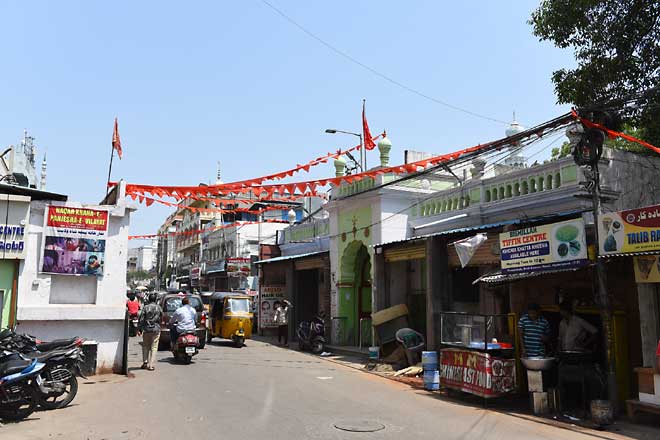
The area of Panje Shah houses relics of saints and the Messenger of God and many stories of forgotten riches .
Kali Kaman road in Panje Shah. — Photos: Surya Sridhar
The area of Panje shah has a rich history behind it. The word, ‘Panja’ means an ‘imprint of hand’. It is located on the left of the main road leading towards Kaali Kamaan from Aitbaar Chowk. The story goes that during the reign of Sultan Abdullah Qutb Shah, a person named Ibn-e-Sher Ali came to Golconda from Najaf-e-Shareef in Iraq, where Hazrat Ali is buried.
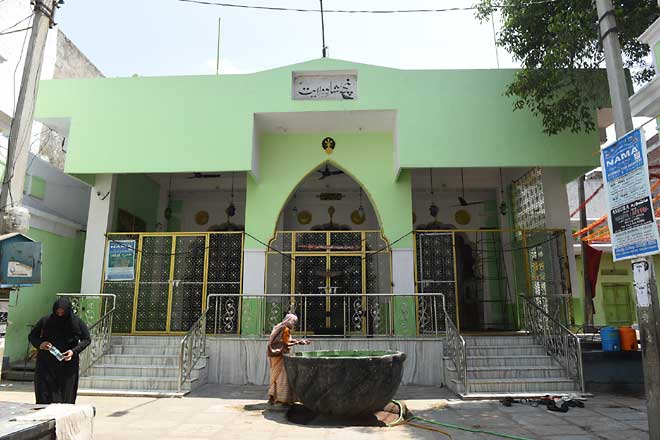
He brought an imprint of the Hazrat’s hand and gifted it to the Sultan, who built an Aashoor Khana and installed the imprint there. The imprint is an amalgamation of metals and resembles solid wax. Light brown in colour, it is about 15 inches in length and 8-10 inches in width. The holy names of Prophet Mohammed, Hazrat Ali, Hazrat Bibi Fatima, Hazrat Hasan and Hazrat Hussain are engraved on the Panja. It is covered with a piece of cloth. Above the Panja on a platform is an alam(standard). Since it was installed by the king, the area came to be known as Panje shah.
During the mourning month of Moharram, more alams are set up around it. A round stone cistern is placed in the courtyard, where the sharbat prepared during this month is stored and distributed to the visitors.
On the walls are some paintings depicting the martyrs of Karbala, scenes of strange phenomena like bleeding trees among other subjects of the artworks.
Opposite this holy place is another place of faith called ‘Qadam-e-Rasool’, where a foot-print of Prophet Mohammed is placed. Sayyad Mohammed Ali is said to have got it from Isfahan, Iran, in 1575, along with adequate proof of its authenticity. He bought a large house, got it decorated and installed the footprint there. (Qadam-foot, Rasool-Prophet Mohammed). There are two stone reservoirs at the gate which are filled with milk beverage (sharbat) and distributed to the devotees during Moharram.
The annual Bibi ki Sawari, which arrives on an elephant stops here on the 10th day of Moharram. It is said Bibi Fatima, the daughter of the Prophet and mother of Hazrat Hussain, laments and woes about the merciless killing of her son in Karbala. This scene is so heart-rending that it leaves everybody present in tears and inconsolable.
Apart from the holy footprint, relics such as the hair of Hazrat Ali and Hazrat Hussain are also kept here.
A round stone cistern in the courtyard, where the sharbat prepared during the month of Muharram, is stored and distributed to the visitors. — Photos: Surya Sridhar
Gurvanna gali
Opposite Panje shah is a lane named after Hakeem Guruvanna, which leads to Mir Alam Mandi. An important landmark of this lane is Kashmiri Qivam factory, established by the descendants of Guajarati businessman Poorandas Ranchoddas, in 1973. Qivam is a paste made of saffron, tobacco, cardamom and other spices which is added to paan to give it a kick. This Kashmiri Qivam was a favourite with film stars like Sunil Dutt, Meena Kumari and Nargis. Shaik Mujeeb-ur-rahman, the first President of Bangladesh was also a customer. Apart from Qivam, a hair oil named ‘Zulf-e-Kashmir hair oil’ is also prepared here. The factory is spread over a vast area of 3,700 sq yards and is managed by the grandsons of Poorandas ji. A Shivalaya has been constructed here near a large peepal tree.
Deghchi galli
This lane is situated close to Guruvanna galli and owes its name to a fantasy like story. Long ago, a deghchi (a vessel) full of rich gems and jewellery was found here during digging. Close to Panje shah is another lane called Kotaah galli (narrow lane) which is erroneously called Kotta galli.
On the way to Panje shah from Aitbaar Chowk, lies the haveli of Raja Mahipat Ram, an army commander and a minister of the second Nizam. It was called ‘baawan darwaazon ki haveli’ since it had 52 doors. The havelis of Raja Vithal Pershad and Raja Shainblum Pershad were also located here and came on the way to Kaali Kamaan and Gulzar Houz.
Upon crossing the Kaali Kamaan, one also gets to see several shops selling kites, thread, maanja and charqas. The kites have many fascinating names like dulhan, pachchisi, langot, aiyyawar, ek qakam, gola suleman, chand-tara, singhada, and lehanga. Similarly, the names of maanja are also very interesting like motiya, gandhak, feroza, and angoori to name a few.
source: http://www.telanganatoday.com / Telangana Today / Home / by Dr. Anand Raj Varma / April 15th, 2018