Category Archives: Community Involvement / Social Issues

Role of Muslims in freedom struggle

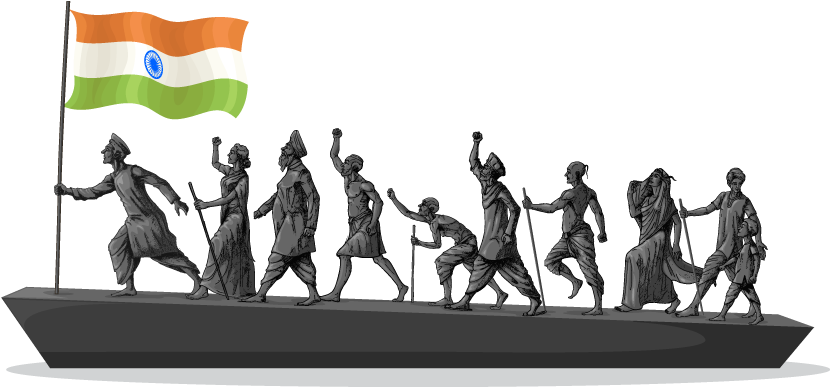
The freedom movement of India was not the sole agenda of a particular political party but it had moved aam aadmi in the form of masses in his/her own capacity. The history of Indian national movement would be biased and incomplete without the presentation of the actual role of Indian Muslims in it, right from the revolt of 1857 to the day of Independence in 1947.

Shoulder to shoulder they fought with the other communities for the Independence of India. The contribution of Muslim poets, revolutionaries and writers is not known today. Instead of secular historiography, it has been communalised.
                                             Courtesy: Mapsofindia.com

The Muslims and other minorities never envisaged India as adopted land because Muslims of India have not come from outside but are the converts to Islam and have deep feeling sense of belonging to this country and therefore contributed to the cultural, economic, intellectual and spiritual progress throughout the ages.

The role, significance and uprising of Indians against British imperialists can be seen since mid of 18th century in the form of Battle of Palashi (Plassey), June 23, 1757. It was Nawab Siraj-ud-Daulah who first awakened Indian rulers and gave a call to oppose the British. He, however, lost the battle and was executed at the young age of 24. This was soon followed by the great Tipu Sultan, who was killed by Lord Wellesley during the fourth Anglo-Mysore war in 1799.

The contribution of Muslim revolutionaries can be witnessed from the first half of 19th century. The Faraizi and the Wahhabi Movements had disturbed the pace of British plan in the initial stages of its expansion in India. The Wahabi movement of Syed Ahmed Barelvi was the most organised one. He appealed to all Hindus and Muslims to overthrow the British and thus he was killed in 1831 at Balakot.

The number of Muslims executed only in Delhi during 1857-58 was 27,000. During this revolt, Asghari Begum (mother of Qazi Abdur Rahim, the revolutionary of Thana Bhawan, Muzaffarnagar) fought against the British and was burnt alive when defeated. It was estimated that about 225 Muslim women gave their lives in the revolt.

Similarly, barely is known about the contribution of Muhammad Ashfaq Ullah Khan of Shahjehanpur who conspired and looted the British treasury at Kakori (Lucknow) to cripple the administration and who, when asked for his last will, before execution, desired: “No desire is left except one that someone may put a little soil of my motherland in my winding sheet.”

Likewise, the present generation does not know about Khan Abdul Gaffar Khan, a great nationalist who had passed 45 years of his 95-years of life in jail for the freedom of India and thus awarded ‘Bharat Ratna’ in 1987. Barkatullah and Syed Rehmat Shah of Ghadar Party sacrificed their lives. Umar Subhani, an industrialist and a millionaire of Bombay who, then, presented a blank cheque to Gandhiji for Congress expenses and who ultimately sacrificed his life for the cause of Independence. Maulana Hasrat Mohani, with his poetry, infused zeal of freedom in young hearts.

Maulana Abul Kalam Azad, at the age of 35, became the youngest person to serve as the President of the Indian National Congress. He was the icon of Hindu-Muslim unity as well as espousing secularism and socialism. Raj Mohan Gandhi in his book ‘Understanding Muslim Minds’ mentioned that Maulana went straight to Congress office just after the funeral procession of his wife, Zuleikha Begum and led Quit India Movement.

Manmohan Kaur in her book entitled as ‘Women In India’s Freedom Movement’ makes reference to only Begum Hazrat Mahel and Bi-Amma out of the hundreds of women who fought the battle of freedom along with their men folk against the British Raj. The history of the Indian national movement would be incomplete without mentioning the heartily services of Abadi Begum (mother of Maulana Muhammad Ali), Amjadi Begum (wife of Maulana Muhammad Ali), Amina Tyabji (wife of Abbas Tyabji), Begum Sakina Luqmani (wife of Dr Luqmani and daughter of Badruddin Tyabji), Nishat-un-Nisa (Begum Hasrat Mohani), Saadat Bano Kitchlew (wife of Dr Saifuddin Kichlew), Zulekha Begum (wife of Maulana Azad), Mehr Taj (daughter of Khan Abdul Ghaffar Khan), Zubaida Begum Daoodi (wife of Shafi Daoodi, the reputed nationalist of Bihar) and many others.

Santimoy Ray’s ‘Freedom Movement And Indian Muslims’ challenges the many prejudices that generate bias and hatred against the Indian Muslims, particularly their contentions role in Indian freedom movement.

This shows the great sacrifices they made to oust the British rule in all the national uprisings from Sanyasi Movement to Independence, finally led to the withdrawal of British from India in 1947. It is such a pity that their roles in the struggle for freedom has not been adequately presented in the Indian history. The comprehensive study about the role of Muslims struggle for freedom is essential to help eradicating prejudices and many misconceptions against the Muslims grown in the absence of fair historiography.

I’m recalling some of the beautiful lines of Faiz Ahmed Faiz …

Ye daagh daagh ujaalaa, ye shab-gaziida sahar,
Vo intizaar thaa jis-kaa, ye vo sahar to nahiiN,
Ye vo sahar to nahiiN jis-kii aarzu lekar
Chale the yaar ke mil-ja`egi kahiiN na kahiN
Falak ke dasht meN taroN kii aakhiri manzil,
KahiN to hogaa shab-e sust mauj kaa sahil,
KahiN to jaake rukegaa safiina-e-gham-e-dil.
Abhii chiraagh-e-sar-e-rah ko kuchh khabar hii nahiiN;
Abhii giraanii-e-shab meN kamii nahiiN aa’ii,
Najaat-e-diidaa-o-dil ki ghaRii nahiiN aa’ii;
Chale-chalo ke vo manzil abhii nahiiN aa’ii.

Meaning:

This stain-covered daybreak, this night-bitten dawn,
This is not that dawn of which there was expectation;
This is not that dawn with longing for which
The friends set out, (convinced) that somewhere there we met with,
In the desert of the sky, the final destination of the stars!
Somewhere there would be the shore of the sluggish wave of night,
Somewhere would go and halt the boat of the grief of pain.
The lamp beside the road has still come no lessening,
The hour of the deliverance of eye and heart has not arrived.
Come, come on, for that goal has still not arrived.

(Author is currently preparing for civil service examinations.)

source: http://www.twocircles.net / TwoCircles.net / Home> Articles> Indian Muslim / by Shaik Amer Arafath / August 14th, 2015
The Prince is Dead. Long Live The Legend

UTTAR PRADESH /  Kolkata, WEST BENGAL / NEW DELHI :

They are not the only one calling the Malcha Mahal prince an imposter. Many old families of Lucknow that have for long maintained their discernment for the Royal family concur.

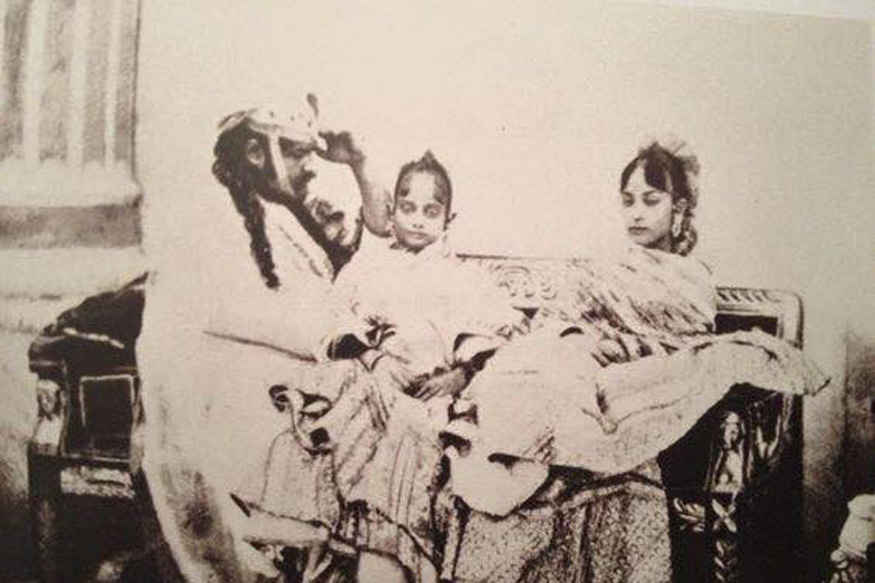
King Wajhid Ali Shah in Matiaburj. (Image: News18)

New Delhi:

The Prince who died in Malcha Mahal was a pauper. Not just in the life he lived but also in the claims he made about his family lineage. At least that’s what the descendants of Wajid Ali Shah and Begum Hazrat Mahal, currently living in Kolkata, will have you believe in.

They are not the only one calling the Malcha Mahal prince an imposter. Many old families of Lucknow that have for long maintained their discernment for the Royal family concur.

Taken aback by the media reports which referred to one Ali Raza— who died in New Delhi’s 14th century’s Malcha Mahal— as Prince, the living members of the Royal Family of Oudh are trying to clear the air on Nawab’s lineage. 

“We want to assert our credibility as the real heirs to the title. We have in the past dealt with the menace of impersonation. My uncle also raised the issue with the government of Uttar Pradesh and the Prime Minister when the impersonator – the mother of the deceased ‘prince’ called Vilayat Mahal got an allotment in Malcha Mahal on the false claims of royalty,” said Manzilat Fatima from Kolkata, who is the “great, great grand-daughter of Wajid Ali Shah. She lives in Kolkata and spends her time working to “preserve Awadh cuisine”.

The Malcha Mahal, Fatima claims, was a Mughal hunting-house or shikargah given to Vilayat Mahal and her two children including the ‘ the dead Prince’ when the family arrived in Delhi after many a unsuccessful bid to claim the Nawab’s title in Lucknow.

The family spent days in the waiting-room of the New Delhi Railway Station before their petition to the then Prime Minister Rajiv Gandhi for temporary accommodation in Delhi was acceded to by the government.

Fatima’s 89-year-old father, Dr Kaukub Qudr Meerza, is not surprised by the reports of ‘Prince’s death’, because he knows the real Prince is still alive. His Highness, and yours truly, Dr Meeraz, says “our family has witnessed the hoax for years now.”

The family says one of the immediate relatives— Prince Anjum Qudr had in-fact challenged the false claims of Vilayat Mahal before the government.

Qudr wrote a series of letters in 1975 to the UP government and then again in 1985 to Prime Minister Rajiv Gandhi informing him about the “impersonation” being done by Vilayat Mahal calling it “hoax”. The letter is available on the website of their Oudh family to keep people informed about the legend of impersonation. Qudr wrote Begum Hazrat Mahal had only one son Birjis Qadr, who was crowned in 1857.

Details regarding Qadr’s children from different wives are available in Kaiserut Tawarikh Vol-2 and other books on the history of Oudh. An auto-biographical Masnavis (illustrated stories) of Wajid Ali Shah Huzn-e Akhtar or Tarikh-e Pari Khana also describe the Nawab’s lineage in some detail.
These details corroborate with other sources of information on the exiled King from the poems and Diwan of Birjis Qadr- the only son of the Begum of Oudh.

The original claimants say that there are records of the Political Pension Office of the District Collector of 24 Parganas, West Bengal, from where all heirs of Birjis Qadr drew a political pension after Qadr was assassinated in 1893 in Kolkata. Wajid Ali Shah in his will has named only one son Birjis Qadr (and no daughter) that Begum Hazrat Mahal bore him.

“Fraud of the present claimant is obvious from her very name “Begum Vilayat Mahal” because Mahal is not really an inheritable work,” said Qudr in his appeal to the various government. Mahal is a title which used to be awarded by a Muslim King or Emperor in India to his wife after she bore him a son.

Thus when Birjis Qadr was born to Begum Hazrat, that King Amjad Ali Shah awarded the revered title Mahal to the wife of his Crown Prince. Just as Mumtaz, Mughal Emperor Shahjahan’s wife acquired the title after bearing successor to the Mughal throne.

Nawab Ibrahim Ali Khan of Shish Mahal, Lucknow, where Vilayat Mahal lived briefly before leaving for New Delhi, told News 18.com that the veracity of the claims can be established from the family tree or shajra of Nawab Saadat Khan who established the Oudh dynasty in the early 16th century.

He adds, further that King Wajid Ali Shah, when he was exiled to Matia Burj, Calcutta [now Kolkata] in 1856, took all his sons and daughters with him and only his siblings, divorced wives and close relatives were left behind. Some of his progeny migrated to Pakistan and England later on. Every descendant of King Wajid Ali Shah is registered with the Kolkatta office.

For the record, any title of Maharaja, Raja, Rana or Nawab recognized by the East India Company and later by Her Majesty’s government was registered with the British Indian Association or Anjuman e Hind in 1861.

The documents are still available at Lucknow Baradari.

source: http://www.news18.com / News18.com / Home> News 18> India / by Eram Agha / November 19th, 2017

PBD 2018 celebrated in Riyadh with fervor

SAUDI ARABIA :

IndiainSaudiMPOs17jan2018

Riyadh :

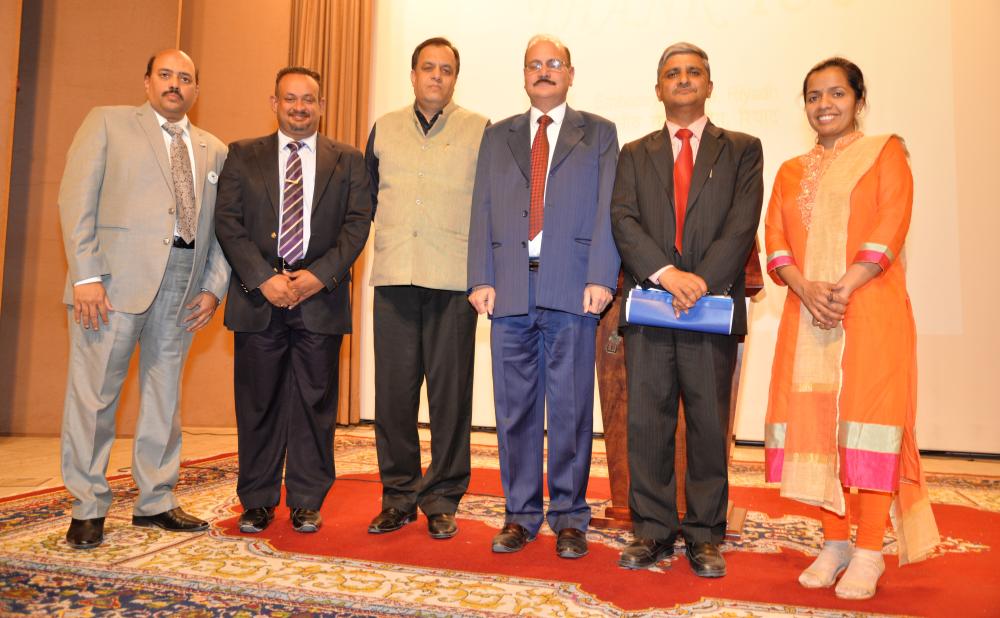
Indian Charge d’Affaires Dr. Suhel Ajaz Khan, during the recent Pravasi Bhartiya Divas (PBD) 2018 celebrations held at Indian Embassy auditorium here, advised Indian nationals to help each other and participate in assisting the community when needed.

Dr. Suhel, in his opening remarks while welcoming the gathering, said that the number of Indians living illegally in the Kingdom is very minute compared to its population after the completion of the recent Amnesty period. The Saudi officials, rounding up illegal residents, have revealed that so far among 250,000-300,000 rounded up in their sweep, that just 1,000 were Indians.

Even though this number is very small when compared to the overall figure and the number of Indians working here, Indian Embassy officials are regularly visiting deportation centers to see if there are any Indian still there needing their help, or is there any fresh Indians detained.

Dr. Suhel also said that during the amnesty period around 75,000 Indians were deported while adding, “It is a matter of satisfaction for us that Indians are very few among illegals.”

Highlighting the community outreach program of the Embassy, the DCM said that the Indian Ambassador traveled length and breadth of the Kingdom to meet the Indian nationals.

Embassy of India has actively implemented the flagship program of Indian government Madad and Emigrate.

He also said that the Indian Embassy would be merciless towards unscrupulous agents who send people to Saudi Arabia through illegal ways.

DCM disclosed that upon the request of Indian Prime Minister Narendera Modi, the Saudi government had issued royal pardon to 291 Indians during last year, the highest for several years.

The DCM also had a message to aspiring job seekers in India to come to Saudi Arabia through legal means and work here with honesty and dedication.

The event started with the playing of recorded speech of Indian Prime Minister Narendera Modi. Dr. Suhel briefed community members on the highlights of the speech.

This is a historic occasion as on this day the greatest Pravasi (traveler) of all time Mahatma Gandhi, the father of the nation, returned to India and this day commemorated as PBD,

Every year, Jan. 9 is celebrated as Pravasi Bhartiya Divas (PBD), an annual celebrations that marks the contribution of overseas persons with Indian Origin towards the homeland.

This year PBD is held at Singapore and the theme is Ancient Route, New Journey — Diaspora in the Dynamic ASEAN India Partnership

The Embassy of India selected four prominent members from the community to speak on the various flagship programs of the Indian government. The speakers included Salman Khaled, Yogacharya Soumya, Magesh Prabhakara, and Taqiuddin Mir Fazal.

The speakers stressed on various topics specially the flagship programs of the government like Digital India — Power to Empower, Yoga, Deen Dayal Upadhyaya, Gram Jyothi Yogna and Beti Bacho-Beti Padhaao.

The speakers were widely applauded for their depth and understanding of the government initiatives and its implications on Indian expatriates abroad, particularly from the Gulf region.

Anil Nautiyal, counselor, Embassy of India, conducted the proceedings and proposed the vote of thanks. Embassy staff actively participated in this event.

First Secretaries Venkateswaran Narayan, Dr. Hifzur Rahman Azmi, community members Architect Abdul Rahman Saleem, 2017 PBD recipients Zeenat Jafri, Shihab Kottukad, Ahmad Imthias, Deepak, Suhail Ahamad, Kundan Lal Gothwal, senior AGM Air India, principals of all Indian schools, managing committee members of various and large number of Indians and their families attended.

Students of Indian International Public School, Riyadh presented colorful cultural program depicting the unity and diversity of India.

source: http://www.saudigazette.com / Saudi Gazette / Home> Saudi Arabia / by Mir Mohsin Ali / January 16th, 2018

Ayesha Khatun : The woman on a mission

Birbhum District , WEST BENGAL :

Kolkata:

Socially disadvantaged marginal groups such as Adivasis (Tribals) and Muslims living in the remote district of Birbhum of West Bengal are being severely neglected in terms of educational development as well as economic and political empowerment. Abject poverty has reduced them to the level of the most backward people of society. Not only are they unaware of the benefits of education, social awareness and self-employment, but they also lack in the basic issue of feminine hygiene.

Although the problems of the Tribals and Muslims are different because of their different cultural context, it is clear that at the grassroots level, both communities require serious efforts at social upliftment if they are to compete with the rest of society. To this effect, a team of passionately devoted women has taken it upon itself to create awareness of empowerment and the need for self-reliance among the tribal and Muslim women of these areas.

AyeshaKhatun01MPOs16jan2018

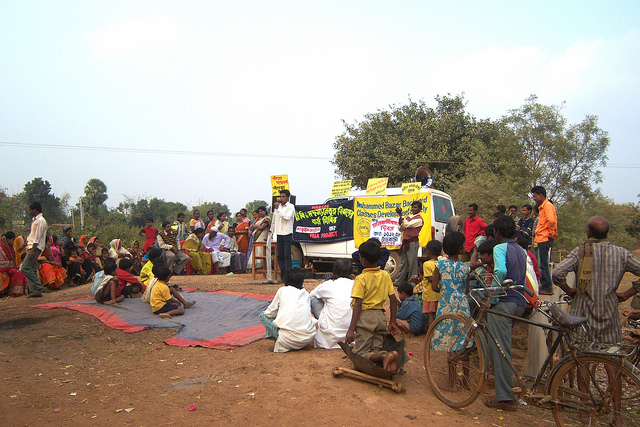
An awareness programme of MBBDS at Purana Gram Panchayet Area

The Mohammad-Bazar Backward Classed Development Society of Birbhum District of West Bengal (MBBDS), targets people from the marginally weaker sections of society, mainly the Tribals and Muslims women. The society is both headed and managed entirely by women. Speaking to TwoCircles.net, Ayesha Khatun, head of MBBDS confirmed that the Secretary and President are both Muslim while the rest of the six members comprise four Muslim and two Adivasi women.

In the remote villages of Birbhum, Muslim women groups run schools, training programs, health and hygiene awareness, HIV prevention programs and promote Self-Help groups

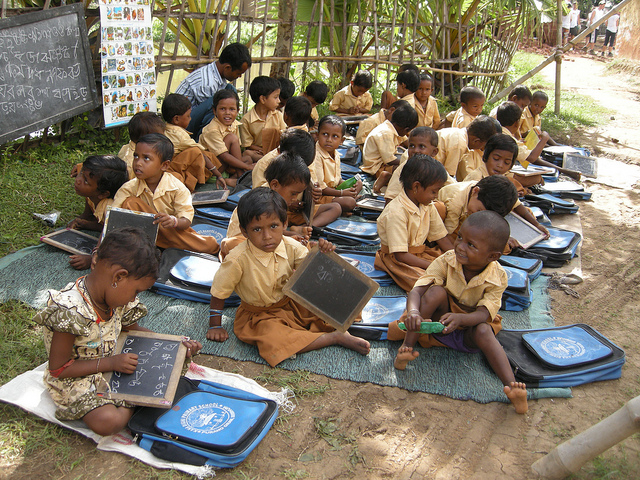
The main areas of operation of MBBDS are concentrated in Purana, Bharkatta, Sekada gram panchayets in Birbhum and Shikaripara in Jharkhand. They are also active in projects for Muslim girls’ education in Murshidabad and Howrah districts. They have been running the Kanadighi Prathyahik Bidyalaya, a school, under the Purana Gram Panchayet in Birbhum since 2003. More than 250 students who were dropouts are getting education there. Another school, Jambani Cluster Child Growth Centre for Tribals under the Deucha Grampanchayet, has enrolled 78 students up to now.

AyeshaKhatun02MPOs16jan2018

A school for Tribals at Jambani by MBBDS

MBBDS also supports a school along the Ganges River bank, an area affected by land erosion. As a result of the land erosion, people are losing their homes and living in very poor and inhumane conditions. Their main occupation is bidi making. Ayesha Khatoon sees education as the way forward, and so has established a school in Akheriganj which has 71 students at present. Another school is being run in Panchpara, Sultanpur of Howrah district near Kolkata.

Panchpura of Howrah district is a Muslim dominated area. According to research conducted by the MBBDS, most of the residents are refugees of the Bhagalpur riots. Since it is a low-lying area, it is easily flooded during the rainy season and so the school dropout rate was very high as children were unable to go to school. Also, there is no electricity or a road network connecting the area to major cities. So, the MBBDS has provided a school for basic education to the poor Muslims.

AyeshaKhatun03MPOs16jan2018

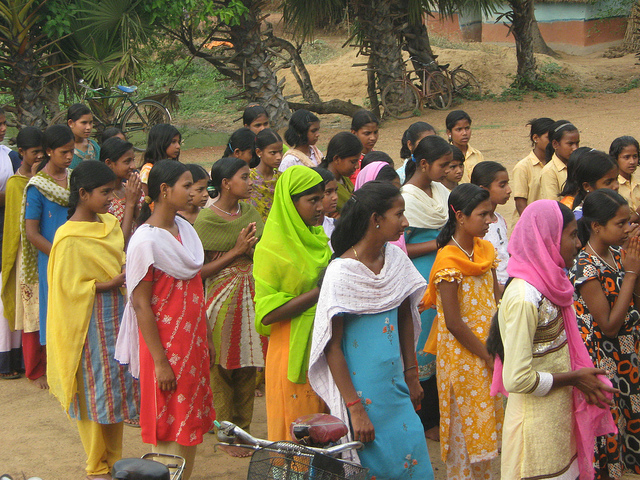
Muslim girls at an education camp

Though they belong to the Hindu community `Adivasis’ are locally called `Santhal’. Their culture and lifestyle is vastly different from that of Muslims, and they even speak their own language, ‘Santhali’. The Birhum district is mainly dominated by the Tribals but there are a few Muslim pockets too.

The MBBDS has taken some initiatives which may help both communities:
• Provision of Elementary schools for Adivasi children in the area
• Health awareness: diarrhea and malaria prevention programs
• Built a nutritional garden
• Vocational training: tailoring and stitching; making of low-cost sanitary napkins; `Kantha Stitch’ (traditional hand embroidery particular to Bengal); hand batiks.
• A Pond for fish reproduction
• Training programs to develop leadership abilities in women
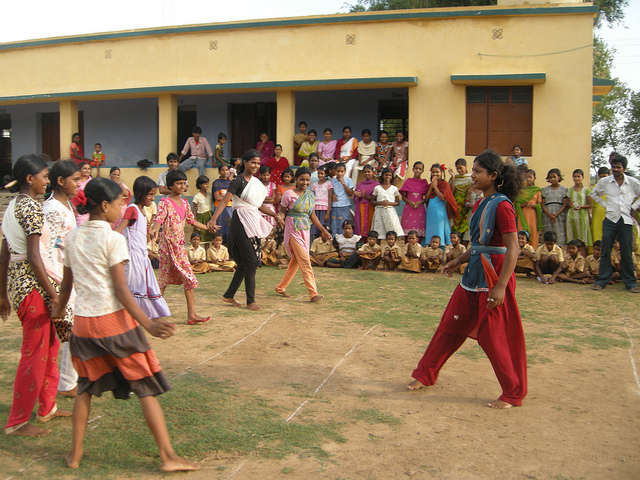
• Sports training (volley ball, khokho, kabadi)
• Provision of adult education to teenage girls
• HIV/AIDS Awareness Programs
• Awareness and Prevention of child marriages

The MBBDS has opened up a school which provides free study materials, free coaching, free uniforms, and even free food. There have been generous donations from internationally renowned organizations such as Association for India’s Development (AID), Hope Foundation, American Jewish World Service (AJWS), Dining for Women (DFW), PRIYA, to name a few.

The grinding poverty in these remote areas has forced the people to work as menial laborers earning daily wages while their women earn a living as sex workers. As these areas are located along the National Highway, truck drivers stop by to rest and find willing partners, for a small price. Hence, the risk of HIV/AIDS is very high. In order to combat this deadly trend, Ayesha Khatun has created an awareness program highlighting the dangers of unprotected sex.

AyeshaKhatun04MPOs16jan2018

Mumtaz Khatun, student of Rokeya Mission is a national-level Kabaddi player

There is also one pre-primary school in the area which encompasses at least 6-7 villages including Heruka, Sahanagar, and Kaldighi. Ayesha Khatun hopes that education will pave the way for these under-privileged communities to interact and assimilate with society and building schools is the first step in this direction.

Ayesha Khatun’s Society bought nearly an acre of land and built a school from the Fifth standard to Secondary Level. The Rokeya Mission School in Puranagram Muslimpara (Mohammadbazar area) has 109 students enrolled to date. The school provides leadership and self-help group training, family life education and counseling besides the other facilities named above. Mumtaz Khatun, a student of Rokeya Mission School has been selected to be a member of the National Kabadi Team: a real achievement indeed.

Ayesha Khatun, the inspiration behind this noble mission comes from an educated and elite background. She has seven other siblings: five brothers and two sisters who all hold Postgraduate degrees. She has a double Masters degree herself. Her father, Mohammad Minhilal was a school teacher. Ayesha Khatun was very impressed with the teachings of the Quran and the life of the Holy Prophet in her teenage years. She believes that Islam gives women equal rights and that the Quran should be followed and implemented correctly. It was after reading the Quran and its interpretation that Ayesha ventured to do social service.

Ayesha Khatun strongly believes in the social upliftment and political empowerment of women. The three-tiered Panchayet system already has a 50% reservation for women. She thinks that if women took the initiative and availed the opportunity to take part in politics, society and especially Muslim women would greatly benefit from this.

Besides being a social worker, Ayesha Khatun is also a writer. She has won the Rokeya Award from Bharatiya Bhasha Parishad, Young Writers Award from Bharatiya Sahitya Academy and Ila Chand Award from Bangiya Sahitya Parishad.

Edited by Ozma Siddiqui

source: http://www.twocircles.net / TwoCircles.net / Home> Articles> Indian Muslim> Women / by Zaidul Haque, TwoCircles.net / April 08th, 2012

Nazeer Ahamed Mohamed Zackiriah

BRUNEI DARUSLALAM  :

NazeerMPOs16jan2018

Brunei :

Mr. Nazeer Zackiriah, Permanent Resident of the Sultanate of Brunei Darussalam, is an Indian-origin entrepreneur who has strengthened the links between India, Brunei and the Indian community of Brunei.

He has actively supported Government of India initiatives and events and has ensured meaningful interactions with local and Indian entrepreneurs for visiting Indian delegations.

He has heightened respect for the Indian community in Brunei by his active charitable endeavours, both in his individual capacity and as President of the Indian Chamber of Commerce of Brunei.

By virtue of the recognition that he has obtained from His Majesty the Sultan of Brunei for these charitable and community-building efforts, he has been instrumental in raising the prestige and profile of the Indian community in Brunei.

Mr. Nazeer Ahamed has achieved notable success in the textile retail sector in Brunei.

From humble beginnings, through hard work and acumen, he has built up the largest chain of textile stores of Brunei which is now providing significant employment and promoting trade.

He has contributed towards strengthening the link between the Indian community and Bruneians by organizing the active participation of the Indian community in Bruneian national events like the National Day of Brunei and the Birthday Celebrations of His Majesty the Sultan.

source: http://www.pbdindia.gov.in / Pravasi Bharatiya Divas / Home> Profile of Awardees / 07-09 January 2017, Ministry of External Affairs, Government of India

A hero who comes to the rescue of the dead

KERALA / UNITED ARAB EMIRATES (UAE) :

AshrafMPOs16jan2018

Until December 2016, UAE-based businessman has helped transport 3,886 bodies to 38 countries

Heroes are often made out to be those who save lives, but here is one who comes to the rescue of the dead and their families. Ashraf Thamarassery, a UAE-based businessman, is credited with helping the final journey of the dead to their home countries.

The 41-year-old, a native of Kerala, was in Bengaluru to participate in the Pravasi Bharatiya Divas, an event which saw him being conferred the Pravasi Bharatiya Award in the past.

“It was 2002 when I saw the struggle of a family I knew when the father passed away,” he said, recalling how his tryst with the dead began. As he learnt of the money involved in transporting bodies to their home countries, the lengthy procedures, and the large amount of paperwork, he decided to dedicate a significant amount of his time to helping those in similar situations.

Until December 2016, Mr. Ashraf is said to have helped transport 3,886 bodies to 38 countries. Transportation to India is one of the most expensive, he said. This is because Indian airlines charge per kilogram of weight of the body, which often ends up becoming a huge financial burden on the grieving families.

“What if it is a poor worker here? Their families will have to contact around 16 departments and pay hefty airline charge,” he said, advocating for government intervention on this.

Though often perceived as morbid, his family is completely in support of what he is doing, Mr. Ashraf said, making it clear that he will continue to remain a call away for those who want his help at one of the most difficult times of their lives.

source: http://www.thehindu.com / The Hindu / Home> News> Cities> Bengaluru / by K. C. Deepika / Bengaluru – January 09th, 2017

Awarding PIOs in recognition of their services

BRUNEI / LIBYA  / SAUDI ARABIA  :

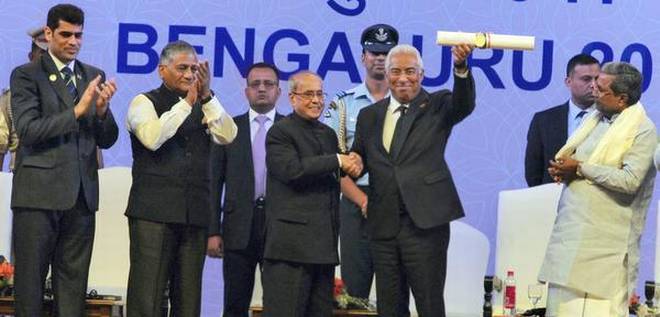
President Pranab Mukherjee honours Dr. Antonio Costa, Portugal Prime Minister, who received the Pravasi Bharatiya Samman, as Suriname Vice-President Michael Ashwin Adhin and Union Minister V.K. Singh look on, in Bengaluru on Monday. | Photo Credit: G R N SOMASHEKAR;G R N SOMASHEKAR -
President Pranab Mukherjee honours Dr. Antonio Costa, Portugal Prime Minister, who received the Pravasi Bharatiya Samman, as Suriname Vice-President Michael Ashwin Adhin and Union Minister V.K. Singh look on, in Bengaluru on Monday. | Photo Credit: G R N SOMASHEKAR;G R N SOMASHEKAR –

Winners of Pravasi Samman Awards include Portugal Prime Minister Dr. Antonio Costa

Her son was three years old when she realised that there was no school she could send him to. British and American schools were too expensive and she didn’t want to send him to a local school.

That prompted Zeenat Jafri to start the second Indian school in Saudi ArabiaInternational Indian School — in 1982 with her husband. She was among the 30 people feted for her achievement on Monday during the Pravasi Bharatiya Divas, when the Pravasi Samman Awards were given away by President Pranab Mukherjee.

The 64-year-old MBA graduate from Bhopal, who was given the award for her contribution to the field of education, said she started the school from her house, gradually scaling it up   to now educate 12,000 people.

Another person of Indian origin who was recognised with the award was Ariful Islam, coordinator and nodal point in the Embassy of India in Libya.

The electrical engineer relocated from India to Libya in 1980 following a pact between the two nations. He has seen his adopted country go through the worst of times, but continues to live there alone, though his family has moved back to Aligarh. “I have spent half my life there. We have successfully rescued many Indians,” he said.

The rescuer

The most recent episode he was involved was in the rescue of three abducted Indians from the IS in a dramatic operation in 2016 from the deep Libyan deserts.

Among the organisations that were awarded were the Singapore Indian Association in the category of community service.

The event saw double the number of awardees as it was being held after an interval of two years.

Among the other prominent winners of the award were Portugal Prime Minister Antonio Luis Santos da Costa, Labour Member of the European Parliament representing the West Midlands Neena Gill, British politician Priti Patel and Mauritius Minister of Finance and Economic Development Pravind Kumar Jugnauth.

Nisha Desai Biswal, Assistant Secretary of State for South and Central Asian Affairs in the United States Department of State, who was also among the 30 awardees, said persons of Indian origin, who were building bridges and connecting in an “increasingly divided world,” retained strong ties with India, she said.

source: http://www.thehindu.com / The Hindu / Home> News> National / by K.C. Deepika / Bengaluru – January 10th, 2017

Ariful Islam

Aligarh, UTTAR PRADESH / Benghazi, LIBYA :

ArifulIslamMPOs16jan2018

Libya :

Mr. Ariful Islam resides in Benghazi, the second largest city of Libya.

Mr. Islam has been providing selfless service to Indians in Libya and has been instrumental in building trust between the Libyans and Indians.

Mr. Islam helped during the evacuation of Indian nationals from Libya during the civil unrest in 2011 and was amongst the last to leave from Libya.

His assistance in extricating Indian nationals from the eastern region was invaluable and was appreciated and recognized by Indian as well as the Libyan authorities.

He facilitated repatriating 287 Indian citizens from Benghazi by ship to Malta in August 2014.

He again helped the Mission in December 2014 January and February 2015 to evacuate subsequent batches of Indian nurses from Benghazi and arranged for their safe passage till Labrak airport, about 250 km from Benghazi, while the security situation was very fragile.

Although, he does not have active business now due to the civil war like situation and continuous fighting in Benghazi, he returned to Libya to assist in the evacuation of our nationals and to attend to other consular matters of our citizens and to follow up with the local authorities.

source: http://www.pbdindia.gov.in / Pravasi Bharatiya Divas / Home> Profile of Awardees / 07-09 January 2017, Ministry of External Affairs, Government of India

School for expats in Saudi Arabia wins Muslim woman top award

Bhopal, MADHYA PRADESH / SAUDI ARABIA :

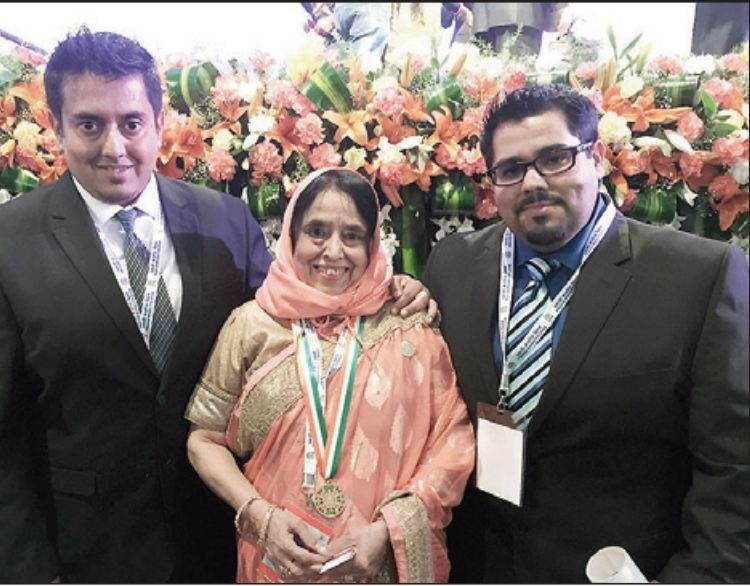
Zeenat Mussarat Jafri with her sons at the Pravasi Bharatiya Divas in Bengaluru on Monday

Bengaluru :

“A Muslim from Saudi Arabia being recognized and awarded by the BJP government. This is India.” This is how Syed Mohsin rejoiced when his mother was conferred the Pravasi Bharatiya Samman  017 in Bengaluru on Monday.

Zeenat Mussarat Jafri, 65, was given the award by President Pranab Mukherjee for providing quality education to children of Indian expatriates in Saudi Arabia. She started the first Indian school in Riyadh in 1982. “My mother is also the first woman of Indian origin from Saudi Arabia to get the Pravasi Samman,” Mohsin’s elder brother Syed Mudassir told TOI.

A native of Lucknow and a former teacher at Kendriya Vidyalaya, Zeenat went to Saudi Arabia in 1979 with her husband Musarrat Jafri, a former DRDO scientist who later joined the Saudi government as a chemical expert.

Zeenat said: “I was moved by the plight of Indians living in Riyadh. Most of them had left their children behind in India because of a lack of educational opportunities. We wanted to do something and that’s when we met Indian Prime Minister Indira Gandhi when she visited Riyadh in 1982. We requested her to speak to Saudi authorities and get permission to start a school for Indian children. We got the green signal.”

Zeenat established the International Indian School in Riyadh from the family’s savings. From the first batch of 20 students in 1982, the school now has 12,000 students and is affiliated to CBSE. “I get angry when people pull their children out of schools. I want them to complete graduation,” said Zeenat, who is running the school for the past four decades.

But what’s more Indian about Zeenat and her husband Jafri is that they haven’t given up their Indian citizenship.Since Saudi Arabia does not allow for dual citizenship, they have accepted permanent resident status. “I am an Indian and I will always be an Indian,” she said.

source: http://www.timesofindia.indiatimes.com / The Times of India / News> City News> Bangalore News / by Rakesh Prakash / TNN / January 10th, 2017

DM & doctor: IAS officer to attend to poor patients in Uttarakhand’s Champawat

Kanpur, UTTAR PRADESH / Champawat, UTTARAKHAND :

Dr Iqbal Ahmad had in 2009 completed his MBBS from Kasturba Medical College, Mangalore in Karnataka. A year later, he was selected for Indian Administrative Service (IAS).

When Iqbal Ahmad, now the district magistrate of Champawat district in Uttarakhand, joined the civil services in 2010, he did not just have the aim of serving the nation, but wanted to go the extra mile.

The young officer had in 2009 completed his MBBS from Kasturba Medical College, Mangalore in Karnataka. A year later, he was selected for Indian Administrative Service (IAS).

However, the Kanpur-born Ahmad had to wait for another seven years to fulfil his “old wish” — to give free medical consultancy to the poor — as he had “no formal registration”.

“On September 15, the Uttarakhand medical council cleared the registration and now I can serve,” Dr Iqbal told HT.

On Friday, he walked into the district hospital and started his medical practice for the first time.

The district magistrate will serve for one hour every morning at district hospital. During tours, he will give consultancy to the locals

Dr MS Bora, chief medical officer of Champawat, welcomed the move, saying, “DM Dr Iqbal’s dececison would motivate our health department and the needy of the district would definitely benfit from his one-hour medical consultancy.”

Champawat has only 42 doctors out of the 95 sanctioned. It has one district hospital and 21 other hospitals besides about 1,500 OPDs.

Uttarakhand has almost 60% shortfall of doctors. Against a requirement of 2,700 doctors state has just 1,000 doctors.

Kumaon commission, Chadra Shekhar also welcomed the decision, saying “If an IAS like him wants to utlize his specialization for the common public, it will benefit the state.”

Shekhar recalled that earlier, a senior IAS officer from Uttarakhand, Dr Rakesh Kumar, also an MBBS holder, had served the people by providing free medical consultancy.

Another officer to have done the same is Sadanand Date, a senior superintendent of police (SSP) posted in Uttarakhand, who is also a qualified surgeon.

source: http://www.hindustantimes.com / Hindustan Times / Home> Cities> Dehradun / by Mohan Rajput, Hindustant Times. Champawat / September 23rd, 2017