Arcot, MADRAS (now TAMIL NADU ) / Faizabad, UTTAR PRADESH :
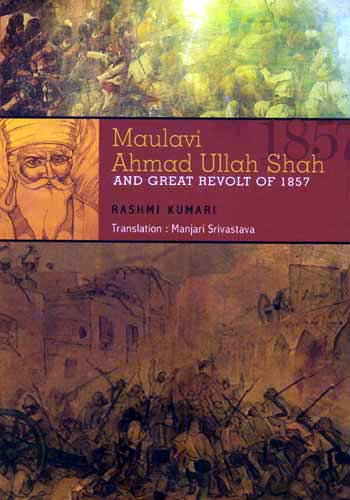
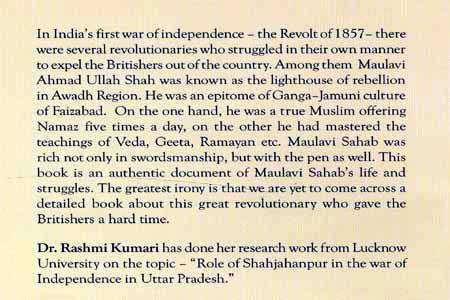
source: http://www.nbtindia.gov.in / National Book Trust, India / Home> Books> National Biography
Arcot, MADRAS (now TAMIL NADU ) / Faizabad, UTTAR PRADESH :
source: http://www.nbtindia.gov.in / National Book Trust, India / Home> Books> National Biography
Arcot, MADRAS (now TAMIL NADU ) / Faizabad, UTTAR PRADESH :
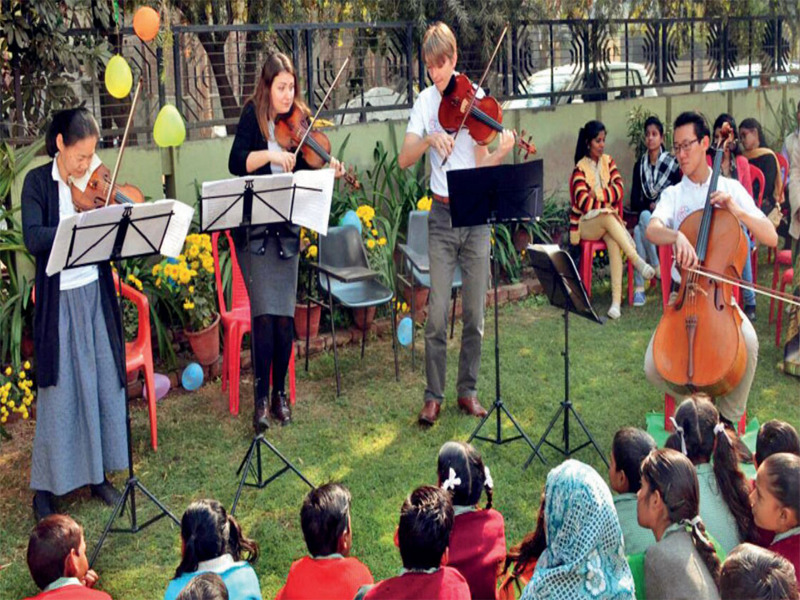
Faizabad
Built 200 years ago, Wesleyan Chapel, a fine specimen of British Architecture, for the British soldiers posted in Faizabad Cantonment, Church of North India is all decked up to celebrate Christmas.
Wesleyan Chapel, built in 1816, merged with Diocese of Lucknow in 1970 and then came to be known as Church of North India.
Talking to TOI, Rev Kaushalendra Solomon, pastor of the church said that special prayer service would be held at midnight on Christmas and then in the morning. Different religious activities will continue in the church till December 31and a special watch night service would be held on New Year eve.
The church committee led by secretary Chitij Charles has ensured special decoration with flowers and lighting as the Church has completed 200 years. Rev Solomon said that they get special cakes baked for Christmas celebrations at a local bakery.
“Ghulam Mohammad, a local scholar, said that Maulvi Ahmad Ullah Shah, who was leading the 1857 mutiny against Britishers from Faizabad, had instructed his soldiers not to damage the Wesleyan Chapel because it was a place of worship.”
source: http://www.timesofindia.indiatimes.com / The Times of India / Home> Neww> City News> Lucknow News / by Arshad Afzal Khan / TNN / December 25th, 2017
Surat, GUJARAT / London, UNITED KINGDOM / Mumbai, MAHARASHTRA :
The book “Surat” by Moin Mir begins with a truth that will send a chill down anyone’s spine.
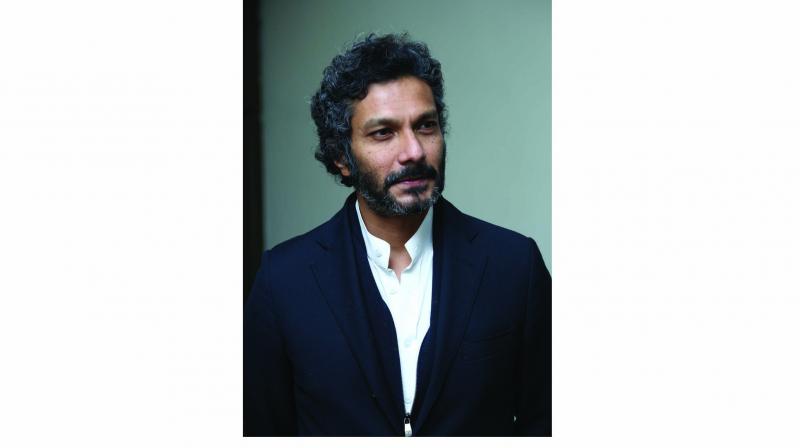
Breaking all the shackles and bending, actually, even defying all the ‘rules’, the prince of Surat, Meer Jafar Ali Khan fought a battle all by himself. And win he did!
The book “Surat” by Moin Mir begins with a truth that will send a chill down anyone’s spine. “It is about how the East India Company took control of the great port city, Surat. They violated a treaty with the Nawab of Surat which stated that his family would be secure from generation to generation by stopping the family’s income, usurping the palaces, estates, jewellery and all that was part of the private estates of the Nawab, leaving the infant granddaughters of the last Nawab on the brink of destitution. In a counter attack Meer Jafar Ali Khan, father of the two infant girls stood to defy an empire and expose the corrupt practices of the Company in Victorian England. Spearheading a legal offensive that would shatter the Company’s reputation, Khan’s campaign for justice generated great heat and debate in British Parliament. Fighting against all odds this prince won it all back for his daughters and found true love” says Mir.
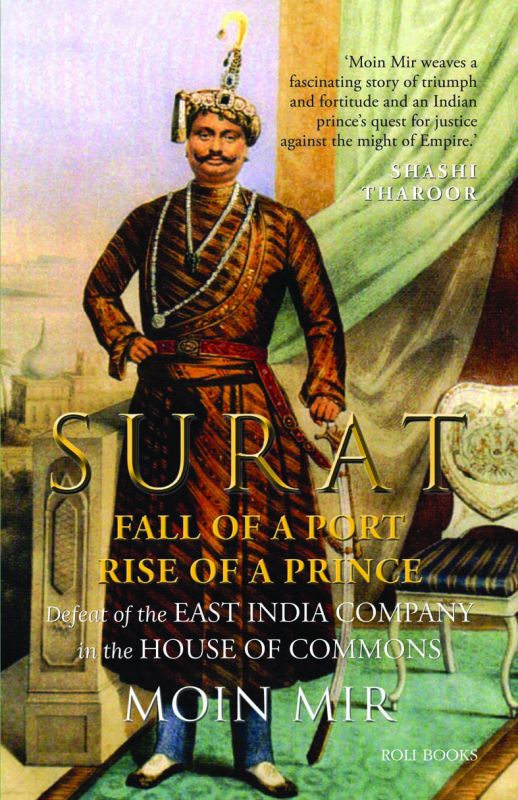
“Two things that inspired me to write this, one that the lead character was a fathr on a quest to fight for justice in 1844 by planting himself there and defying an empire on its own soil.
The second reason to write this book was the city of Surat which was an important port. I wanted people to know that how this thriving maritime port was brought down by the English East India Company,” he adds.
Wanting to release the book on Meer Jafar Ali Khan’s 200th birth anniversary, Mir thought that 2017, was the right time to release it. The message he wants to give is that it is a story of a man who believed in his cause. “It’s a story of a city, an individual, a father and an Indian man in London in 1844. That is rare. And not just being an Indian in London but fighting the empire on their home turf. What are the chances of you winning? Zero! As the empire was at the peak of its power,” he signs off.
source: http://www.asianage.com / The Asian Age / Home> Books / by Kavi Bhandari / January 03rd, 2018
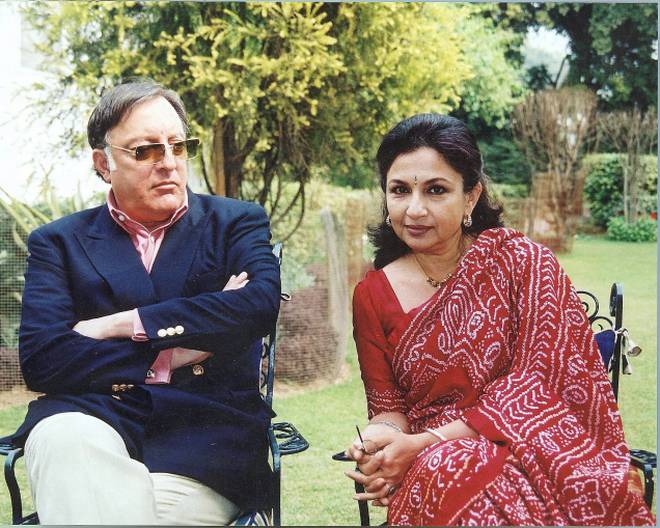
Cricket, cinema and royalty — can there be a more potent mixture? Three decades after he headed the Indian cricket team with such distinction and his begum won the hearts of cinegoers, the spell cast by the couple continues. The Pataudis — Mansur Ali Khan and Sharmila Tagore — embody the Indian dream of gracious living and togetherness. You realise why when you meet them at their spacious bungalow in Delhi.
Though his clipped replies on the telephone make you apprehensive about the interview, he is quite forthcoming when you begin to talk to him. “I know what it is like to be at the other side for I was a reporter for the Ananda Bazaar Patrika many years ago,” he says. He listens to the questions with patience and courtesy. To be a Nawab is to be heir to a lifestyle marked by refinement in speech and behaviour.
How does it feel to be so respected three decades after leaving the game and how much has the royal aura contributed to this, you ask.
“If there is respect, it is because of a mixture of many things,” he replies. “It is also because I married into a recognised family (Sharmila is a grand niece of Rabindranath Tagore) with cultural interests and a literary background. There is a lot of curiosity (about us).
“I was not the only one in cricket from a similar background,” he says. “There were others like me — Hanumant Singh, Inderjit Singh, Fatesingh Gaekwad (who was President of the Board of Cricket Control), the Maharaja of Udaipur, the Patiala family… there were a lot of us around. The disadvantage was not because of the background but because I did not understand the undercurrents; I had not studied in India but abroad. It helped too for I did not get involved in the local politics. Regarding the royal aura, you are right in the sense we didn’t indulge in nepotism or favouritism. We played it pretty straight — not promoting someone because he was from a particular background. I played most of my cricket from the South. I still meet Chandrasekhar, Prasanna and Ramnarayan.”
What are his links now with Pataudi, the princely State in Haryana?
“Links are with the people, not with the soil, After Independence, there was a large transfer of property. Quite a few people from Pataudi migrated to Pakistan. Many of my family members too went away, like my uncle, a former army general in Pakistan, who has written a book about the family and its history.”
Does he visit often and how much regard is there now in Pataudi for the former royal family?
“I’m a fairly private person. I don’t make an issue of going there. But for certain occasions, I do go. A large number of people came to my mother’s funeral to pay their respects. So the connection is still there, the bond is strong. I’m not into politics in Pataudi. I do some social work and am involved in running an eye hospital.”
What are his earliest memories?
“The background for me is cricket or sport. The earliest memories are of playing cricket on the lawns of our home and at the Roshanara Club at the age of nine.”
As for the story that he was upset when his father, the renowned cricketer, Ifthikar Ali Khan, stepped in and took a catch, he says, “Oh, that! I was young and father thought I would drop it.” He adds with feeling, “His was a very good presence.”
“My first coach was Sir Frank Worrell,” says the Nawab who became the youngest captain in the world at the age of 21 and acquired the appellation “Tiger” for his superb fielding skills. “My Master at Winchester College (in England where I did my school) also coached me. Winchester was an important turning point. My son Saif also went there, but perhaps,” he adds reflectively, “it is better to go abroad to study when you are a little older.”
Does he regret not playing one-day cricket as he would have been eminently suited for it?
“Yes. But I’m happy I played for my country. Nobody thought that one-day cricket would become so popular. When we played, there was not much money in the game but we enjoyed our game very much. And no, I don’t watch all the matches whether the World Cup or others. I was a commentator for AIR and Doordarshan. The main activity however had to be cricket or commentary — we had to be totally committed to the game.”
Is he disappointed his son Saif did not become a cricketer but an actor?
“Not at all, there was no compulsion for him to be one. I’m very happy that he is happy.”
Did not the commercials on television and the advertisements in print contribute to keeping the Pataudis in the public eye, projecting them in a regal way?
“If I came across well, it was because of the directors of the commercials,” he states simply.
Having been educated in England, did he not want to settle there?
“I feel very comfortable living here. My forefathers came here from Afghanistan during the time of the Lodis and established themselves after Aurangazeb died. Pataudi was set up as a principality by the English.
How difficult is to maintain the property?
“I have no palace. Palaces are like elephants around your neck. They are very difficult to maintain. Part of the Bhopal Palace has been given to a University. My cousins live in the other portions. My father sold the house in Delhi and built the palace at Pataudi for my mother when they got married in 1938. My mother was recognised as the Begum in 1968. Her elder sister migrated to Pakistan and her son, my cousin, was the manager of the Pakistan cricket team in this World Cup.”
With paternal ancestors at Pataudi and the maternal inheritance of Bhopal, life must have been interesting for him as a child…
“It was. Bhopal was a State with a great deal of protocol. There were bodyguards. When we had to meet our grandfather, we had to wear our best clothes and we were then lined up before him. He would ask: `How’s school? Which class are you in?’ We would answer, bow and come away. Pataudi was different — there were no bodyguards and life was more informal.”
Is not the present trend in the country — of religious fanaticism — disturbing?
“Extremely. But it is inevitable, a post-colonial syndrome which the country has to go through. Moderate voices won’t be heard for a lot of propaganda has been unleashed. It reflects poor thinking and vision, as there are more important things to think of — building houses and providing drinking water. There is so much of unemployment and frustration.”
What does he have to say about his foray into politics?
“I was in politics in 1992, when Rajiv (Gandhi) said `we would like you to come into it’. If he was alive, I might have still been in politics though I find it claustrophobic as it robs you of privacy.”
And how does he spend time now?
“Talking to reporters,” he deadpans.
* * *
“WHAT’S in a name?” asks Sharmila Tagore, acclaimed actress and the Begum of Pataudi, when you talk to her. “To elderly family members and friends, I am the Begum. I’m Rinku to my friends and Mrs. Khan to others. I’m better known as Sharmila Tagore. That’s what I am, what I have made of myself. I come from a middle-class literary background and I don’t have an identity crisis.”
“Belonging to a royal family is not an advantage any more in India,” adds the Begum.
“Titles are no longer respected. The tendency is to minimise their worth whereas titled people are respected in England.
“The reaction here comes from a very uninformed source and is a response to the reading of novels, which depict the royals as debauched and autocratic. The books do not highlight how the former rulers maintained law and order. Bhopal did not lose a single life in riots during Partition. The rulers provided good administration. They still have a place in the hearts of the people and are invited to grace marriages and other functions. Jealousy prompts some people to look down on them. But they can’t help but be impressed by royalty.”
Has she had to give up anything — freedom for instance — by marrying the Nawab?
“I haven’t given up anything. He is very liberal in his views. I’ve gained a lot of experience and gained another culture, cuisine, and way of dressing. I’ve benefited a lot.”
As an outstanding example of a successful Hindu-Muslim marriage, would it not be a good idea for them to make efforts to promote communal harmony?
“Pluralism is the strength of our country. History has shown us that we can co-exist peacefully. India absorbed other cultures but now we are becoming xenophobic. We are reacting 500 years after the Moghuls came. But if Tiger and I make attempts to promote harmony, I do not know how far we will succeed. People will say that I am not a Muslim and that Tiger is a Hindu fanatic.”
How do her two daughters, Saba and Soha, and son regard their lineage?
“Saif is very much into family history and all three children are conscious of their ancestry but in a nice way.”
Cricket lofted it
FIVE HUNDRED years ago, Mansur Ali Khan’s ancestors came from Afghanistan, equipped with superb skills in horsemanship, and looking for greener pastures. Salamat Khan, his forefather arrived in India in 1480 A.D. with his clan during the time of Bahlul, an Afghan of the Lodi tribe, says Tiger’s uncle in his book on the history of the family. Bahlul was governor of the Punjab and later ruled Delhi. A mass migration of Afghans to India took place during his time. Salamat Khan’s family was chosen to quell the Mevati tribe.
Bahlul’s grandson, Ibrahim Lodi, did not trust the Afghan nobles. This led to their rebellion and Babur of Kabul was invited to India resulting in the Battle of Panipat. Ibrahim Lodhi was killed and Mughal rule was established.
Salamat Khan did not actively participate in the Battle of Panipat. His great-grandson, Muhammed Pir, rose to power in Akbar’s court.
In the 18th Century, Alaf Khan of the family assisted the Mughal ruler in his battle against the Maharaja of Jaipur. He was rewarded with Kalam Mahal (which later came to be known as Pataudi House near Delhi Gate) to serve as the family residence.
The princely State of Pataudi was established in 1804 by the British when Faiz Talab Khan (who was made the first Nawab) aided them in their battle against the Marathas. In 1857, the Nawab of Jhajjhar, the Nawab of Pataudi’s cousin, joined anti-British forces and was hanged by the British. The territory was cut in half and Pataudi became a minor State. Cricket placed it on the international map with two generations of players excelling in the game.
Tiger’s mother Sajida Sultan belonged to the well-known House of Bhopal. She became the Nawab Begum of Bhopal after the death of her father, Nawab Hamidullah Khan. Flag Staff House, the residential building of the Bhopal rulers is located within the Ahmedabad palace complex which Hamidullah Khan built in the old Bhopal area. Former Prime Minister Jawaharlal Nehru and President Rajendra Prasad were State guests here.
This article was published in ‘The Hindu Sunday Magazine’ on August 3, 2003
source: http://www.thehindu.com / The Hindu / Home> Sport> Cricket / by Kausalya Santhanam / September 26th, 2011
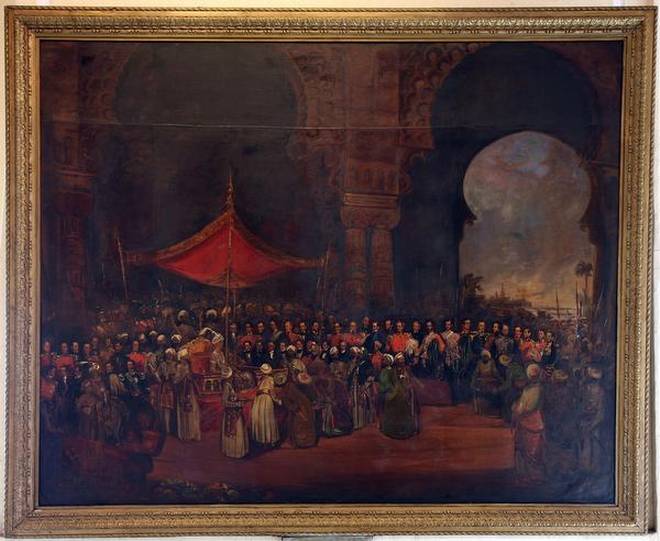
It wasn’t just another royal wedding, when Nawab Ghulam Ghouse Khan, the last Nawab of Carnatic, took Jahangir Baksh as his second wife. Unlike his first wife, who hailed from a Hyderabadi noble family and chosen by the elders, Jahangir Baksh with whom the Nawab had madly fallen in love, was a dancing girl, a courtesan otherwise known as the Tawaif or Kanchen. On November 24, 1848, he married the dancing girl Jahangir Baksh and awarded her the title Azamunnisa Begum.
The tawaifs were female entertainers who excelled in the arts of poetry, music, dancing, singing, and were considered to be well-versed in etiquette or what was known as ‘Aadaab.’ Highly respected for their politeness and refinement, their entertainment was a fine balance of classical song and dance and romantic enticement.
Though the tawaifs were no strangers to the Tamil country, in Madras they were mostly known as ‘Kanchen.’
“The elite among the tawaifs in the Mughal court were usually referred to as Kanchen” says Saba Dewan, an independent documentary film maker, who had made a film on the tawaifs of Varanasi and is currently writing a book on the same theme. In the 1760s when Nawab Muhammad Ali Walajah moved his durbar from Arcot to Madras, it was only natural that the court musicians and dancers, well-versed in Hindustani, followed him to the city.
According to Sawanihat-I-Mumtaz, which chronicles the history of the Nawabs of Carnatic, “Latifa, Tanu and Sajni, known as Sona, were the dancing girls” and “Aminud Din Khan and Ram Singh Bayragi” were the musicians often invited by Nawab Umdat ul Umra to perform at the palace of his senior sister, Sultan Unnisa Begum.
Umdat ul Umra, who also wrote poetry under the pen name Mumtaz, occasionally asked the musicians to set his verses to Hindustani tunes and even chose the dancing girl to sing and dance the verse. An occasion like his father Walajah’s birthday was celebrated with Sona singing and dancing the verses of Umdat ul Umrah set to tune by Aminuddin Khan and Ram Singh.
Kanchenwada
Over a period of time, Madras became home to a number of Kanchen looking for patronage and a locality sprang up in the heart of Madras, right next to Amir Mahal at Royapettah.
Mir Bakshi Ali Street, Mohammed Hussain Street and Jani Jahan Khan Road, where interestingly the Anglo Indians also lived, became the centre of a thriving Hindustani music and dance tradition in Madras. Perhaps due to the predominant number of dancing girls and musicians at Madras, who originated from Hubli Dharwad, the two streets and the road came to be known as Kanchenwada, as wada in Marathi means a locality or a traditional complex with several mansions for different members of a family or a community.
A century after Nawab Ghulam Ghouse Khan passed away the tradition was still alive in Madras. Old timers recall that as the night wore on, the ‘Kanchenwada’ came alive to the rhythms of the tabla, harmonium, dholak, sitar and sarangi, competing with the ghungroo of the dancing girls, who sang sensuous thumris from Urdu ghazals and popular Hindi film song.
For the elite North Indian in Madras, it was at the Kanchenwada, at the mehfil, that some of the finest ghazals of Mirza Ghalib, Kaifi Azmi, Faiz Ahmed Faiz, Shahir Ludhianvi, Shakeel Badauni (UP) and many other poets could be heard. One could also listen to the likes of Ustad Bismillah Khan, ‘who at the invitation of Nayab Jan Bai played Shehnai at her house’ says Saleem, who learnt the Sitar from Ustad Ahmad Hussain. Just like their patrons, among the Kanchen there were both Hindus and Muslims.
Kamala Bai, Gulzar Bai, Radha Bai, Haseena, Mumtaz, Nazeeraa Banu, Nayab Jan Bai and Baby Bai were some of the names that the old timers remember with fondness. The Kanchen were held in such high esteem that ‘the rich used to send their children to the tawaifs to learn etiquette,’ says Rauf, a senior photographer, who spent his childhood in the Kanchenwada.
Cinema and the Kanchen
“The kanchen also sang popular songs from Hindi films such as ‘Pakeezah,’ ‘Kohinoor,’ ‘Taj Mahal,’ ‘Mughal-e-Azam’ and ‘Umrao Jaan’,” says Laiq Ahmed, who himself wrote poems for the Kanchen. Though the arrival of cinema meant new entertainment avenues for the masses, and possibly declining patronage, many Kanchen took to the medium. “Nasreen Banu had danced in Gemini studio’s Hindi film ‘Paigham’,” says Ilavenil, a Tamil writer who also happened to be her neighbour on Jani Jahan Khan Road. Baby Bai, the most popular of the Madrasi Kanchen of the 1950s made a guest appearance in ‘Gharana’ as a nurse, says Laiq Ahmed. She also made a film, which of course bombed, recollected Abdur Razaaq, who met Baby first as a patron and ended up marrying her in 1960.
Like the dancing girls, the Hindustani musicians too found place in the Tamil film industry. Ustad Ahmad Hussain Khan from ‘Achpal Gharana’ in Pune, moved to Madras at the young age of 14. He subsequently became the Choudhry (caretaker) of the Kanchenwada at Royapettah. “He played Sitar for Tamil film Music composers, mostly for K.V. Mahadevan,” says Saleem, his disciple. “The close-up shot of the fingers playing the sitar in the famous song, ‘Sonnathu Neethaana’ of Nenjil Oru Aalayam are not Devika’s but that of the Ustad Ahmad Hussain” reveals Makbhool Hussain, who used to accompany the Ustad for recording to various studios in Madras. Incidentally, the Ustad also taught music at Bharatiya Vidya Bhavan. The Hindustani musicians found patronage in some of the city’s prominent hotels, while the Kanchen were invited to perform at weddings.
Most of the Kanchen had rich patrons. “Every Kanchen who lived on Jani Jahan Khan Road used to entertain at least five customers. There was a plate kept in front of the musicians. The dancer used to drop the money collected from the evening into the plate. After the performance it was split between the musicians and the dancers,’ says Makbhool Hussain, who played the tabla for many of them. There were occasions when a happy patron would shower more than just money. Ilavenil, the Tamil journalist, remembers the instance of a patron throwing a house document at Nazeera Banu (obviously he had registered it in her name), a Kanchen who had migrated post- Partition from a riot torn Delhi to the relative safety of Madras.
Though the Kanchen were entertainers and inhabited a world that bordered on the ‘sinful,’ they were also religious. Rauf, a senior photographer who lived in Mir Bakshi Ali Street observes, “They would not perform during the month of Ramzan or during Muharram. They also celebrated all festivals including Diwali,” he says.
Horse Racing
“Interestingly, the tawaifs from other cities, including Benares, Lucknow, Bombay, Nagpur, Hyderabad, Hubli and Khanpur, descended on the city when horse racing was on,’ says Makbhool Hussain. They probably followed their wealthy clientele, rented houses and camped in the city till the races were over.
However, cinema and the changing social mores were having an impact on the Kanchenwada and trouble was brewing. The anti-Nautch movement that brought a traumatic end to the Devadasi system, was having its impact on the tawaifs too. Cases were filed to stop their practice and Kamala Bai, a Kanchen, engaged M.A. Ghatala, a High Court lawyer, to fight the case. Around 1958, the Madras High court ruled in the Kanchens’ favour. “The kanchen celebrated the win with a big party for my father, at a house near the Music Academy and the Tamil film actor and great comedian Chandrababu was one among the guests,” recollects Javed Ghatala.
However, the times were changing. What the judiciary rightfully refused to stop was brought to an end by a marriage. Abdur Razaq married Baby in 1960 and moved with her to the upcoming T. Nagar in 1962. With Baby Bai, the star performer moving out to lead a family life, the Kanchenwada lost its lustre and many other Kanchen followed in Baby’s footsteps, seeking a future for themselves in the institution of marriage. By the 1970s, a little more than a 250-year old tradition in Madras came to an end, leaving almost no trace of its splendorous past. As Nazeer Akbarabadi, the people’s poet of 18th century laments:
Kya tamashe inqelab-e-charkh ke kahiye Nazeer
Dum mein wo raunaq thi aur ek dum mein yeh be-raunaqi
(What to say of the lustre of revolving time, O Nazeer. In an instant there was such splendour and in another, this dullness)
(Second part: The Thanjavur Quartet connect)
source: http://www.thehindu.com / The Hindu / Home> Society> History & Culture / by Kombai S. Anwar / January 04th, 2018
Bhopal , MADHYA PRADESH :
An 18-year-old widow who declared her infant daughter queen; a wife who survived an assassination attempt and held her husband captive; a princess who abdicated the throne in favour of her mother; a ruler who served as the only woman chancellor of Aligarh Muslim University.
The erstwhile royalty of Bhopal has borne some of the bravest, most dynamic rulers in the 19th and 20th century India. These nawabs were popular, fair, reformist, and fierce; they were also women.
While several women have enjoyed power as regent mothers and influential wives throughout history, Bhopal and its royalty are unique. Between 1819 and 1926, the kingdom saw four women rule it – women who were Nawab Begums, not just Begums, who ruled through inheritance, not proxy.
The movie
Much has been written about these women and their reign, including by the Nawab Begums themselves, documenting both the personal and the political events of their times.
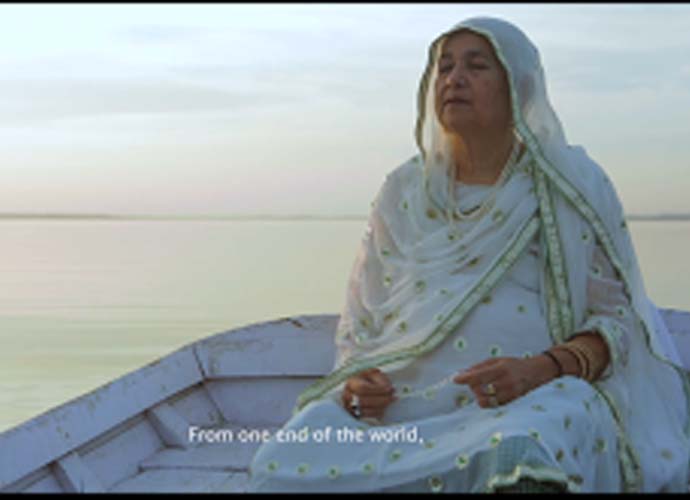
The footprints they left behind have become part of Bhopal’s everyday life, informing and forming its consciousness and character. It is the exploration of this connect that has resulted in Begamon ka Bhopal, a short film, which is both an ode to the universal feeling of nostalgia, and a document of how an interaction with history can turn deeply existential and personal.
The movie has been directed by Rachita Gorowala, a 30-year-old alumna of Xavier Institute of Communications, Mumbai, and FTII, Pune, and will be available to viewers in January on filmsdivision.org.
Gorowala says she made the movie as her own experiment with truth: “A fascination with Pathan woman rulers who ruled Bhopal for over 100 years started me on Begamon ka Bhopal. A journey that may have begun on the lines of fascination with history became existential, introspective and deeper as an experiment with cinema.”
The movie speaks of a Bhopal long past, and seeks to conjure it up through a writer rooted in the city, a grandson who has preserved reels of films shot by his grandfather between 1929 and 1975, two royal descendants, a royal attendant.
The overarching emotion running through the movie is huzoon, a Persian word for powerful nostalgia, a longing for something lost but not gone. The characters speak of their own past lives, or their engagements and attempts to understand the past life of their city.
The emotion and the sense of old Bhopal is created through both audio and visual evocations – the magnificence and now the absence that marks palaces (Moti Mahal, Shaukat Mahal), the Taj-ul Masjid that is a solid link to the past and the present of the city. Music has been used powerfully – songs written and sung by Firoza Khan, one of the former royals who features in the movie – play like both a dirge and an ode.
“As a student of cinema, I learnt that a film is a medium of time and not of telling stories. Stories are meant to be heard and read. It is through juxtaposition of images and sounds that one creates an emotional journey,” says Gorowala.
Begamon Ka Bhopal is her first short film in the genre of poetic-realism, “a lyrical, musical, introspective journey”. “The movie is an ode to the times that once existed in Bhopal, through an everyday nostalgia that is lived by a writer, a film keeper and royal descendants. Each in their own way hold onto time and thus become it,” she says.
The movie has a lot of frames that show only parts, fragments – walking feet, hands busy with embroidery, dry rustling leaves – which seem to reflect the fragments in which we understand and engage with the past, the parts we hold on to, some passages, some stories that call out to us especially, and through which we try to understand the whole, through which we seek to anchor ourselves in the ocean of time.
The character Salahuddin, writer Manzoor Etheshaam, Nawabiyat descendants Firoza Khan and Meeno Ali, the royal attendant Zohra Phupo, all have important roles, the three women are symbols of the past and have survived into the present, the two men belong to the present and are trying to hold onto their connect with the past.
There is a powerful scene of Firoza fingering dolls as she talks of her own moulding into a member of a royal family post her marriage in 1961; she talks as she dresses up, her begum-ness coming alive with each addition of earrings, kangan, kaajal.
The Begums
For her movie, Gorowala had rich material to draw on. Bhopal’s famous Begums had a lot of variety among them in terms of personality and traits – the first, Qudsia, defied her court’s nobles and conventions to declare her infant daughter King in 1819.
Qudsia ruled as proxy for her daughter for 18 years, defending her kingdom against the battering armies of the mighty Marathas – Scindias, Holkars, Gaekwads – and her daughter’s inheritance against internal opposition.
However, some nobles managed to convince the British that a woman ruler was un-Islamic. Thus began a period of daughters inheriting the kingdom and their husbands ruling it. Qudsia’s daughter, Sikander, was married to her cousin Jahangeer. Jahangeer proved unpopular. He even tried to kill his pregnant wife, but she escaped, took refuge in another fort, and subsequently managed to imprison him inside the fort.
Jahangeer died at 26, and once again, his six-year-old daughter Shahjahan was declared king, with power to pass on to her husband when she would get married.
However, Qudsia argued and harangued the British till this clause was removed. Thus, Sikander, and then Shahjahan, both ruled Bhopal as kings who inherited the kingdom. After Shahjahan’s death in 1901, her daughter Sultan Jahan ascended the throne.
While Qudsia was brought up illiterate and in purdah, she rose to the occasion when the need befell her. Sikander was raised to be king. Shahjahan was the most feminine and the least austere of the four, and wrote several books. Sultan Jahan went back to observing purdah, and was the first chancellor of Aligarh Muslim University.
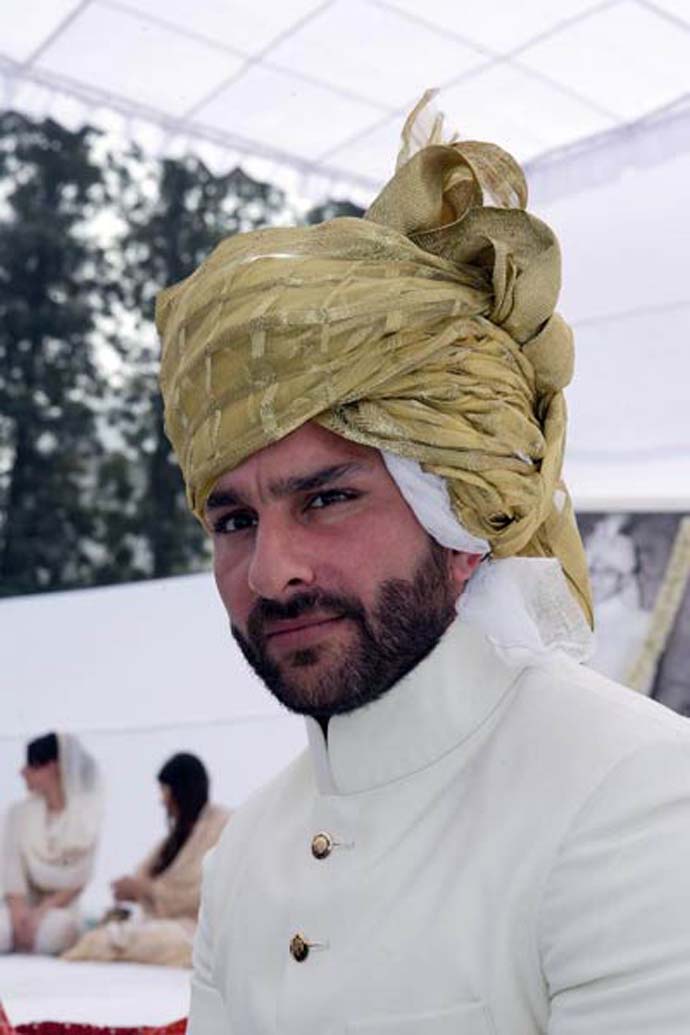
After Sultan Jahan, the throne went to a man, her son Mohammad Hamidullah Khan. However, after Hamidullah died in1960 and his eldest daughter Abida Sultan migrated to Pakistan, his younger daughter, Sajida Sultan, came to power. Sajida’s husband was Iftikhar Ali Khan Pataudi, the grandfather of Saif Ali Khan.
Incidentally, Abida Sultan’s son Shaharyar M Khan, Pakistan’s former foreign secretary, authored the book, The Begums of Bhopal, on his path-breaking ancestors.
source: http://www.dailyo.com / Daily O / Home> Art & Culture / by Yashee @ yasheesingh / December 24th, 2017
NEW DELHI :
Debates were becoming rare and disruptions more frequent, four time Rajya Sabha MP Karan Singh, rued even as he bade farewell to the upper house along with two other Congress MPs Janaradhan Diwedi and Parvez Hashmi.
In a speech peppered with Sanskrit shlokas and Urdu verses, Mr. Singh said, “Parliament has evolved over these 50 years but not all the changes have been positive I must say. I used to remember when I went to the Lok Sabha for the first time. There were brilliant debates by Hiren Mukherjee, Madhu Limaye, Nath Pai, Atalji and here Bhupesh Gupta. Those were the debates now seem to me becoming rare, and disruptions are becoming more frequent.”
He called upon the members to introspect. He said he had come to Delhi as an idealistic young man of 36 and was retiring as an ‘idealistic old man’’. “I have implicit faith that the county will overcome all its challenges as long as we remain faithful to our Constitution and civilisational values,” Mr Singh said.
Speakers from both sides showered praise on them for their contributions. All the three retiring MPs were elected from Delhi. The farewell was held today, the last day of the Winter Session. Their actual retirement date of January 27 would fall in the inter-session period.
Leader of the Opposition and senior Congress leader Ghulam Nabi Azad said his veteran party colleague Karan Singh had become the head of Jammu and Kashmir at the age of 18 and was probably world’s youngest person to hold such a post.
Mr. Dwivedi, who completed three terms as the Rajya Sabha MP, said generally farewell became like an “obituary reference” but today [Friday] was different.
Mr. Hashmi was not present in the house.
source: http://www.thehindu.com / The Hindu / Home> News> National / by Special Correspondent / New Delhi – January 05th, 2018
Bombay (now Mumbai), MAHARASHTRA :
India’s fight against colonial rule was a long drawn out battle that gained momentum in several phases since it started in the early 20th century. Examples of these phases are the Non-Cooperation movement of 1920-22 and the Civil Disobedience movement of 1930-32. However, the one rallying call that gave the country its ultimate push towards complete independence was “Quit India”.
By far the strongest and most vociferous appeal made by the Indian National Congress (INC), “Quit India” asked the British, loud and clear, to leave India once and for all. Interestingly, contrary to popular belief, it wasn’t Mahatma Gandhi who coined this iconic slogan.
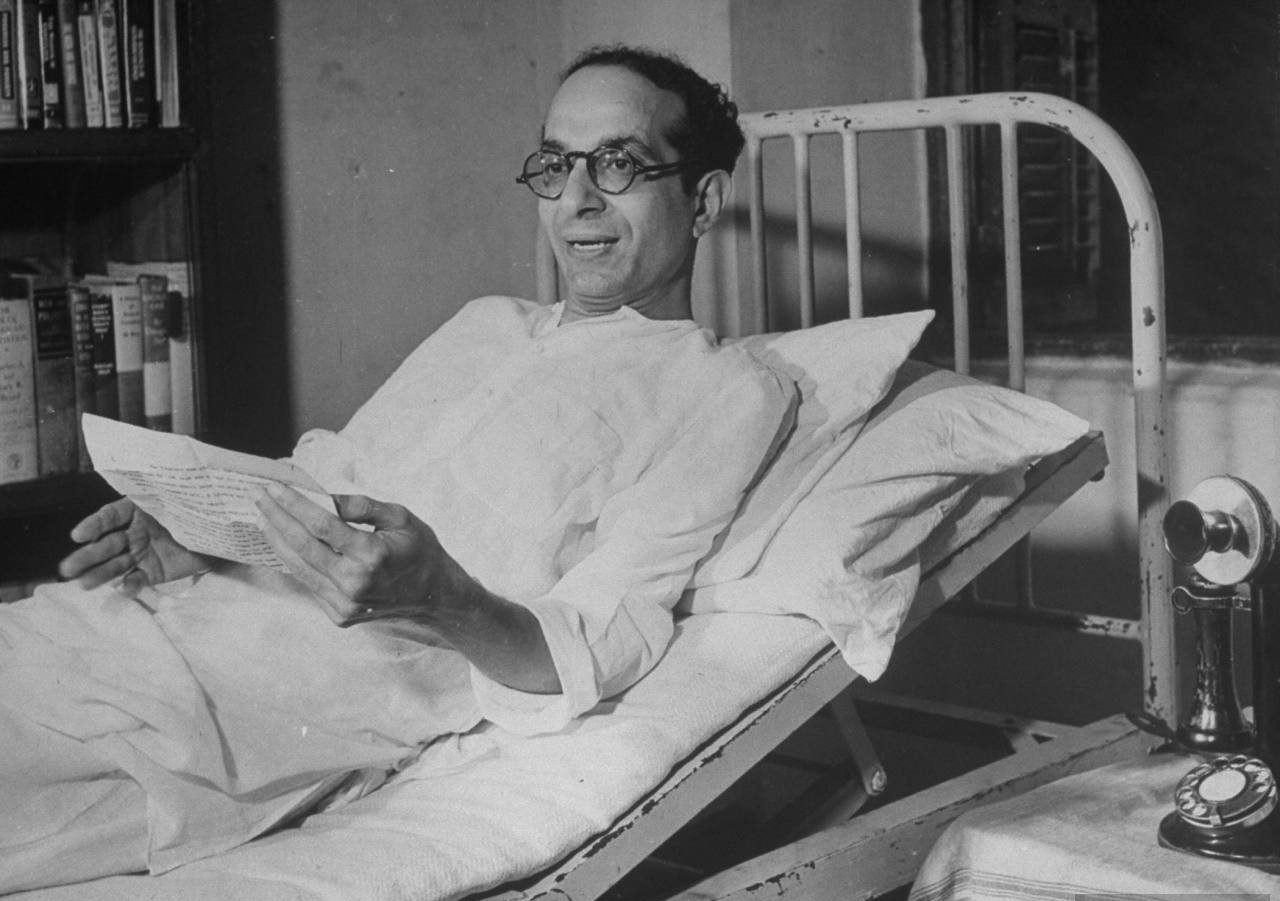
The son of a well-to-do businessman, Yusuf Meherally was born in Bombay on September 3, 1903. Fifty years earlier, his great-grandfather had established one of Bombay’s first textile mills and the family had prospered ever since.
As a young boy, Meherally was curious about the nationalist movements developing around him. While he was in high school, he would spend much time reading about the revolutionary movements of the different nations and the role youth had played in them. Having witnessed his family’s upper class prejudices all his life, the sensitive boy was also deeply affected by the struggles of the working class.
Having soon become a staunch supporter of the freedom struggle, young Yusuf was looked upon as an embarrassing renegade by his pro-British family. Unaffected by their disapproval, he joined the movement immediately after finishing his schooling from Bharda High School.
After earning a B.A. in History and Economics from Elphinstone college, he was studying law at the Government Law College in February 1928 when Simon Commission reached Bombay. A group of seven British Members of Parliament, the Simon Commission had arrived in India to suggest constitutional reforms but didn’t have a single Indian member. This unfair and insulting decision had led to much anger and disappointment among Indians.
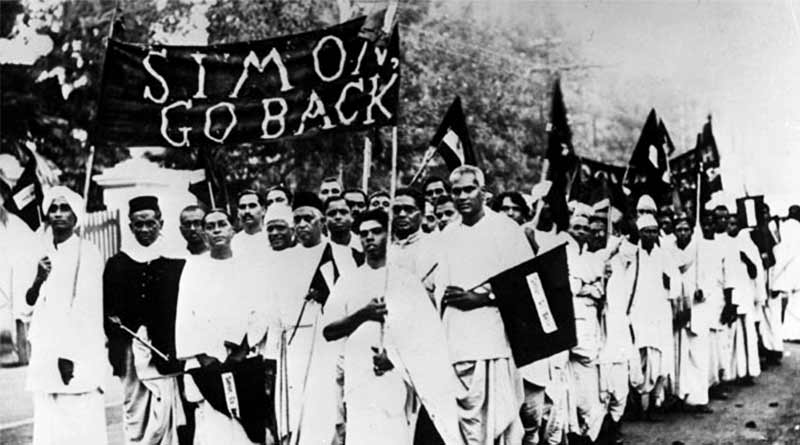
Having founded the Bombay Youth League the very same year, Meherally immediately organised a protest against the Simon Commision. He had initially planned an ambitious expedition on boats to meet the members at sea itself, but the plan was leaked and the police took stringent steps to prevent it from happening.
Undaunted, Meherally and other young men dressed up as coolies to get access to the Bombay port where they greeted the members of the commission with black flags and the slogan “Simon Go Back”. The resolute demonstrators were lathi-charged thrice but they did not budge an inch. As the news of the demonstration spread like wildfire, establishments across the city began observing spontaneous hartals.
Overnight, Meherally’s courage and slogan were on everyone’s lips, including Mahatma Gandhi’s. Not only had he dared to shout his slogan to the face of a powerful British politician, he had also defied the directions of his political seniors who counselled inaction.
Threatened by his growing popularity and radical views, the British debarred him from practising law to the consternation of his family. The rarity of this action can be seen from the fact that though several nationalist leaders were lawyers, none of them had been barred from practising law.
Two years later, when the Civil Disobedience movement was launched, Meherally and his band of young volunteers worked tirelessly to keep the morale of the public up in face of the severe repressive measures that the British unleashed.
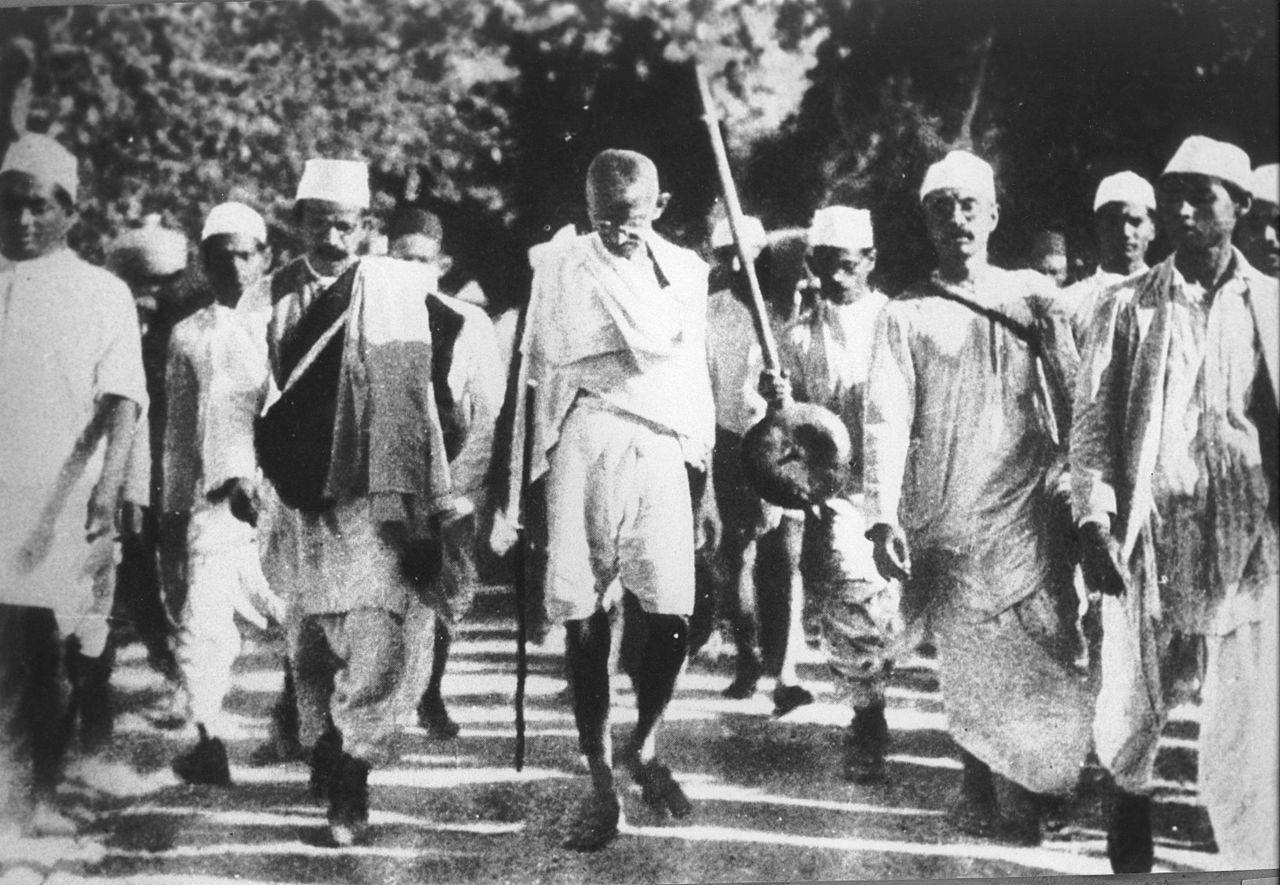
As INC’s prominent leaders courted imprisonment and went to jail during the Salt Satyagraha, Meherally kept the movement running till he himself was arrested in 1930 and sentenced to four month’s imprisonment.
In 1932, Meherally was again arrested for conspiracy and sentenced to a two-year term in the Nasik prison. It was here that he met and interacted with the radical socialist leaders of the freedom struggle.
After his release in 1934, he joined hands with Jayaprakash Narayan, Asok Mehta, Narendra Dev, Achyut Patwadhan, Minoo Masani and others to found the Congress Socialist Party. The organisation hoped to transcend communal divisions through class solidarity and bring about economic empowerment through decentralized socialism (i.e farmer co-operatives and trade unions).
In 1938, Meherally led the Indian delegation to the World Youth Congress in New York before attending the World Cultural Conference taking place in Mexico. Here, he was struck by the lack of literature on contemporary issues in India when compared to the West. Determined to fill this gap, he authored a series of books titled ‘Leaders of India‘ that focused on current topics and translated them to Gujarati, Hindi and Urdu.
Here is an excerpt from the foreword he wrote:
“The rise of the pamphlet and the booklet as a powerful weapon for the spread of ideas has been truly remarkable. During my visits to these continents (US and Europe) I was greatly impressed by the part that such brochures play in moulding public opinion. In Europe and America there exists a wealth of topical literature that is in striking contrast to its scantiness in India.
The Current Topics Series of Padma Publications is an attempt to meet this need. The idea is to publish every few months a booklet on a subject of topical or special interest having regard to present-day controversies and their bearing on the future. The series will not be restricted to political questions only. Every title will be published in a pleasing format, at a price within the reach of all.”
In the next few years, Meherally was arrested several times for defying prohibitory orders and participating in Individual Satyagraha (launched by Gandhi to affirm one’s right of speech and oppose the British decision to involve India in World War II without the consent of its people).
In 1942, he was still in Lahore Jail when he was nominated by INC for the election to Bombay Mayoralty.This nomination was personally backed by Sardar Vallabhbhai Patel who knew that Meherally belonged to that rare breed of leaders for whom personal gratification meant ensuring the well-being of fellow countrymen.
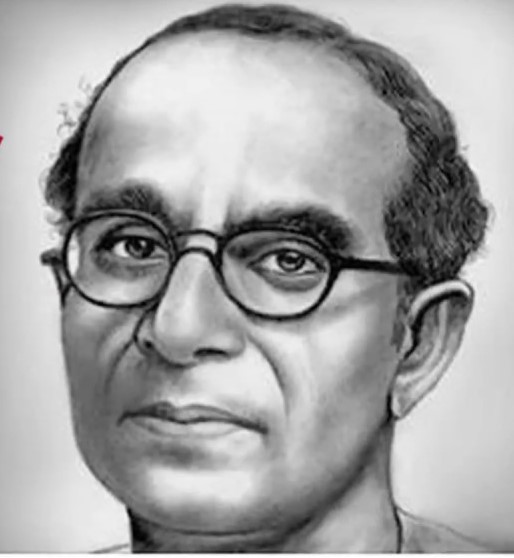
Released from prison to participate in the elections, Meherally won comfortably, becoming the youngest Mayor in the history of Bombay’s municipal corporation. During his tenure, he became immensely popular among the public due to his dedication towards ensuring effective civic service.
One of Meherally’s first steps as a mayor was to introduce a quick dispatch system for files and deal with slacking officials with an iron hand. Other than personally attending to citizens’ complaints on civic issues, he took the unprecedented decision of refusing to pay municipal money for the British Government’s Air Raid Precautions (ARP) scheme.
The ARP scheme was a programme initiated for the protection of civilians from the danger of air raids. It included the organisation of ARP wardens, messengers, ambulance drivers and rescue parties who would liaison with police and fire brigades in case of an air raid.
Earlier, Bombay’s municipal corporation used to pay Rs 24 lakh to the British government for the ARP scheme but an adamant Meherally argued that the defense of the city should be in the hands of those who would remain on the scene no matter what and not the British who would probably withdraw in case of an attack (just like they had done in Malaya and Burma).
This led to the organisation of the People’s Volunteer Brigade in Bombay and the city became the only one in India where the municipal corporation was allowed to run the ARP scheme.
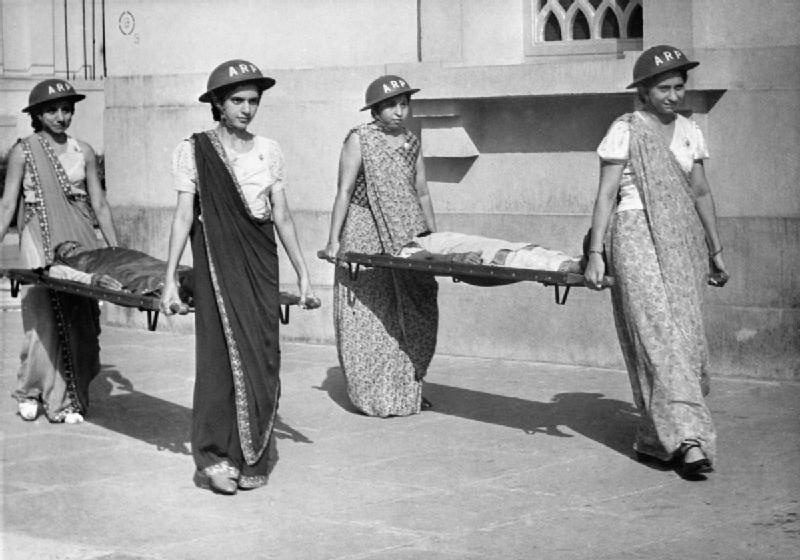
All this while, he continued being involved in the country’s fight for freedom. On July 14, 1942, INC’s working committee had met at Wardha and demanded complete independence, failing which a massive civil disobedience movement would be launched.
Soon after, at a meeting in Bombay, Gandhi conferred with his closest associates on the best slogan for the movement. C Rajagopalachari suggested ‘Retreat’ or ‘Withdraw’ but it didn’t find much favour with the leader. It was Meherally who then came up with the succinct phrase — ‘Quit India’ — that got Gandhi’s approval.
In preparation for the nationwide movement, Meherally published a booklet titled Quit India (that sold out in a matter of weeks) and got over a thousand ‘Quit India’ badges printed to popularise the slogan. On August 8, 1942, Gandhi delivered his powerful Quit India speech at Mumbai’s Gowalia Tank Maidan. The next day, he was arrested along with practically the entire INC leadership.
Realising that these arrests had created a vacuum in the communication between the leadership and the masses, Meherally immediately mobilized his socialist colleagues – Aruna Asaf Ali, Ram Manohar Lohia and Achyut Patwardhan – to take charge of the Quit India movement while hiding underground, just before he himself was caught and put in prison.
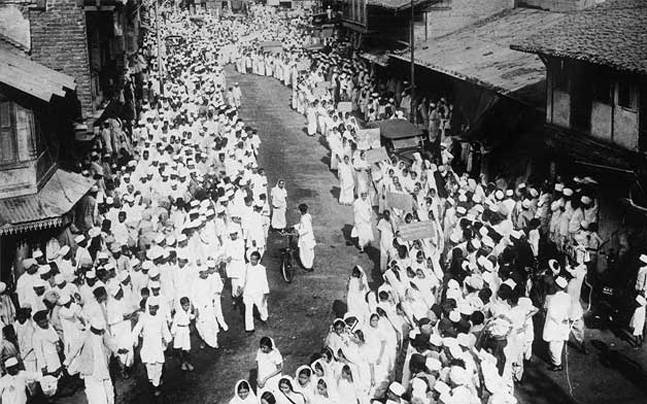
It was during this last tenure in prison that Meherally suffered a debilitating heart attack. The prison authorities offered to shift him to St George Hospital for special treatment but the principled man demanded that two other ailing freedom fighters should also get the same facilities. When the authorities refused, he chose to remain in prison.
Over the following few months, freedom fighters across India responded with waves of civic rebellion despite the violent backlash from the British authorities. While the Quit India Movement did not result in immediate attainment of freedom, it did indeed create the massive pressure that resulted in India bidding farewell to the British just three years later.
By the time he was released in 1943, Meherally’s health had deteriorated sharply but he continued to contribute to the cause of Indian independence. The selfless leader was over the moon when his beloved motherland finally unshackled the chains of colonialism and awoke to freedom on August 15, 1947.
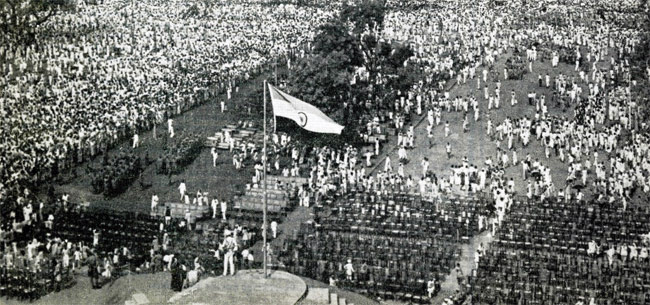
However, the years of struggle had taken its toll, rendering him weak and bed-ridden, though only physically and not in spirit. Even from his hospital bed, he continued to work to highlight India’s vibrant diversity and rich heritage.
In October 1949, Meherally organised a one-of-its-kind exhibition that displayed more than 200 pictures and paintings that traced the evolution of India’s freedom struggle since 1857. He also organised several cultural and literary events at Bombay’s famed Kala Ghoda, inviting Indian personalities who were legends in their respective fields.
On July 2, 1950, Yusuf Meherally passed away at the age of 47, his death rousing the same passion in the public as his slogans. Shocked at the loss of their beloved leader, all of Bombay was in collective mourning. The next day, as the clock struck noon, buses, trams and trains across the city stopped for a few minutes.
Almost all schools, colleges, shops, factories and mills remained shut. The Bombay Stock Exchange, an iconic symbol of the city’s financial strength, witnessed no trading though officially open for business. The city that never stopped, Bombay stood still in the memory of the man who had literally given his lifeblood for the city’s well-being and the country’s cause.
source: http://www.thebetterindia.com / The Better India / Home> Freedom Fighter> History> Lede / by Sanchari Pai / September 28th, 2017
Kolanur Village (Konaraopeta Mandal) , ANDHRA PRADESH :
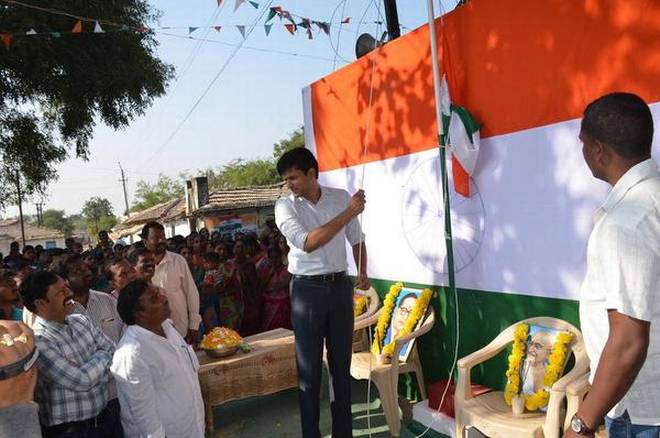
In order to inculcate the values of patriotism, a village sarpanch belonging to the Muslim community launched a novel campaign of singing the national anthem everyday in the interior Kolanur village of Konaraopeta mandal on Monday.
Buoyed over the successful singing of national anthem in Jammikunta town of Karimnagar district since last Independence Day, village sarpanch Abdul Rasheed has decided to implement the singing of Jana Gana Mana in the village everyday from the New Year, at 8 a.m.
Collector D. Krishna Bhaskar formally launched the programme in Kolanur village on Monday by hoisting the national flag at the gram panchayat office. All the villagers — including children, women and elders, participated in the programme and recited the anthem by saluting the national flag.
Mr. Bhaskar lauded the villagers and sarpanch for taking up the programme. Taking a cue from Kolanur villagers, the Collector wanted other villages to take up the patriotic programme.
Village Sarpanch Abdul Rasheed said that he had taken up the programme to educate villagers on the importance of freedom struggle and supreme sacrifices made by freedom fighters.
“The daily singing of the national anthem is also a way to pay respect and tribute to the soldiers who lost their lives while discharging duties on the borders,” he maintained.
DPRO Mamidla Dasaratham, District Grandhalaya Samstha chairman Akunuri Shankaraiah, DRO Shyam Prasad Lal, MPP Laxmi and others were also present.
Korutla joins the initiative
Meanwhile, now it is the turn of the Korutla Kirana Merchants association members to hoist the national flag and sing the anthem daily in the Korutla town of Jagtial district from Monday.
The association members installed 33 public address systems in the town to ensure that the anthem is audible to all people in the town at 9 a.m.
The town entered the Telugu book of records for hoisting 101 national flags to launch the programme. Korutla legislator K Vidyasagar Rao, Municipal chairman S. Venugopal, DSP Malla Reddy, public representatives and philanthropists hoisted the flags along the National Highway. Telugu book of records founder Chintapatla Venkatachary handed over the certificate to Korutla Kirana Merchants association president Chidrala Ashok on the occasion.
Meanwhile, inspired by patriotic zeal of Kolanur villagers, two other villages in the Konaraopeta mandal have come forward to launch the daily singing of the national anthem in Marthanpeta and Suddala villages.
source: http://www.thehindu.com / The Hindu / Home> News> States> Telangana / by K.M. Dayashankar / Rajanna-Sircilla – January 02nd, 2018
Bombay (Mumbai), MAHARASHTRA :

IN 1942, a daughter was born to Fathema Ismail, the sister of cotton king and Congress financier Umar Sobhani, and Mohammad Hasham Ismail, a government of India trade commissioner posted in Mombasa. She was fondly named Usha – after the Goddess of dawn – in the expectation of a new dawn as the city and the country was immersed in the Quit India movement. Fathema Ismail was closely involved with Kulsum Sayani (the mother of Ameen Sayani) in women’s education and the establishment of All India Village Industries Association. When Usha turned three the family discovered that she had polio.
“Amma was dejected with the news, but at the same time she was determined to get the best treatment for me,” recalls Usha Cunningham who is now based in New York. She recalls the turbulent years where India fought and finally achieved freedom from the British, which ran parallel to her own fight with polio. Patel Manzil at Nepean Sea Road, where Usha grew up was a safe haven for underground activists. “Aruna khaala (Aruna Asaf Ali) and other leaders would live under assumed names in our house. My mother’s nationalist leanings were well-known but as my father was a trade commissioner, we escaped scrutiny.”
In her search for a doctor, Fathema was referred to Dr M G Kini, an orthopaedic surgeon based in Madras. “Dr Kini was a crusty, old man who first declined to accept my case. Amma would literally sit outside his residence and accost him in the morning, afternoon and evening when he would travel between his house and clinic. He ultimately agreed and we stayed in Madras for around eight months,” recalls Cunningham. Under Dr Kini’s guidance Usha showed tremendous improvement.
The Madras visit also marked the beginning of Fathema’s discovery about the lack of facilities for children afflicted with polio. Soon her husband Mohammad was transferred to Iran from Mombasa, but she stayed in India. After Madras, the next stop was Pune, where, Fathema had gathered, there were some facilities for rehabilitating injured soldiers at the British Army Hospital. “There were three British physiotherapists who would treat the injured soldiers with the help of a few trained Indian assistants. Amma requested similar training and after some reluctance was allowed access,” remembers Cunningham.
What worked in her favour was the fact that Fathema had gone to Vienna to study medicine in 1920 after finishing her schooling, but had to return due to a financial crisis in the family. For three years she had stayed alone in Vienna absorbed in her studies. Decades later, those three years of study helped facilitate a better understanding of the process of rehabilitation. More than two years of treatment and therapy changed Cunningham’s life. From “totally paralysed”, she regained remarkable mobility in her right leg. Little did she know that she would soon become an exemplar of how patients with polio need not be confined within the walls of their house – ignored and neglected.
Fathema was now determined to start a facility for the countless poliostricken children and their parents. Her experience and observation in Madras and Pune gave her the confidence to start a clinic in Bombay (as it was known then). But finding a suitable space amidst a financial crunch plus low awareness of the disease were formidable hurdles. She also had to ensure she had enough medical equipment to attend to the children. The war had ended and the imminent departure of the British meant that the Army hospital in Pune faced an uncertain future.
In 1946 she had established the Society for the Rehabilitation of Crippled Children (SRCC) but despite her pleadings, the hospital was not willing to share or sell the equipment. She then convinced two of the Indian assistants to get the various equipment and kits transferred to Bombay while the hospital was winding up. “She promised them jobs and convinced them of the immense good this would do for the poor patients,” recalls Cunningham, the excitement in her voice palpable as she recounted her mother’s exploits.” Not many people know that six truckloads of machinery were taken out from Pune,” she says.
These surreptitiously transported kits formed the base for a polio clinic that was opened in May 1947 in the empty Chowpatti premises offered by Dr A V Baliga, who was going to the United States on a study tour. After few months the Bombay government gave space in the empty barracks at Marine Drive as the clinic’s immense popularity led to a waiting list. In the wake of Independence, Bombay and India, had woken up to the need of rehabilitating the differentlyabled. Medical journals and international aid organisations took note of Fathema Ismail’s enterprise.
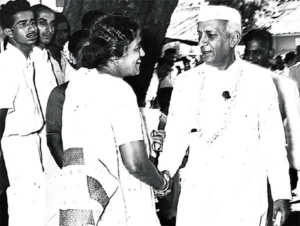
In 1951, she visited the United States on the state department’s invitation for a four-month tour of various hospitals, and the same year went to Europe to attend international conferences. She was now determined to open a full-fledged hospital. “She caused quite a headache to Prime Minister Nehru as she demanded a plot near the race course at Haji Ali. It was a prime location and Nehru would say ‘Fati, why only that plot? I can request the Bombay government to give some other place’. But Amma was insistent. The racecourse was frequented by the rich and the famous and one of the reasons for the request was that she wanted larger society to be fully aware and responsive to the problem of polio.”
The result was a children’s orthopaedic hospital, which opened in 1952 and was inaugurated by Nehru, which continues to operate to this day. After roughly 30 surgeries and years of therapy, Cunningham who is now 75 years old, has no regrets. “I have climbed mountains, ran a business in Delhi, shifted to America, got married, have a caring husband and daughter. This is what Amma wanted. Similarly she convinced several industrialists to offer training for the handicapped at her centres so that they could get employment.” In 2011, India announced that it had eradicated polio but the foundation stone for this incredible campaign was laid by a lady who had the grit and determination to envision a polio-free society over 70 years ago.
source: http://www.ahmedabadmirror.indiatimes.com / Ahmedabad Mirror / Home> Others> Sunday Read / by Danish Khan, Ahmedabad Mirror / August 20th, 2017