Category Archives: Community Involvement / Social Issues

With a rare mehr, this Kerala bride has broken stereotypes

Mallappuram , KERALA  :

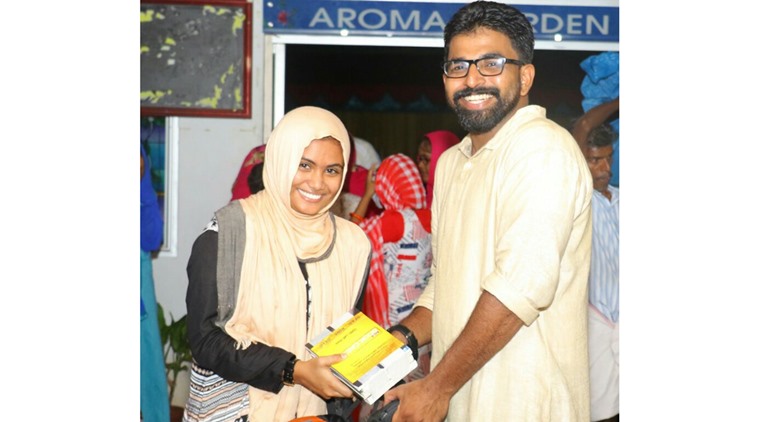
A Malayali Muslim bride demanded 50 books as part of a custom in Muslim weddings, only that the custom has mostly seen woman’s family demanding gold or money.

This Malayali Muslim bride decided to break stereotypes, the religious way, on the day of her marriage! (Source: Sahla Nechiyil)

How often do you see a woman demand books as mehr, and not the customary jewellery or gold. In Kerala’s Malappuram district, a woman set an example for her community. A post graduate in political science from the Hyderabad University, Sahla Nechiyil never dreamt of a perfect, fairytale wedding. But when she decided to get married, she also sent across a social message to the “gold-obsessed” Muslims in Malappuram.

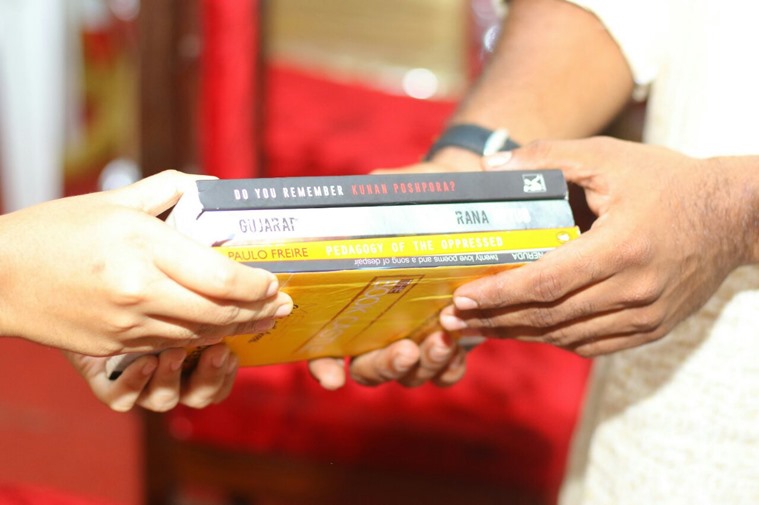
Nechiyil decided to demand 50 books from her fiancé as mehr, a mandatory payment in the form of money or possessions paid or promised to be paid by the groom to the bride at the time of marriage. She asked for books as mehr because of two reasons. “One, because according to the religious texts, a girl can demand anything she wants and the groom cannot disagree. And second, because I wanted to show the Malappuram Muslims that a wedding can take place without obsessing over the amount of gold transacted between both parties,” she said.

(Source: Sahla Nechiyil)

Her husband (they got married on August 11) cannot agree more with Sahla and supported her stand wholeheartedly. “Mehr is the right of the woman, not the generosity of the man,” he said. Anees Nadodi  was promptly handed a list of 50 books by Nechiyil, and he went all the way to Bangalore to find all the books that she wanted. All this amidst much disapproval from both the families. In Nechiyil’s case, however, more than her parents, her relatives disagreed. “They could not argue for long, because we were not doing anything against the religious texts,” said Nechiyil.

source: http://www.indianexpress.com / The Indian Express / Home> Lifestyle> Life-Style / by Soumya Mathew / New Delhi / October 29th, 2016

Rani Chennamma Award for 16 women

KARNATAKA :

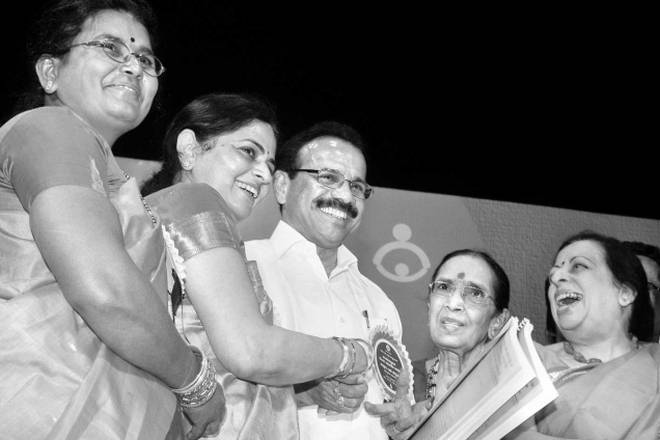
ACHIEVERS:Chief Minister D.V. Sadananda Gowda and his wife, Datty, sharing a light moment with winners of the Kittur Rani Chennamma Award in Bangalore on Thursday.— Photo: V. Sreenivasa Murthy

Chief Minister D.V. Sadananda Gowda on Thursday presented the Kittur Rani Chennamma and other awards instituted by the Women and Child Development Department to six women organisations and 16 women for their achievements in different fields of women development on the occasion of International Women’s Day.

Adarsha Stree Shakti group of Mysore, adjudged as the best got Rs. 50,000 cash prize, a rolling shield and award. Nandini Stree Shakti Group of Davangere and Yashasvini Stree Shakti Group of Kolar were given Rs. 30,000 and Rs. 25,000 cash prizes respectively.

The organisations honoured with Rs. 25,000 cash prize each for their role in the development of women are: CICOPA, Bangalore; Paripoorna Grameenabhivrudhi Mahila Seva Samsthe, Dharwad; Yashasvini Mahila Mandali, Kolar; Basaveshwara Vidya Samsthe, Chitrudurga; Krishi and Grameena Yuvajana Abhivrudhi Samsthe, Haveri; and Grameena Abhyudaya Seva Samsthe, Doddaballapur.

Leela Krishnamurthy and K.B. Sarvamangala Sastry of Bangalore, Kudikandi Kaveramma Somanna of Madikeri, Rekha Patil of Bijapur, Pushpa Ramachandra Pathar of Gadag, Annapoorna Nirvani of Belgaum, Nirmala Jodappa of Koppal in women development; Shilpa Nanjappa of Kodagu, A. Rukmini of Chamarajanaagar, Nagaratna Nagaraja Hadagali of Dharwad, Naseebanu Abdul Ghani of Bagalkot and Lakshmi Mahadeva of Belgaum in arts; Pramila Karnad of Mangalore and Vimala Inamdar of Koppal in literature; A. Shaheena of Bangalore and Vijayakumari of Hassan in sports were also honoured on the occasion.

Three district awards of Rs. 80,000, Rs. 70,000 and Rs. 60,000 were given to stree shakti okkoota of Sullia, Chikkanayakana Halli taluk stree shakti okkoota and Mysore taluk stree shakti okkoota, respectively.

Mothers-in-law plea

Karnataka Mothers-in-law Association president Shilaja Hiremath and general secretary Rani Nagaraj wanted to present a memorandum to the Chief Minister complaining of harassment by the daughters-in-law and their relatives misusing Section of 498 A of IPC. But, Mr. Gowda asked them to meet him in Vidhana Soudha to discuss the issue.

Addressing the gathering Mr. Gowda said that there was a need for ending female foeticide for maintaining the male-female ratio. He called upon women to strive for achieving self respect and expressed happiness over the achievement made by 1.40 lakh stree shakti self-help groups by saving Rs. 1,040 crore. His wife Datty Sadananda Gowda was also present.

The former Union Minister M.V. Rajasekharan gave away cash prize of Rs. 25,000 each to Bhoomika Stree Shakti group of Bangalore, Dyamavva SSG of Hassan, Maheswari SSG of Haveri, Jija Matha Mailara SSG of Bidar. He released a book-Yashodhara Gathe and Karnatakada Saadhakiyaru to mark the birth centenary of the former Minister Yashodharamma Dasappa. The State Planning Board Vice Chairman Ramachandra Gowda released Antarala Sanchike-7 book.

source: http://www.thehindu.com / The Hindu / Home> National> Karnataka / by Special Correspondent / March 09th, 2012

Bilal Nazki appointed chairperson of JKHRC

BIHAR / Srinagar (JAMMU & KASHMIR) :

Srinagar : (PTI)

Jammu and Kashmir Governor N N Vohra today appointed former Chief Justice of Orissa High Court Bilal Nazki as the chairperson of the State Human Rights Comission.

“The Governor today appointed Justice (retired) Bilal Nazki as Chairperson and Jang Bahadur Singh Jamwal, District and Session Judge (retired) as Member of the J-K State Human Rights Commission (SHRC) with effect from the date they assume charge of their offices,” an official spokesman said.

Justice Nazki retired as Chief Justice of Orissa High Court in November 2009 and was later appointed as the chairperson of Human Rights Commission of Bihar.

He also headed the committee set up by the Centre to review the functioning of the Haj Committee of India and its state units in 2013.

While the SHRC was without a chairperson since 2011, it became non-functional since June 2014 after the last of its members completed their term.

source: http://www.ptinews.com / PTInews.com / Home> National / PTI / Srinagar – October 24th, 2016

Rummana Hussain, 47, Indian Conceptual Artist

Bengaluru, KARNATAKA / Mumbai, MAHARASHTRA :

Rummana Hussain, a painter and conceptual artist who was also active in Indian politics, died on July 5 at her home in Bombay. She was 47.

The cause was cancer, said the photographer Ram Rahman, a friend.

Ms. Hussain, who came from a prominent Muslim family in Bombay, was for much of her career a painter of allegorical figurative subjects. But political events in India, particularly the destruction of a mosque by Hindu militants in the city of Ayodhya in 1992 and the subsequent attacks on Muslims, spurred her into political action and changed the direction of her work.

She participated in demonstrations protesting both the Ayodhya incident and growing religious nationalism in India. She developed a photo-based feminist art that brought images of ruined architecture, land and the female body together in pointed combinations.

As an artist in residence at Art in General, an alternative space in Manhattan, she created a video-based installation last fall. Titled ”In Between,” the video combined images of Bombay with others of South Asian immigrant life in New York and alternated shots of the artist under treatment in a Manhattan hospital with others of her walking across the Queensboro Bridge wearing the tinkling ankle bells of an Indian classical dancer.

Ms. Hussain showed widely in India and in Europe

She is survived by her husband, Ishaat, and a daughter, Shazmin.

source: http://www.nytimes.com / The New York Times / Home> N.Y./ Region / by Holland Cotter / July 18th, 1999

Kurnool royal wedding comes to Dubai

Kurnool, ANDHRA PRADESH  / Dubai, UNITED ARAB EMIRATES :

Besides the groom dressed as a prince in a royal entourage, flanked by a column of soldiers and a set designed as a castle, the wedding will bring together celebrities from the UAE, Turkey, Sri Lanka and Pakistan.

Some Indian ministers are also expected to attend this wedding of the daughter of Nawab Shahtaj Shaji Ul Mulk, founder and chairman of Sharjah-based Mulk Holdings.

A hall at the famous Atlantis hotel is being recreated into a mini palace for the main wedding event which is scheduled for January 4.

The groom, Bilal Muahid Khan, who has a degree in infrastructure engineering is settled in the US. He recently won an award for his design proposal of infrastructure study and solutions for the city of Charlotte. His father, Masood Nawaz Khan, is a cardiologist based in Charlotte.

The Khans also belong to a royal family and are distant relatives of Nawab Shaji Ul Mulk.

Royal entertainment such as dance shows, poetry recitation and fire throwing will be part of the show.

An Indian singer has reportedly been roped in for an unplugged show.

Indian Mela (carnival) will be the theme for the Mehndi ceremony, which is scheduled for January 3.

Performers like magicians, stilt walkers and rice carvers have been roped in for this event.

source: http://www.business-standard.com / Business Standard / Home> PTI Stories> International News /by Press Trust of India / Dubai / August 03rd, 2010

First place in Pratibha Karanji

Mysuru, KARNATAKA :

Mohammed Salman, 9th std student of Nazarbad Government Bifurcated Maharaja PU College and High School has won first place in the State-level Pratibha Karanji, Ghazal singing competition held at Siddaganga Mutt in Tumakuru district.

source: http://www.starofmysore.com / Star of Mysore / Home> In Brief / October 13th, 2016

Second Yamin Hazarika Award Goes to Athlete Tayabun Nisha

Guwahati, ASSAM :

tayabunnishampos16oct2016

Guwahati :

The strains of Assam’s state anthem ‘O mur apunar dex’ marked the conclusion of the memorial meeting held in memory of one of the iconic daughter of Assam, late Yamin Hazarika.

The second Yamin Hazarika Woman of Substance Award 2016 was presented to Tayabun Nisha, former athlete of Assam who represented India in the 1982 Asian Games. She is the second recipient after noted author and columnist Indrani Raimedhi who received it last year. This award was institutionalised to honour late Yamin Hazarika, DCP, Delhi Police, who passed away while still in service. She was the first woman police officer from Assam, a trendsetter in those times. The award is given by Women’s Hub, a collective of women professionals from around the country.

This year’s award ceremony was held on her 17th death anniversary (24 July) at Blue Paradise in Six Mile, Guwahati amidst an august gathering. Dr. Nahid Islam, Consultant Psychiatrist, GNRC, in her welcome address, gave a brief overview of Women’s Hub. She said that this award is given to honour and appreciate women from diverse fields who have made a mark against all odds.

The function opened with three books written by members of Women’s Hub being released by the guests. This event was co-ordinated by Dr. Shabnam Choudhury, Dental Surgeon. Noted writer Indrani Raimedhi released the book Aasroi written by Nazin Ahmed. Ahmed became emotional when talking about her late father who had inspired her to write.

Santikam Hazarika released Marjina Haque’s book Anutapto Prabansak, which is a set of short stories based on real-life stories. Dr. Dhruvajyoti Saikia, VC, Cotton College State University, released a book of poems by Tinat Atifa Masood. The collection, titled ‘10 on 20’, has random thoughts on love and drug addiction.

Sabrina Iqbal Sircar, Department of Political Science, Cotton College, moderated the Panel Discussion on the theme ‘Women: Breaking Stereotypes.’ The panelists were Nayama Ahmed, Assistant Jailor, Tezpur Central Jail, Darshana Sengupta, first Car Driving Trainer in the Northeast, Megha Kashyap, Program Coordinator for UTSAH, a child rights organisation, Afrida Hussain, programme head of Radio Mirchi, North East, Taanishi Inaam, Entrepreneur and Purnima Devi Barman, wildlife activist.

Nayama Ahmed spoke of the challenges she faced when taking up a job that was traditionally given to men. She said that one has to rise above the obstacles that come in the way of fulfilling one’s responsibilities.

Darshana Sengupta spoke of the need for women to take an active interest in their own well being. She said that she started a women’s car rally to inspire women to live life fully.

Megha Kashyap spoke of the challenges she faced when she gave up a secure future in a job to take up social work. She said women must come out of the restrictions imposed by society.

Taanishi Inaam quoted Malala Yusufzai who said, “I raise my voice not to shout but for the voiceless to be heard.” She shared a few tips on how to be successful: do not stuck with micro management, do not feel guilty about your work, and have different dreams to strive for.”

Purnima Devi shared her experiences during her struggle to save an endangered bird Greater ‘Adjutant’ Stork or Hargilla, in Assam. She spoke of the physical hardship she had to face and sacrifices she had to make to commit to such causes.

While summing up, Sabrina Iqbal Sircar asked the audience to reflect on who creates stereotypes and how they permeate in society. She said one should be aware of how such stereotypes hinder women’s development.Yasmin Ahmed, sister of Yamin Hazarika, Indrani Deb, Chairperson of FICCI FLO, Swabera Islam, academician, Jabin Rahman Ghosh Dastidar and Huma Hazarika Sharma, daughter of Yamin Hazarika, felicitated the panelists.

Nellie Ahmed Tanweer, eminent educationist shared her impression of the late Yamin Hazarika, her cousin and friend, who she knew very closely. She recalled how, when going out for a family dinner, they spotted a man lying on the road fighting for his life and Yamin Hazarika immediately stopped the car and rushed the man to hospital. She said that for her cousin, work always came first. The late Yamin Hazarika was known since childhood for her quiet demeanour, hard work and for being a vivacious reader. Tanweer hoped that younger generations will be inspired to follow her example and make the nation proud.

Vikram Hazarika Sharma, Yamin Hazarika’s son, recalled the precious time that he and his sister spent with their mother. He said that they never felt neglected even though their mother was a busy police officer in Delhi.

Reshma Shah, Education Consultant, introduced the awardee Tayabun Nisha. She said that it was the undying spirit and hard work of women like Tayabun Nisha who can be an inspiration for younger generations.

The awardee was presented with a shawl, a salver and a bouquet. In her acceptance speech, Tayabun Nisha said that she was touched by the gesture. She recalled her early days when she had to look after her younger siblings after her parents passed away. She also shared her adventures when travelling alone to different places to play. She advised the younger generation to lead a fit and healthy life by doing exercise regularly. She suggested that such functions should be held at different educational institutions to inspire the younger generation.

Sheila Bora, noted historian pointed out that the women’s movement was just taking shape throughout the world when women like Late Yamin Hazarika broke many stereotypes and joined a profession which was dominated by men. She said that the late Yamin HHazarika’s life will inspire many to follow in her footsteps. Dr. Dhrubajyoti Saikia, the chief guest, said that backward societies such as tea tribes and scheduled castes need to be empowered. He said that society needs more Yamin Hazarikas to combat the problems in society. Indrani Raimedhi, in her speech, said that one should also try to understand the forces that drive women to commit crimes. She announced that she will be dedicating her next book in the memory of Late Hazarika.

Anjuman ara Begum, lawyer and activist recalled the struggles she faced when working on the ground with different communities in different parts of the world. Tinat Atifa Masood, the anchor for the evening, thanked everyone and advised the young girls present in the audience to be inspired to achieve more. Mehbooba Begum, Deputy Secretary, Legislative Department, Government of Assam delivered the vote of thanks.

(Reshma Shah is an education consultant based in Guwahati)

___________________________________________________________________________

 Love of Chocolates Made Tayabun Nisha An Athlete, And One to Reckon With!

ABDUL GANI

Guwahati :

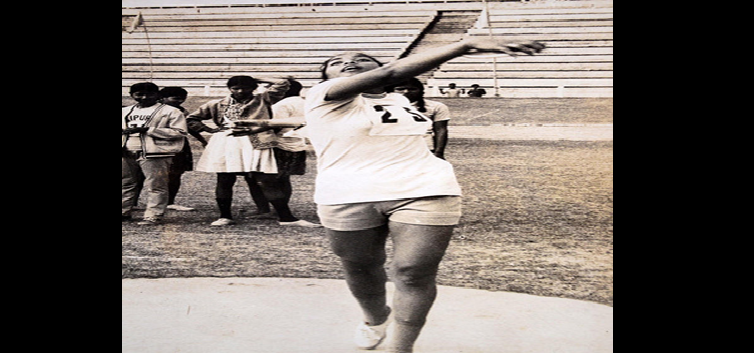
She is as strong as ever. Meet Assam’s first ever female athlete to win a medal at the national level. She is Tayabun Nisha who broke a national record in discuss throw in 1971 and represented the country in several international events across the globe.

“Even today, I want to achieve so many things. Maybe I’ve again too many challenges. But I will overcome those,” Nisha told Thumb Print.

Though it was the love for chocolates which dragged her to the field of athletics and she went on to become the first female athlete to win a medal for Assam at the national platform. But later it is her determination and toughness to see off the challenges which sailed her through for success.

On receiving the ‘Yamin Hazarika Woman of Substance Award 2016’, she is elated. “What else I can ask for? It’s a great feeling for me. I wish people know more about Yamin Hazarika. She can be a source of inspiration for many. I feel myself to be a part of it. I also thank the organizer for choosing me the worth of it,” said Nisha.

Moving on her past, the champion athlete said that the road was never been an easy one. “When I look back to my childhood, it seems so funny. There used to be some village level competitions in my native place at Dhaiali in Sivasagar district on various occasions like Independence Day, Republic Day or on Bihu. Those days the winners used to get a box of chocolates. The love for the chocolates made me work harder to win medals as we could not afford chocolates. But gradually, I realized winning a medal also gives a recognition and later on I took it seriously,” Nisha said.

Belonging to a conservative Muslim family was another hurdle for her to take part in sports activities and all these things could not deter her from the goal.

“Losing my parents at an early age was a setback but it gave me the courage to fight back the odds in life. I lost my father in 1970 when I was a class VIII student. It doubled the responsibility on my shoulders to look after my siblings. There were people in our neighbourhood who used to say things against a girl going out to take part in outdoor activities. But simply didn’t care because I knew in the hour of crisis these people never came forward to help us,” said Nisha. But earlier, her father was encouraging.

All these developments always motivated her to be even stronger. “We did not have much facility to practice but I used to be prepared mentally always. I knew only my dedication can lead me to the success,” she said.

Then even when she was going through a bad phase, Nisha started working for the Railways at a salary of Rs 250 in 1970s.

In 1971 Nisha took part in the 9th Inter State Athletic Meet to make her debut in Ahmedabad. Bronze in that tournament created a history in sports as she became the first woman athlete from the state to won a medal in a national championship.

In 1974 in Jaipur broke a 12 year old national record in discuss throw throwing a distance of 29.32 metre.

In 1982 Asian Games she missed medals but it did not hamper her mental strength.

“Though we worked hard before the games, I could not win a medal. But I was upset as I knew the reality. We were not up to the mark of other countries,” she said.

But a thought always haunts her that if they were provided better facilities, there would have been more medals. “We never had proper training. We did not have idea about the proper diets. But our contemporaries from other countries were well ahead than us. So I sometimes feel that we could have done much better,” Nisha added.

Now, she is planning to set up a sports academy and hostel especially for girls who are from poor families.

“As we have experienced lack of proper facilities for the rural girls, I’m planning to start a hostel where a young will be taken care of to build her sports career. But I’m not sure when we can start it,” she said.

On the present generation, the veteran athlete said that the determination is must. “One has to be determined to achieve. But unfortunately that kind of determination and hunger for success is missing among the today’s youngsters,” she said.

___________________________________________________________________________

source: http://www.thecitizen.in / The Citizen / Home> Border / by Reshma Shah / Guwahati – Tuesday, July 26th, 2016
Fort lends historical backdrop to retell Husain’s sacrifice

Lucknow, UTTAR PRADESH :

Mahmudabad  :

The pallid, smudgy walls of Mahmudabad fort glistened in yellow lights as hundreds of followers of Imam Husain (Prophet Mohammad’s grandson and martyr of Karbala) walked barefoot on the rugged path from the outer gate to its interiors, beating drums and reciting ‘nauha’ (elegy) that filled the air with a tradition that has been part of the cross cultural commemoration of Muharram at the royal estate. For centuries, locals have been an important aspect of the Muharram legacy and on Saturday, Mahmudabad offered a special experience for many first-timers from Lucknow and other cities of India as well as foreign nationals from different religious backgrounds, who took part in the tradition, showcasing the synergistic nature of Awadh’s heritage.

A joint effort of Waqf-e-Maharaja and a citizen-driven initiative working for communal harmony- Shoulder to Shoulder (S2S), ‘Karbala: Beyond Religious Boundaries’ served opportune time for people from different cultures to gather and watch closely what Muharram signifies. An eye-opener to Awadh’s culture, the initiative served also as a platform for breaking several myths about Islam and Shia faith.

“I thought there would be a ‘tamasha’ of people striking their bodies with blades but instead I came to know about the sacrifice of Imam Husain and could feel the pain during the sermon,” said Amit Kumar, part of the entourage from Lucknow.

Visitors witnessed several traditional arts that are part of ‘azadaari’ (mourning) at this Sitapur town and the intangible heritage of Awadh, from melancholic classical Indian ragas on shehnai like Khamaj and Bhairavi , to the recitation of ‘sozkhwani’ and ‘marsiya’ in English and Urdu  and experiencing the age old tradition of Nassari-a dying narrative art.

“In most part of the world, I had met only Sunnis from Asia but here is an example of how much more there is to India than just one culture,” said Philipp Jeun from Switzerland.

When the maulana (priest) began his speech on Karbala with: “Dar-e-Husain pe milte hain har khayal ke log/yeh ittehaad ka markaz hai aadmi ke liye (At Husain’s threshold meet people of all ideologies/this is the hub of unity of mankind),” all agreed in unison.

source: http://www.timesofindia.indiatimes.com / The Times of India / News Home> City News> Lucknow / by Yusra Hussain / TNN / October 11th, 2016

Selected for Kolkali performance

Kozhikode, KERALA :

A team of Serve India, a Kozhikode-based cultural organisation, has been selected to perform Kolkali in Rashtriya Samvrithi Mahotsavam organised by the Union Department of Culture in Delhi from October 15 to 23.

According to a press release issued here, the team consisting of artistes from across the State will undergo a three-day training in Chennai before they set off to Delhi.

The traditional dressing style for Kolkali has been altered to be more colourful considering the importance of the festival as well as to suit the audience expectation.

The team is led by Yasin Kurikkal while Noushad Mankavu is the troupe manager, the release adds.

source: http://www.thehindu.com / The Hindu / Home> News> Cities> Kozhikode / by Staff Reporter / Kozhikode – October 12th, 2016

Old Poor House Road is rich in tolerance

Bangalore, KARNATAKA :

A cluster of shrines of all denominations dots the road that has not seen a single instance of communal violence.

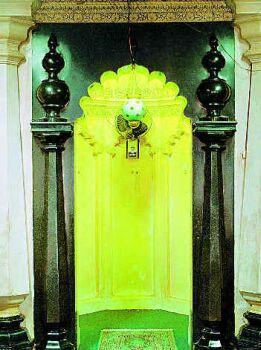
The meharab with the black granite frame at the Jumma Masjid.

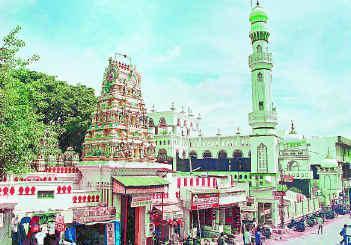
IT IS every bit a spot Mahatma Gandhi dreamed of. A stretch on Old Poor House Road in the Cantonment area, behind Bowring Hospital, has a church, two temples, and four mosques. As the country enters its 57th year of Independence at a time of competitive communalism, the businessmen on O.P.H. Road have insulated this busy street from the influence of zealots.

“We live like brothers here. We sit across the table and sort out the differences, if there are any,” says Syed Masood, Chairman of the Jumma Masjid Trust, which owns 290 shops on O.P.H. Road. The mosque, which has a 90-foot minaret, was built in 1790 with materials supplied by Tipu Sultan from Srirangapatna. The magnificent granite structure can accommodate up to 5,000 people for namaz. The frame of its mehrab is carved out of a single block of black granite. The serene prayer hall has black stone pillars. The other four mosques are Masjid-e-Azam, Masjid-e-Bewarpawan (Merchant’s Mosque), Lal Masjid (1845), and Masjid-e-Lababeen.

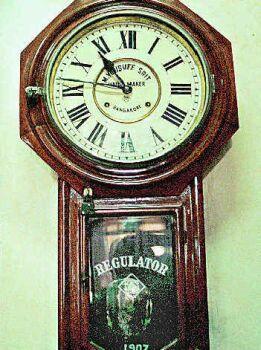
The Jumma Masjid also has a clock that has been ticking for 97 years now. Its late Imam, Abdul Hafeez Junaidi, had the distinction of being the only imam in India to have conducted prayers for 50 years in a row. Having played no mean role in promoting peace, he is still revered by the businessmen of the area.

To the left of the mosque stands the Lakshminarasimha Swamy Temple. The sanctum sanctorum was earlier a small mandapam with the beautiful deity carved out of granite, said to date back to early 19th Century. Doddanna Shetty (1840-1921), well-known philanthropist and founder of S.L.N. Charities, drawn to the modest shrine as a boy, developed it into a full-fledged temple in 1910.

A striking example of harmony.

Later, the late Mayor, C.P. Deenadayalu Naidu, took over management of the shrine. After his time, the mantle fell on his nephew, V.P. Chengalarayalu Naidu, in 1986. The latter says even on December 6, 1992, when the area was tense after the Babri Masjid was razed in Ayodhya, the area, on which a curfew was clamped, remained free of violence. “I rushed to the temple on hearing the news that day. The businessmen told us that nothing untoward would happen,” he says.

The temple attracts a large number of devotees from the surrounding villages on Holi, not to speak of hundreds of Christians who throng St. Mary’s Basilica during Mary’s Feast in September. Incidentally, a few feet away from the temple is St. Paul’s Church, which has its entrance at the Bowring Hospital end.

To the right of the Jumma Masjid is the 101-year-old Sri Venugopalaswamy Temple, run by the Reddy Bhoomi Kalyana Kula Brundam. The garba griha here has Rukmini, Venugopala Swamy, and Satyabhama as deities. Built in 1902, it used to have Sugreeva as the presiding deity earlier. When a shrine at Vannarpet (Viveknagar) was dismantled, the idols of Rukmini, Venugopala Swamy, and Satyabhama were shifted to this temple by members of the Reddy Bhoomi Kula community.

Says V. Krishnamurthy Shastri, an astrologer who has been working here for the past seven years: “Till recently, oil for the lamps and flowers for puja were supplied by Muslims. When they take out processions, they don’t trouble us. On special occasions, the traders go out of their way to help us.”

T.H. Yang, a Chinese trader, who makes special shoes for disabled persons, finds it hard to be unaffected by the friendly nature of the people in the area. He has been doing business here (his shop is called C.H. Yong and Company) for 51 years. His father opened the establishment in 1933 and he took over in 1952.

The clock that has been ticking for 97 years at the mosque.

Communal harmony had always existed in the 15-odd villages surrounding Cantonment, even before General Wellesley trooped in with his soldiers in 1809 after conquering Srirangapatnam. The burrah sahebs and memsabs, as the Europeans were called, did not attempt to alter this situation either.

“The Assigned Tract (Cantonment) had a charm of its own, which can hardly be described. The area is an agglomeration of people of different tongues — both Indian and European — welded into one community by the common economic interests. Here met East and West in a most dynamic focus. A warm handshake, a courteous salaam, and a kindlynamaste greeted the citizens. Its population, in 1891, was 1,00,81 as against 80,285 in the city,” says Fazlul Hassan, historian, in his bookBangalore Through The Centuries.

Although vivacious shoppers from Europe and savvy merchants dominated life here, lending its own character, the Cantonment area did catch the spirit of nationalist fervour. During the height of the Khilafat movement in 1921, it reverberated with slogans of Swaraj. Merchants and philanthropists supported the movement and a public meeting was held at the Idgah Maidan in Benson Town which was addressed by Mahatma Gandhi, Moulana Abul Kalam Azad, and Moulana Shoukat Ali. In a fiery speech, Moulana Mohammed Ali said: “The power behind the chakra gun is so effective that a single shot fired from Bangalore is sufficient to destroy Manchester.”

Traders from Commercial Street sent bales of foreign cloth to the sprawling maidans of Blackpalli (Shivajinagar) and the Muslim orphanage on Dickenson Road, which were set on fire. Osman Sait, a wealthy merchant, sold all his property to meet the expenses of Khilafat movement in the area and to start nationalist educational institutions and publications.

Today, not many remember the heady days and valorous deeds that eventually won us Independence. When our country now battles religious turmoil from within, communities like those on O.P.H. Road are an inspiring example.

V. RAMESH

source: http://www.thehindu.com / The Hindu / Home> Metroplus Bangalore / by V. Ramesh / Thursday – August 14th, 2003