The historic tank has been revived with water from the Krishna river
Brimming with water, with women washing clothes at the edge while children swim in the fresh water, it is hard to believe that just a month ago, the Begum Talab, spread across over 234 acres, was a barren wasteland, with few small pools of water.
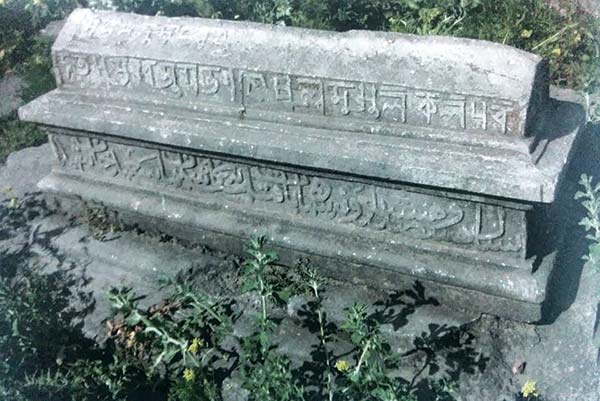
The ancient tank, built during the rule of Mohammad Adil Shah in 1651, has not seen such water levels for the past five decades. But under an ambitious project of the Water Resources Ministry to rejuvenate and replenish tanks, water from the Krishna river has been drawn to fill the tank and recharge ground water. Over the past year, a 50 km pipeline was laid from the river to the tank. The tank was among seven revived in the district at a cost of Rs 190 crore.
Crucial water source
According to historian Abdulghani Imaratwale, Adil Shah built the tank in the name of one his queens; Jahan Begum. The construction was supervised his commander Afzal Khan to provide drinking water to Bijapur city which then had the population of around nine lakh.
Dr. Imaratwale said the water was not only used for the palaces or prominent places of the kingdom, but also for public consumption as the city did not have other drinking water sources.
The tank, located on the southern part of the city, used to supply water through the earthen pipes to many ganjs (overhead stone tanks). It was the second major water source for the city after the Ramalinga tank. Unfortunately the ganjs and the old pipes have fallen into disrepair,
Expressing elation over the government decision to refill the tank, Dr Imaratwale termed the project a significant step in restoring the history of the city.
“ It is heartening to know that Water Resources Ministry led by M. B. Patil is showing concern to restore and revive the ancient tank which had once served a major water source. The tank still has the same capacity if the water is stored and used,” he said.
source: http://www.thehindu.com / The Hindu / Home> National> Karnataka / by Firoz Rozindar / Vijayapura, October 10th, 2016
A woman from Dakshina Kannada district got an international certificate in transactional analysis psychotherapy. She is reportedly the third Muslim woman in the world to achieve this feat.
Forty-two-year-old Haseena Abdulla, daughter of K Abdulla Parkala of Manipal , received the certificate by the International Transactional Analysis Assoication at the conference hosted by SAATA – a South Asian Association in September. Transactional analysts from many countries witnessed the event and examiners were from Germany, UK, Japan, South Africa, US, and India. This award is an appreciation for her eight years of effort in exploring the world of psychotherapy.
P K Saru, the former president of SAATA and founder director, ASHA Counselling and Training Centre, Coimbatore and Fuson, provisional teaching supervising transactional analyst from Turkey are the only two Muslim women, to have got this certificate before Haseena Abdulla.
Haseena said she is very passionate in discovering the frames of relationship and initiating empowerment efforts for many. “As an ardent learner of human behaviour, my journey of seeking knowledge led me into the world of transactional analysis.
It was a road less travelled for Muslim women, and I am the third Muslim woman transactional analyst in the world, and second in the country to earn this certificate,” she said proudly.
Haseena, who was trained under P K Saru, is a post graduate in psychology and sociology. She has also been trained in hypnotherapy, gestalt therapy and psychodrama. She is a master practitioner in NLP trained by Dr. Richard Mc Hugh, USA. Currently she is a practising psychotherapist and has a clinic in Manipal. She is also a visiting practitioner at Calicut, Kerala.
“Transactional analysis is a most advanced discipline in psychotherapy arena, which empowers the patients with awareness and the power to heal. It has a strong evidence based, effective diagnosis and participatory treatment plan for patients with psychiatric problems. Consulting a psychologist is still a stigma in the community and labelling the client as psychotic, sometimes even by the practitioners caused this unfortunate situation. Discovering the unknown part of the self is essential in completion of a healing process. Transactional analysis psychotherapist helps the client to achieve this by not being labelled,” Haseena said.
“The concepts in transactional analysis could be readily applied in our lives from the moment we are exposed to them. It believes that the power to cure and heal is in the patient. Therapist is just a facilitator to the patient to think and decide. Application of TA has also been instrumental in organizational success and educational excellence,” she added.
source: http://www.timesofindia.indiatimes.com / The Times of India / News Home> City News> Mangalore / Vinobha KT / TNN / October 05th, 2016
Freedom fighters suffered for a cause and passed away, leaving behind a shadow of their love for India. One such person now forgotten by the new generation is Haji Oosman Sait. His family still lives in the city of Bangalore, where once upon a time, it was richest owning nearly 27 bungalows, Imperial Talkies on St. Marks Road, the most costly land in the city.
Whenever our his wife was pregnant, Hajee Usman Sait used to name the bungalow where she will deliver the next baby. That is why, until recently, all these bungalows had the stone name-plates like Yakoob Villa, Ebrahim Villa, Khader Villa, Iqbal Villa etc. All bungalows starting from Richmond Road petrol station to the present-day India Garage was known as “Cash Bazaar departmental stores”.
This highly successful businessman and cloth merchant met Gandhiji and Nehru who changed his life and infused him with a mission to work for the independence of India, to be free from the bondage of the British rule. Haji Oosman Sait now started supporting the freedom movement financially. He gave gold coins in leather bags to Nehru and Gandhiji so much so that he was labelled as the “cash bag of the National Congress”. His support to the freedom movement angered the British who started boycotting Haji Oosman Sait’s businesses. He had to sell and pledge his properties and yet continued paying the National Congress regularly to continue its activities. The amount spent by Haji Oosman Sait in support of the freedom struggle has been estimated in today’s terms at 7000 crore rupees.
At the call given by Mahatma Gandhi to boycott English schools, Haji Oosman Sait was first to open an Indian National School in 1921. This motivated many Muslims to start their own schools.
The family of Hajee Oosman Sait, consisting of 102 members today, are proud of the sacrifices of their grandfather. The leaders of the freedom struggle never forgot their friend in need. After independence, Nehru in 1949 allotted 300 acres of land to the family of Hajee Usman Sait, but the family showing great respect for the sacrifices made by their grandfather, refused to take any favours in return for the sacrifices offered by Haji Oosman Sait who was the first Congress President of the erstwhile Mysore State and served the National Congress till his death. His children hope to see the India that their grandfather and leaders of the freedom struggle had in their dreams. (Based on information provided by Haji Oosman Sait’s grandson, Mohamed Ali Javeed)
This article appeared in The Milli Gazette print issue of 16-31 August 2013on page no. 12
source: http://www.milligazette.com / The Milli Gazette / Home> Online News> Community News / August 22nd, 2013
Bollywood actor Nawazuddin Siddiqui may have backed out of his Ramlila act in riot-affected and divided Muzaffarnagar , but in adjoining Agra, Nizamuddin continues to rock the Ramlila stage.
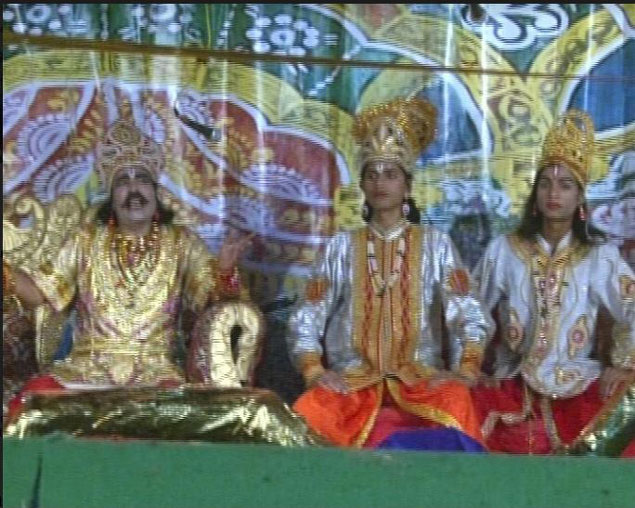
He’s been doing key roles for over last five years and is Janak, the father of Sita, this time, no less. It wasn’t always that easy for Nizamuddin though.
During his early years in the Ramlila theater, he too faced protests and opposition like the way Nawazuddin did. But he stood his ground. In fact, another Muslim will do the part of Bharat along with him this year.
The 55-year-old Nizamuddin, who is the track man at Agra cantt station in north central railway zone, never had any acting classes but landed up for top notch role in 46th edition of Ramlila theater on dussehra.
Speaking to TOI, Nizamuddin said, “Back in 2010 when I gave my first audition for Ramlila play organized by railway, I was offered roles of Shantanu (father of Shravan) and Rishi Atari (mentor of Sabri). But soon, scores of people from my own community raised questioned on my faith in Islam. I was almost ousted.”
Nizamuddin playing Janak character, father of Sita, sits on the extreme left and delivers his dialogues.
“But as an artist I never changed my stance. There is no sin if a Muslim man acts in Hindu play. Ramlila talks about peace and triumph over evil. Getting a role in Ramlila is a matter of pride for me,” he said.
Expressing his dissent on Bollywood actor Nawazuddin Siddiqui backing out from play after opposition from right wing members, Nizamuddin said, “Nawazuddin is an artist, he should have continued with his act instead of giving up against bullies. I’m sure, the local residents and administration would had supported him if he would have stood up.”
Talking to TOI, director of Ramlila theater, Manoj Singh, who has been playing role of Ravan since 1998, said, “It is amazing to see the zeal of men like Nizamuddin, who outsmart other contestant for the roles. This is blunt and appropriate reply to those people, who want to create enmity and disturbance among different communities.”
“This year we had only two Muslim artists who have notched the top roles, while for the first time a woman has joined the play to act as Sita,” added Singh.
source: http://www.timesofindia.indiatimes.com / The Times of India / News Home> City News> Agra / by Arvind Chauhan / TNN / October 08th, 2016
Abortive takeover bids did not prevent the Muslim influences from impacting the Kashmir society. Long before Kashmir’s transition to Islam, the new faith existed and thrived even during the Hindu rule, says Sara Wani
(Manuscripts of the Holy Qur’an calligraphed in 1237 AD on a 25 feet long and 2.5 inch wide scroll paper. Belived to be gifted by Shiekh Hamza Makhdoom (RA) to Khawaja Miram Bazaz, great grand father of Majid and Ashraf Quazi, who displayed it in an exhibition in Srinagar.)
Mohammed bin Qasim packed home never to return and Ghaznavids’ left, as if vowing never to set foot on mountains guarding Kashmir like a wall. Kashmir kingdom was apparently insulated against the changes that swept proper India. Delhi Muslim kings and Turkish Sultans remained too preoccupied with power consolidation to make any advance toward Kashmir.
But for the ideas and influences, high Himalayas were no impregnable. Then, political boundaries did not stop trade, refugees and even fortune hunters. Kashmir knew of Islam much earlier than the two failed conquests.
In his Shah Hamdan of Kashmir, Kashmir’s former Director of Archives, Archeology, Research and Museums, Prof Fida Mohammad Khan Husnain has referred to a legend that then Kashmir ruler Veenditya’s emissaries had trekked through Bahrain and met the prophet of Islam. “This information is further collaborated in a Persian manuscript entitled Anwar-i-Kashmir, where it is informed that the Holy Prophet did depute Abu Hazifa Yamani in about 8 AH (after Hijra) with letters to the Chinese emperor but the above emissary got held up in Kashmir due to a heavy snowfall,” Husnain wrote. “Veenditya, the Raja of Kashmir treated them well.”
While the author offers no detail about the veracity of the manuscript and its writer, he claims that Caliph Umar ibn Khitab had deputed a delegation of five persons to Kashmir in about 21 AH. He offers no reference to substantiate the claim. Extensive research failed to trace the king in Rajatarangini. At that point of time when Islam was getting established in the deserts of Arabia, Kashmir was witnessing transfer of power from Baladitya, the last Gonanda king, to Karkotas whoso rule begun with Durlabhavardhana (627-649). Even the Thang dynasty records in China suggest that the first Muslim delegation comprising 15 Arabs was led by Said Ibn Abi Waqqas. Thabit ibn Qays accompanied him. Dispatched by Caliph Usman, it met Chinese Emperor Yung-Wei in 651.
But the existence of Muslims in Kashmir is well documented after the fall of Sindh. Chachnama author Alafi bin Hamıd al-Kufı, states that Muhammad Alaf, an Arab mercenary who had served Sindh ruler Dahır (712 A D), sought refuge in Kashmir. The then Kashmir ruler Candrapıda, received him well and bestowed on him the territory of Shakalbar. G M Sufi, the author of Kashir: Being A History of Kashmir has quoted Sir Alexander Cunningham locating Shakalbar somewhere around the slat range saying the territory was then under the control of Kashmir king.
After Alafı’s death, his estate was inherited by one Jahm, who, according to al-Kufı, “built many mosques there”.
Writing in the UNESCO publication History of Civilizations of Central Asia (IV), N A Baloch has quoted al-Bırunı recording that Muhammad bin al-Qasim bin Munabbih who took Multan “belonged to the house of Jahm bin Sama al-Shami, who had allegedly settled in Kashmir as far back as 712–14 and whose descendants had reportedly continued to flourish there.”
Baloch says though Kashmir was ruled, from the eighth century onwards, by the local, independent, originally non-Muslim dynasties, the region had “increasing political contacts with the Muslim rulers of Sind and Khurasan.” Kashmir and Kashgar, then, would be the two main trading states through Gilgit.
(Arabic and Sharda inscription on the grave of Seda Khan, next to Ziarat of Bahauddin Sahib, who died in a battle in the reign of Mummad Shah (1484-1537).)
Gaznavids’ returned home from Rajouri as winters set in and failed to wrest Kashmir from Sangramaraja in 1021. “It is, however, possible that some of Mahmud’s soldiers, finding it difficult to cross the mountains towards the plains of India, stayed behind and settled in Kashmir,” historian Abdul Qayoom Rafiqui writes in the UNESCO publication. “It is after these Turkish invasions that Kalhana refers, for the first time, to the presence of Turuskas (Muslim) in Kashmir when describing the reign of Harsa (1089–1111).”
Venetian adventurer Marco Polo is still a widely reliable traveler of that era. He visited Kashmir in 1260. His description of an “idolatrous” Kashmir, then ruled by Laksmanadeva (1273-86) – an “incompetent” ruler “consistently harassed by the Turks and his turbulent nobles”, is brief but interesting.
“They have an astonishing acquaintance with the devilries of enchantment; insomuch that they make their idols to speak,” Polo records in his Travels of Marco Polo. “They can also by their sorceries bring on changes of weather and produce darkness, and do a number of things so extraordinary that no one without seeing them would believe them.”
While terming Kashmir as the “very original source from which Idolatry has spread abroad”, Polo has made the predominant faith clear. But he has made two other observations.
“There are in this country Eremites (after the fashion of those parts), who dwell in seclusion and practise great abstinence in eating and drinking. They observe strict chastity, and keep from all sins forbidden in their law, so that they are regarded by their own folk as very holy persons. They live to a very great age,” goes the first one.
“The people of the province do not kill animals nor spill blood; so if they want to eat meat they get the Saracens who dwell among them to play the butcher,” is the other observation. Saracen is a generic term for Muslims that Christian writers widely used in Europe.
Evidences suggesting Muslim presence in thirteenth century were further corroborated in August 2012 by Qazi brothers – Ashraf and Majid, originally from Khawaja Bazaar. At an exhibition, they displayed full text of the Qur’an calligraphed in 1237 AD on a 25 ft x 2.5 inch scroll paper. “It is part of our heirloom and we had forgotten it on our attic in our old house under the shingled rooftop and nobody touched the two boxes for nearly 150 years,” Ashraf said. “Once we discovered and opened the box, we discovered the treasure.” The rare manuscript, calligraphed by Fatahullah Kashmiri was gifted by Sheikh Hamzah Makhdoom to Khawaja Miram Bazaz, the great grandfather of the Qazis. It carries a certificate of authenticity and transfer with 35 Ulema as witness. Historians did not expect Muslims to be living in Kashmir, then.
Focusing on the ‘court’, Rajatarangini, Kashmir’s oldest historical chronicle skips mentioning social changes in detail. But the first major mention of a social change is during the reign of Lohara dynasty king Harsa (1089-1101). The king says Kalhana, “introduced into the country more elaborate fashions in dress and ornaments and made his courtiers imitate his own taste for extravagance in personal attire.” The ‘new dress code’, an apparent ‘Western Disturbance’ was explained by M A Stein as the “Mohammedan influence”.
This observation is indicative of a social impact though not a religious transformation. But the Kashmir court was never immune to foreign influence. Even Lalitaditya’s had a Turk minister Cankuna. Stein says he was from Badakhshan or its immediately adjoining tracts on the upper Oxus. Besides, Lalitaditya, “as overlord of India”, according to Maharajas’ of India, by Annmorrow Shrishti was “already recruiting regiments from Central Asia.”
Vajraditiya-Bappiyaka, Lalitaditya’s son who ruled Kashmir for seven years, says Kalhana “sold many men to and introduced in the country many Mleccha practice”.
Apparently, Mlecchs were to Hindu scholarship what Saracens were to European writers. A Sanskrit word, Mleccha means “alien in language and manners, uncouth, inferior”. Their presence was felt throughout the reign of Korkotas’, the dynasty that reigned Kashmir between 663 – 855 AD, coinciding with the period when Arab armies were being dispatched to the length and breadth of the world. Even the Bhavaishya Purana, one of the 18 Puranas of ancient Vedic literature dealing with the future, anticipates the rise of prophet of Islam as “the Acharay of Mlecchas”, a desert resident who would be the embodiment of divine qualities. Some Kashmir historians see Ali Kadal as the Mleccha Mar that Rajatarangini refers to.
Husnain is correct in saying that Islam was brought to Kashmir by non-Muslim Rajas. While Karkota king Vajraditya (761– 767) introduced Mleccha practices, Lohara dynasty king Harsa not only employed Turuska commanders but made temple spoliation a state policy. He confiscated idols possessing the valuable metals, they were made of.
A Hindu iconoclast, Harsa was an interesting character. Initially prudent, courageous and lover of art and music, Sufi feels “his mind was rather demented”. Kalhana see him as “a jumble of contraries”, who was bankrupted by extravagances. To manage his kitty, Kalhana says he would loot the temple treasures, especially the metallic idols. An exploitative taxman, he would even levy night soil! Even though famines, bandits and plagues attacked Kashmir, Harsa never exempted his subjects from taxes. Eventually, his nephews led a rebellion, putting his palace afire, roasting his queens alive and slaying his successors. He was perhaps the only Kashmir king who head was sliced after being hunted down and left to be cremated by a wood-dealer “as a naked pauper”.
Stein has explained Harsa differently. “As Kalhana is particular to specify the new metal statues of gods throughout Kashmir which escaped Harsa’s clutches, we cannot doubt the extent and thoroughness of Harsa’s iconoclasm,” Stein writes. “Can the latter have been instigated or encouraged somehow by the steady advance of Mohammadanism in the territories? Kalhana when relating to these shameful confiscations, gives to Harsa the epithet Turuska i.e; Mohammadan, and later makes reference to Turuska captains being employed in his army and enjoying his favor”.
Having little faith in his people and his soldiery, Harsa had raised a new model for his army. Comprising mostly Ekangas, the royal bodyguards and the Tantrins, the reformed trouble-makers, each group of hundred soldiers was placed under a Muslim commander, thus making it impossible for soldiers to run away or hatch plots. This was the beginning of Muslim influence in Kashmiri politics. After Harsa, Bhiksacara (1120-21) is understood to have raised a Muslim cavalry for his personal guard, a task they eventually failed in.
Harsa, however, was one of the series of puppet kings who misruled Kashmir for nearly 500 years after Lalitaditya (724-60) when court rivalry would change kings in Kashmir like turbans. In between came Avantivarman (855-883) who tried to put the house in order. Putting foreign conquests at halt, he devoted his attention to his state focusing on development, welfare, and delivery of services. As his son succeeded him, things were back to square one with class-wars and internecine battles triggering the political instability and reducing the kingdom to its old territorial confines.
By the time Jayasimha (1128-1155) took over, Muslim mercenaries had gained so much popularity that the king and his army chief, according to Kalhana, would go “into the camp with Yavanas (Muslims).”
The gradual decay of the state and the society had led to such deterioration, according to Rajatarangini that when Sahadeva (1300-1 to 1319-20 AD) took over, Kashmir had reduced to a kingdom of “drunkards, gamblers and profligate women”. So when Mongol king Karmasena’s commander Dulcha (Zulchu) invaded Kashmir in 1320, the king fled to Kishtwar. Nobody resisted 70,000-strong invaders, who devastated Kashmir for eight months, selling men to Tartar traders, setting afire dwellings and standing crops. But the entire army perished over Devsar Mountains in south Kashmir while fleeing Kashmir winters with thousands of men and women slaves.
Dulcha destruction literally marked the end of a long chaotic Hindu rule. That changed Kashmir forever.
(This is the second in a four part series on advent of Islam in Kashmir. Read the first partIslam’s Kashmir Story.)
source: http://www.kashmirlife.net / Kashmir Life / Home> Faith History / Tuesday – February 16th, 2016
Allahabad University returning officer (RO), Prof RK Singh, administered oath of office to the newly-elected office-bearers of the Allahabad University Student Union (AUSU) at the union hall of the university, on Saturday
The results for the AUSU polls were declared late on Friday night.
Rohit Kumar Mishra of Akhil Bhartiya Vidyarthi Parishad (ABVP) bagged the president post, defeating his nearest rival Ajit Kumar Yadav of Samajwadi Chatra Sabha (SCS) by a margin of 95 votes. Mishra bagged 3,397 votes while Yadav got 3302 votes.
Likewise, for the post of vice-president, Adeel Hamza Sahil of SCS was declared the winner. Hamza got 1,860 votes, while Ashwani Kumar Maurya of Pratiyogi Chatra Morcha with 1,740 votes came second.
With 2,853 votes, Shivbalak Yadav of Samajwadi Chatra Sabha (SCS) emerged victorious for the post of general secretary. He defeated Ravi Pratap Singh, who bagged 1,856 votes.
Abhishek Kumar Pandey of ABVP won the post of joint secretary with 2,191 votes, while his nearest rival Anirudha Singh Rudra could manage 1,365 votes.
Maneesh Kumar Saini of Samajwadi Chatra Sabha bagged the post of cultural secretary, securing 1,864 votes.
source: http://www.timesofindia.indiatimes.com / The Times of India / News Home> City News> Allahabad / TNN / October 02nd, 2016
Noted physician and nephrologist Dr SNA RIZVI has been conferred the DRA Distinguished Service Award for the year 2003 by Delhi Rheumatology Association of India. The award has been conferred on Dr Rizvi in recognition of his contributions in the field of Rheumatology. Born in 1935 in Amroha, Moradabad district of Uttar Pradesh, Dr Rizvi obtained his MBBS and MD degrees with gold medals from Maulana Azad Medical College, New Delhi. Later he served the college for 30 years and retired in 1997 as Director, Professor and Head of the Department of Medicine and Nephrology. Dr Rizvi is the recipient of 24 Gold Medals and 10 Honorary Fellowships besides wining 13 national and international awards. At present he is a Senior Consultant Physician Nephrologist at Apollo Hospitals and Sanjeevan Medical Research Centre.
MUHAMMAD ADNAN HASHMI, a class XI student of Iltifat Rasool Intermediate College, Sandela, Hardoi, Uttar Pradesh has been given Presidential Medal. Hashmi was earlier given a medal by the Governor of Uttar Pradesh. Besides studying, Adnan Hashmi has made public service his motto in life. Congratulations Adnan!
Senior journalist SAEED NAQVI was conferred the National Integration Award 2003, instituted by the National Commission for Minorities in New Delhi on December 18. The award was conferred on Naqvi for his outstanding contribution towards promoting communal harmony and national integrity. The function, which also marked the Minorities Rights Day, was attended by Tarlochan Singh, chairman of the National Commission for Minorities, Dr MS Usmani, vice-chairman of NCM, MP and Journalist Kuldip Nayar and others. A seminar on how to improve communal harmony was also organised on this occasion.
MUHAMMAD KHALIL, editor of Science Ki Duniya (Urdu) has been presented Sir Syed National Award, Iswa Honour of Science Society for his services to science and literature and Whitkar Science Award for popular scientific literature. These awards have been conferred on Khalil for his outstanding services to scientific literature. Earlier too he has been conferred awards on national and international levels. An Urdu science magazine, Science Ki Dunya is being published under National Institute of Science Communication and Information Resources for the last 27 years.
The 15th annual award distribution function of Maulana Muhammad Ali Jauhar Academy was held at Ghalib Academy, New Delhi on December 10. Chief guest, former Vice Chancellor of Aligarh Muslim University, Hamid Ansari presented the Maulana Muhammad Ali Jauhar Awards 2003. Recipients of the awards includedMAUALANA AHMAD MUSTAFA SIDDIQUI RAHI (Urdu journalism), KAMAL YUSUF MALIK, Uttar Pradesh state minister (national politics), RAJA SYED MUZAFFAR ALI, filmmaker (academic services), DR GHULAM NABI WANI (social services) and DR VIBHUTI NARAIN RAI, IG (social services). Speakers shed light on different aspects of Maulana Muhammad Ali Jauhar’s life. A souvenir of the Academy was released by MP, Shahid Siddiqui.
source: http://www.milligazette.com / The Milli Gazette / Home / January 01-15, 2004
26 July was observed as the 16th anniversary of the so-called Kargil War or the Operation Vijay which occurred in 1999.
In this three month long war which began on 3 May, the Indian army operation was declared accomplished on 26 July and hence the date is marked as the Kargil Day or ‘Vijay Diwas’ to be particular and has an immense significance in Indian history.
PM Modi said on the eve of the anniversary, “I salute all the brave soldiers who lost their lives in the Kargil war, for their sacrifice and valor, on the occasion of Kargil Vijay Diwas. Kargil war though fought on borders had significant contribution from every village, every town of the country.”
Like him his cabinet colleague and the Minister of Finance Arun Jetly twitted yesterday, “Today, we remember & salute our brave soldiers who gave supreme sacrifice to protect the motherland in the Kargil war.” However, he was reminded by the followers that he was not correctly remembering the day; it was the next one, 26 July. One follower retorted on his tweet, “Sir Kargil Divas is tomorrow, not today dnt be exited to tweet but think twice b4 try to grab voter attention.”
These instances may be found illustrious enough how the national leaders take “supreme sacrifices” of war heroes in a disingenuous way. They are even not publically sure about the date of the sacrifice, then what much should be expected of them. May their act was inadvertent but it gives a message of oblivion.
The American poet Richard Watson Gilder hoped in his composition, “The ballads of martyrs be sung/at each anniversary of martyrdom/so that generations to follow value/the sacrifice of our Heroes./….Lest we forget.”
One Indian poet has paid his homage to the martyrs in these words, “Shaheedon ke chitaon par lagenge her baras mele. Watan pe marne walon ka yehi baqi nishan hoga (On the pyres of martyrs, celebrations shall take place every year, memorial of those shall be kept intact this way for surrendering their lives on the nation).”
However, not only the national leaders but even the public belies such romantic expectations.
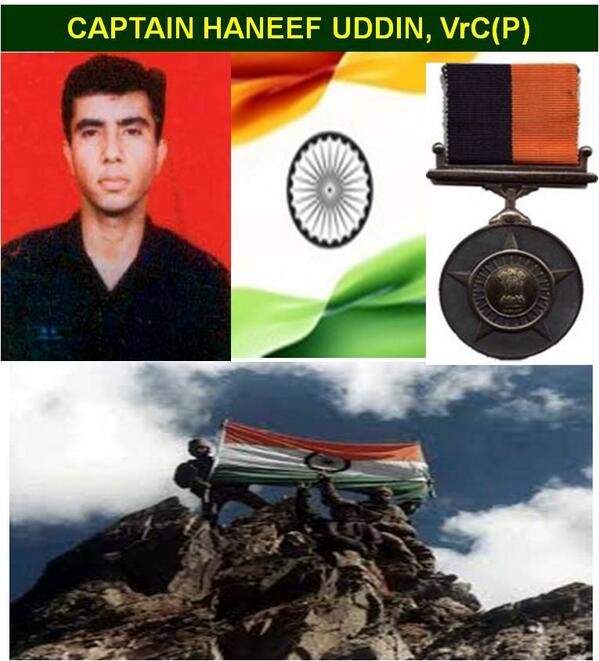
Let us understand this reality from the instance of one hero of the Kargil War, Captain Haneef Uddin, Veer Chakra (P).
He was an officer of the 11th Battalion, The Rajputana Rifles of the Indian Army laid down his life defending the country at an altitude of over 18000 ft in 1999. When he died on 6 June as one of the first causalities of the War but with much strategic gains, he was less than 25 years of age.
Times of India reported on 23 July when his corpse reached Delhi, “Thousands of Delhiites lined the streets of the capital to salute their brave hero, Captain Hanifuddin, who laid down his life fighting intruders in the Kargil region. When the body was brought to the Sajjadanashin Dargah in Nizamuddin, Hindus and Muslims stood side by side to pay their respects to the martyr. Since people had lined up on both sides of the road, it took almost an hour for the cortege to traverse the short distance between the Dargah and the cemetery. People seemed overwhelmed with the reported heroics of the soldier. “The country is blessed with such brave sons who sacrifice their lives like this,” said a mourner. The captain from the Rajputana Rifles was buried with full army honors as befitting a war hero.”
“16 years on” laments his memorials Facebook account, “Do we still remember? The road leading to Captain Haneef Uddin’s house was named after him. His name engraved on a stone to tell the world, ‘Here lived the Hero’. Then one day, the stone was replaced with a shabby metallic board, at a height convenient for people to stick posters. Alongside, a big blue board was also put up later, but even then no one thought of giving the Martyr the respect due to him. Same is the condition of the school named after Captain Haneef Uddin. No one knows! We honor our Martyrs so that future generations take inspiration but this is how we remember our Martyrs.”
Captain Haneef was a science graduate, multifaceted talent and trained computer expert of Delhi University from its Shivaji College where he himself was crowned as ‘Mr Shivaji’ during his studies before joining the Indian Military Academy in 1996. He was commissioned into the army on June 7, 1997. Exactly two years later he died.
There is no doubt that he could have pursued some other lucrative career or would have become an all-imposing politician and deliver sermons on nationalism seeing his popularity in the college, but he chose to devote himself for the defense of his country and ultimately offered it his supreme sacrifice. His name denotes, “someone single-minded in his religion”. He was truly single-minded in his religion, patriotism.
During parliamentary elections, Narendra Modi created a controversy by using the name of another Kargil hero Vikram Batra for electioneering, quoting his famous rhetoric “Ye dil mange more.” Disgusted with his non-serious and populist stance Batra’s mother joined AAP in annoyance. Sadly, neither Modi nor the AAP leader Arvind Kejriwal could take a little pain to go to Haneef’s house which is not far from their official residences and pay homage to the young man, who left his mother in utter pain and lasting sorrow for defending the motherland. They could have even sent someone to register their concern. But, there is a noticeable silence from both of them and also from their followers. No RSS, no Bajrangdal, no Shiva Sena or any other patriotism vigilantes and no Congress secularists are around. Even, Muslim organizations are as distant on the occasion as others.
At the time of Kargil War I was in my home town in Rajasthan. One day I was waiting for any public transport to reach home from some other place. Hopelessly, after waiting much for it, I signaled to a rider nearing me to give me lift on his bike. He cooperated. He happened to be an RSS Pracharak of our district.
Finding me to be a Muslim he said, “Sir, it is the right time that Muslims should show their patriotism by donating blood to the Kargil combatants.”
I retorted, “Mister, the blood already donated for the purpose is being sold in Delhi from where I am here. Don’t worry, we will make bigger sacrifice for the nation than you, if the time so arise.”
This episode makes me thoughtful and I wonder whether the nation which forgets the highest sacrifice of its citizens like Captain Haneefuddin deserves even a small drop of blood from its people.
Haneef’s father died when he was only seven years old. His widow and Haneef’s mother, Hema Aziz, valiantly responded seeing his dead body, “As a soldier Haneef served his country with pride and dedication. There cannot be a greater statement on his valor than his death which came fighting the enemy.”
Like Captain Haneefuddin, many other Muslim soldiers surrendered their lives on the anvil of Kargil War along with many other fellow countrymen from the cross sections of society. A few names may be noted from the available list: Lance Naik Ahmed Ali, Lance Naik Gulam Mohammed Khan, Havaldar Abdul Karim, Rifleman Mohamad Farid, Rifleman Mohamad Aslam, etc.
It is a common speculation that none of them would have been remembered on the day, including over 500 others.
It has been marked by different commentators that Muslim martyrs’ number should be any figure between 10-25% of the overall casualties, officially endorsed as 527. Since it was explicitly disproportionate to the presumed number of Muslim soldiers in the Indian army, less than 1%, it unbelievably surprised many and also raised election time controversies: who led to the Kargil victory, Muslims or Hindus? The Kargil War is also known for ‘coffin scandal” wherein allegedly people in the establishment at that time took undue advantage in their procurement. Consequently, the erstwhile defense minister had to resign.
The Kargil Day comes and reminds us of many things. It makes us fresh with the great sacrifices of the war heroes and inspires us to make similar sacrifice for a noble cause. It saddens us seeing hypocritical rhetoric from podiums. It makes us ashamed on knowing, how many people use war and war heroes for political and communal goals.
The poet apprehended “Lest we forget” and we really forgot them.
Sorry martyrs! We didn’t deserve your grace!!
Contributor is a social activist, analyst and author of many books including his recent one, Islam in 21st Century: The Dynamics of Change and Future-making
source: http://www.countercurrents.org / CounterCurrents.org / Home / by Abdul Rashid Agwan / July 27th, 2015
As the city is being spruced up for it to sport a bridal look, inside the Palace too, hectic activities have begun to get the elephants ready for the Vijayadashami grand finale. The main attractions on the last day of the festival are the 12 elephants with Arjuna, carrying the Golden Howdah (Ambari), being the cynosure of all eyes.
Special care is taken by the team of Forest Department officials, mahouts and kavadis to ensure that the elephants are fed well and trained so that they can gain enough weight enabling them to stay composed amidst the cheering crowd at the Jumboo Savari. Care is also taken to decorate them with specially designed robes. Their trunks are painted and metal ornaments with hangings are fixed into their tusks.
Among the specialised team is Pasha and Zakaulla, the two mahouts who have retired from service and who are experts in creating the ‘Gaadhi’ or the cushion and ‘Namdha’ or ‘Gouse’, a robe for the elephants. While the ‘Gaadhi’ is tied to the elephant’s back, a ‘Namdha’ covers the elephant skin and looks like a jacket. The ‘Gaadhi’ and ‘Namdha’ are newly made every year.
Explaining the ‘Gaadhi’, Pasha and Zakaulla say that it makes the uneven surface of the elephant plain and look good when the “Namdha” is spread on the elephant. Each ‘Gaadhi’ has a girth of 1.5 ft and the length depends on the size of the elephant.
While Arjuna, the Howdah Elephant’s ‘Gaadhi’ will weigh 500 to 800 kilograms, the ‘Gaadhi’ made for other elephants weigh 250 to 300 kgs. This is because Arjuna has to carry the 750-kg Golden Howdah with the idol of Goddess Chamundeshwari placed inside. The combined weight of the ‘Gaadhi’ and Ambari is around 1,100 to 1,200 kgs.
A special grass that is grown abundantly on lake and river side is used to make the ‘Gaadhi.’ Locally the grass is called ‘Odake Hullu’ that turns soft when dry. The grass is bundled and filled into a soft but sturdy square shaped cloth specially stitched for the purpose. Along with this grass, dry paddy grass is also used to fill the edges.
“The proportion is important to give a soft and sturdy feel,” say the mahouts. Once the grass is filled, the ‘Gaadhi’ is stitched after covering it with jute gunny bags.
“When I was the mahout before 2006, I used to observe people making the ‘Gaadhis’ and ‘Namdhas’ and slowly I learnt the tricks of the trade. I retired in 2006 and since then I am doing this job every year,” says Pasha.
Pasha and Zakaulla have been a part of the festival and have stitched many ‘Gaadhis’ and ‘Namdhas’ for many elephants in the past. The Forest Department officials too have reposed their trust in their skills and summon them every year for the job. While Pasha is the resident of Gandhinagar in Mysuru, Zakaulla is from Gundlupet.
“I have been the mahout for elephants including Radhika, Jayaprakash, Ramani and Chandrika. I retired 10 years ago and I am happy to serve the Naada Habba. I am willing to teach other mahouts on the making of these specialised equipment,” says Zakaulla.
source: http://www.starofmysore.com / Star of Mysore / Home> Feature Articles / September 26th, 2016
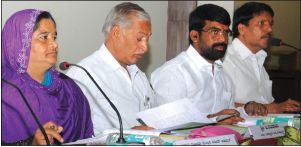
KDP progress review meeting expresses concern over rising cases of dengue, chikungunya
Zilla Panchayat President Nayeema Sulthana and others at the KDP progress review meeting held at ZP auditorium yesterday.
Zilla Panchayat President Nayeema Sulthana and others at the KDP progress review meeting held at ZP auditorium yesterday.
Mysuru :
The Health Department is facing acute shortage of staff with 16 Primary Health Centres (PHC) in the district having no doctors at all. Apart from this, many posts, including doctors and pharmacists are lying vacant in the district.
This came to light during the progress review meeting of Karnataka Development Programme (KDP) that took place at the Zilla Panchayat auditorium here yesterday.
Expressing displeasure over the issue, ZP Social Justice Standing Committee President Beerihundi Basavanna questioned the use of the PHCs when there were no doctors.
He demanded the officials concerned to take measures to fill all the vacant posts immediately.
Expressing concern over rising cases of dengue and chikungunya in the district, the members asked the Health Dept. officials to stop breeding of mosquitoes, which are causing the diseases.
Health Department officials said that the Department had collected blood samples of 1,899 people in the district to check for dengue of which 454 people tested positive for dengue, while 124 persons returned positive for chikungunya from January to September. Out of this, 281 dengue cases and 69 chikungunya cases were reported from the city alone, they said while claiming that no deaths have been caused due to these diseases.
ZP Chief Executive Officer (CEO) P. Shivashankar asked the officials concerned to take preventive measures to check the breeding of mosquitoes.
He also directed the officials to take the necessary action for recruitment of staff under the Natl. Rural Health Mission (NRHM).
ZP Vice-President Kayyamballi Nataraj questioned Food and Civil Supplies Dy. Director Dr. K. Rameshwarappa over inaction against Fair Price Shops (FPS) found indulging in unfair practices.
Dr. Rameshwarappa, in his reply, said that a total of 147 cases have been registered against FPS for violation of rules and procedures and also 97 people have gone to jail for misappropriation of Public Distribution System (PDS) food grains. Pointing out that severe action has been taken against 40 FPS on charges of improper PDS grains distribution, he said that the Food & Civil Supplies Department is yet to dispose off 1.2 lakh BPL card applications and that the applications will be disposed off once the Government sets a deadline.
Other issues like lack of teachers in schools, fodder for cattle, progress of various Government Schemes among others, also came up for discussion during the meeting.
ZP President Nayeema Sulthana asked all TP Executive Officers (EO) to submit the list of beneficiaries under SCP, TSP Schemes by Oct. 2.
Women & Child Welfare Dept. Asst. Director Radha, Health Department Official Dr. Somashekar and others were present.
source: http://www.starofmysore.com / Star of Mysore / Home> General News / September 27th, 2016