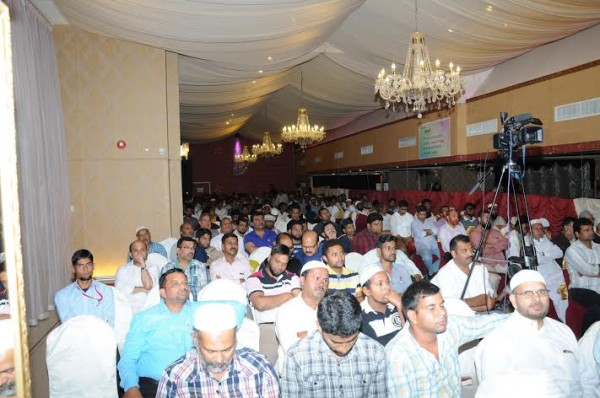
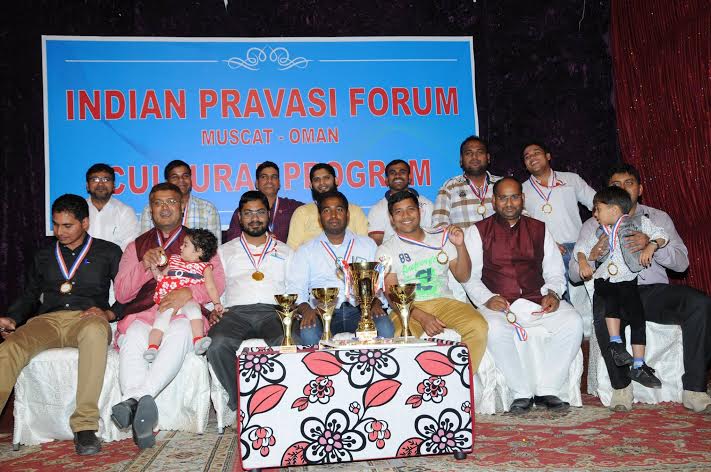
Indian Pravasi Forum Oman Organized “Paigham E Rasool (PBUH) and Children’s Cultural Program-2016 on 22nd Jan at Al Maas Hall in Muscat.
Yusuf Hyder Mukka (President Indian Pravasi Forum Oman, Karnataka Chapter) in his Presidential address emphasized for the unity of community. He stressed the importance of brotherhood.
While addressing the gathering Mufty Haneef Ahrar Qasimi (National Secretary of All India Imam Council), the chief guest of this occasion highlighted “guidelines from life of Prophet (PBUH) in present situation”.He described how the prophet granted the status of women in society.
He also stressed the importance of teachings life style of Prophet Mohammad (PBUH) and explained how he is a role model from all aspect for all mankind and his entire life should be followed Muslims.
The event started with cultural program for children’s under the supervision of Abdul Rahiman Nitte and Noor Mohammed. Over one hundred children participated enthusiastically in cultural program. Suhaib Bailoor group presented “Lavish Life” skit.
A quiz competition was also held for the audience.
While Maqsood Chandavara introduced the guest, Moideen Sunathkere proposed vote of thanks. Haneef Bantwal and Hashim Kundapur were the conveners of the program.///
The program was graced by the presence of Janab Faisal Khan, Janab. Moulana Saheb Zade Mahmood, Janab. Riyaz Gangolli (President of Gangolli Jamath Oman), Janab. Moideen (president of DKSC Oman), Janab. Moideen Shastan (President of SKMWA Oman), Janab. Abdul Shukoor( Vice President of Thonse Jamath Oman), Janab. Anwar Moodabidre (President of Indian Social Forum Oman –Karnataka Chapter), Janab. Noor Mohammad Padubidre (President of Indian Pravasi Forum Ruwi Area), Janab. Irfan Ujire (President of Indian Pravasi Forum Barka Area), Janab. Maksood Chandavara (President of Indian Pravasi Forum North Zone) was on the dais on the occasion.
source: http://www.muslimmirror.com / Muslim Mirror.com / Home> Culture / by Abdul Mubarak Karaje / Muscat – January 27th, 2016
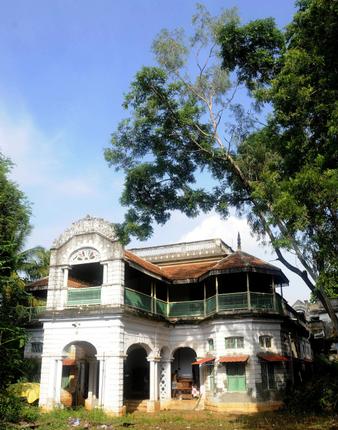
A view of the M.K. Maaligai in Khajamalai, Tiruchi. Photos:A. Muralitharan
Behind the façade of this heritage residence in Tiruchi lies the story of its enterprising owner, M.K. Mohamed Ibrahim Ravuthar.
It is an arresting sight on the Race Course Road in Tiruchi. A stately home, complete with gabled roofs and stained glass windows peeks out demurely from behind black granite walls, willing you to stop and take a closer look.
“It’s a unique building just like the man who built it,” says Dr. M.A. Ansar, describing the mini 11-roomed palace and his grandfather M.K. Mohamed Ibrahim Ravuthar in one breath.
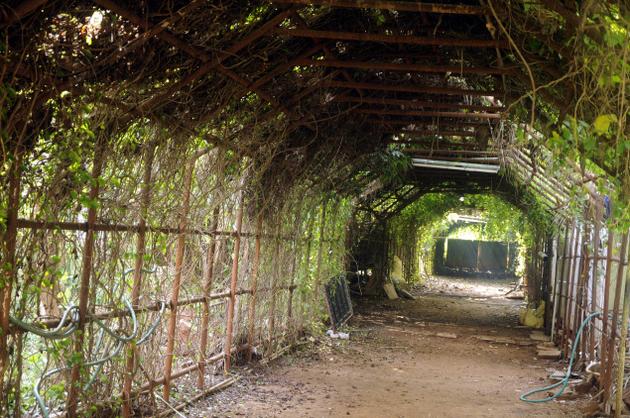
Built in 1928, the M.K. Bungalow was actually the main home in a complex of four residences in this quiet nook off the Race Course Road in Khajamalai. It resembles a structure straight out of a Jane Austen novel, especially when you walk through the green corridor (an iron trellis walkway that is still covered with the ‘December Poo’ or Philippine Violet vines planted by the patriarch) to reach the main entrance.
A trellis ‘green corridor’ leads up to the bungalow. Photo: A. Muralitharan
The garden is overgrown, and the annexes that once housed a live-in washerman, stables for horses and cattle, huge bathrooms and an elaborate pantry and storehouse, clearly have seen better days. Even so, when Mrs. Najma Begum, the current resident of the house and one of M.K.M. Ibrahim’s granddaughters, opens the main door, it is possible to see flashes of another, more flamboyant world that once existed here.
“When Thatha was alive, this house used to be called ‘M.K. Maaligai’ (Palace), today I can hear people calling it the ‘Pei (Ghost) Bungalow,’ when they walk past on the other side of the walls,” says Mrs. Najma.
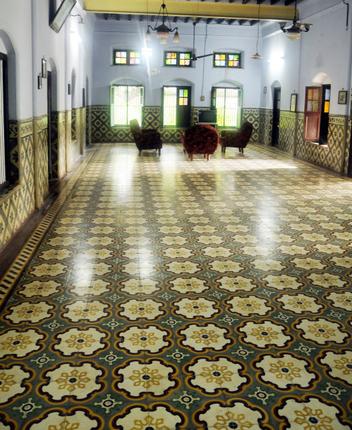
Keeranur tiles brighten up the interior of the M.K. Maaligai. Photo: A. Muralitharan
As room leads to room, each with Keeranur floor tiles and wide windows fitted with cooling coloured glass, the other tales about the house are dusted off and narrated too.
Tales of how chandeliers with red glass and gold paintwork imported from Austria used to adorn the halls. Records that were played on a Polyphon, a coin-operated music box which played metal discs measuring 195/8 inches in diameter, for dance parties hosted for British guests. And how a fountain and a ‘chaukhandi’ (gazebo) used to be star attraction of the garden.
The M.K. Maaligai was the entertainment venue not just for M.K.M Ibrahim’s friends and business acquaintances, but also guests of the State from Britain. On average, some 15-20 people would gather for the daily repasts, made with the finest of produce sourced from nearby towns.
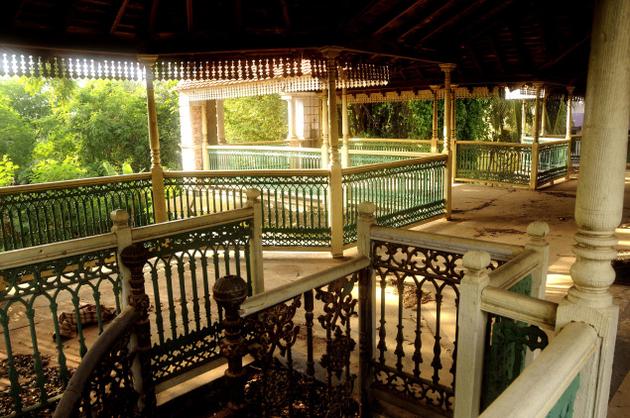
Elaborate decorative work done on the verandah’s eaves and railings. Photo: A. Muralitharan
As the tour continues, up an imported cast-iron spiral staircase (one of two), to the first floor where the master suite looks out on a large decoratively gabled verandah, it becomes clear that this house was meant to be a personal work of art.
Hands-on leader
“My grandfather used to be known as the ‘Prince of Tiruchi’ for his lavish lifestyle,” says Dr. Ansar, whose late father M.K. Abdul Salam was the eldest son of M.K.M. Ibrahim. “Though he didn’t have much education, he used speak English fluently because of his close association with the British. He was among the invitees to a special assembly to commemorate the coronation of King George VI in May 1937.”
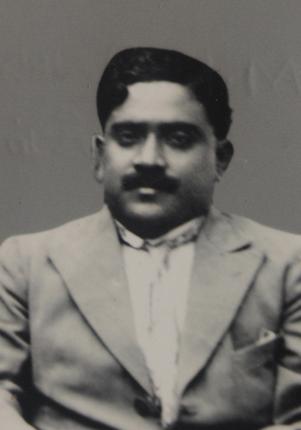
M.K.Mohamed Ibrahim Ravuthar.
Born in 1885, M.K.M. Ibrahim was the second son of M. Kasiappa Ravuthar, a wealthy businessman and landowner who migrated to Tiruchi from Ettayapuram, Tirunelveli district (see related story on Page 4).
Taking over his father’s kerosene dealership and leather tanneries after his elder brother Yusuf died, Ibrahim diversified the family business rapidly, branching out into petrol supply (he owned 18 petrol stations in his heyday), bus transport, and construction, besides starting a third tannery near Hyderabad.
The family made the Palakkarai area in Tiruchi its base.
The contracting projects that his M.K. Constructions company is associated with are still in use – the Erode Railway Junction, a part of Erskine’s Hospital Madurai (now renamed Government Rajaji Hospital), the Kakinada port (Andhra Pradesh), Chikmaglur Railway Station (Karnataka) and Railway staff quarters in Dindigul, besides a number of highways.
He also built a four-storey building in Chennai, close to the harbour, between Angapannaickan Street and Moore Street, where the leather from his tanneries used to be transported to by coal-fuelled lorries, and then exported to Britain.
Despite not being a part of the Independence movement, Ibrahim commanded a lot of popular support in Tiruchi. He served the city as its Municipality Vice-Chairman from 1925-28 and as Chairman from 1928-31.
He was a close friend of veteran freedom fighter P. Rathinavel Thevar, and co-operated with him on numerous occasions to preserve communal harmony in the city.
Known as a hands-on leader who once paid Municipality workers their salaries from his own funds, he donated the land for Ibrahim Park on West Boulevard Road on the condition that it would be put to public use.
He owned homes similar to M.K. Maaligai in Dindigul, Kodaikanal and Courtallam, which became summertime resorts for the family.
A poignant reminder
“The bungalow was still under construction when there was an epidemic of cholera or typhoid in the inner city areas in the late 1920s,” recalls Dr. Ansar. “Thatha decided to shift the entire family to this place from Palakkarai.”
Despite the love with which he built the residential complex, M.K.M Ibrahim was able to spend only around two to three years there, as he passed away at the age of 55 years on December 2, 1940 due to a heart ailment.
“It is astonishing to see how much this person achieved in a short period of 20-25 years,” says Dr. Ansar, whose father grew up in the complex of four residences along with his siblings. “He was inspired by the things he saw and people he met on his travels, and always tried to recreate the best of it for himself.”
Following the partition of his properties, the M.K. Maaligai was bequeathed to his second son M.K.M. Abdul Hakeem in 1949, whose children still maintain ownership of the heritage building.
After a brief spell as a student’s hostel, the M.K. Maaligai is now back to its original role as a family home.
“We clean it out for family functions, and whitewash it sometimes,” says Mrs. Najma Begum, who stays alone on the ground floor of the vast house.
“Even though it needs a lot of effort to maintain, we’d rather not demolish it. This residence is tied to many people’s lives.”
***
Snippets from an eventful life
M.K.M. Ibrahim fell in love with Rukkaiyya Bi when he saw her coming from the Madrassa (Islamic school) while he was working in Palakkarai. She was 9, he was 15. They married two years later, despite initial parental disapproval. They went on to have three sons and two daughters.
Tiruchi observed an unofficial day of mourning when M.K.M. Ibrahim died on December 2, 1940. Shops were closed as the public thronged to catch a sight of the cortege that was taken out from the family home in Palakkarai, through Main Bazaar to Rock Fort, NSB Road, and Main Guard Gate and to the burial ground just a few yards away from where the procession started in Palakkarai.
In the middle of the four homes that he built around the M.K. Maaligai, M.K. Ibrahim had left space for a tennis court that was never completed. The yard has since been sold to a scrap merchant.
His eldest son M.K.M. Abdul Salam showed an aptitude for public office, and was the first Congress Member of Parliament from Tiruchi in 1957.
***
Founding father
It is easy to see where M.K.M. Ibrahim got his penchant for largesse and flamboyance from. His father, M. Kasiappa (a merging of ‘Kasim’ and ‘Appa’), Ravuthar was an businessman who made his fortune in the early 19th century after migrating to Tiruchi from Ettayapuram.
He was the kerosene agent for Tiruchi and Thanjavur districts, and owned residential properties in the city centre called ‘stores’. The ‘Kasiappa Ravuthar Store’ was one such property near the Rock Fort area.
Besides that he had nearly 500 acres of agricultural lands near Samayapuram and Maruthur.
Kasiappa Ravuthar built two tanneries, one for goatskin and another for buffalo skin which used to be sent to Chennai and then exported to England, in the 1880s. Since the British didn’t allow outside sales, the leather used to be auctioned in England, and the money would be sent back to him in India.
As an expression of gratitude for recovering from a severe skin abscess on his back, Kasiappa Ravuthar dedicated a gold ‘kalasam’ to the main stupi (pillar) of the Nagore Dargah weighing 1,000 sovereigns, that stayed intact until it was knocked down by cyclonic winds in 1958.
source: http://www.thehindu.com / The Hindu / Home> Features> MetroPlus> Society / by Nahla Nainar / November 13th, 2015
The recently retired judge of the Madras high court, Justice K N Basha, has been appointed chairman of the Intellectual Property Appellate Board (IPAB). He succeeds Justice Prabha Sridevan, who retired from the post a few weeks ago. At present S Usha has been holding the acting chairman post.
An order appointing him to the national body was issued on August 23 by Chandni Raina, director of the department of industrial policy and promotion (IPR section) under the Union ministry of commerce and industry.
The salaries and allowances payable to Justice Basha and conditions of service shall be in accordance with the provisions of the IPAB (Salaries and Allowances Payable to, and other terms and conditions of service of chairman, vice-chairman and members), Rules, 2003, the appointment notification said.
Justice Basha was born in May 1951 and he studied in Madras Christian College and Madras Law College. He enrolled as advocate in 1976 and joined the office of senior advocate N T Vanamamalai. In 1985 he established independent practice in criminal and civil side.
Justice Basha was appointed judge of the Madras high court on December 10, 2005, and retired on May 13, 2013.
source: http://www.timesofindia.indiatimes.com / The Times of India / News Home> City> Chennai / TNN / August 25th, 2013
QuaideMillath Documentary Film Released and Screened in Kuwait
A special historic documentary film, explaining the chronicle, virtues of Marhoom Honorable QuaideMillathSaahib, was Launched in Kuwait on the cool pleasant evening of Thursday, 08.01.2015.
Muhammad Ismail(1896–1972) was an Indian politician belonging to the Indian Union Muslim League. He was a member of the Tamil Nadu Legislative Assembly, and a member of the Indian Parliament – both Rajya Sabha and Lok Sabha. He was also a member of the Indian Constituent Assembly which framed the Indian Constitution. He is popularly known in his native states of Tamil Nadu and Kerala by the title “Quaid-e-Millat” (Leader of the Nation).
For More details please click: http://en.wikipedia.org/wiki/Muhammad_Ismail /http://ta.wikipedia.org/wiki/முகம்மது_இசுமாயில்& http://ml.wikipedia.org/wiki/മുഹമ്മദ്_ഇസ്മായിൽ
The program was initiated and well organized by the Kuwait Tamil Islamic Committee (K-Tic), whose executive members are key associates in forming QuaideMillath Forum in Kuwait and candid members of Indian Union Muslim League, Tamilnadu State.
This documentary movie, was published by Muslim League Publication, and was directed by Aloor Sha Nawaas, renowned as “Ilam Oodaga Pooraalee” (Young Media Gladiator)a title conferred by K-Tic during his first visit to Kuwait. He was further designated as “AavanappadaAalunar” (Biopic Commandant), in the Grand Seerathun-Nabi (sal.) Convention, held at Masjid Al Kabeer on 02.01.2015.
The documentary was screened at the “Sirajul Millath” hall at Rowdha. This event was presided by K-Tic President, Moulavee Al-Haaj M.S. MuhammadMeeraShaFazilBaaqavee, and anchored by K-Tic’s General Secretary Moulavee A.B. Khaleel Ahmed Baqqavee M.A., The program started with Qur’anic Recitation by K-Tic’s Vice-President MoulaveeM. MuhammedNizamudeenBaaqavee, welcome speech by K-Tic’s Deputy General Secretary Al-HaajA.K.S. Abdul Nazar.
The Key Note was delivered by the Director of the Film, Aloor Sha Nawaas, where he mentioned the struggle on making the movie, for the great leader, whose roots are lost or forgotten by the blooming generation.
He mentioned, this movie was created from zero to this level, so that it shall be an immense tribute to the noble leader – not only for Tamil speaking community nor only for Muslims but for whole regions and religion allover India.
The movie enlightened the strengthening of early Indian Union Muslim League, when QuaideMillath, joined and servedearnestly.
The spectators astonished and shed tears on watching the movie.
Executives of Indo-Kuwait Friendship Society, Kuwait Kerala Muslim Cultural Committee, ThaimanKalaiIlakkiyaPeravai, Kuwait Tamizhosai Poet Association, Islamic Guidance Centre andTamil Nadu Islamic Student Association witnessed and greeted the outcome & efforts on the documentary and each observer was presented with a DVD copy of the film.
Representatives of various Tamil Associations, businessmen, social workers, community activists, admired on the missioned by Honorable leader of QuaideMillath. The event concluded with vote of thanks and Dua’a by K-Tic’s Deputy Treasurer Al-Haaj H. Mohammed Nasar.
——————————
Media & News Wing, Kuwait Tamil Islamic Committee (K-Tic), Kuwait.
He is probably the only teacher to set up a mathematics lab.
Yaqoob Koyyar
by Shabana Sultana
Nada (Bethangada Taluk), Dakshina Kannada District :
Most of the students find mathematics the toughest subject. But if a hard working teacher puts his efforts wholeheartedly in this subject, students can begin to see a bright future and show a keen interest in those head-spinning numbers and graphs. They will no more find mathematics a scary subject.
If a teacher decides to do something for the students without worrying about the hurdles coming in the way, success is sure to come to their doorstep.
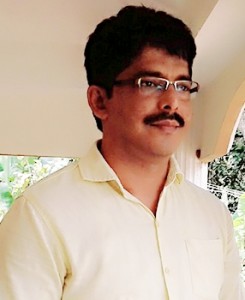
Yaqoob Koyyar hails from a small village called Nada in Belthangady taluk of Dakshina Kannada district. He belongs to that rare breed of teachers who are always ready to solve any math problem. But that’s not what makes him truly rare. He has inculcated qualities like sound thinking, hard work, interest, appreciation and broadmindedness in his students as well. It seems he was born only to spread knowledge.
Nowadays, teachers have an attitude which belies the noble work they render. They think just being teachers makes them great. But Mr. Koyyar isn’t one of them. He works extra hours in the class to teach students the nuances of mathematics and channelize their creativity.
I got to know about Mr. Koyyar through a WhatsApp group called MSTF (Maths Science Teachers’ Forum) run by Mr. Naveed Ahmed Parvez, a high school teacher from Shimoga. This group introduced me to many a local legend in mathematics and science.
Mr. Koyyar’s parents believed his birth brought light in their lives. He studied primary education at the Belthangady government school. There was no Urdu-medium school nearby, so he studied in Kannada medium. He did his secondary education at Manjunatha High School in Dharmasthala. He went on to study Bachelor of Science (B.Sc.). He studied Bachelor of Education (B.Ed.) at the Mangalore College of Teachers’ Education.
He isn’t one who just eyes destiny and does nothing. He is one who can change the atmosphere.
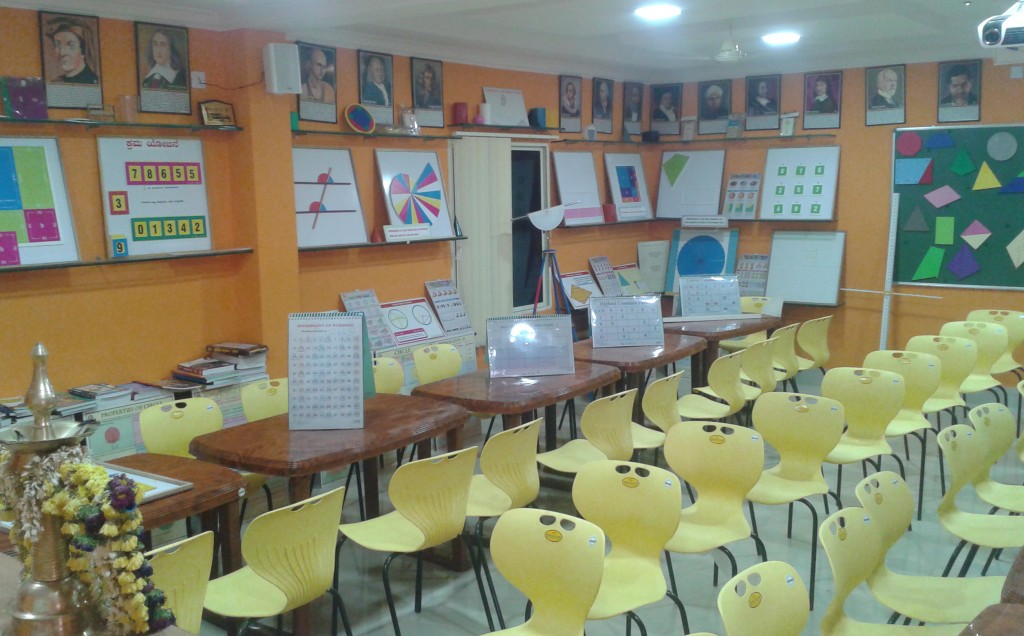
Mathematics lab established by Yaqoob Koyyar in Nada, Belthangady taluk of Dakshina Kannada district
Mr. Koyyar was posted at a high school at his native village. He achieved a lot in his career as a teacher. His students still admire his dedication. He made all of them to think that mathematics is the easiest of all subjects.
He became a tree, giving the fruits and shadow of knowledge to all in this world of selfishness. He himself bore the scorching sun. He evaluated his students with different tests and exams. He would teach most of his students till midnight during exams. He demonstrated so many exercises to the students to make them fall in love with mathematics.
Later, he was transferred as assistant director of Akshara Dasoha (mid-day meal) scheme. There too, he his did duties sincerely. He is popular as the math and science resource person. He was honored by many organizations, too.
Mr. Koyyar used his knowledge and set up a wonderful mathematics lab for all the teaching community of Karnataka. I salute him for his dedication.
His children inherited the same qualities. His daughter scored 611 out of 625 marks in SSLC exams in 2015, with centum scores in Kannada and mathematics.
Computer is known as a multi-tasking and programming machine. I would like to compare Mr. Koyyar with a computer, because he is multi-faceted, hard working and dedicated to spread knowledge.
A recently launched Roti Bank that feeds the hungry has become a huge success in Aurangabad.
An unusual food bank in Aurangabad, Maharashtra, which feeds the poor and the hungry with fresh food supplied by its ‘depositors’ has seen its membership double in less than two months of being operational.
This initiative has been launched by 38-year-old Yusuf Mukati, who opened the doors of the bank on 5 December with 250 members. Depositors had to fill out a form with their details and were given a specific code, which is akin to a bank account. The details of the depositor are stored under this number. As the founder of the Haroon Mukati Islamic Centre in Aurangabad, Mukati already had a long list of contacts. So when he bounced the idea of a Roti Bank off them, he found that people were quite keen to contribute. As a rule, this bank only deals in freshly cooked food items.
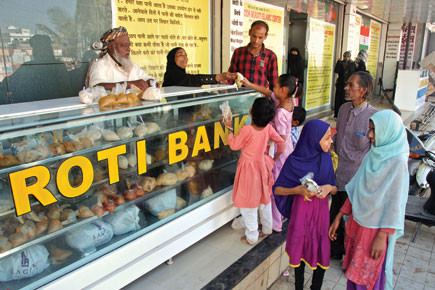
The Bank is open from 11 am to 11 pm. Each of its members has to deposit two chappatis and either a vegetarian or a non-vegetarian preparation. There is no bar on the number of times this can be done. Once the food comes in, helpers segregate the vegetarian and non-vegetarian food and repack it in plastic bags and containers.
This free food is handed out to all those who come to the Bank’s counters. Leftover food is frozen for reuse the next day. In case there is excess food, Mukati distributes it amongst his staffers.
Mukati grew up in a family of modest means where food was a dear commodity. He says, “Seeing poor and hungry people is a common sight. People feed them, but it is never fresh food. I wanted to create a place where people can get fresh food at no cost. It is not just beggars who go hungry. There are so many among the middle-class who have to forgo meals due to rising costs.”
source: http://www.openthemagazine.com / Open / Home> Open> Shorts / by Haima Deshpande / January 28th, 2016
F. M. Khan is taking a walk in his home garden. Picture right shows Dahlia in full bloom.
Madikeri :
Former Rajya Sabha member F. M. Khan is holding the annual flower show at his home garden for the public in Boikeri, near Madikeri, on Jan. 30 and 31.
The garden at Khan’s Balyatrie Estate, with more than 100 varieties of flowers — most of them rare — is spread over more than half-an-acre in front of his house.
Multi-hued roses, dahlia, chrysanthemum, jasmine are in full bloom to welcome the visitors.
Addressing media persons here yesterday, he said floriculture helps in the economic progress of the country and urged the government to support floriculture.
Stating that there is a huge demand for flowers at the international market, he said floriculturists should grow flowers in a natural atmosphere.
With the vagaries of nature, one needs to give special emphasis on protection of plants, he added.
Flowers like Jasmine, anthurium, marigold, salvia, Gerbera, Zenia, Dahlia, Cosmos, croton, colin, Plectranthus, Impatiens, Daisy, Gardenia, sun flower, Hollyhocks, Clarkia, Cockscomb, Lupine, Verbena, Fuchsia, pinks, spider flower, oster flower, calendula flowers, cupia, Gazania, Sweet pea, Cineraria, stock flower, love in a mist flower, devil in the bush and others are on display.
The flower show will be open to visitors from 10 am to 5 pm today and tomorrow.
source: http://www.starofmysore.com / Star of Mysore / Home> General News / January 28th, 2016
Power minister Aryadan Mohammed inaugurated the state’s first floating solar plant at Banasura Sagar reservoir in Wayanad on Thursday.
The 10-kilowatt-capacity plant, spread over 1,200 sq ft has been installed on concrete floaters with hollow insides. The platform can carry 45 tonnes and the power generated will be fed to the KSEB grid through cables drawn through the reservoir bed. KSEB officials said that it is the first floating solar plant to be set up inside a reservoir in the country.
The innovative power generation system, set up at a cost of Rs 20 lakh, is the brainchild of two young entrepreneurs from Wayanad – Ajay Thomas and V M Sudhin. The duo’s startup firm Vatsaa Energy Private Ltd has implemented the project with financial aid from KSEB under its Energy Open Innovations Zone.
Inaugurating the plant, Aryadan Mohammed said that KSEB was making a big push in the area of renewable energy. He added that the government has acquired 500 acres of land in Kasaragod to set up a 200 MW solar park. A further 1500 acres will be acquired for the project.
The KSEB also has plans to convert the largest earthen dam in the country to a hub of solar power generation with the launch of construction works for two other solar projects at the site.
The projects include a proposed 500-kW floating solar plant at the reservoir and a 400kW ‘dam- top’ solar power generation project. The former is a scaled-up version of the 10kW concrete floating plant. The Rs 9.25-crore project will be spread over the water surface of the reservoir across 1.25 acres.
The minister will also inaugurate the works of the 400-kW dam-top solar project by installing solar panel canopy over the walkway atop the dam at a cost of Rs 4.6 crore. Another hydel tourism development project is being envisaged near the dam premises.
Ajay Thomas, who had developed the indigenous technology for the floating plant, said the device has around 20% higher efficiency compared to ground-mounted units as the cooling effect of water helps in keeping the temperature of the solar panels low, thus boosting output.
“The low dust environment in the reservoir also aids in enhanced performance of the photo-voltaic panels. Water bodies in the state, including those in large hydroelectric projects, can be used for large-scale solar power generation through floating plants,” he said.
KSEB chief engineer (renewable energy and energy savings), Suku R, said the floating solar plant was designed for dam reservoirs in the state, also taking into consideration the seasonal water level variations, heavy rain and winds.
M V Shreyams Kumar MLA presided over the function. KSEB chairman and managing director M Sivasankar, academician RVG Menon among other spoke.
www.timesofindia.indiatimes.com / The Times of India / News Home> City> Kozhikode / K.P. Rajeev / TNN / January 21st, 2016