The Coimbatore Medical College and Hospital has performed 100 cochlear transplant surgeries in the last two years, becoming the first government hospital to reach this number.
Coimbatore :
The Coimbatore Medical College and Hospital (CMCH) has performed 100 cochlear transplant surgeries in the last two years, becoming the first government hospital to reach this number.
All the surgeries had been performed under the chief minister’s comprehensive health insurance scheme, said doctors.
The CMCH is the only other government hospital, besides Madras Medical College, approved to perform cochlear transplants under the Tamil Nadu Health Systems Project.
Doctors said they performed their first cochlear transplant surgery on August 10, 2013 and performed the 100th surgery on October 1 this year.
“All the surgeries were successful and all the children operated have recovered and are doing extremely well,” said professor and head of the ENT department Dr V Aravindhan.
The insurance scheme makes cochlear transplant surgeries free for children between 0 to 6 years of age.
“Cochlear transplants are usually done on stone deaf children or those who are severely hard of hearing,” said ENT professor Dr Ali Sultana.
“But since the implant is something that stimulates an auditory nerve in the brain, and later fills the auditory cortex with sounds and information, children learn to use it and benefit better,” he said. “Thus they can speak on the phone and have face to face like conversations like normal people.”
Earlier cochlear transplants were being done only at private hospitals because of the implant was expensive—Rs 5.1 lakh even for the basic low-end one. Now since the scheme allots Rs 7 lakh for the surgery, government hospitals have now begun performing the surgery.
“This includes pre-surgery screenings tests, the surgery, implants, post-surgery complications and a one-year rehabilitation program for the children,” said Dr Aravindhan.
The CMCH has tied up a private institute called “Hearing Aid Centre” to provide the one-year rehabilitation post-surgery.
“They with a team of audiologists and speech therapists provide audio verbal therapy to children, who will start filling their memory cortex with sounds and noises, and slowly start repeating them as part of speech processing. Within the first three months, they start speaking simple words,” said Dr Sultana. `
While cochlear implant surgeries are being done under the state comprehensive health insurance scheme in private hospitals too, other screening and post-surgery costs start piling up, say patients.
source: http://www.timesofindia.indiatimes.com / The Times of India / News Home> City> Chennai / by Pratiksha Ramkumar, TNN / October 05th, 2015
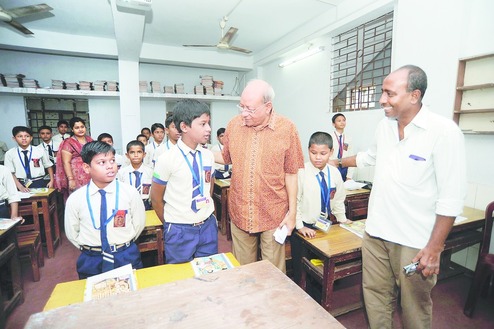
Mamoon Akhtar (right) with Emami co-founder RS Goenka during a visit to his school in Tikiapara. Picture by Sanjoy Chattopadhyaya
Mamoon Akhtar was forced to drop out of school in Class VII because his parents couldn’t afford his tuition fees. Three decades later, the 43-year-old from Howrah is the driving force behind a school in Tikiapara with 3,000 students, most of them children of unlettered parents.
Mamoon’s extraordinary journey from victim to champion of the underprivileged started the day he decided that he wouldn’t be deprived of an education just because his family couldn’t pay for his schooling.
“My father was a labour contractor. Our family fell on bad times when his business collapsed and I had to leave school. But I started giving tuitions and continued studying on my own. I would sit for examinations as a private candidate and this continued till Class XII, beyond which I couldn’t progress because my father died and our financial condition got worse,” Mamoon recalled.
Mamoon is the youngest of six siblings, including four sisters. While one of the Akhtar girls went on to get a bachelor’s degree in arts, he is the only one among the remaining siblings to study beyond Class X.
After his father died, Mamoon took up a librarian’s job in a private school in Tikiapara, supplementing his income by giving private tuitions. Life would have gone on as usual but for what was playing at the back of his mind. Try as he might, Mamoon couldn’t get over how he was forced out of school.
In 2002, Mamoon founded a school in Tikiapara with six students. “I would take in nursery-level kids and prepare them for admission to Urdu, Bengali and Hindi-medium schools the next year,” he recounted.
While the initial expenditure on books and furniture was entirely Mamoon’s, help arrived as the queue of parents wanting to put their children in his school grew longer. Caring Friends, a group of philanthropists, came forward to fund the initiative and the aptly named Samaritan Help Mission School hasn’t looked back since.
Homemaker Tara Khatun’s son and daughter study in the school and she couldn’t be happier for the opportunity. “I pay Rs 80 as the monthly tuition fees for my two children. We couldn’t have paid for an English-medium education if this school didn’t exist,” said Tara, whose husband works at a blacksmith’s shop.
Samaritan Help Mission School is in stark contrast to its surroundings – narrow, dingy lanes lined with shanties inhabited by families for whom life is a struggle every single day. The five-storey school building on a three-cottah plot has Wi-fi enabled classrooms equipped with projectors, among other facilities.
“We use projectors for the benefit of some students with impaired vision. It is easier for them to see on the screen than strain their eyes trying to make out what is on a blackboard,” Mamoon said.
The school currently takes in students from classes I to VIII. Younger students are admitted to the Rebecca Belilious English Institution, located around a kilometre away in an area that used to be a den of crime.
The land on which the second school stands had been a garbage dump for years until Howrah City Police and the Howrah Municipal Corporation got together to create a conducive atmosphere for Mamoon to expand his initiative.
“We helped them (Mamoon and his staff) build a wall, remove encroachments and start a school there. Today, many children from poor families get free education there,” police commissioner D.P. Singh said.
Sources said Singh’s predecessor Ajey Ranade played the key role in transforming the place into a site suitable for a school.
After completing Senior KG at Rebecca Belilious English Institution, most children move to Samaritan Help Mission School, which has been adding a class every year.
“We are affiliated to the West Bengal Board of Secondary Education. When the current batch of Class VIII students is ready for promotion, we will start Class IX,” a teacher said.
Both schools run on corporate funding from companies like Chevrolet, Cognizant, Emami, Edelweiss and Tata Steel. Charity organisations like Kolkata Gives and Caring Friends continue to fund several school activities.
Last Sunday, a team of industrialists and businessmen visited the two schools to see the fruition of Mamoon’s dream. R.S. Goenka, one of the founders of the Emami Group, said: “I come here because the school and the kids here inspire me. I also get to see how people are benefiting from our funding.”
The Emami Group has financed toilets and projectors on the main campus while Rebecca Belilious English Institution has an AstroTurf funded by car manufacturer Chevrolet.
Sport is integral to Mamoon’s vision of a school. Samaritan Help Mission School recently acquired a table tennis board and two of its students, Mohammad Sharik and Sonu Rajbhar, got the opportunity to visit Manchester United Club in Old Trafford earlier this month.
“A big company sponsored the trip. The duo were selected from among kids from underprivileged families who have excelled in football,” a teacher said.
Sharik is in Class IV and Sonu is a student of Class V.
For Mamoon, it’s been a tough but satisfying ride since the days when a group of college girls he had enlisted would go around Tikiapara trying to convince people to send their children to school.
“Many people suggested that I turn my school into a Bengali, Hindi or Urdu-medium institute, but I insisted on an English-medium school. Knowing English is very important in the current scenario,” the 43-year-old said.
Scores of parents are grateful that Mamoon stuck to his plan. Sending their children to any other English-medium school in the area would have been 10 times more expensive.
Mamoon’s three daughters – seven-year-old Atifa Fatema, six-year-old Adifa Fatema and four-year-old Batul Fatema – also study at Samaritan Help Mission School. When wife Shabana readies the three girls for class every morning, he can’t help but wonder what life might have been if he weren’t asked to leave school in Class VII.
What is your message for Mamoon? Tell ttmetro@abpmail.com
source: http://www.telegraphindia.com / The Telegraph, Calcutta,India / Front Page> Calcutta> Story / by Subhajoy Roy / Wednesday – September 30th, 2015
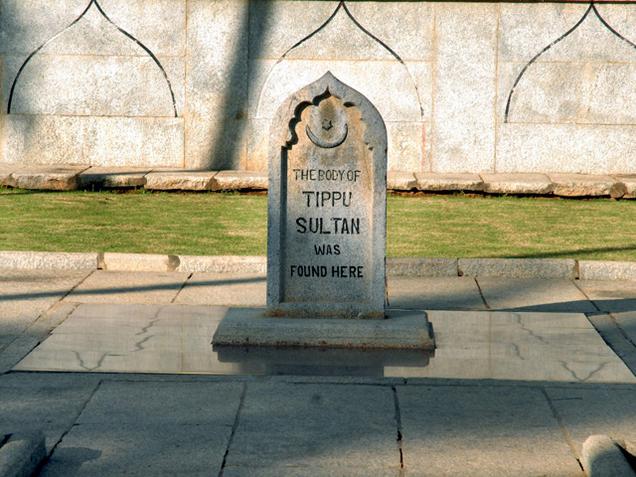
Tipu Sultan cannot be reduced to a singular narrative or tradition of intolerance or bigotry as he represented multiple traditions. Photo: M.A. Sriram / The Hindu
The recent offer made by a film producer to Tamil superstar Rajinikanth to act in a movie on the ‘Tiger of Mysore’, Tipu Sultan, has yet again opened up a Pandora’s Box. The Bharatiya Janata Party (BJP) and some Hindutva groups have demanded that Rajinikanth refuse the offer. This argument is made on the grounds that Tipu, the 18th century ruler of Mysore state, was a “tyrant” who killed thousands of Hindus as they refused to convert to Islam.
This is not the first time that Tipu’s name has been dragged into a controversy. It began some years back when Sanjay Khan made a tele-serial based on Bhagwan S. Gidwani’s book, The Sword of Tipu Sultan. His name was once again dragged into a controversy when the Congress government intended to celebrate his birth anniversary in 2014. There was opposition when a proposal was made to establish a university named after him.
Tipu’s very name has become contentious for two reasons: first, his controversial steps in dealing with different communities and people who rose against him. Second, different perspectives through which history was constructed and his image built.
Colonial historians have projected Tipu as a “religious bigot”, who was instrumental in killing and converting to Islam thousands of Nayars of Kerala, Catholics of Dakshina Kannada and Coorgis of Kodagu. Even Kannada chauvinists have projected him as anti-Kannadiga as he was instrumental in changing the local names of places and introducing Persian vocabulary into administration. Marxist historians, on the other hand, have viewed him as “one of the foremost commanders of independence struggle” and a “harbinger of new productive forces”.
History is unkind to Tipu Sultan. The fact is that Tipu cannot be reduced to a singular narrative or tradition of intolerance or bigotry as he represented multiple traditions. He combined tolerant inter-religious traditions, liberal and secular traditions, anti-colonialism and internationalism. He could do this as he had strong roots in Sufism, which is not explored much by historians. He belonged to the Chisti/Bande Nawaz tradition of Sufism.
In fact, Tipu was radical in more than one sense. He was the first to ban consumption of alcohol in the entire State, not on religious grounds, but on moral and health grounds. He went to the extent of saying: “A total prohibition is very near to my heart.” He is credited with introducing missile or rocket technology in war. He was the first to introduce sericulture to the then Mysore state. He was the first to confiscate the property of upper castes, including Mutts, and distribute it among the Shudras. He is also credited with sowing the seeds of capitalist development at a time when the country was completely feudal. He thought about constructing a dam across the Cauvery in the present-day location of Krishnaraja Sagar. He completed the task of establishing a biodiversity garden named Lal Bagh.
His tolerance is reflected in his annual grants to no less than 156 temples, which included land deeds and jewellery. His army was largely composed of Shudras. When the famed Sringeri Mutt, established by Shankaracharya, was invaded by the Maratha army, he issued a firman to provide financial assistance for reinstallation of the holy idol and restoring the tradition of worship at the Mutt. His donation to the famous Srikanteshwara temple at Nanjangud; the donation of 10,000 gold coins to complete temple work at Kanchi; settling the disputes between two sects of priests at the Melkote temple; and gifts to Lakshmikanta temple at Kalale are all well-known. Interestingly, Srirangapatna, a temple town, remained his permanent capital till the end of his rule. He was also instrumental in constructing the first-ever church in Mysuru. Incidentally, well-known historian B.A. Saletore calls him “defender of Hindu Dharma”.
The allegation of forcible conversions has to be seen in the background of political exigencies — either they were with the colonialists such as in the case of Christians of Dakshina Kannada, or were waging a protracted guerrilla war as in the case of Coorg. Here, historians have distorted the facts by reducing political exigencies to the “communal ideology” of Tipu.
A ruler, who once identified himself with the American and French Revolution and Jacobinism, has remained an enigma to many. That a man who ruled for just 16 years continues to haunt Hindutva groups obviously means that Tipu continues to exist in the political discourses, political narratives as well as in the imagination of nation-building. This is where the irony of history lies — one cannot just bury Tipu in the annals of history.
Muzaffar Assadi
(The writer is chairman, department of political science at the University of Mysore. muzaffar.assadi@gmail.com.)
source: http://www.thehindu.com / The Hindu / Home> National> Karnataka / by Muzaffar Assadi / September 27th, 2015
A workshop-cum-exhibition on digitization of palm leaf manuscripts was organised at Sadakkathullah Appa College here on Tuesday.
Students from various colleges visited the exhibition which had a good number of palm leaf manuscripts on display.
Since most of the palm leaf manuscripts, carrying rare medical remedies with herbal plants for a range of human and domestic animal ailments, are so fragile, efforts are on to digitize them.
A relative of Tamil scholar U.Ve.Sa. handed over a bunch of palm leaf manuscripts to Sadakkathullah Appa College’s managing committee member Pallaakku Lebbai for the digitization project.
Palm leaf manuscript scholar Sankaranarayanan, faculty of Government Siddha Medical College, Palayamkottai, Subhash Chandran, Assistant Director of the Department of Archaeology Chandravaanan, Principal of the college Mohamed Sathik and others spoke on rare information found in the palm leaf manuscripts.
source: http://www.thehindu.com / The Hindu / Home> National> TamilNadu / by Special Correspondent / Tirunelvelli – September 30th, 2015
A scientist and a teacher came together recently to narrate select letters written to and from Lucknow, over a period of nearly 150 years, by both the famous and the commoner, to depict the resounding, and changing, cultural ethos of the city of Nawabs.
“Lucknow in Letters: endeavours, achievements and tragedies”, presented here recently by Saman Habib and Sanjay Muttoo, is a multilingual reading of letters from and to Lucknow in the 1850s.
The letters, collected from private sources and museums, newspaper reports and essays provide a glimpse of the living experience of the city since the ‘Ghadar of 1857’.
The letters, which were accompanied by rare manuscripts, original letters and pictures of those who wrote them, came together to provide a life-like narrative of the events in Lucknow of a long-gone era – from the mutiny to the subsequent rebuilding of the city, the plague of 1903 to 1936 floods, the freedom movement and the pain of Partition.
The presentation, hosted by Indira Gandhi National Centre for the Arts (INGCA), is a heart-rending glimpse of what shaped the city over the course of time and includes mails by everyday people living life while some of them also had their senders in important personalities like Mahatma Gandhi, Jawaharlal Nehru, Mirza Ghalib and Rabindranath Tagore – all accounting their connections to Shahar-e-Awadh.
The concept, says Saman, was conceived by her in February last year when she was writing letters to her relatives in Pakistan, who had migrated there during Partition, while the first staging took place after three months – in May.
“There are families in Lucknow which have preserved the letters from older times. In older days, letters happened to be a huge event in families, when all members of the family would read a letter that would reach to them from far-off places. But that is a gone era now… So we thought that explaining that whole concept to people it would be a good idea to collect letters and make a narrative out of it,” Saman, a senior scientist at the Central Drug Research institute in Lucknow, told PTI.
“The idea was that we not only read it but also come up with pictures – of the letters, the people writing them, buildings of that time, etc. So as to understand the city, to know it more and relive the whole experience. Its not a history lesson, listening to letters and watching visuals is an experience.
“Letters are firstly an authentic documentation of all occurring of the time. Plus, it depicts the ‘zabaan’, the language of the city as used by people. And as we transcend the era sifting through letters we can notice a palpable change in the language and customs too. Then, the social class and language. Who is writing and in what language… I think many things come out with that,” she says.
source: http://www.business-standard.com / Business Standard / Home> PTI Stories> National> News / Press Trust of India, New Delhi – September 27th, 2015
The South Indian Classical Dance Festival began in the city on Saturday under the aegis of Southern Cultural Centre (Tanjavore), cultural councils of Central and state governments, and Young Men’s Hindu Association (YMHA).
Andhra Pradesh Assembly speaker K Siva Prasada Rao lit the lamp and inaugurated the festival. He emphasised upon the need to encourage the classical art forms in the state and pointed out that Tamil Nadu encourages art forms in a big way. He assured to set up Government Music and Dance College in the city with the help of public representatives.
Southern Region Cultural Centre director EN Sajith, city mayor Sheikh Noorjahan, YMHA Trust Board general secretary KV Satyanarayana and working committee president Ch Gopi also participated. Later the speaker felicitated the dance artists.
On the occasion, the Aiswarya Warrior team of Baroda performed Mohiniyttam (‘Shakti’ dance play let), while Kuchipudi artiste Amaranth Ghosh from Chennai performed ‘Jayadeva Ashtapadi’ and ‘Shivasthakam’. The Ghosh team also performed ‘Ganapathi Kowtham’, ‘Govardhan Giridhari’ and ‘Marakata Manimaya’, which enthralled the audience.
source: http://www.newindianexpress.com / The New Indian Express / Home> States> Andhra Pradesh / by Express News Service / September 27th, 2015
People usually hurry to reach Mina creating tremendous risk for themselves and others. It’s during this ritual that chaos is triggered.
I went for Haj pilgrimage with my wife in December-January 2006. During the journey, we noticed that the Gulf region was unstable owing to the trial of the deposed Iraqi dictator Saddam Hussein in Baghdad and emotions were running high among the Arabs. The political fever in the region also spread among Haj pilgrims. Emotions and arguments add to the atmospherics of Haj. One can imagine the energy and excitement of a pilgrimage in which millions of people from diverse linguistic, ethnic and racial backgrounds are united by religion.
Our delegation was special as we were being accompanied by former Chief Justice of India A.M. Ahmadi and other dignitaries from different parts of India. But from the beginning of the journey, I saw that arrangements on the ground were not quite right. The Saudi officials gave out instructions only in Arabic, though most of the pilgrims were unfamiliar with the language.
Countries that send the largest number of pilgrims are from South and Southeast Asia like Indonesia, Pakistan, Bangladesh, Afghanistan and India. People from this region speak many languages. Special attention is needed for the elderly, many of whom undertake foreign travel for the first time and, therefore, are quite disoriented and find it difficult to adjust to sudden orders yelled out in Arabic by policemen.
Also, the Saudi rules aim at segregation of men and women which creates a lot of problems for first-time travellers from our region. Often families which are separated by the Saudi police have to endure hardship, which is multiplied because neither the pilgrims nor the police can understand each other.
The process of Haj starts from Mina where one has to begin early after a prayer, followed by the circumambulation of the holy mosque Kaaba. The pilgrimage ends at Mina following the ritual of ‘Stoning the Shaitan.’ This last ritual at Mina needs to be completed before sunset and people usually hurry to reach Mina creating tremendous risk for themselves and others. It’s during this ritual that chaos is triggered.
On January 12, as we were returning to Mina for the last ritual of Haj, we saw the big stampede from a distance as waves of people collided. Dust and fear enveloped us. Our group stopped midway out of fear and went back to Mecca.
Next morning, we started early at 3 a.m. for the dash to Mina. On the way, we saw huge piles of shoes, clothes, and water bottles left behind by the stampede victims being loaded onto the trucks by the police. Officials informed us that around 350 people had died in the stampede and hundreds more were injured. The possessions of the pilgrims left behind made me suspicious of the official account.
The road to Mina which is where the stampedes often happen is very risky as it’s the only one for the journey to Mina and for returning to Mecca. I am told that the Saudi government has created an alternative route for the pilgrims returning to Mecca but that route is longer and many pilgrims continue to return by the old, shorter and narrow route which puts them at risk.
Year after year, stampedes have taken place on the same route near Mina, yet the Saudi authorities have failed to do anything to reduce the risk.
The occasion of Haj brings more than three million pilgrims to Mecca. A number of factors can trigger a crisis and a stampede on the ground where the crowd is united by religion and divided by political sentiments of the Arab countries. Sabotage is often suspected when such tragedies take place.
The Saudi government should also be open to learning from other countries where a large number of pilgrims congregate, for example in India’s Kumbh Melas and in the Vatican where authorities take care of the linguistic differences while managing people. There is no harm in learning from others.
Prof. Pasha teaches West Asian politics in JNU.
(As told to Kallol Bhattacherjee)
source: http://www.thehindu.com / The Hindu / Home> National / by Prof. A.K. Pasha / September 26th, 2015
All India Radio will be broadcasting an English feature on 1965 war hero Company Quarter Master Abdul Hamid, Param Bir Chakra (Posthumous).
The feature titled “Lest We Forget” will be broadcast on September 25 at 10 p.m. on the Rajdhani Channel, AIR Delhi and AIR FM Rainbow network.
The feature can also be enjoyed through live streaming available on allindiaradio.gov.in By downloading our web applications for either for Android, iOS or Windows, one can also get to hear programmes of All India Radio.
To commemorate 50 years of 1965 Indo-Pak War, All India Radio is continuously broadcasting talks and features both in English and Hindi.
This particular national programme of features (English) intends to retell the story of one such brave son of India, soldier no239885, who played a pivotal role during a bloody encounter in Khemkaran, which was the site of a major tank battle in 1965.
The 1965 Indo-Pakistani War witnessed the largest tank battle in military history since World War II. Khemkaran is, till today, known as the graveyard of tanks, the area where Pakistani Patton tanks were crashed and burnt as they met the solid iron wall of mother India’s sons.
This was one of the first instances in modern warfare when an armoured division was beaten back by an infantry regiment. And this was the point where the tide turned towards India.
This programme will attempt to travel back in time to Khemkaran of 1965 to recreate the day when amidst blazing guns and war-cries, Company Quarter Master Havildar Abdul Hamid, PVC, of the Indian Army who made the ultimate sacrifice. (ANI)^
source: http://www.in.news.yahoo.com / Yahoo.com – News / Home> National by ANI / Thursday – September 24th, 2015
With an aim to add sheen to its Heritage zone scheme the Uttar Pradesh Government is all set to put up plaques on the buildings of Lucknow where once historical personalities lived in bygone era.
The Chief Minister’s office has asked the Tourism Department to prepare a plaque that could match the flavour and history of Awadh and identify the houses once inhabited by historical personality – may be artist literature or even freedom fighter..
“This is a small gesture that will help people to identify the buildings where say once Premchand lived or where Mir Taqi Mir wrote his gazals. People might have passed through these buildings without knowing the historical importance of those structures,” a senior official in CM’s office told The Pioneer here recently.
The idea to have plaque at important buildings has been borrowed from London’s Blue Plaque. This plaues, which are in blue in colour, are put up on the buildings where famous people had lived and worked. It celebrates the architecture of London’s streets and the diversity and achievements of its past residents. London’s blue plaques scheme, founded in 1866, is believed to be the oldest of its kind in the world.
The official said that the scheme is aimed at to celebrate the link between people and buildings. “The buildings carrying plaques will invoke interest of the people about the person and the building where he lived. This will not only add to the historical importance of the city but also help the Tourism department to give added tinge to its Heritage zone scheme,” the officer said.
The Chief Minister’s office has asked the Tourism Department to prepare a detail proposal including the design of the proposed plaque. It has been asked to rope in historians like Yogesh Pravin to identify the buildings of city where the celebrities of olden era once lived.
There are over 50 litterateurs, artists, freedom fighters and people associated with films were either born or worked in Lucknow. From Mir Taqi Mir to Begum Akhtar, from Prem Chand to Sri Lal Shukla and from Pahari Sanyal to K.P. Saxena all have their share of association with Lucknow. Then there are people like Amrit Nagar, Kaifi Azmi, Bhagwati Charan Verma, Mirza Hadi Ruswa, Josh Malihabadi, Jan Nisar Akhtar and this list is endless. This scheme only aims at identifying the buildings where they lived.
“The buildings tell a lot about the character of the person who lived or worked there. Some of them may be dilapidated but they are rich in history,” he said. “The Plaque will not offer any kind of special protection to buildings, but will raise awareness of their historical significance. This in turn can assist in their preservation,” he said.
source: http://www.dailypioneer.com / The Pioneer / Home> State edition> Lucknow / by Biswajeet Banerjee, Lucknow / Saturday – July 25th, 2015
Information Commissioner, Hafiz Usman stressed need of maintaining communal harmony and claimed that every human being in creation of God and all other classification on basis of caste, religion, rich or poor, strong or weak etc are man made.
Speaking at inauguration of Urs Festival at Syed Salar Sahu Gazi mazar in Bara Banki on Tuesday night, Usman, who was also chief guest said that every family had some one elder or younger but only when both lived jointly that family prosper otherwise inner conflict over who is bigger ruin them. Similarly irrespective of who is bigger or who is smaller, if every one live and cared for each other, only than the society would prosper. He said that the message of every saint is similar i.e to maintain brotherhood and communal harmony.
Usman said that even the constitution of India gave similar message i.e every citizen of the country had equal rights and there is no discrimination on basis of caste, religion, rich or poor etc. He called the members of his community to contribute their best in maintaining communal harmony and social fabric of this country.
source: http://www.dailypioneer.com / The Pioneer / Home> State edition> Lucknow / Pioneer News Service, Lucknow / Thursday – August 13th, 2015