Volunteers of Wipro Care Trust plant saplings at Perumbakkam. Photo D. Gopalakrishnan
The event was organised by TIST Tree Planting India in association with Wipro Care Trust.
Over 2,000 saplings were planted in Perumbakkam village on Sunday as a mark of respect to former President of India A.P.J. Abdul Kalam.
The event, organised by TIST Tree Planting India in association with Wipro Care Trust, a corporate social activity arm of Wipro Limited, Bengaluru, marked the launch of the program to plant 25,000 saplings sponsored by WCT for the current year.
Creating biodiversity
Speaking to The Hindu , B. Praveen, programme manager, said Wipro sponsors 25,000 saplings every year and plants them in five northern districts of Tamil Nadu through local groups formed by TIST-TPI.
The main objective of TIST India’s programme is to create islands of biodiversity in an already fragmented landscape to help farmers said A. Joseph Rexon, director, TIST-TPI. He said around 1.8 million saplings were planted in Kancheepuram, Tiruvallur, Vellore, Tiruvannamalai and Villupuram districts since 2003.
Over 5,500 farmers have been enrolled as members of this programm that is sponsored by Corporates including Wipro. Mr. Rexon said participants were also entitled to avail greenhouse gas (GhG) credits after 20 years.
This would be paid based on the World market price of GhG credits, as on December 1 of the year for which payment was made, he added.
source: http://www.thehindu.com / The Hindu / Home> National> Tamil Nadu / by Staff Reporter / Kancheepuram – September 08th, 2015
Muslim Cosmopolitanism in the Age of Empire Seema Alavi Harvard University Press, 2015, 504 pp, Rs 1495
Muslim Cosmopolitanism in the Age of Empire is an exhilarating book encompassing broad swaths of trans-imperial history, religio-cultural geography and a stunning breadth of vision. Seema Alavi’s credentials as a historian of substance are well-established. Starting with a book on India’s military history and the Sepoys of the Company that came out of her doctoral research work in Cambridge with C A. Bayly, she later forayed into the history of indigenous medicine, producing the gem of a book, Islam and Healing with another book thrown in between—The Eighteenth Century in India. The current tome has a distinguishing feature that sets her apart from the ordinary run of historians – her multilingual scholarship, her willingness and ability to access source materials in several languages and her skill in marshalling arguments from different perspectives combined with insights drawn from literary sources to give a comprehensive, almost definitive, view of the phenomenon under discussion.
The seed of Muslim cosmopolitanism was, perhaps, sown when the Prophet had exhorted his disciples to undertake even the hazardous journey to China in quest of knowledge. Unlike some cultures, where travel across seas and mountains were proscribed for fear of losing purity/caste, Islam always put a premium on travel and trade, the Prophet himself being the best exemplar of both. When one travels one gets exposed to multiple cultures, belief systems and world-views, thus shedding one’s parochialism and embracing traits of cosmopolitanism. Baghdad (of Baitul Hikmah fame), Constantinople (current Istanbul, the seat of Ottoman empire), Cairo, Cordoba, Damascus, Bukhara, and Delhi were all Muslim cosmopolitan cities at different historical moments where scholars, statesmen, adventurers from all over the world congregated and conducted dialogue in a spirit of openness and catholicity. In the current times, when Muslims, for a variety of reasons, have become victims of insularity and ghettoisation, Alavi’s book is a potent antidote to the widespread but ill-informed media narrative about Muslim resistance to forces of modernity and globalisation.
Extraordinary journeys
Alavi’s articulation of Muslim cosmopolitanism in the 19th century is chronicled through the extraordinary biographies of five Islamic scholars from India – Sayyid Fadl, Maulvi Rahmatullah Kairanwi, Maulvi Imdadullah Makki, Siddiq Hasan Khan, and Maulvi Jafer Thanesri – who transcended their limited identity as British subjects and charted careers at the interstices of imperial borders. Taking advantage of imperial knowledge, strategies and rivalries between two great empires of the day, British and Ottoman, “they carved out a spiritual and civilisational space between the [these] Empires and projected it as their cosmopolis.”
The chapter on Sayyid Fadl brings alive the phenomenon of the ‘Indian Arab’ who hailed mostly from Hadramawt, Yemen, and whose presence was marked in Delhi, Gujarat, Deccan and Malabar. Starting his Indian career in the Malabar district of modern day Kerala, he was branded as a “fanatic” and an “outlaw” by the British government because of his alleged involvement in the anti-British Moplah uprising. But he fled from British India and then used the British and Ottoman tension and his trans-imperial connections to put himself up as the ruler of Dhofar – a semi-independent region in the southwest of Arabia . “Sayyid Fadl’s remarkable journey – born and brought up in a Malabar Sufi family of Arab descent and rising to become an independent ruler of an Arabian principality, a leader who commanded respect in both Meccan and Istanbul high society – was enabled by the connections he forged early on between British and Ottoman societies. And he established these connections using imperial networks as well as his religious and kinship ties.”
Amadeo Preziosi’s Entrance to the Golden Horn, painted c.1840-1880. Credit: Seema Alavi
Nawab Siddiq Hasan, who had a prominent position in the state of Bhopal, exerted great influence through his agents in Hijaz and Istanbul and fully exploited the potentialities of print culture to propagate a version of Islam at odds with the political interest of the British rulers in India. But the British resident in Bhopal could do little to prevent him from propagating his anti-British views. Exploiting British-Ottoman rivalries allowed him to publish his books and journals from Bhopal, Calcutta, Mecca, Madina, Istanbul and Cairo. His agents also bought books pertaining to a similar ideology and had them printed from Bhopal. “Imperial assemblages were also empires of print”, and Hasan fully exploited the possibilities of the moment to propagate his version of the Muslim cosmopolis making forays through porous imperial borders.
For the other three religious thinkers, the 1857 war of independence provided the backdrop for their political careers. They became suspects in the eyes of the British because of their alleged roles in the uprisings. Rahmatullah was one of the rebel leaders of Kairana who escaped the British noose by fleeing to Mecca, and his extensive family estate was confiscated by the colonial administration. He established the Madrasah Saulatiya in Mecca which became a hub of Muslim cosmopolitanism and produced scholars who spread out in different parts of the world, establishing similar seminaries and spreading the same message of consensus and unity among Muslims. Kairanwi wrote in Arabic, Persian and Urdu, addressing the Muslim umma across the empires, adhering largely to the Salafi intellectual tradition. Imdadullah followed Rahmatullah to Mecca and taught in his Madrasah Saulatiya. Both met Muslims from all over the world who came for hajj and discussed with them the challenges of anti-British struggles being waged in their own countries.
Challenge to colonialism
The pedagogical model evolved in Saulatiya and their ideological underpinnings shaped the broad curricular structure at the Deoband seminary in India. Thanseri who couldn’t escape was sent to the Andamans. However, he was one of those convicts who was co-opted in the colonial administration. “Unlike Kairanwi and Imdadullah Makki, he did not manage to escape to the Ottoman territories. But this did not stop him from envisaging a Muslim cosmopolis stretched across empires, and via his writings he envisaged an embracive civilisational space that spilled out of British India and challenged the colonial regime through its call for Muslim unity across the imperial assemblage.” (P. 333)
Alavi is prescient in her analysis of how print capitalism, the telegraph and the increasing ease of travel that fuelled resentment in colonised societies by upsetting the social order were also the means that helped build Muslim solidarities across a vast geographical divide. She is equally prescient in her debunking of the British paranoia of ‘Wahabism’ which the nervous officials saw everywhere. The British fear of Muslims was exacerbated by 1857 and William Hunter’s meretricious book Indian Musalman predisposed them to see the spectre of Wahabism even in innocuous reformist movements among Muslims and equate what Alavi defines as Muslim cosmopolitanism with territorial loyalty. The study reminds the reader of how intensely nationalist these Indians were even while they were trying to bring about a broad consensus among Muslims of different countries regarding contentious issues that divided them along ideological faultlines. Through her book Alavi has retrieved a segment of our national history that had been all but erased from public memory.
M Asaduddin, an award-winning author and translator, is currently Dean, Faculty of Humanities and Languages, Jamia Millia Islamia
source: http://www.thewire.in / The Wire / Home> Books / by M. Asaduddin / September 06th, 2015
Delivering an Inaugural Address at the National Seminar on ‘Shifting Paradigm: Re-Envisioning Minority Issues and Minority Studies in India’, Mukhtar Abbas Naqvi, Minister of State for Parliamentary and Minority Affairs said that NDA-II Government is committed to change socio-economic environment in the country to promote security and inclusive growth. The overwhelming mandate obtained by the NDA established beyond doubt that young India has sought both systemic change and elimination of stereotypes. He talked about the need to empower minorities politically so that they could become agents of change.
Prof. Imtiyaz Ahmad, an eminent Political Scientist and formerly at Jawaharlal Nehru University, giving his Keynote Address, talked about how a democratic state, which was a distributor of rights, could provide insurance for survival and sustenance of the subordinate groups for want of which market forces would bring about their marginalization and exclusion.
The progress of subordinate groups cannot be realized by mere dependence on market forces, he elaborated. He felt that the rights enjoyed by minorities in a democratic set-up can be fully realized only if the state chooses not to abdicate its responsibilities. He went on to add that minorities should move away from identity-politics and get themselves mobilized in respect of socio-economic issues. Talking about the strengths of Indian Islam, he said that it was informed by eclecticism, diversity and tolerance and felt that promotion of democracy, moderation and economic development by the state since Independence had instilled confidence even amongst minorities who realized that despite being subordinate groups they could exercise their rights. It was important, he observed, to prevent erosion of confidence that has got built assiduously over years.
Prof. T.K. Oommen, Professor Emeritus, Jawaharlal Nehru University, delivering his Keynote Address, presented the need to evolve a social morphology of minorities to understand and promote issues of equity, identity, security and dignity that stood intertwined and intersected. He felt that it was important to bring about a socio-economic environment wherein issues of equity and dignity could be addressed in concrete terms.
Prof. Talat Ahmad, giving his Presidential Remarks, said that there was diversity in the country which could be best upheld by the state. It was important to bring education to all the diverse groups in the country that could lead to social democratization, he said. He averred that the efforts of the political leadership to bring about economic growth and prosperity would help address the real issues that confront the nation. State policy formulations should not only be informed my economic and legal inputs but also sociological, he added.
Earlier, Dr. Arvinder A Ansari, Organizing Secretary of the Seminar, presented the theme of the seminar. Later, Dr. Neshat Quaiser, Head, Department of Sociology, JMI gave his concluding remarks.
source: http://www.okhlatimes.com / Okhla Times / Home> JMI / by Okhla Times Campur Reporter – JMI / OT – September 09th, 2015
For the first time in the city, a motivational programme was held for street vendors on Monday. The United Forum organized the session for the vendors as well as students and teachers of madrasas.
Motivational trainer Saeed Ahmed, who has conducted several such sessions in Maharashtra, Uttar Pradesh and Karnataka, conducted the sessions. Ahmed trained the gatherings on body language, ethics, upkeep of the outlets of street vendors, self-motivation, language and other soft skills.
Ahmed said the theme of the sessions revolved around working for one’s heart and not merely stomach. “If you make your work your hobby and passion, you are happy and content with it,” said Ahmed.
Zuber Gopalani, who had organized the event, said a quarrel he saw between a street vendor and his customer prompted him to hold the event. “Clearly, the street vendor was going to lose business,” said Gopalani.
source: http://www.timesofindia.indiatimes.com / The Times of India / News Home> City> Vadodara / TNN / September 08th, 2015
Hyderabad’s ‘real heroes’ were honoured by 92.7 Big FM
It is not easy to initiate a change. But, the best way to bring a change is by paving a new path. While most of us complain at the way society turns a blind eye to the problems and situations, there are a few who do not complain, instead take things in their hands and set an example. To felicitate their efforts and set them as role models to society, 92.7 Big FM invited these heroes as part of their ‘Big Real Hero Awards’ campaign.
As we celebrate the 69th year of independence the change makers of our society become the real heroes to fight for various forms of independence in our independent society. These heroes are silent and are making a difference without talking about it.
As part of their campaign, Big FM in their breakfast show asked people to share the names of heroes they have seen working for society. After an overwhelming response some of them were even featured in their breakfast show ‘Salaam Telangana’ hosted by RJ Shekar and Swapna.
In an event on Friday, the channel felicitated the six heroes namely—Bal Gangadhar Tilak, Sharif, Rajeshwra Rao, Bhagya Lakshmi, Yadigiri and M. Vijay Ram Kumar. The awardees come from different walks of life and serve society in different ways and means. They, in their own right have been working for a change. Bal Gangadhar, a retired railways employee has used his pension to fill more than 1100 potholes in the city. He took the initiative when he witnessed several incidents caused by the bad state of roads. In Bal Gangadhar’s absence his brother Bhimesh Shankar was present. He established shramadaan.org
Sharif is the founder of Friends2support.org. F2S is a group founded by five friends to help people meet the emergency blood requirement for free. F2S claims to be India’s largest blood donor database. The organisation has won several national and international awards. Rajeshwar Rao is the founder of Satya Harishchandra foundation. They cremate unclaimed and unidentified dead bodies. Bhagya Lakshmi from ‘Manchi Pustakam’ is a small initiative taken to publish, encourage and promote Telugu books. Yadigiri is a chef and he donates food from his restaurant—Ulavacharu to orphans everyday and M. Vijay Ram Kumar of Emerald sweets has been working for a green society. The awards were given away by Somesh Kumar, Commissioner GHMC and actor Manchu Lakshmi.
source: http://www.thehindu.com / The Hindu / Home> Features> MetroPlus / by Prabalika M. Borah / Hyderabad – August 14th, 2015
Author Anwar defies many myths about writers. He could only write in his mother tongue, but has carved a niche for himself in Telugu poetry and short story genres.
He is widely known for his acclaimed short stories – ‘Bakri, ‘Pichidhi’, ‘Maa tuje salaam’ and his anthologies of poetry titled ‘Talavanchani Aranyam’ and ‘Mutti’ among others.
He went on producing remarkable works in the past ten years and is popularly known among people of Telangana for his laborious work ‘Atma Balidaanalu’ – a compilation of details of all those who sacrificed their lives for the cause of statehood in the recent movement.
Sporting a bag, carrying a camera, pen and a note book, he went from street to street, village to village talking to parents and relatives of youths who jumped before speeding trains, hanged themselves, immolated themselves aspiring for separate statehood to the region.
Speaking to The Hindu, Mr. Anwar says that the book demanded much from him, including his personal life. “I am happy to be part of the separate Telangana struggle. My work required more silence and hard work. It gave me immense pleasure in bringing to light the sacrifices of over 170 youths and it helped the families get financial assistance promised by the TRS government,” he says.
Powerful poetry
Committed to making a name in Telugu contemporary literature, he writes sparingly but powerful poetry and prose unlike others who churn out pages and pages. He edited scores of poetry books such as `Nayina,’ ‘Ajaah’ and is soon coming out with his short story book.
Mr. Anwar works as health educator in the Medical Department and is an active social activist striving to reach out to the poor and the needy.
source: http://www.thehindu.com / The Hindu / Home> National / by Gollapudi Srinivasa Rao / Warangal – September 06th, 2015
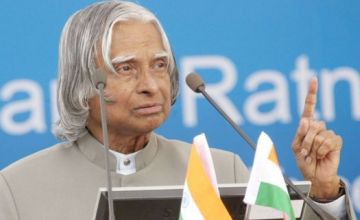
Filmmaker Nila Madhab Panda, who is planning to make a biopic on APJ Abdul Kalam, says he needs good amount of time to direct the movie on the former Indian President.
The I Am Kalam director said he had even discussed the idea of making the film with Kalam.
“When you think of making a film on such a personality, you have to take a hiatus for at least three years. It is not a film which can be made in six-seven months.
“I would love to make a film on him because I have spent ample amount of time with him. But I don’t know when I will start making it. I had few discussions with Kalam sir too about his biopic when he was alive,” Nila said.
When the entire country was mourning the death of the former Indian president, who died in Shillong in July, the filmmaker was happy to see how every channel was showing “I am Kalam” to keep his spirit alive.
“Every channel was showing I Am Kalam after his death.
Though it was not a film on his life, it is a film which will keep his spirit and teachings alive.”
I Am Kalam, a 2011 film, revolved around a poor Rajasthani boy whose life changes forever after he takes a cue from a speech delivered by the former President.
Nila’s latest satirical drama Kaun Kitne Paani Mein hit theatres recently. The film talked about the water scarcity in a village in Odisha.
source: http://www.thestatesman.com / The Statesman / Home> Interview / Press Trust of India, New Delhi / September 07th, 2015
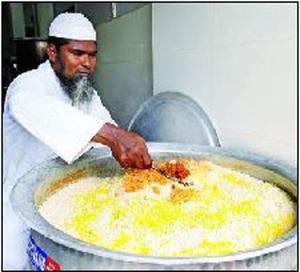
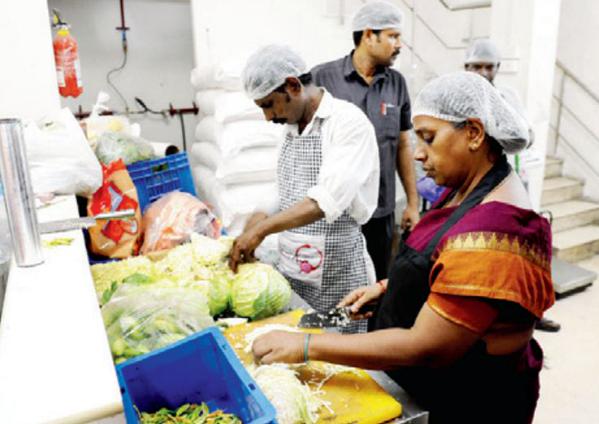
Mohammed Shabbir toils over a huge handi to conjure up his signature dish – kacchi gosht ki biryani. In the kitchen, a few men and women work quietly, cleaning vegetables, and washing vessels. Bhawarchi Shabbir on Whites Road, Royapettah, is not just another restaurant. It is a training centre which aims to help people who have battled or are battling mental illness, find gainful employment and their own space in mainstream society.
An initiative of The Banyan, a mental health NGO, and restaurateur M Mahadevan, Bhawarchi Shabbir was officially launched last Monday. “This is a training centre where about six to eight people will be trained in service – pouring water, cleaning and cutting vegetables in the kitchen, washing vessels and assisting the chef,” says Mahadevan. “At present, we have five women and two men.”
After three months of training, they will be placed in establishments run by Mahadevan, such as The Marina, Copper Chimney and Bombay Brasserie. “Once they become full-time employees they will be paid Rs 9,000 per month, plus accommodation, food on duty, medical and insurance.”
To run Bhawarchi Shabbir, Mahadevan has brought down ustad Mohammed Shabbir from Hyderabad. While customers can drop into the 30-seater place and sample Shabbir’s Dum Ka Murg Biriyani, Shabbir’s Kacchi Gosht Ki Biriyani and vegetable biriyani, along with other Hyderabadi dishes, takeaways is a major market they are targeting. The specialty, of course, are the biriyanis, which customers can order by the kilo.
All the trainees are either residents of The Banyan or former clients who have accessed services from The Banyan. “We select those who are interested in the initiative. The idea is for them to be trained and employed so that more people are inspired to come forward,” says Mrinalini Ravi, assistant director of male shelter programme of The Banyan.
“There are many people living with depression and bipolar disorder who are part of mainstream work; maybe they haven’t disclosed their status for fear of stigma and discrimination. In the case of those who are symptomatic and experience a certain level of chronicity which makes ill health more visible, discrimination seems to be rampant. Sadly maintaining social order is the norm in our society and differences are not easily embraced. Thus one gets judged and alienated if one is different or doesn’t conform,” says Vandana Gopikumar, one of the founders of The Banyan.
This initiative aims to ensure that there is promotion of self-reliance, self-worth and creativity amongst those living with a mental illness as well as positive reinforcement at the society level so that people question their own perceptions and aspire to think inclusively, she adds. “This change in mindset will encourage social mixing and build a more just, friendly and cohesive society,” says Vandana.
There are, of course, challenges. For one, Mahadevan’s staff will be sensitized to work along with the trainees. “His employees know some of the people can be symptomatic, so they have to accept it. They need to incentivize, reward and motivate them,” says Mrinalini.
For Meenakshi*, supervisor, it is a chance to have steady employment. Deserted by her husband and treated for depression, she had to discontinue working as a teacher. “After that I worked in several places,” she says. “But here I hope to get steady work and a regular salary.”
*name changed
source: http://www.timesofindia.indiatimes.com / The Times of India / News Home> City> Chennai / by Priya Menon, TNN / September 06th, 2015
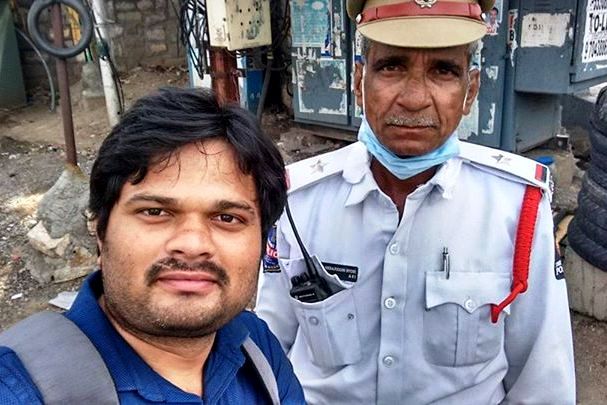
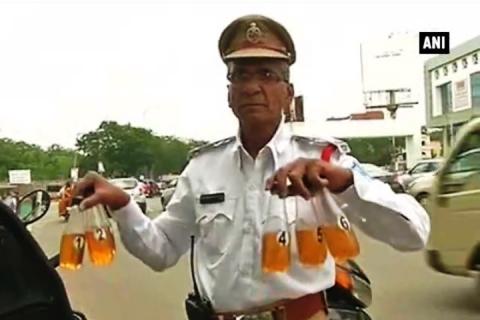
Merajuddin Syed has become a local hero over the past few weeks
Image: Facebook/Vijay Vj
Vijay, a resident of Hyderabad, was going home from work on August 26 when his bike ran out of fuel.
As he was pushing his vehicle, on the lookout for a place to refill, he was stopped by Merajuddin Syed, a traffic policeman who was on duty near the Begumpet area of the city.
“When he came to know that I had run out of petrol, he yelled at a man beside him to get a bottle of petrol from his bike. Meanwhile, he told me that he has got a hike and with the raise in his salary, he wanted to help people. Now, he helps people out who have run out of petrol, gives it to them free of cost. I was so overwhelmed by his kind and helpful nature. Hats off to you,” Vijay wrote in a Facebook post that had earlier gone viral.
Merajuddin Syed has become a local hero over the past few weeks and is always greeted with a smile as vehicles pass by.
He carries 6 bottles of petrol in his scooty and refuses to take any money for it, even if the vehicle owner insists.
Syed was interviewed by ANI recently where he spoke about his inspiration to do the good deed, and how the idea came up.
He also added that he was content with what he was doing. “I like when they smile after a messy day. I want people to understand that we (police) are not here just to punish offenders or to take a bribe. We can also help them.”