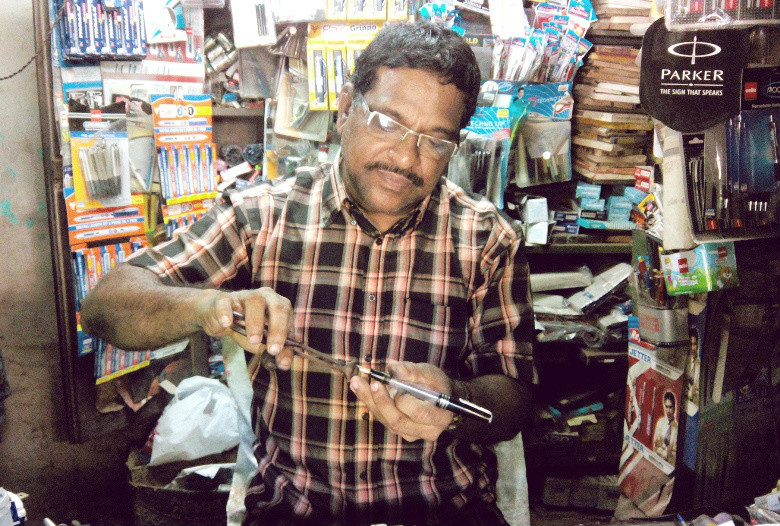
A few metres down the Town Hall Road from the famous Round of Thrissur district of Kerala is a small, single-shuttered, 78-year-old shop where pens of many famous people have been repaired, including those of a former prime minister and president.
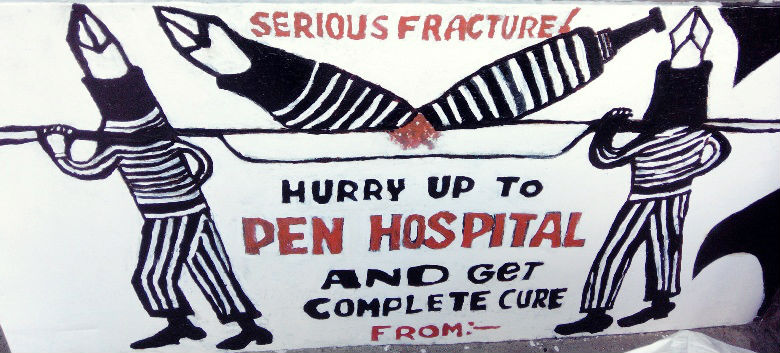
In bold yellow letters against a black background is a rectangular signboard – Honest Pen Hospital. A painting on a wall adjacent to the shop shows a fractured pen being carried on a stretcher by two fountain pens, below which is written ‘Hurry up to Pen Hospital and get complete cure.’
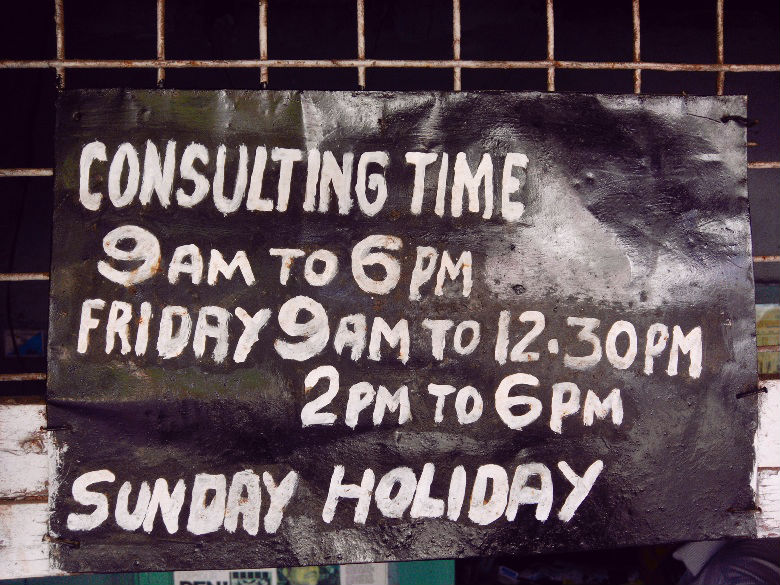
On the entrance hangs a small board with a caption ‘Consulting Time.’ 9 am to 6 pm. Next to it, hangs another board which reads ‘Wait for 10 minutes.’ This is the board which Nazar displays when he is away from the ‘hospital’ to do some household chores.
Fifty-eight-year-old Nazar is the pen doctor and has been repairing pens for the past 36 years, having learned the craft from his father.
Nazar’s father, Kaalathodu Koluthu Parambil Abdulla worked as a fountain pen mechanic in Bengal at a time when they were not popularly used. Swan, Blackbird, Pilot, etc. were the few fountain pens that were then available in India, and they were costly.
“When pens became cheaper and more people started using them, my father came back to Kerala to do the same work here. Thus was born the Honest Pen Hospital in1937,” Nazar recounts. The shop was first located in Thrissur district’s St Thomas College Road and shifted to its current location in 1959.
“My father’s fingers had some sort of magic in them. He knew pens so well that once he got a faulty pen in his hand, even before the owner could say what the problem was, he would diagnose it. He could successfully cure all pen ailments,” Nazar said.
In the last 50 years, the hospital has repaired the pens of many a famous person including former prime minister Indira Gandhi and former president APJ Abdul Kalam, and renowned Malayalm poets Kunjunni Master and Vyloppilli Sreedhara Menon.
Nazar claimed that Indira Gandhis’s secretary had once sent her pen to the shop for repairs when his father was running it. “The pen was special to Mrs Gandhi because it was gifted to her.”
After hearing of the death of his father passed away in December 2010, Nazar says that a man turned up at his shop. “The man showed me a fountain pen which my father had repaired. His father, an Ayurvedic doctor, only prescribed medicines using that pen,” Nazar says, adding that the pen was sent to the shop with a faulty nib.
“But the nib was not readily available and it needed a week to be replaced. By the time the son had got the pen repaired and taken it to his father, the father had got another pen for himself.” Nazar says that after his father gifted the pen to him, he got a wooden box made by a carpenter exclusively for keeping the pen safely in his locker. “As years passed the son got many more pens for himself and he forgot his gift. It was when my father passed away that he got reminded of the pen and brought it to me. Even after so many years the pen worked perfectly.”
As Nazar was telling me this story a customer walked in asking for a good fountain pen. Nazar showed him few pieces of the old, famous Doctor brand of pens made in Bombay. These pens are hardly available in ordinary shops as they are out of stock.
Having sold the pen, Nazar told his customer to use the pen regularly, or else to wash the nib section and keep it dry. “It is because of this advice that pen of the Ayurvedic doctor’s son worked perfectly when we tried writing with it after years,” says Nazar.
Nazar has had his own fifteen minutes of fame – he says he has repaired former president Abdul Kalam’s pen when the latter visited the city for an event. After returning to Delhi he learned that the organizers had cut down a tree to make arrangements for his welcome. He asked the organizers to plant a sapling in its place, for which he returned to Ernakulam. “When was placing the sapling in the pit that was dug, his pen fell into it and the pen’s top got stuck. He wanted it repaired and his secretary suggested this hospital to him. I repaired the pen.”
Today, most of Nazar’s customers are judges of the High Court of Kerala, advocates, doctors, or document writers. Typing has eaten away his customers, but for Nazar, other concerns are more important.
“Apart from helping in improving handwriting, fountain pens are more eco-friendly than ball point pens. Also, fountain pens bring sort of a discipline to life. It makes one slow down in this age of pace,” he says.
Even though business is slow as people have switched over to ball-point pens, Nazar sees his work as a service. “It is not all about money. Of course money is a factor but I do it more as a form of service. I know how badly people get affected when the pen they use regularly stops working the way they want it to. Most of the services require minor tweaking of the feed and the nib and I do not charge anything for it,” says Nazar.
But for all his love of pen, the man does not own one. “The only writing I do is when I check a pen after I repair it.”
As a young man, Nazar wanted the Malayali dream – a job in the Gulf. But his schooling was erratic because of a court case that his father had to attend to, leaving his son in charge of the shop. “But for the civil cases in the court I would have been in the Gulf. It is God that wanted me here, and he will have someone else in mind when I am not able to discharge my duties.”
The only thing that Nazar is sure of is that the next doctor in Honest Pen Hospital is not going to be either of his sons who are medical doctors.
(The stories were narrated by Nazar).
source: http://www.thenewsminute.com / The News Minute / Home / by Siddharth Mohan Nair / Sunday – September 06th, 2015
Inspiring stories of four persons who graduated from workers to educators
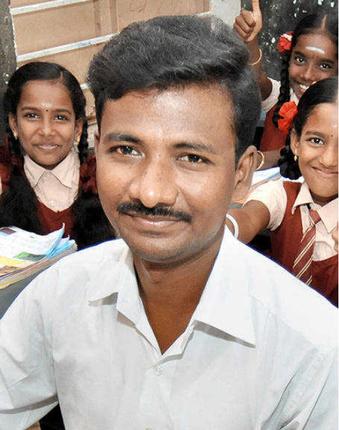
R. Kanakaraj and others have made it as teachers after an arduous strugglein early part of their life.
Many teachers prefer to work in schools in their home town, but R. Kanagaraj has chosen the government school for tribals in Pilloor to start his career.
He works at the Panchayat Union Middle School in Alathivachinampalayam near Karamadai, where 90 per cent of the students are Sri Lankan Tamil refugees.
“As a former child labourer, I know the difficulties of students with a poor family background. I like to work for them,” says Mr. Kanagaraj, son of a cobbler and a physically challenged mother, who used to work in cotton fields and reared cattle when he was a III standard student.
When his family’s financial condition forced him to quit school and become a child labourer, he was spotted by officials of the Labour Department and his entry into a school run under National Child Labour Project became possible. This institution prepares beneficiary children to join mainstream schools.
“In the child labour school, I acquired many skills like candle-making while pursuing education. As a teacher, I teach my students general knowledge and other subjects that will empower them,” said Mr. Kanagaraj. More than 15 former child labourers have become teachers in the State.
E. Rajeswari, head of the Panchayat Union Primary School in R.S. Mangalam in Ramanathapuram district, worked in the match industry before she was rehabilitated by Labour department. She belongs to Thiruthangal near Sattur.
“I had no electricity at my residence. My parents agreed to send me to school when officials promised that I would receive Rs. 100 per month and could learn tailoring and others skills,” says Ms. Rajeswari, adding whenever she narrated her life story, her students found it incredible. “But I could see my story was an inspiration,” she said.
Nithya is happy that she has become a teacher at one of the schools for child labourers, where she was a student once. She chose it though the salary there was comparatively low.
She studied till III standard and took up work in the beedi industry as her father who faced neurological problems could not work. “My mother eked out a livelihood as a worker and education was beyond reach in a family of five sisters,” she said.
After attending the school for child labourers, she joined the Adi Dravidar Government Higher Secondary School in Pernambut.
Even thourgh she was interested in higher education, Ms. Nithya had to take up a job to support her family. The Labour department appointed her a teacher in its school at Peranampet.
“I have to be content with what I have now,” she said.
M. Reshma and others have made it as teachers after an arduous strugglein early part of their life.
Unlike others who were school dropouts, M. Reshma, now working as a teacher at Kalaimagal Vidyalaya Matriculation, in Peranampet never attended school till she was eight. “I could not afford to attend school because of my family circumstances,” she said.
After completing the bridge course at the school for child labourers, she joined VI standard at the Government Girls Higher Secondary School. She then graduated from M.K. Jain College for Women in Vaniyambadi in English literature. Subsequently, she completed B.Ed., and got the present job.
Unfulfilled desire
“I actually wanted to pursue post-graduation in English literature. But with three elders sisters and a brother I am left with very little option, but higher education remains a passion,” she said.
source: http://www.thehindu.com / The Hindu / Home> News> Cities> Chennai / by B. Kolappan / Chennai – September 05th, 2015
When late President APJ Abdul Kalam prayed at Jamiah Mosque in Madikeri, Kodagu
by Prof. M.I.K. Durrani
Jainulabadeen always felt that his son was destined to be exceptional and in his heart of hearts he hoped that his promising young son would one day make the family proud by becoming a Collector (Deputy Commissioner), not having the slightest inkling of what the future had in store for this darling of the family. His wife Ashiamma joined her husband in wishing Godspeed to their son as he left Rameswaram.
And thus commenced a long scientific odyssey leading to one achievement after another, followed by one glory succeeding another and finally one accolade upon another accolade in the form of Padma Bhushan, Padma Vibhushan and Bharat Ratna and then the acme as the first citizen of this country — President of India.
[Continued from yesterday]
But in spite of all the innate greatness of the genius that the country can boast of, this very personification of humility has got this to say:
“Each individual creature on this beautiful planet is created by God to fulfil a particular role. Whatever I have achieved in life is through His help and an expression of His will. He showered His grace on me through some outstanding teachers and colleagues and when I pay tribute to these people, I am merely praising His glory. All these rockets and missiles are His work through a small person called Kalam, in order to tell the several million mass of India to never feel small or helpless. We are all born with a divine fire in us. Our efforts should be to give wings to this fire and fill the world with the glory of its goodness.”
And I wondered how the young dreamer, who once watched cranes and sea-gulls soar into flight, longed to fly and did realise his dreams. And that unique person was going to visit the Jamiah Mosque at Madikeri and I too would be one of the fortunate few to behold the nonpareil in flesh and blood.
By the time I reached Balayatrie Estate on Thursday, the 6th April, 2006, it was nearly 10 pm. I was welcomed with all the usual warmth and affection that my brothers-in-law could muster up. There was the eldest of them, F.M. Khan, former MP and his third brother, Noor Mohammed and the youngest of the five brothers, Afroz Mohammed Khan. F.M. Khan was virtually a recluse after his cardiac surgery and whenever any relatives came to stay with him, he would be immensely pleased to enjoy their company. Noor Mohammed had arrived from Mysuru along with his family comprising his wife, son, daughter in-law and his two grand-children. Since Dr. Kalam was by nature very fond of children, Afroz suggested that the President should be welcomed to the mosque with a special bouquet of flowers from carnivorous plants as a mark of respect and the honour of presenting it should be given to Noor Mohammed’s exceptionally cute four-year-old grandson, Mohammed Khan. Everybody endorsed Afroz’s suggestion. F.M. Khan was feeling drowsy so he retired to bed and Noor also followed suit.
Afroz and I were by ourselves, not feeling sleepy at all, I, because of my curiosity pertaining to the President’s impending visit to the Mosque and Afroz due to his bubbling excitement. He got up and said he would fetch some tea for me and went straight to the kitchen. Of all the five Khan brothers, Afroz is the youngest but the tallest. He happens to be chip off the old block since his philanthropic nature, charitable generosity and compassion for all his paternal and maternal relations have been inherited by him to a large extent from his father late Yusuf Ali Khan.
F.M. Khan, his eldest brother, as the dejure muthavalli (manager) of the Mosque wasn’t able to discharge his duties owing to his ill health. Afroz, the youngest volunteered to shoulder the responsibility and thus he was the defacto muthavalli at that time and simultaneously he had been elected as the President of the Managing Committee of the Jamiah Mosque. As a dedicated and zealous servant of God Almighty, he had just then completed the renovation of the Mosque and had changed it into a well-known mosque of Madikeri.
As we started sipping our respective beverages, I asked Afroz how he had manoeuvred to get the President participate in the Friday prayers. Synopsised, it amounted to this:
It was during the first week of April 2006 that the news was flashed in the newspapers that the President of India was to visit Madikeri to participate in the centenary celebrations of General K.S. Thimayya and the day selected happened to be a Friday which all devout Muslims consider as a day of festival for the followers of the faith and every Muslim is expected to attend the congregational prayer on that day. So assuming that since Dr. Abdul Kalam had descended from a very pious family, he might in all probability would not miss the obligatory Jummah prayers.
So Afroz wanted to find out whether there was any scheduled programme of the President to attend the prayers. The first thing he did on 5.4.2006 was to ring up the office of the Deputy Commissioner, the Superintendent of Police and the Wakf Board, Mercara, to ascertain whether a visit to the Mosque was envisaged but from all the three places, the curt answer was an emphatic “No.” And thirty minutes later at 11.30 am, he called the Offices of the Deputy Commissioner and the Superintendent of Police again to find out the latest position but once again he was told that there was no such programme.
Afroz, as the President of the Mosque, was in a dilemma. Then suddenly he had an inspiration. He got an e-mail sent to the Rashtrapathi’s Office stating that the Friday prayers at the Jamiah Masjid in Mercara will commence at 1 pm. The very next day, on Thursday, the 6th April 2006 at 11.30 am, there was a call to the Jamiah Masjid from P.M. Nair, Secretary to the President, desiring Afroz Mohammed Khan to contact P.M. Nair and Afroz did so at noon. Nair said that his e-mail was received and the President thanked him for the information. He added that the President would be joining the Jummah prayers. Nair further said that it would be a purely private visit, therefore there was no need to inform either the Deputy Commissioner or the Police about it.
Afroz informed his brother F.M. Khan about the talk he had with the President’s Secretary and the ex-MP wanted to get it confirmed so he contacted the Deputy Commissioner, the Superintendent of Police and the Office of the Wakf Board but none among them had any information about it. F.M. Khan was rather sceptic about the visit to the Mosque and expressed his fears.
However, Afroz went to the Deputy Commissioner’s office at 5 pm to discuss about the President’s visit. He sent his card in but the officer was otherwise busy, as usually people in such position are, and then there was no urgent need to attend to a visitor who was only a President of a Mosque.
Afroz waited patiently for about half-an-hour but since there seemed to be no end to his travail, he left the place and went back to the Mosque.
[To be continued]
source: http://www.starofmysore.com / Star of Mysore / Home> Feature Articles / Saturday -September 05th, 2015
———————————————————————————————————————–
Recollections …: Prayer with People’s President – 3
By Prof. M.I.K. Durrani
The Mosque was as usual spic-and-span and there wasn’t any room for further improvement. At about 8.30 pm that evening, Additional Superintendent of Police Bhagwan Das arrived at the Mosque just to inspect the place with regard to cleanliness and security. He was completely satisfied with the upkeep of the place and desired to know how the President would be received and by whom. Afroz informed him that he himself, as the President of the Mosque, would receive President Dr. Abdul Kalam. The officer wanted to know how many garlands would be used since they had to be subjected to a thorough scrutiny. He was told that garlanding a person in the Mosque as a gesture of welcoming him isn’t customary and, therefore, there would be no garlanding. However, as a token of high regard, it was decided to offer the President a special bouquet of flowers from carnivorous plants and the same would be presented by a four-year-old boy at the entrance of the Mosque. The Additional Superintendent of Police was completely satisfied with the arrangements and bid goodbye to the staff of the Mosque.
[Continued from yesterday]
The next day was Friday, the day named after Frigga (or Freya), wife of Odin (the God), who is immortalised in the name Wednesday (Odin’s Day) but in Arabic it is called Jummah, meaning Congregation — an assembly of a large number of people for prayer. Jummah is considered by Muslims all over the world as a Holy Day, a sacred and blessed one.
A great deal of sanctity is associated with it since it is believed that Adam, the first man, was created on that day and that was the day he was admitted into the Garden of Eden from where he was much later expelled and that day also happened to be another Jummah and when he passed away, it was a Jummah too. The Day of Judgement is also expected to be on the same day. Furthermore, it is also believed that Allah forgives all sinners on this day when they are truly contrite, so it may as well be described as a day of deliverance from sin.
And on the D-day, we, all the menfolk, got ready well- in-time. After our bath, every one put on his Friday’s best comprising a white jhubba and white pyjamas, both soaked in light perfume. We reached the Mosque at about 12 noon. Already there were quite a few Policemen in the vicinity and the devotees had started trickling in. Afroz told the Mouzzan (Mosque official) to keep sufficient stock of water in case it was required by the President for performing Wazoo (the mandatory ritualistic washing of the face and limbs) before joining the congregation.
Exactly at 1 pm, the Imam started his bayan (speech) in Urdu which usually precedes the mandatory Arabic Khutbah (sermon or talk) in two parts. The first part of the Khutbah was over but there wasn’t any sign of the VVIP. The second part was also started, still the suspense continued. Exactly at 1.55 pm, there was a phone call from S.M. Khan, the Press Secretary, informing Afroz that the President would be arriving in another five minutes.
The Mosque clock chimed two O’ clock, the Khutbah came to an end and at that very moment, the President’s car arrived at the entrance of the Mosque and out emerged the smiling President wearing a closed collared coat and trousers with a white skull cap in his hand, which he put on to his head as he entered the odoriferous prayer hall. His feet were covered with white socks as he had left his shoes inside the car. He was received by Afroz in his capacity as the President of Mosque and Dr. Kalam shook his hand warmly and regretted his late arrival.
Then Noor Mohammed’s grandson, Mohammed Khan, the cute little laddie presented the bouquet to the President. After receiving the bouquet, the President, good humouredly snatched the cap from the boy’s head as though he was taking it away, but the very next moment he put it back on the child’s head and blessed him by placing the palm on his head and the boy bent his head and simpered. In the meanwhile, Afroz approached S.M. Khan and enquired sotto voce whether the President would perform the Wazoo. Khan replied that the President never went out with Wazoo. Even then he was Bawazoo (with the Wazoo).
Dr. Kalam, followed by his Secretary, joined the congregation. He found a vacant place on the carpeted floor in the third row and there he sat down. Though he had been offered a place in the first row, he had declined it as he must have felt that he was just a devotee like any other person and he didn’t like any kind of discrimination on the basis of a person’s status. Just then all the people stood up and formed lines. The Imam said ‘Allah-o-Akbar’ and the entire flock joined the rituals.
One thing which had at that time moved me almost to tears was when I saw the first citizen of this great land of ours, like any other commoner, joining the congregation wherever he found a vacant place, not expecting any kind of special consideration. What a contrast it is with the attitude of upstarts among the self-styled VIPs, who always consider it their birth right to enjoy preferential treatment wherever they go. Dr. Kalam, a man of remarkable humility, must have remembered one stanza from Dr. Mohammed Iqbal’s Urdu poem, Shikwa (complaint) in which there is this touching narration:
1. Aagaya aine lada ee may jab waqt-e-namaz,
Qibla roo ho ke khadi ho gayi qaum-e-hijaz,
2. Ek hi saf may khade ho gaye Mahmood-o-Ayaz,
Na koyee banda raha na koyee banda nawaz,
3. Banda-o-saheb-o-mohtaj-o-ghani ek huye,
Teri sirkar may pahunche toh so bhi ek huye.
And the above lines have been excellently rendered into English by no less a person than late Khushwant Singh, thus:
1. In the midst of raging battle, if the time came to pray,
Hijazis (Arabs) turned to Mecca, kissed the earth and ceased to fray;
2. Sultan and slave (Mehmood and Ayaz) in single file stood side by side,
Then no servant was nor master, nothing did them divide;
3. Between serf and Lord, needy and rich, difference there was none,
When they appeared in your court, they came as equals and one.
And that one act of self-effacement speaks volumes about the greatness of the humble, God-fearing scientist.
[To be continued]
source: http://www.starofmysore.com / Star of Mysore / Home> Feature Articles / Sunday -September 06th, 2015
Recollections …: Prayer with People’s President – 4
By Prof. M.I.K. Durrani
[Continued from yesterday]
Jamiah Mosque in Madikeri, Kodagu.
After the prayers were over, the courteous President told Afroz to seek, on his behalf, permission from the Imam to address the gathering.
While all the members of the congregation were seated, he stood up and spoke to them in English. He expressed his happiness at witnessing such a large gathering. He said that his father and grandfather were all orthodox Muslims and never missed a single prayer.
His father used to take him to Mosque every evening and whenever he achieved anything, his father used to make him offer thanksgiving prayers in the Mosque. He hoped that the audience would continue to keep up the practice of their ancestors and lead virtuous lives. At the same time, he advised them to live in greater harmony with the people of other religions and to be proud of being Indians.
Sensing that what he was saying might be misunderstood by a majority of the audience due to their ignorance of the English language, he concluded his speech by asking the people to join him by repeating the Arabic Ayats (lines) from Surah Al Fatihah which all Muslims recite during prayers and which implore Allah to guide them to the path of those who were favoured by Him and not the path of those who earned His wrath by going astray.
The audience felt maximum spiritual intensity by repeating each ayat with fervour as the President recited them like a teacher.
Afroz proposed a vote of thanks and the President started moving through the throng of the much impressed audience, shaking hands with several persons who were standing on either side of his path.
Noticing a group of children, he went straight to them and spoke to them in English and was much pleased to find them responding in that language. Then he got into his car, waved towards one and all, who were standing on both sides of the route and departed leaving behind the admiring people of Madikeri, who would always cherish the memory of a People’s President’s visit to their beautiful hill station.
And today, when I look back and recollect what a great day it was in my life when I had the honour of shaking hands with that gem of a man, I just wonder whether it was really so or it was just a dream. Today he is no more with us but he has left such an indelible impression on our mind that the Bard whispers from nowhere:
“His life was gentle and the elements
So mixed in him, that nature might stand up,
And say to all the world, This was a man.”
[Concluded]
source: http://www.starofmysore.com / Star of Mysore / Home> Feature Articles / Monday -September 07th, 2015
For someone who works seven days a week, the concept of a ‘weekend’ does not exist. I’m usually hosting events, working at the radio station, shooting or travelling around the world for various occasions, so I don’t get much free time to myself.
However, I do get cosy once in a while — it’s mostly the times between my travels — but there are moments. Whether I’m travelling or at home, my idea of ‘chilling’ involves hanging around in my room, going for a swim, playing some video games, or working out at the gym. I’m not someone who takes a break and calls my friends to go have a good time. I enjoy working during my free time. I don’t believe in wasting time and I’m always looking out for new things to try and do. Looking at nature and doing absolutely nothing is just not my style!
I have two very close friends that I love hanging out with, but unfortunately they moved to Mumbai. But even when they were in the City, we would just hang out and do productive things like brainstorm for new ideas and create new content. And when I really want a break, I shut everything down and go on a long vacation. This happens only once in six months or more — that’s when I know that I need to reboot.
Recently, after working six months like a mad man, my sister and mother planned a Europe trip. I was already there for a shoot and they joined me after. It was a great time; we did regular tourist stuff — a visit to Milan, hung out at Amsterdam, went up to the Eiffel Tower, took a city tour around Paris and more. We made a lot of new friends there and it was quite refreshing. But, as usual, I missed work, so coming back was such a relief!
Generally, when you ask someone what they like to do, they immediately tell you that it’s either reading a book, painting, or something they are good at. But I haven’t found my ‘favourite thing’ to do yet. I did experiment with what I thought I might like — tried my hand at painting and realised that I am a terrible artist. I even tried to read a book, a motivational one, but I couldn’t go past the third page. I didn’t think a person who is always fuelled up needed anymore ‘gyaan’!
But I do enjoy spending time with my three-year-old cat, Red. Being around him makes me feel calm and gives me the peace of mind I need. We usually hang out in the garden, where he drinks water from his little bowl and enjoys his food. That moment, that experience, makes me feel like nothing else in the world matters. So it turns out that’s the detoxing I needed, not reading or painting.
I guess one can say that I make up my weekends and vacations as and when they happen. If it’s a place I’ve never been to before, I make sure that I allot some time to explore it. Since I’m a city-person, I enjoy nightclubs, the architecture, monuments and landscapes. Going to a coffee shop in a city is more important to me than going to a lake or river. It’s also a good thing that I’m an extrovert; I love meeting new people in the places I visit and I generally hang out with them during my trips. After all, the best things in life are not planned or reserved, so I take it as it comes and go with the flow.
The idea of a weekend is to relax and free your mind, and I do that on a daily basis. The drive I have from home to the radio station, that fifteen minutes of music and zoning out, is my weekend and my free time. I couldn’t have asked for a better life!
A few of my favourite things
Watching ‘Family Guy’
Playstation
Practising and rehearsing weird voices
The colours black and blue
Chinese food
source: http://www.deccanherald.com / Deccan Herald / Home> Supplements> MetroLife / by Anila Kurian / Saturday – September 05th, 2015
Pakistan had the better tanks, but not the skill to man them well
by Nitin A Gokhale
In popular imagination, the original Operation Vijay in 1971 is rightly seen as India’s greatest military victory. That campaign broke up Pakistan, helped create Bangladesh and erased the painful memories of the politico-diplomatic-military debacle India had suffered against China in ’62. But before ’71 came ’65 and the 22-day war that allowed the Indian military to regain its confidence. Looking back at that confrontation 50 years on, it’s clear Pakistan saw that time as its best chance to wrest Kashmir from India. Perhaps rightly so since India’s military was still struggling to overcome the humiliation of ’62. It was in the middle of an expansion and reorganisation. India itself was in transition after Jawaharlal Nehru’s death. A seemingly soft Lal Bahadur Shastri was at the helm.
The Pakistan army on the other hand was being equipped with latest American military hardware. The Patton tanks were far superior to India’s World War II vintage Shermans, Centurions and AMX tanks. But as history shows us half a century on, superior military equipment does not necessarily translate into guaranteed military victory.
Although Pakistan’s ultimate objective was Kashmir, it launched a diversionary gambit in faraway Kutch in March ’65, then followed it up with Op Gibraltar (sending in waves of raiders into the Kashmir Valley) in August and then threatened to cut off Akhnoor in September.
Facing a dire situation, Prime Minister Shastri authorised opening another front across Punjab, apparently catching Pakistan by surprise. As Indian forces raced towards the Ichogil canal and were on the doorsteps of Lahore, a desperate Pakistan launched its spearhead, the 1 Armoured Division equipped with the latest Pattons into the war to break through Indian defences to threaten Amritsar and Jalandhar. The M-47 and M-48 Pattons were the most modern of that period. They had good sighting systems and stabilised gun platforms that had a range of 2,000 metres. Equipped with infrared sights, they could operate by night. The Indian armoured regiments on the other hand were mostly equipped with Shermans, with a range of just 800 metres and no night sights.
As the Pakistani armour reached the vital bridges across the Beas river, it seemed only a matter of time before the tanks broke through Indian defences.
Pakistan had a bold plan to reach the bridges at Harike and Beas which would give it multiple options of threatening Amritsar, Jalandhar and onward to Delhi. It is also apparent that India’s Western Command was not certain of the location of Pakistani 1 Armoured Division, which was positioned at Kasur, ready to spearhead the offensive into India’s critical bridges on the Beas.
D-day for the operation was initially September 7, 1965. Inexplicably, Pakistan delayed the offensive by 24 hours. The delay helped the Indian troops prepare defences, lay mines and undertake flooding of the fields by breaching the Rohi Nala and the distributary canals to make the open area waterlogged. This automatically imposed restrictions on the movement of the Pakistani armour. As the unsuspecting tanks of Pakistan’s 1 Armoured Division launched the offensive at 8.30 am on September 8, they were engaged by tanks of Deccan Horse. Utilising standing crops, the tanks were engaged by Deccan Horse, medium guns and tank-hunting teams. Deccan Horse managed to destroy 11 tanks while losing four of their own. Three other Pakistani tanks were damaged by medium guns and tank-hunting parties.
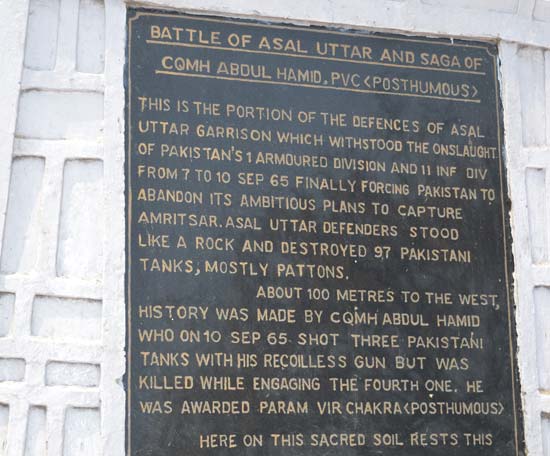
Such heavy losses compelled the Pakistanis to retreat. Their units launched the next attack after a considerable gap at 11.30 on September 8. The attack was led by a regiment of Pattons, a squadron of Chaffees and a motorised battalion of the Pakistani 4 Armoured Brigade. They attacked 1/9 Gorkha Rifles and 4 Grenadiers. The attack was partially successful in the 1/9 Gorkha Rifles location but unable to make headway in 4 Grenadiers. The Pakistanis again attacked 4 Grenadiers at 12. Despite some of their trenches being overrun, the battalion with its anti-tank gunners comprising Subedar Mool Chand and Company Quarter Master Havildar (CQMH) Abdul Hamid knocked out four tanks. The armour tried to outflank the divisional sector from the north but the prepositioned tanks of 3 Cavalry countered this ably. Attacks were made at dawn on September 9 too along both axes. Two tanks were blown up on the minefield and another was destroyed by the recoilless gun of 4 Grenadiers. During the afternoon, the Pakistanis made an attempt to outflank from the southeast but failed as they got bogged down in the flooded area at Valtoha and were destroyed one by one.
————————————————————————————————-
On the third day of the op, the Pakistani tanks had overrun the forward trenches. CQMH Abdul Hamid got three, not the fourth.
—————————————————————————————————
In the battle, some Pakistani tank commanders who had their heads out of the cupola were killed. By September 10, the Pakistanis were in a desperate situation. They tried to outflank the defences from the west with two regiments of Pattons and a squadron of Chaffees with a motorised battalion only to be encountered by the tanks of 3 Cavalry and 8 Cavalry that were camouflaged in the cane fields. Then, 4 Grenadiers was attacked with a battalion of infantry and a few Patton tanks. The tanks managed to overrun the forward trenches. CQMH Hamid who had been shifted to the anti-tank platoon destroyed three tanks but was shot by the fourth. For this act of gallantry, he was awarded the Param Vir Chakra posthumously. As the attack on 4 Grenadiers failed, the Pakistani outflanking armour charged on Mahmudpura, but they were decimated by the Centurions lying in wait, crushing Pakistan’s 1 Armoured Division. The commanding officer of Pakistan’s 4 Cavalry was captured in the cane fields. Asal Uttar-Khem Karan was a great victory for the Indian army. The Pakistanis lost 97 tanks, including 72 Pattons; 32 were captured in running condition. India in contrast lost only five. India won what is now acknowledged as the biggest tank battle fought after WW-II.
It is now apparent that Pakistan had grand plans but poor execution. India on the other hand displayed keen tactical sense, resolute leadership and clever improvisation to turn the tide of the war. The battle also showed that the man behind the weapon is more important than the weapon itself. Deccan Horse and regiments of 2 Independent Armoured Brigade were adept at handling Shermans, Centurions and AMX tanks. In assaults led by armour, the infantry must move with the armour. This prevents tanks falling prey to anti-tank weapons, something CQMH Hamid exploited.
Demoralised with the setback at Khem Karan, Pakistan lost the heart to fight. Today, a memorial for those who fought and won in this sector boasts a board ‘Patton Wreckers’ on the general area of Assal Uttar and Khem Karan. It’s a reminder that no matter how good the weapon, the battle is won by those who wield it effectively.
(Former Outlook staffer Nitin Gokhale is a defence analyst. He is currently writing a book on the ’65 war.)
source: http://www.outlookindia.com / Outlook / Home> International – Opinion / by Nitin A. Gokhale / Magazine – May 25th, 2015
“The Hardayal library is an important signpost of our city’s history. We need to ensure that it is restored to its erstwhile glory,” said Jung.
In a meeting on Friday, Lieutenant Governor Najeeb Jung approved a Rs 3-crore grant for the restoration of the ailing Hardayal municipal public library in Chandni Chowk.
The meeting was attended by Commissioner (North corporation) representatives from the South and East corporations, the secretary and librarian and senior government officers.
“The Delhi Urban Heritage Foundation (DUHF) will look into the restoring the library’s outer and inner structure. A joint inspection shall be undertaken immediately to chart out the course to be taken and for removal of encroachments. Work shall also be undertaken to help digitise rare and old books in the library’s collection,” stated the Lt-Governor.
“The Hardayal library is an important signpost of our city’s history. We need to ensure that it is restored to its erstwhile glory,” said Jung.
Established in 1862, the library is more than 150 years old and is presumably the oldest one in Delhi. It has a collection of extremely rare and precious books, including books dating back to the 16th century.
It has a collection of more than 1,70,000 books in different languages, with 8,000 of these in the rare category section. It has 28 branches which are spread all across the three municipalities of Delhi.
source: http://www.indianexpress.com / The Indian Express / Home> Cities> Delhi / by Express News Service / New Delhi – August 29th, 2015
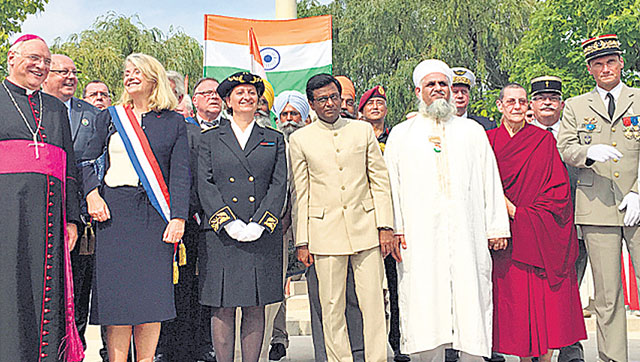
The Indian ambassador to France, Dr Mohan Kumar (centre), was also present at the ceremony to pay tribute to the Indian soldiers who fought in the First World War. (HT photo)
An interfaith commemoration for Indian soldiers who died in the First World War was held at the Indian memorial in France on Sunday. This year also marks the 100th anniversary of the battle of Neuve Chapelle (March 10-13, 1915) which was the Indian Corps first major action in the war as a single unit.
Organised by the Indian Interfaith association and the local French administration at the Neuve Chapelle memorial, the event was attended by more than 1,300 Indians of different religious groups and about 300 French guests, the organisers told HT.
The memorial commemorates over 4,700 soldiers and labourers from British India who lost their lives on the Western Front during the First World War and have no known graves.
“Many come to pay homage to the Indian soldiers here, but we wanted to read their last prayers as this had never been done” said Ramesh Chandar Vohra, President of the Interfaith association.
A local band played the Indian and French national anthems as well as the last post, the final salute to fallen soldiers.
Pradeep Kumar Singh, a business executive said, “Back home, we tend to forget about these thousands of people who travelled thousands of kilometres to fight in unfamiliar territory and unfamiliar climate for a cause and for enemies that were not theirs”
The event took on a nationalist flavor, with Indian flags being waved and slogans of “Jai Hind” and “Indo-France ki Jai” greeting the prayers read by Muslim, Hindu, Christian, Sikh and Buddhist religious leaders.
The Indian ambassador to France, Dr Mohan Kumar, told HT, “We should appreciate the fact that the relationship between India and France goes back not just 40-50 years but a whole century.”
source: http://www.hindustantimes.com / Hindustan Times / Home> World / by Noopur Tiwari, Hindustan Times, Neuve Chapelle / September 02nd, 2015
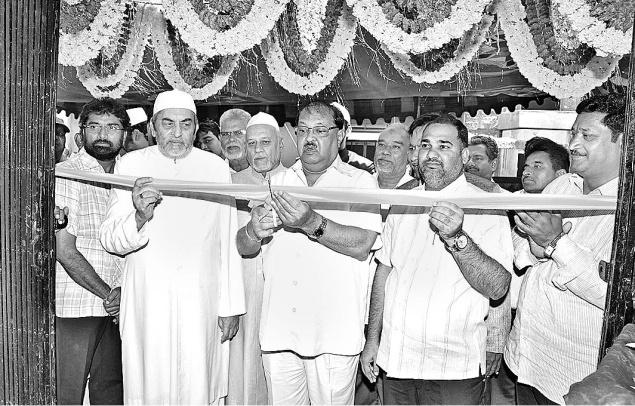
Municipal Administration Minister Qamarul Islam inaugurating the newly constructed toilet and bathroom block at the Khaja Banda Nawaz Dargahin Kalaburagi on Tuesday.— PHOTO: ARUN KULKARNI
New toilets, bathrooms will be open 24 hours for pilgrims visiting the shrine
The famous Khaja Banda Nawaz Dargah, frequented by thousands of pilgrims every day, now has a modern multi-purpose block consisting of kitchen-cum-dining hall with store room, exclusive toilets and bathrooms for the pilgrims visiting the dargah.
Up until now, the dargah had limited toilets and bathrooms which remained always overcrowded due to the heavy flow of pilgrims. At the time of the annual Urs, the situation used to become very difficult.
The new block constructed at a cost of Rs. 2.25 crore is entirely funded by the Karnataka Urban Infrastructure Development Finance Corporation-North Karnataka Urban Sector Investment Programme (KUIFDFC-NKUSIP) with the Asian Development Bank (ADB).
The multipurpose block has 125 toilets and 39 bathrooms, with exclusive bathroom and toilets for the physically challenged persons.
The kitchen facility has six cubicles, a tone room and a slaughter room also. The entire block is constructed on 1,098 square meters and this would be maintained by Sulab International. Inaugurating the new facility on the dargah premises, Municipal Administration and Minority Affairs Minister Qamarul Islam said that the long felt need of the pilgrims has been fulfilled.
Another toilet block constructed at a cost of Rs. 40 lakh has been completed and handed over to the authorities, he said.
Mr. Qamarul said that the multipurpose block would be available for the use of the general public and the pilgrims visiting the dargah for 24 hours.
The annual urs of the Khaja Banda Nawaz Dargah is scheduled to begin on August 30.
Sajjada Nasheen of the Khaja Banda Nawaz Darga Dr. Syed Shah Khusroo Hussaini, in his brief address, thanked the State government and the former Union Minister M. Mallikarjun Kharge for sanctioning the multipurpose block to the dargah.
source: http://www.thehindu.com / The Hindu / Home> National /by T.V. Sivanandan / Kalaburagi – August 26th, 2015
Telugu Desam leader and former MLC, Ibrahim bin Abdullah Masqati, died on Monday after a brief illness.
He was 85. He is survived by six sons and four daughters.
Before joining the TDP, he was with Majlis-ittehadul Muslimeen and served for two terms as MIM MLA. Subsequently, he joined TDP and was made the Chairman of Urdu Academy, and later became an MLC.
Andhra Pradesh Chief Minister N. Chandrababu Naidu visited the residence of the departed leader and paid floral tributes to him. Conveying his heartfelt condolences to the bereaved family members, he said that his death was a great loss to the party.
As vice-president of the party, he strove hard to strengthen the party and used to exert pressure on the government to solve the problems of minorities, he said.
Telangana Chief Minister K. Chandrasekhar Rao expressed grief over the TDP leader’s death and recalled the yeoman services rendered by him as a legislator.
Telangana Deputy Chief Minister Mohammed Mahmood Ali, and MIM leader Asaddudin Owaisi were among those who visited Masqati’s residence and offered their condolences.
source: http://www.thehindu.com / The Hindu / Home> National> Andhra Pradesh / by Special Correspondent / Hyderabad – August 25th, 2015