Category Archives: Community Involvement / Social Issues

Agra’s crucial role in freedom movement not documented: Historians

Agra:

As the political capital, first of the Mughals and later the British, Agra was always a key centre of political action. The city played a crucial role in the freedom struggle but poor documentation of records has failed to highlight the contribution of the freedom fighters, say local historians.

Syed Ikhtiyar Jafri, director of the Mirza Ghalib Research Academy, who recently released a paper on the contribution of Urdu journalists, said “for whatever reasons the authentic history of Agra`s contribution to the freedom movement, to arts and literature, suffers from poor documentation of records, and therefore the contribution under-valued.”

Hardly any documented history book on the `Braj region` is available that could provide a true picture though fragmented pieces, mostly in newspapers are there for study. “Interestingly, Agra was a major centre of Hindi and Urdu journalism, and we have a long line of fighters with the pen,” says Prof Amit Mukherjea, head of the history department at St John`s College.

The first call for freedom in 1857, ignited by the visits of Nana Sahab, Azimullah Khan, Maulvi Ahmadullah Shah and dozens of other revolutionaries to the city, drew passionate support from the local youth who targeted government installations. Thousands of Hindus and Muslims, particularly in the rural hinterland, rose in revolt which forced the colonial rulers to declare Martial Law in the area.

The rebels against the imperialists were more active in the rural areas than in the city till Tantya Tope shifted base to Agra and the mohallas around Agra College and Gokulpura became the hotbeds of unrest. The heroes of the 1857 revolt, Thakur Heera Singh, Thakur Govind Singh, Chand Baba and Thakur Prithvi Singh continued to lead the mutineers with rare valour.

With the introduction of the railway and opening of the Tundla station in 1862, the city became the transit point of revolutionaries from the East. In 1857 the family of Jawaharlal Nehru migrated and settled in Agra following disturbances in Delhi. Motilal Nehru was born in Maithan mohalla in 1861.

The visits of Tilak, Lajpat Rai and the late Mahatma Gandhi in 1920 and 1929 galvanised the youth and the city came into prominent focus.

Revolutionaries like Bhagat Singh, Chandra Shekhar Azad, Raj Guru and Sukhdev stayed here for days in the Noori Darwaza area, making bombs. A series of bomb blasts and conspiracies like the Hardy Bomb case, explosions in Sheetla Gali, Moti Katra, Barah Bhai ki Gali and other parts sent shock waves in British cantonments.

On the vanguard of revolutionary activities were journalists like Pandit Sri Ram Sharma, Mahendra Jain, Devendra Sharma, Goverdhan Das, Ganpati Kela and Hari Shankar Sharma, in addition to scores of poets and litterateurs.

Ram Chandra Bismil from Mainpuri had fired the imagination of youth with his revolutionary writings. Bismil`s “Shaheedon ki chitaon par lagenge har varash mele, watan par marne walon ka yahi namo nishan hoga,” rings an echo to this day.

Hindi daily Sainik of Sri Krishna Dutt Paliwal was the first to launch a frontal attack on the British colonists. Some of the best editors of the time including Ageya served as editors of this daily. The success of Sainik gave impetus to a long line of periodicals including Hanumant Singh Raghvanshi`s Swadesh Vandhav, Laxman Singh`s Praja Hiteshi, Taja Tar, Ujala, Citizen, Punch and dozens of others.

Women played a crucial role leading protest marches and participating in dharnas. Saroj Gaurihar, Parbati Devi, Bhagwati Devi Paliwal, Sukh Devi, Damyanti Devi Chaturvedi, Satyawati, Angoori Devi Jain, Shiva Dixit, Chandra Kanta Mishra, Vidhyawati Rathod and Heera Bahen Hemraj Betai of the INA were some of the leading figures of that era.

“So many others were there and there was absolutely no gender bias or differences,” says Saroj Gaurihar recalling her activities during those years, adding that “the boycott movement against foreign goods was recognized as the most successful by Motilal Nehru in Agra” in a speech.

Two stalwarts of the freedom movement, Thakur Ram Singh, the hero of Kala Pani, and Prof Siddheswar Nath Srivastav, died recently.

Officially, Agra witnessed 110 violent incidents that resulted in the death of British officials or destruction of property. The famous Hardy Bomb case, Postal Robbery case, Chamraua and Jaunia bomb cases at railway stations are still talked about.

Contrary to popular belief, the city played a very crucial and notable part in the hundred years preceding independence in 1947, but much of the record and documentation work has been lost.

“With more than 400 leaders arrested for varying terms in jail at different times, Agra`s contribution needs to be re-assessed and recognised,” says veteran media activist and former president of the press club Rajeev Saxena.

With railway connectivity to all parts, and situated on the borders of the Deccan plateau, the Thar desert and the Doaab region, Agra was naturally the key hub of revolutionary activities, says senior citizen Surendra Sharma.

IANS

source: http://www.zeenews.india.com / Z News / Home> News> India News> States News> Uttar Pradesh / Friday – August 14th, 2015
Relic of finesse, hub of intellect buried in neglect

Lucknow :

Famous as ‘Shahji ki Deodhi’ or ‘Saat Aangan ki Kothi’ (mansion of seven courtyards), the residence of Amritlal Nagar is now in a dreadful state. Today, the kothi with a significant history is shadowed by past and broken with time. Not just family members, artists, neighbours and culturati want the mansion restored and declared heritage building.

The mansion is facing legal problems over property rights and encroachment issues. Put up for sale, a precious piece of history is on the verge of being lost. Daughter of the writer, Dr Deeksha Nagar said, “Government can transform the mansion into a live cultural museum.” In the maze of Old Lucknow there is a subtle presence of shredded memories woven by Nagar’s writings. “The mansion can be transformed into a place where literature can be created, reworked and performed as theatre,” she added.

When TOI contacted principal secretary culture Anita Meshram, she expressed inability to talk on the issue and said, “I cannot comment on this particular problem.” On tracing the forgotten house that Nagar lived in, it found to be actually a rented part of the kothi which originally belonged to Sharf-ud-Daula. It is said to have been the place where once Shahji had given refuge to Begum Hazrat Mahal, the night before she escaped to Nepal. The part of the kothi in which Nagar lived was the mardana (men’s) area of the Kothi’s original structure.

Saat Aangan ki Kothi may be lying in neglect but has not lost the resonance of beauty. Filmmaker Muzaffar Ali remarked, “Amritlal Nagar’s residence should be protected and marked as heritage of the City of Nawabs.” Some extensions of the kothi which earlier included a Thakurdwara, wooden doors and jharokhas with flawless filigree have slowly worn out over time, added Laavi Tikkha, neighbour of Amritlal Nagar from 1964-89.

Residence of Amritlal Nagar in those times used to attract lots of personalities from the Hindi film industry. “Shashi Kapoor, Shyam Benegal, Raj Babbar and K P Saxena were among the visitors and Junoon (1978) was shot here,” recalled Manoj Kumar Mehrotra, who resided in the house opposite Amritlal Nagar’s.

Though Nagar did not own any property, the kothi used to be an evening attraction of Mirza Mandi till a couple of decades ago. “The evening of courtly entertainment of poetry was part of his life in this kothi,” his neighbour Rahul Seth told TOI. Envisaging the past of 1980’s five and eighty years old Munendra Nath Mehrotra recalls that, “Amritlal Nagar’s kothi used to be a charm of this place but now it is surrounded by buildings on all sides.”

Blended with Lucknowi Tehzeeb and Nazakat, Amritlal Nagar was one of the renowned artistes of Lucknow’s literary repertoire. Former MP of Lucknow Lalji Tandon told TOI, “We tried to restore Nagar ji’s place a few years ago but didn’t make a headway. Government spending crores of rupees on development can easily restore this invaluable piece of history.”

Standing very differently from today’s world the work of Amritlal Nagar have transcended all boundaries compelling the reader to think. Made from ‘lakhauri’ and organic paste with Mughal architecture the mansion exudes an arresting aura of uniqueness. Wild grass growing on the 400-year-old building shrouds this relic of visual and oral arts of Old Lucknow.

(Compiled by Ashutosh Agarwal)

source: http://www.timesofindia.indiatimes.com / The Times of India / News Home> City> Lucknow / TNN / August 23rd, 2015

Shaikh Al Shareef, who belongs to family of Prophet, visits AMU

ShaikhAlSharifMPOs24aug2015

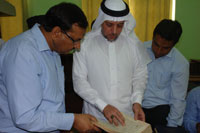
Shaikh Al Shareef Mustafa Fouad Shafaee, who belongs to the family of the Prophet of Islam, Hazrat Mohammad Mustafa (Peace Be Upon Him) recently, visited Aligarh Muslim University’s Maulana Azad Library to see the collection of rare manuscripts and books.

During his visit, he expressed happiness over the availability of the rare documents relating to the pre 18th century particularly on the history of Islam and the cities of Makkah and of Medina.

The visitor’s family has been holding the key of the Tomb of the Prophet (Peace Be Upon Him) for the last 14 centuries.

Shaikh Al Shareef belongs to the 41st generation of the Prophet and he has arrived in India to see the culture of the country. He had mentioned that he was interested to visit AMU and the Taj Mahal in Agra.

The AMU Librarian, Dr Amjad Ali accompanied Shaikh Al Shareef to the Manuscripts Division where he spent an hour consulting the documents relating to the geography, geology and history of Arab specially the cities of Makkah and Madina.

Shaikh Al Shareef had a look on Futuhat-e-Makkiah of Ibne Arabi and expressed joy over the method of scanning and preservation of the Islamic heritage. He added that he has visited libraries of some Islamic countries including Egypt and Turkey but could not see such a well-maintained rich collection, displayed for the visitors.

While praying for peace and prosperity of India, Shaikh Al Shareef added that this is the land where Hazarat Adam descended from Heaven and from where the human race spread all over the world. During his visit to the Manuscripts Division, the Shaikh added “I love India” and promised the Librarian, Dr. Amjad Ali to visit the Library again for a longer time.

Photo from AMU official

source: http://www.okhlatimes.com / Okhla Times / Home> Despatches / by OTNS – AMU / OT – August 23rd, 2015

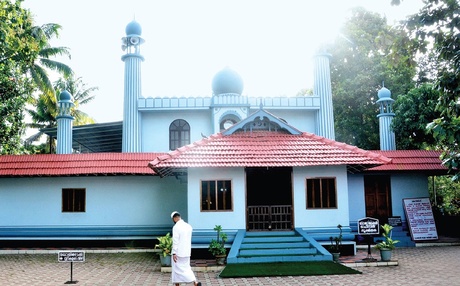
A Space for Missile Man at the Country’s Oldest Mosque

Cheraman Juma Masjid

Kochi  :

As a mark of tribute to the memory of the legendary man who took the pride of the country to the world and beyond, India’s first mosque, Cheraman Juma Masjid, will dedicate a portion of its Islamic Heritage Museum to A P J Abdul Kalam.

“The Islamic museum sheds light on the composite culture that existed in the God’s Own Country during the medieval period and showcases the relics of the rich past. In honour of the former President, it will be equipped with the digital collections of his visit to the legendary mosque and the town along with other documents,” said Faisal E B, administrative officer of the mosque. “We would also hold a meeting of various stakeholders this week to chalk out a plan to this effect,” he added.

It was hardly a decade ago when Kalam visited Cheraman Juma Masjid, considered to be the oldest mosque in the country, situated at the ancient port town of Kodungallur in Thrissur. The illustrious son of the country who visited the legendary 1400-year-old mosque on July 29 in 2005, wrote on the guest book, “I pray in the ancient mosque for the peace and prosperity of the country.”

The mosque committee is renovating the ancient monument under Muzaris Heritage Project of the state government. It is being renovated in tune with the style of Kerala architecture that existed during the times of the Cherman Perumal, the last of the Chera kings who ruled Kerala with Kodungalloor as their capital. The mosque is believed to have been constructed in 629 AD by Malik Bin Dinar, a contemporary of king Cheraman Perumal. “We would set aside a space for the former President in the renovated mosque, which already carries a plaque of his visit. The museum in the mosque would soon be expanded to include digital collection of the Muslim culture in Kerala. It will also carry the relics of the visit of the Missile Man to the mosque,” said Dr Mohammed Syed, president of the mosque committee.

The committee is already in the process of collecting audio-video footages of the Muslim culture in Kerala, which include the traditional art forms of the community, the artifacts associated with their daily life and other such memorials.

“The digitalised museum will be a top choice for global tourists and we are in the process renovating it in tune with world standards,” said a member of the mosque authority.

source: http://www.newindianexpress.com / The New Indian Express / The Sunday Standard / by Dhinesh Kallungal / August 02nd, 2015

Meritorious Awards to AP Police Officers

Visakhapatnam :

Chief Minister Nara Chandrababu Naidu presented medals in various categories to police officers in recognition of their meritorious service on the occasion of the Independence Day in Vizag Saturday.

Six Police officers, including Director- General of Fire Services TA Tripathi, Additional DGP, Intelligence, AB Venkateswara Rao, JMD/AP Transco P Umapathi, DIG, Intelligence, T Yoganand, Inspector of Police SIB Intelligence B Veera Reddy, Chittoor SI K Murali Narasimhulu were given the prestigious ‘President Police Medal’(PPM) for their distinguished service.

Meanwhile, 25 police officers were awarded ‘Indian Police Medal’ (IPM), which include JD AP Police Academy J Venkateswara Rao, CV and SO TTD D Nagendra Kumar, DCP (Crimes) T Ravi Kumar Murthy, SP (NC) Octopus Hyderabad P Rajendra Prasad, Additional Commandant of Grey Hounds P Seeta Ram, Additional Intelligence, Hyderabad, P Venkata Rami Reddy, Madanapalli DSP K Venkata Raghava Reddy, DSP ISW Hyderabad K Bhadraiah, DSP PTC K Veeranjaneya Reddy, DSP ISW AP P Rajeev Kumar, DSP CID D Naga Mahesh, DSP ACB K Ranga Raju, Additional SP  (Crimes) V Subba Reddy among others.

Five cops received Mahonnatha Seva Pathakam, including Commandant SARCLP SK Hussain Saheb, Additional SP (Tirupati Urban) S Trimurthulu, Additional SP (C.O Stores) K Surya Bhaskar Reddy. Divisional Forest Officer, Narsipatnam, G Lakshman and the Forest Section Officer, Salur Range, Vizianagaram, S. Venkata Rao received State Vana Samrakshana Meritorious Medal.

Eleven Firemen received President Fire Services Medals, Six police officers were given Police Award for Gallantry (PMG/PPMG), 10 Police officers, including Seven Grey Hounds cops, were presented Mukhyamanthri Sourya Pathakam.

Best School Award

Category I /  ZP High School, / East Godavari District

Category I I /  AP Residential School (Boys), Srikakulam District

Awards for Best Contingents

Armed Category / 6th Battalion, APSP, Mangalagiri

Un-armed Category  / AP Social Welfare Residential Educational Institution Society 

Tableau display

1 Animal Husbandry Dept

2 Cultural Affairs Dept

3 Energy, Infrastructure and Investment Dept

source: http://www.newindianexpress.com / The New Indian Express / Home> States> Andhra Pradesh / by Express News Service / August 16th, 2015

Inspired girls make a mark at Times NIE Quizomania

Bengaluru :

“No clues, No clues,” came the fervent pleas from a crowd of 1,200 students from 200 schools, as they competed for a place in the finals of the Times NIE Quizomania 2015-16. It was held jointly with the State Bank of India at The Cathedral High School, Bengaluru, on Thursday.

The excitement and tension was palpable from the word go, as quizmaster Giri ‘Pickbrain’ Balasubramanium took them through 20 questions in the preliminary round, before 12 schools made it to the semifinals. Presidency School, RT Nagar, walked away with the winning trophy.

They also got an impromptu cash prize of Rs 10,116, from Vijaya Kumar, general manager-network II of SBI, St Mark’s Road.

From Viv Richards starting his cricketing career from K Chinnaswamy Stadium to RBI governor Raghuram Rajan starring in the Oscar-winning documentary ‘Inside Job’, to Fauntelroy being Donald Duck’s middle name, the students had answers to almost all the questions.

Chief general manager of SBI Rajni Mishra said: “Some of the questions bowled me over; the children know so much today. I am often asked where I see India going economically, and today I can say that India is going to be No 1 in the world soon. We will have brilliant scientists, entrepreneurs and leaders,” she said.

Isabella Simon, principal of The Cathedral High School, said quizzing is a fun way to learn and gather information. CEO of Greycaps India Pvt. Ltd Giri Balasubramanium said he was delighted to see so many girls taking to quizzing. “Girls opening up to a mind sport like quizzing is a fantastic new trend. The comfort level the youngsters have with all the information around them is also amazing,” he said.

The winners, Aymen Maqsood and Bavadharini Manohar attributed their success to the 40-minute quiz they have in school every day, and reading the newspaper. The prizes to the winners were sponsored by Vedantu.com. General manager-network I, YV Ramana Murthy was among those who gave away the prizes.

source: http://www.timesofindia.indiatimes.com / The Times of India / News Home> City> Bengaluru / by Santrupti Rajankar, TNN / August 21st, 2015

5,000 of Kaifi Azmi’s books now in AMU library

Aligarh : 

A group of mostly librarians went from Aligarh Muslim University to Mijwan village in Azamgarh district recently to take possession of the 5,000 books from Urdu poet Kaifi Azmi’s collection that were being donated to the university by actor Shabana Azmi, the poet’s daughter.

What the group was stumped by was the mint condition of the books. There was little work to be done, the group said, as the books were all neatly covered and stocked in an almairah. The spines of the books were sturdy, the authors and titles all neatly marked.

Kaifi Azmi was born to a landed family in Mijwan village in January 1919. By the time he died in 2002, he was renowned as a poet, communist and member of the Progressive Writers’ Movement. Donating a collection of 5,000 books from her father’s library to the university, his daughterShabana Azmi said, “People who had come to collect the books were surprised at the upkeep of his personal library. They were astounded that someone hailing from such a small place like Mijwan could have such a vast and neatly maintained collection of books.”

Maulana Azad Library at AMU has received donations from at least 50 people so far. “Kaifi sahab’s personal library was so unique, it is hard to find a personal library so well maintained,” Amjad Ali of the Maulana Azad Library.

On Wednesday, the university released a catalogue of the books acquired from the Kaifi Azmicollection. The university also held a symposium titled, ‘Life in Creative Pursuits’ organized in collaboration with the Sahitya Academy.

In the collection were books of Urdu poetry and literature, books in Persian, Urdu periodicals, accounts of history and books authored at the peak of the Progressive Writers’ Movement that could prove to have significant research value. Among the Urdu periodicals are issues of Khuda Bakhsh, Naqoosh, Nigar and Shair.

Speaking of her father, Shabana Azmi said she always remembered him as someone who marched to his own drum. She admitted to being a little ashamed of him as a child: “He didn’t go to ‘office’ or wear the normal trousers and shirt like other ‘respectable’ fathers. He wore his cotton kurta-pyjama 24 hours of the day, he spoke no English. Worse, I didn’t call him ‘Daddy’ like other children. He was ‘Abba’! I learned quickly to avoid referring to him in front of my school friends. I lied that he did ‘business’. Imagine letting my school friends know he was a poet. What on earth did that mean? A euphemism for someone who did no work?”

The renowned actress remembered that when it was time for her to seek admission to school, her parents Kaifi and Shaukat sent other people to ‘represent’ them as her parents, so she could more easily be accepted as a student in an English-medium school. It was only with media reports that her school friends realised that she was actually poet Kaifi Azmi’s daughter, the thespian recounted.

Shabana Azmi’s husband, lyricist Javed Akhtar, said, “Kaifi spoke for the masses. He fought, through his writing, against injustice. His work has never been more relevant than now, when one thinks of the hardships people experience. He wrote about the downtrodden after living with them. He wrote of women’s rights. That did not mean he had different standards for the women in his own home. That is why he had a daughter like Shabana Azmi.”

source: http://www.timesofindia.indiatimes.com / The Times of India / News Home> City> Agra / by Eram Agha, TNN / August 20th, 2015

Over a cup of evening tea: A golden nugget from a bygone era


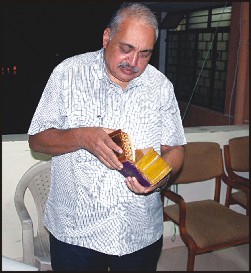
Dr. Javeed examining the Holy Quran.

By Dr. K. Javeed Nayeem, MD

Late last night I had the good fortune of holding in my hands, albeit momentarily, a gold-leaved copy of the Holy Quran from a bygone era that had been seized recently by the Mysuru district Police when attempts were being made by some persons to sell it for a sum of rupees five crores. It all started with a late night phone call from my close friend A.G. Murali, who wanted to know if I had on hand someone who could read Arabic.

When I said that I could do it myself although I could not claim to have a scholarly knowledge of the language, he asked me if I could come down to the office of the DySP of Mysuru rural district. Sensing that I was puzzled by such an unusual request at such an odd time, he explained to me that the Police officers there were examining the recently seized Quran and were keen to know a little more about the book.

Excited by the request, I hurried to the place with my cousin Adil Pasha and my camera, sensing a rare opportunity to see and photograph the rare find. Most often I go looking far and wide for a subject to write about in my column and only once in blue moon a subject comes looking for me and here was one such Godsend!

After meeting the DySP Dr. Vikram Amte, when I eagerly asked him where the book was he smiled and pointed to an almost cubical object placed on the table right before him. Because of its unusual dimensions, I could not immediately recognise it as a book which I expected would be flat and broad as most books are. It was almost as thick as it was broad because its 302 sheets were unusually thick, being gold plated and inter-leaved with butter paper to preserve them. The rich black ink stood out against the golden background, the shine of which seemed to be without the slightest loss over the centuries. Printed on both sides of each sheet, the book has 604 hand-written pages, the text of which is very readable with the naked eye. The title page has the name ‘Al Quran Al Kareem’ like most other Qurans but on the last page is an unusual inscription; ‘Buzargaane Rava’ which the noted historian, Dr. B. Sheik Ali, after examining the book, has interpreted as a dedication of the labour of love by its calligraphers to contemporary saints. He has also said that going by the date AH 1050 on it which translates to 1605AD of the Gregorian calendar the book seems to have been crafted at the time when Emperor Jahangir ascended the throne. This was a time when hand-written calligraphy was at its pinnacle in the Moghul court.

Incidentally, the Islamic lunar year is eleven days shorter than the solar year which we follow and, therefore, an Islamic century is equal to 97 solar years. The present year of the Islamic calendar is 1436 Hijri. A book on calligraphy which I have says that the word which means ‘beautiful writing’ is derived from the Arabic and Persian word ‘Qalam’ which means pen.

Although calligraphy exists in almost every other language too, it is in the Arabic script that it has almost become an art form. The present artifact which has now passed perhaps from the Moghul court to the custody of the law court will perhaps pass on to the desk of the archaeologists who will verify its authenticity. And, if it confirmed to be a genuine antique really from an era of which it bears the date, it will perhaps go down in history as the biggest catch of our district Police led by our young and dynamic SP Abhinav Khare. The team deployed by him to tactfully nab the persons trying to sell it consisted of Dr. Vikram Amte, Dy.SP, Mysuru Rural Sub-Division; Inspectors D. Ashok, Mysuru South, Siddaiah, K.R. Nagar, Gopala Krishna, DCIB, Sub-Inspectors Gangadhar, Saligrama, Poonacha, DCIB and Police constables Bhaskar, Anand, Ravi, Zahoor and Pachche Gowda.

It appears the BBC channel has been trying to contact our district Police for details of their find. While it is now only the small fry that are in the Police net the actual owner has not yet been traced although evidence points to a source somewhere in the Hyderabad region which is again a prominent seat of royalty and, therefore, a well-known source of royal antiques. If this relic had found its way to the international market, it would perhaps have gone under the hammer for a price that would perhaps have made the whopping sum of five crores it was being peddled here for seem like a mere pittance!

e-mail: kjnmysore@rediffmail.com

source: http://www.starofmysore.com / Star of Mysore / Home> Feature Articles  / Friday – August 14th, 2015

You ask, the commissioner answers

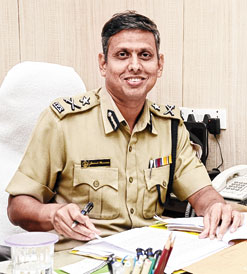
Police commissioner Jawed Shamim in his office. (Bhubaneswarananda Halder)

Jawed Shamim, commissioner of police, Bidhannagar, answers 10 questions asked by the residents of Salt Lake through The Telegraph Salt Lake.

When you took over as commissioner, what was your message to your force? And in your stint as commissioner, what have been the three biggest challenges faced by you and your team, and what has been your plan of action to face these challenges?

The message was simple: Together we shall and we will provide an effective police force for the residents of this Commissionerate.

Each and every sphere of policing is equally challenging and maintenance of law and order and prevention of crime are the biggest challenges for any city policing force. However, in the short term, the following three targets were identified.

Revamping the traffic system with special emphasis on traffic engineering and infusion of technology in traffic management. More visibility and better enforcement of traffic rules including removal of the auto and bus stands from various important crossings. It has already been implemented at Karunamoyee crossing and we will implement it in other parts of this Commissionerate.

Rein in illegal activities of the various dance bars and restaurants and immoral activities in various parts of this Commissionerate, especially in Baguiati, New Town & Airport areas.

Devising a mechanism to prevent house burglary and theft in the Salt Lake area through human intelligence patrolling and use of technologies, and involving the community in these efforts.

Does the Commissionerate have adequate manpower and what area does it cover? 

Manpower is more than what it was before this Commissionerate was formed. However, it has to be increased further and the same is under the active consideration of the government. Bidhannagar Police Commissionerate has got an area of approximately 150sq km covered by 10 police stations.

The area of Bidhannagar Police Commissionerate has seen changes both in its demographical as well as topographical aspects. It has become the IT hub of Bengal. Many government and corporate houses have made this their home. New townships and recreation centres have sprung up. These have necessitated a more intensive and direct policing system. Policing has become much more professional, inculcating all the values needed to serve the people in these ever-changing times.

Does the police plan to install CCTVs at major crossings? A few block residents’ associations have installed CCTVs, but after a theft last year in one, it was found that the cameras were placed too high to capture faces. What is your advice for such private initiatives?

Yes, this Commissionerate will gradually be covered with CCTV cameras. As of now, we have already installed CCTV connections at 29 places in Salt Lake area, monitored centrally at Bidhannagar control room. There is a proposal for increasing the CCTV surveillance in the Smart City project. Red Light and Stop Line violation camera is being installed at one crossing on VIP Road, which will gradually be increased at other crossings of the Commissionerate.

Many CCTVs have been installed by private units. We have also sent request letters to the business establishments and housing societies to install CCTV cameras. Nowadays, CCTV camera comes at a very reasonable rate and individual houses can also afford to install these. This will go a long way in detection and thereby prevention of crime, especially property crimes. Those who are installing CCTV cameras at their own initiative are requested to contact the local police station so that they can get proper guidance regarding the correct installation points.

What steps would the police take to free the northern side of the Eastern Drainage Canal of squatters? While the other side of the bank is being beautified as the approach to Sector V, shacks have come up in rapid succession on this side over the last year and half. 

We are aware about the problems of the squatters and have already taken up the matter with Bidhannagar Municipality.

Salt Lake, as the common saying goes, is like one big old-age home. What steps are the police taking to ensure the safety of elderly residents of the township who stay alone?

We are acutely aware that the services to the elderly residents of Salt Lake is one of the prime responsibilities of Bidhannagar Police Commiss-ionerate and it extends beyond normal policing. To cater to the various requirements, we have associated with the NGO called OFFER in the project Sanj Baati which exclusively looks after the problems of elderly residents of the Salt Lake area. Sanj Baati has its office in the Bidhannagar North P.S. compound. To provide ambulance and other medical facilities is also a prime area that we are working on. All police stations have been asked to get a list of the elderly people staying in their respective jurisdiction and to keep in touch with them as far as possible. Those working on 100 dial are also sensitised to attend the calls of elderly people efficiently and promptly.

Are all crimes related to cyber crime to be reported to the cyber crime police station only? Can we lodge such complaints in the other police stations as well?

This being the IT hub, increasing cyber crime has been a natural corollary. Keeping this in mind, Cyber PS has been set up to cater to the crimes arising out of the cyber world. However, it is not mandatory that  cyber crime has to be reported only to the Cyber PS. All police stations are authorised to register cyber cases. If need be, they can take the expert help of Cyber PS.

What can a citizen do if a police station refuses to lodge an FIR and pressures the complainant to turn it into a general diary?

On no account should the citizens under the Bidhannagar Commissi-onerate accept the refusal to lodge an FIR. Clear instructions have been given to police stations for registration of all cognisable cases. In spite of that, if there is any reluctance on the part of the police station to register any case, the matter has to be promptly brought to the notice of the concerned Zonal ACPs / ADCPs / DCPs and my office.
There is now a separate section on your website for registration of landlords, tenants, PGs and domestic helps. How has the response been?
There has been steady response to the online registration on our website. Around 30,000 registrations have already taken place but we will urge citizens of the Salt Lake area to use this facility and register themselves in greater numbers.

One complaint from residents of Sectors 1 and 2 is how thieves escape by crossing the footbridges across Kestopur canal and reaching VIP Road. Do you have plans to guard those at night? Also can the patrol cars do a few rounds in the post-lunch hours when some of the petty thefts take place? 

Regular vigil at different footbridges connecting stretches of Salt Lake with Lake Town-VIP connector etc is maintained. Police personnel are posted for night duty at the connecting points of footbridges at Salt Lake side. However, more effective methods of patrolling including foot, bicycle and motorcycle patrol are being introduced within the constraints of the available manpower and resources.

What are your goals for the next few years? 

The goals for the near future is to build up a dynamic force…
capable of quick response to tackle a law & order situation.
proficient in prevention and detection of crime.
adept in ensuring smooth traffic management.
involved in various community policing projects.

What would you like to ask the police commissioner?
Write to saltlake@abpmail.com

source: http://www.telegraphindia.com / The Telegraph, Calcutta,India / Front Page> Salt Lake> Story / Friday – August 14th, 2015

Bengaluru activist gifts e-rickshaw to honest Aabid

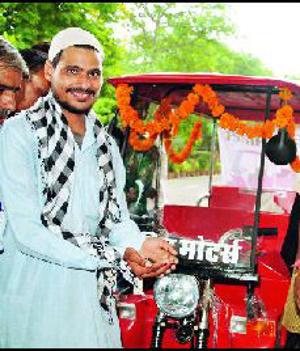
Nagpal along with social activist Sabir Qureshi (who took Aabid to the commissioner of police, Jaipur, Janga Sriniwas Rao to return the money) came to the Jaipur police commissionerate and the keys of e-rickshaw were handed over to Aabid by the commissioner.

Jaipur :

He woke up at 3.45 am to board the flight from Bengaluru to Jaipur. Sixty-six-year old Lal Chand Nagpal arrived here on Monday to salute and reward Aabid Qureshi, the honest rickshaw puller who had returned Rs 1.17 lakh he had found on the road.

After checking into a hotel, Nagpal met with the family of Aabid and in the presence of commissioner of police, Jaipur, Janga Sriniwas Rao, gifted an e-rickshaw to Aabid.

Nagpal, a businessman-turned-social activist, who had won ‘Sindhu Ratan’ award for his work had read Aabid’s story – Rickshaw puller returns Rs 1.17 lakh found on road’ appeared in Times of India on August 6 and contacted the scribe and wished to reward Aabid.

“After reading the news in Bangalore, I was so impressed with Aabid because if you lost a Rs 100 note these days, you can’t expect to get it back. And this man has returned over Rs 1 lakh despite having a very poor financial condition. I met his family and found that they were very humble. It is a good feeling while I gave them an e-rickshaw to raise bar in terms of their daily earning,” Nagpal said while talking to TOI on Monday.

Nagpal along with social activist Sabir Qureshi (who took Aabid to the commissioner of police, Jaipur, Janga Sriniwas Rao to return the money) came to the Jaipur police commissionerate and the keys of e-rickshaw were handed over to Aabid by the commissioner.

“I think this is the best example of a welfare state. A man shows honesty and another man sitting in a city rewards him. These are the real heroes of the society,” said an elated Rao.

Nagpal said, “There were few friends in Bangalore with whom I discussed the idea. They all encouraged me and also asked me to check the credentials of the man. I am satisfied and humbled after seeing the simplicity of Aabid. However, my only concern is that the people of Jaipur should now ensure that the e-rickshaw I have gifted him should only be utilized to earn his bread and butter. They should not misuse it.”

“I thought just money won’t solve the problems of his life. I am giving him a source which can ensure him a proper monthly income,” said an elated Nagpal.

Nagpal further urged the people of Muslim community who had come to welcome Aabid at the commissionerate that they should work as guarantor to ensure that Aabid should not change his path of simplicity and honesty. “Mujhe bada dukh hoga agar meri mehnat ke paise zaya honge (I will feel bad if my hard earned money will be wasted),” he added.

Aabid and his wife Ameena along with their infant daughter Anam were happiest while they were handed over the keys of e-rickshaw. “I had never thought that good act will fetch me so many things. A day after the news stories on me appeared, I had fever and went to see a doctor. The doctor after seeing me said that he had read my story in newspapers and did not charge a penny as fees as a mark of respect. I will now ensure that I should work hard to earn better in my life for my wife and family members.”

Aabid and people of his colony boarded in the e-rickshaw and departed to their destination while celebrating the moment.

source: http://www.timesofindia.indiatimes.com / The Times of India / News Home> City> Japipur / TNN / August 18th, 2015