Category Archives: Community Involvement / Social Issues

The idea of India

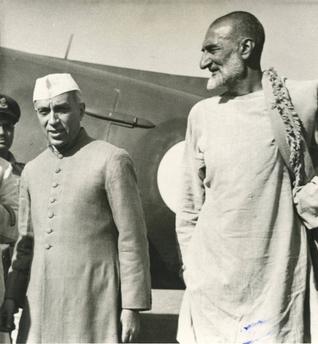
Pandit Jawaharlal Nehru with Khan Abdul Ghaffar Khan at Miranshah during his visit to the North West Frontier in October 1946. Photo: The Hindu Archives

This Independence Day let’s spare a thought for those Muslims who chose to migrate to Gandhi’s India

Taj Mohammad Khan was a young Pathan when India was carved out on communal lines in 1947. He was a Congress activist in Peshawar and was greatly influenced by Mahatama Gandhi and Frontier Gandhi (Khan Abdul Ghaffar Khan). He was a broken man when it became clear that the nation would be divided on communal lines. He was in extreme dilemma whether to stay back in Peshawar, the land of his forefathers, or move to a new place in a new country. And when communal riots broke out post Partition, he decided to leave the homeland for Muslims for secular India. He came to Delhi along with his family and couple of other friends. Today we know him as father of superstar Shah Rukh Khan.

The likes of Taj Mohammad Khan had rejected the two-nation theory with utter disdain. If not thousands, there were many Muslims who shifted to India from newly created Pakistan in 1947 when communal passions were running high.

Many years ago H.C. Shourie, who was the Rehabilitation Commissioner of refugees in Delhi, told this writer that several Muslims families from NWFP region of Pakistan came to India in 1947.They were not ready to live in Jinnah’s Pakistan. That was the region that was not much impacted due to communal violence that engulfed Punjab and Bengal. The local people were close to Gandhiji and Ghaffar Khan. That was the major reason for many Muslims to leave Pakistan and settle in secular India.

Many Hindus, Sikhs and even Muslims migrated to Afghanistan. A former Pakistani diplomat and historian, Nazar Abbas, said that there is a possibility that some Muslims had migrated to India then. “It is a fact that due to Ghaffar Khan, large number of people there were not supporting the idea of Pakistan. As he had a huge support base, I can believe that some of them had shifted to India,” noted Nazar Abbas.

Massive population exchanges occurred between the two newly-formed states in the months immediately following Partition. Once the lines were established, about 14.5 million people crossed the borders. Based on 1951 Census of displaced persons, 7,226,000 Muslims went to Pakistan from India while 7,249,000 Hindus and Sikhs moved to India from Pakistan immediately after Partition. However, the Census failed to identify those Muslims who migrated from Pakistan to India.

Returning to Taj Mohammad Khan and others like him, it goes without saying they would have taken that conscious decision after much thought. Among others, Mohammad Yunus, a close family friend of Nehru-Gandhi family, also came to Delhi with many Muslims. A close relative of Khan Abdul Ghaffar Khan, Mohammad Yunus never returned to his native place. For years together, he was heading Trade Fair Authority of India.

Delhi-based noted theatre activist Dr. Shamshul Islam’s family came from Rawalpindi to Delhi after violence broke out there. His father, grandfather and other close relatives were not ready to live in Pakistan. Islam, who teaches in the Capital’s Satyawati College, says that no member of his family has ever regretted their decision to live in Gandhi’s India.

Shah Rukh Khan has said several times that his father was a Congress activist and was totally opposed to the idea of Partition of the country on the basis of religion. He came to Delhi along with his family members. A lawyer, Taj died of cancer in 1981.

It is rather surprising that the reverse migration, albeit small, but very significant, hardly get any attention from historians. Unlike the general perception that only Hindus and Sikhs migrated to India in the wake of partition of the country in 1947, many Muslims families too decided to shift to India rather than staying in an Islamic country. It is not known whether Hindus or Sikhs too migrated to Pakistan then, but it is a fact that large number of Hindus remained there, especially in Sindh and East Bengal (now Bangladesh).

source: http://www.thehindu.com / The Hindu / Home> Features> MetroPlus / by Vivek Shukla / August 14th, 2015
Telegana Oppn leader Mohammed Ali Shabbir felicitated in Chicago

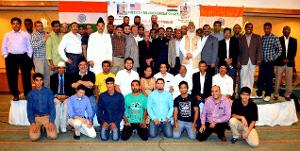
Mohammed Ali Shabbir, opposition leader, Telangana State Legislative Party(India) at a reception organized by American Telugu Association (ATA) and Telangana Association of North America (TANA) in Chicago, USA.

Chicago :

American Telugu Association and Telangana Association of North America, headed by its President Iftekhar Shareef, organized a reception dinner in honor of Mohammed Ali Shabbir, MLC, and Opposition leader of Telangana state legislative council at North Shore Banquets, Chicago.

Shabbir said that the extension of the benefit of 4% reservations, during his tenure as cabinet minister, enabled minority students to make their mark in education and employment. “Success in reservation for minorities, despite multiple legal hurdles and strong opposition from some sections of society, was a milestone,” said Shabbir.

Shabbir said nearly two million Telugu diaspora in the USA have been immensely contributing to the growth of both American and Indian economies and thereby making Telugu people proud. He also encouraged them to invest their savings in their home states. “However, considering the heavy incidence of backwardness in the rural areas of Andhra Pradesh and Telangana, the NRIs, with flair for social service, may use their resources in finding enduring solutions to these problems,” said Shabbir.

“Iftekhar Sharief, who was the first recipient of dual citizenship, continues to be a role model for all NRIs,” said Shabbir and thanked ATA and NATA for arranging the reception.

Iftekhar Shareef, trustee and events chair of the Federation of Indian Association, Chicago, said that the political career of Shabbir reflects the true secular credentials of the Indian voter. “Even though the non-Muslim voters constitute a staggering 92% in his constituency, Shabbir won the elections with thumping majority,” he said.

source: http://www.timesofindia.indiatimes.com / The Times of India / News Home> NRI> US & Canada News / August 13th, 2015

Unfurl tricolour on rooftops on Independence Day, Deoband tells Muslims

Faizabad :

Leading Islamic seminary Darul Uloom, Deoband has asked Muslims to put up the national flag on their houses and other establishments on Independence Day and has also appealed to the members of Muslim community to celebrate the national day with spirit of patriotism.

Talking to TOI, the seminary spokesman Ashraf Usmani said, ulemas (religious leaders) of Darul Uloom played prominent role in the freedom struggle.

“Call for complete independence which later turned into the ‘Poorna Swaraaj’ movement, was first given by Hussain Ahmad Madani and Maulvi Ahmadulla Shah of Deoband and were among a long series of freedom fighters who laid their lives down for independence of the motherland,” said Usmani, adding, “Darul Uloom has asked Muslims across the country to unfurl the national flag on their houses and other establishment on Independence Day ”

Reacting to the appeal, seminary leader Maulana Arshad Qasmi said, “We have advised all madrassas across the country specially to host the tricolour and enlighten students about India’s freedom struggle and the country’s original spirit of unity in diversity.”

“Muslim community has always been on the target of communal forces,” said Hafiz Akhlaaq Ahmad Latifi, who runs a madrassa in Ayodhya, adding, “They always question our patriotism. In madrassas we always teach love for motherland and patriotism. In the past too, we have celebrated Independence and Republic Days, and will continue to do so.”

source: http://www.timesofindia.indiatimes.com / The Times of India / News Home> India / by Arshad Afzal Khan, TNN / August 14th, 2015

Panchala Museum plans gallery for freedom fighters

Bareilly :

With the 69th Independence Day less than a week away, authorities at Panchala Museum are planning to set up a gallery dedicated to the lives of freedom fighters from the Rohilkhand region.

Officials have started collecting pictures, letters and other memorabilia belonging to those who were a part of the freedom struggle.

Abhay Singh, a professor at MJP and the project coordinator, said, “We are requesting families of these bravehearts to provide photographs and texts related to their lives. We are working on a strategy to gather as many belongings of the freedom fighters as we can and we also plan to appeal to the public through newspapers in this connection.”

“Residents aren’t aware of the kind sacrifices freedom fighters from this region made. With the gallery we plan to highlight their glories in our museum. For instance, FR Rahman alias Chunna Miyan who was known as Gandhi of Bareilly worked for creating communal harmony in the city,” Singh added.

However, setting up of the gallery is subject to the availability of required material.

Shyam Bihari Lal, head of the department of ancient history and culture, said, “The gallery will be set up in the museum only after we receive enough material to put things up on display.”

Many people from the Rohilkhand region, including Bareilly, Shahjahanpur, Pilibhit, Rampur, Badaun, Moradabad, Bijnor and Sambhal played an active role in the freedom struggle.

Bareilly was the headquarter of the Rohilkhand region during the revolt of 1857. In fact, on May 31 that year, freedom fighters killed several British officials including the principal of Bareilly College.

The museum is located on the MJP Rohilkhand University campus. Till now, it was only accessible to varsity students but it will be opened to public from this month.

“There will be no entry fee for outsiders but there will be timings for public visits,” said Singh. He added the final touches are being given to the renovation and beautification work at the museum.

source: http://www.timesofindia.indiatimes.com / The Times of India/ News Home> City> Bareilly / by Priyangi Agarwal, TNN / August 10th, 2015

Enclave’s first baby after freedom named Azad

Kolkata :

Midnight on July 31 had ushered in a new freedom in Cooch Behar’s 51 Bangladeshi enclaves. It took the wail of a newborn 12 days later to underline what it actually meant. Named Azad, he is the first baby born in free territory -with his parents’ real names, and calling what was no-man’s land his home.

When TOI had met the pregnant 18-year-old Jharna Biwi a fortnight ago, the Bangladeshi enclave of Poator Kuthi in Cooch Behar was excited because this baby would be special. At 6.30am on Wednesday , Azad was born at Bamonhat primary health centre. Never has the birth of a newborn -to a teenage mother -been the cause of such joy in any enclave.

Gone are the days when even quacks, what to speak of doctors, would refuse to deliver babies of enclave residents.Would-be-mothers would suffer the ignominy of lying about their husbands’ name.Azad’s elder brother, born four years ago, was named Saheed (martyr). Grandfather Mujibur Ali is ecstatic but cannot forget the shame and agony of half a century .”When Saheed was born in 2011, we had to send Jharna to her maternal home in Dinhata’s Picnicdhora, evading BSF patrols. We had to lie about her husband’s name and give a fake Indian address just to get her into hospital. Not any more,” Ali said. “Azad signals the new dawn,” he said, before hurrying off to offer sweets to visitors flocking to his home.

When Jharna felt pre-mature labour pains in the predawn hours, her brother-inlaw Meharul and mother-inlaw Jamina Biwi took her in a van rickshaw to the primary health care centre, half-anhour away . This in itself would be a huge task a fortnight ago. Being Bangladeshis, they couldn’t step out of their villages for fear of being hounded by BSF or police.And getting admission in a state-run health facility was out of the question.

As Poator Kuthi savoured the sweets of Azad’s birth, 70 year-old Mansoor Ali recalled how Asima Biwi was denied treatment in 2010.

“Nearly 3,500 enclave residents braved a nine-hour stand-off with police and BSF to get her treated at Dinhata sub-divisional hospital. The administration relented only when they realized the protest could snowball into a huge agitation. Her baby was born that day and we named him Jehad (struggle),” said Mansoor, president of Poator Kuthi enclave exchange committee. Mansoor said, “Jehad’s birth may have brought our plight before the people but it didn’t change our way of life. Expectant mothers had to fudge their husbands’ name (give an Indian’s name) and address to get admitted to hospitals. Nothing can be a bigger insult to a married woman than to lie about the father of her child.” He added, “But this morning, I held Jharna’s hand and told her to go with her head held high and tell them that she belongs to Poator Kuthi, India, and her husband’s name is Jamidul Ali. She did.”

source: http://www.timesofindia.indiatimes.com / The Times of India / News Home> India / by Kamalendu Bhadra, TNN / August 13th, 2015

Picking the pieces of a rich heritage

KuttichiraMPos14aug2015

Efforts needed to preserve the unique socio-cultural identity of Kuttichira

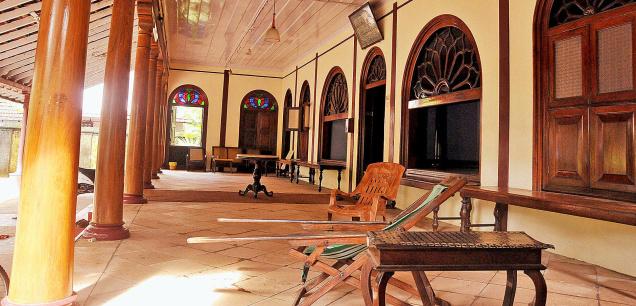
Kuttichira, a predominantly Muslim settlement in the coastal region of Kozhikode, holds testimony to the city’s trade relationship with the Arab world.

Built around centuries-old mosques, the region comprises hundreds of families who still keep its unique socio-cultural identity at different levels. The last vestiges of its physical expressions—the ancestral homes and a number of household articles—are vanishing and efforts to set up a cultural museum to preserve them failed to bear fruit.

After a few decades, no one would believe that more than 100 members of a family in a matrilineal descent system lived in a single tharavadu at a time, says Hassan Vadiyil, a veteran journalist and a member of a prominent family in Kuttichira.

Six kitchens for a single house may sound like a bit of an exaggeration. But that was what some of these colossal houses had at a time. “Some of them even had three domestic wells around them,” says Mr. Vadiyil, who had first hand experience of the entire socio-cultural practices and customs that were part of life in Kuttichira.

Ramsy Ismael, member of CIESCO, a socio-cultural organisation based at Kuttichira, had a good collection of a number of artefacts related to the cultural life of Kuttichira. They included a decorative cap used by the groom on the wedding day and even furniture used during special occasions like wedding. “But many of them have been lost,” says Mr. Ismael.

Most of the families at Kuttichira have now left their joint families migrated to the Middle East. “Members of the new generation have been completely disconnected from their glorious common past,” says Parappil Muhammed Koya, writer and historian, who has an entire title ‘ Kozhikkotte Muslimgalude Charithram,  written on the lives of people in Kuttichira. “Documenting and preserving at least the valuable remnants of this remarkable culture is a necessity,” he says.

At least one of the traditional homes in the area could be purchased or taken over on lease by the tourism department to be converted into a museum which can house whatever is available to tell the story of Kuttichira to the future generation, says Dr. Koya.

“That can also become one of the most valuable tourism attractions of the city if materialised,” he says.

source: http://www.thehindu.com / The Hindu / Home> News> Cities> Kozhikode / by Jabir Mushthari / Kozhikode – August 14th, 2015

Quran dating back to Akbar’s period recovered by Dist. Cops

Ten-member gang trying to sell it for Rs.5 crore arrested

AkbarQuranMPOs12aug2015

Mysuru :

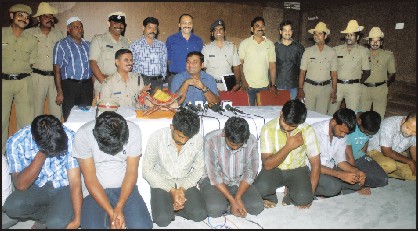
In a meticulously planned and precisely executed operation, sleuths attached to the District Police, seized a 410 year-old Quran, written during Mughal ruler Akbar’s period in the district and also arrested a gang of 10 members who were allegedly trying to sell it for Rs.5crore.

Police have also seized a Ford Ikon car (MH02 AK-4967) from the gang

The nabbed have been identified as S. Nagaraju of Sindhanur, A. Muralikrishna of Sasalamai Camp, Kanakappa Kambli of Yerebeleri village in Gadag district, Kallappa Kambali o Kalaburgi and Sanath of Kollur in Udupi taluk, Ravindra, Vijayendra of Hosanagar in Shivamogga district, Prasad of Heggodu in Sagar taluk, Bhaskar of Sindhanur and Raghu of Karwar.

Addressing a press conference at his office in city yesterday, SP Abhinav Khare said that Police, who came across a video on the antique Quran that the gang was sharing with prospective buyers formed a team to trap the gang.

The Police team, posing as prospective buyers approached five members of the gang near the Railway Station in Hosa Agrahara in K.R.Nagar taluk in the district and nabbed them before nabbing the remaining members in Mysuru city, he said and added that the accused had confessed to have got the antique from some persons in Hyderabad promising to share the proceeds of the sale with them.

Additional SP Kala Krishnaswamy, Rural Dy.SP Vikram Amte led K.R.Nagar Inspector H.N.Siddaiah, DCIB Inspector Gopalakrishna, Saligrama SI Poonacha in the nabbing and seizing operations.

Meanwhile, noted historian and former Vice-Chancellor of Mangalore and Goa Universities Prof. B. Sheikh Ali, who was present at the press conference described the calligraphy as a 604-page book, each separated by a butter paper for better preservation as a piece of Exquisite Art adding that writing in the Quran is legible.

Continuing, Prof. Sheikh Ali said ‘It was written in 1959 of the Hijri calendar, which works out to 1605 A.D. This was around the period when Mughal rule was at its peak in India and the time when Akbar was succeeded by Jahangir.”

He further said that though there is no other information on the last page other than the year in which it is written, there is a sentence that says that the calligraphy is dedicated to the saints.

Interestingly, SP Khare removed his footwear while holding the Quran to pose for photograph before the Quran was carefully placed in a carved wooden stand and covered with a cloth.

source: http://www.starofmysore.com / Star of Mysore / Home> General News / Wednesday – August 12th, 2015

Azad Bhavan to come up in city by next year : Minorities Dev. Corporation Chairman

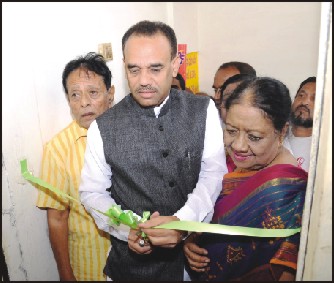
Minorities Development Corporation Chairman Masood Faujdar is seen inaugurating the newly-shifted office of the Corporation at K.R. Mohalla here yesterday and former MLA Muktharunnisa Begum and others look on.

Mysuru :

“Azad Bhavans, housing all offices related to the Development and Welfare of Minorities, will be constructed at all district headquarters across the State and the one in Mysuru will come up in a year,” said Karnataka Minorities Development Corporation Chairman Masood Faujdar

Speaking after inaugurating the newly-shifted Office of the Corporation in Kempananjamba Agrahara in K.R. Mohalla here yesterday, Faujdar said following complaints of public inconvenience over the different location of offices related to minorities welfare, the government has decided to construct Azad Bhavans, for which budgetary allocations have been made by the Chief Minister.

Stating that the Corporation has raised the upper limit ceiling of loans extended by the Corporation under various schemes, he said that the Corporation has sanctioned Rs. 7 crore to Mysuru district this year for the implementation of the schemes.

Stressing on the need for organising widespread awareness campaigns for popularising the Corporation’s initiatives, especially educational loans, Faujdar called upon the beneficiaries to make good use of the schemes.

K.R. MLA M.K. Somashekar, in his address, said that the State Government is doing its best for the upliftment of minority communities and called upon the beneficiaries to be informed about the schemes and make the best use of them.

Former Mayor Ayub Khan, who also spoke on the occasion, said that the frequent shifting of offices related to minorities welfare was causing great inconvenience to the beneficiaries, especially those from rural regions. Stating that lack of education, health and houses was the main reason for the backwardness of minorities, he appealed the government to release more funds to the Corporation for effective implementation of welfare schemes.

Mysuru Industries Association (MIA) General Secretary Suresh Kumar Jain, former MLA Muktharunnisa Begum, Corporator Suhail Baig, Congress leaders Allah Baksh, Rehana, Tajunnisa and others were present.

source: http://www.starofmysore.com / Star of Mysore / Home> General News / Tuesday – August 04th, 2015

Blind youth develops mobile app for eye donation

Kochi :

A new app called Netradaan enables users to sign up for eye donation through their mobile phones. What makes the app all the more special is the contributions by a visually challenged person in its making.

Muhammed Ramees was born with partial eyesight. When Sunil Mathew, founder of Sightica Solutions spotted him during an interview to train visually challenged persons in using computers, he realized that Ramees was too good to be just trained in basics. That was the beginning. Together the duo went on to develop a series of Android apps.

“One of the unique features of the app is t the recipient request through which a request for cornea can be made. This will go into the database of the association. The app has English and Hindi versions, Ramees said. The app encourages users to donate their eyes through an easy to fill-and-submit donor form. “We have partnered with the Eye Bank Association of India. The donor receives an eye donation card from the association,” said Sunil, who also runs Society for Rehabilitation of the Visually Challenged (SRVC), an NGO in Kochi.

Another app called Kuluk created by them enables the blind to call for help by shaking or tapping their phone “A visually challenged person can call for help by shaking the phone or tapping it just once keeping the app on. The users can customize the number of shakes upto three. A shake or a tap prompts a call or message to emergency numbers saved on their phones,” said Sunil. Another app called Mapseeker helps the elderly or visually challenged to find important places using google maps. “This is just like the GPS but with more user-friendly features for the blind,” Ramees added. ”

Netradaan app has won the m-inclusion Awards at the mBillionth Awards held in New Delhi last week. The award honours outstanding mobile content and apps from South Asia.

“We should spread awareness regarding eye donation. What pushed us to develop this app was the long waiting list for corneas. About 45,000 corneas are imported from Sri Lanka alone every year,” said Sunil. All the apps can be downloaded from Google Playstore.

source: http://www.timesofindia.indiatimes.com / The Times of India / News Home> City> Kochi / by Sudha Nambudiri, TNN / August 04th, 2015