Category Archives: Community Involvement / Social Issues

Centenary celebrations of City Central Library from Aug. 2

CM likely to inaugurate; ‘Kuvempu Mobile Library’ to be revived
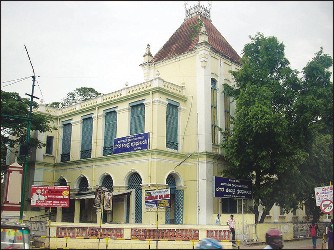
CityCentralLibraryBF04jul2015

Mysuru :

The City Central Library (CCL) on Sayyaji Rao Road, established in 1915, is a treasure house for lakhs of knowledge seekers. Now, preparations are afoot to celebrate the 100 years of CCL.

Nalwadi Krishnaraja Wadiyar, Sir M. Visvesvaraya and Sir Mirza Ismail were instrumental in the construction of CCL.  Janab M. Hussain, B. M. Shri, Rao Bahadur Ranga Iyengar, M. Venkatakrishnaiah, Rev. E. W. Thomson, N. S. Subbarao and B. G. Lakshman Rao were the other key players in establishing this library in the heart of the city.

CCL was inaugurated on October 15, 1915 by the then Mysore King Narasimharaja Wadiyar and since then lakhs of Mysureans have benefitted from the vast collection of books in the library.

Centenary celebrations

To mark 100 years of CCL, various programmes will be held from August 12, 2015 to November 14, 2015 in city, according to B. Manjunath, Deputy Director, City Central Library, Mysuru.

Chief Minister Siddharamaiah is likely to inaugurate CCL’s centenary celebrations on August 12, the National Librarians’ Day. The CCL’s Centenary Day valedictory will be held on November 14, the National Library Day.

Tenders have been invited by Public Works Department (PWD) to get the CCL building painted for the Centenary celebrations. New furniture is provided for the inner hall of the library.

An Editorial Committee has been constituted to bring out a Souvenir on the occasion. Articles written by litterateurs, members of the library and other prominent persons which have already been submitted will be featured in the Souvenir.

Mysuru District Publishers’ Association has come forward to sponsor the printing of the Souvenir.

The CCL in Mysuru was the first to introduce ‘Kuvempu Mobile Library’ in the State and due to various reasons the Mobile Library stopped functioning a few years back. Now the authorities have taken a decision to revive the Kuvempu Mobile Library.

Apart from this, it has been decided to construct a library building in People’s Park.

The CCL run by Public Library Department has 17 other libraries in city, 9 Seva Kendra Libraries, 5 Vachanalayas, one Community Children’s Centre and two affiliated centres. Around 50,476 people are registered members of CCL in city. CCL has a collection of over 55,000 rare books and it keeps adding new books every year. The library was handed over to the State Government in 1965, when the Public Library Act was passed.

source: http://www.starofmysore.com / Star of Mysore / Home> General News / Sunday – June 28th, 2015
Lucknow Shias mediate between Saudi Arabia and Israel

New Delhi :

In May, Lucknow played host to an unusual meeting — a high level track-2 interaction between Israel and Saudi Arabia attended by prominent Shia intellectuals in India.

The Raja of Mahmudabad, well-known Shia intellectual in Lucknow and erstwhile royalty and his sons were part of a meeting between an Israeli think tank, Jerusalem Center for Public Affairs and a Saudi delegation from the Middle East Center for Strategic and Legal Studies, in Jeddah.

Interestingly, the Israeli team was led by Dore Gold, who has just been named Israel’s new foreign secretary. The Saudi delegation was led by Maj Gen(retd) Dr Anwar Majed Eshki, according to Shimon Shapira, one of the members of the Israeli delegation who wrote a blog on the meeting, calling it “extraordinary”.

“Our hosts were the leaders of the Shiite community in Lucknow, the Raja of Mahmudabad Amir Khan, his son Ali Khan, intellectuals, and teachers of the local madrassa. It was an extraordinary meeting of Jews from Jerusalem, Saudi Sunnis from Mecca and Medina, and Indian Shiites from Lucknow,” Shapira wrote, describing the meeting as a “delicate dialogue with restrained tension.”

However, Ali Khan Mahmudabad who was at the meeting denied that they had “hosted” the meeting. In his own blog on Huffington Post, Ali Khan said it was organized by a New Delhi think tank, and it was not until they actually met that he realized it was a meeting between Israelis and Saudis. “Initially, those of us invited to this half-day discussion were not informed of the composition of the delegations except that the visitors were interested in finding out more about the ‘syncretic culture’ of the region. Amongst those invited from Lucknow were a university professor, a representative of a prominent cleric, some businessmen, my father, brother and I. When we gathered, it quickly transpired that the visitors were high-ranking ex-military officials.”

Even more interesting, this meeting was reportedly one of five bilateral meetings held by Israeli and Saudi representatives, which a diplomat confirmed to TOI was with the full blessing of the governments. The other meetings were reported to have been held in Italy and Czech Republic, covering almost an entire year. The last one was literally “out of the closet” when Gold and Eshki did a joint event at a US think tank, Council for Foreign Relations, where both countries said they believed Iran should be stopped.

Saudis and Israelis have made common cause against Iran. There was no official recognition of the Israel-Saudi meeting in Lucknow, but the government would certainly have been aware of it. India and Israel will be getting into a counter-terrorism and political dialogue at the official level next week.

In his blog Ali Khan observes, “With the potential of a nuclear agreement between Iran and the United States in June 2015, it was becoming increasingly clear that the delegation was visiting India in order to find out about public opinion amongst Shias for Iran and perhaps gauge what reaction there maybe amongst Indian Shias if something happened vis-a-vis Iran.”

Israel and Saudis have been at daggers drawn for decades, with Saudi Arabia leading the regional political and diplomatic boycott of the Jewish state. But in recent years, the evolution of Iran as a regional power, complete with nuclear capability has affected both nations equally, which is about to intensify after a deal is struck between Iran and the world. There have been off-radar outreach between Riyadh and Jerusalem, as both sides make common cause in their opposition to Iran. Wikileaks, exposing 5 lakh Saudi documents reveals that students from the Arab nation actually visited the Israeli embassy in Washington DC and received a “diplomatic briefing” and got photographed with Israeli diplomats.

Summarizing the meeting, Shapira quotes the Raja as saying “all religious extremism in Islam in this era began with the disintegration of the Ottoman Empire and the creation of the Saudi Arabian kingdom. He contended that the Saudis supported Islamic movements that became extremist and violent over the years.” To which Shapira says Dr Eshki, the chief Saudi guest, respectfully countered that as a devoted Muslim, he saw great importance in bridging the Islamic sects.

Later Shapira also goes on to describe one morning when the Sunnis and Shias put aside their religious differences to pray together.

source: http://www.timesofindia.indiatimes.com / The Times of India / Home> India / by Indrani Bagchi, TNN / July 03rd, 2015

Fish haleem to make debut in Port City

Visakhapatnam :

Haleem lovers in the Port City are in for a bigger treat this Ramzan. For, a local haleem maker-cum-vendor is cooking up plans to introduce Vizagites to fish haleem on July 3, the 15th day of the holy month of Ramzan.

“So far Vizagites have sampled chicken, mutton and vegetarian haleem. But this year, we will be giving them a taste of fish haleem at our outlet,” said Sheik Zuber, proprietor, Dil Se Haleem, which is located opposite the mosque at Jagadamba Junction.

Divulging the recipe of the seafood variety of haleem, Zuber said it will be prepared using Tuna and King Fish (Konam in Telugu). “There are just one or two shops offering fish haleem in Hyderabad. In Andhra Pradesh we will be the first to introduce it. I am trying to arrange the tuna and king fish for the haleem,” he said.

He said fish haleem will be more expensive than mutton but claimed it will be healthier for people suffering from diabetes, heart diseases, cholesterol and eye sight problems though it will be made of pure ghee.

Pointing out that almost 75% of the haleem customers in the city are non-Muslims and are mainly students and corporate employees, Zuber said his stall gets a good response every year and he earns around Rs 5 lakh every Ramzan on an average just by selling chicken and mutton haleem. This year he hopes to rake in higher profits with the introduction of the fish variety.

Mastan Valli, a haleem vendor from Gajuwaka, said the city has nearly 100 haleem centres at key locations with the ones at Jagadamba Junction, RK Beach, Leela Mahal Centre, NAD Junction and Gajuwaka getting a good response from consumers. “Most of the haleem makers go to the sheep market at Hanumanthawaka Junction on National Highway-16. Healthy male healthy sheep are much in demand among haleem makers,” he added.

Mohammed Sadiq, president, Vizag Young Muslims Association, said the city has 52 mosques and nearly three lakh Muslim residents. “Muslims traditionally eat haleem while breaking their fast to get instant energy, but now the dish has become a much sought-after delicacy among Vizagites of all walks irrespective of community,” he explained.

China Rehman, a senior member of the Muslim community in the Old City area, said five years ago there were just a handful of stalls selling haleem near a mosque at Jagadamba Junction, but now the numbers have gone up manifold due to rising demand and increased publicity. “I strongly feel that Vizag will soon turn out to be another Hyderabad when it comes to the haleem business,” Rehman said.

Sources said that nearly 2,000 bowls of haleem are sold every day in the city during the month of Ramzan, generating revenues of around Rs 60 lakh. Zuber said the cost of a family pack of chicken or mutton haleem has gone up this year due to the rise in price of spices. “A bowl of chicken haleem costs Rs 50 this year and that of mutton Rs 100. A family pack of chicken haleem will now cost Rs 180 (750 grams) and that of mutton Rs 300 this year,” he said.

source: http://www.timesofindia.indiatimes.com / The Times of India / Home> City> Visakhapatnam / by V Kamalakara Rao / June 23rd, 2015

Hazrat Baba Khader Auliya’s dargah a symbol of religious harmony

Visakhapatnam  :

Nestled amid greenery away from the humdrum of city life, just 54 km from Vizag on Kumili Road, lies a symbol of communal harmony. Spread over seven acres, the over 60-year-old dargah of Hazrat Baba Khader Auliya is as popular with Hindu pilgrims as it is with Muslims.

Like K Shiva Ram Babu, a taxi driver from Visakhapatnam who visits the dargah regularly. “Though I am from Vizag I had never been to a dargah all my life. It was only when I started travelling to Vizianagaram that I chanced upon the dargah of Hazrat Baba. The tranquility and spiritual ambience of the place caught my attention and when I looked at the image of Khader Baba I was transfixed. I first visited the place during the birth anniversary celebrations of the Baba in November 2011. Ever since, I have been visiting the dargah every month and at times have even spent the night there,” said Ram Babu

Eswar Rao, an auto driver and pilgrim from Vizag, said, “I carry a photograph of the Baba in my pocket as I feel blessed and protected. Though the Baba passed away in 1952, I can still feel his presence at the dargah.”

“At the dargah, they preach that Hinduism and Islam both address the same issue of the God and the Devil within us. They neither preach nor practice hatred against any faith. All the major Hindu fests are celebrated at the dargah, be it Rama Navami or Dasara. Even the prasad offered is simple and vegetarian,” Rao added.

Another proof of this harmony is the fact that the baba and his disciples were laid to rest in the dargah, the land for which was provided by Maharaja PVG Raju of Vizianagaram. “Hazrat Baba Khader Auliya was a symbol of Hindu-Muslim unity and considered one of the foremost Sufi saints of the 20th century. His dargah is mainly visited by Hindus, who believe that the Sufi saint’s spirit will guide them in their endeavours,” said Vizianagaram resident Khalil Ur Rehman, who is a regular at the dargah.

Born in Vizianagaram in 1899, Hazrat Baba Khader Auliya received taleem from the Sufi saint Hazrat Tajauddin of Nagpur, who visited Vizianagaram in 1911, at the tender age of 13. After being initiated, Khader Baba dedicated his entire life to promoting peace and harmony and helping people deal with their problems.

Talking about Baba’s childhood and initiation into the Sufi way of life, Rehman said, “The Baba’s desire to become a Sufi was also influenced by the fact that he had read and studied the Hindu texts like Ramayana and Mahabharata as a school kid and was very much moved by the fact that all religions lead to the same ultimate goal.”

When asked about the number of pilgrims that visit the dargah regularly, Salil Kader, a former darbaan at the dargah said, “More often than not, people who frequent the dargah are Hindus. Many Hindus believe that he represents Ram and Rahim and consider him an incarnation of Lord Vishnu. The dargah receives on an average over 40,000 visitors per year.”

source: http://www.timesofindia.indiatimes.com / The Times of India / Home> City> Visakhapatnam / by Venkatesh Bayya, TNN / June 30th, 2015

An Urdu poet and translator

KNOW YOUR NEIGHBOUR: Qaiser Shameem  Urdu poet

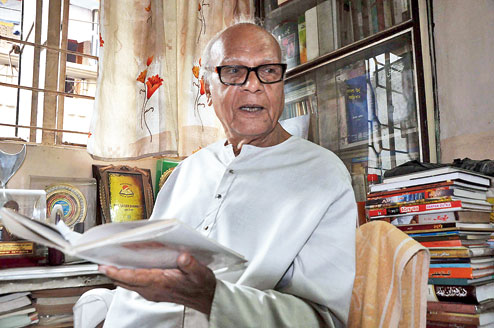
Qaiser Shameem recites a poem from his collection. Picture by Gopal Senapati

 His poetry is about life, society, relationships and his experiences. Those who read him feel that he evokes sentiments that are lost in everyday life. Qaiser Shameem writes in Urdu, the language in which he can express himself best. Living in one corner of Shibpur, Shameem’s works are recognised nationally and outside the country as well. He was invited as chief guest at an international shayari sammelan organised in London in 2006.

In 2013, Shameem was part of a team selected by the Department of Urdu in Jamia Milia Islamia, Delhi for translating selected Rabindranath Tagore’s works into Urdu. “We had to attend a five-day workshop and each writer was assigned a certain poem, novel or short story by Tagore to be translated into Urdu. I translated his poem, Jatri,” said Shameem.

Qaiser has always been involved with various literary activities. When he was a boy, he liked to study. Qaiser Shameem was born as Abdul Qayyum Khan in Angus in Hooghly district. He was the eldest among his siblings. His father worked in a factory, but the young Shameem always told him that he wanted to study. Since 1951, Shameem’s poetry, short stories and critical essays have been published in almost every Urdu magazine and journal in the country. Shameem was also a bright student. He passed the High Madrasa examinations with a first class and was a topper in the board in 1953.

Since he wanted to study further, Shameem had to shift to Howrah, closer to Calcutta for better opportunities. He took admission in Central Calcutta College, better known today as Moulana Azad College. “I had to give tuitions to students to earn a living. I had to send money back home to run the household and also run my own expenses here,” said Shameem. While studying and teaching, Shameem was also writing, attending literary meetings and doing other things. “I was a regular at the Progressive Writers’ Association, where I had met Subhas Mukhopadhyay and Pervez Sahidi and other well-known writers,” said Shameem.

After college, Shameem took up teaching Urdu in a number of schools in Howrah and Calcutta. He was also a professor at the Urdu department of Calcutta University from where he retired. He now teaches at his college, Maulana Azad College. Shameem was also the co-editor of two magazines, Azad Hind and Howrah Times.

From 2002 to 2005, he was the joint secretary of Paschim Banga Urdu Academy.

Shameem’s collection of poetry have been published as books like Saton ka Samandar (1971), Saans ki Dhar (1997) and Pahar Kaatte Huye published in 1998. Tridhara published in 1996 was Shameem’s collection of Hindi poetry. “I always believed that words and literature are a stronger medium than any other form of expression,” he said.

While writing, Shameem has also established Writers’ Association in Howrah in 1966. “The plan was to have a cultural exchange between Urdu writers and writers of other languages. I wanted to start a group where all writers would get an opportunity,” said Shameem.

Other than Tagore, Shameem has also translated the works of Kazi Nazrul Islam and Mahasweta Devi.

MORE ABOUT SHAMEEM

  • DoB: April 2, 1936
  • Born in: Hooghly
  • Education: MA
  • Family: Wife, son, daughter-in-law, grandchildren
  • Loves: Writing
  • Hates: Two-facedness

source: http://www.telegraphindia.com / The Telegraph, Calcutta,India / Front Page> Howrah> Story / Friday – July 03rd, 2015

Collector’s Internship Programme

Kozhikode, Kerala :

The District Collector’s Internship Programme (DCIP), a first-of –its-kind initiative in the country, will be launched at the Indian Institute of Management – Kozhikode (IIM-K) at Kunnamangalam here at 9.30 a.m. on Thursday.

True to its motto of facilitating the development of a compassionate and professional civil society, the programme will be inaugurated by two students, Fatima and Fatima Baby, who are leading their lives after a series of struggles.

The two Fatimas, one of them an undergraduate at the Homoeopathy College at Kottayam, have been chosen for the inauguration considering their achievements in spite of their physical disabilities.

“They are not only a symbol of women empowerment but also role models for the youth.

In fact, the life of one has inspired filmmaker Anjali Menon to portray on celluloid the radio jockey Sarah in the blockbuster Bangalore Days , ” N. Prasanth, District Collector, told The Hindu on Wednesday.

The DICP is an unpaid multi-disciplinary internship programme for senior and junior development fellows.

source: http://www.thehindu.com / The Hindu / Home> News> Cities> Kozhikode / Kozhikode – July 02nd, 2015

They raise funds for cancer patient with Ramzan food

Bengaluru :

Every day, before the sun goes down, Khurrum Sheriff (22) and a bunch of other youngsters flock to the masjid at 3rd Cross, Benson Town. They wait for customers to arrive at their makeshift stall to break their fast. They dish out everything from piping hot samosas, spring rolls and biryani to juices and milk shakes, and ensure that all items are sold.

The money racked up from the sales doesn’t end up in their pockets, instead it’s handed over to the mother of a cancer patient.

This is how several residents of Benson Town, who ta ke turns to prepare food and sell it, are observing the holy month of Ramzan. And all this amid their work schedules.

It all started when Tasmeen Farzana Khan, counsellor at a government aided school, came to know about Sunandha R (name changed), a 13-year-old girl in her class suffering from blood cancer. “Sunandha’s father has passed away and her mother, who works as an attendant, is struggling to make ends meet. I learnt that the treatment costs around Rs 16 lakh. And it’s a challenge to keep Sunandha away from the fund-raising as she doesn’t know about her ailment,” she added.

When Tasmeen brought the issue to the Benson Town Youth Association’s notice, members came up with the idea of the stall.

The team comprises 17 members, say AS Nimra Khan (18), a PU student, and Sarah Yaseen (19), a college goer. “Every afternoon, we assemble at the basement of Sarah’s house to cook. We share the task of preparing different food items. By 5pm, we throw open the stall and sales go on till 7pm,” said Nimra.

Khurrum says the response to the initiative has been great and many volunteers have co me forward to offer monetary help. “The month of Ramzan is one wherein we have to donate whatever we can to the needy. Helping a cancer patient, we thou8ght, may be one of t he best ways to do that. We will carry out the exercise throughout the month,” he added.

Sunandha’s mother said she is overwhelmed by the support. “I just want my child to get relief,” she added.

source: http://www.timesofindia.indiatimes.com / The Times of India / Home> City> Bengaluru / by Rohith B R , TNN / July 02nd, 2015

He quits job to fight for ‘one nation, one road tax’

Bengaluru :

The IT City is a gateway of opportunities for many – corporate professionals, students, interns. No wonder, it’s home to a large floating population. But if you stretch your visit beyond a month and bring your vehicle along, you may be in for more than teething troubles.

If you use a vehicle with a non-Karnataka registration number for more then 30 days, you’ll have to shell out a bomb as road tax. For example, if your car costs Rs 20 lakh, you’ll have to pay 25% as tax, which amounts to Rs 5 lakh. Two Facebook groups have now become the epicentre for the fight against this draconian law, a cause of concern for owners of out-of-state vehicles. The man behind the movement, Waseem Memon, has quit his job to concentrate on the campaign. The crusaders seek the right to drive without fear, anywhere in the country.

Memon’s personal mobile number has now become a toll-free number for those in trouble with RTO officials.

He runs Facebook groups ‘Justice for non-KA registration vehicle owners’ and ‘Drive without borders’ (since 2014). The former clinical researcher has taken up the cause on a full-time basis. “Both groups, which have more than 50,000 members, are battling several court cases in multiple states, including Karnataka. We’ve had success in Telangana and are hoping to replicate it here too,” he said.

In 1998, Memon moved to Andhra Pradesh from Karnataka, with a KA registration vehicle. He moved on to Maharashtra and then returned to Hyderabad with an MH registration vehicle. He was pulled up by authorities. In 2010, when he moved back to Bengaluru after his numerous corporate stints, he landed in soup for owning a non-Karnataka vehicle. That’s when he decided he’d had enough.

“Although we started the fight with a Facebook page, we are doing much more. Every month, we hold meetings which are attended by people who face this problem. I get at least 30 calls every day from harried users. Our Facebook pages are flooded with grievances,” said Memon, for whom threat calls have become a norm.

The question Memon and his team want to ask the authorities is when technology parks and IT parks are coming up across the country, which require professionals to relocate frequently, why are these laws in place? “Our goal is one nation, one road tax. And we believe we’re getting close to that,” he pointed out.

source: http://www.timesofindia.indiatimes.com / The Times of India / Home> City> Bengaluru / by Arun Dev, TNN / June 02nd, 2015

Nadia gets U.N. pat forachieving total sanitation

The district Magistrate of Nadia along with chief of Nadia Zilla Parishad in West Bengal was on Saturday presented the United Nations Public Services Award 2015 for eliminating open defecation in the district.

Nadia district, located in south Bengal, had half of its population defecating in open till October 2013. The district administration, under a programme called Sabar Souchagar, built 3.56 lakh toilets in the district. As a result, the number of people continuing with the practice dropped to mere 0.2 per cent.

The award was presented by the acting Secretary-General of the U.N., Lenni Montiel, along with Head U.N. Women Stefani Senese, on conclusion of the U.N. Day celebrations 2015, on June 26 at Medellin in Colombia, District Magistrate P.B. Salim informed The Hindu over email.

Banikumar Roy, chief, Nadia ZP, was also present.

‘Unique model’
The U.N. has described Sabar Shouchagar (Toilets for All) as a “unique model developed to generate awareness, improve access to sanitary toilets, and bring substantial health improvement through improved sanitation.”

The U.N. added that the scheme has mobilised all stakeholders, “especially women and schoolchildren and saw involvement of faith-based organisations” and “if replicated, it has the potential to eliminate open defecation from across the world.”

West Bengal Chief Minister Mamata Banerjee had on April 30 held a programme in Nadia district highlighting the success of the scheme and announced that ‘Nirmal Bangla Divas’ will be observed across the State every year.

source: http://www.thehindu.com / The Hindu / Home> News> National / by Special Correspondent / Kolkata – June 28th, 2015

Nilgiris sharp shooter drives away ‘rogue elephant’ in Bihar

Udhagamandalam  :

A sharp shooter from Masinagudi village in the Nilgiris returned home after successfully managing to drive a rogue elephant back to forest area in Jharkhand last week despite orders from the Bihar government to shoot it. The tusker killed eight people in Bhagalpur area in Bihar in a span of four days in the first week of June.

Nawab Shafath Ali Khan, a shooter from Hyderabad, is currently a resident of Masinagudi.

An authorized tranquilizer of wildlife, Khan was called by the Bihar forest department on June 5 as a rogue tusker had strayed into Bihar from the adjoining forests of Jharkhand. “While I was capturing blue bulls in forests around Delhi, I received a call from the Bihar forest department,” Khan told TOI.

Khan has trained forest officers and veterinarians of Karnataka, Telengana, Madhya Pradesh, Andhra Pradesh, Bihar and Himachal Pradesh.

The rogue tusker, aged about 20, had entered the town of Bhagalpur in Bihar on June 4 and in a span of four days it killed eight people, including three women and a child, who came in its way.

Khan was summoned to kill the elephant and he flew to Patna from Delhi and from there he was flown to Bhagalpur by the chief minister’s special aircraft. Armed with his 470 double barrel rifle he took charge as designated chief of ‘Operation Rogue Elephant’ and over 100 forest officials were in the operation team to assist him.

Khan said he didn’t want to kill the elephant as it was very young and instead strategically made the pachyderm follow him to the nearest forest which was 12km away in Jharkhand.

“I am happy that during the operation neither the animal nor any human was harmed,” he said.

Khan returned home a couple of days ago after being applauded by the chief minister of Bihar Nitish Kumar for his efforts.

source: http://www.timesofindia.indiatimes.com / The Times of India / Home> City> Coimbatore / by Shantha Thiagarajan, TNN / June 15th, 2015