Category Archives: Community Involvement / Social Issues

Food trucks on a roll

Road rovers

spitfireBF29jun2015

 Thanks to the number of food trucks that have come up in the City, the foodies here are a happy lot. Though the concept of food trucks is not new in India, it has been gaining popularity in Bengaluru only over the last two years. These trucks have found many takers and one can always spot a lot of crowd around them.
Owned by Sudarshan MS and Francis Xavier along with two others, ‘De3-The Eatery’ was started in March 2013 and serves Continental, Italian and American food. One can spot it in Shanthinagar, Kammanahalli and Jayanagar. “We always wanted to do something different and focus on quality and cleanliness. The idea of starting a food truck came in as we wanted to popularise the concept of mobile and clean restaurants with an open kitchen. So when people see how their food is being prepared, they get a sense of satisfaction,” says Sudarshan.

Many of these food trucks have a clear idea of their target customers. ‘The Great Indian Bhukkad’ was started by Suraj Agarwal in 2014 and caters mainly to the students of PES University, Banashankari. Parked at the college premises, it offers a variety of rolls and wraps among other Chinese dishes. “Our USP is that we cater only to students and our prices are reasonable. The students know that we serve clean and hygienic food and really appreciate the taste. We are glad that we have been able to establish a relationship of trust with them,” says Suraj.

‘Spitfire BBQ Truck’, which was started in 2014 by Sidhanth Sawkar and Gautami Shankar, moves around in Sahakara Nagar, Kammanahalli, Indiranagar and Koramangala. As the name suggests, it serves barbecued delights. “Bengalureans today are getting into food culture professionally. As the city is a melting pot of different cultures, people here are open to different types of food. Everyone has high expectations from us not just because of the food we provide but also the personal bond that we have built with our customers,” says Sidhanth.

Their experience of working in the food industry in the United States led Siddharth and Bharath to start ‘Off Road Food Truck’ (ORFT). The place, which was started in January this year, often stops in Sahakara Nagar and Kammanahalli and serves burgers, sandwiches, Spanish rice, chicken and fried ice creams. “We were working for different restaurants in the US. It was our interest for food that brought us together. Our idea was to go up to people and serve them rather than they coming to us,” says Siddharth. According to him, cleanliness, affordability and convenience are the things that attract the crowd to ORFT.

Some of these trucks are area specific too. ‘Frying Wagon’ in RT Nagar was started merely two months ago but has been seeing great business. The truck serves Chinese dishes and rolls and the dishes are served only on eco-friendly paper plates. Vijay Kesarkar and Soujanya Vijay, the owners, say, “Our business is picking up and now people are aware of us. They look for cleanliness, quality and hygiene and come to us because we meet their requirements. Our prices are reasonable thanks to which, we have a lot of students coming to us. Even the IT crowd comprises a chunk of our customers.”

‘Meals on Wheels’ is another such truck that can be spotted near Richard’s Park in Frazer Town. Serving Chinese cuisine with a twist, one can often see foodies relishing a variety of momos, Chinese ‘bhel’ and saucy lollipops here. “The concept of food trucks is becoming popular in India and people in the City are more open to it now. The business too is growing at a fast pace,” says Syed Harris, who owns the truck along with Aftab and Maaz.

source: http://www.deccanherald.com / Deccan Herald / Home> Supplements> MetroLife / by Surupasree Sarmmah / DHNS – June 29th, 2015
It is a mixed bag for candidates at GP polls

The counting of gram panchayat election held on May 29 was held at St Joseph’s High School in Madikeri on Friday. 

Manjula of Hoskeri in Madikeri taluk has won by a mere margin of one vote. Congress supported candidate Hamsa had contested from two constituencies in Hodavada and won both the constituency. T H Amahhed of Napoklu won for the fifth time while Ameena won for the third time. Subhash Somaiah in Galibeedu GP won for the fourth time. AAP district convener Madetira Thimmaiah has won the election.

The election was held for 1,133 seats in 102 gram panchayat. There was neck and neck situation for Congress and BJP supported candidates in the district. Though BJP supported candidates had a upper hand in Madikeri, the Congress supported candidates performed well in Virajpet and Somwarpet taluks.

The supporters of SDPI and AAP have opened their account in the district.

There was 1,219 seats in 102 gram panchayats. No nominations were filed for three seats and 83 persons were nominated unopposed. The district had 3.50 lakh voters and the 2.50 lakh voters had exercised their franchise.

The counting was held till late night. The exact picture will be known by Saturday morning, according to polling officials. AAP supported candidates Madetira Thimmaiah, Vamana, Prathima have won in Kadagadalu panchayat. SDPI supported candidate Shamsheer won in Nelyahudikeri.

source: http://www.deccanherald.com / Deccan Herald / Home> District / DHNS – Madikeri, June 06th, 2015

Three Dalit students from ‘Super 30’ bag medical seats

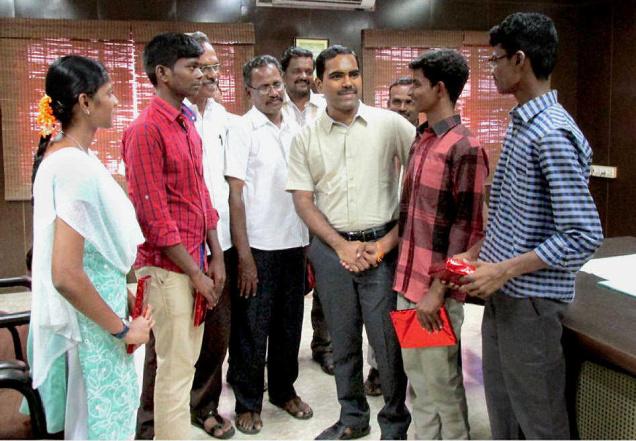
Collector (in-charge) Madhusoodhan Reddy congratulating the ‘Super 30’ group students who have been allotted seats in medical colleges, in Perambalur on Saturday.

Standing on the threshold of realising his childhood dream of becoming a doctor, B.Prasanth, an Arunthathiyar student from a poor family of agricultural labourers from Irur in Perambalur district, is not sure whether his mother would be able to raise the fee for the course.

He is one of the three Dalit students who have secured MBBS admission from a group of 57 students who were handpicked from government schools of the district for special coaching in Plus-Two under the ‘Super 30’ initiative of the district administration. A Dalit girl has bagged a BDS seat, bringing acclaim to the district and the special initiative.

With a Plus-Two score of 1,108 marks and a cut-off of 193.25, Prasanth has been allotted a seat in the Chenglepet Government Medical College. Prasanth is supported by his mother, a farm hand. His father, also a farm worker, spends most of his earnings on liquor.

“I have to pay a fee of Rs.11,000 now. My mother is trying to raise the money and officials have promised to arrange for a loan. But I am not sure whether these will materialise. I am looking for sponsors,” he said speaking to The Hindu over phone.

P.Prakash of Ladapuram, with 1,140 marks in Plus-Two, and T.Aravindaraj of Kolathur, with a score of 1,119, have been allotted seats in the Stanley Government Medical College and Tuticorin Medical College, respectively. M.Manjula of Nattarmangalam, with a cut-off of 191.75, has been allotted a BDS seat in the Chennai Government Dental College and stands a chance of getting a MBBS seat as she is on the wait list. Inspired by District Collector Darez Ahamed, Prakash wants to enter the Civil Services after MBBS.

All the four students belong to poor families of agricultural labourers, says N.Jayaraman, district coordinator, ‘Super 30’. There are about 15-20 other students from the group with good engineering cut-off marks and are hopeful of getting BE seats, he said. A brainchild of Mr.Darez Ahamed, the ‘Super 30’ idea is being implemented over the past couple of years in the district.

All are from poor agricultural families and need assistance to pursue studies

source: http://www.thehindu.com / The Hindu / Home> News> National> Tamil Nadu / by S. Ganesan / Perambalur – June 28th, 2015

Book Review: Muslim Cosmopolitanism in the Age of Empire

With the end of the Mughal Empire and the rise of British power, the 19th century Muslim intellectual had to reimagine his politics.

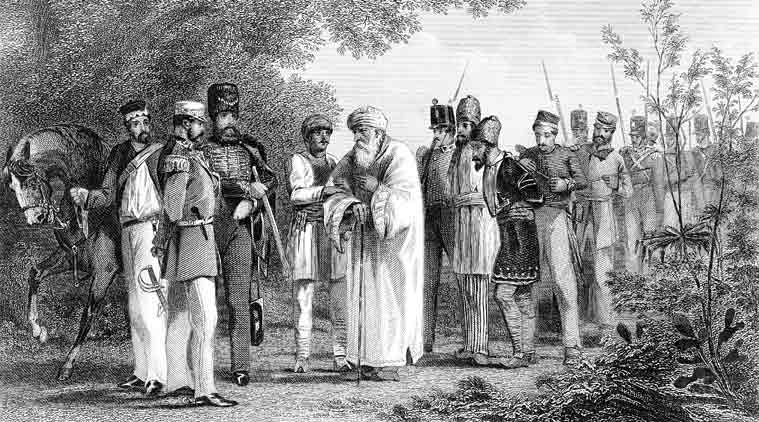
The King of Delhi is brought by guards before Captain Hodson, after the capture of Delhi by the British army during the 1857 rising. (Source: Hulton Archive/Getty Images)

Title:  Muslim Cosmopolitanism in the Age of Empire  / Author: Seema Alavi  / Publisher: Harvard University Press  /  Pages: 504  / Price: Rs 495

Muslim Cosmopolitanism in the Age of Empire is an engrossing, wide-ranging and beautifully written account of an emerging Muslim political imagination in the 19th century. Through an examination of five extraordinary figures, Sayyid Fadl, Rahmat Allâh Kairanawi, Haji Imdadullah Maki, Nawab Siddiq Hasan Khan and Maulana Thanseri, Seema Alavi brings alive the variegated, improvisatory and inventive character of Muslim politics and theology, as it struggled to come to terms with new imperial forms. Each of these figures is deeply fascinating in their own right, chosen in part for the extraordinary geographical range of their influence. There is Sayyid Fadl, who is memorialised in Malabar, but whose political activity and theological influence extended to Egypt, Yemen and the seat of the Ottoman Empire itsef; Thanseri participated in the production of new knowledge forms in the Andamans; and Kairanawi’s pedagogical innovations in Mecca became the inspiration for Deoband. Each of these figures could constitute a lifetime of study and Alavi carries her deep learning lightly and well. 

But Alavi’s intellectual ambitions are considerably larger than the study of five figures. She wants to demonstrate the ways in which new forms of material culture, print media and transnational merchant networks were opening new vistas of knowledge production and circulation. At one level, the 19th century witnessed in the Ottoman and Mughal worlds something Europe had experienced at least three centuries earlier: the ways in which print cultures and merchant networks transformed theological debates by democratising them. These combined with existing religious and ethnic networks (for instance, the Hadrami diaspora, that provided a crucial link between Yemen, Hyderabad and Malabar) to create new political forms. She shows how the end of the Mughal Empire created new political opportunities to replace an Indo-Persianate intellectual formation with a more Arabic engagement within Indian Islam, facilitated by the existence of the British Empire itself.

But, most ambitiously, Alavi challenges staple assumptions about Islamic political thinking. These include, among other things, the idea that the Caliph remained central to the Muslim political imagination. Alavi debunks this notion, arguing that much of the political thought in the period was about desacralising the Caliph. It was, rather, devoted to exploring other political forms, including the authority of the Sayyid, perhaps best captured in Fadl’s career.

Second, she argues that pan-Islamic engagement was not incompatible with particular territorial loyalties. She shows how so much political and theological effort was being expended to prove the idea that loyalty to the British Empire was not incompatible with Islamic allegiances. In a way, it seeks to demolish the canonical image created by W.W. Hunter’s Indian  Musalmans, which centred on the idea that Indian Muslims would remain a political threat to any territorial political formation because their allegiances were transnational. She builds on Ayesha Jalal’s somewhat overstated thesis that pan-Islamism was a British phobia. Third, she seeks to show how political loyalty to territorial forms combined with the creation of a new cosmopolitanism, where the field of thought and action transcended the boundaries of one empire and spilled into the other. And in a theme with the most contemporary resonance, she demonstrates the symbiotic love-hate relationship between the empires and newly emerging theologies. On the one hand, empires feared and demonised new movements like Wahabism; on the other hand, they consistently used them for political ends. If you want to understand the contradictory nature of the engagement of modern empires with Islam, this book provides a fascinating historical guide.

There will be much to quarrel with in a book this rich. The use of the term “cosmopolitan” is misleading and under-theorised. Sure, these are figures that operate on a large geographical canvas, but they could be remarkably insular. Take for instance Kairanawi’s Izharul Haq, which was not an exemplar of modern scientificity as Alavi claims. It was a mean-minded polemic that sought to demolish the authenticity of Christian and Jewish revelation, while establishing the superiority of Islam. It is true, as Alavi argues, that the Muslim political imagination was compatible with a variety of political forms. But she skirts over the thorny question: in the process of producing new interpretations, new forms of authority, new codes of conduct for Muslims straddled in and between empires, what were the kinds of exclusions being produced? How does the language of purity, a recurring theme, sit with the discourse of cosmopolitanism? It is not a cosmopolitanism that is attuned to difference. Alavi’s generosity has opened a fascinating vista of scholarship, but it also prevents her from asking somewhat nastier questions about the evasive exclusions and silences in the figures she studies.

Pratap Bhanu Mehta is president, Centre Policy Research, New Delhi

source: http://www.indianexpress.com / The Indian Express / Home> Lifestyle> Books> Book Review / by Pratap Bhanu Mehta / June 06th, 2015

A bond for communities in Kolkata

Kolkata :

It’s that time of the year again when, every evening, huge crowds line up in front of eateries for the Ramzan dish, the haleem, which ranks high in the order of preference for foodies and, in equal measure, for the faithful who observe ‘Roza’ (fasting).

The stew is a popular ‘iftaar’ dish across the Middle East, Central Asia and the Indian sub-continent. In Kolkata, it is not just the Muslims, but gourmets from other communities too who love ‘haleem’, which means ‘patience’ in Persian because of the time and effort required to prepare it. A debate also rages on which eatery serves the best ‘haleem’.

The top ‘haleem’ picks are from Shiraz, Arsalan, Aminia, Zeeshan, Royal Indian Hotel, Shabir’s (Bowbazar), Islamia, Aliah and Sufia, to name a few. All claim their ‘haleem’ to be special, thanks to the zealously-guarded ‘secret ingredients’ they say they put in.

“Haleem came along with the Arab and Persian settlers to India. But the most remarkable thing about the haleem is that the original way of cooking this dish has not been changed. Arabs used aromatic spices in their food, which has been retained in our version,” said Ishtiaque Ahmed, partner of Shiraz.

Customers at restaurants like Royal Indian Hotel, Aminia, Sabir’s Hotel and Arsalan and Zeeshan don’t mind shelling out Rs 130-180 for each helping. But for those who cannot afford to pay so much, the eateries around Tipu Sultan Masjid are the solution — they sell ‘haleem’ at Rs 75 a plate while the makeshift stalls sell it for as low
as Rs 20.

Aalamir, one such eatery, is popular for its Halim-e-Firdaus. “Firdaus is a Persian word which means heaven. We use a special recipe, which even the staffers do not know. I keep the spices with me here, at the counter,” said Bashir Mohammad, the fourth-generation owner.

Zakaria Street is another favourite destination for ‘haleem’ lovers. Restaurants and halim ‘vendors’ do brisk business as ‘Roza’ ends. Nawaid Amin, the third generation owner of Aminia, says, “We use a blend of 40 ingredients. Sometimes we get ingredients from Unani and Ayurvedic shops. This was a practice started by my grandfather and we have not tampered with the traditional recipe,” he said.

Actor-anchor Mir doesn’t mind queuing up for the stew. “I love the haleem at Arsalan, but there was such a mad rush I had to wait for an hour. I got it packed for my family. Be it Zeeshan, Arsalan or Shiraz — they all make good haleem. But if you want authentic haleem, you need to go to Colootola,” said Mir.

source: http://www.timesofindia.indiatimes.com / The Times of India / Home> City> Kolkata / by Shounak Ghosal, TNN / June 27th, 2015

DOWN MEMORY LANE – Princess still in distress

The pathos of Princess Jahanara’s life is reflected in her grave too

Jahanara Begum led a life of hardships and now more than 300 years after death her agony continues as her grave lies neglected with the Archaeological Survey of India (ASI) and the Nizamuddin Dargah Committee washing their hands off the matter. The ASI says guards are there only to protect the tomb from vandals while the Nizami family, trustees of the shrine of Hazrat Nizamuddin, contend that the ASI is the caretaker since the grave comes under the Ancient Monuments Preservation Act. As it cannot circumvent this it is just a helpless onlooker. But the fact remains that the grave needs repairs and clearing of waste left behind by pilgrims to the adjacent shrine, most of whom don’t even know who Jahanara was!

Illustration by Vinay Kumar

It’s not so much grass that grows on Jahanara Begum’s grave these days as shrubs. Her wish to be buried in a “kuccha” grave was duly fulfilled though a sarcophagus protects it from the elements, open as it is to the sky but situated in an enclosed chamber with perforated marble screens, south of the Dargah of Hazrat Nizamuddin Auliya. Still, when one sees it, one is reminded of the Persian poet Sadi’s poignant lines :

“I saw some handful of the rose in bloom with bands of grass suspended from a dome/I said, ‘What means this worthless grass that it should in the rose’s fairy circle sit?”/Then wept the grass and said, ‘Be still and know the kind their old associates ne’er forgo/Mine is no beauty here or fragrance-true. But in the garden of the Lord I grew.” No wonder grass springs up like hope eternal even on old forgotten monuments, where no roses may bloom. Grass is never a deserter. That was why Shah Jahan’s eldest daughter wanted it to grow on her grave.

Forced spinsterhood found an outlet in poetry and both Jahanara and her sister Roshanara gave vent to their feelings in verse. Persian was the language employed, as Urdu was considered the camp language and was yet to take over its predominant position. Persian similes and metaphors, like the jam (wine cup), the shama (lamp), the moth, the mythical mountain Kohkaf and the bulbul were hardly considered alien at a time when the ambience at the Mughal court was the same as that of Persia, Arabia or Turkey. As a matter of fact, even present day Urdu poetry waxes eloquent on them – and who doesn’t enjoy this escape to a romantic past, so far removed from the mundane image of the modern age when Kohkaf has been identified as the Caucasus mountain?

Even such a selfless person as Jahanara must have no doubt yearned for someone, who could be the master of her heart. Her emotions are portrayed in her poetry, which is that of a pious woman deeply attached to her Maker. She was also a great lover of gardens and laid the Begum Bagh in Delhi, in which was also situated the Begum Sarai. Outside the bagh was the Chandni Chowk, which was also her creation. After Aurangzeb came to power Jahanara preferred to stay with her father, who was held captive in the Agra Fort for seven years until his death on 16th January, 1666. She became a recluse after that and patronized mystics and mendicants until her own death. As per her wishes, she was buried in the tomb she had built for herself in 1681, next to the shrine of the saint she held in high regard.

The hollow sarcophagus is the receptacle, in which the grass grows in accordance with her epitaph. “Let naught cover my grave save the green grass, for grass will suffice as covering for the lowly.” And yet she was the one, who was once the virtual ruler of Hindustan and whose “pandan kharch” (betel leaf expenses literally but pin-money in this case) which was met by the revenue of two flourishing ports of the Mughal empire. Sleep well, gentle princess!

When Rudyard Kipling visited her grave in the 19th Century he couldn’t help comparing her to Christina Georgina Rossetti, the celebrated sister of Dante Gabriel Rossetti (1828-1882) writer of the famous poem “The Blessed Damozel”. Christina too died a spinster in 1894 when the last of the Mughal princess were still alive in the Mori Gate. Hence Kipling’s poignant comparison of the green grass growing over their lowly graves, with Christina’s words ringing in his ears; “Be the green grass above me/With showers and dewdrops wet…/I shall not hear the nightingale/Sing on as if in pain/And dreaming through the twilight/That doth not rise nor set/Haply I may remember/And haply may forget.” Few indeed forget Christina Rossetti after visiting her last resting place! The same is true of Jahanara.

source: http://www.thehindu.com / The Hindu / Home> Features> MetroPlus / by R. V. Smith / June 21st, 2015

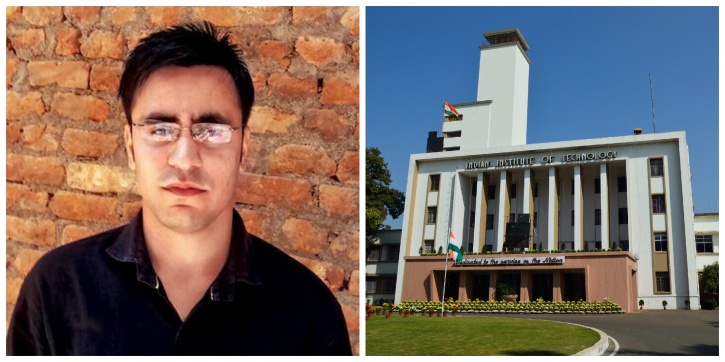
This Boy From Kashmir Got Into IIT, But Can’t Afford The Rs 10,000 Counselling Fee

Not many possess the willpower to overcome obstacles and emerge victorious against all odds. But Zahid Ahmad Qureshi is one who has fought life’s several battles – living without parents, poverty etc, to accomplish his dream.

At 21, Zahid made his grandparents proud when he cracked IIT.

Zahid’s father was killed by suspected militants when he was just two months old. His mother remarried and he was left at the mercy of his old grandparents, who themselves needed attention and care. But guess destiny was in Zahid’s favour and he was lucky to have such grandparents who supported him even while facing extreme impoverishment.

DNA|Wikimedia
DNA|Wikimedia

Until 10 years back, his 96-year-old grandfather Azizullah Qureshi ran a small makeshift tea stall in Kupwara town to make ends meet. Despite facing extreme poverty, Zahid’s grandparents sent him to school and he did not let them down. A bright student since his childhood, Zahid studied hard and his efforts and struggle paid off when he secured an enviable 89th rank in the IIT. 

But Zahid’s struggles were far from over. Inspite of achieving such a rank, what’s discouraging is that he can’t arrange money for admission to secure a seat in the prestigious engineering institute. Unlike the Saroj brothers, who got help from all quarters to get through IIT, this Kashmiri boy has still found no help.

Zahid received several calls to congratulate him for his achievement but none offered any help. Even the banks refused loan without an admission letter. With luck and money not in his favour, Zahid is losing all hopes of getting admitted to the IIT.

“We don’t have even Rs 10,000 to pay my counselling fee. If not paid, my admission will be cancelled. I thought of selling my cell phone, but it is fetching only Rs 5,000,” Zahid, who hails from remote Dudwan village of Kupwara district, was quoted telling DNA.

For someone who doesn’t even have counselling fees, to arrange money for admission to the IIT is next to impossible. Therefore he is now contemplating to let go his IIT dream and join a local degree college to complete his graduation.

We are hoping that the Ministry of Human Resource and Development takes cognizance and helps this young boy too just like it helped the Saroj brothers fulfill their dreams.

source: http://www.indiatimes.com / India Times / Home> India> News /by Mugdha Kapoor / June 26th, 2015

Lucknow zoo renamed after the last Nawab

In a “historic” decision, the Samajwadi Party government has renamed the Lucknow Prani Udyan, popularly known as Lucknow zoo, as “Nawab Wajid Ali Shah Prani Udyan, Lucknow,” making it the first official move-since Independence – to name a monument after a Nawab of Oudh, or Avadh (roughly corresponding with Central Uttar Pradesh ). Nawab Wajid Ali Shah was the last Nawab of Oudh before the province was annexed by the British under the policy of Doctrine of Lapse in 1856. He was banished to Matia Burj in Bengal.

Bird sanctuary too renamed

Another first was the decision to rename the Nawabganj Bird Sanctuary in Unnao district after revolutionary freedom fighter Chandra Shekhar Azad. The bird sanctuary will now be known as “Shaheed Chandra Shekhar Azad Pakshi Vihar, Nawabganj.”

Though Chandra Shekhar Azad was born in Alirajpur district in Madhya Pradesh (July 23, 1906), his father, Sitaram Tiwari, belonged to Badarka village in Unnao district. It was on account of his parental ties with Unnao district that the bird sanctuary has been named after him.

These decisions were taken at a Cabinet meeting presided over by Uttar Pradesh Chief Minister, Akhilesh Yadav on Tuesday.

The Lucknow Zoo was established in 1921 and was named after England’s Prince of Wales as “Prince of Wales Zoological Gardens.” It was renamed as Lucknow Prani Udyan on June 4, 2001.

The State Cabinet further approved the cancellation of the agreement for handing over the power distribution in Kanpur city to Messrs. Torrent Power Limited, Ahmedabad. An official spokesman said the deal was called off through mutual understanding.

Laptops for bright students

The proposal to distribute laptops to meritorious students of high school and Intermediate examinations conducted by UP Madhyamik Shiksha Parishad, Central Board of Secondary Education and the Indian Council of Secondary Education in the year 2015 was also approved by the Cabinet.

Another important Cabinet decision pertained to the demolition of three temporary structures on the service road near bungalow Number 13 in Mall Avenue (former Chief Minister Mayawati’s official bungalow).

source: http://www.thehindu.com / The Hindu / Home> National> Other States / by Atiq Khan / Lucknow – June 24th, 2015

Mysore District Moon Committee meeting held

Ramdhan month begins tomorrow

RamadhanMPOsw24jun2015

Mysuru :

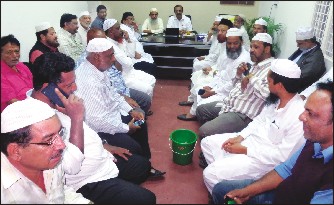
The meeting of Mysore District Moon Committee was held at the office of the Mysore District Wakf Advisory Committee on Sayyaji Rao Road yesterday at 7.30 pm.

The meeting, which was presided by Sir Khazi of Mysore Hazarath Moulana Mohammed Usman Shariff and Ariff A. Mehkri, who is the convenor of the Mysore District Moon Committee, collected information from various parts of the district regarding sighting of the moon.

As moon was not sighted in any part of the district in the State and on the advice of the Central Moon Committee which met at Bengaluru, it was decided to start the Holy Month of Ramdhan and to begin fasting from tomorrow (June 19).

Hazrath Moulana Mohammed Naseem Rishadi, Hazrath Moulana Mohammed Rafiuddin Qasmi, Hazrath Moulana Maqbool Ahmed Nizami, Hazrath Moulana Mohammed Zaka Ulla Siddiqi, Hazrath Moulana Shah Vali Ulla Umri, Hazrath Moulana Mufti Syed Tajuddin, Hazrath Moulana Mufthi Salman, Hazrath Moulana Shujauddin, Jameel Ahmed Asrafi, Javeed Ahmed, Mahmood Ali Khan, Sayeed, Mohammed Mumtaz Ahmed, S.A. Rahman, Rafiq Ahmed, Syed Yunus and Allah Bakash were present.

source: http://www.starofmysore.com / Star of Mysore/ Home> General News / Thursday – June 18th, 2015

Copa America gets a Malappuram twist

Malappuram :

If Malappuram’s collective heart beats for anything, it is for football — a sport that has grown to conquer the land like no other. And with Copa America, the oldest international continental football competition, already under way in Chile since Friday, it is no wonder that soccer-crazy fans in Malappuram are a restless lot.

Unable to find contentment in just watching the tournament on television, football aficionados in Therattammal — a rural Malappuram village which has moulded several national players like U Sharafali, Sakker Ahammed and K Jaseer — are gearing up for a local version of Copa America.

Starting next week, 12 teams from neighbouring villages in the region would represent the teams participating in the South American tournament and the winners would take home a cup designed just like the one for Copa America.

Besides, football clubs and fans associations across the district are busy organizing small tournaments, hoisting banners and erecting flex boards. Flags and jerseys of prominent teams are also up for sale at Manjeri, Malappuram, Tirur, Perinthalmana, Kondotty, Areekode and Nilambur towns. The flags of Brazil and Argentina, the most popular teams in Malappuram, can be seen fluttering in the streets. Close on their heels are other favourites Chile, Uruguay and Mexico.

Musthafa, a native of Cherumuku near Tirurangadi and a die-hard Brazil supporter, said Brazil fans’ association is already campaigning hard for their team. “We are sure that Brazil will perform well to compensate the defeat against Germany in the semi-final match of the World Cup,” he said.

“Villages and towns here are in a festive mood, organizing various activities in support of their favourite teams,” said Muhammed Saleem, secretary of Malappuram district football association. With ardent supporters of non-playing teams like Germany, France, Spain and Italy also joining the celebrations, the excitement of fans has reached a crescendo.

Local clubs had set up big screens and televisions at several spots where enthusiasts of all ages gathered in the early hours of each day to watch matches.

It, however, remains to be seen if the monsoon showers or Ramzan fasting would dampen the prevailing high spirits.

source: http://www.timesofindia.indiatimes.com / The Times of India / Home> City> Thiruvananthapuram / by T.P. Nijeesh, TNN / June 14th, 2015