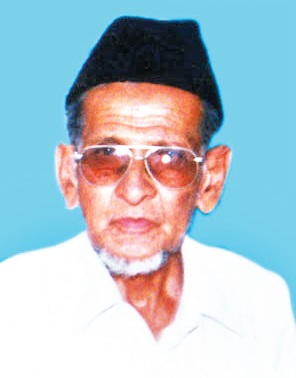
Veteran social activist, M M Basheer Ahmed, of Vaniyambadi passed away on Wednesday morning in a private hospital after a brief illness at the age of 92.
He is survived by his daughter Munavara Sultana. Basheer lived alone after the death of his wife Badrunisa some 22 years ago.
N Mohamed Nayeem of Vaniyambadi Muslim Educational Society recounted Basheer as a down-to-earth social worker who made himself available any time for a social cause without expecting anything in return. He lived his life championing the cause of people and commanded respect from all sections of society.
Basheer was associated with the management of several mosques in the region and ensured that poorer sections of the community benefited.
The humanitarian society he established in Vaniyambadi promoted blood donation, voluntary service and communal harmony through which he was able to influence a large number of youngsters to take up social work, Nayeem said.
Basheer initiated Palar Protection Movement, an NGO, in the 1980s, to create awareness about the deterioration of the eco-system of the river.
source: http://www.newindianexpress.com / The New Indian Express / Home> States> Tamil Nadu / by V. NarayanaMurthi / June 18th, 2015
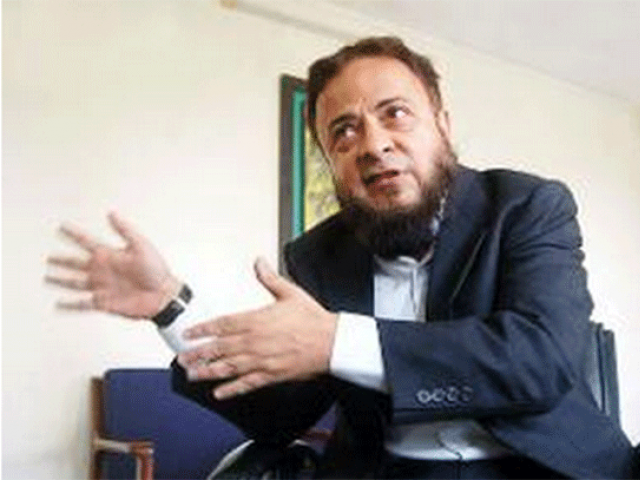
A Muslim educationist has offered 20 acres of land in Lucknow district for the proposed campus of Hyderabad-based Maulana Azad University. Prime Minister Narendra Modi’s pointsman Zafar Sareshwala, who has been trying hard to make inroads into Muslim intelligentsia and electorate, is the vice-chancellor of the university.
Zafar Sareshwala (above), PM Narendra Modi’s pointman, is the vice-chancellor of Hyderabad-based Maulana Azad University.
Speaking to TOI, Maulana Yusuf Hussaini, who has offered the piece of land in Malihabad, said: “We all welcome and should compliment Prime Minister Narendra Modi’s moves for socio-economic welfare of the community.” Hussaini, a kin of renowned scholar Ali Mian, former rector of Nadwa Islamic seminary, runs several madrassas and other educational institutions in the city.
When asked whether association of Modi’s name with the proposed institution would put him into trouble, Hussaini said there was no issue at all. “We would whole-heartedly welcome any initiative of the Prime Minister for the socio-economic upliftment of Muslims, who need government’s support,” he said, adding “Modi is the Prime Minister of the country and not of the BJP.”
He said that Sareshwala was due to visit the city soon to finalize the proposal for the land transfer and if all goes well the city could soon get another national-level university.
Sareshwala told TOI on Sunday that Hussaini had offered the land and a building at Malihabad, on the outskirts of the state capital, without any cost. “Prime Minister Narendra Modi wants speedy growth of Muslims and for this reason he has increased the budget for minority welfare by nearly 12%,” Sareshwala said.
source: http://www.timesofindia.indiatimes.com / The Times of India / Home> India / by Subhash Mishra, TNN / June 15th, 2015
J Prasannakumar, a delivery executive at a telemarketing company, grew up in the neighbourhood of the Government Rajaji Hospital. During his many visits to the hospital, he noticed that there were people who were in need of dire help. Touched, he began helping them out in what ways he could. Initially, he would help them locate their wards but as he became more involved, his activities widened.
Today, the 28-year-old graduate in business economics and his two friends arrange blood for the needy, buy them food, counsel them and admit helpless elderly people to homes, among other things. His friends N N Ajmal Hussain, a BCA graduate and C Vinoth, an MCA degree holder, joined him seven years after he began helping out at the hospital. For the past three years, the three have been spending at least five hours in the hospital everyday. Ajmal, who is a website designer, Vinoth, who is preparing for bank exams and Prasannakumar find time between work to help out patients.
Recently, when the summer vacations were going on for colleges, the hospital faced a shortage of blood donors as most of the contributions to blood banks usually came from students. The three youngsters arranged blood for the patients, and their efforts were much appreciated.
“We arrange blood for those who need it urgently. Anybody we know who needs help inside the hospital premises will get our support. Many patients need food and money to buy medicines from outside. If we have money, we help them. Otherwise, we connect the needy and the donors. We usually ask the donors to help directly and avoid mediation. However, some prefer to do it through us as they do not have time to spare,” Ajmal said.
“We are not an NGO. We have not kept a name for the group. We are friends and do it purely for the satisfaction of helping someone in need,” he added.
The hospital deals with about 10, 000 outpatients and 3000 inpatients every day.
“They are favourites among people in the hospital. From arranging blood to helping the patients and their attenders, they do a lot on the premises,” said a senior doctor from the hospital.
source: http://www.timesofindia.indiatimes.com / The Times of India / Home> City> Madurai / by Devanathan Veerappan, TNN / June 13th, 2015
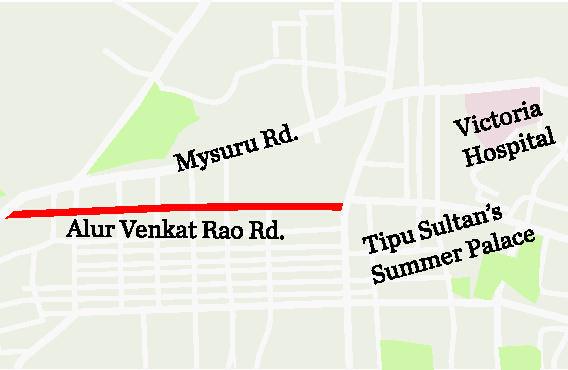
Is it Albert Victor Road or Alur Venkat Rao Road? Whatever the name, there now is a proposal to rename this road as Tipu Sultan Palace Road.
The main road in Chamarajpet is in the midst of a renaming storm. While the BJP-Karnataka unit has opposed the proposal to rename the road again, the Bruhat Bangalore Mahanagara Palike (BBMP) is now wondering when the road was renamed as Alur Venkat Rao Road in the first place.
It so happens that neither the BBMP nor the Department of Posts have any records that show when the road was named after Alur Venkat Rao.
Noted city historian Suresh Moona said that the road was popularly known as A.V. Road. “The initials A.V. stand for both Albert Victor and Alur Venkat Rao. The road was named after Prince of Wales Albert Victor to commemorate his visit to the city to inaugurate the Glass House in Lalbagh. It was probably renamed in the late 1960s and early 1970s when a number of roads that had Colonial names were rechristened,” he pointed out.
On Monday, a delegation from BJP, including MP P.C. Mohan, MLC Ashwathnarayan, city MLAs S. Suresh Kumar, B.N. Vijaykumar and Jagadeesh Kumar, submitted a memorandum to BBMP administrator T.M. Vijaybhaskar and urged him to drop the proposal to rename the road. Their contention was that renaming the road would be an “insult” to Alur Venkat Rao, who led the Karnataka unification movement.
Conceding that the BJP-led BBMP council that passed the resolution to rename the road had not followed the protocol, Mr. Suresh Kumar told The Hindu that the BBMP should examine all proposals closely before clearing them. “
N.R. Ramesh, former Ruling Party Leader who proposed the renaming, said that during the last meeting of the BBMP council, over 30 road renaming proposals were approved by the council. The proposal to rename the main road in Chamarajpet was not in the agenda initially. “It was proposed based on a letter submitted by a private organisation. The letter did not mention that the renaming was for the Alur Venkat Rao Road,” he said.
Who is Alur Venkat Rao?
Bengaluru: Alur Venkat Rao, who is known as Karnataka Kulapurohita, was the leading figure of the Karnataka unification movement. He was also an eminent historian, a dedicated writer and journalist. He made use of the press to achieve the cause of Karnataka. When he started editing and publishing the newspaper ‘Jaya Karnataka’, he declared in its very first edition that the sole aim of the newspaper was to strive for Karnataka’s statehood.
Protocol for renaming roads
Bengaluru: Every time a road or an area is renamed, questions are raised over the procedure and logic behind the process. Names can be mooted by anyone, either the public or the BBMP council. The proposal for renaming is then published in newspapers and objections are invited. On receiving objections, they are discussed in the council for approval. In the absence of a council, the administrator takes a decision. The approved resolution is moved to Urban Development Department, Government of Karnataka which renames places in the city, an official said. After this, an intimation about the same is sent to the Department of Posts.
Previous cases of controversy
S.K. Karim Khan Road: Indiranagar 100 ft Road was renamed after the Kannada folklorist S.K. Karim Khan in 2014, even though a resolution about the same was taken in 2006.
Narasimha Raju Road: Though a road in Palace Guttahalli was named after the actor, another road (from ISKCON to Mahalakshmi Layout Swimming Pool) was named after him.
source: http://www.thehindu.com / The Hindu / Home> News> Cities> Bengaluru> by Chitra V. Raman / Bengaluru – June 02nd, 2015
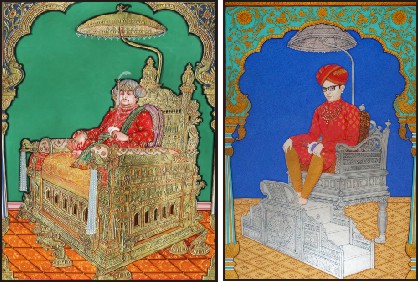
1) Mysore style portrait painting of Srikanta Datta Narasimharaja Wadiyar seated on the Golden Throne based on the 2013 Khas Darbar. Artist: K.S. Shreehari, 2014. Size: 41×51 cms. Collection: Ramsons Kala Pratishtana, Mysore. 2) Portrait painting of Yaduveer Krishnadatta Chamaraja Wadiyar seated on the silver Bhadrasana. Artist: Manish Verma, 2015. Size: 37×51 cms. Gouache on paper. Collection: RKP, Mysore.
by R.G. Singh, Secretary, Ramsons Kala Pratishtana, Mysore
Peacock pavilion of the Mysore Palace is where the coronation of the new Scion of the Mysore Royal family is scheduled to be held tomorrow. In the hall adjacent to this pavilion is the portrait gallery that has on its walls the official portraits of several Wadiyar rulers along with their family members. It is here that one begins to realise the importance that a royal portrait played in private and public life of the nobility.
Nalwadi Krishnaraja Wadiyar IV
But it was also special events that were to be immortalised on canvas or photographed or painted. The Daly Memorial Hall of the Mythic Society in Bengaluru greets the visitor with a portrait officially commissioned of Nalwadi Krishnaraja Wadiyar IV on the him being conferred the honour of Knight Grand Commander Star of India on January 1, 1907.
The oil on canvas portrait shows the king partly in profile. The Honour is pinned to a sash. The bejewelled necklace covering the neck of sherwani only adds to the richness of the attire. The fluted and feathered plume with a jewelled brooch holding it in place to the turban also adds to the portrait’s grandeur.
11-year-old Krishnaraja Wadiyar IV
Royal portraits have hidden sutras embedded in them that takes the viewer back in time. The Official Coronation portrait of the 11-year-old Krishnaraja Wadiyar IV is one such portrait.
This is a stylised photographic portrait and has several artfully placed emblems; the jacquard seat of the chair, the three-legged table with a curved triangular holder, a clock and some leather covered folders. The young prince is shown resting one hand on them while the other is on his hip. A Beagle stands motionless under the table.
Photographer Buranuddin of Mysore has used all possible elements that signify royalty in composing this photograph.
Nalwadi Krishnaraja Wadiyar
The autographed official photograph of Nalwadi Krishnaraja Wadiyar to mark the Silver Jubilee of his coronation in 1927 shows the then King dressed sombrely resting one hand on the back of a chair. The single-row bejewelled necklace and the chain and fob in the upper coat pocket add a touch of elegance. Even the Mysore peta is unembellished. The photograph was printed in Germany on water-marked archival paper.
Chamaraja Wadiyar
Another painting at the Jaganmohan Palace is the coronation scene of Maharaja Chamaraja Wadiyar. The painting was created by the artist Venkata Subbu in 1868.
There is an official portrait of Chamaraja Wadiyar on being conferred with the Knight Grand Commander of the Order of the Star of India in 1892. The above photograph reproduced here was ‘clicked’ by the famous Raja Deen Dayal of Hyderabad.
While the English royalty painters used pastoral themes their Indian counterparts used the very ‘Indianness’ of such public events of those days to display their virtuosity.
For instance, the 1927 Silver Jubilee of Nalwadi’s coronation has been commemorated with a beautiful portrait done by artist Keshavaiah; this masterpiece is on display at the Banquet Hall of the Vidhana Soudha. Interestingly, the advent of photography did not deal a death knell to the art of portrait paintings. Instead it led to another innovation – the painted photograph.
Jayachamaraja Wadiyar
By the time Jayachamaraja Wadiyar ascended the throne, both photography and painted photographs were very much in vogue. But such was the ingenuity of the Indian photographers that their photographs of the Royalty was a marriage of these several stylisations. Thus you have photographs of Jayachamaraja Wadiyar shown in what was supposed to be a candid form. At various times you had special photographs of Jayachamaraja Wadiyar ‘clicked’ by the then well-known City Studios like Star Studio, Palace Studio and Raj Studio. The variation was of course the painted photograph of Jayachamaraja Wadiyar by M.N. Murthy.
The photograph taken by the unknown photographer of Palace Studios of Jayachamaraja Wadiyar in 1940 to commemorate the king’s coronation has been replicated as a painted photograph by artist M.N. Murthy and is now in the RKP collection. But at no stage did photographs or painted photographs replace the portrait painter.
The tradition of painting historical events continues to this day. The last scion of the Royal House of Mysore, the late Srikanta Datta Narasimharaja Wadiyar along with his sisters and their husbands have been painted as several individual portraits by M. Ramanarsayya, the former Superintendent of Jaganmohan Palace.
Keeping the art of Painted Portraits alive
Ramsons Kala Pratishtana, in its efforts to keep alive the art of painted portraits, first commissioned artist K.S. Shreehari in 2014 to paint a classical portrait of Srikanta Datta Narasimharaja Wadiyar in the Mysore style (see pic. top right) based on photographs of 2013 Navaratri Khas Darbar.
This was followed by commissioning artist Manish Verma to recreate a Mysore style painting using a photograph of the Yaduveer Krishnadatta Chamaraja Wadiyar. This classic Mysore style portraiture shows the young scion accoutred in his royal vestments and Mysore peta adorning his head while his posture follows the classic from that can be seen in many of the older Wadiyar portraits. He is seated on the silver Bhadrasana which suggests that he has just been invested with the (symbolic) royal authority of Mysore Kingdom.
source: http://www.starofmysore.com / Star of Mysore / Home> General News / Wednesday – June 02nd, 2015
N.R. Constituency MLA Tanveer Sait today launched the long-pending Jodi Tenginamara Road works from Highway Circle to the junction behind JSS Dental College.
The MLA, who was accompanied by MCC officials, conducted survey by taking measurements for the widening works.
Speaking to SOM, he said that the works would be taken up in two phases with works pertaining to construction of drains, removal of old soil and putting new soil for laying of the new road in the first phase covering 760 mts at a cost of Rs. 2.9 crore.
He further said that in the second phase works on 1,100 mts of this stretch would be taken up and added that the Pourakarmika Colony would be demolished and the residents of the Colony would be accommodated in the houses built by the Slum Board under JnNURM scheme.
The MLA said that the works in the second phase would be taken up at a cost of Rs. 5.5 crore and added that a separate road for heavy vehicles to ply is also being taken up jointly by the MCC, MUDA and the Railways.
He further said that only asphalting the stretch of road would be unscientific as the road is very low and during rains, the road is flooded besides damaging it again and hence the road would be heightened and asphalted.
He said that before taking up asphalting, new sewage pipeline with bigger pipes would be laid.
As the density of traffic on this road is high, the road would be widened, he said and added that measures would be taken to prevent heavy vehicles such as lorries, fuel tankers from entering this stretch as separate road is being laid for them to join the Ring Road.
Former Corporator N.B. Tiwari, Railway Goods Shed Lorry Owners Association President Abdul Khader Shahid, Mahadevaprasad, MCC officials and others were present.
source: http://www.starofmysore.com / Star of Mysore / Home> General News / Wednesday – May 27th, 2015
A free seminar on ‘Wealth and Value Creation Free of Interest Intervention’ has been organised by Rehbar Financial Consultants, Bengaluru, tomorrow (May 31) at Taj Convention Hall, Bannimantap, from 2.30 pm onwards.
Islamic principles and guidelines for a just economic system and a prosperous society;
Challenges faced by the Muslim business community in modern era and solutions and other related topics will be discussed during the Seminar which will be followed by a question and answer session.
For details, contact Saifur Rahman on Mob; 98860-06767.
source: http://www.starofmysore.com / Star of Mysore / Home> In Brief / Sunday – May 24, 2015
The observance of the death anniversary of Shah Jahan and Mumtaz Mahal still fascinates people
The 360th Urs or death anniversary of Shah Jahan was observed at the Taj Mahal last week, but there were ripples of it in Delhi too with a busload of people reaching there to pay homage to the Emperor. Mohammad Saquib of Suiwalan was one of them. He has been attending the Urs for years as one of his ancestors was among the artisans who worked on the inlay work at the mausoleum, or so he claims. Another interested visitor was Shahnawaz Khan of Basti Nizamuddin who went for the first time to offer fateha in observance of a vow. Earlier Khan Abdul Haye Khan was a regular Delhiwallah who never missed the Urs. Abdul Haye was a Pathan who was very fond of fishing. One remembers that in 1966 during the monsoon he sat down on the rear side of Etmad-ud-Daulah to fish in the Yamuna, which was in flood and whose waters were beating against the mausoleum where rests the father of Nur Jahan and grandfather of Mumtaz Mahal. A rohu caught by Abdul Haye was so big that it sufficed for dinner for the whole family when cooked in Matia Mahal.
Shah Jahan like the unlucky Mohammad bin Tughlak was fond of Yamuna fish and so also presumably Mumtaz Mahal, but he did not drink wine till the age of 23 when he was persuaded by his father, Jahangir to do so. He however, never drank after the death of Mumtaz at Burhanpur on 16th June 1631. Accordingto Dr Ishwari Prasad, Shah Jahan died in January 1666 aged 74. Why his Urs was celebrated in mid-May is not understandable unless the date is fixed according to its proximity to Mumtaz Mahal’s death or some lunar calculation or as per the convenience of the khadims (caretakers). One remembers attending an Urs in 1958 when among those who prayed for the Emperor’s soul was Nawabzada Farouqur Rehman Khan of Datoli. Earlier the Nawab of Chhatarhi, Chief Scout of India and Freemason Grandmaster, had offered his obeisance. The first Urs of Shah Jahan, a year after his death, was presided over by Prince Muezzim, eldest son of Aurangzeb, who came from Delhi partly on horseback and partly in a horse-driven carriage, past Akbar’s Tomb at Sikandra, where he dismounted to offer fateha at the grave of his great-great grandfather. Aurangzeb came a month later. The same thing happened at the first Urs of Mumtaz Mahal at the Taj after Shah Jahan’s death.
A special feature of the Urs of Shah Jahan, which was later merged with the Urs of Mumtaz Mahal, is the laying of a gigantic multi-coloured Hindustani Chadar at the grave. This was offered on Friday May 17, with the Urs continuing on the subsequent Saturday and Sunday. Entry to the Taj was free from the afternoon of Friday (which is usually a closed day for visitors). The shehnai was played, along with the naqarra drum, at the top of the main entrance to the monument and on the following days the big kettle drums were beaten to mark the occasion, as in Mughal times when Shah Jahan is believed to have once remarked to Mumtaz: “Naqqare tumhari amadh ka ailan karenge aur tum Manno Malika kehlaugi” (The drums will announce your arrival and you dear will be called Emperess). Not much information is available of the first Urs of Shah Jahan but the one for Mumtaz Mahal is recorded, as follows, by father in his 1977 memoirs: “The celebrations traditionally begin with the washing of the tombs of the Emperor and his wife with rose water and the lighting of ‘agarbattis’. Prayers are offered with and flowers and cloth ‘chadars’ — one of them on behalf of the Department of Archaeology — are placed on the graves.
Occasionally a visitor whose prayers have been heard sends a ‘chadar’ as a token of thanksgiving. Atop the gate facing the mausoleum sit shehnai players and as evening advances, qawwalis in praise of the dead couple attract a big audience from neighbouring Tajganj, where reside the descendants of the builders of the monument. In keeping with tradition, food is distributed to the poor. The entire cost of the Urs is borne by the khadims from offerings made at the tombs. The first Urs of Mumtaz Mahal was performed by Shah Jahan himself in 1631. The Emperor wore a white dress and the nobles were in mourning habit. A covering with strings of pearls worth several lakhs of rupees was spread over the tomb. Prayers were offered for the soul of the queen and fateha was performed. Asif Khan, father of Mumtaz Mahal, was assigned a prominent place at the ceremony. A lakh of rupees was sanctioned for the ceremony, Rs 50,000 of it was given in alms to the poor.”
This time the Urs followed the recent earthquake which did not have any significant effect on the monument, except Sahilion-ki-Burj. Believe it or not, Mufti Ehsan Sahib of Mehrauli thinks Shah Jahan and Mumtaz Mahal always protect those who come to offer homage to them.
source: http://www.thehindu.com / The Hindu / Home> Features> MetroPlus> Society> Down Memory Lane / by R.V. Smith / May 24th, 2015
One-of-its-kind silver ‘zarih’ is being made in Lucknow to commemorate the ‘wiladat’ (birth anniversary) of Bibi Sakina, great grand daughter of Prophet Muhammad and daughter of Imam Hussain, the martyr of Karbala, celebrated on 19 Rajab, falling this year on May 9. Zarih is lattice work, often gilded, that encloses an Islamic tomb. Handcrafted by 10 skilled artisans for past six months, it is replica of the original zarih in Syria.
The estimated cost of the lattice made of 25kg pure silver is Rs 15 lakh, an amount collected from donation at Hazrat Abbas dargah. It is 3 feet wide, 4.5 long and 3.5 feet high and has Quran verses and story of Bibi Sakina’s pilgrimage carved on it in Arabic.
Once construction work is complete the existing zarih made of plain iron will be replaced with the silver one to enclose the holy shrine of Bibi Sakina situated on the premises of Dargah Hazrat Abbas in Rustam Nagar.
One of the most revered shrines in Lucknow built in 1819 this Dargah is perhaps the oldest shrine of the Shia Muslims in the city, popular among non-Muslims too.
Speaking to TOI, member Hazrat Abbas Dargah committee Arif Hasan said, “Donation was received from members of all communities.”
Artisan Nisar Hussain said, “Though original zarih in Syria is placed on a stone we will be installing the zari on a wooden platform.”
Plan is to make a 100gram gold crown embellished with multicolored semi-precious stones to be placed next to the zarih.
source: http://www.timesofindia.indiatimes.com / The Times of India / Home> City> Lucknow / by Uzma Talha, TNN / May 01st, 2015
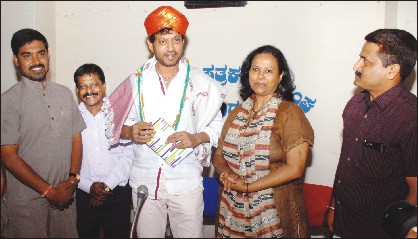
Bollywood actor Irrfan Khan, who was felicitated by Mysore District Journalists’ Association (MDJA) in city yesterday, is seen with (from left) MDJA President K. Deepak, Rangayana Director H. Janardhan, Irrfan’s wife Sutapa Sikdar and MDJA General Secretary K. J. Lokesh Babu.
Mysuru :
Bollywood actor Irrfan Khan arrived in Mysuru yesterday along with his wife Sutapa Sikdar to extend his support to the Badanavalu Satyagraha, which has been promoting sustainable living and has gained momentum throughout the State.
Irrfan Khan also stayed overnight at Badanavalu with his guru Prasanna, former Rangayana Director. On his arrival, Irrfan had an interaction with media persons at Mysore District Journalists’ Association (MDJA) office on his association with the Badanavalu movement.
During his interaction, Irrfan Khan said that it was important to stop villagers from migrating to cities which are already overloaded with people and suffering from unplanned development. “If villagers leave their lands and come to cities, they will be left with nothing. In fact, they would be forced to work under someone,” he added.
Citing the example of Mahatma Gandhi’s support to cottage and small industries, the actor said that the villagers should become self-efficient in the interest of country’s development. “It is important to create awareness among the people that products from villages are important to us. Dependency on foreign products will grow if we do not support our own products,” said Irrfan Khan.
When asked about Badanavalu movement, the actor said that he was curious when he came to know about the movement. He added that he was eager to visit Badanavalu, the place which Gandhiji visited to witness the function of handloom industries. “It is a unique concept and such movements should happen to protect our tradition, instead of adopting the western culture which is a use-and-throw culture,” he said.
To a question related to Deepika Padukone’s much talked ‘My Choice’ video that has gone viral, Irrfan said, “Come out of it. It’s over. You only need give it the importance that it deserves. Watch ‘Piku’, my upcoming movie, in which I have acted with Deepika. You will enjoy.”
Continuing with ‘Piku’, Irrfan said that the movie had come out well and that people who watch the movie will start loving their parents and those with kids will start enjoying parenthood.
Irrfan also said that he would be off to the US soon, to shoot his upcoming Hollywood flick ‘Inferno’ in which he will be starring alongside Tom Hanks.
Later, he left for Badanavalu where he stayed overnight along with theatre person Prasanna and others involved in the Badanavalu movement. His wife Sutapa Sikdar, Rangayana Director H. Janardhan, MDJA President K. Deepak and General Secretary K. J. Lokesh Babu were present during the interaction at Pathrakarthara Bhavan.
source: http://www.starofmysore.com / Star of Mysore / Home> General News / Friday – April 10th, 2015