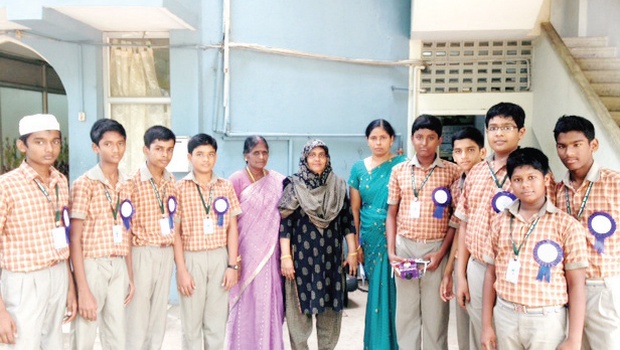
National Education day commemorating the birth anniversary of Maulana Abul Kalam Azad was celebrated at Bearys Institute of Technology here on Tuesday.
As a part of this, BIT-Innovators club conducted an elocution competition for the students on the topic “Technical Education in India- Challenges and concerns”.
Prof Sheikh Moidin, head, Department of Information Science Engineering, gave an introductory talk. Speaking on the occasion, Principal of BIT, Dr Palakshappa K spoke in brief about the achievements of Maulana Abul Kalam Azad, the first education minister of India.
Fayiz C.K of Seventh Semester Mechanical Engineering, who won the first place in the elocution contest, said there was a time in India when education was not everyone’s cup of tea. It is the result of the dreams of a great educationist like Moulana which all are witnessing today in the form of the great edifices of higher education in India. It is the responsibility of every student to make those dreams come true, he added.
Prof S Abdurrahman, Campus Director Dr.M.Sainath and the Heads of departments, along with the faculty and students were present at the occasion.
source: http://www.timesofindia.indiatimes.com / The Times of India / Home> City> Mangaluru / by Stanley Pinto, TNN / November 11th, 2014
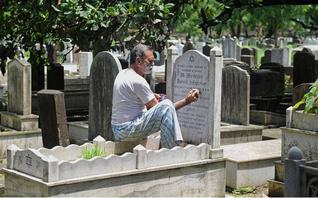
Mohammad Abdul Yaseen, 74, gives a fresh coat of paint to tombstone letterings at the Bene Israel Jewish cemetery in Mumbai.— Photo: AFP
The 74-year-old carefully chisels away at a slab of marble, engraving a passage that recounts the devout Jewish faith of the deceased.
On another tombstone he touches up a painted Hebrew inscription, undisturbed by the blare of car horns outside the central Mumbai cemetery.
Muslim engraver Mohammad Abdul Yaseen has for decades worked in this Jewish graveyard, inscribing memorials in English, the local Indian language Marathi, and Hebrew, in which he is fluent.
Mr. Yaseen serves the tiny Bene Israel or “Sons of Israel” community, whose origins in India go back about 2,000 years, as well as the Baghdadi Jews who came to do business in Mumbai in the 19th century.
While the country’s Jewish population is now dwindling, Mr. Yaseen has been in demand since he took up the trade in the 1960s after arriving in Mumbai from northern India.
He has since received numerous invitations to go to Israel, but has preferred to stay with his family in Mumbai.
“It was not really meant to be a job. But work kept coming and I stayed. In any case, I did not want to sit at home and do nothing,” he said. — AFP
source: http://www.thehindu.com / The Hindu / Home> National / AFP / Mumbai – November 12th, 2014
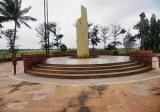
Bellary has come to acquire, in the recent years, a pleasing monument in memory of Turkish Prisoners of War (PoW) of the First World War (1914-18).
For nearly a century, hundreds of Turkish prisoners who were brought here in 1918, from the Suez Canal war zone by the British, have rested in the soil of Bellary Cantonment area. Thanks to the interest shown by the Turkish Embassy in Delhi, the
Turkish Martyrs Graveyard stands here now, commemorating their sacrifice for the nation, ten thousand miles away from their motherland.
The memorial raised over nearly two-acre site next to the Bellary Airport, and in the vicinity of Visveswaraiah Institute of Medical Science (VIMS), has a spiral column made in stone over a rectangular platform. Flags of Turkey and India flutter over high masts near the column. The memorial has been aesthetically landscaped with a number of fountains, trees, flower-beds and grass courts, lending it great charm.
Of the two marble-dressed graves in the complex, the memorial plaque on one
of them records the name of the person buried as General Agha Pasha Abdussalam. He is said to have been a prince from the Ottoman ruling family of Turkey.
The plaque mentions his date of demise in Persian as 10th Rajab 1336, of the Islamic Hijri lunar year. It is just 100 lunar years since then as the new Islamic lunar year 1436 started on October 25, 2014. [Note: The lunar century is shorter than Gregorian century by three years.
According to the old-timers, there used to be hundreds of graves of Turkish
soldiers in the area till 1980s. But they vanished as granite slabs were pilfered away and other remains were erased during the expansion of the Bellary Aerodrome.
Haji Abdussalam, a businessman of the Cowl Bazaar, wrote to the Turkish
Embassy in Delhi about the derelict condition of the graves.
Later, former municipal councilor, Haji Adam, took up the case and supervised the construction of the memorial at the direction of the Turkish Embassy in consultation with the Bellary Deputy Commissioner who allocated the site for the memorial.
Historical records say that nearly 2,000 Turkish soldiers taken captive at the Suez Canal were brought to India and lodged at Thane in Maharashtra and the famous Allipuram Jail in Bellary. But it is a mystery as to how so many soldiers died in Bellary.
According to the management of a Muslim graveyard in Banhatti locality, 2.5 km south of the city centre, dozens of graves of Turkish soldiers could be spotted in the graveyard a decade or two ago.
But over a period, granite gravestones were stolen and since the land had to be used and reused, several of these graves have disappeared and only seven or eight of these Turkish graves could still be seen surviving with mortar pillar standing over them.
Satyanarayana Rao, a retired professor of the local Veerashaiva College, says, it is a puzzle as to how such mass graves came to be located in Bellary. According to him, in normal course, so many soldiers could not have died. He says some historical records attribute these to several prisoners being mowed down by a trigger-happy British officer (like General Dwyer in the Jallianwalla Bagh) when they went on a strike at a worksite and knelt while doing namaz. Another report, according to him, links the mass deaths to a plague but adds that the plague struck the area in 1934, while prisoners died in 1918.
Whatever may be the reason, the new Memorial is seen as a picturesque locale for the local folk who come visiting the memorial.
source: http://www.deccanherald.com / Deccan Herald / Home> Supplements> Spectrum / by M.A. Siraj / DHNS-Bangalore, November 11th, 2014
Nature enthusiasts and students gathered at a barrage on the river Kosi in north India, observing migratory birds on the occasion of National Bird Watching Day, celebrated to mark the 116th birth anniversary of renowned biologist Salim Ali.
Armed with binoculars, notebooks, field guides and cameras, they stood at the edge of the reservoir, making a note of the resident and migratory species present at the site.
The bird watchers said that it was important to educate people about the importance of conserving the country’s diverse fauna.
“We brought a few children who study in a local school, so that they can make themselves aware of bird life. The message for the people of the country and people in the world is that we must keep (these birds) alive, so that we learn about them and protect them,” said a birder, Rohit Sati.
The waters of the reservoir had large numbers of Ruddy Shelducks and cormorants swimming, feeding and sunning themselves.
The reservoir at Ramnagar is close to India’s iconic Jim Corbett National Park, which is home to over 500 species of birds, a sizeable chunk of more than 1200 species found all over the country.
Winter sees many species of birds migrate from north and central Asia and other, colder parts of the world, as the birds breed and live in the more temperate climate of the Indian subcontinent.
The Director of the Rainbow Wildlife Awareness organisation, Rajesh Bhatt said that the reservoir itself played host to over 200 species of resident and migratory birds.
“The important birds here are the Ruddy Shelduck, the Ibisbill, wallcreeper, cormorant, garganey, pintail, Bar-headed Goose, which can be seen easily,” Bhatt said.
Born in 1896, Salim Ali, known as ‘the Bird Man of India’, made his name as one of the first Indian naturalists to conduct systematic surveys on birds. His field guides are used by many birdwatchers when they set out in pursuit of the hobby.
Ali, who died in 1987, is also credited with the creation and recognition of such biodiversity hubs as the Keoladeo National park in Rajasthan and the Silent Valley National park in Kerala. (ANI)
source: http://www.aninews.in / ANI News / Home> National / November 12th, 2014
Dr.Najma Heptulla, Union Minister for Minority Affairs unveiled and garlanded portrait of Maulana Abul Kalam Azad here today on the eve of his 125th Birth Anniversary. The Minister also unveiled the Foundation Stone for launching of activities of Maulana Azad National Skills Academy (MANAS) set up by National Minorities Development and Finance Corporation (NMDFC) under the aegis of Ministry of Minority Affairs.
The office of MANAS was also inaugurated by the Minister located at Maulana Azad Bhawan, Opposite New Delhi Railway Station Reservation Counter, Chelmsford Road, New Delhi. The office space has been leased out by Maulana Azad Education Foundation (MAEF). To begin with, MANAS will operate from 4 rooms and first Floor premises in the Maulana Azad Bhawan. The open space in front of the building is also planned to be utilised for construction of training facility for MANAS.
Delivering the inaugural address, Dr Najma Heptulla, who also happens to be Grand Niece of Maulana Abul Kalam Azad informed about the life and time of Maulana Saheb. She described him as a towering figure on the Indian political scene and a scholar rated high in the realms of Urdu Literature. He was a dogged freedom fighter and an un-failing upholder of secular and democratic values, she said.
She also highlighted his contributions in shaping the Education System of the country as First Education Minister of Independent India. He gave lot of thrust to Adult literacy, Universal primary education — free and compulsory for all children, girls education, diversification of secondary education and vocational training.
The Minister specially appreciated the commendable efforts by MANAS and NMDFC to completely renovate the Maulana Azad Bhawan in record time of one week. With the efforts of MANAS, the entire building in neglected condition so far has been repaired, painted, polished, open space levelled/cleaned and brought to its present shape for use as office and training centre.
source: http://www.business-standard.com / Business Standard / Home> Government Press Release> News / AT / Delhi – November 10th, 2014
Diverse events are on the cards to celebrate the birth anniversary of renowned ornithologist Salim Ali, often observed as the National Bird Watching Day, on November 12.
The events are being organised by the Social Forestry wing of the Dept of Forests and Wildlife and World Wildlife Fund-India.
source: http://www.newindianexpress.com / The New Indian Express / Home> States> Kerala / by Express News Service / November 11th, 2014
To create environmental awareness in Saidapet, three teams — the Eco-friendly, the Blue Boys and the Go-Green — were started in Fathima Matriculation Higher Secondary School.
The Blue Boys team contributed with a water alarm. Afrith of Class 10 invented the alarm.
One day when Afrith was alone at home, he saw water overflowing from the tank, which led to the invention. He decided to create an alarm to alert people when water overflows from the tank.
source: http://www.thehindu.com / The Hindu / Home> News> National / by S.N. Vijetha / New Delhi – November 11th, 2014
Rafi Ahmed Kidwai Road, which was one of several roads that became one-way after traffic direction was realigned in the 1990s to decongest major streets in the city, has been reverted to a two-way street following concretization of tram tracks.
The new traffic alignment will enable both south and north-bound traffic between Park Street and Bowbazar intersection to flow unhindered along Rafi Ahmed Kidwai Road and Nirmal Chandra Street.
Actually, north-bound traffic can now flow from Park Street to Shyambazar while south-bound traffic will have to continue making the detour between Vivekananda Road and Bowbazar via Ahmerst Street.
Kolkata traffic police officers said that the new rule, which begun on Friday, was part of a “long-term experiment”.
“We are studying the results. We will wait for Monday to study the full impact. We will then take an informed decision on whether to allow parking on this road or whether to restrict it,” said DC-Traffic V Solomon Nisha Kumar.
Sources said that the South traffic guard had no reservations on two-way traffic on the road even if trams were re-introduced between Bata and Wellington.
“But we have to wait to study the impact and speak to Calcutta Tramways Company about it,” said a source. Kumar though insisted that traffic between SN Banerjee crossing and Lenin Sarani crossing will have to continue to take a detour.
Though the new alignment came into effect from Friday, north-bound vehicles were seen attempting to venture into the road between 8am and 1pm as Kolkata Police did not launch any drive to make commuters aware of the changes. Similarly, south-bound vehicles continued to avoid this stretch between 1pm and 10pm despite signs that mentioned that the road had been thrown open to two-way traffic.
Before Friday, Rafi Ahmed Kidwai Road and Mirza Ghalib Street (Free School Street) used to change directions alternately. When the former road was open to south-bound traffic, the latter carried north-bound vehicles.
While Mirza Ghalib Street remains a one-way road, traffic constables posted on the Park Street end and on Rafi Ahmed Kidwai Road felt traffic will become two-way only after the traffic signals were suitably changed.
For motorists, making the road two-way will be a boon as frequent disruptions on SN Banerjee Road owing to political demonstrations will enable them to look for other alternatives. However, unless parking is banned along both kerbs on Rafi Ahmed Kidwai Road, the traffic will get impeded once trams resume service along the stretch. CTC managing director Nilanjan Shandilya has already indicated that trams would resume plying on the stretch sometime during November-December.
source: http://www.timesofindia.indiatimes.com / The Times of India / Home> City> Kolkata / TNN / November 09th, 2014
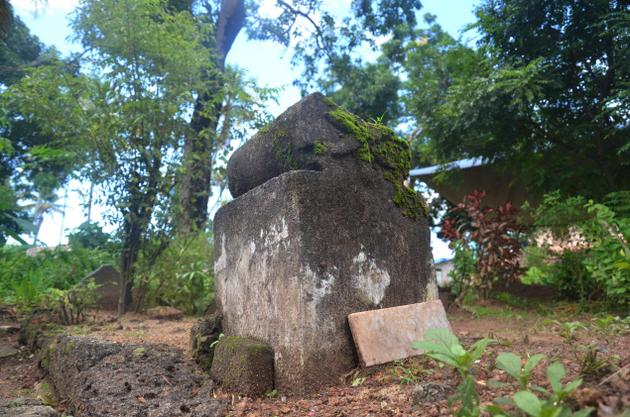
A view of the burial place of Makthi Thangal at Calvethy, Fort Kochi. Photo: Thulasi Kakkat / The Hindu
Syed Sanaullah Makthi Thangal, one of the earliest progressive Islamic scholars of Kerala, lies buried in the ancient Juma Masjid at Calvathy
In the middle of the khabaristan or burial ground adjoining the historic Juma Masjid at Calvathy, among the many grave markers, weeds and grass is one ancient grave. The tombstone is worn out and cracked, a row of laterite bricks mark out the grave, and a small neem plant has grown right in the middle. This is perhaps the only surviving memory of Syed Sanaullah Makthi Thangal (1847-1912), the famous Islamist reformer and author.
Historical documents reveal that Makthi Thangal was born at Veliyankodu, Malappuram district. But most of his creative pursuits and death happened in Kochi. He studied Arabic from his father Syed Ahmed Thangal and then enrolled at the Chavakkad Higher Elementary School. He went on to become an expert in Islamic studies and an expert in Malayalam, Arabic, Hindustani, Persian and Tamil languages.
He began his career as an excise inspector in the British government. This was a period when the Muslims in Kerala had not opened up to public education, were bound by superstitions, were gullible to accept anyone as their spiritual leader. Added to this was the government supported conversion threats. Thangal quit his job and plunged into public life. His mission was to help his community rise from the social and cultural depths into which it had fallen.
Thangal began writing, speaking and propagating his views that were bold, poetic, reformist and directed to benefit the Muslim community. Thangal wrote in the newspapers that were in circulation at that time, those that were ready to publish his articles and also published books on matters relevant to the community in British India. His speeches and all what he wrote turned out to be a clarion call to many who towed his line of thought. Thangal is considered to be the first Muslim to write, publish books and launch a daily newsletter.
Dr. C.K. Kareem, in his Kerala Muslim History, Statistics and Directory, Volume 1 (History of Kerala and of her Muslims), records that Thangal had to suffer a lot for his work. He quotes from Thangal’s concise autobiography, Makthi Manaklesham that gives a graphic account of his travails. The fierce attacks came from the conservatives within his community and from the British. But Thangal was not one to be cowed down by all this.
For nearly 30 years Thangal is said to have travelled the length and breadth of the State spreading awareness about the need for education, women’s empowerment, calling for a fight against superstition, conversion and non-Islamic beliefs.
Book cover of Makthi Thangal’s complete works / The Hindu
E. Moidu Moulavi, in his preface to the collected edition of Makthi Thangal’s works (Makthi Thangalude Sampoorna Krithikal) published by Kerala Islamic Mission, Tirur, states that Thangal must have written 40 books. Though he did not have the means, found no publishers, did all that on his own. Moidu Moulavi considers Thangal’s works as a value addition to the ancient Malayalam literary style and an invaluable historical document. What makes these works more important is when one considers the time during which they were written. The language may not have the finesse but certainly did not lack the power.
“Some of Thangal’s works like Kadora Kudaram, which was a resistance against the British supported religious conversions, Muslimugalum Vidyabyasavum that exhorted Muslims to embrace Malayalam and English education and Naari Narabhichari on the need for women’s education are all revolutionary, progressive works of a genius. As Dr. C. K. Karim observes and from what I have read they were brave views that shook the conformist mindset of the community. Thangal had to suffer a lot for his writings with many slapping court cases against him,” says M.A. Aboobacker, cultural activist.
What made Thangal unique was that he was the first reformist who studied the religious aspects of various religions before formulating his views. As historian M. Gangadaran notes Makthi Thangal as a reformist who used his vast knowledge to find a way out for the Muslim community from the darkness. He understood the significance of language and insisted that it should not be a barrier for Islam.
Failing health forced Thangal to settle down permanently in Kochi. He died on September 18, 1912. Among his many disciples and followers was C.V. Abdurahman Hydrose, editor of Malabar Islam. “Hydrose Sahib stayed at Darussalam Road. His father was also known to Makthi Thangal. It is said that Thangal presented his pen to Hydrose Sahib telling him that he has nothing else to give him and prayed that this pen would be helpful to him.
As Moidu Moulavi writes, Hydrose Sahib, true to the legacy he inherited, went on to publish many of Thangal’s works including Makthi Vijayam,” says Aboobacker.
Once in a while people visit Thangal’s grave, people who have read about him, who have read his works. “It was my friend Gaffoor who first told me about Thangal’s grave. I had read a lot about him and also some of his writings. In January 2013, when Gaffoor came down from Muscat, we went for the Biennale. We then decided to find out where Thangal’s grave was. It took us a lot of wandering, asking many people to finally find it. I feel Thangal who has contributed so much for nourishing and reforming the Muslim community deserves more”, feels R.P. Sivan, a Malayalam teacher at SRV High School.
Apart from a literary award instituted by an organisation in Makthi Thangal’s name there is nothing else to perpetuate the memory of this visionary reformer.
Perhaps, adapting Emily Dickinson’s lines, after a hundred years nobody would know this place. Weeds will rage triumphant, strangers will stroll past this lone tombstone, no one to tell them of the man buried there; lost to memory.
source: http://www.thehindu.com / The Hindu / Home> Features> MetroPlus> Hidden Histories / by K. Pradeep / Kochi – October 31st, 2014
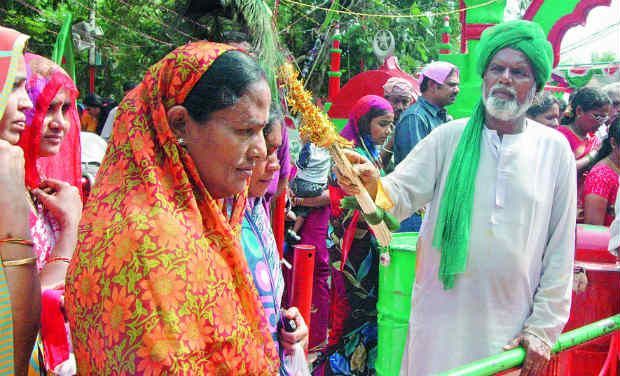
Thousands of devotees of all faiths from all corners of the state and neighboring states offered prayers at Bara Shaheed Dargah and exchanged rotis at Nellore Tank on the first day of Rottela Panduga
Nellore:
Thousands of devotees of all faiths from all corners of the state and neighboring states offered prayers at Bara Shaheed Dargah and exchanged rotis at Nellore Tank on the first day of Rottela Panduga on Tuesday.Water level in the Nellore tank has been increased from 10 feet to 12.5 feet by releasing water from Somasila for the benefit of the devotees. Police and expert swimmers mounted on special boats kept a tab on the devotees entering the tank to exchange rotis.
For the first time mobile E-Toilets have been arranged besides bathrooms exclusively for women. Officials have arranged temporary facilities and illumination at parking lots since hundreds of devotees have been sleeping at the parking lots itself during nights. Authorities have instructed the managements of colleges and educational institutions in the city to be ready to accommodate the pilgrims in case of heavy downpour.
source: http://www.deccanchronicle.com / Deccan Chronicle / Home> Nation> Current Affairs / DC Correspondent / November 05th, 2014