Organised during Muharram, the Majlis or religious gathering serves as a reminder of the martyrdom of Imam Hussain and his 72 followers at the battlefield of Karbala. For women orators or zakiras addressing these gatherings, however, the majlis is increasingly evolving as a platform to espouse the cause of women’s rights and empowerment.
Taaj Bano, a zakira, considers her responsibility to educate azaadars (those who lament the death of Imam Hussain) that there is much more to a majlis than just the narration of atrocities faced by Imam Hussain.
“The ruthless battle of Karbala gives a strong message to the women of today teaching them how to live a life of dignity, understand their rights and duties by following the footsteps of Bibi Zainab, who despite all odds stood up against the tyrant ruler Yazeed,” said Bano, who has been addressing majlis since she was four.
In the bylanes of Raqabganj, zakira Massarat Fatima is deeply concerned over the increasing number of divorce cases. This year, she addressed azaadars on what should be the ideal the character of a mother and wife.
“The pious character of Bibi Fatima Zehra who never made any demand from her husband Hazrat Imam Ali initiated the nuances of Islamic studies in me,” she added.
Being a zakira is a matter of pride for Dr Naseem Subhi Rizvi who feels that a woman must receive the highest degree of worldly knowledge by seeking education in top most universities but remain close to her religion.
“Hadees (sayings of Prophet Mohammad) recited during majlis teaches working women to strike a balance between office and household chores,” she said.
source: http://www.timesofindia.indiatimes.com / The Times of India / Home> City> Lucknow / by Uzma Talha, TNN / November 03rd, 2014
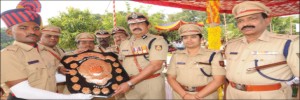
Best all rounder Fakirappa B. Karigar is seen receiving the shield from ADGP (Prisons) K.V. Gagandeep at the passing out parade held at the Central Jail premises here this morning as Mysore Central Jail Superintendent Divyashree, KSRP Commandant Ramadas Gowda, Asst. Superintendent Mahesh Jigani, Prison Staff Training Institute Principal T.P. Sesha, DIG (Prisons) Veerabhadraswamy and ADGP N.S. Raja look on.
Mysore :
The passing out parade of the 42nd batch of probationers was held at the City Central Jail Parade Ground here this morning.
The 108 probationers, all men, underwent a 9-month training at the Prison Staff Training Institute here.
ADGP (Prisons) K.V. Gagandeep received the guard of honour from the passing out probationers.
Speaking on the occasion, Gagandeep said recruitment of 250 jail warders is underway. CCTV cameras will soon be installed in the city jail and measures have been initiated to computerise all jail operations in the State, the ADGP said and advised the successful probationers to work with conviction and confidence.
ADGP N.S. Raja, KSRP Commandant Ramadas Gowda, City Police Commissioner Dr. M.A. Saleem, DIG (Prisons) Veerabhadraswamy, Mysore Central Jail Superintendent Divyashree, Asst. Superintendent Mahesh Jigani, Prison Staff Training Institute Principal T.P. Sesha and others were present.
The winners of various prizes are as follows:
Firing: First prize- Ramesh Jadhav of District Prison, Bidar; Second- Vittal Rajappanavar of Chitradurga prison; Third- Ramachandra Sippimani of Jamkhandi Sub-Jail.
Out-door: First- D.S. Nalku Ravi of Hubli Sub-Jail; Second- Kumar of Raichur District Prison; Thirdg – Thawaseef M. Mohammad Muragoda of Bangalore.
In-door: First- Prakash Rathod of Bagalkot; Second- Shankarappa of Raichur; Third- Fakirappa B. Karigar of Bagalkot.
Prize for best Jail Dairy maintenance: Lakkegowda of Hassan District prison
Karnataka Prison rules and regulations: N. Shivakumar of Nanjangud Sub-Jail; Water and power utility, First aid treatment: Suresh Hanumantha Kaddi of Ramanagar; IPC and GPC: Fakirappa B. Karigar
Sociology, Psychology, Criminology and Indian Constitution: K.S. Nagaraj of Kadur Sub-Jail; Karnataka Government Service rules: Sheetal of Bangalore.
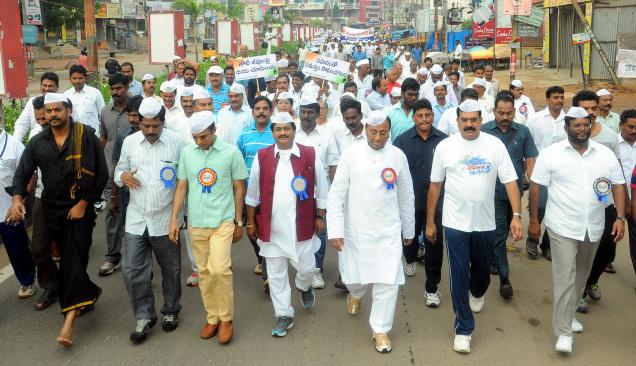
The Vande Ganhiyam peace march held from Gandhibomma Centre in Nellore to Pallepadu Ashram. Photo: K. Ravikumar / The Hindu
Speakers appeal to the youth to follow in the footsteps of the great leaders
Civil society activists, people’s representatives and district officials took part enthusiastically in the ‘Vande Gandhiyam’ peace rally which was organised from Gandhi statue in Nellore city to Pallepadu Ashram near here on Sunday.
Singer Ghazal Srinivas, MP Mekapati Rajamohan Reddy, Mayor Sk. Abdul Aziz, Nellore Town MLA P. Anilkumar Yadav and several other leaders and youth were present on the occasion. The event was organised to pay tributes to the values and ideals cherished by Mahatma Gandhi who stood out as a unique world leader by winning freedom through peace and non-violence.
District Collector N. Srikanth, who flagged off the rally in the city, said that the peace march would go a long way in drawing wide attention to the Gandhian principles that brought special recognition to the country. He said that the Pallepadu Gandhi Ashram was among the few important ashrams which were being preserved as a tribute to Gandhi.
Ghazal Srinivas led the march and underlined the significance of peace in bringing about harmony and unity among the countries of the world. He said that he had toured many parts of the world in the propagation of world peace. Calling upon the active participation of all sections of society, the speakers appealed to the youth to follow in the footsteps of the great leaders who fought for the independence of the country in those days. They said that it was everybody’s responsibility to protect and preserve the unity and integrity of the country.
source: http://www.thehindu.com / The Hindu / Home> News> National> Andhra Pradesh / by G. Ravikiran / Nellore – November 02nd, 2014
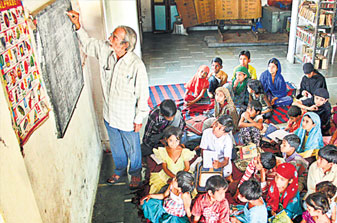
Dr Aziz Indori’s school is not affiliated to any board, but the curriculum is well thought through. Amit Jaiswal/HT Photo
It is 10 am sharp when Kavita, 13, reaches the school in Khajrana. The teacher may have been impressed with her punctuality, but quickly draws attention to her unkempt hair.
Tidiness is among the many lessons this sprightly teenager from the slums of Khajrana and 84 of her schoolmates are being taught at Indori’s Paathshala.
The school takes its name from Aziz Indori, 80, who scripted an education revolution in the heart of Madhya Pradesh’s commercial capital.
After retiring from the city’s Islamia Karimia Degree College in 1995, Indori took up the task of educating poor Muslim children. The doors of his school are, however, open to children from other communities also.
The retired Urdu teacher is a bundle of energy despite his age. His experiment with 10 children has blossomed in the last two decades. The two-storey school now accommodates eight times its original number of students going right up to Class 8. The school is not affiliated to any board, but the curriculum has been well thought through and gives the children of the local daily wage earners a shot at a better life.
Kavita recites multiplication tables up to 4, while her junior Anamika (another Hindu student) writes the English alphabet with a flourish. Daily wage earner Ghulam Mohammed, father of Firoz, 11, who studies in the school says, “I could not study much, but did not want my child to loiter on the roads. Given my means, I could not afford to educate him… then one day I came across Indori sahib’s school.”
Indori, a doctorate in Urdu, derives immense satisfaction from his work. “I have always stood for the education of the poor. Rich have the means and resources. Who cares for the poor?”
Indori chacha, as he is known to his students, says, “I want to break this tradition in the Muslim community that the child of a cart-puller will be a cart-puller.”
MP’s slide in the Annual Status of Education Report (ASER) 2011-12 — the largest survey of what children across the country are learning — makes Indori’s effort more praiseworthy. According to the report released in January, attendance in primary schools (Classes 1 to 5) of MP has dipped to 54.5% in ’11 from 67% in ’07.
Till date, Indori has not involved any politician or religious leader in his project. “It is with the help of 4-5 friends that I’m running this project.” His Muscat-based brother-in-law, Dr Abdul Rashid, donated the building that houses the school.
With age catching up, Indori has roped in two persons to care for the students. “One is paid Rs. 800 and the other R1,200 per month by my friends.”
The students, who make do with well-worn clothes, are provided stationery and winter clothing — all for a nominal fee of R20 per month. With no examination system, students are judged according to their daily progress. The system has worked. Nearly 20 of the school’s students have gone on to complete their matriculation, some of them from a state-run school in the locality.
An alumnus of the school, Parveen, who studied up to Class 10, says, “I am thankful to Indori chacha.” Parveen, who is getting married today, also got the opportunity to learn tailoring, and contribute to her family’s earnings, at another Indori initiative — the Jan Shikshan Sansthan. This is Indori’s effort to provide vocational training to girls in the slum. The programme already has more than 75 trainees.
Indori says, “I feel satisfied. I wanted to educate and make poor Muslim girls self-reliant. I didn’t want them to get just a degree, but also knowledge.”
source: http://www.hindustantimes.com / Hindustan Times / Home> / by Vijay Swaroop, Hindustan Times / Indore – May 03rd, 2012
One of the things I find unique about Bengaluru is its tradition of public celebrations and ceremonial processions that have come to occupy a permanent space on the city calendar. These demonstrations often define community identity and unite its past with the present; ancient agrarian festivals (Kadle Kai Parishe) reclaim modern suburbs, temple and church `car festivals’ mark ritual routes across the city (Poo Pallakki and St Mary’s Feast), ooru habbas recall rural antecedents and the Karaga procession re-imagines a lost community identity. The events are marked by active public participation and are a valuable reminder of the all-encompassing nature of our city.
Hosur Road’s annual Ashura juloos (procession) too occupies a significant place on this list. While Johnson Market (a heritage municipal market in the area) is known primarily for its kebab joints, hole in the wall chai cafe’s and eateries, once a year, the coal burns here not for the epicureans, but for the pious. Sounds of mourning rent the air at public and private gatherings (majlis) in the locality as sombre men and women dressed in black gather during the holy month of Muharram, the first in the lunar Islamic calendar to commemorate the tragic Battle of Karbala. Men walk over coals in the symbolic fire walk or ‘aag ka matam’ on the 9th night and the grieving intensifies in a juloos (procession) on Ashura, the 10th and culminating day of battle.
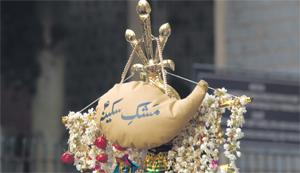
The procession moves from Arab Lines near Johnson Market towards the 19th century Persian Shia Cemetery on Hosur Road. The road is closed to traffic. Sacred Alams, symbolising ancient battle standards, are carried. Nauhas and Marsias (elegiac poetic genres) are recited over loudspeakers. Children climb astride the Zuljenah, symbolising the Imam’s faithful horse, for blessings. A young man weeps as he carrys a blood-stained cradle. Curious bystanders watch the synchronised breast beating of the `matam’, a ritualistic sign of mourning. Zanjeers (blades attached to chains) connect with skin. The community understands its significance. It is a symbolic reliving of the battle, a personal declaration of solidarity with the martyrs.
The juloos has been a part of our cityscape for over a century. It finds its roots in the 7th century, a turbulent time in the history of Islam. Racked by schisms and discord, the tribes turned upon each other in a relentless quest for power. While on his way from Mecca to the town of Kufa in Iraq in 61 AH (around 681 CE) with his army-entourage, Imam Hussein, son of Imam Hazrat Ali Ibn Abi Talib and grandson of the holy Prophet Mohammed, was intercepted by the opposing army of the Ummayid Caliph and tyrant, Yazid I. Vastly outnumbered, they were denied food and water before being massacred on the scorching sands of Karbala. Hapless women and children from the Prophet’s household were then subjected to unparalleled atrocities.
The narrative is filled with powerful themes like pre-determination, martyrdom, suffering and sacrifice. It is renewed annually with fresh emotional intensity as Hosur Road transforms into a site of symbolic meaning – a blood drenched battlefield.
Across the country, non-Muslims too participate in Muharram rituals. They make paper ‘Tazias’ and offer water and `sharbat’ to processions. Poets of all faiths write eloquent elegiac poetry-nauhas and marsiyas. Several Islamic sects in Bangalore also commemorate it in different ways. The Ashurkhanas (shrines) and Imambaras are open to people of all faiths. Ashura blurs the distinctions between castes and communities. The language of grief is universal.
The writer is a cultural documentarian and blogs at aturquoisecloud.wordpress.com
source: http://www.bangaloremirror.com / Bangalore Mirror / Home> Columns> Others / by Aliyeh Rizvi, Bangalore Mirror Bureau / November 02nd, 2014
The Umar Alisha Rural Development Trust plans to plant 10 lakh trees in cyclone hit Visakhapatnam district to bring back the district’s greenery.
Addressing reporters after launching the project after planting a tree at their Viswa Vignana Spiritual Centre at Bheemjuniatnam in the district here today, Chairman of the Trust Umar Alisha said the trust would plant 10 lakh trees in the district within five years. He said 70 to 80 per cent of trees in Visakhapatnam have been destroyed due to cyclone.
‘Make Vizag Green’ is a project taken up by the Umar Alisha Rural Development Trust to replant lost greenery in Visakhapatnam.
He said it is everybody’s responsibility to protect the environment and plant trees which provide oxygen.
“Every tree will provide oxygen, which is very important for human beings,” he said.
Umar Alisha said that the trust would select trees which could withstand even wind speeds of 200 kilometres per hour during natural calamities like cyclones.
The project plans to use information technology, crowdsourcing, geocoding and social media to encourage people to participate.
He said the trust would plant 200 trees in various places in Bheemunipatnam today and also plant 1,100 trees in various places as well as both sides of the national highway.
source: http://www.business-standard.com / Business Standard / Home> PTI Stories> National> News / Press Trust of India / Visakhapatnam – November 02nd, 2014
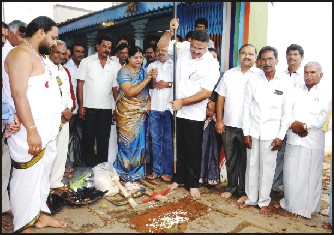
Narasimharaja Constituency MLA Tanveer Sait launched various developmental works at Yeraganahalli in city yesterday.
Speaking after launching the developmental works, MLA Tanveer Sait said that developmental works of roads, underground drainage system and other basic facilities would be taken up at a cost of Rs. 80 lakh and added that these works were being taken up due to demands from local representatives and the residents. He also said that developmental works in other areas in his constituency would be taken up soon.
Corporator Rajani Annaiah, Sahukar Chennaiah Block Congress President Manjunath, leaders Annaiah, Venkatesh, Swamy, Eeranna, Srinivas, MUDA officers Nagabhushan, Aradhya, Ramaswamy and others were present.
source: http://www.starofmysore.com / Star of Mysore / Home> General News / Tuesday, October 28th, 2014
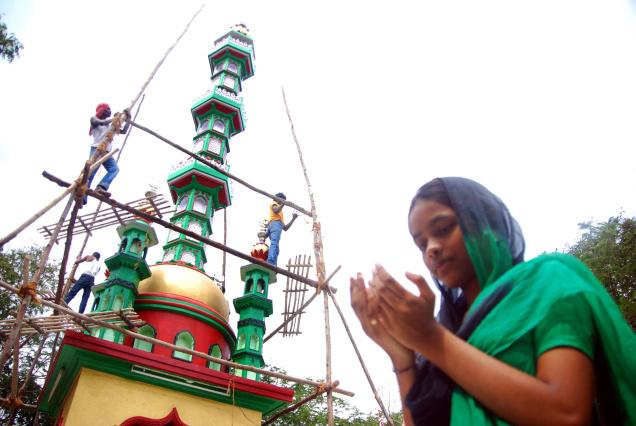
Finishing touches being given to Bara Shahid Dargah for ‘Rottela Panduga’ in Nellore city. / PHOTO: K. RAVIKUMAR
The annual ‘Rottela Panduga’ (roti festival) being celebrated at the Barashahid Dargah on the banks of Swarnala Cheruvu here has proved to be a landmark event for Nellore city. The 4-day event will be held from November 4 to 7.
Forecasting arrival of a larger numbers of pilgrims this year, the dargah committee and the Nellore Municipal Corporation are making additional arrangements for the smooth conduct of the festivities.
Mayor Sk. Abdul Aziz said that nearly 20 lakh pilgrims from different parts of the country would be expected to take part in ‘Rottela Panduga’ festival this year. Accordingly, the drinking water, sanitation and toilet facilities were being made available to avoid any inconvenience to people.
The dargah committee was formed with nearly 110 members on it recently. The festival was special for the devotees as they exchange ‘rotis’ between them standing in the cool waters of Nellore tank here in fulfilment of their wishes made at the tombs of the warriors in the past.
Mr. Aziz said that those, whose wishes were fulfilled, would present ‘rotis’ to those who arrive to make their fresh wishes. Different devotees make different wishes, which mostly relate to health, wealth, family harmony, marriage alliances, educational progress and so on.
source: http://www.thehindu.com / The Hindu / Home> News> National> Andhra Pradesh / by G. Ravikiran / Nellore – November 01st, 2014
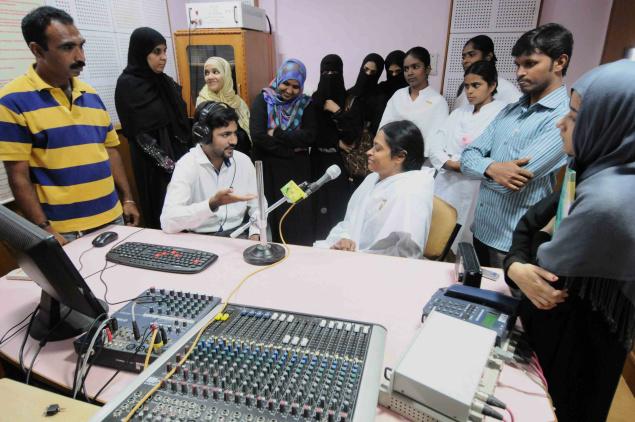
Deccan Radio station manager Zahed Farooqui providing a live interview experience to Radio Jockey trainees at the Siasat daily’s office. – Photo: Mohammed Yousuf
Community station Deccan Radio 107.8 FM runs eight-hour social programmes
While we tune in to FM radio stations to listen to our favourite songs and talk shows, the concept of community radios is something that is yet to catch up in the city. And to encourage it and give ordinary people a platform to discuss social issues, Deccan Radio 107.8 FM has begun providing free training to its first batch of students from Monday.
“There is no age bar or qualification required for those interested in enrolling for the training programme. It will benefit those who are interested in participating in social activities,” said Zahed Farooqui, station manager of Deccan Radio 107.8 FM. The programme covers recording, editing, interview techniques and also provides an opportunity to go live on radio.
With a frequency spread across a radius of one kilometre, the radio station also encourages the contribution of local community members. Presently, the station runs eight-hour social programmes, comprising different types of radio shows everyday from 8 a.m. to 12 p.m. and from 4 p.m. to 8 p.m. daily.
“Last time, we conducted a programme for only journalism students, but this time it’s open for everyone,” he mentioned, and further stated that the batch would consist of 50 students. “If more people come forward, we will start more batches. Also, after the course, if we think the students are competent enough to work with us, we hire them,” he added.
source: http://www.thehindu.com / The Hindu / Home> News> Cities> Hyderabad / by Yunus Y. Lasania / Hyderabad – October 28th, 2014
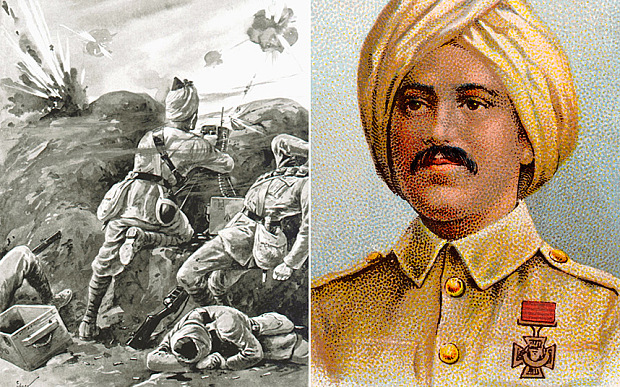
Khudadad Khan, the first Muslim soldier to be awarded the Victoria Cross, should be more widely recognised, say two former heads of the Army
Sepoy Khudadad Khan was awarded the Victoria Cross during World War One Photo: GETTY
by Edward Malnick
Two former heads of the Army have called for greater recognition of the first Muslim soldier to be awarded the Victoria Cross, in a move intended as a “riposte” to the “sickening extremism” of Isil militants.
General Lord Dannatt and General Lord Richards lead a group of peers, MPs, historians and religious leaders who say children should be told about the role played by Muslim troops in the First World War.
The knowledge of his role, together with that of the other 400,000 Muslims who fought alongside British troops, is vital to “fully understand the multi-ethnic Britain that we are today”, they add.
British Future, the think tank behind the letter, believes that the commemoration of Sepoy Khan and the other Muslim soldiers will act as a rebuttal to Isil extremists. It has been claimed that more than twice as many British Muslims have travelled to Syria to fight alongside jihadists than are serving in the Armed Forces.
Dilwar Hussain, a Muslim academic and one of the signatories of the letter, said: “The quiet dignity of our commemoration of Khudadad Khan’s bravery and service is perhaps the most powerful riposte we could possibly send to the sickening extremism of Isil.”
Other signatories include Lord Ashdown, the formal Liberal Democrats leader, Sir Hew Strachan, the military historian, Baroness Warsi, the former Coalition minister and Sughra Ahmed, president of the Islamic Society of Britain.
“We wish today to highlight one man whose service exemplified the courage of many who served in the First World War,” they write.
They describe how on October 31 1914 Sepoy Khan, who was later promoted to the rank of subedar, fought off a German advance at Ypres, helping to protect two vital ports used to supply British troops with food and ammunition from England. He was one of 1.2 million men from the Indian Army who fought for the Allies in the war.
On Friday Lord Ahmad, the communities minister, will unveil a commemorative stone which will be laid at the National Memorial Arboretum in his honour.
He said: “In honouring the courage of Khudadad Khan we not only remember our shared history, we are also cherish the long tradition of Muslims fighting bravely alongside British soldiers, for a just cause in the service of this country.”
source: http://www.telegraph.co.uk / The Telegraph / Home> History> World War One / by Edward Malnick / October 31st, 2014