Category Archives: Community Involvement / Social Issues

Industrialist P.K. Mohamed dead

P.K. Mohamed
P.K. Mohamed

People from all walks of life paid tributes to industrialist P.K. Mohamed, 73, who died here on Monday. He was the managing director (MD) of Western India Plywoods Ltd. (WIP).

He had been recuperating at his residence at Thana here after a recent cardiac surgery. The body was taken to Thalassery for burial at Elangol Juma Masjid, Chettamkunnu.

Early years

He followed his father, A.K. Kaderkutty, into the industry. After college education in Chennai, Mohamed went to Germany for extensive training in wood technology.

He joined WIP as production manager in 1962. He was made MD in 1993.

He was involved in the modernisation and diversification of the company.

He had functioned as office-bearer of the North Malabar Chamber of Commerce and was a sports organiser. He was a member of various industry organisations and was actively involved in the social sphere.

He is survived by wife and four sons. Political leaders including Rural Development Minister K.C. Joseph and E. Ahamed paid their last respects.

source: http://www.thehindu.com / The Hindu / Home> News> National> Kerala / by Special Correspondent / Kannur – October 01st, 2014

No Gowda, no HDK: Is Zameer planning an exit?

Zameer Ahmed Khan
Zameer Ahmed Khan

Bengaluru: 

Two years ago, when Chamarajpet MLA, B Z Zameer Ahamed Khan sponsored the haj of workers of mosques and madrassas, it was clearly a party affair with former Prime Minister and JDS supremo, H D Deve Gowda and his family being a big part of the event held to send them off on pilgrimage.

But on Sunday at a similar function organized by the JDS MLA, the Gowda family was conspicuously absent and there were no posters either recalling them at the event. Mr Zameer, who had recently announced his decision to stay away from party affairs, had also dropped enough hints about his souring relations with the  Gowda family. And now it was there for all to see although he chose to call it a private function and invited his close friends in the JD(S) like N Cheluvarayaswamy,  H G Balakrishna and  Puttanna, who also share an uneasy relationship with the Gowda family, to be a part of it.

Mr Zameer,who has been sponsoring the haj of poor workers of madrasas and mosques for the last 20 years, has this year too sponsored a number of them footing a bill of  over one crore. Since 2004, he  promoted the JD(S)  at the functions held to send the workers off on pilgrimage. But  things have clearly changed over the last six months. However, when asked about it, Mr Zameer dismissed speculation. “I sponsor the pilgrims. It is not a JD(S) function, but a private event.”

source: http://www.deccanchronicle.com / Deccan Chronicle / Home> Nation> Politics / DC / Vinay Madhav / September 26th, 2014

Blowing From Guns Sepoy Revolt Of 1857

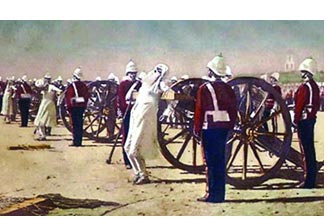
Blowing from Guns in British India (1884) by Vasily Vereshchagin. This painting depicts events of 1857 with soldiers wearing (then current) uniforms of the 1880s.-http://www.vokrugsveta.ru
SepoyMPOs01oct2014

[Picture printed above and commentary was forwarded to me.  Someone with more interest in history asked about the picture, associated story and procedure of blowing up from canon as punishment.  Others have previously asked about capital punishment in seventeenth & eighteenth century India.  Only for those interested in history of the Raj.]

“Lets salute the first martyred journalist in the Independence movement against the British back in 1857.

Moulvi Mohammed Baqir editor of ‘Urdu Akhbar Dehli’ was the first journalist to be martyred by the British army through Taliban-e-Pakistan style execution.

He was tied with canon and blown up for his ‘seditious’ writing against British colonial rule in the First War of Independence 1857.

Unfortunately the brave martyr hardly got any recognition in the history books.

The photograph below shows how the “benevolent” and “humane” British army blew up these unarmed captured Muslim civilians with cannon. This even beats the “humanity” of the Taliban-e-Pakistan.

Share as much as you can, if you want his legacy to live on.”

My Comments

“The very ink with which history is written is merely fluid prejudice”.  Mark Twain

Few things should be kept in mind as a backgrounder.  There is a narrative of the victor and a completely different one by the vanquished.  Facts are interpreted in different ways and that is fine.  Selective use of facts to support one’s point of view is also common especially in post 1947 India and Pakistan (the fact that Bengal army that was two third Hindu Brahmin revolted and came to Delhi to fight under the Mughal flag will never be acknowledged by the right wing of both India & Pakistan as it does not fit into their respective narrative).  However, sometimes folklore is mixed with facts and this adds to the confusion rather than bringing clarity.  Few basics; It is a painting and not a photograph and this painting has nothing to do with the story narrated above.  It is simply a folklore and not based on any historical event.  Below is the copy of the print of the original painting (from Library of Congress collection) and my explanation.

Blowing from guns in British India (Library of Congress)

This painting is by a Russian painter Vassili Verestchagin (1842-1904).  He visited India in 1874-76.  He painted many scenes of India and Central Asia.  This is artist’s imagination of how the sentence was carried out and probably not based on any individual case or any eyewitness portrayal by the painter.  This was painted in late 1870s when this practice had been abandoned.  The uniform of British soldiers standing next to guns is of late 1800 era and not 1857.  Vassili like many artists abhorred war and painted many works showing horrors of war.  In fact, at one time German and Austrian military high command banned their officers to visit Vassili’s exhibitions of paintings as they viewed his work as anti-war.

I have my own theory about this particular painting.  One of last incident of large scale blowing up from canons occurred in January 1872 in the small princely state of Malerkotla in Punjab.  A small sect of Sikhs called Namdharis is very strict against cow killing and there were incidences where they attacked slaughterhouses and killed butchers.  An ox was slaughtered in the presence of a Namdhari.  He narrated the incident to his kin and a band of about 200 Namdharis attacked Malerkotla and in the ensuing firefight fifteen people were killed and some arms looted.  Remaining Namdharis escaped to neighboring Patiala state.  Nawab of Malerkotla Ibrahim Ali Khan was a minor and Superintendent of Council of Administration Mr. Heath was administering the state under the supervision of Deputy Commissioner of Ludhiana L. Cowan.  Cowan rushed to the scene and many Namdharis who had escaped were brought back to Malerkotla from Patiala.  Cowan interpreting this act as rebellion summarily executed sixty six Namdharis by blowing them from canons (brought from neighboring Patiala and Jind states) over two days time period without trial.  Later, when this act was denounced, Punjab government fully supported Cowan but Government of India disapproved. Cowan was sacked while Commissioner of Ambala division Forsyth transferred to Awadh.

This incident occurred in January 1872 close to the time of Vassili’s visit to India in 1874-76.  He may be referring to this recent incident of Namdharis in his painting.  The only person clearly visible in painting is the first gentleman tied to the canon in the front.  He has white beard, all white clothing and wearing a turban.  The remainders three tied to the guns are also wearing white clothes.  Namdharis wear white home spun cotton clothes and tie their turbans horizontally different from other Sikhs.  It is not likely that Vassili painted this based on an eyewitness account (he didn’t mention any such incident in his autobiography) as to the best of my knowledge; there was no incident of blowing from canons for mutiny at the time of Vassili’s visit to India in the time period of 1874-76.  It is quite possible that the gentlemen in the painting are all Muslims as from clothing one can guess that they are not Hindus.  Vassili may have painted 1857 incidents when he became aware of this during his visit.

Maulvi Muhammad Baqar Ali (1810-1857) was a Shia intellectual of Delhi.  He was educated at Ghaziuddin Madrassah that later became famous Delhi College.  Baqar owned a printing press and published first Urdu weekly newspaper called Dehli Urdu Akhbar in northern India in 1836 (in July 1857, it was renamed Akhbar al Zafar).  His paper mainly covered social and literary activities of only Delhi.  He also published many works translated from English.  In 1857, he continued to publish his newspaper after the fall of Delhi to rebels.  He praised the cause of rebels and supported last Mughal emperor Bahadur Shah Zafar.

Baqar was arrested on September 15, which was the second day of assault when Delhi was not yet secured by British.  His son Muhammad Hussain after putting rest of the family on a journey out of Delhi came back to Delhi to look for his father.  A Sikh general who was friend of Baqar helped Hussain to stay under his protection.  This Sikh fellow took Hussain to the field on September 17 where prisoners were awaiting their trial and execution.  Father and son just looked at each other before Baqar was hanged (This is described in detail by Darlymple in his excellent account of the time period in The Last Mughal).  During British assault on Delhi, majority of people were killed by swords, bayonets and firearms.  Later, after securing the city, summary executions were carried out mostly by hanging.

Baqar was supporter of the rebel cause and Zafar.  However, near the end of July when things started to deteriorate and doubts were raised about victory of rebels, many residents of Delhi now had second thoughts.  A number of residents including members of royal family opened up communication with British camp through intermediaries in contact with British (Hakim Ahsanullah Khan, Maulvi Rajab Ali etc.).  Many wrote intelligence reports giving information about happenings in the city.  Baqar also sent a report to the Ridge (Translation of a letter from Munshee Mahomed Bakar, July 1857 at Delhi Commissioner’s Office Archives quoted in Darlymple’s The Last Mughal) and its text gives an idea of feeling among Delhi inhabitants.  He wrote, “We, the respectable portion of the inhabitants are reduced to the last extremity by the violence of the sepoys, and have no hope of escaping with our lives. The General Bakht Khan’s spies dog me wherever I go.  There are sentries over the house of Mufti Sadruddin Khan and all exit and entrances prohibited.  Through Zinat Mahal I suggested to the King to open the gates and invite the English to come and seize the city, telling him that if he could destroy the mutineers it would be great advantage to himself and his children.”

Somewhere in my own humble collection of materials on military history of the Raj, I have a note where someone named Hobson then present at the Ridge during the siege mentioning that it has been communicated to Baqar to publish in his paper that if the city surrenders it will be spared destruction and also to encourage people to leave the city at once.  He mentions that if Baqar publishes this notice then his life may be spared.  Unfortunately, I do not have reference for this anecdote.

Residents of Delhi were in a very precarious situation and self preservation demanded careful maneuvering.  Ordinary folks could stay neutral but those well known or wealthy had to declare openly.  Some may have genuinely believed that old order was gone and they had to profess loyalty to Bahadur Shah to stay on the right side of the power.  Even those not sure about the change, silence on their part could label them as sympathetic to British cause and hence punishment from rebels (many were killed by rebels and same happened to some unfortunate native souls at the Ridge where they were accused of in sympathy with rebels and killed by British).  Delhi inhabitants were at the mercy of rebels in control of the city but after two months, they were not sure about victory of rebels.  Baqar tried to balance this by supporting rebels in the editorials of his papers while also keeping channels open with British at the Ridge to safeguard his life in case of return of the British.  The chaos of assault, vengeance on part of British soldiers and hatred of Sikh, Punjabi Muslim and Pathan allies of British meant that even the lives of friends of British were not safe in Delhi.  Many who provided valuable information to British about Delhi during the siege were killed by the victorious British army and its Indian allies.  All able bodied males were summarily executed and whole city was turned out.  Thousands perished from extremities of weather and starvation all around Delhi.

Baqar’s son Muhammad Hussain Azad survived the mutiny despite writing a poem praising rebels in his father’s newspaper.  He left Delhi with twenty two members of his family.  His one year old daughter was killed by a stray bullet.  After wandering for four years through Madras, Niligiri hills and Lucknow, Azad later settled in Lahore and under the patronage of great Orientalist Gottlieb W. Leitner became celebrated Urdu literature critic.

“History will be kind to me, if I intend to write it”.  Winston Chuchill

Top Dum – Execution by Blowing Up from Canon

Throughout human history various methods of execution have been used.  Execution by blowing up from canon was used during Mughal times but it was limited to those guilty of armed rebellion and used very rarely.  Beheading, hanging and later firearms were more common methods.  In fact, these were considered more humane methods of execution compared to slow and torturing death by other means.  Cutting off limbs, flaying and skinning alive, crushing by elephants, tying all four limbs to four horses and whipping them to run in opposite directions thus dismembering the victim and throwing the victim from the top of a building were more gruesome methods used against enemies.  A particularly cruel method was amputating one limb at a time but pouring boiling oil on the wound that not only caused severe pain but also had a cauterizing effect on blood vessels that prevented quicker death from blood loss.  The purpose of these tortuous and painful deaths was not only to punish the culprit but also to instill fear among general population.

East India Company used occasionally the method of blowing up from canons only in cases of mutiny.  The last case of blowing up from canons prior to 1857 was in late 1820s.  In 1857 rebellion, this method was used on large scale for a variety of reasons.  The main reason was a deterrent effect on general population.  There was no preference for any particular ethnic or religious group.  This method was used more in areas where rebellion was large scale and affected civilian population like Delhi and its surrounding areas and Rohilkhand (majority Muslims) and Central India (majority Hindus).   In individual cases, a variety of factors were at play when decision was made to use this method of execution.

The method included lowering the muzzle of the gun to about three feet from the ground.  The condemned man was then tied to the muzzle of the canon where small of the back touched the muzzle of the gun (in some cases, victim faced the gun where his stomach was touching the muzzle). Hands were tied to the wheels of the gun and in some cases legs were secured by tying ropes to tent pegs driven in ground near victim’s feet.  About a quarter of the powder was used in cartridge shell; double charged in case of more than one person tied to the muzzle.  The gunners stayed behind a back board to light the charge to avoid being sprayed with the blood and flesh of the dying man.  Most of the time, one man was tied to the gun for each shot but in some cases four to six were tied together.  Torso was disintegrated by the blast while head and limbs scattered over a wide area.

In May 1857, 55th Bengal Native Infantry (BNI) was stationed at Nowshehra with one detachment in Mardan on the frontier.  55th BNI mutinied and sepoys ran away with their weapons (their heart broken commanding officer Colonel Henry Spottiswood committed suicide).  Legendry John Nicholson chased the mutinous 55th with the help of his Pathan allies killing and capturing many.  Forty men of 55th BNI were brought to Peshawar and blown away from canons.  In June 1857, ten sepoys of 5th BNI were blown from guns in Umbala.  In Bengal, Colonel George Sherer of 73rd BNI got hold of three ringleaders of sedition in his regiment and executed them by blowing from canon.   In June 1858, 300 captured rebel soldiers were executed at Kirwee by this method.  In view of large numbers condemned to die by this method, six were tied to each muzzle at a time.

The main reason for using this punishment during mutiny was a salutary effect on other soldiers and civilian population as sight was terrible.  Another reason was to instill the fear of eternal damnation among both Hindu and Muslim sepoys.  Among Hindus, proper disposal of ashes after cremation is an important step while for Muslims burial after appropriate rites is considered important for eternal bliss.  Blowing up bodies to pieces where remains could not be collected and disposed off with religious rites was a terrible thought.  Usually, all soldiers of the station as well as native population was invited to witness this horrible scene which suggests that the main purpose of this punishment was to instill fear among spectators.

In some cases opposite was true where blowing up from canon was considered a better option and in some cases as a favor to the condemned man.  Hangmen were usually ‘untouchables’ and for a Brahmin to be hanged by an untouchable was a terrible thought.  Any other method was preferable than coming in contact with an untouchable on the final journey from the world.  Two sepoys of 35th BNI were arrested on charges of sedition and awarded death sentence.  Brigadier Neville Chamberlain addressed the assembled soldiers and told them that “these men have been blown from a gun and not hung, because they were Brahmins, and I wished to save them from the pollution of hangman’s (sweeper) touch, and thus prove to you that the British government does not wish to injure your caste and religion”.

In Central India, Commander-in-Chief and Commandant of Artillery of the deposed Raja of Satara were arrested on charges of sedition.  They were awarded death sentence.  One of the condemned prisoners was told that he will be hanged.  Fearful of being polluted by the touch of a low caste hangman, he requested that instead he should be blown away from a canon but his request was denied.  In Ferozpur, fourteen sepoys of 45th BNI were sentenced to death.  Two low caste men were hanged while twelve Muslims and Brahmins were blow from canons.

Almost all eyewitness accounts of this punishment give grudging tribute to the behavior of the victims.  They never showed any sign of fear or panic and faced their end with remarkable courage. In one case, when few ready to be blown complained and asked for mercy, their fellow soldiers waiting for their own turn rebuked them with comments that ‘you have fought for your religion’ and ‘die like a man not like a coward’.  In another case, a group of soldiers of a mutinous regiment were sentenced to be blown from canons.  Soldiers of the Grenadier company of the regiment requested that as they are always on the right side of the regiment during the battle and go forward first, therefore they should be given the honor to be placed on the right side and blown first.  Many tried to explain this behavior in various terms such as passivity, native fortitude, stoic demeanor, acceptance of fate and belief in the righteousness of their cause.

In the immediate aftermath of the mutiny, defeated soldiers and civilians faced the brunt of retribution.  Summary court martial and special civilian commissioners with powers of life and death were instituted.  This was a mere formality as no proper trials were conducted and sentences were passed summarily.  Death sentence was the rule rather than exception (although there are cases where British acted with extreme restraint such as in case of 45th BNI in Ferozpur.  Over 200 rebel sepoys were arrested and their trial lasted for a month.  One hundred were convicted but only fourteen were awarded death sentence).  Most common method was hanging followed by use of firing squads and the least common blowing up from canons.  There were no specific laid down procedures for capital punishment and the method of execution was decided by the presiding officer.  In some cases, when large number were condemned to death at the same time, it was not unusual to have gallows set up on one side of the ground, a firing party to the other side while canons on another.  Condemned men were sent in batches to different sites of execution; some hanged, some facing a firing squad while others blown from canons.

Notes:

*          Vassili Verestchagin . Autobiographical Sketches (London: Richard Bentley & Son, 1887)

*  George Dodd.  The History of the Indian Revolt and of the Expeditions to Persia, China and Japan 1856-7-8 (London: W and R Chambers, 1859)

*          Charles John Griffiths.  A Narrative of the Siege of Delhi (London: John Murray, 1910)

*   Sir George Forrest.  The Life of Field Marshall Sir Neville Chamberlain (London: William Blackwood & Son, 1909)

*          William Darlymple.  The Last Mughal (New York: Borzoi Books, 2006)

*          Christopher Hibbert.  The Great Mutiny (New York: Viking Press, 1978)

*          Anna Bigelow.  Punjab’s Muslims: The History and Significance of Malerkotla,

*          http://www.global.ucsb.edu/punjab /journal_12_1/4_bigelow.pdf

*          http://www.expressindia.com /news/fullstory.php?newsid=50074

Hamid Hussain

coeusconsultant@optonline.net

source: http://www.bdj.com.bd / Bangladesh Defence Journal / by Hamid Hussain / Home> Facts & Fiction

Iqbals’s Hindu relations

THIS ABOVE ALL – Khushwant Singh

IqbalMPOs01oct2014

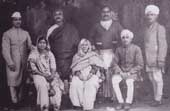
I am beholden to P.V. Rawal of Jammu for sending me a photograph of Allama Iqbal’s Kashmiri Brahmin family taken in Sialkot in 1931. At this time Iqbal was in his mid-fifties. He had already risen to the top as the greatest Urdu poet, at par with Mirza Asadullah Khan Ghalib. Although he was proud of his Brahmin descent, he had nothing to say about his Hindu relations. In this picture, the elderly lady seated in the middle is his grandmother, Indirani Sapru, nicknamed Poshi, wife of Pandit Kanhaya Lal Sapru. The man standing on the left in a shawl is Iqbal’s cousin, Amarnath Sapru; note the close resemblance to the poet.

The family traces its origin to one Birbal. They lived in the village of Saprain (hence, the surname Sapru) on Shopian-Kulgam road. Then the family moved to Srinagar where Iqbal and most of his cousins were born. Birbal had five sons and a daughter. The third one, Kanhaya Lal, and his wife, Indirani, had three sons and five daughters. Kanhaya Lal was Iqbal’s grandfather. His son, Rattan Lal, converted to Islam and was given the name Nur Mohammad. He married a Muslim woman — Imam Bibi. The Saprus disowned Rattan Lal and severed all connections with him. There are different versions of Rattan Lal’s conversion. The one given to me by Syeda Hameed, who has translated some of Iqbal’s poetry into English, maintains that Rattan Lal was the revenue collector of the Afghan governor of Kashmir. He was caught embezzling money. The governor offered him a choice: he should either convert to Islam or be hanged. Rattan Lal chose to stay alive. When the Afghan governor fled from Kashmir to escape its takeover by the Sikhs, Rattan Lal migrated to Sialkot. Imam Bibi was evidently a Sialkoti Punjabi. Iqbal was born in Sialkot on November 9, 1877. As often happens, the first generation of converts are morekattar than others. Iqbal thus grew up to be a devout Muslim. It is believed that once he called on his Hindu grandmother, then living in Amritsar. But there is no hard evidence of their meeting and of what passed between them; Iqbal did not write about it. Though he had many Hindu and Sikh friends and admirers, he felt that the future of Indian Muslims lay in having a separate state of their own. Iqbal was the principal ideologue of what later become Pakistan. Iqbal’s mother-tongue was Punjabi but he never wrote in it. He used only Persian and Urdu, as did many Urdu poets before him.

There are many aspects of Iqbal’s personal life which have not been fully researched by his biographers. We know he married two or three times and that his favourite son was Javed, who became a judge of the Lahore high court. Iqbal’s affair with Atia Faizi of Bombay when they met in London is well-known. There must have been some correspondence between them to show the kind of relationship they had. When in Heidelberg, he was taken up by his young German tutor, Emma Veganast. This secret was divulged by the mayor of Heidelberg in a speech in which he named a part of the bank of the river Neckar after him — Iqbal Weg. The Pakistani ambassador to Germany had the mayor’s speech mentioning the girl’s name suppressed. Iqbal and Emma continued to write to each other till the end of his life. The correspondence should be available in archives in Lahore and Heidelberg. Lovers of Iqbal, among whom I count myself, deserve to be presented with a fuller picture of their idol. We have biographies of Rabindranath Tagore revealing all his love affairs but none of the Allama telling us of the kind of man he was.

Cleansing the system

A couple of lines by Guru Nanak which I often recite to myself to preserve my mental balance run as follows:

Haumain deerag rog hai

Daaroo bhee iss maahen

Ego is a foul disease

Its cure also lies in itself.

I agree with every word of the Guru’s advice. Egoism or self-esteem is a disease like cancer. If not nipped in the bud, it infects other parts of the body and ultimately makes a person a deadly bore who loves talking about himself and wants others to praise him. Every one of us is prone to catch it and must evolve his own methods of fighting it.

Since I get more than my share of flattery from men and women who want me to write about them in my columns, I have to battle against them in different ways. Most tell me how they have read everything I have written and how much they liked it. I know it is not true; so I try to put it out of my mind. Others lay it on thick, that is, makkhan lagoing, when they come to see me. I do my best to change the subject. Despite that some of it sticks because later I find I am pleased with myself. I have found a more effective antidote: it is to make fun of myself. I narrate incidents in which I have made an ass of myself. I did that so many times. Everyone has a hearty laugh at my expense and thinks I must be the kind of fool I make out myself to be. It has a cathartic effect. It purges a lot of ego-poison out of my system.

Try out this purgative

Recently, I had to undergo an endoscopy to clear or confirm cancer in my belly. Needless to say, I wanted everyone to show concern for my health. It is another form of feeding one’s ego. As I had calculated, I got exaggerated shows of affection for me. After it was over, I felt I should restore my ego-balance to its earlier level. I wrote about it in lurid detail. Since I had to use a lot of indelicate vocabulary, which I feared publishers of my columns would find unacceptable, I sent the copy to Vinod Mehta, editor of Outlook. He is the only man I know who would understand what I wanted to say without censuring how I said it. In that piece I have written in detail about the humiliation and loss of esteem an endoscopy entails. Writing about it did cleanse my system of the false notions I had about myself. I felt much better.

source: http://www.telegraphindia.com / The Telegraph, Calcutta / Front Page> Opinion> Story / Saturday – June 30th, 2007

Solar-powered, self-cleaning eToilet for schools unveiled

The eToilet has an automatic flush, which works before and after use, sensor controlled water usage and eliminates the need for manual cleaners in schools. / The Hindu

Eram Scientific, manufacturers of the country’s first eToilet, on Tuesday unveiled the world’s cheapest unmanned, self-cleaning eToilet with inbuilt solar panel and metallic platform for schools.

“This is our contribution to the nation and comes as a response to the “Clean India Campaign” announced by the Central Government. It perfectly matches with the “Make in India” campaign as well,” said Siddeek Ahmed, chairman of Thiruvananthapuram-based Eram Group.

Built of stainless steel base, mild steel super structure and occupying 25 sq.ft space, the eToilet comes with a price tag of Rs.99,999 ex-factory, which is inclusive of insurance charges and one-year warranty.

It has got an inbuilt solar panel, which eliminates the need for electricity connection while the metal platform avoids civil construction too.

It has an automatic flush, which works before and after use, automatic floor wash, sensor controlled water usage and eliminates the need for manual cleaners in schools.

“The present problems in sanitations at schools are known to be not because of the dearth of toilets. The lack of maintenance and requirement for manual cleaning has made them dysfunctional. We are out to address that gap and that is why we are now launching this comprehensive solution for schools,” said K. Anvar Sadath, CEO.

source: http://www.thehindu.com / The Hindu / Home> News> Cities> Thiruvananthapuram / IANS / Thiruvananthapuram – September 30th, 2014

Two Brothers Wanting Power For Their Farms Invented A Bamboo Windmill That Is 10 Times Cheaper!

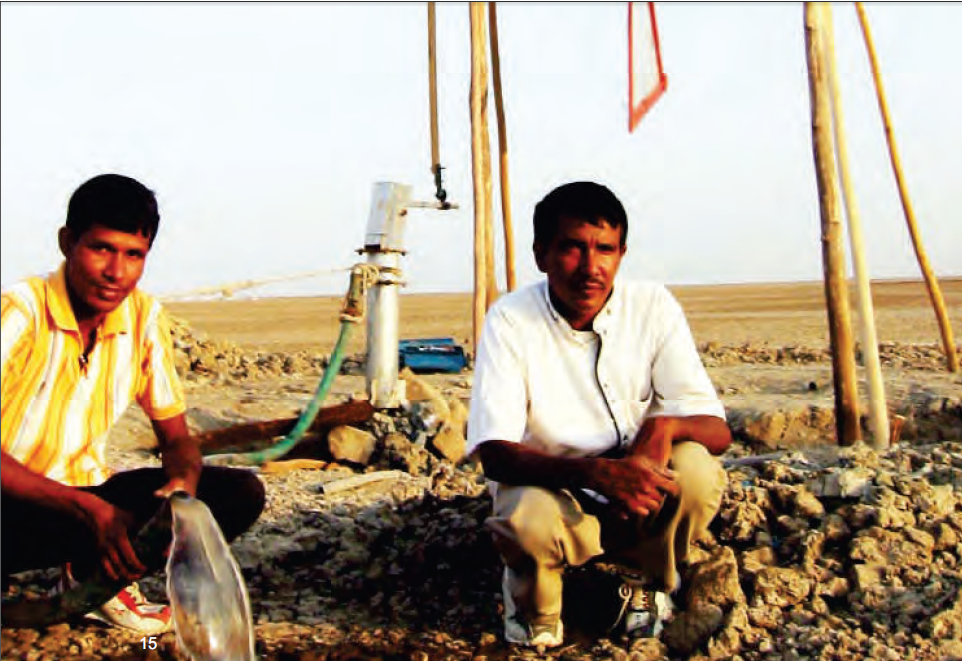
Brothers Mohammad Methar Hussain and Mushtaq Ahmad wanted power for irrigation and they developed a low cost windmill made out of bamboo, which is more than 10 times cheaper than the regular ones available in the market. Now, there are more than 25 such windmills running in Gujarat. Read to know more about their journey and how they did it. 

Mohammad Methar Hussain and his brother Mushtaq Ahmad from Darrang district in Assam grew paddy in the winter season (also known as bodo paddy). Irrigation involved a lot of manual effort and using diesel sets for pumping  water was a huge drain on the resources. To tackle this issue, Mehtra thought that if they could run a large wheel on wind power, and connect the wheel to the hand pump, that would serve their purpose quite efficiently.

So, both of them started working on making a windmill unit from locally sourced materials such as bamboo wood, strips of old tyres, pieces of iron, etc. With the help of a carpenter, the first prototype was ready in four days. Since the supporting framework was composed of bamboo, the final product costed Rs. 4500, vis-a-vis the commercially available wind mills which cost over Rs. 60,000.

Mehtar and Mushtaq
Mehtar and Mushtaq 

Innovation Diffusion : Assam —–> Gujarat

India is the third largest salt producing country in the world with an average annual production of about 157 lakh tonnes. The Little Rann of Kutch (LRK) supplies 21% of the total salt production of India.

Salt workers, known as Agarias, are some of the poorest people in the state. Agarias mostly used counterpoise, a method that requires two people, one for lowering the counterpoise and other for straining the water. Some of them started using diesel pumps, but the exorbitant machine and fuel costs made a huge dent in their already diminishing returns from salt farming.

With the mission to improve lives of salt farmers, Gujarat Grassroots Innovation Augmentation Network – West (GIAN W) along with National Innovation Foundation (NIF-India) took the lead in diffusing the innovation in salt farming areas.

Based on the feedback received from salt farmers, GIAN W improved the design and developed a multi-dimensional model which was installed at LRK in 2008. Understanding the diverse needs of farmers to increase the efficiency of windmills, GIAN W joined hands with Alstom foundation for design modification and improvement.

As of 2012, 25 of these windmills have been installed in Kathivadar and Kadiali villages in Amreli district.

Low cost windmill has solved irrigation problems for the village

 Benefits of the Windmill Pump

Thanks to the windmill pump, now salt farmers don’t have to slog for hours with the water pump. The windmill pump saves about Rs.50,000 worth of diesel in six months. It has decreased salt farmers’ reliance on manual labour resulting in savings of about Rs. 28,000 per season per person. Farmers can now easily recover their investments within the harvesting season.

The innovation would also result in the reduction of five tonnes of carbon emissions for every 100 tonnes of salt produced. As per NIF, on an average, every windmill-powered hand pump should generate five Carbon Emission Reductions (CERs) certificates worth Rs.3750.

Every rupee saved and milligram of carbon emission reduced is a glaring testimony of how rural innovations impact the community, society and the world at large.

In the next phase, GIAN W plans to erect more windmills in other parts of Gujarat. The salt farmers of Gujarat are indebted to Mehtar and Mustaq for making their lives more efficient and their occupation, profitable.

For any enquiries related to the machine, please get in touch with NIF-India at bd@nifindia.org.

source: http://www.thebetterindia.com / The Better India / Home> Innovation> Gujarat / by Rahul Anand / July 24th, 2014


Sir Syed Day 2014 in San Francisco Bay Area

San Francisco:

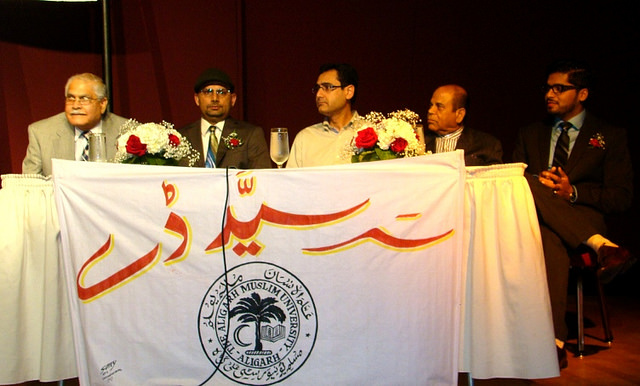
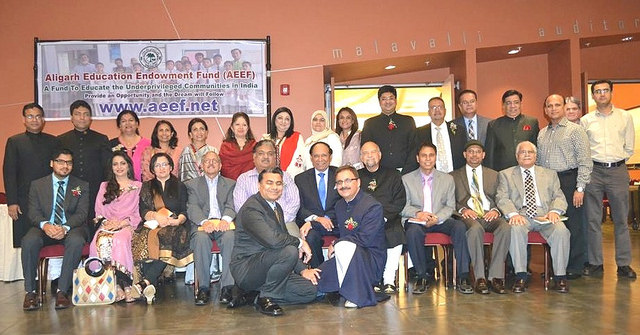
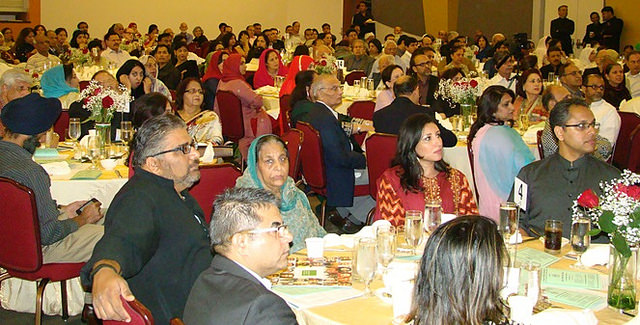
The Aligarh Muslim University Alumni Association of Northern California carried on its annual tradition of holding Sir Syed Day in the San Francisco Bay Area with a fine evening of cultural expression, reflection and entertainment at the ICC in Milpitas on Saturday, September 20th.

Funds were also collected on the occasion for the Aligarh Education Endowment Fund (AEEF) which supports those whose path to education is impacted by lack of funds or social mobility. Both children and youth are assisted through this AEEF vehicle and one can commend Aligarh Muslim University (AMU) alumni for making their annual homage to Sir Syed Ahmad Khan, the founder of their Alma Mater an added purpose.

SirSyed1MPOs30sept2014

After a fine dinner of Mughlai cuisine the formalities began with the traditional recitation from the Holy Qur’an by Mohammed Nadeem. Emcee for the evening Dr. Shaheer Khan made the necessary introductions. He said that everyone here needs to be thanked for their dedication, because the hall tonight is full to its maximum capacity and people unfortunately had to be turned away. He added that the Mushaira or Urdu poetry recital held here attracts many people but it is the cause which is the prime reason for this gathering, which is Sir Syed and AMU. He said that Aligarh was and is a movement and not just a place. He also took the opportunity to thank the sponsors and supporters along with the ICC for making this event possible. He also recognized local South Asians who are running for positions in the upcoming elections (Mohammed Nadeem running for Santa Clara City Council and Moina Shaiq running for Fremont School Board were here. Congressional candidate Ro Khanna was to arrive later).

Next was the President’s Welcome which this year was given by the new head of the AMU Alumni Association of Northern California, Mr. Shachindra Nath. In his short speech Shachindra Sahib welcomed everyone and took the opportunity to share his familial connection with Aligarh Muslim University (AMU) which his father also had the good fortune to attend. He pointed out the mutual respect and tolerance which he found at AMU. “I am so proud to be an Aligarian,” he said. Shachindra Sahib has been a dedicated member of the AMU Alumni Association for several years and it should come as no surprise that today he is the President of this organization.

The Sir Syed Day keynote address this year was presented by Ambassador Islam A. Siddiqui. Dr. Siddiqui till recently served as Chief Agricultural Negotiator in the Office of the U.S. Trade Representative and has now joined a think tank, the Center for Strategic and International Studies (CSIS) as a senior adviser in its Global Food Security Project in Washington DC. He is also a very familiar face to many of us in northern California because of his many years working for the State of California in Sacramento and for his long-time community activism; he is one of the founders of UMA and has been the President of the Downtown Sacramento Muslim Mosque. Although not an alumni of AMU, Dr. Siddiqui said that he was forever indebted to the campus because that is where he met his wife over 40 years ago!

“When I think of Sir Syed Ahmad Khan’s contributions to India and the world at large, it is about Education, Economic Empowerment and Moderation,” said Siddiqui. Giving the audience a backdrop of British-Indian history, and the poor state of Muslims after the 1857 revolt (the first attempt by Indians to gain independence) which failed, Sir Syed’s unique role was highlighted. “Here came a thinker and a visionary, who had worked for the British East India Company, had studied the causes of the Indian revolt, published a commentary on the Bible and was even instrumental in establishing The Scientific Society of Aligarh,” he said. He added that Sir Syed was fighting for the educational, social and economic uplift of Indian Muslims about the same time as President Abraham Lincoln was fighting for the cause of African Americans to abolish slavery in the United States.

He said that today the situation of the Muslim masses in India is not great and cited some relevant statistics from the Sachar Committee Report of 2006 which concluded that “When it comes to education the situation of Indian Muslims is indeed depressing as compared to other socio-religious communities and the problem is more acute among girls and women”. Siddiqui remained hopeful that as India’s economy grows, economic opportunities for all Indians will expand. “As the saying goes: A rising tide lifts all boats,” he said. He also reinforced the charter of the AEEF and its fundraising activity by saying that it is our moral obligation to give back to the under-privileged in the community and country that made it possible for us to reach where we are today.

SirSyed2MPOs30sept2014

Dr. Shaheer Khan returned to present an AEEF Update. The Aligarh Education Endowment Fund needs about $100,000 for 2014-2015 academic year to fund its projects which include the sponsorship of excellence in education through scholarships, Aligarh Modern School, Hamara School Aligarh, Faizabad Public school (Faizabad), Faiz-e Aam Muslim Inter College (Faizabad), Hira Public School (Ambedkar Nagar), J.A.B.I.C. Bhadarsa (Ambedkar Nagar), J.D.J.B. Anand P.G. College (Faizabad), M.I. Girls Inter College (Faizabad), Rishiraz Singh Maha Vidyalya (Faizabad), and many others.

It is also supporting Saiema Mansoor Public School (Hathras), vocational training for women, a mentorship program and students at premier institutions in India. A short fundraising appeal was made with a target of $60,000 in mind. And in the process, just before the entertainment, the Aligarh Tarana or anthem was enthusiastically played and sung by some of the alumni of AMU present.

The second part of Sir Syed Day is the “International Mushaira” which brings together some of the finest poets or practitioners of Urdu language poetry from around the globe (mainly from where it is used most, India and Pakistan). Countries can be partitioned but one cannot do that with a language. Urdu’s birthplace is in India where AMU is physically located too, but Urdu ironically is the national language of Pakistan. Where borders and governments divide, language-culture and family unite. I did get an opportunity at this event to meet the Consul of India in San Francisco and air the trials and tribulations of getting a visa for India for a person of Pakistani origin!

This year the list of poets was “Pakistan heavy” for the lack of a better term. The Mezban or host poets in order of appearance were Shahid Siddiqi (Canada), Misum Samer (Bay Area), Faisal Azeem (Canada), and Ahmar Shehwaar and Tashie Zaheer (both from the Bay Area). The Mehman or guest poets were Ambareen Haseeb ‘Amber’ (Pakistan), Nusrat Mehdi (India), Abbas Tabish (Pakistan) and Sarfraz Shahid (Pakistan). Two new aspects were noted in this year’s Mushaira. One the Nizamat was done by a young lady (Amber) and two the Sadarat and closing poet (Sarfraz) was the one who provided comic relief (possibly designed so that people went home in a good mood).

It would take another full article here just to cover the Mushaira segment of the evening. But just to highlight some of the activity here, senior poet Abbas Tabish aptly described the entire Mezbaan Shayir group (locals) as amongst the most talented that he has ever seen. All of them were worthy and it was good to see young Faisal Azeem back in this area. I just had to thank Tashie Bhai personally for his one line that made us proud. In a nutshell none of the local “amateur” poets were less than professional!

SirSyed3MPOs30sept2014

Amongst the four Mehman Shayir’s (guests) Ambareen was extremely entertaining both as a poet and in her “Tum Bhi Naa” and in her Nizamat role. Nusrat Mehdi was the feminist voice of the evening and she was amazing in Tarannum especially with her “Mein Bhi to Hoon”. Abbas Tabish was his usual pensive self with his “Intizar ke Lamhe” and his ode to mothers everywhere. And last but not least Sarfraz Shahid who in his Sadarat role provided enough comic relief to us that many had smiles on our faces as we made our way out of the door. His take on “Maulana and Hoorain”, romance in Cricket “Musalman mard ko char hi run ki Ijazat Hai” and his political cutlery were all very well received.

The Annual Sir Syed Day Aligarh magazine was also released on this occasion. The magazine is dedicated to Hali and Shibli. This year marks the 100th death anniversary of Maulana Altaf Husain Hali and Maulana Shibli Nomani, two pivotal members of the team of Sir Syed’s ‘Rufaqaa’ in the establishment of the MAO College.

In conclusion we did not stay for the doosra daur (round two) of the poetry but it was already quite a rewarding and satisfying event for us. The Aligarh Alumni Association of Northern California once again needs to be congratulated for holding this gathering where everyone enjoyed the food, revisited Sir Syed’s vison and participated in quality entertainment.

source: http://www.twocircles.net / TwoCircles.net / Home> News / by Ras H. Siddiqui, TwoCircles.net / September 30th, 2014

Muslim Library turns 100

The only public library of its kind that has survived without government grants, NGO money or foreign funds 

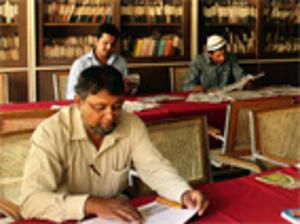
Muslim Library at Shivajinagar, houses more than 25,000 rare books and manuscripts. Photo credit:Anantha Subramanyam K

It was a time when the final push for freedom from British rule was gaining momentum. Prose and poetry were motivating people to join the freedom movement and a small group of Muslim intellectuals in the city responded the best way they knew — by spreading knowledge. Determined not to seek funds from “outside”, the group gathered as much money as they could spare and launched a library.

A hundred years on — commence centenary celebrations on Sunday (Sept 28) — the Muslim Library in Shivajinagar still stands tall and proud, a testimony to the steely determination and goodwill of its founding group. The library now houses about 25,000 rare books and manuscripts and holds a record of sorts: It is the only public library of its kind that has survived without any government grants, NGO money or foreign funds.

Located at Number 8, Veerapillai Street near Jumma Masjid Road Cross, Shivajinagar, the Muslim Library continues to retain and promote the old charm of calm and quiet library-reading in the age of Kindles and iBooks. Though the library is largely patronised by senior citizens, one can find young academicians and researchers pouring over tomes in the library every day.

“Apart from translations of Mahabharata, Ramayana and the Bible in Urdu, the library has around 2,000 books in Persian and an equal number in Arabic,” said Ayub Ahmed Khan, president of The Muslim Library Trust. What differentiates this library from others though is its funding mechanism: It has been self-financed since its inception.

The library was launched on May 5, 1912 by a group of Muslim intellectuals including Mahmood Khan Mahmood (author of Saltanat-e-Khudadad — an authoritative history on Tipu Sultan in Urdu), printing press owner Mir Abdul Haq, headmaster Abdul Rauf, teacher Farheed Khan, advocate Mohammed Saleh Ansari and Mohammed Abdul Abdul Aziz. “These people were inspired by the freedom movement,” says Khan. “They contributed from their own pockets and vowed not to source funds from outside. That custom continues till date,” he said.

Although launched in 1912, it began full-fledged operations only a couple of years later (that’s why the centenary celebrations this year) from a rented room with a collection of 867 books. Abu Mohammed Abdul Wahed, the septuagenarian secretary of the library, says, “By 1929, the library had 29 members and 12,000 books. We now have 600 members not just from Bangalore, but even from Kolar, Mulbagal and Doddabalapur. The present members of the library are well-known personalities including IAS, IPS officers, doctors and lawyers all of whom are proud to be associated with the library. All our members donate books and the collection has now swelled to 32,000.”

Inflation appears to have given the membership fee a miss — it was Rs 10 in 1928 and is now a very affordable Rs 200. The visitors’ book has the names of several dignitaries including poet Mohammed Iqbal who penned ‘Sare Jahan Se Achcha’, author Syed Sulaiman Nadvi, poets Josh Malihabadi, Jigar Moradanadi and Seemab Akbarabadi. Moulvi Abdul Haq, the editor of the Urdu journal ‘Shair’, also visited the library in 1937.

The library got its own three-storey building in 1970 in Shivajinagar. The building was constructed by L Mohammed Yisuf, the architect of 66 buildings of various Muslim organisations in the city. Mohammed Altaf Hussain, who has been librarian for the past 15 years, said, “A lot of school children visit during the summer vacation. There are 30 to 40 regular visitors every day. The library is open between 10 and 12 in the morning and 4 and 8 in the evening.”

Hussain reveals that great care is taken to maintain the books. “Besides daily sweeping etc, the library is comprehensively cleaned and pest-controlled every month. I don’t keep old books lying around. They are taken out of cupboards only if members specifically ask for them. We have regular visitors who come here to read magazines and newspapers, but most visitors are keen to read novels which are treasured in our library.”

source: http://www.bangaloremirror.com / Bangalore Mirror / Home> Bangalore> Others / by Bharat A. Patel , Bangalore Mirror Bureau / September 28th, 2014

Historian’s guide through the Constantia

Lucknow :

The grand construction of General Claude Martin, the Constantia, served as a lodge for Freemasons, a secret society, as many of the English officers including Martin were Freemasons.

Many such lesser known facets pertaining to the life and times of Claude Martin were brought to light by celebrated British historian, Dr Rosie Llewellyn Jones at La Martiniere College on Sunday. The talk was organised by Indian National Trust for Art and Cultural heritage (INTACH), Lucknow Chapter.

After being attacked by the Raja of Banaras invading Lucknow through Farhat Baksh Kothi, General Claude Martin began residing in the Constantia which he built as a fort. Constructed with four spiral columns that go right up to the terrace, cleverly with a lone staircase, Gen Martin made sure the building he liked to show off to his fellow Englishmen was secure with iron doors made from imported English iron. These doors could then be shut once a single man defending the building from the top took position upstairs.

Constantia was safeguarded by cannons on the first floor of the building next to lion statues with lamps within them. “Its construction as a defensive structure to frighten people, basically its attackers, is one of the least known features of the Constantia, which prior to being an educational institution, was a fort,” shared Dr Jones.

INTACH’s convenor Vipul Varshney talked about the axial symmetry and architectural genius of the gigantic structure with pioneering ventilation. Dr Jones also spoke about many paintings of Claude Martin.

Iron girders in the basement of the Constantia go deep down to its foundation. Dr Jones denied presence of any such tunnels opening into the Gomti against a popular myth.

Convernor Vipul Varshney talking about the architectural skyline of Lucknow said, “the heterogeneity of cultural conceptions and artistic styles triumphed to strike a harmony between the many buildings of Lucknow getting along the Nawabi and English architecture successfully in Lucknow’s skyline, and so in that order we decided to educate and inform Lucknowites about one such magnificent structure, the Constantia.”

Gen Martin a self taught man had as many as 5000 books and the presence of certain books on creating electricity have made historians like Dr Jones believe that he might have attempted to create electricity as well in the lower rooms of the Constantia. The result of his trial and error techniques on it though are yet to be studied further.

Heritage conservationist and lawyer by profession, Mohammad Haider stating the building as an unprotected monument applauded the efforts of Principal Carlyle McFarland, the staff and students of the college, ” the unique feature of this building stands in the fact that it has been well maintained within the precincts of its original form and the monument an architectural masterpiece is devoid of any uncalled for scribbling on the walls of the campus unlike the state of most protected monuments in the country.”

source: http://www.timesofindia.indiatimes.com / The Times of India / Home> City> Lucknow / by Yusra Husain, TNN / September 29th, 2014

Azim Premji

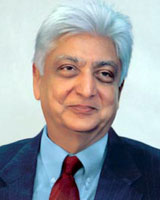
A personality revered by all the software professionals and an icon to the aspiring youth of the country, Azim Premji besides being the Chairman of Wipro Technologies, is a good human being who has never failed to inspire the young entrepreneurs. Initially starting with cooking oil to household goods to software, the company under the flag of his leadership never failed to deliver its best.

Early Genesis

AzimPremjiMPOS29SEPT2014
Azim Premji was born in the year 1945 in Mumbai in a Gujarat Muslim family. He studied electrical engineering at Stanford University, US when he had to come back to India to take care of his family business because of the sudden demise of his father. He took control of ‘Wipro’ the company that dealt in the business of vegetable oil at the age of 21 and his success that followed afterwards is history. Azim Premji is happily married to Yasmin Premji with two children, Rishad and Tariq.

A devoted professional and hard worker, Azim Premji took ‘Wipro’ to an admirable height. Eventually ‘Wipro’ grew into a 3,500 Crore empire. Today ‘Wipro’ is included among the top hundred technological companies in the world and Azim Premji holds the position of the richest man in country his property amounting to around 17.1 billion US dollars. Azim has taken his company to the height from where it operates with the major IT companies of the world namely Nokia, Cisco, Nortel, Alcatel and General Electric company. Under Azim Premji the company has spread its wings in the fields of IT, R & D Services and BPO. The largest outsourcing company in India and research and service provider, ‘Wipro’ has ventured into the areas which nobody could think of.

Other Achievements
For his stupendous contribution to the field of software technology Azim Premji has received several awards and accolades. He has been titled ‘Businessman of the year 2000’ by Business India, ‘Business leader of the year 2004’ by Economic Times, one of the ‘100 most influential people in the world’ by the Financial Times in the year 2004, ‘One of the 25 most powerful business leaders outside the USA’ by Fortune in the year 2003 and “power to effect change” by Forbes in the year 2003. He has also been facilitated and honored by the title of doctorate by the Indian Institute of Technology,Roorkee and Manipal Academy of Higher Education. He is the first person in India who received the ‘Faraday Medal’ in the year 2005. He has been given the title of ‘Padmabhushana’ by the government of India.

The Other side of him

AzimPremji2MPOS29SEPT2014

Azim Premji has contributed a lot to the development of the country. He has started an organization known by the name of ‘Azim Premji Foundation’ which works with the sole motto of providing primary education to every single child of the country. Having around 17,000 schools operating under the organization, Premji finances for all its requirements.

A man of principles and ethics, Azim Premji has never compromised with the quality and level of commitment to his work. He is informed of all the officials working for his company who respect and revere their employer for the strength of his character. ‘Don’t do anything that you’re unwilling to have published in tomorrow’s newspaper with your photograph next to it’ -is the slogan of his company with which it has reached the zenith of success and fame.

source: http://www.headlines.mapsofindia.com / Headlines India / Home> LifeStyle> Man’s Word