Category Archives: Community Involvement / Social Issues

First Muslim Woman to Enter Civil Services Awarded Padma Shri

She broke the glass ceiling many a times, from being the first woman to enter any Class-I civil service to becoming the first IRS officer to be appointed a UPSC member and to being the only woman to have worked in the Central Narcotics Department.

After donning multiple hats during her long career, it was another proud moment for Parveen Talha, when she was conferred the Padma Shri award on Saturday for her contribution to the Civil Services.

But the road to success wasn’t that easy for Talha and the biggest hurdle was to overcome the anti-women mindset of her bosses at the initial stages of her career.

“It is indeed a proud moment for me but I am grateful to my bosses too. Though I had to initially deal with their anti-women mindset when I joined services 45 years ago, after a few years I was able to prove that I could handle the tricky jobs as efficiently as my male colleagues,” Talha told PTI.

70-year-old Talha joined Indian Revenue Service (Customs and Central Excise) in 1969 where she worked for 35 years and was then picked up as a member of the Union Public Service Commission (UPSC) in 2004.

“Once my bosses began to trust in my capabilities, I started getting challenging assignments including posting as Deputy Narcotics Commissioner in Uttar Pradesh,” she said.

“There was a large-scale leakage of opium going on in UP then. While I tried my best to play a stringent officer dealing with certain illegal channels, poppy cultivators were surprised too because they had never seen a woman at that level,” she added.

By halting for days in the cultivation areas and delving deep into all processes of poppy cultivation from sowing to lancing and harvesting, she gathered foolproof intelligence which was put to good use by her hand-picked preventive parties.

During her posting in UP and Bihar in 1990s, she attached illegally acquired property worth millions of rupees belonging to smugglers and drug traffickers at the risk of her life.

While she was posted as Director General Training in 2002, Talha provided strategic vision to the Department of Customs and Central Excise in evolving comprehensive packages of programmers for technical capacity building of all cadres and service providers.

Talha, who was honoured with the President Award for “Specially distinguished record of service” in 2000, also has a penchant for writing.

She has written ‘Fida-e-Lucknow’, a collection of 22 short stories, besides writing the dialogues for the serial ‘Husn-e-Jana’ directed by Muzaffar Ali.

“I find there are stories in every nook and corner that are waiting to be told. So I will pursue my passion for writing now that I am a retired person,” she said.

source: http://www.newindianexpress.com / The New Indian Express / Home> Nation / by PTI –  New Delhi / April 27th, 2014

MELANGE : At home in Peelamedu

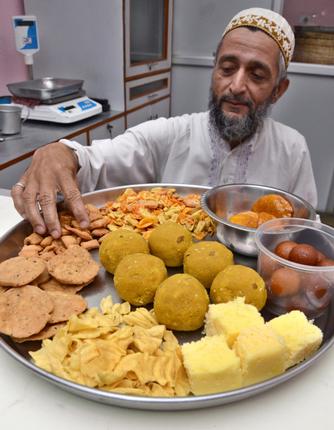
A taste for community spirit: Saifuddin, the mithai wallah./ Photos: M. Periasamy / The Hindu

The Dawoodi Bohra Muslim Community, originally from Gujarat, has made Coimbatore its own, yet it retains its distinctive cultural and culinary identity

Evening Namaz has just ended. Men in topis and flowing white kurtas emerge from the mosque. Women in colourful gowns zip through the lanes on their two wheelers. The smell of hot khakras wafts from the nearby sweet shop. Children returning from their evening Arabic and Quran classes, buy savouries from there and run home. The conversation one overhears in a language that sounds like a mix of Urdu, Gujarati and Persian. It is called Lisanud-Dawat. Sound of laughter comes out of a home. The Burhani colony of Coimbatore in Peelamedu wakes up to its night life.

“Many of us have settled here for generations since the time of our great grandfathers,” says Alifiya M Mamoowala who has volunteered to be my guide for the day. “There are around 392 families here. And, we have become a part of this city.”

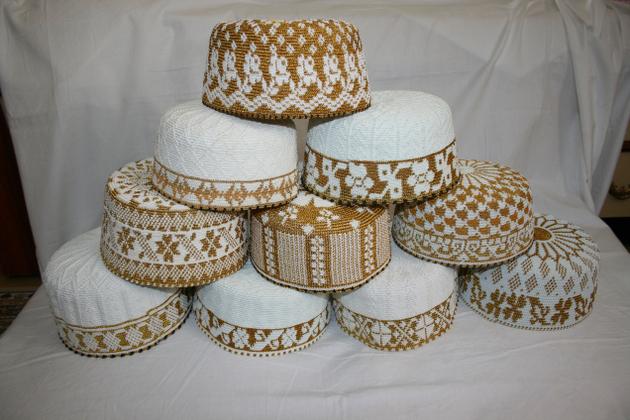
Topis worn by Bohra men./ The Hindu

At the same time we hold onto our tradition,” adds Feroz Y Dak, as he leads me to the office of Aamil Saheb, the community’s religious and administrative head.Aamil Saheb hails from Madhya Pradesh and has been holding this office for the last two years. “The community settled in Coimbatore in the early 1930s. We originate from the Khambat district in Gujarat,” he explains. And they believe they must abide by the law of the land where they live, says Aamil. “I am learning Tamil. And, my children go to a Tamil medium school,” he smiles.

Next, I visit the burhani mithai stall, where Saifuddin Bhai Ahmedabadwala fries hot mathris. His shelves are laden with laarvas, a typical burhani laddoo made of besan and stuffed with raisins. His sweet puris drip sugar syrup and I am told they are a must during Shab-e-barat. But Saifuddin’s road to fame is his gulab jamuns, made with khoya. “Even the locals love it,” he says with pride.

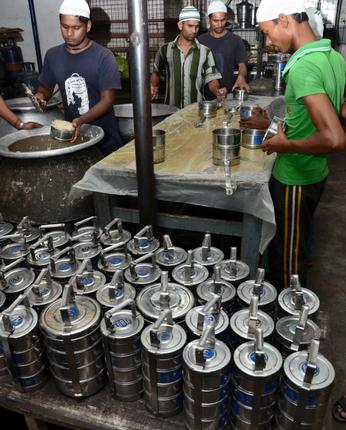
I meet another Saifuddin who is head chef at the Community Food Hall. “I have worked across India I have learnt other recipes by working with the local chefs.” “At the Community Food Hall they prepare free dinners for all the houses in the colony. This is one way of making sure that the ladies of the community get some free time to do what they want,” says Feroz.

The food hall./ The Hindu

“Looks like it is biryani today,” says Feroz as we sniff appreciatively. Inside, there are huge davaras of chicken biryani. Hundreds of tiffin boxes are neatly arranged on the floor. They will be despatched along with rose lassi and raitha. “Each tiffin box carries a number allocated to a house. So, no one uses the vessel used by the others,” says Feroz. Residents can either collect their tiffin boxes at the hall or get them delivered at their door steps. As dusk falls, lights pop on in the kitchens. At Alifiya’s house, Gulshan Y Mamoowala has whipped up a grand meal. As soon as we enter, she welcomes us with a bowl of crystal sugar. “That’s the bohra custom of welcoming the guests with a sweet note,” says Yunus Bhai Mamoowala, her husband. Gulshan’s lemon yellow skirt and a blouse that she wears with a pretty shawl is called jori. “We wear these inside the house. The burqas are called ridas and are worn outside,” says Alifiya.

“Ridas and joris have become a big style statement,” adds Munira Gheewala, who has dropped in to apply mehendi on Alifiya’s daughter’s hands. “During weddings women wear ridas with zardozis and elaborate embroidery, floral panelling and tatting.” Bohra weddings are grand, says Munira. “We apply mehendi on the entire arm of the bride! Our designs are mostly Arabic motifs, featuring creepers and flowers.”

ThaalMPOs26apr2014

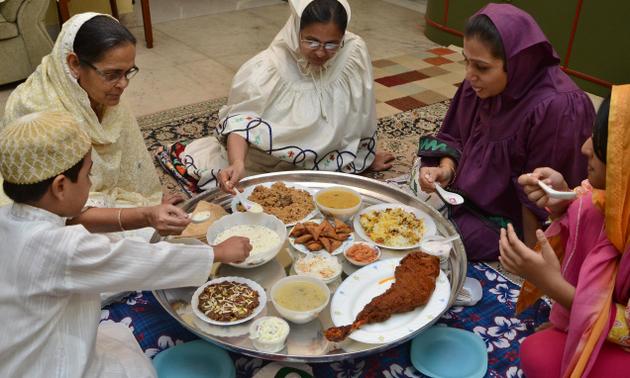
Conversation ceases as Gulshan brings the huge thaal and places it on a stool. The entire family sits around the thaal. “The whole point is to drive home the message of togetherness,” says Feroz. “This strengthens our bond.”

The first thing I am offered is a pinch of salt! “It opens your taste-buds,” says Gulshan. And in bohra cuisine, desserts come first, says Alifiya. Sodena (sweet rice and badam) and Shir khurma, (something like semiya payasam) kick start the fare. The main course has a shoulder of lamb hot from the tandoor, dal chawal palidu and rotis with khichda (haleem). “The signature dish in a burhani cusine is the simple dal, rice and palidu combination. Palidu is a little like rasam. It is cooked with tuvar dal stock, drum stick and regular spices,” explains Gulshan.

We round off the sumptuous meal with sweet paan. As we sit back on the cushions, Yunus shows me the pictures of their ancestral home at Sidhpur, Gujarat. Magnificent havelis, with a dozen windows, mark the bohra colony. “All the traders used to live here. Each house is built close to each other to create community spirit,” says Yunus. “Our family came to Coimbatore 25 years ago to set up business here. We still go back there once in a year,” says Yunus.

As I bid farewell to the Mamoowala family, Gulshan sprays attar on my hands and tells me to rub it on my clothes. “This is for you to always remember the beautiful memories of the evening you spent with us,” she says.

I smell my hand again and smile as the fragrance recreates in my mind the lanes of Sidhpur and its airy havelis.

source: http://www.thehindu.com / The Hindu / Home> Features> MetroPlus> Melanage / by Parshathy J. Nath / Coimbatore – April 25th, 2014

Geared up

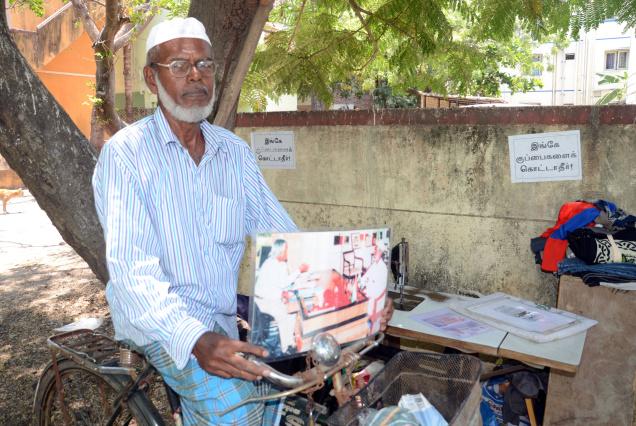
Mission on wheels: While cycling to Delhi from Chennai, S. Nagoor Meeran made many friends./  Photo: M. Karunakaran / The Hindu
Mission on wheels: While cycling to Delhi from Chennai, S. Nagoor Meeran made many friends./ Photo: M. Karunakaran / The Hindu

Nagoor Meeran, a tailor, cycled to Delhi to meet Abdul Kalam. Vipasha Sinha on his feat

Neither the merciless weather nor the bumpy roads could stop S. Nagoor Meeran from meeting the APJ Abdul Kalam in 2003. At that time, Kalam was the President of India.

Nagoor started his journey to the capital by cycle from Tenkasi. In 35 days, he rode through Chennai, Hyderabad, Nagpur, Bhopal, Agra. It was commendable for a 57-year old to perform such a feat.

Ten years later, Nagoor shares the story of that journey and talks of his love for cycling.

“The Lion’s Club was planning to do an event to promote world peace. They had different ideas in mind but I suggested that I could cycle all the way to Delhi and meet the president,” says Nagoor, who is a tailor by the day and watchman by the night.

It was an Imam from his town who suggested to him the idea long ago and this seemed like a perfect opportunity. He had also met Kalam’s brother in Rameshwaram and expressed his interest in meeting the head of the country.

“However, when I reached Delhi I was told I could not meet the President. Yet I was hopeful. I wrote about my journey and the purpose of the meeting and left the request in a glass box kept for people who wish to meet the President. Reading it, he agreed to meet me. I quickly changed my clothes ahead of the meeting. Mr. Kalam was kind enough to have lunch with me. We spoke about three things – the need to promote peace and communal harmony, development in his native town of Tenkasi, and my desire to visit Mecca. I also presented a letter appreciating him,” says Nagoor.

He also got a chance meet other ministers and personalities. All that he carried for the journey on a basic Hercules cycle was a small bag and a bottle of water. He says there were many people who helped him complete his quest along the way.

“I would start in the morning and by six in the evening, I would look for a temple or a police station or a forest department office where I could spend the night. Some people would offer food and water. Between Agra and Delhi come these humungous soft drink outlets, I went there and they gave me two big bottles of cool drinks for the journey. Since water was a major problem, I would befriend the truck and lorry drivers on the highway, and they would erect tents where they could rest. I would use their water tanks to clean my clothes and take a bath. There were times when I would go without a bath for days. I also maintained a diary with the signature and names of all the people who helped me during the journey,” says Nagoor, who has to spend around Rs. 10,000 for this trip, which was partially sponsored by Lions Club and Sun Tv.

Completing his mission, he took a train back to Chennai. Now, he carries in his small bag a photo taken with Kalam and few newspaper clippings lauding his feat. Ask him why he took that journey, he says: “It was just for the love of cycling.”

source: http://www.thehindu.com / The Hindu / Home> Features> Down Town / by Vipasha Sinha / Chennai – March 29th, 2014

Confluence of ragas


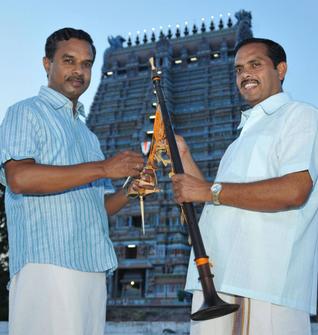
S. Kasim and S. Babu, Nadhaswaram vidwans and grandsons of the legendary nadhaswaram exponent Sheikh Chinna Moulana, feel there is no place for ego in music. / Photo: M. Moorthy / The Hindu

Kasim and Babu are the inheritors of nadhaswaram exponent Sheik Chinna Moulana’s musical legacy in more ways than one. Nahla Nainar listens to their story

Grandsons or disciples? “Before we are grandsons of Sangeetha Kalanidhi Sheik Chinna Moulana, we are his disciples,” asserts Subhan Kasim. Speaking about his maternal grandfather and acclaimed nadhaswaram exponent is clearly a matter of great pride for Kasim, who with his younger brother Babu, was handpicked by the maestro to continue the family’s musical legacy.

Kasim and Babu meet visitors at ‘Alaphana’, the 1950s-era house in Srirangam that was formerly Sheik Chinna Moulana’s residence and is now Kasim’s home. A hot breeze stirs up the dry leaves outside, but the mood inside is one of quiet reflection. It will be 15 years this week since Sheik Chinna Moulana died at the age of 74.

“From 1982, after I graduated from college, until Thatha’s last concert in 1999 in Chennai’s Music Academy, where he was awarded the Sangeetha Kalanidhi title, I was performing with him,” recalls Kasim. “Thatha never had a retirement phase, he just kept working, or teaching.”

The Dr. Chinnamoulana Memorial Trust set up by Kasim and Babu will be hosting its 15th Shradhanjali (commemorative gathering) at Tiruchi this week.

Music in the veins

Originally from Karavadi in Andhra Pradesh, the family has over three centuries of experience in playing the nadhaswaram. “Thatha belonged to the Chilakaluripet school of music,” says Kasim, naming the town in Guntur district. “Among his gurus were his own father, Sheik Kasim Sahib, and later, Sheik Adam Sahib.”

Despite emerging as a noted performer in the Andhra style of Carnatic music, Sheik Chinna Moulana decided to explore the Thanjavur ‘bhani’ (school) which allows for greater variations in presenting ragas. “From an early age, Thatha was influenced by the recordings of T.N. Rajarathinam Pillai (1898-1956). He migrated to Tamil Nadu to get trained in the Thanjavur style of playing by the Rajam-Duraikannu brothers of Nachiarkovil for four to five years,” says Kasim.

Sheik Chinna Moulana’s career took off in the early 1960s, and Kasim believes it was the exposure to the Thanjavur ‘bhani’ that helped immensely. The maestro decided to make the pilgrimage town of Srirangam his home. Kasim, who accompanied his grandfather to Tamil Nadu early on, studied at the Srirangam Boys High School, and went on to graduate in Physics, at St. Joseph’s College, Tiruchi, while getting his music education at home.

Babu joined the in-house gurukul in his teenage years, and was educated up to Standard 8 in Andhra Pradesh. “We started our training with smaller versions of the nadhaswaram,” says Babu in halting Tamil, “Then, as we became older and and our hands grew accustomed to reaching all the fingering holes, we were given the regular-size instruments.”

The nadhaswaram, together with the ‘thavil’ drum, are often referred to as ‘mangala vadyam’ or auspicious instruments, showing their importance to sacred music in southern India.

The nadhaswaram’s use as a solely temple-based instrument for daily prayers and processions was slowly introduced to a more public and secular platform by royal families and later, the landed gentry.

“Nadhaswaram is an integral part of our society,” says Kasim. “Few occasions – weddings, housewarming ceremonies or prayers – are complete without its music.”

The days of concerts that would start late and go on past midnight are well and truly gone, says Kasim. “Artists today have learned to compress what was being done in four hours, to two-and-a-half. Most of the concerts these days are held from 7 to 9.30 p.m., which is a good duration. It allows more women to attend as well,” he says.

Concert exposure is as important to the artist as getting practical instruction, says Kasim. “I learned a lot about presentation and public relations while performing with Thatha,” he says. “These days, with overseas assignments, the artists must be prepared to interact with people of other nationalities too.”

Above all barriers

Kasim and Babu maintain an extensive audio-visual archive of their grandfather’s music concerts at home. Some video samples, such as Sheik Chinna Moulana and shehnai virtuoso Ustad Bismillah Khan exchanging ideas on fingering techniques on the two instruments, are shown to students of the Saradha Nadaswara Sangeetha Ashram, a school established by Sheik Chinna Moulana and today run by his family in Srirangam.

A typical day for the brothers starts off with breathing exercises (pranayama), and is followed by practice sessions on the nadhaswaram. Afternoons are reserved for vocal music lessons for the students, followed by instrument training in the evenings. “We spend the rest of the day in updating ourselves,” says Kasim. “Unlike before, there are hundreds of compositions being brought out these days, so as active performing artists, we must be familiar with what is going on in the arena.”

As to whether there’s any sibling rivalry during concerts, Kasim replies: “I support my brother when he takes the lead, and he supports me when I take the lead. There is no place for ego in music.”

The success of Muslim artists like Sheik Chinna Moulana and Bismillah Khan in a sometimes exclusively Hindu cultural sphere is a great example of India’s syncretism. Both the brothers, presently the special nadhaswaram artists of the Tirumala Tirupati Devasthanams, feel that music is above matters of faith.

“Thatha often used to say ‘music is my religion; perfection is my aim.’ In northern India, most of the doyens of classical music are Muslims. You have the Kirana gharana, Bade Ghulam Ali, Roshanara Begum and so on. Those who speak of religion cannot ignore the contribution of the Mughal dynasty to the field; ragas like Malkauns, Amir Kalyani and Darbari Kanada all have an Islamic origin. Only those who are ignorant about music object to Muslims in the field,” smiles Kasim.

What is more pertinent is institutional support for classical music in India, he says. “The temple’s day begins and ends with nadhaswaram music. But increasingly, even big temples are doing without these musicians. The government should step in by paying exponents a decent salary and encouraging their employment,” says Kasim. “The backing of sabhas is crucial as well, because it helps in the musicians’ professional growth.”

Tribute to the maestro

The Dr. Chinnamoulana Memorial Trust, set up in 1999 by his grandsons Subhan Kasim and Subhan Babu, will be hosting its 15th ‘Shradhanjali’ (commemorative gathering) at Hotel Sangam on April 13 and 14.

At the event, the trust will be presenting nadhaswaram instruments to six deserving students this year, and for the first time, ‘thavil’ drums to three pupils, as part of the corporate social responsibility initiative of Bharat Heavy Electricals Limited (BHEL). In addition to this, a purse and citation each will be presented to senior artists Pandhanallur P.K. Ramalingam Pillai (nadhaswaram) and Needamangalam C. T. Kannappa Pillai (thavil).

Concert performances include a vocal recital by T.K. Krishna on April 13, and a nadhaswaram rendering by M. Sivadivel the next day. The event is being organised in co-operation with Rasika Ranjana Sabha, Tiruchi.

source: http://www.thehindu.com / The Hindu / Home> Features> MetroPlus / by Nahla Nainar / Tiruchirapalli – April 11th, 2014
Young minds behind Rizwan’s online footprint

Volunteers working at Rizwan Arshad’s war room. (Left) Congress candidate from Bangalore Central, Rizwan Arshad along with MLA Dinesh Gundu Rao campaigns in Gandhinagar on Wednesday —R.Samuel

Bengaluru: 

The Karnataka Pradesh Congress Committee (KPCC) office stands proud on Queens Road, with larger-than-life posters of Rahul Gandhi gazing down on the busy street. However, all the election time action is happening elsewhere, in a narrow bylane nearby where the party’s back office is located, invisible to those who are not in the know.

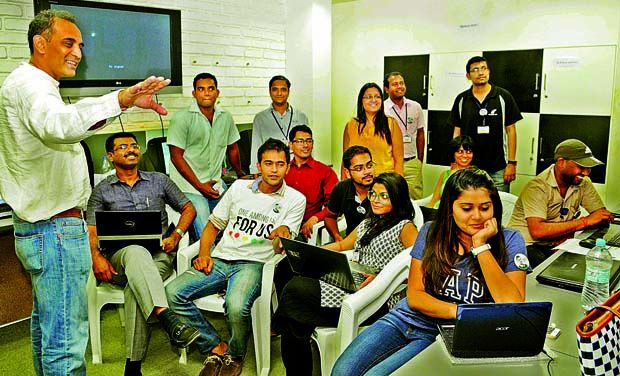
About 30 people sit inside the quiet office, slaving away at their computers. Youtube videos, social networking and Website content are generated here, and the group is responsible for the Congress party’s strong online presence.

These are volunteers who have put their regular jobs on hold for Congress’ Bangalore Central candidate Rizwan Arshad, vowing to ensure that he wins the election.
Inside the ‘op centre’, people from different teams don’t interact with each other directly.
“The campaign is never fully revealed,” said a source. “That’s the best way to keep it a secret.” Even so, the pieces come together to form a well-knit campaign, titled “One Among Us, For Us.”
“I heard of this through a mutual friend and I think Rizwan is a great guy. Besides, being part of the campaign gives me a high. I have been doing this since the last three elections,” said Bhagath Reddy, a marketing professional in his thirties. “I make it a point to volunteer for someone or the other.”
The group of volunteers, he said, comprises people between the ages 18 and 32, some of whom work on the campaign full time and others who come in on weekends. “It’s interesting to see these volunteers here, because in today’s world, people barely know who the candidates are even in their own constituencies.”
At this point, Muzaffar enters the room. The 34-year-old businessman says he and Rizwan are childhood friends and have been together since school.
“I’ve been campaigning for him since college,” he said. “We’ve been together through thick and thin.” Although he has been closely involved with local politics and his loyalty to Rizwan Arshad has never faltered, he has no political ambitions himself.
That seems to be the case, though, with all the young volunteers. The involvement of youth in politics seems issue-based. Anushree N., who does content, and Shruti Das, who handles graphic design, echo this sentiment.
“I want to understand how the system works,” said Shruthi, in response to why she volunteered for this. “I’ve never done political writing and I wanted to give it a try. It’s been a great experience so far,” said Anushree.
Whatever their reasons, for the youth, this is more than a battle between political candidates. This is a chance to shape the India they want to see. //
source: http://www.deccanchronicle.com / Deccan Chronicle / Home> Nation> Politics / by Darshana Ramdev / April 10th, 2014  

Drumming up a legacy of 32 generations

Artistes gather this weekend to remember Ustad Karamatullah Khan, who carried a legacy of centuries, Yogesh Pawar reports

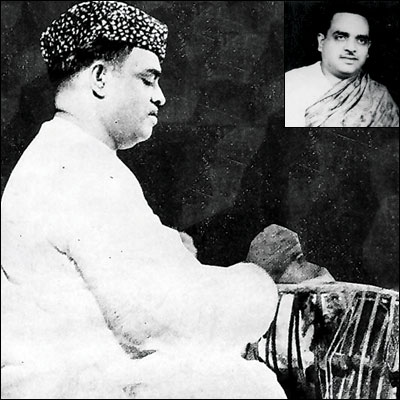
UstadKaramathullahKhanMPos14apr2014

An unbroken lineage going back to the 12th century: that’s the legacy of the late tabla doyen Ustad Karamatullah Khan, who passed away in 1977 after a lifelong commitment to music.

“To carry the weight of the legacy of 32 generations and do it ever so lightly is no joke,” says renowned octogenarian sarod maestro Buddhadev Dasgupta. Though frail in health, his spirits pick up as he remembers Farukkhabad gharana’s Karamatullah Khan, who passed away when he was just 60.

“Just the mention of his name brings memories of his divine tabla,” he adds while addressing a gathering on the occasion of a special tribute to the late legend at the National Council of Performing Arts, Mumbai this weekend.

In fact, there was a time in the 50s and 60s when no top artist would perform without him, remembers well-known vocalist Ustad Rashid Khan, part of the line-up at the event.

“Imagine his formidable talent that he would be the accompanist of choice for the late sarod maestro Haafiz Ali Khan saheb (father of Ustad Amjad Ali Khan), sitar maestros Enayat Khan saheb (father of the late sitar maestro Ustad Vilayat Khan), Pt Ravi Shankar and Kathak legend Pt Birju Maharaj,” he points out. “These are giants in their arts. If all of them insisted on him, can you begin to fathom his exceptional greatness?”

International Kathak legend Pt Chitresh Das, who grew up in the Kolkata of yore, sheds more light on the man. “I grew up watching Ustad Karamatullah Khansaheb performing in all-night concerts in Kolkata. I also saw his father perform. I danced with Ustad Karamatullah Khan when I was just 20 years old at the grand New Empire auditorium in Kolkata. (Karamatullah’s son) Sabir was just three years old then. It’s a great feeling to have performed with three generations of this family,” Das says.

Vocalist Begum Parveen Sultana echoes him. “Music is the only way to pay tribute to a soul as great as him. We can only hope and pray dua for a man who was an exceptional guru, musician and human being. In classical music, the main requirement is surrender and complete bhakti for the art. Without that, there can be no sukoon in your art like the kind Ustad Karamatullah Khan found.”

In this, Karamatullah was taking a leaf from his father, the late Ustad Masit Khan, the unparalleled tabla legend of his time who also performed with most if not all top musicians, such as vocalist Ustad Fayyaz Khan saheb and Ustad Haafiz Ali Khan. In fact, he was primarily responsible for popularising the tabla in West Bengal through disciples like the late Pandit Jnan Prakash Ghosh and, of course, his son who brought in a new dimension as he blended his tabla technique effortlessly with vocal, instrumental and dance, not to mention his solo performances with equal ease.

As India’s top names from the world of classical music come together on one platform, his son and heir to the Farukkhabad legacy, Ustad Sabir Khan, who will a lead a tabla quartet with his three sons, admits to being overwhelmed by the love and respect for both the gharana and his father. A tinge of bitterness escapes him though.”I wish some of this had come in his lifetime. Despite being a pioneering artiste and composer, he never got his due.”

Stating that his father was so devoted to his art that he barely had time to chase honours like the Padma awards, the son says, “But the fact that he is remembered and recognised by music lovers for the unparalleled rich legacy he has left behind is perhaps the best possible award.”

This is not a son’s indulgent hyperbole. Other tabla legends like Ustad Zamir Ahmed Khan point out how no tabla player in the world can be free from the Farukkhabad gharana influence. “Many others have hogged the limelight and become media darlings but the true connoisseurs know when they begin playing how much they borrow from our gharana’s teachings.”

The Farukkhabad gharana of tabla was created in the 12th century by a Rajput court musician, Akaasa, who later converted to Islam and changed his name to Mir Akaasa. Sabir Khan credits him with introduction of bols into percussion. The first bols introduced were tat-dhit-thun-nan. “It began with pakhawaj and later these techniques were brought into tabla too.”

Mir Akaasa died in 1189 AD. He was succeeded by nine sons and a daughter. He passed on his legacy to his eldest son, Ustad Bilawal Khan, who in turn passed the torch of the gharana to Ustad Ali Bux (famous for his kran bols). This tradition continued till the 26th descendant, Ustad Haji Vilayat Ali Khan (1779-1826). It was he who named this gharana after the province he settled in — Farukkhabad.

Soon after his seven pilgrimages to Mecca, Haji Vilayat Khan gained fame for his famous battle of tabla gats with Ustad Salaali Khan saheb who had challenged Ustad Bakshu Khan saheb of the Lucknow gharana. In order to save his pride, Bakshu Khan saheb requested Haji saheb, who was also Salaali Khan saheb’s uncle, to fight the battle with Salaali Khan saheb, on his behalf.

A fortnight-long battle ensued where many gats (authentic compositions of the gharanas) and jodas (pairs of such compositions) were exchanged, Haji saheb played a unique gat (gat of Gazi) whose joda Ustad Salaali Khan saheb could not come up with. Haji saheb was declared the winner.

As a reward, Ustad Bakshu Khan saheb gave his daughter in marriage to Haji saheb, who in return gave Salaali Khan saheb his own daughter in marriage along with 14 authentic gats known as jahezi gats as dowry. Ustad Sabir Khan — the 33rd generation of this unbroken lineage is followed by his sons Arif, Asif and Ameen Khan who take after him.

There is a huge variety in the repertoire of compositions owing to the tremendous creative output of great composers such as Haji Vilayat Ali Khan, Ustad Nisar Hussain Khan saheb, Ustad Nanhe Khan saheb and Ustad Karamatullah Khan. This is of course discounting the huge number of new gats.

Little wonder then that the oldest school of tabla has such a rich and varied repertoire.

Earlier known as the purbi baaj (eastern style), characterised by an extensive use of resonant strokes the playing style contains similarities to the techniques of the pakhawaj certain bols, such as dheredhere, takataka.

Medieval pandits
Mir Akaasa (founder) (1132 – 1189)
Ustad Bilawal Akasa (1151 – 1208)
Ustad ALi Bux (kran) (1182 – 1255)
Ustad Bairam Khan (1204 – 1260)
Ustad Dhamman Khan (1236 – 1292)
Ustad Tajalmulh Khan (1260 – 1297)
Ustad Bunda Khan (1284 – 1329)
Ustad Asgari Khan (1306 – 1348)
Ustad Ali Raza Khan (1331 – 1371)
Ustad Ali Ahmed Khan (1355 – 1398)
Ustad Ramzan Khan (1378 – 1438)
Ustad Bakshu Khan (1397 – 1508)
Ustad Ali Asgar Khan (1425 – 1480)
Ustad Neyaz Khan (1450 – 1525)
Ustad Daulu Khan (1496 – 1548)
Ustad Waheed Khan (1517 – 1565)
Ustad Altaf Khan (1534 – 1574)
Ustad Jannesar Khan (1546 – 1609)
Ustad Dilawar Khan (1570 – 1646)
Ustad Yawar Khan (1602 – 1653)
Ustad Nasru Khan (1628 – 1677)
Ustad Bhurey Khan (1648 – 1691)
Ustad Enayat Khan (1676 – 1732)
Ustad Murad Khan (1705 – 1747)
Ustad Inam Ali Khan (1731 – 1790)
Ustad Shetab Ali Khan (1759 – 1816)
Ustad Aman ALi Khan (1779 – 1826)
Ustad Haji Vilayat Ali Khan (1803 – 1873)
Ustad Nesar Hussain Khan (1824 – 1877)
Ustad Nanhe Khan (1847 – 1902)
Ustad Masit Khan (1872 – 1974)
Ustad Karamatullah Khan (1917 – 1977)
Ustad Sabir Khan (1959)
Arif Khan (1986)
Asif Khan (1990) Ameen Khan (1992)

source: http://www.dnaindia.com / DNA / Home> Lifestyle / by Yogesh Pawar / Place:Mumbai, Agency:DNA / Sunday – April 13th, 2014

Lucknow madrasa stands apart

Writing success stories from behind the veil

Girls studying in the seminary speak fluent English and learn about interior decoration.For a casual visitor they may appear to be orthodox Muslim girls in veil receiving Islamic education at a “madrasa” (Islamic seminary).

Begum Shehnaz Sidarat watches as girls study in madrasa at Firangimahal in Lucknow

But when you talk to them the opinion will quickly change. They tell you  their views about the world in fluent English and turn out to be modern in their outlook. They are computer savvy and can give you a tip on interior decoration.

These girls, as a part of their studies at the seminary, learn language and affairs of the world. Besides, they are told to be modern in their outlook. “I want the girls to remain in hijab (veil) but at the same time drive a car and also speak English,” says Begum Shehnaz Sidarat, who runs the seminary, which is located at the historic Firangimahal in the walled city in Lucknow.


The name Firangimahal had been given to the building as it used to house Britishers before Independence, who were then referred to as “firangis”.

“There is a general perception that girls who receive education in madrasas, are not modern and progressive in their outlook. They prefer to remain indoors and are considered to be orthodox. I want to change this perception,” Shehnaz told Deccan Herald.

Shehnaz calls it a kind of “fusion”. “It’s an endeavour to bring the religion closer to society, to make it progressive and make sure that there is no clash between society and the religion,” she says.

She started the madrasa in 2012. “Today, we have 33 girls and all of them are from conservative families. But that doesn’t make any difference,” Shehnaz remarks.

“The syllabus of the madrasa has been designed in such a way that it integrates religious education with modernity,” she points out and adds that it was essential today to teach the girls how to conduct themselves in a fast-changing world and at the same time maintain the traditions. Shehnaz says that all her faculty consisted of voluntary workers. She even has a Canadian national to teach girls English. Canadian Catherine Laur came in contact with Shehnaz while the former was in India in connection with her research work and got impressed with the concept of “religion-society fusion”.

Vocational training

“Besides English,  girls are taught computers, interior decoration and given vocational training so that they can become independent,” she says. Girls are also taught about the rights of Muslim women. “There is a popular misconception that Islam has not given rights to Muslim women.

We want to dispel this notion. The rights are there but women do not know about them and thus become vulnerable to exploitation,” she says. “Islam has given rights to women but society has deprived them of their rightful due.  It is really an unfortunate scenario,” Shehnaz says.

She said that almost all the girls at the madrasa are from middle class families and are studying 12th standard. “Initially, the response was not good but gradually it picked up,” she adds. Girls are charged a nominal fee at the time of getting admission. “We charge a nominal fee of Rs 50 only,” she says.

Shehnaz feels that there is an urgent need to re-define Islamic laws so that they are not in conflict with society. “When religious beliefs are in clash with the social beliefs, confusion begins,” she points out. “For instance there is a lot of misconception about the fatwas (religious decrees). There is no compulsion on anyone to abide by what the fatwas say.

They are simply advices to the people who seek some guidance on particular issues in the light of the islam,” she says.

Misconceptions

She also seems to be annoyed with the media for spreading such misconceptions about the “fatwas”. Shehnaz has been running adult education classes for Muslim women. She recently started adult education classes for Muslim women, who had been displaced after a large-scale communal violence in Uttar Pradesh’s Muzaffarnagar district. “We have opened four centres in Muzaffarnagar for such women,” she says.

Shehnaz says that she was thrilled by the tremendous response she received from Muslim women in Muzaffarnagar. “There were as many as 180 registrations on the first day of the opening of the centres,” she adds. Shehnaz and her group of volunteers also provide counselling to Muslim women who face exploitation of different kinds. “So far, hundreds of Muslim women have received counselling. Some were also provided legal help when it was required,” she adds.

A recipient of several awards, Shehnaz has so far successfully united hundreds of families which were on the verge of split owing to one or the other reason. Shehnaz wants to turn her madrasa into a university some day where Muslim girls could be given every kind of education. Though she herself belonged to a conservative family, Shehnaz wants Muslim girls to break the shackles of orthodoxy and adapt themselves to the changing world.

Shehnaz is also associated with All India Talim Ghar, which is engaged in providing training in teaching. “The Talim Ghar has so far prepared thousands of teachers. The students at Talim Ghar consist of all sections of society,” she says.

She underlines the need for conducting  an in depth research in Islam. “Some research has been done in Islam. Ulemas (clerics) have not been able to link the religion with society,” she adds.

source: http://www.deccanherald.com / Deccan Herald / Home> Special Features / by Sanjay Pandey – Lucknow / DHNS / March 30th, 2014

Shazia baaji an icon

Aruti Naya traces the journey of Shazia Ilmi from a middle class Muslim home to the electronic media

For Shazia Ilmi, Senior Anchor, Star TV, Chandigarh was a pleasant surprise, coming as she was after almost a decade. As she puts it, “The city compares favourably with any metro, it is amazing.”

In the city for the programme Match ke mujrim, for Star, which had to be hurriedly refocused because there were no mujrims! The audience was the students on the PU campus at Gandhi Bhavan, who went berserk after the cricket team’s win as Shazia talked to them after the match. “Each of them wanted the name of their department mentioned. Syed Kirmani and Bishan Singh Bedi who were on the live show could barely get a word in, says she.

Thirty-three-year-old Shazia has very good memories of the city because for this student of St. Bede’s, the city was a frequent stopover during the journey to the college in Shimla after the vacations. Shazia’s journey from a girl from a conservative Muslim family of Kanpur to a profession in the electronic media with a high visibility quotient was not easy. She had to persist and doggedly keep doing what she wanted to because no woman in her entire clan had ever worked. In fact, her mother still wears a burqa.

It was her father, the founder-editor of the oldest and largest-selling Urdu daily from Kanpur, Siyasat Jadid, who was her role model and Shazia always wanted to be a journalist. After schooling from St. Mary’s in Kanpur and Nainital and college from St. Bede’s, Shimla, it was mass communication from Jamia Millia Islamia and finally a diploma in broadcast journalism from University of Wales, Cardiff.

The youngest in a family of four brothers and two sisters, she was expected to marry comfortably and settle down or at best (since she was academically bright) become an IAS officer. But as she puts it, “When you have so many problems with the system, how can you become a part of it? Freedom is not economic alone, it is the freedom to make a choice and do what you want to from your heart.”

Five years hence Shazia sees herself in politics. Covering politics was very stimulating for her, especially elections in Bihar and Maharashtra. She travelled through the length and breadth of the states to get the views of people especially at the grassroots for the programme Maratha Express. She is also into programming, writing and production.

Shazia does not believe that “it is not a natural progression for an idealist to become a cynic. In fact, you can retain your idealism.” And she did not view marriage as a passport to a better life and even to happiness.

Icons who she looks up to, Kalpana Chawla and Kiran Bedi because, “They won respect for being action-oriented and decisive.”

Shazia is upbeat about the changes being wrought by the electronic media, it is changing the way the young are looking at themselves. The resonance of this changed perception echoes even in the bylanes of Chamnganj, Kanpur, when Rabia, who has never stepped out, tells her “Shazia baaji, please find out about Frankfinn, I want to become an airhostess,” At least, girls are thinking and dreaming.

In Kanpur Shazia baaji is an icon. Married to investment banker Sajid Mallik, half-Gujarati Muslim and half-Tamil Iyer, Shazia is emotionally dependent upon her extremely supportive husband. Shazia is not overtly religious but is into spirituality and meditation, still seeking answers. How does she distress, “I do not distress. Stress suits me fine and brings out the best in me.”

source: http://www.tribuneindia.com / The Tribune / Home> Lifestyle / Chandigarh – Sunday October 30th, 2005 

The Biography of Sazia Ilmi, a prominent Team Anna Member

Sazia Ilmi is a prominent member of Team Anna and one of the beautiful faces in the Indian Media. A Former Anchor in Star TV and  a noted  Journalist, she is now the urbane, Muslim, media-savvy face of Team Anna.

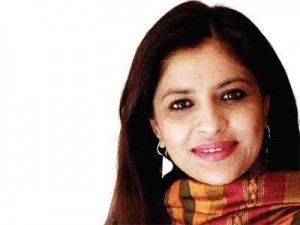
ShaziaIlmiMPos01apr2014

Born in 1970 to a middle class Muslim Family in Kanpur, she did her schooling from St. Mary’s in Kanpur and Nainital and college from St. Bede’s, Shimla.

Her Father was  the founder-editor of the oldest and largest-selling Urdu daily from Kanpur, Siyasat Jadid.

The youngest in a family of four brothers and two sisters, she was expected to marry comfortably and settle down or at best (since she was academically bright) become an IAS officer. But as she puts it, “When you have so many problems with the system, how can you become a part of it? Freedom is not economic alone, it is the freedom to make a choice and do what you want to from your heart.”

She is married to an investment banker Sajid Mallik, half-Gujarati Muslim and half-Tamil Iyer, Shazia is emotionally dependent upon her extremely supportive husband.  For her famous women like Kalpana Chawla and Kiran Bedi are source of Inspiration and possibly this is the reason she joined Team Anna.

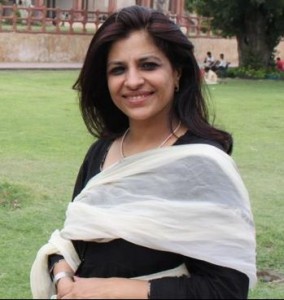
ShaziaMPos01apr2014

She is the Media Face for Team Anna. Whether it is Press Briefing or Television Debates it is Sazia who plays a prominent role.  Being on TV is Ilmi’s core competence. She has done it for 15 years, as political correspondent and news anchor. Sometime in 2010, she contracted a condition prevalent among working journalists of a certain vintage—a crisis of purpose. “I was done with mouthing inanities night after night,” Ilmi says.

She also plays her familiarity with Delhi’s media and political class to Team Anna’s advantage. Many decision makers in TV newsrooms are friends, former colleagues, or were fellow beat reporters. “I understand how the system works. And I know the media well. I have seen all the power broking and the wheeling-dealing,” she says.

Recently she was  nominated to be part of a media contingent travelling with Prime Minister Manmohan Singh to Mexico and Brazil but the proposal was withdrawn amid opposition from her brother.

source: http://www.news.biharprabha.com / Bihar Prabha / Home> Nation / by BP Staff / August 02nd, 2012

Capturing beauty of historical monuments

Private collectors across the world possess Mohammed Ayaz-ud-Din’s photographs

Mohammed Ayaz-ud-Din

Gulbarga, Karnataka : 

The story of lensman Mohammed Ayaz-ud-Din hailing from a remote village in Gulbarga district is an example of how dogged perseverance can take a person to the pinnacle in his profession.

Mr. Ayaz-ud-Din, who was born in a middle class family in Gadikeshwar village of Chincholi taluk, is making waves in the world of photography. Many of his works are owned by private collectors across the world.

Mr. Ayaz-ud-Din completed his post-graduation in photography from the College of Visual Arts, Gulbarga. He has a passion for historical monuments, and his photographs of Khajuraho Temple, Bodhgaya, and Ajmer, and the monuments in North Karnataka have won him laurels not only in India, but also in countries such as the United Arab Emirates (UAE).

The prizes he has received include the All India Exhibition Best Photography Award in 1990; award in the PAC Salon Photography Competition: Best Photography Award during Mysore Dasara in 2000; Tasmiya Art House Best Photography Award; Best Photography Award in the Awantika Art Exhibition in New Delhi. Mr. Ayaz-ud-Din’s love for photography took him from the expansive deserts of Rajasthan to the Khajuraho Temple and fashion shows in Sharjah. Al Sayegh Graphic Company appointed him graphic designer and still photographer in Sharjah for a period of three years from 1991.

Mr. Ayaz-ud-Din helped Mexican researcher Nora Fisher for during her research work on the lives of Lambada women.

His private gallery, “Ayaz Art Gallery,” which will be the second of its kind in the Hyderabad-Karnataka region, is scheduled to be inaugurated next week. Mr. Ayaz-ud-Din has made documentaries on artists, including former Minister Ghorpade, J.S. Khanderao, and Mr. Patil, and also on the Khaja Bande Nawaz Darga and Sharanabasaveshwar Temple in Gulbarga city. He is the founder president of the National Graduate Art and Photography Association.

source: http://www.thehindu.com / The Hindu / Home> Karnataka – Gulbarga / by Special Correspondent / Wednesday – May 03rd, 2006