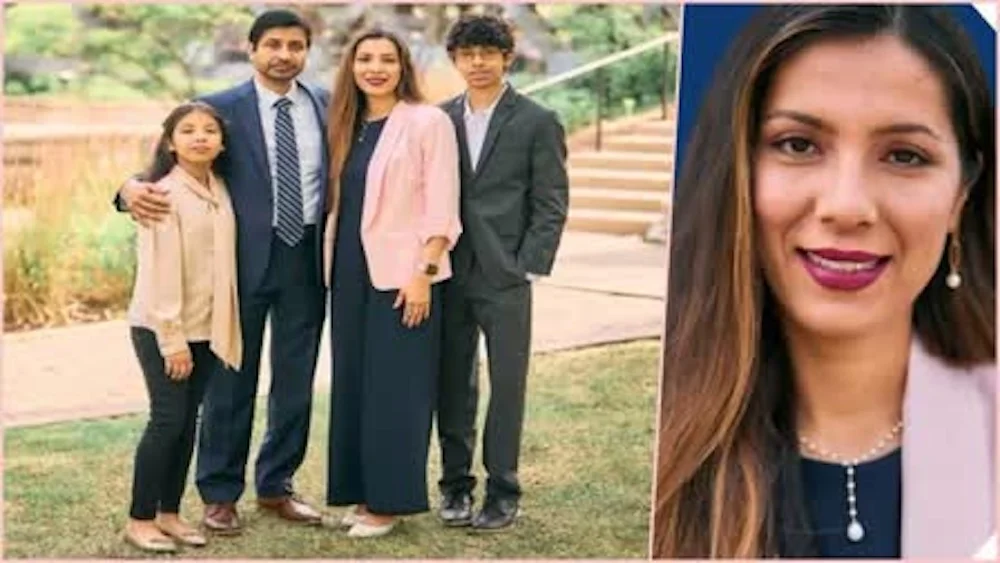
Falkia Khan, the Brand Ambassador of Mysuru City Corporation’s (MCC) Swachh Bharat Abhiyan and the Chairperson of Karnataka Junior Jaycees Wing, has been honoured with the District Kannada Rajyotsava Award this year, thus becoming the youngest to receive the award.
A 2nd PU student, Falkia has created multiple Records including in HI VIBE Book of World Records and India Book of Records, besides bagging Prerana Award- 2022 and Iconic Speaker of the Year-2024 award.
As a sports person, Falkia has bagged gold medals in District, State and National Muay Thai Championships. She has also demonstrated exceptional public speaking skills, winning numerous competitions and has been recognised as the youngest teen to deliver maximum public speeches.
Her philanthropic efforts, leadership and motivational endeavours have earned her recognition from esteemed organisations. She aspires to become an Indian Foreign Service Officer.
source: http://www.starofmysore.com / Star of Mysore / Home> News / November 10th, 2024
My sons, Morad and Yavar, were born in 1968 and 1972, respectively, and my daughter, Ayesha, in 1974. When I was pregnant with Morad, my husband said to me that he hoped for a girl in my image. But I gave birth to a robust ten-pound son! My male gynaecologist, Dr Beck’s remark is my first recollection when I regained consciousness from the Caesarean section, “Congrats, you have a little football player!” A Canadian could not have given a greater compliment. Later I realised that my husband’s desire to have a daughter had no firm basis. Holding his firstborn, he declared to all in the hospital room that from now he wanted only sons!
When I first set my eyes on Morad, I had just come out of general anaesthesia in the maternity ward of the University of Alberta Hospital. I saw his face and I can still feel my own gasp. His face was my mirror. He was lying, neatly bundled beside me. It had been a breach delivery. It took eight days for the stitches to heal before I could be discharged from the hospital. Hameed brought us home, both mother and child, wrapped and bundled. A memory that lingers is placing him on a white sofa before a large bay window overlooking the front lawn in which the grass had begun to turn brown. It was October 12, 1968.
Over the years, how did I see my older son? Introspective, and sensitive, he used to tease me by saying that his sensitivity was the result of his regressive genes! He was thoughtful, gentle, and he always had the right words for the right moment. One summer in Delhi, my children and I were at the Jamia Qabristan to recite Fatiha at their grandparents’ graves. As we waited in the drizzle for Mohammad Yunus, who was like family, to arrive to recite Fatiha for his son, Adil Shahryar, Morad must have felt the immediacy of death. “The land on which peoples’ marble is placed,” he said to me, “is incredibly fertile.” He remarked how lush and green the place was. Death, Morad said, was just a flash in this evergreen process of incarnation and reincarnation.
I think of another side of Morad: to put away his clothes, to pay his bills, to open his cheques, and to eat his packed lunches may not always happen. But he can pick up the brush and carefully clean the cobwebs. He has beautiful hands and a mane of dark curly hair. Tall like Yavar, a little stooping (which Hameed continually checked). Always a smile and word of encouragement for those around him.
“Mother, I was just thinking about you,” he said once as I came in, sweaty, rushed, and irritated.
“About me? What?”
“How beautiful you look and how much I love you.”
Sitting in my father’s home in Delhi years later, I wrote about my children in my diary. At the end of the piece on Morad, I wrote: I hope people can appreciate his quality and I hope I don’t fall into the trap of wanting to protect him. A man who has just finished studying five months of human anatomy. A man who has been running from work to school for two years. Surely, he doesn’t need his mother in that sense. Am I pig-headed?
My second son, Yavar, was born on Canada’s Dominion Day on July 1, 1972. Morad was the firstborn but Yavar was equally the joy of our life. He grew into a responsible young man, as well as a poet and an artist. One year, when I was away in India, he was invited to deliver his class valedictory address in Grade 12. He wore his father’s sherwani and delivered a beautiful speech. Why didn’t I return for the event? It remains one of the deepest regrets of my life. Through handwritten letters exchanged with him and with my sister I learnt how hard he had worked all year. Cleaning the house, mowing the lawn, hauling the garbage, washing dishes, folding laundry, and shovelling snow. Then he would sit down and compose a beautiful poem, play his guitar, paint, act, or run a marathon for the city. Initially, he had considered a career in community medicine or public health, but then he was accepted for a joint Master’s degree in law at the North Patterson School of Carleton University and the University of Ottawa. So he became a lawyer.
In 2009, I timed my return to Canada so that I could be in Ottawa for Yavar’s birthday. He received me at the train station since I had flown directly from Delhi to Toronto and taken the train from there. We drove straight to his office where I asked him about the landmark case he was fighting. Abousufian Abdelrazik was a Sudanese Canadian who was arrested in Sudan, while he was visiting his ailing mother in 2003. He was denied re-entry to Canada based on a United Nations anti-terrorism listing. The Federal Court of Canada later concluded that this arrest likely took place at the request of the Canadian Security Intelligence Service (CSIS). Though never charged, Abdelrazik was beaten, threatened, and tortured during two periods of detention totalling a year and a half. Blocked from returning to his home in Montreal, Abdelrazik went public with his story and took refuge in the Canadian Embassy in Khartoum, where he remained a virtual prisoner for fourteen months. Finally, a groundswell of public support from across Canada and a Federal Court ruling forced the government to issue permission. It was his lawyer, Yavar Hameed, my son, who fought the case with unswerving grit. He flew to Khartoum and returned home with his client.
That night I wrote in my diary: Yavar is on the brink of something big, something which will make him rise to great heights one day. I am so proud of him. His name will be up there with global crusaders for human rights.
From his office, we drove to his apartment which was across the street from the hospital where I had worked when I first stepped on Canadian soil in 1967, General Hospital on Bruyere Street. It has another name now and looks nothing like it was thirty years ago, but its sight revived some precious memories. Looking around Yavar’s well-kept apartment, I was happy to see that my three gifts were beautifully displayed. Three carpets that I had given him over the years: one from Peshawar, a Killam, one from Baku in Azerbaijan, and the third from Bokhara in Uzbekistan. The next morning, Yavar drove me to the airport. I wrote in my diary, “I am going to Edmonton with a heavy heart; it is always painful to leave Yavar.” I told him, “Yavar, you will become our torchbearer towards better climes and hemispheres. I will arrange my work so I can spend a few months with you every year.” Happiness flushed his face. At the end of my life, I say with regret that it never happened.
Excerpted with permission from A Drop in The Ocean: The Story of My Life, Syeda Saiyidain Hameed, Speaking Tiger Books.
source: http://www.scroll.in / Scroll.in / Home> Book Excerpt / by Syeda Saiyidain Hameed / October 03rd, 2024
Saba did her MSc in Wildlife Sciences at AMU, earning a gold medal. She moved to the United States with her husband, who is a computer engineer
Ghaziabad :
Saba Haider, a former student of Aligarh Muslim University (AMU) and a native of Ghaziabad in Uttar Pradesh, has achieved a significant victory in the recent DuPage County Board election in the United States. Standing as a Democratic Party candidate, she won by a margin of over 8,000 votes against Republican candidate Patricia Petty Goston, sparking celebrations in her hometown. Friends, family, and well-wishers are visiting her parents’ home here to congratulate them on this remarkable achievement.
In an exclusive conversation, Saba’s father, Ali Haider, shared insights into her background. Originally from Aurangabad in Bulandshahr, he moved to Ghaziabad for work, where he raised his family. Saba, known for her academic prowess from a young age, completed her intermediate from Holy Child School in Ghaziabad and earned a BSc from Ram Chameli Chadha College. Later, she pursued an MSc in Wildlife Sciences at AMU, earning a gold medal for her outstanding performance. After her marriage, Saba moved to the United States with her husband, who is a computer engineer.
Ali Haider emphasised that Saba’s interest in social service and politics began early in life. In the US, she initially taught yoga and soon became actively involved in community services. Her engagement in local governance led her to run for a school board position, although she narrowly missed victory in that earlier attempt. Despite setbacks, she remained determined, embodying the family’s philosophy of resilience and perseverance.
Saba’s mother, Meh Jabin Haider, expressed her pride in Saba’s determination. “We always taught her that one should never give up,” she said. “When faced with setbacks, it’s important to continue pushing forward.” Reflecting on her previous loss in a close race, Meh Jabin emphasised that Saba’s unwavering dedication and perseverance finally led to success in this election.
In a competitive race with a total of 70,109 votes cast in DuPage County, Saba Haider garnered 39,365 votes, while her opponent received 30,844 votes. Saba’s victory margin of 8,541 votes stands as a testament to her popularity and commitment to the community she now serves.
Saba’s win brings a sense of pride not only to her family and Ghaziabad but also to Aligarh Muslim University, where she built the academic foundation that has supported her remarkable journey. Her parents are hopeful that her success will inspire more young women to pursue their aspirations and make a positive impact both at home and abroad.
source: http://www.clarionindia.net / Clarion India / Home> Indian Muslim> Women> World / by Clarion India / November 08th, 2024
Senior leader of Telugu Desam Party (TDP) and former chairman of Andhra Pradesh Legislative Council Mohammed Shariff Ahmed has been appointed as the Advisor to Andhra Pradesh government on minority affairs.
Shariff, who is TDP general secretary, will enjoy the rank of a Cabinet Minister. He is the first Muslim leader to be appointed as Advisor by the TDP-led NDA government.
Shariff’s name figures in the list of 59 leaders appointed on nominated posts by the Chandrababu Naidu government.
This is the second important post given to Muslim leader by Chief Minister N. Chandrababu Naidu.
Nasyam Mohammed Farooq is the lone Muslim in Naidu’s Cabinet. The 74-year-old is the minister for law and minority affairs.
Shariff hails from Narsapuram in West Godavari district. The 70-year-old has been associated with the TDP since the party’s inception in 1982. He holds Bachelor of Commerce degree from a college in Narsapuram and Master of Commerce and LLB degrees from Bhopal University.
Shariff became chairperson of Legislative Council in February 2019 and held the position till May 2021.
TDP State Minority Cell president Moulana Mushtaq Ahmed has been appointed chairman of Andhra Pradesh State Minorities Finance Corporation. Hailing from Nandyal, he studied from Darul Uloom Sabeelur Rashad, Bangalore.
Shariff and Mushtaq are only two Muslim leaders in the second list of nominated posts.
In the first list released last month, the government had appointed TDP leader Shaik Abdul Aziz as chairman of state Waqf Board. Abdul Aziz, a former mayor of Nellore, is currently the TDP president for the Nellore parliamentary constituency. The 64-year-old industrialist-cum-politician was expecting nomination to the Legislative Council but was appointed chairman of the Waqf Board.
source: http://www.radiancenews.com / Radiance News / Home> Latest News> Report / by Radiance News Bureau / November 09th, 2024
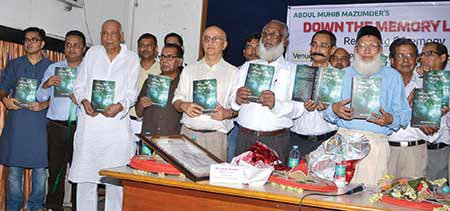
“Down Memory Lane II”, the second in the autobiographical series of books authored by Abdul Muhib Mazumder, former Minister and Advocate General of Assam, was launched in presence of a host of dignitaries at the Guwahati Press Club on 29 July.
The book has been edited by Abdul Wadud Aman, a lawyer and civil rights activist and published by the Centre for Minority Studies, Research & Development (CMRD) Assam.
At the outset, a citation on behalf CMRD was presented to Mazumder by Anowar Hussain, working president while a sorai was handed over by Zamser Ali, general secretary of CMRD.
Mazumder addressed the audience on this occasion saying, “I am tempted to make an appeal to the readers to enter into a discussion on the subjects dealt with by me which have a pronounced effect on social restructuring of our polity.” He appealed to the legal fraternity, in particular, who were present at the event in good numbers, to take up the issues, discuss them, analyse them and suggest solutions acceptable to all sections of people and the polity to pave way for emergence of a resurgent Assam.
Harsh Mander, Director of the Centre for Equity Studies & Special Commissioner to the Supreme Court of India in the Right to Food case, was the chief guest. Along with other dignitaries on the dais, he released the book. In his address, Mander said that he was born in Shillong and has had a long association with the North East. He has been visiting the region regularly to bring succour to the victims of natural and man-made calamities. He appealed to the youth of the region to stand by the side of the oppressed and the persecuted and raise their voice whenever their human rights are violated.
Others who addressed the event included Justice Aftab Hussain Saikia, former Chief Justice of J&K High Court; Justice DN Choudhury, former Justice of Gauhati High Court; Prof Abdul Mannan of Gauhati University; Ram Chandra Saikia, President of the Gauhati High Court Bar and Chinmoy Choudhury, Advocate General of Assam.
Incidentally, except for Prof Abdul Mannan, all the above mentioned personalities were students of Mazumder when he taught law at Gauhati University and were his junior colleagues when they started practice at Gauhati High Court.
(Nurul Islam Laskar — nurul.laskar@gmail.com)
source: http://www.milligazette.com / The Milli Gazette / Home> News> Community News / by Nurul Islam Laskar / August 29th, 2016
To mark Kannada Rajyothsava, Team B-Human conducted a charitable distribution drive on Thursday at Wenlock Hospital, Mangaluru, offering fruits and essential items to dialysis patients and children receiving treatment.
Dr. Shiva Prakash, District Medical Officer at Wenlock, inaugurated the event and praised Team B-Human’s efforts in raising awareness on health issues and supporting patients in need. “Wenlock Hospital has a well-equipped dialysis centre, and we provide a full range of treatment options in the children’s ward. Our mission is to offer free medical and surgical services to the underprivileged, both in urban and rural areas, along with specialized care,” he said.
Shareef Whitestone, a trustee of Team B-Human, highlighted the group’s commitment to community service, noting that they have sponsored free dialysis for many needy patients at Yenepoya and Kanachur hospitals over the past two years. “Our goal is to assist the economically disadvantaged across all communities. In the future, we also intend to offer financial aid to students from low-income families,” added Asif Deals, the founder of Team B-Human.
The distribution included lunch, blankets, and towels for adult patients, and special kits for young patients containing toys, fruits, biscuits, chocolates, diapers, slippers, and other essentials.
Several hospital staff and officials attended the event, including RMO Dr. Sudhakar T., physicians Dr. Sadananda Poojary and Dr. Abdul Basith, Nursing In-charge Sumanagala, Office Superintendent Tilak U., SDO Avil Clarence Raj, Health Committee Member Shashidhar K. Bajal, and ARS Member Prabhakar Amin.
Representing Team B-Human were members Imthiyaz Z. M., Abbas Uchil, Imran Hasan, Nazeer Ullal, Iqbal Bantwal, Ahnaf Deals, Basheer, Azeez, Faiz, and Health In-charge Haneef Thodar.
source: http://www.english.varthabharati.in / Vartha Bharati / Home> India / by Vartha Bharati / November 07th, 2024
Tariq Ahmad Patloo, 51, says he is grateful to the PM for appreciating his efforts, yet, he remains unmoved by the fame because successive governments have done nothing for the Hanjis- the dwellers of waters in the Dal and other lakes of Kashmir Valley.
The floating ambulance by Tariq Ahmad Patloo on Dal Lake in Srinagar (Image: ANI)
Houseboat owner Tariq Ahmad Patloo, who converted his boat into a floating ambulance to ferry COVID-19 patients on the Dal Lake in Jammu and Kashmir, found mention in Prime Minister Narendra Modi’s monthly radio address ‘Mann Ki Baat’ on June 27.
Fifty-one-year -old Patloo, who lives with his mother, wife and daughter, along with thousands of others in the houseboats stationed in the world-famous Lake of Srinagar, had designed the free floating ambulance service after he recovered from COVID-19 during the first wave of the pandemic in August last year.
Tariq Ahmad Patloo
Patloo, who owns the house boat named ‘Sea Palace’, apart from the ambulance, is grateful to the Prime Minister for appreciating his efforts. But, he is unmoved by the fame because of the grudge that successive governments have not done anything for the Hanjis- the ethnic community who are dwellers of waters in the Dal and other lakes of Kashmir Valley.”I can’t thank the Prime Minister enough for mentioning me in his address. But I would have been happier if the Centre, or the state, may have done something for the progress of our community.” Patloo told MoneyControl.
Hanjis living in about 900 houseboats, Patloo said, have been living in misery for years. “No one care for us. They talked about rehabilitation, nothing happened. They said they will relocate us, nothing happened. We do not have even a dispensary here. No one has been ever given a government job. We have had enough promises,” he said.
Patloo is not the only member from his family to catch Prime Minister Modi’s attention. In 2018, the PM praised his eight-year-old daughter Jannat’s efforts for cleaning Dal Lake.
“We don’t need money. We need to live a respectful life, like any other community,” he said.
During his ‘Mann Ki Baat’ programme the PM appreciated Patloo’s novel idea of a boat ambulance.
“Here a boat ambulance service was started at Dal Lake. This service was started by Tariq Ahmad Patloo ji of Srinagar, who is a houseboat 0wner. He himself has also fought the battle with COVID-19 and this inspired him to start the ambulance service,” the Prime Minister said in the 78th edition of the address.
Patloo said he thought of setting up the ambulance out of his personal experience. He had faced difficulties to reach the hospital from Dal waters when he contracted the disease. He was in home isolation for the first few days but had to be hospitalised at downtown Srinagar’s Shri Maharaja Hari Singh (SMHS) hospital after his health deteriorated.
“I had a difficult time in reaching the shore of the Dal Lake. I cannot even tell you how my family managed to take me to the hospital,” said Patloo.
The ambulance comes equipped with PPE kits, stretchers, wheelchair and other healthcare amenities. It also provides oxygen cylinders to the needy besides generating awareness regarding COVID-19 appropriate behavior.
Jammu and Kashmir reported 415 new COVID-19 cases and eight deaths in the last 24 hours. As many as 46,148 fresh COVID-19 cases and 979 deaths were recorded across the country in the last 24 hours, the Union Health Ministry said.
source: http://www.moneycontrol.com / Money Control / Home> News> India> Trending Topics / by Gulam Jeelani / June 28th, 2021
In the preface to her memoir, the author B. M. Zuhara writes, “I grew up at a time when Muslim girls did not even have the freedom to dream.” The Dreams of a Mappila Girl is set at the time when independent India was embracing its new identity as a free nation. It offers a rare portrait of women in Muslim households in North Kerala through the lens of a woman writer. Zuhara showcases how women, bound as they were by the rules of society, still managed to hold key positions in their family and had an important voice in the discussions concerning their lives, contrary to popular perception.
The following piece is an excerpt from Fehmida Zakeer’s translation of the book, soon to be out from Yoda Press.
****
During the holidays, the hall upstairs turned into a playground for the children, who were allowed to play outdoors only in the evenings. Lined by long windows without grills, and furnished only with Uppa’s charukasera and writing table, the hall was an expansive place for us to jump and run and skip and play. Below the glass windows was a cement slab broad enough to be used as a seat, running the length of the hall. If you sat on it and looked out of the window, you could see paddy fields and coconut groves and people out on the road in front of the house.
One evening, I was playing with Achu, the elder brother nearest me in age. Though his name was Assoo, I called him Achu. We were racing cars, or rather matchboxes converted by our imaginations into pretend cars. Since both Achu and I were recovering from a fever, we did not have permission to go out and play with the others, and so we were playing in the hall upstairs. Suddenly I heard the sound of Umma’s medhiyadi on the staircase leading from the women’s section of the house.
In those days, people used wooden footwear indoors. Climbing stairs in a medhiyadi, gripping the peg in the middle with the big toe and the second toe, was a feat in itself. Valippa’s medhiyadi, which he wore when he went out, had leather straps. Uppa preferred to wear shoes when he stepped out of the house. Once a year, Chandu Aashari, the family carpenter, made medhiyadi for the whole family. Achu once broke the small medhiyadi made for me by Chandu Aashari, and how I wept!
Umma did not normally come upstairs in the evenings. I looked enquiringly at Achu when we heard the sound of her footsteps.
‘Umma is going to Kozhikode tomorrow morning. She knows that you will cry and insist on going with her. That’s why she didn’t tell you.’
Even though I knew Achu was trying to provoke me, my eyes started filling with tears. I was five years old at that time, and in class one at school. I missed school frequently because I used to accompany my mother wherever she went. This continued in class two. At the end of each year, Uppa would visit the school and meet the teacher, and I would be promoted to the next class. This was the usual practice.
I closed my brimming eyes and stood there thinking.
Achu spoke again. ‘Umma must have come upstairs to pack her clothes for the trip. You’d better go quickly.’
‘Don’t take my matchboxes. I’ll be right back,’ I called out as I ran to Umma’s room.
‘I told you about Umma’s trip, so now the matchboxes are mine,’ I heard Achu shouting after me, but I decided to ignore his words for now.
When I entered the room I saw the doors of the meshalmarah opened wide. The scent of kaithapoo filled the room. How it lingers, the fragrance of screwpine! The meshalmarah doubled as a table and a cupboard, and was actually a long table with drawers on both sides with space to store things below. Umma called the meshalmarah her clothes cupboard. Umma stored her clothes on one side and the children’s on the other side. In those times, children usually had only one or two sets of clothes, made from lengths of cotton. Trousers and shirts for the boys and chelakuppayam, or frocks, for me.
‘You are packing to go to Kozhikode without me?’ I whimpered.
Umma turned to look at me. ‘The crybaby has arrived!’ she said.
At that, I wailed even more loudly.
I had three nicknames as a child. Karachapetti, Tarkakozhi and Ummakutty. Karachapetti because I cried a lot; I did not know the meaning of Tarkakozhi but when someone called me that, I would put on a sullen look; I actually liked my third nickname of Ummakutty, ‘mother’s darling’. When someone called me by that name, a shy smile would tug at my lips. I liked to sing the lullaby Umma often sang to me. ‘Umma’s little girl Soorakutty, darling little daughter of mine.’
But at that moment, I was not thinking about the nicknames or Umma’s special song for me.
‘If you go without taking me with you, by God, by the Prophet, I will not go to school till you come back.’
‘Moideen will tie your hands and legs and take you to school,’ Umma said as she placed her clothes in a cloth bag fitted with wooden handles.
Moideen was the caretaker of our house, and all the children were scared of him. But even though he put on a stern face when any of us misbehaved, he really liked us. Whenever I cried and created a fuss, he would arrive and take me to the pond at the back of our house. He would get into the pond and pluck a lotus for me or teach me how to make toys with lotus leaves.
‘If I complain about a stomach ache, Ummama will not send me to school,’ I said, pouting.
‘This is too much. Don’t you want to learn to read and write? If you follow me around all the time, how will you learn your lessons?’
‘I don’t want to,’ I said resolutely.
‘Don’t imagine I’ll take you this time, Soora. If you hide inside the car, I will drag you out.’
Usually when it became clear that Umma would not take me with her on a trip, I would hide between the seats in the car without even having changed into an appropriate outfit. It did not occur to me that my grandfather, seated in the charukasera on the verandah, the driver, and the servants busy in their tasks would all notice my presence. I thought I was fooling Umma by hiding in the car. When Umma came out of the house and went up to the car, Valippa would jokingly call out, ‘Mariya, be careful, there is a cockroach in the car.’
Umma would understand immediately. She would get into the car and pinch my ear and say, ‘Don’t get smart with me. Get out of the car.’
I would hug the seat and wail loudly.
Valippa would say then, ‘Take her with you. She’s a baby after all.’
‘Baby indeed, she’s over five years old. You are all spoiling her.’
And I would get to accompany Umma to Kozhikode once again. Umma’s younger sister lived in Kozhikode and, to us children, her house was a source of wonder. Umma had to see the doctor in Kozhikode every three months and she would drop in at her sister’s house when she made the trip.
Now Umma ignored my wails and placed the bag filled with her clothes on the table. Then she went downstairs. Sobbing loudly, I followed her.
‘Why is the baby crying?’ Ummama called out from below the stairs.
‘If she complains of a stomach ache tomorrow morning, don’t allow her to take the day off from school, Elama.’
When Umma was fifteen years old, her thirty-year-old mother, nine months pregnant, died. Later, Valippa married again. Our present Ummama was his second wife. I understood all this only later. Even though my mother and her siblings called their stepmother Elama, Ummama treated them as if they were her own children.
Ummama intervened on my behalf now. ‘Take her with you, Mariyu. If you leave her here, she will raise the roof with her crying.’
By then we had climbed down the stairs.
Umma ignored me and asked Ummama, ‘Is Uppa sitting on the verandah?’
‘He was asking for you. He just sent Assan to look for you.’ Assan, the handyman, was Moidyaka’s son.
Every evening Umma and Ummama went to the verandah to keep Valippa company. This was the only time they were allowed on the verandah.
‘Aren’t you coming?’ Umma asked as she made her way outside.
‘You go on. I’ll come soon,’ Ummama said, walking towards the eastern side of the house where the bathrooms were located.
As Umma made her way to the front of the house, I followed close behind, sniffling and crying.
‘Soora, don’t irritate me. If you don’t stop I’ll lock you up in the kunhiara. I’m warning you.’
Kunhiara. As soon as I heard that word, my wails dwindled to a whimper. Kunhiara was the small room where the sparingly used big and heavy copper and brass utensils were stored. The room was dark even during the daytime and was a haven for cockroaches, moths and rats. I was not really scared of the cockroaches, the moths, the rats. What terrified me was the tomcat installed in our house to catch the rats. Its glowing eyes struck terror in my heart. To me, spending time there was like being in hell, and once locked inside I would remain there until the servants came to rescue me. I was still sobbing when we reached the verandah.
‘Chu, why are you laughing?’ asked Valippa.
My grandfather called me Chu.
‘Your darling Chu cries all the time,’ Umma said crossly.
‘Don’t say that, Mariya. Look at her smiling now. She looks so beautiful.’
On hearing this, in spite of the tears streaming from my eyes, I attempted a smile.
‘That’s my brave girl. Come here.’ Valippa beckoned to me. ‘If you massage my legs, I’ll give you a mukkal.’
Forgetting about the trip to Kozhikode, I walked towards the charukasera where my grandfather sat with his legs hoisted over its elongated armrests. I massaged his legs one by one with my small hands.
‘I want the coin with the hole.’
In those times, one pice coins came with a hole and without. I preferred the ones with the hole. I dropped all the coins I got from Valippa into a powder tin which had its top cut open with a knife.
By then, Ummama had reached the verandah. Ummama would sit on the bench and Umma would stand by the door as they talked about the events of the day with my grandfather. I listened to them talking as I pressed Valippa’s feet, directing smug looks at my mother and feeling like the valiant Unniarcha.* Absorbed in conversation, Umma too seemed to have forgotten the whole episode.
***
* Unniarcha is a mythological warrior woman celebrated for her fearlessness, immortalised in the vadakkan paatu, the ballads of the region.
Translator’s Bio
Fehmida Zakeer is an Independent writer with bylines in several publications including, The Bangalore Review, The Hindu, Al Jazeera, Reader’s Digest, National Geographic, Whetstone Magazine, NPR. Her fiction has appeared in publications such as The Indian Quarterly, Out of Print Magazine, Quarterly Literary Review Singapore, Asian Cha, among others. A story of hers was placed first in the Himal South-Asian short story competition 2013, and another was chosen by the National Library Board of Singapore for the 2013 edition of their annual READ Singapore anthology.
___________________________________________
B. M. Zuhara
BM Zuhara has written novels and short stories and is the first Muslim woman writer from Kerala. She won the Kerala Sahitya Akademi Award for her contribution to Malayalam literature in 2008 and has received awards such as Lalithambika Antharjanam Memorial Special Award, Unnimoy Memorial Award and the K. Balakrishnan Smaraka Award. Her novels, Iruttu (Darkness), Nilavu (Moonlight) and Mozhi (Divorce), have been translated into Arabic while the English translation of Nilavu was published by the Oxford University Press in an anthology titled, Five Novellas. She translated Tayeb Salih’s Wedding of Zein and Naguib Mahfouz’s Palace Walk into Malayalam.
______________________
source: http://www.bangalorereview.com / The Bangalore Reviews / Home> Non-Fiction / by B M Zuhera / July 2022
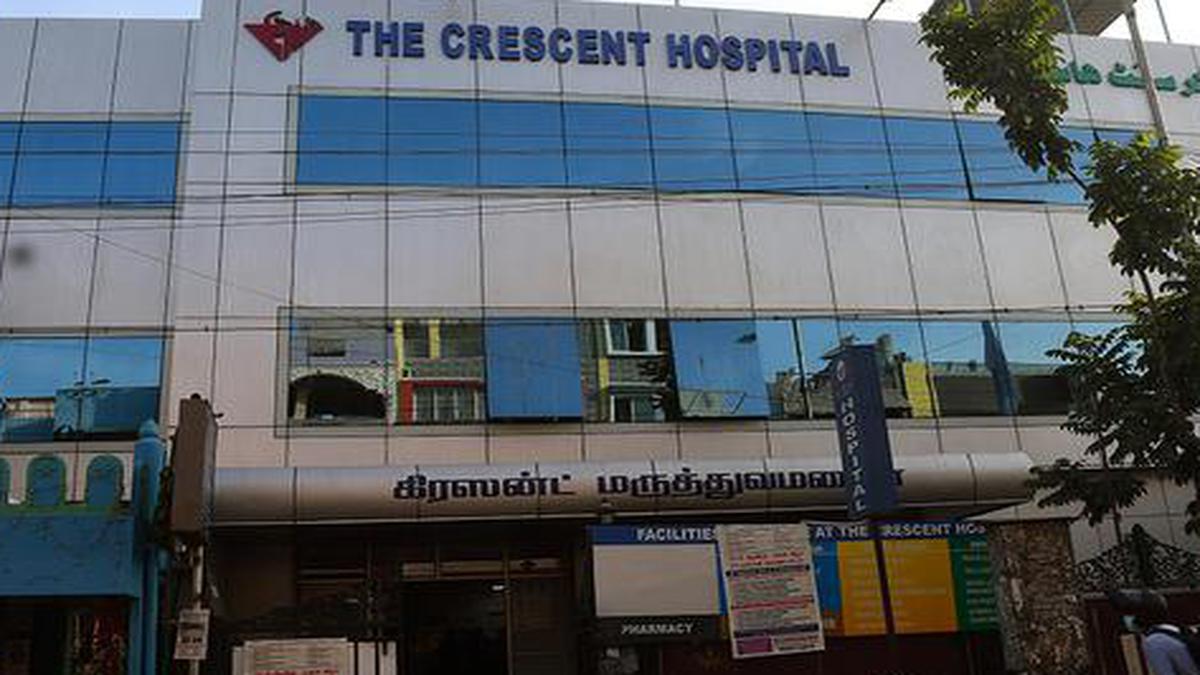
Crescent Hospital, which renders free and subsidised services to the poor, was started by a committed group of young doctors in 1946
The Crescent Hospital
The chaotic and congested Dr. Besant Road at Triplicane has undergone tremendous changes over the years. But The Crescent Hospital remains a popular landmark on the road, rendering free and subsidised health services to the poor for 75 years, even right through the COVID-19 pandemic.
The hospital, started by a committed group of young doctors in 1946 on the land donated by the then Prince of Arcot, entered the 75th year of its service last month. The present Prince of Arcot, Nawab Mohammed Abdul Ali, is the patron of the hospital, while Dr. Syed Khaleefathullah, a Padma Shri awardee, is the president.
N.K.S. Shaik Mujibur Rahman, a doctor practising at the hospital for more than 10 years, said that when the hospital was started, it primarily offered outpatient and circumcision services. “While circumcision of male children is part of the Muslim culture, there were not many hospitals that offered the service at that time. Even if they were offering, the wait time was more as this was an elective procedure,” he said.
Dr. Rahman said the 23-bed hospital now offers a variety of services to all people, irrespective of their religion, at affordable and subsidised cost.
Some of the key services are dialysis, cataract surgery and maternity care because a large number of low and middle income families are in need of them.
“We also treat patients with other serious illnesses by engaging external consultants. For instance, we recently removed a huge fundal fibroid, weighing five kilogram, from a woman who was fighting obesity. Since she was poor, we did it at a subsidised cost,” he said.
A. Muruganandam, medical administrator of the hospital, who also handled its dialysis services, said the hospital was among the few that did not shut its door for a day for its dialysis patients at the peak of COVID-19. “We even handled a few symptomatic cases whose COVID-19 test results were awaited as they were in dire need of dialysis.” At least 15-20 patients underwent dialysis daily.
M. Mohsina Banu, an administrative staff member, said she had handled several patients unable to pay even the subsidised rates charged by the hospital. “We do not turn them away. We provide them free treatment after consulting some of the trusts supporting us.”
The platinum jubilee celebrations were inaugurated last month by the Prince of Arcot. The Prince of Arcot told The Hindu that he truly believed in the saying, “Service to the humanity is service to god,” and the the services offered by the hospital were the need of the hour because of the escalating healthcare expenditure.
He said a lot of what the hospital had achieved today would not have been possible but for the efforts of Dr. Khaleefathullah, who was ably supported by his son Dr. Syed M.M. Ameen, and doctors, nurses and others involved in the administration of the hospital. Many celebrations and free medical services have been planned throughout the year.
source: http://www.thehindu.com / The Hindu / Home> News> India> Tamil Nadu / by Pon Vasanth B A / October 23rd, 2021
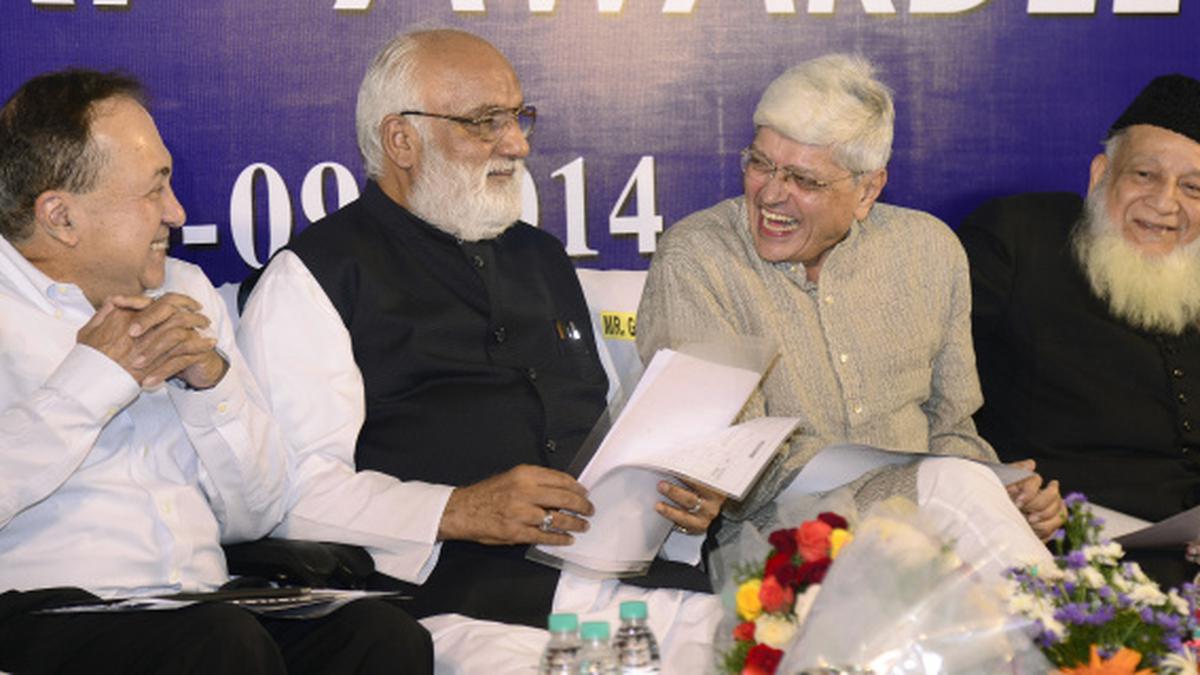
(From left) N. Ram, chairman of Kasturi & Sons, Nawab Mohammed Abdul Ali, Prince of Arcot, Gopalkrishna Gandhi, former Governor of West Bengal, and Padma Shri Hakim Syed Khaleefathullah Sahib — Photo: R. Ravindran
Former Governor of West Bengal, Gopalkrishna Gandhi, on Thursday, urged the Muslim Community to spread the system of Unani throughout the country.
Speaking at a function to felicitate eminent Unani practitioner Hakim Syed Khaleefathullah Sahib, on receiving the Padma Shri, Mr. Gandhi said it was popularly thought that Unani belonged to the Muslim community, and not used by everyone as much as Ayurveda or Yoga.
He said that though modern medicine had its place in healing, Unani and Ayurveda should be used in the treatment of chronic ailments.
Chairman of Kasturi & Sons, N. Ram, said the Hakim was a humble man representing a great tradition of indigenous healing, and he had combined his tradition with modern medicine.
He was an institution builder and wanted his knowledge to be institutionally sustained, enriched and developed. Mr. Ram also released a booklet about the Hakim.
Prince of Arcot, Nawab Mohammed Abdul Ali, who received the first copy of the booklet, said the connection between the House of Arcot and the Hakim’s family dated back to 150 years.
Among those who offered felicitations were T. Rafeeq Ahmed, convenor, Committee of Hosts, S.K. Khadri, U. Mohammad Khaleelullah, P.S.M. Syed Abdul Khadir, and Akhtarul Wasey, commissioner for linguistic minorities in India.
source: http://www.thehindu.com / The Hindu / Home> News> Cities> Chennai / by Special Correspondent / September 05th, 2024