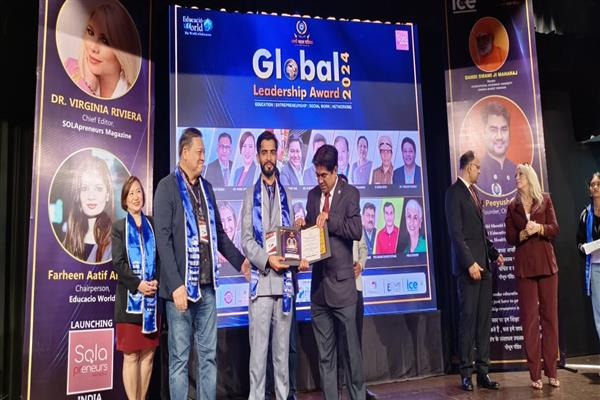
Sheikh Jamsheed, a well-known social and peace activist from Handwara, was awarded the prestigious Outstanding EduLeader of the Year 2024 award at a grand ceremony in New Delhi. Recognized for his contributions to social work, community development, and education,
Jamsheed’s achievements were celebrated at the Indian Islamic Cultural Centre, with Dr. Sandeep Marwah, founder of Noida Film City and Chancellor of AAFT University, as the Chief Guest.
The event was hosted by the International Internship University (IIU) and attended by distinguished personalities from across the globe. Sheikh Jamsheed received multiple honors, including the International Honorary Doctorate and the International Mother Teresa Award, in recognition of his tireless efforts to improve education quality, address environmental issues, and empower youth and women in the region.
Jamsheed was presented his awards by IIU Founder Piyush Pandit and Dr. Virginia Riviera, President of World Edicous in America. In his acceptance speech, Sheikh Jamsheed expressed gratitude, stating that his achievements are a collective result of support from individuals and organizations who share his vision.
His work includes various initiatives focused on the rights of marginalized communities, youth development, and women’s empowerment, particularly in Kashmir. Jamsheed’s dedication to environmental conservation and public welfare has cemented his reputation as a leading social activist.
source: http://www.knskashmir.com / Kashmir News Service / Home> J & K / by KNS Desk, Srinagar (headline edited) / November 11th, 2024
The sudden demise of veteran bureaucrat and author Shehzad Mohammad Khan, widely known as S.M. Khan, has left many in shock and grief. Social media is flooded with tributes, with admirers remembering him as a person of “utmost humility and generosity,” reports the ATV.
S.M. Khan passed away on Sunday at the age of 67 after a brief illness. He is survived by his wife and three children. His last rites took place today in his hometown of Khurja in Uttar Pradesh’s Bulandshahr district, according to family sources.
Khan’s passing marks the end of an era in the Indian Information Service (IIS) and public relations field, where he set benchmarks for loyalty and dedication throughout his illustrious career.
Born on June 15, 1957, in Khurja, S.M. Khan completed his education at Aligarh Muslim University and the University of Wales, England. Joining the IIS in 1982, he held several critical roles over the years.
One of his most prominent assignments was serving as the spokesperson for the Central Bureau of Investigation (CBI) between 1989 and 2002. During this time, he skilfully handled media communications for high-profile cases such as the Harshad Mehta financial scandal, Bofors scandal, and Rajiv Gandhi assassination case.
From 2002 to 2007, Khan served as Press Secretary to President Dr. A.P.J. Abdul Kalam. His tenure included managing the President’s media relations and accompanying him on national and international tours. Inspired by Dr. Kalam, Khan authored Awami Sadar (The People’s President), which shed light on lesser-known aspects of the former president’s life.
Khan also played a pivotal role in shaping Indian media through his work as the Director General (News) of Doordarshan, where he oversaw coverage of significant events such as National Film Awards and Dada Saheb Phalke Award. Additionally, he served as Director of the Directorate of Film Festivals (DFF), representing India at prestigious platforms like the Cannes and Berlin Film Festivals.
Beyond his professional achievements, Khan was deeply involved in fostering interfaith harmony as a trustee of India Islamic Cultural Centre (IICC). Elected Vice President of the IICC in 2019, he dedicated himself to promoting mutual understanding across communities.
S.M. Khan maintained a strong bond with his alma mater, Aligarh Muslim University, serving as a member of its Court and the Executive Council. His efforts in promoting education and cultural understanding continue to inspire many.
His passing is a significant loss to the nation, leaving behind a legacy of excellence, humility, and dedication.
source: http://www.radiancenews.com / Radiance News / Home> Obiturary / by Radiance News Bureau / November 19th, 2024
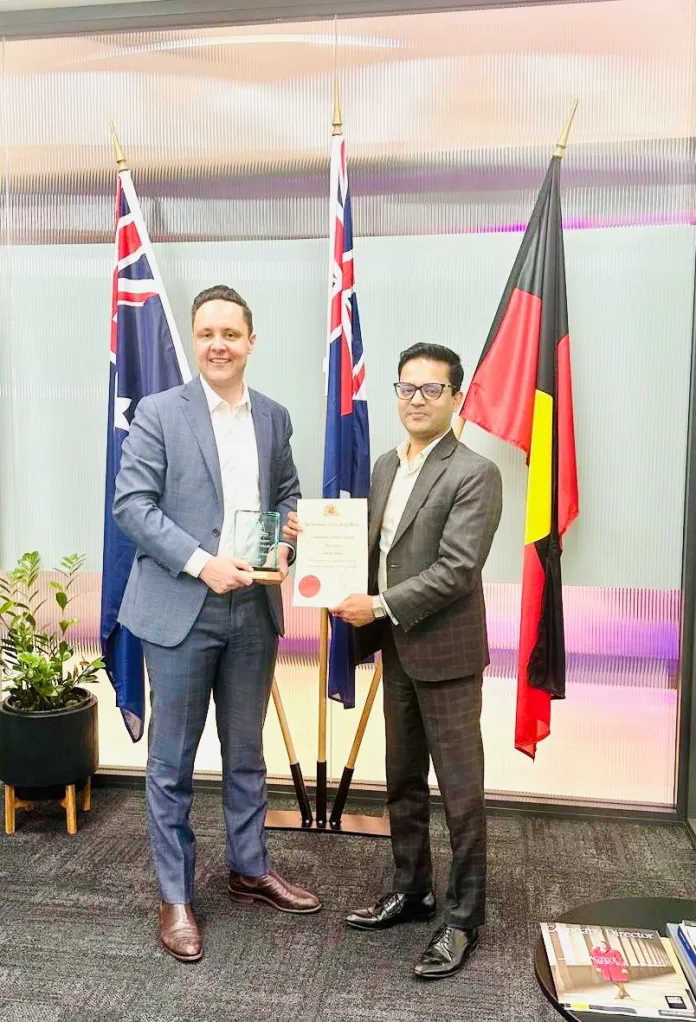
Nadeem Ahmed, the dynamic founder of ‘Indians in Sydney’, has been awarded the prestigious NSW Government Community Service Award in recognition of his exceptional contributions to the Indian diaspora and broader community in New South Wales.
The award acknowledges individuals whose work has significantly enhanced the quality of life for members of their community, and Nadeem’s tireless efforts have made a lasting impact on the lives of many.
A leader with compassionate and vision
Since founding ‘Indians in Sydney’ in 2007, Nadeem has devoted himself to creating a supportive and inclusive community for Indian migrants and residents. What began as a modest initiative has grown into the largest Indian community platform in NSW, now boasting over 135,000 members.
Under his compassionate leadership, ‘Indians in Sydney’ has become a beacon of unity, where cultural heritage is celebrated, newcomers are supported, and vital connections are made across generations.
Upon receiving the award, Nadeem expressed his gratitude, saying, “This recognition is not just for me but for everyone who has been part of Indians in Sydney. We are a collective force of people who care about each other and who are passionate about giving back to the community. I am truly humbled by this award, and it motivates me to continue serving and building stronger connections within our society.”
With a passion for connecting people and promoting Indian culture, Nadeem started organising events and activities that celebrate heritage and address the unique needs of the diaspora community.
Nadeem says his vision was to create a space where people could support one another, share their stories, and find a sense of belonging in a new land. “Little did I know it would grow into something so much bigger than myself,” he reflected.
Nadeem also extended his heartfelt thanks to Nathan Hagarty MP for his endorsement, noting, “I am deeply grateful to Nathan Hagarty MP for his continuous support. His faith in our mission has been an incredible source of encouragement. Together, we aim to create a more inclusive and compassionate community where everyone feels welcome.”
Transformative community initiatives
Nadeem’s vision for ‘Indians in Sydney’ is one that extends beyond social connection—it is about making a tangible difference in the lives of individuals and families.
Several of the group’s key initiatives reflect this mission, including Winter Drive, Meal for Everyone Drive, Samvaad, Journey, Indians in Sydney Gala Event.
Nadeem’s leadership was instrumental in organising the recent Indians in Sydney Gala Event , which celebrated India’s 78th Independence Day that was a remarkable success, bringing together leaders, dignitaries, and community members to celebrate the achievements of the Indian community and reinforce the group’s ongoing mission to promote inclusivity and cultural exchange.
Looking ahead
With the NSW Government Community Service Award serving as a testament to his exceptional leadership, Nadeem is more determined than ever to continue his journey of service. The recognition highlights not only his personal achievements but also the tireless efforts of the ‘Indians in Sydney’ community to create positive change.
For those inspired by his work, Nadeem’s message is clear: “There is always more we can do, and together, we can make a lasting impact. Our journey is just beginning.”
Indians in Sydney is the largest community group for Indians in New South Wales, dedicated to fostering social connections, cultural pride, and charitable initiatives.
Through a wide range of programs, including meal drives, cultural events, and support services for migrants, the group serves as a vital resource for the not only to Indian diaspora in Australia but to Wider Australian Communities
source: http://www.amust.com.au / AMUST / Home> Community> Featured / by Imtiaz Khan / October 29th, 2024
Munshi Mazahar Ali was a freedom fighter of Belgaum who lived near HESCOM counter at Kacheri Road, Shaniwar Khoot, Belgaum.
He was said to be a butler in the British army at the Belgaum regiment and being a staunch Muslim, was a follower of Wahabi moment. This movement was strictly against British rule in India and played an important role in First Independence war of 1857.
The Belgaum gazette (page 133) refers this great son of the land as “One Muslim Munshi in the army at Belgaum, who had been a Wahabi, was discovered instigating the others, transported for life in the connection “
Munshi Mazahar Ali was involved in the “Reshmi Rumal Movement “and was arrested by the British. He was assassinated at the Race Course grounds in presence of thousands of people.
The Corporation of the City of Belgaum has given the name of Kacheri Road as “Munshi Mazahar Ali Road”. But even now Kacheri Road is used by Govt and the public.
source: http://www.allaboutbelgaum.com / All About Belgaum / Home> History / by editor / August 14th, 2009
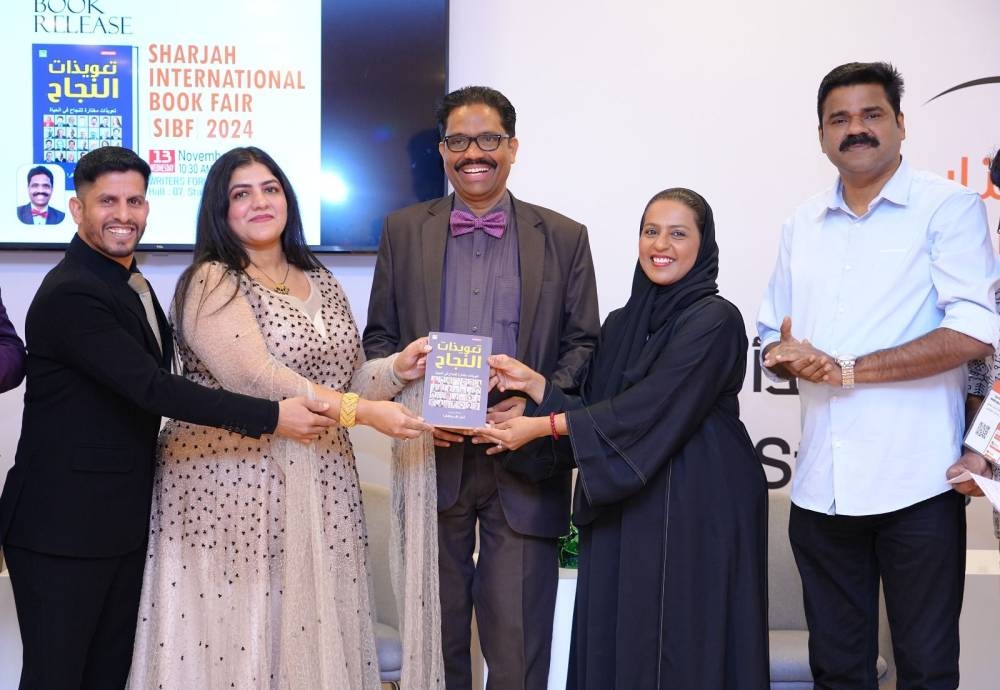
‘Taeweedatu Nnajah’ (Success Mantras), a motivational book in Arabic by Doha-based Indian author Dr Amanulla Vadakkangara, has made debut at the 43rd Sharjah International Book Fair, drawing a diverse audience of multinational readers.
Dr Mariyam Shinasi, a prominent author and cultural figure from the UAE, officially released the book at the Writers Forum on Wednesday.
She praised Dr Amanulla’s efforts in crafting an inspirational work in Arabic, commending the unique accomplishment of a non-Arab author publishing a motivational text in the language and showcasing it at one of the world’s leading book fairs.
“Indians in general, and Keralites in particular, have shown a keen interest in Arabic language and literature. Publishing a motivational book by a non-Arab is indeed commendable,” Dr Shinasi remarked.
At the event, the first copy of the book was received by NVBS CEO Benazir Manoj, and Founder and Chief Coach Manoj Sahib Jan.
Several notable personalities attended the launch, including Saleem Ayyanath, Lipi Akbar, and the author himself.
The book has been published by Lipi Books from Calicut, India.
source: http://www.qatar-tribune.com / Qatar Tribune / Home> Nation / by Tribune News Network / November 17th, 2024
Yakoob Mansuri, a young man in his 20s, became a hero for several children on Friday night. However, he couldn’t save his own newborn twin daughters from a fire at the hospital.
Originally from Hamirpur, Yakoob, a food vendor, had been sleeping outside the neonatal intensive care unit (NICU) of Maharani Laxmi Bai Medical College. His two newborn daughters were admitted there for treatment. With his wife Nazma, Yakoob stayed at the hospital, taking turns to watch over their babies.
When the fire broke out on Friday night, Yakoob broke the glass window and rushed into the NICU to rescue as many infants as he could. Unfortunately, his twin daughters were not among those he managed to save. Their bodies were found on Saturday. Yakoob and Nazma waited outside the hospital all day, their faces reflecting deep sorrow.
Similarly, Sanjana Kumari, who had recently given birth to her first child, found her joy turn into grief. “My baby was burned to death before my eyes, and I could only watch helplessly. The hospital’s negligence destroyed my dreams. I couldn’t even hold my child,” she said, wiping away her tears.
Santoshi Devi from Jalaun, who had brought her baby to the hospital due to delivery complications, also lost her child in the chaos of the fire. She identified her baby’s body on Saturday. “I heard loud screams, but my baby was gone,” she said, overwhelmed with grief.
Just 11 days ago, she had given birth to a baby who is no longer with her. “I heard loud noises and rushed to the scene, but how could I save my child? Nobody told us what was happening,” she lamented.
Sonu and Sanjana, who had admitted their baby due to respiratory issues, also lost their child in the fire. “We were told not to feed him, so we stepped away for a while. By the time we returned, the NICU had been ravaged by the fire,” said Sanjana. “We did everything we could, but in the end, he was taken from us,” said Sonu, while his brother Parsuram recounted their struggles: “We sold everything and took loans, all in the hope that he would survive.”
Niranjan Maharaj from Lalitpur identified his grandchild’s charred body by its name tag. “The hospital staff didn’t act in time,” he alleged.
Families of the victims have accused the hospital of negligence, claiming that timely intervention could have saved lives. Authorities have launched an investigation to determine the cause of the fire and lapses in safety protocols.
source: http://www.english.varthabharati.in / Vartha Bharati / Home> India / November 17th, 2024
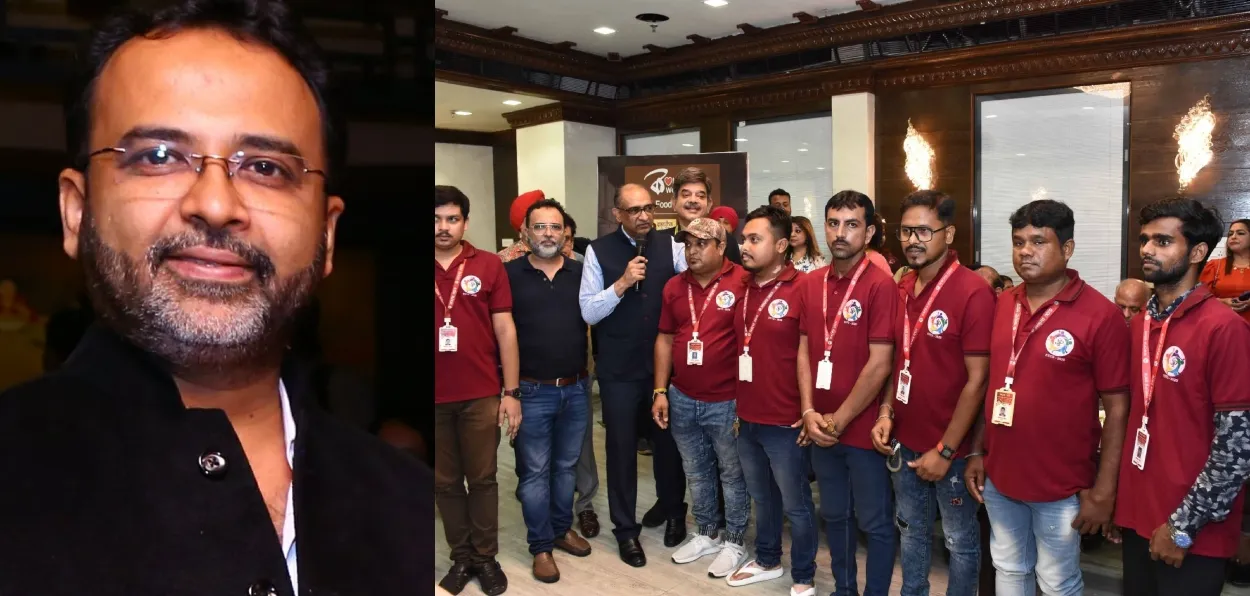
Asif Ahmed and his group of Volunteers of the Kolkata We Care group
A 320-litre refrigerator laden with food – the leftovers from the restaurant and at homes of citizens – placed at a busy crossing of Kolkata is ensuring that the poor and needy do not go hungry in the City of Joy.
Thanks to the initiative launched by Asif Ahmed, co-owner of Sanjha Chulha restaurant, whose concern for food wastage and food insecurity many around him had led to his initiative on the first Food ATM of the city.
The initiative has recently expanded with more civil society groups including the Kolkata We Care group NGO led by Imran Zaki.
“It broke my heart to see good, edible food being discarded at the end of the day, knowing it could nourish someone in need. As a restaurateur, I was often faced with the dilemma of what to do with the surplus food. The idea of redistributing it to the hungry was not just a solution – it was a responsibility,” Asif Ahmed said.
Asif Ahmed’s idea emerged from his concern for thousands around him facing food insecurity. He placed a big refrigerator with a transparent door at the roadside with neatly packed food donated by those visiting the restaurant, the restaurant itself, and the citizens inside. People can pick up the food. The volunteers even distribute food by visiting various vulnerable communities in the city.
The feeding the needy programme has since been relaunched through collaboration among Asif Ahmed’s outlet, the Kolkata We Care group, the Rotary, Round Table, and JITO (The Jain International Trade Organisation).
The initiative feeds almost 50 people daily and Asif plans to involve the Kolkata Police in it.
“The initiative has since become a beacon of hope and plans are underway to involve Kolkata Police to further strengthen its reach and impact in the community,” he said.
The Food ATM is crafted with care to meet safety standards while overcoming the logistical challenges of food distribution. Like cash in an ATM, food is now available to anyone who needs it, stored in a transparent refrigerator placed in a public space.
Asif Ahmed said, “We wanted to ensure that those who come to the Food ATM feel a sense of dignity. No one should feel ashamed for needing help; everyone deserves respect and compassion.”
The We Care group comprises people from various backgrounds who took charge and came together for the movement. Pilot projects also started in schools like Birla Bharti School in Taratala and BDM High School in Narendrapur which aims to raise awareness through students.
The movement has bloomed well in local organisations and volunteers joined hands in educating donors to inculcate a culture of giving. It has set up one Food ATM at the busy Park street and is planning more.
Sana Ahmed, who works in an NGO, said, “We teachers can instill the right values in children by making them more cautious of food, its usage and recycling. Students’ involvement will deeply impact their growth during formative years and raise a generation when they quickly absorb and value food and the act of giving.
Asif Ahmed says, “The system could be easily replicated and the viability and success inspired further expansion in multiple locations in Kolkata. Although it started at CIT Road but I felt its impact was restricted to that area only. It was later centralized and expanded to serve a broader range of people within a feasible 5 to 10 km radius. We have plans to come up with one in Park Street and the location of another is not decided yet.”
The first Food ATM operates during restaurant hours, from 12 noon till 11:30 PM, with volunteers distributing food in slum areas close by as it is easier to manage.
Asif Ahmed shared a touching story of a lowly paid security guard who struggled with a wage of Rs. 10000- 12,000. He would get his meal from the ATM and it helped him sustain his family and meet ends.
“The Food ATM was a crucial support for him and others like him, making it easier to access meals without compromising their self-respect”, added Ahmed.
Another goosebump scene that Asif remembers is that of a small girl, who approached the Food ATM apprehensively and picked up the food packet before vanishing in the thin air.
Imran Khan, a resident of Park Circus Area, said, “It was a poignant experience to see a child, hungry finding comfort in the food provided. The gratitude and relief in these moments highlight the significant impact of the initiative in bridging the gap for those in need.”
The initial investment includes purchasing freezer units, building secure structures, and installing security measures. The recurring costs involve electricity, regular maintenance, and staffing. Asif Ahmed says he is open to adopting new means and technologies for the initiative.
source: http://www.awazthevoice.in / Awaz, The Voice / Home>Story / by Hena Ahmed, Kolkata / August 13th, 2024
Waris Khan (with garlands) being honoured by citizens
The saga of Waris Khan of the Biaora city in Rajgarh district of Madhya Pradesh has reached Chief Minister Mohan Yadav in Bhopal earning him the first “Good Samaritan” award in the district.
A plumber by profession, Waris Khan, lives in the Tal Mohalla of Beawar and supports his family of five members. He worked as a plumber against a temporary vacancy in the municipality 12 years ago, was fired from his job. He had to face a lot of hardships in life following loss of his job.
He however, continued to support his family through his plumbing job and also other jobs of cleaner, and a daily wage labourer.
However, his life took an unexpected turn on the morning of 13 November 2024 and he became a celebrity overnight.
Waris Khan revceving the Good Samaritan award from DM Dr. Girish Kumar Mishra
On that day Waris Khan was on his way from Biaora to Binaganj on his motorbicycle. He saw a car meet with an accident on Highway due to a technical snag. There were 7 people of a family from Shivpuri in the car. There were two small children and women among them.
After the car overturned, all its doors got locked. Seeing the horrific scene, Waris parked his bike aside without delay and reached the car. He broke the glass of the car with his hands and started taking out the people trapped inside.
He took care to first extricate the children followed by women and finally the men trapped in the car.
Waris carried out his deed without expectations of publicity or fame. In fact he doesn’t have a smartphone nor is he connected to social media.
Chief Minister Dr. Mohan Yadav speaking to Waris Khan on video call
Despite this, the news of his bravery reached the media and the administration.
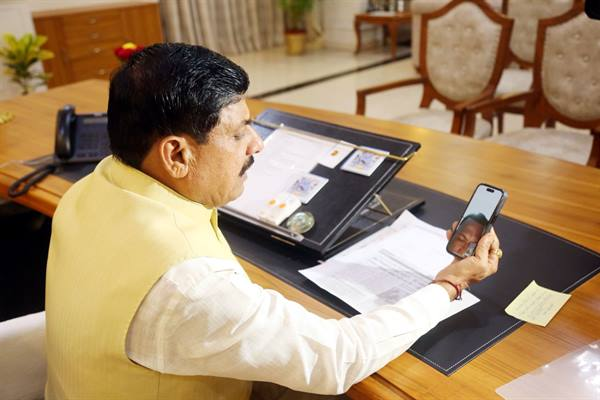
According to officials, Chief Minister Dr. Mohan Yadav spoke to Waris Khan through video call and inquired about his well-being. He told him, “You are the pride of Madhya Pradesh.”
Giving information about the incident, Waris said that he was going to Binaganj on a bike, when the car coming from the opposite side accidentally fell into the ditch.
Chief Minister Yadavs aid, “Waris, you have done a very good job. Helping each other in times of trouble is true humanity. Your work will inspire everyone.”
The Chief Minister promised him a reward of Rs 1 lakh. However, Waris Khan asked Chief Minister to appoint him on his previous job in the municipality. Reports say the Chief Minister agreed to fulfill his demand.
Waris Khan briefing DM Dr Girish Kumar Mishra on his reScue operation
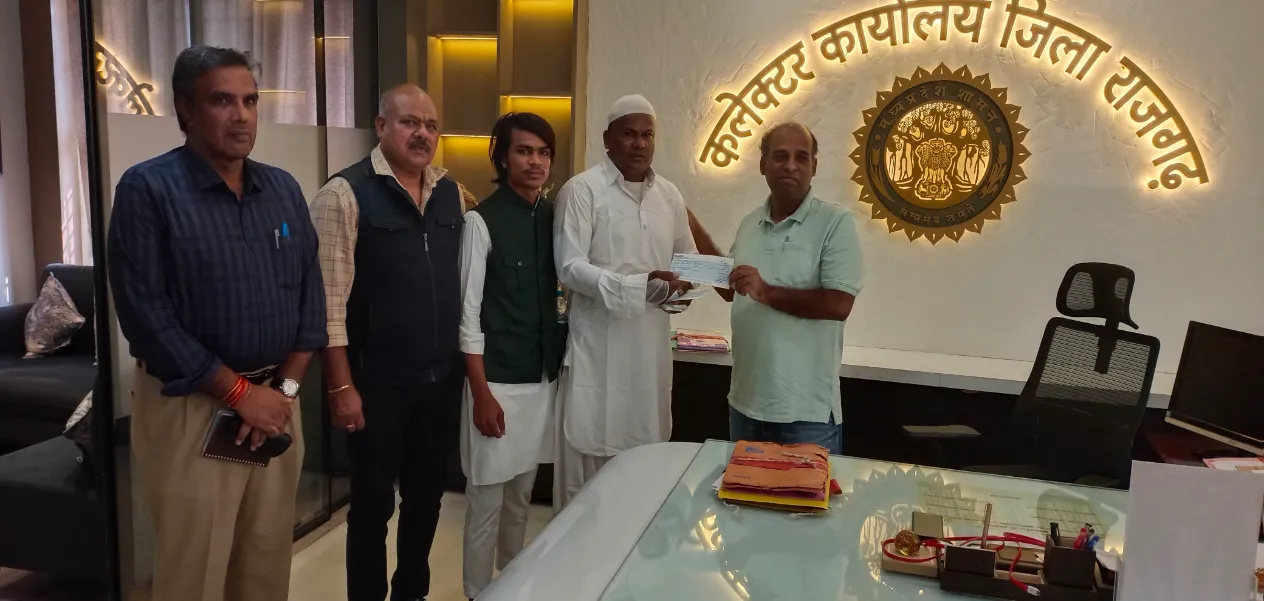
Waris Khan was awarded the first award “Good Samaritan” award by the district adminitration. Rajgarh Collector Dr. Girish Kumar Mishra presented him a cheque of Rs 5,000 as token of appreciation for his act of bravery.
The Good Samaritan Award Scheme is a program by the Ministry of Road Transport and Highways (MoRTH) that provides cash awards and certificates of appreciation to people who help road accident victims.
Introduced in 2015, the award is given to a person who has provided immediate assistance to a road accident victim and rushed them to a hospital or trauma care center within the Golden Hour of the accident.
This scheme was introduced to cut down the road accident rates in India.
Kumar said, “What Waris Khan did is an example of true humanity. He saved people’s lives without any selfishness. His work is an inspiration for the entire society. Such people will be encouraged in the future too.”
Yadav also directed all collectors to honour courageous people like Waris on the occasion of 15 August.
After the CM House and the Public Relations Department praised Waris Khan, he is continuously receiving praise. Many private organizations are ready to honor him. With his courage and humanity, Waris Khan proved that even an ordinary person can become a hero in times of trouble.
source: http://www.awazthevoice.in / Awaz, The Voice / Home>Story / by Abdul Wasim Ansari / November 16th, 2024
The measure of a man is worth his memories after his death.
This is towards a particular reference to Mirza Javed Murtuza, who despite having been born in a Lucknow elitist family, with roots from Faizabad, took for him a road less travelled. His contrast was his campaign, which he undertook, with his utmost commitment, to educate masses and classes, to seek from the Almighty God, on their own, and not through any intermediary. This was his avowed stand against the institutional clergy, which ironically, had always been ‘in consonance’ with the ruling dispensation.
Lucknow had been a seat of power, for centuries, a La Feudal state, which continued to flourish, even after Britishers had taken over. Even after the ouster of the last king of Avadh, Wajid Ali Shah ‘Akhter’, and the subsequent ‘silencing’ of the mutiny or the first war for independence of 1857, there was a ‘virtual or a real’ silence in Lucknow, for the next 90 years. Until came the dawn of independence. India, became a throbbing democracy, but the elite of Lucknow fell into a morass of decadence, in terms of social, economic, educational standards etc, and to make it worse, were the ‘debates and discussions’ over religious denomination’s considered ‘superiorities over each other’. Thus, was enamored on Lucknow’s landscape.
Rubina J Murtuza at the release of Hayat-e-Javed (2010) / Photo Courtesy: Twocircles.Net
After the post-1977 Emergency government, Iranian revolution of 1979, Muradabad riots of 1980, Javed Murtuza took to the stage, of Ali Congress as its Patron, as he could see and also foresee that the clergy, their pageboys and footmen, were all too incapable to relate to the arising situations. Babri Masjid locks were also opened in 1986. He was an advocate and started championing the cause of Muslim rights, articulated the ‘reasoning and argumentation’ not only for self emancipation but also for seeking a place in social-hierarchy in terms of getting a place in government jobs, awareness towards reservation enshrined through Constitution etc.
The issues confronting the community were with a crystal ball clarity to him. He was ahead, to clergy by a goodly margin, which was too involved, and wants to remain still, like a caged mouse on a wheel. Unable to augment any forward path! He was never an extremist showboat, but had earned a personal flak , from administration, when he had printed Ram Aur Islam, extracting excerpts from Dr. BR Ambedkar book, Riddles of Hinduism, that small booklet was a rage, in those days, after Babri Masjid had been demolished. There were reportedly raids to confiscate its copies. He even had organized a function, in the memory of martyrs of Babri Masjid, for those who had been killed in the aftermath of the demolition.
He became the proverbial deacon of a church! Without having attended any conventional religious seminary! Out of his sheer grit, as onlookers still remember him, he would drive his scooter, memorizing Quranic verses to verbalize the gospel. He had arrested the attention of the youth. There was an ever growing numbers to his followers. Young boys with their beards primed, thronged the altar of his speeches. He had to incur the wrath, and was therefore, subjected to a murderous assault, during an auspicious Ramzan night, but only the next day, he would sit, his head, hands and face ‘bruised and bandaged’, soliciting his next homily. Yours truly was present when the assault had taken place.
His avowal that community had to search for its lost self-esteem, was perhaps, his only and long standing forte. He would pass on a road with utmost humility. Always so unassuming. A true picture of keeping a low profile yet exuding high intensity. The campaign spearheaded to safeguard the Auqafs, may perhaps, has lost its steam, but he was much farsighted in his approach, as finally, the government today, is contemplating to bring all Auqafs under its thumb. Had an ear was lent to his call then, perhaps, this situation might never have occurred. But, this is how community, can share its long time complacency towards the gems of its yore.
His persona still resonates around those who sought from his brilliance. He was an engineer by profession. Edited and published Payam-e-Nau (The New Message) in both Urdu and Hindi scripts, and editorialized his vision, which was a true reflection of his time and beyond.
His father and younger brother retired as Justice from High Courts.
His daughter wrote Hayat-e-Javed (The immortal Life) in Urdu language as an ode to the long standing memories of her father. His 15th death anniversary fell on November 9.
***
The writer is a former UP State Information Commissioner.
source: http://www.muslimmirror.com / Muslim Mirror / Home> Indian Muslim> Personality / by Haider Abbas / November 15th, 2024
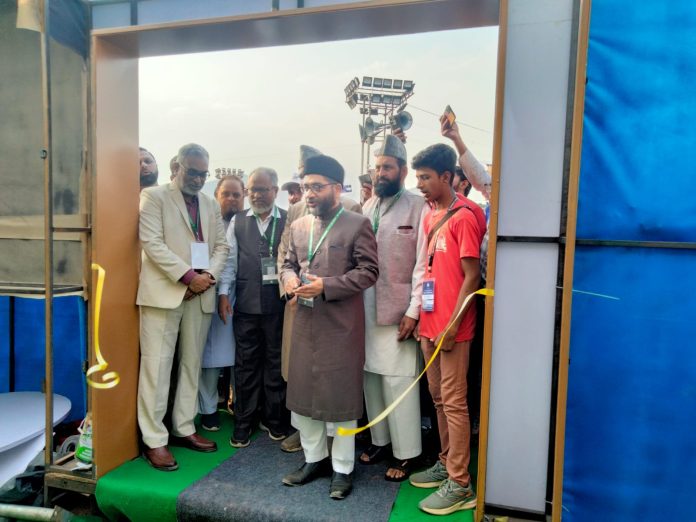
Syed Sadatullah Husaini, President of Jamaat-e-Islami Hind (JIH) inaugurated Idrak Expo, the Tahreeki Showcase here this evening at Wadi-e-Huda, where the All India Ijtima Arkan (Cadre Meet) is scheduled from November 15th to 17th. This showcase is a prominent part of the conference, designed to offer a comprehensive look at JIH’s extensive programmes, initiatives, and developmental projects.
The exhibition spans numerous JIH departments, including media, education, Women’s Department, Rifah Chamber of Commerce, and other impactful initiatives like Vision 26, MDR, and various publications. Through these, the showcase illustrates JIH’s ongoing commitment to addressing societal needs and fostering community growth.
The inauguration of the Tahriki Showcase signals the start of a weekend focused on self-learning, collaboration, and engagement, with a goal of deepening participants’ understanding of JIH’s mission, achievements, and vision for the future. Attendees are warmly invited to explore the exhibition and witness the breadth of JIH’s work across multiple sectors, reflecting its dedication to community welfare and progress.
source: http://www.radiancenews.com / Radiance News / Home> Uncategorized / by Radiance News Bureau / November 14th, 2024