Maulana Azad National Urdu University students receive a scholarship worth 73.9 lakh from SEED
Support for Educational & Economic Development (SEED), a non-profit organisation dedicated to assisting and uplifting the underprivileged, has awarded scholarships totaling 73,90,000 rupees to students at Maulana Azad National Urdu University (MANUU), a central university in Hyderabad, India known for providing higher education opportunities to students of Urdu backgrounds.
The recipients were selected based on their performance and financial backgrounds. The scholarship was sponsored by SEED with the support of two other Hyderabad based non-profit organisations — the Quran Foundation and the Helping Hand Foundation. SEED has provided 586 scholarships to MANUU students across all campuses.
Danish, a journalism student at the university, expressed gratitude to SEED saying, “This scholarship will greatly assist me. Such scholarships boost students’ confidence and enable them to focus on their education rather than financial problems.”
Another student, who wished to remain anonymous, stated, “I lost my father during COVID, and this scholarship is a real help for me to pursue my aspirations.”
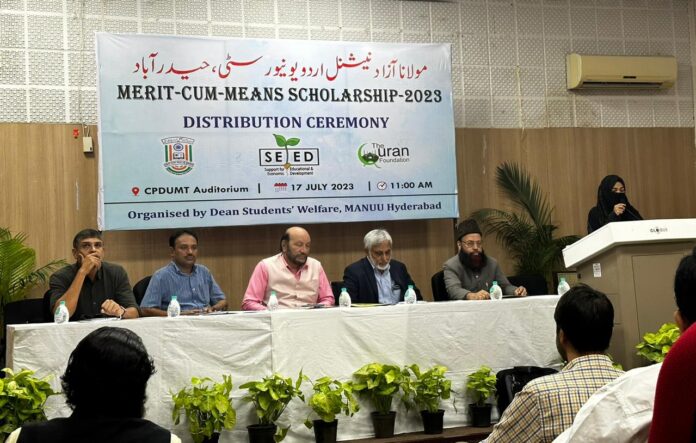
The scholarship distribution ceremony 2023 took place on 17 July at the university campus.
The Vice Chancellor, Prof. Syed Ainul Hasan, expressed his displeasure with the discontinuation of the NSP scholarship for MANUU students. He stressed MANUU students’ talent and potential and stated that the management is actively working to offer them the best possibilities and platforms to demonstrate their abilities.
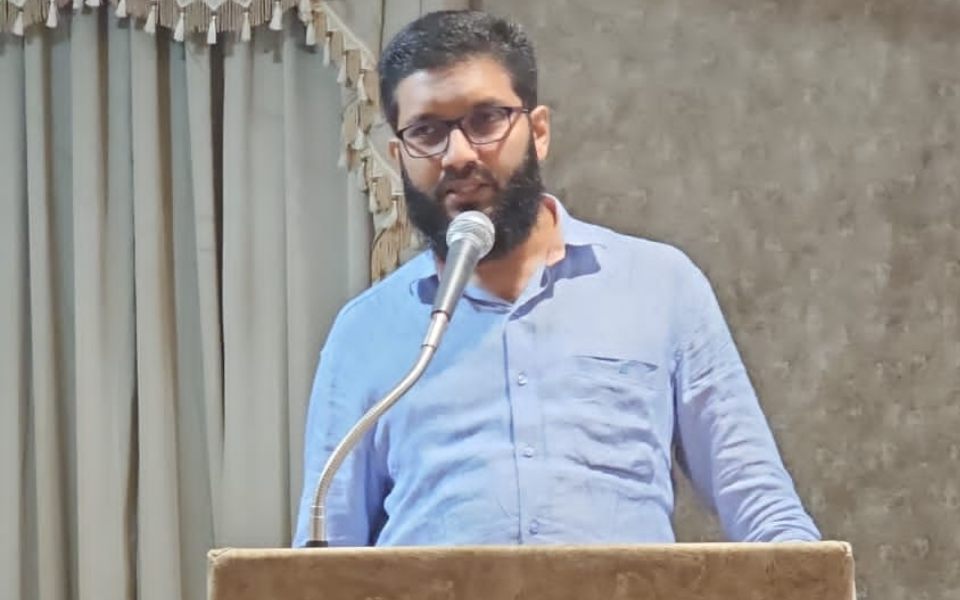
The Executive Director of SEED, Mr. Syed Mazheruddin Hussaini, addressed the students, emphasising the value of hard effort in their academic journey. He also urged them to concentrate on improving their soft skills and communication abilities in order to face future work obstacles.
“It is the students’ responsibility to improve their careers through self-confidence, hard work, sincerity, and effective time management.” He then presented a 73,90,000 rupees cheque to the Vice Chancellor.
The Registrar, Prof. Ishtiaque Ahmed, commended Prof. Syed Alim Ashraf for facilitating the SEED scholarship for MANUU students.
Mujtaba Hasan Askari, Founder of the Helping Hand Foundation, addressed the students and encouraged them to strive for success in life. “Success can only be achieved through education,” he said.
Overall, the SEED scholarship initiative in collaboration with the Quran Foundation demonstrates a valuable commitment to supporting the educational aspirations of MANUU students, empowering them to overcome financial barriers and achieve their academic goals.
source: http://www.twocircles.net / TwoCircles.net / Home> Education / by Musheera Ashraf, TwoCircles.net / July 18th, 2023
A journalist. A Telangana protagonist. A regular figure at protest meetings. A pensive figure at conferences. A concerned citizen whose heart beats for the poor. A secularist to the core. A force to reckon with. Sure.
That gives a word picture of Zaheeruddin Ali Khan, former Managing Editor, The Siasat. In his 62 years, he was more than just a friendly, smiling face. He epitomised the essence of selflessness and compassion. He touched many lives, particularly of Muslim boys and girls, struggling for quality education. In his later years he took on the mighty Wakf mafia and showed by example what protection and conservation really means. Quiet, firm, and unrelenting. His passing away has brought the curtains down on a multifaceted career.
As I sit down to pen a few words about my friend of 30 years, I am at a loss for words. Zaheer Bhai, as he was affectionately called, was so talented and versatile that it is impossible to describe all his traits. But suffice it is to concentrate on just one aspect: his love and care for the well-being of the community. More than a journalist he was a social worker – a true humanitarian. He espoused causes that are not essentially part of a newspaper job. He went the extra mile to help people, especially during times of strife. Zaheer sab was there to lend a hand, be it the Gujarat massacre, the Mumbai riots, or the Bihar floods. He raised money through the Siasat Millat Fund and mobilised resources to help the affected. He was always at the forefront, ready to ease pain and suffering. This compassionate trait earned him a special place in the hearts of people. His innate sense of empathy touched countless lives and brought a ray of hope to despairing souls.
Zaheer Sab’s philanthropy was not limited to just emergency situations. He was always ready to support the needy and destitute. People made a beeline to his office for all sorts of things. Some would come to him seeking a job, some for educational support, and few others for help in corrections to Aadhaar cards and things like that. He lent an ear to everyone patiently and did the best he could.
For him, education was the master key to success. He believed it to be the best investment one could make. And all through his life, he tried to open the doors of opportunities through education to the poor and underprivileged. Women empowerment was a cause dear to his heart. Realising the difficulty the community faced in marrying girls in view of rising dowry demand, Zaheer bhai came up with the idea of ‘Do-ba-do’ (face-to-face) programme. This unique programme helped many families find a suitable match for their daughters without having to run around.
Though I knew Zaheer bhai for a long time, I drew close to him after my retirement from The Hindu newspaper. He wanted me to write for Siasat.com, a news portal set up by him. After initial hesitation, I agreed. He interacted with me on a day-to-day basis discussing story ideas. Like many others, I was touched by his boundless energy and infectious smile. I met him at a book release programme at the P.S. Telugu University on Saturday evening. We chatted together. But I never knew that it would be our last meeting.
The love and respect commanded by Zaheer bhai was evident from the huge turnout of people at his funeral prayers at the Shahi Masjid on Tuesday morning. Rest in peace Zaheer bhai. Your efforts to transform lives will continue to have a ripple effect.
source: http://www.siasat.com / The Siasat Daily / Home> Featured News / by JS Ifthekhar / August 08th, 2023
Bollywood industry have been criticised by viewers for its Islamophobic portrayal. Be it woke series like Family Man or commercial flicks Batla House and Sooryavanshi, Muslims are always portrayed as sleeper cells, terrorists or smugglers. Films always acted as an integral compound for the Hindutva nationalist project. Only a few films stood as exception. This year, May 27 witnessed a unique release.
An industry, which parroted the state narrative of Muslim being the terrorists dared to tell the story of an innocent Muslim teacher Wahid Shaikh who was falsely implicated in 7/11 Mumbai train blast and spent almost nine years in jail to satisfy the ‘collective conscience’ of the state. Haemolymph movie, directed by Sudarshan Gamare, got released in more than 120 theatres across India in its initial phase.
“The title Haemolymph, loosely translated as the ‘blood of the ant’ symbolises how the life of a common can be easily crushed by the authorities similar to how an ant can be easily crushed,” the director Sudarshan Ghamare said to Maktoob.
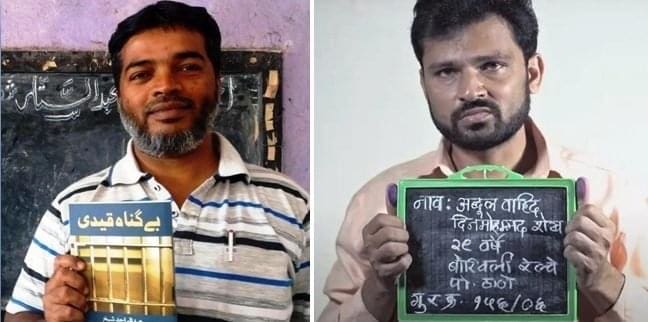
Wahid Shaikh, a primary school teacher respected in the neighbourhood, got picked from Mundra as an accused in the 7/11 Mumbai train blasts of 2006. Shaikh had to spend almost nine years in jail to prove his innocence. Of the 13 accused charge sheeted by the Mumbai Anti-Terrorism Squad, Wahid was the only one to be acquitted of all charges.
Wahid Shaikh was not excited when he got a call from Sudarshan Gamare asking permission to make a biopic on him. ”Many people had contacted me telling their interest to make movie on my life. But all of them got dropped in the midway. I guess nobody had the courage to tell my story,” said Wahid Shaikh.
Sudarshan Gamare got hooked to Wahid’s story after reading NDTV journalist Sunetra Choudhury’s book “Behind Bars” which featured a chapter on Wahid Sheikh . After completing the book, Gamara read Beguna Qaidi( Innocent prisoner), a book wrote by Wahid Shaikh on his experience inside the jail. The book was a documentation of the torture, fabricated charges, forced confessions, prejudice from the investigative agencies and jail authorities and the deep rooted Islamophobia.
“His life story was very horrifying. I can empathise with his pain and I felt so guilty after reading his story. I realised that this is an important story and it need to be shared with the public,” Sudarshan Gamare said.
Gamare discussed the story with his friend Riyaz Anvar, who later played the lead role of the film, and decided to meet Wahid.
The filmmakers met Wahid at a hotel in Mumbai and had a long chat with him. Later, they travelled to Wahid’s home in Mumbra, talked to his friends and family. The team went through the chargesheet of 20,000 pages and the copy of the judgement. They referred all the case-related documents available in public domain and the articles written on the case. The crew even contacted Mumbai Police and the family of victims of the bomb blast to extract their version on the incident.
”It took us almost 15 months to finalise the script; 11 months for research and 4 months to write the screen play. Wahid gave suggestions through out the process,” the director and the screenwriter Sudarshan Gamare said.
“It was really a difficult task to show nine year’s story in two hours. I had to recollect many important incidents happened in those nine year period for the movie. Many unpleasant memories flashed through my mind. It reminded me of the grave injustice done to me. It was not an easy task to revisit those traumatic experience. But I want people to understand what happens to innocent people like me in Indian prisons,” said Shaikh.
The lead actor Riyas Anwar, who was with the crew since the research stage, described the process as an emotional journey.
Riyas talked with Wahid for hours and prepared notes on Wahid’s life, interests, habits etc. “The character preparation started from the very soul of Abdul Wahid Sheikh. I started interacting with the people he was close to. Practised writing with the left hand. I wore the type of clothes Wahid loves to wear and travelled in crowded local trains. We sat for hours outside the Arthur road jail to get an idea on what Wahid might have gone through,” said Riyas.
“The film is a labour of love by my friends. It’s the debut project of cinematographer Rohan Mapuskar and editor Hemant Mahajan. I and three other friends started the production house, Ticketbari. Later, Adiman studio and AB Films Entertainment joined the production,” the director said.
Wahid Shaikh said that there are hundreds of similar stories to be told. “A state sponsored terrorism exists in this country. Most of the victims are Muslims. Be it a blast in a temple or Masjids, Muslim youth were picked as suspects. SIMI, ISIS, Al Qaeda are used as excuses to vilify Muslims,” Shaikh said to Maktoob.
Following his acquittal, Wahid Shaikh, with the help of rights activists, retired judges and lawyers, started an organisation – The Innocence Network.
The organisation mainly works on prisoner rights and exonerates prisoners wrongfully accused by providing pro bono legal services.
“We organised a tribunal in Delhi in 2017 which demanded compensation for the acquitted prisoners. The network organises lectures on Mumbai bomb blast anniversaries and advocates for prison reliefs,” Shaikh said.
Wahid Shaikh, the teacher who wrote major chunk of his book Begunah Qaidi inside the Arthur Road prison, pointed the deep rooted Islamophobia in the state institutions and the effects of the war on terror following the 9/11 attack as the reason behind the wrongful incarceration of Muslim youths.
“The Home ministry of the Union government maintains a war book. It contains name and other details of all Muslims arrested or charged in terrorism related cases in India. My name is still in the book. I got to during a hearing with the National Human Rights Commission,” Shaikh said.
source: http://www.maktoobmedia.com / Maktoob / Home> Features> Film & TV India /by Ashfaque EJ
United Arab Emirates, located in the desert, is one among the few places in the world which can be termed as heavenly, with skyscrapers, thrilling roads, beautiful locations and facilities. NRI entrepreneur and educationist from the town, Dr S M Syed Khalilurrhman, has made India proud by succeeding in getting identified as one among the 100 smartest people in UAE.
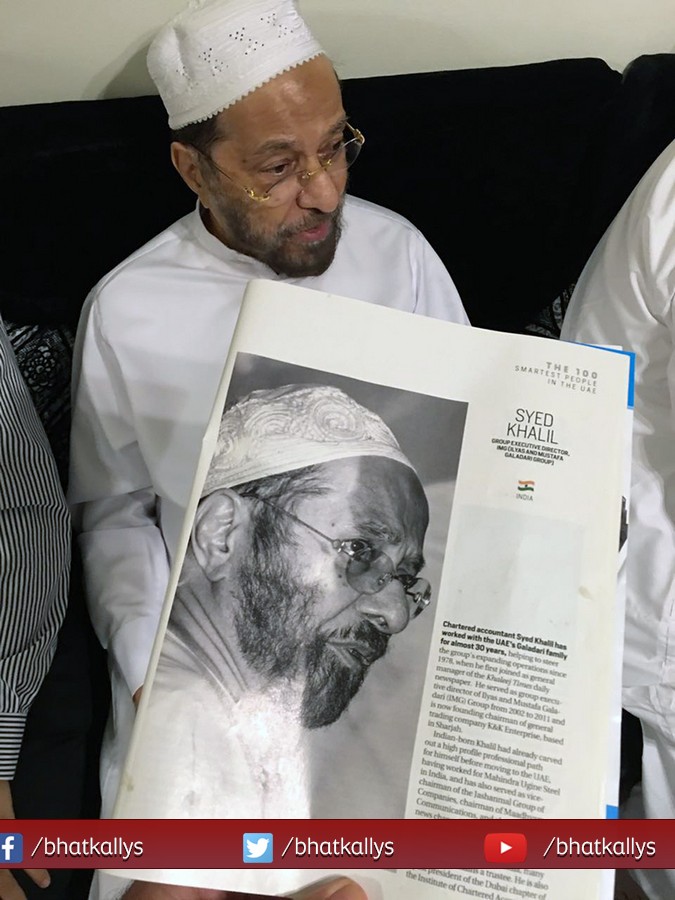
The weekly, ‘Arabian Business’ being published from Dubai in English and Arabic, has brought out a special issue titled ‘The 100 smartest people in the UAE’. By including Dr Syed Khalilurrahman in the list, the magazine has brought global fame to this town.
pix: bhatkallys.com
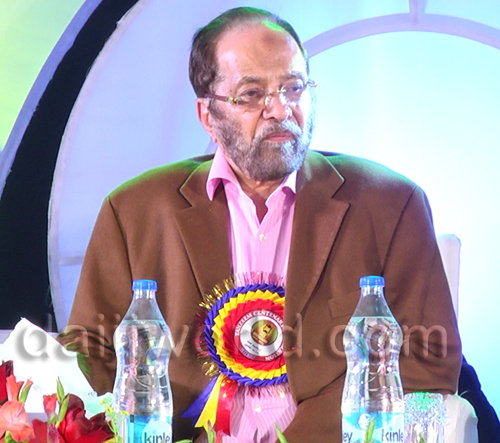
Dr Khalilurrhman, who is fondly and commonly identified by the general public here with the name, ‘C A Khaleel’, belongs to Nawayat community from here. The fact that he has risen to being distinctively endowed with the honour of being one of the most smart persons in the UAE has brought laurels not only for the Nawayat community here, but for Kannadigas and Indians. Khaleel evinces lot of interest and concern in international trade, social service, and education of poor children. He rightfully deserves the honour that has come seeking him.
Being in UAE, Khaleel is involved with business field that has been attuned to serve demands of the modern era. On account of his intelligence and close observational powers, he has grown tremendously in stature, and therefore, has been counted among the 100 most intelligent, clever, and wise persons of UAE. Incidentally, this list has 12 persons of Indian origin, and Khaleel has an outstanding personality because of his diverse interests.
Khaleel Saheb, who went to the Gulf in 1978, on account of his unshaken faith and affection on Galadari family, took Galadari Company to dizzy heights with his meritorious service for 30 years. Currently he has been active in his profession as the founder chairman of K&K Enterprises General Trading Company, Sharjah. He has also been serving as president of a number of educational and social service organizations in Karnataka and elsewhere.
Even when being in foreign soil, he always throbs to the needs of India, particularly his hometown, Bhatkal. He has organized a number of programmes in the town to strengthen harmony between Hindus and Muslims. He always keeps thinking about ways and means to relieve the youngsters from worries about unemployment problem, and towards this end, has been planning an industrial revolution in his native place. In his addresses, he has been expressing about the need of medical education here, and the need to establish a good hospital. This worthy son of Nawayat community has won several awards and honours and they come seeking him. He is the recipient of prestgious ‘Rajyostava Awad’ of Karnataka government, honorary doctorate of Aldersgate College, Ireland, and countless felicitations and honours, all of which go to showcase his imposing achievements and exemplary personality.
pix: daijiworld.com
Syed Khaleel is credited for being one of the first few chartered accountants from the town. Besides being known for his expertise as an expert in finances, he also is a popular leader in social service, religious, and educational circles. He has served as president of well-known organizations from here like Anjuman educational institutions, Rabita Society etc. Khaleel has won over unbridled love and respect of people from all the communities. He encourages total support for the education of girls and has built mammoth educational institutions. A number of influential political leaders, social and religious heads are in the circles that are close to Syed Khaleel.
In the past too Khaleelurrahman has been conferred with a number of honours and rewards.
Other Indians who have found themselves in the said list include Thumbay Mohidin of Thumbay Group, Rizwan Sajan, chairman and founder of Denube group, Yousuf Ali of Lulu Group, Sunil John, chief executive officer of Asda Barsen-Marstella, Dr B R Shetty, founder of NMC Healthcare, chief executive officer and founder of Plan B Group, Harmeek Singh, chief executive officer of Cocoon Centre for Aesthetic Transformation, Dr Sanjay Parashan, Lasic surgeon, Dr Pramod Was Hekar, managing director of VPS Healthcare, Dr Shamsheer Vayalil, and Sunny Warki, chairman of Gems Education.
source: http://www.daijiworld.com / Daijiworld.com / Home> Top Stories / by Yahya Hallare / by Daijiworld Media Network – Bhatkal (SP) / September 22nd, 2017
KKMA Student Awards, ‘Family Benefit Scheme Distribution’ held in Mangaluru
Mangaluru:
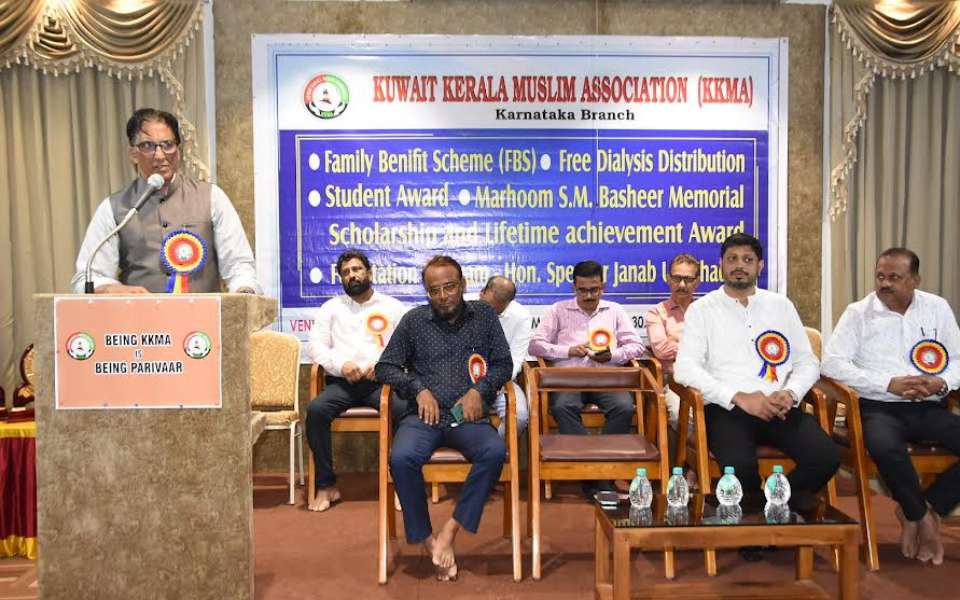
Kuwait Kerala Muslim Association (Karnataka Chapter) held a ceremony on Sunday, July 30, at the Highland Islamic Forum (HIF) Auditorium in Falnir.
The event aimed to provide assistance and recognition to its members and their families through various welfare schemes and awards.
During the ceremony, the Family Benefit Scheme was distributed to the families of deceased members as a compassionate gesture from the association.
Additionally, the deserving patients were recipients of the Free Dialysis Scheme, providing vital medical support to those in need.
The occasion also saw the distribution of the Late SM Basheer Memorial Student Scholarships, which offer educational support to deserving students.
Moreover, the Lifetime Achievement Award was bestowed upon CAO of Shepherd International Academy, Hasan Yusuf, a respected figure recognized for his substantial contributions to social services over the years.
NA Muneer, the former chairman and trustee of KKMA, delivered the inaugural speech, highlighting the association’s commitment to taking care of its members even after their passing. He emphasized how the association, which began in 2002 and now boasts over 16,000 members, has been able to extend financial assistance totaling more than Rs. 15 crore to 255 families who have lost their loved ones. Muneer applauded the selfless contributions of KKMA members, who, despite being small-time earners, generously contribute from their hard-earned money to support bereaved families. He urged the families of the deceased members to pray for the well-being of KKMA members, who tirelessly work for this noble cause.
Yusuf Rasheed, the KKMA Karnataka president, delivered the presidential address, underscoring the association’s dedication to the well-being of its members and the underprivileged within society. This dedication is evident through the distribution of facilities such as free dialysis and educational scholarships, aimed at uplifting and empowering the community.
The ceremony also witnessed an address by Architect Mohammed Nissar, Chairman of Indian Design School Mangaluru. Nissar encouraged the scholarship recipients to make the most of the opportunity and urged the association to provide guidance to these students so they can pursue professions that benefit both themselves and the wider community.
SM Farooq, KKMA Karnataka State President, paid tribute to his late brother, the esteemed SM Basheer, and recounted how he tirelessly worked for the welfare of KKMA Karnataka Chapter. He also highlighted how the Family Benefit Scheme offered essential support to the families of deceased members during crucial times.
In recognition of his exceptional service to KKMA Karnataka Chapter, SM Farooq was felicitated at the ceremony.
Several students were awarded with the KKMA students award for their academic excellence in various exams while several other deserving students were awarded educational scholarships during the event.
The event concluded with Abdul Latif extending the vote of thanks, expressing gratitude to all participants and supporters. Uzaif compered the event.
Prominent personalities like SM Basha and Munir Kodi were among the dignitaries present during the event.
source: http://www.varthabharati.in / Vartha Bharati / Home> Karavali / by Vartha Bharati / July 3oth, 2023
In a recent development, Adil Parvez has been elected as the new President of the Highland Islamic Forum (HIF) India. The election took place on Monday at the HIF India’s auditorium here in the city.
The newly elected president is poised to lead the organization for the next three years, steering its path with fresh vision and ideas.
The electoral process was conducted under the supervision of Katchi Masjid’s Khateeb, Moulana Shoeb Hussain Nadwi, who served as the election officer.
The program commenced with a qirath recital by HIF member Mohammed Haneef PS, adding a touch of spiritual significance to the proceedings.
Bilal Raif, another member of HIF, took on the role of hosting the event as the Master of Ceremony, ensuring a smooth and engaging affair.
Ex-president Nazim Ak expressed his gratitude and extended well-wishes to the newly elected President, Adil Parvez, as he takes on the responsibility of leading HIF India to new heights.
source: http://www.varthabharati.in / Vartha Bharati / Home> Karavali / by Vartha Bharati / July 31st, 2023
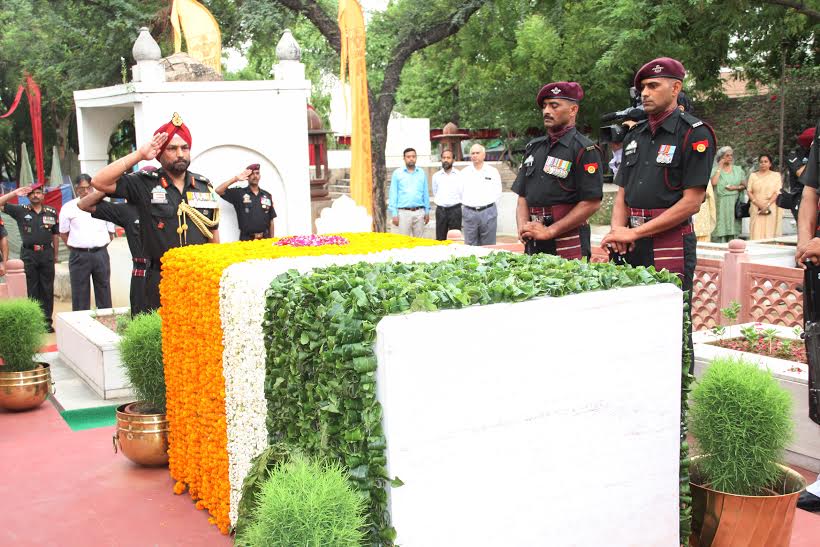
A Wreath Laying Ceremony to commemorate the death anniversary of Brigadier Mohammad Usman, MVC (P) was organised at his Memorial in Jamia Millia Islamia (JMI) Cemetery on 03rd July 2023.
Several Retired and Serving officers including Lt Gen Pushpendra Singh, SM** Col of the PARA Regiment and DG OL & SM, Brig. Rajneesh Mohan Cdr 50 (I) PARA Bde, Lt. Gen Gurbir Pal Singh, AVSM, VSM, DG NCC Delhi, Lt. Gen Velayudhan Sreehari, AVSM, SC, SM, AG’s BR DG (MP&PS), Lt Gen Subriti S Dahiya, SM VSM, Comdt NDC and Maj Gen Prashant Srivastava, AVSM, SM, Addl MS (B) attended the function and paid their tributes by laying a wreath at the Memorial of Brig. M. Usman, MVC (P).
A wreath was also placed at the Memorial of Brig. M. Usman PVC (P) on behalf of JMI Vice Chancellor Prof. Najma Akhtar (Padma Shri), as her tribute to the memory of the gallant officer. NCC cadets and officers were also present to witness the solemn occasion and pay their respects.
Under Brig. Mohammad Usman, MVC (P) Para Brigade successfully defended the city of Naushera against Pakistani Tribal forces, and then valiantly recaptured the city of Jhangar.
Late Brigadier Mohammad Usman, also known as the savior of Naushera, was responsible for the recapture of Jhangar & Naushera (Jammu & Kashmir) during 1947- 48 war with Pakistan.
The gallant officer attained martyrdom on 03rd July 1948 when an enemy artillery shell landed close to him in Naushera.
source: http://www.jmi.ac.in / Jamia Millia Islamia – JMI / Home / by Public Relations Office / July 03rd, 2023
The Dawoodi Bohra community has launched a global program to conserve water and recharge groundwater through effective rainwater harvesting techniques.
Recognising the global water scarcity issues, the leader of the Dawoodi Bohra community, His Holiness Syedna Mufaddal Saifuddin, in his recent address to community members in Mombasa, Kenya, stressed the importance of preserving and conserving water.
“Following the instructions of Syedna Mufaddal Saifuddin, a team of over 200 community officials were mobilised to visit more than 250 villages, towns and cities in India to study the strain on existing water supplies and provide support for building a more resilient and sustainable water management system”, said Shabbir Najmuddin, Associate Executive Trustee of Burhani Foundation, the community’s 30-year-old environmental body which is leading this initiative in collaboration with other organisations.
The process of water conservation
“As part of the first phase of the water conservation program, we targeted water-challenged areas in India by guiding them to harvest rainwater in their backyards, wells, ponds and other local catchment areas,” Najmuddin added, awareness programs were also held at educational institutions and community centres to showcase various methods of rainwater harvesting and their benefits in revitalising depleted groundwater levels.
“Various stakeholders in the water management field and municipalities were also consulted and involved in the survey to gauge the local conditions and take their opinions in adopting methods that best suit the region’s topography,” he added.
For the long-term rollout of the program, Burhani Foundation is identifying project coordinators from each area who will be tagged to experts to troubleshoot issues and facilitate the installation of rainwater harvesting systems in their regions. In the coming days, the Foundation is also going to reach out to community representatives from across the globe to harness the power of rainfall in their regions and share best practices for other areas to adopt. Besides that, the Trust is also rejuvenating defunct wells in the identified areas.
During the survey of rainwater harvesting in households 43-year-old Ismail Raja from Shahada, a town in Nandurbar district of Maharashtra, shared, “We installed a rainwater harvesting system in our backyard two years ago to recharge our borewell. Since then we have never faced water shortage as our borewell provides water not just to our families but also at times to our neighbours.”
Another community member, Jaffer Shabbir (36) from Savda village next to Burhanpur in Madhya Pradesh, is using a simple yet effective solution to recharge the nearby well which had run dry in 2017. He says, “By collecting rainwater from the roof of our hall and parking area which we give on rent for weddings and other functions, we’re harnessing the power of rain to replenish the groundwater in the neighbourhood.”
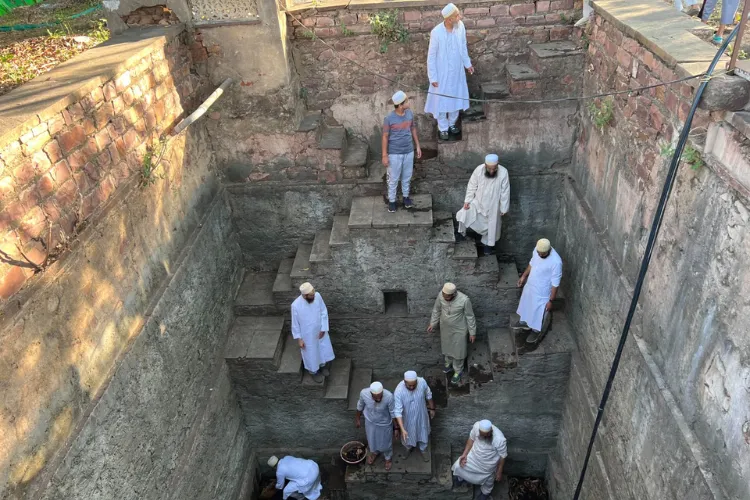
The members checking the progress
Syedna Mufaddal Saifuddin’s unwavering commitment to environmental conservation reflects in his broader vision of leading a harmonious and sustainable life. In his sermons, he continues to counsel the community to protect and preserve nature while inspiring individuals from all walks of life to actively participate in conserving natural resources and embracing practices that promote environmental sustainability.
According to NITI Aayog, nearly 600 million people, which is almost 50% of India’s population, are facing water shortage issues. The country is vulnerable to droughts as well as floods even as climate change is increasing unpredictability in weather patterns and leading to more extreme weather events. Rainwater harvesting, water reservoirs and other methods can help mitigate these extreme events by storing & recharging groundwater and releasing it when needed.
source: http://www.awazthevoice.in / Awaz, The Voice / Home> Story / by Shaista Fatima / July 02nd, 2023
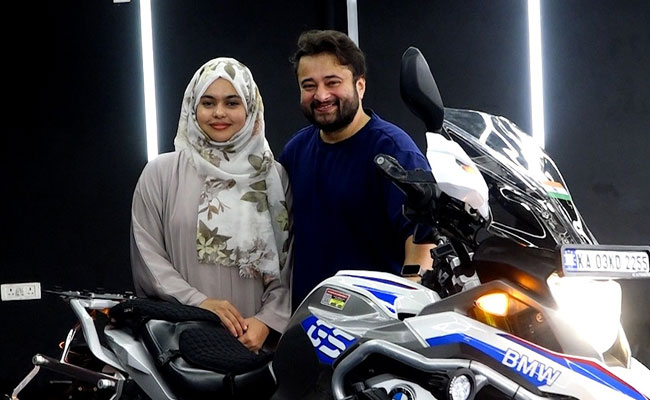
Motivational speaker and life coach, Saif Sultan, along with his wife, Adeela Farheen, is embarking on a remarkable mission to raise awareness about the vital importance of blood donation. The dynamic couple will undertake an arduous 4,000-kilometer motorcycle ride from Mangaluru to Kargil, aiming to spread the message of patriotism, dispel misconceptions about hijab, and highlight the significance of donating blood.
The journey is set to commence on July 29, 2023, at 7:30 am, from Nehru Maida in Mangaluru, under the auspices of esteemed dignitaries, including MLA and State Speaker U T Khader, and Mangaluru Police Commissioner Kuldeep Kumar R Jain. In preparation for their ride, a blood donation camp will be organized on July 28, in collaboration with the Blood Helpline Karnataka and the Red Cross Blood Bank. This initiative not only showcases the couple’s dedication but also encourages others to contribute to this noble cause.
Riding on the BMW GS 310, the couple has made modifications to suit their travel needs before embarking on their journey. Over the course of 19 days, Saif and Adeela will traverse multiple cities, including Honnavar, Belagavi, Pune, Mumbai, Surat, Ahmedabad, Udaipur, Jaipur, Delhi, Amritsar, Jammu, and Srinagar, before reaching their destination in Kargil on August 15. Covering an average distance of 300 kilometers per day, they plan to engage with the public, promoting the importance of blood donation and distributing souvenirs and chocolates to create awareness and foster community participation.
Saif Sultan expressed, “Our primary objective is to raise awareness about blood donation. However, I also hope to dispel misconceptions surrounding the hijab and demonstrate that it is not a symbol of oppression. By showcasing my wife, Adeela, wearing the hijab during our ride, we want to emphasize that Muslim women are educated, empowered, and free to pursue their aspirations within the framework of their faith.”
Reflecting on the inception of their journey, Saif shared, “Originally, I had planned a solo ride to Kargil and was preparing for a 300-kilometer ride to Karwar. But when my wife expressed her interest in joining me, I welcomed the idea with open arms. Our previous trip to Karwar was a transformative experience, allowing us to strengthen our bond and subsequently inspired us to embark on this extraordinary journey together. Our children, Hoodh, 8, and Safa, 6, are also thrilled and supportive of our adventure.”
In addition to raising awareness about blood donation, the couple’s expedition aims to serve as a testament to India’s safety and cultural diversity. Along the way, they will document their experiences through daily blog posts, sharing their insights and encounters with the public. On reaching Kargil, the couple plans to organize a blood donation camp, where Saif will proudly donate blood for the 20th time, and Adeela will contribute for the first time.
As a symbol of solidarity and gratitude, the Indian Army personnel will witness the hoisting of flags, including the flags presented by dignitaries in Mangaluru, along with the Kannada flag on August 15. This gesture honors the memory of the late Kannada superstar Puneeth Rajkumar, with whom Saif had the privilege of meeting on three separate occasions.
This exceptional endeavor by Saif Sultan and Adeela Farheen not only promotes blood donation awareness but also sheds light on the global blood shortage crisis, which affects both low- and middle-income countries, including India. Access to safe and sufficient blood for all those in need remains a challenge worldwide. By encouraging voluntary, unpaid blood donations and fostering active community participation, we can ensure a stable blood supply, particularly during emergencies and disasters.
The couple’s forthcoming plans of touring Thailand next year and Europe the following year reflect their unwavering commitment to exploring the world while advocating for noble causes.
source: http://www.english.varthabharati.in / Vartha Bharati / Home> Karavali / by Vartha Bharati / July 27th, 2023
Long thought to be simple fare, Kokni Muslim cuisine’s unique flavours and aromas are slowly wafting out of the confines of home kitchens.
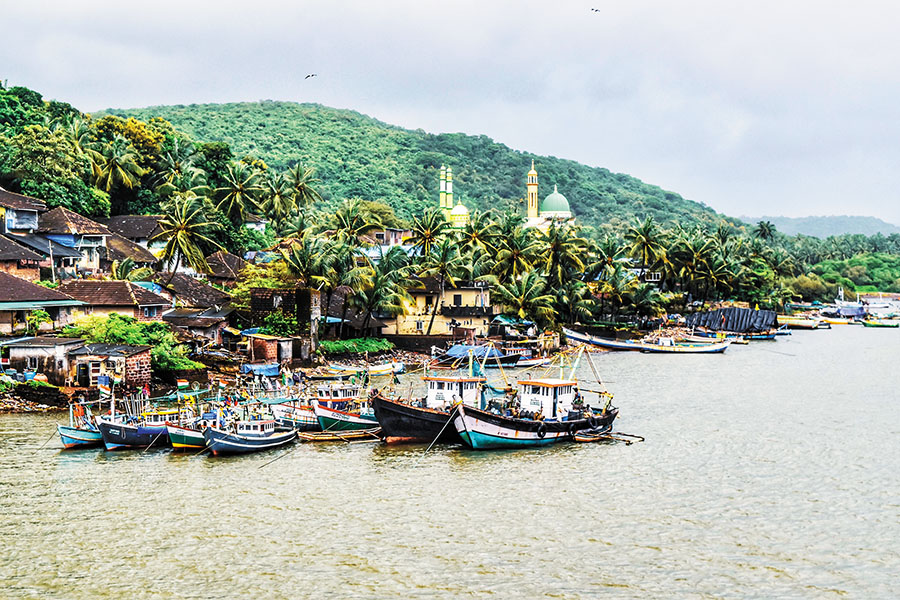
The Konkan coast, which is home to the Kokni Muslim cuisine
When you think of Muslim cuisine, what do you think of? Hyderabadi dum biryani, Lucknowi galouti kebab on a warqi paratha, or the lavish Bohri thaal? Dishes such as yakhni gosht (dry mutton), machli cha halduni (fish gravy), dum che Bombil (Bombay Duck made in the dum technique) are not the ones that readily come to mind as most of us are unfamiliar with the cuisine of the Kokni Muslim community.
What has kept this cuisine away from public knowledge is that it cannot be found at just about any restaurant and can be sampled only at home-dining experiences or pop-ups, that too only over the past couple of years.
One such is Ammeez Kitchen, a home-dining service on weekends at Marol, Mumbai, founded by Shabana Salauddin in 2017. “Ammeez Kitchen happened over a conversation with my mother, Ammee, while having our meal,” she recalls. “The discussion hovered around why Kokni Muslim food, which is so delectable, is unknown compared to other regional cuisines? Ammee dismissed the idea, saying our food is just ‘ghar ka khaana [simple home food]’. This strengthened my resolve, as I felt this was exactly what I wanted to showcase.”
*****
Kokni Muslims are a sub-ethnic group from the Konkan region, including the areas of Thane, Raigad, Ratnagiri and Sindhudurg. About 1,000 years ago, trade between the Indian sub-continent and West Asia saw Arab merchants coming to this region—to ports such as Chaul, near Alibaug—and, over centuries, settling along the coast, marrying into the local communities and giving rise to the Kokni Muslim community of seafarers. The Arabs brought along with them the knowledge of food such as yakhni or mutton dishes, and spices such as fennel. Besides, owing to their location, seafood became an integral part of their cuisine along with local, Maharashtrian influences.
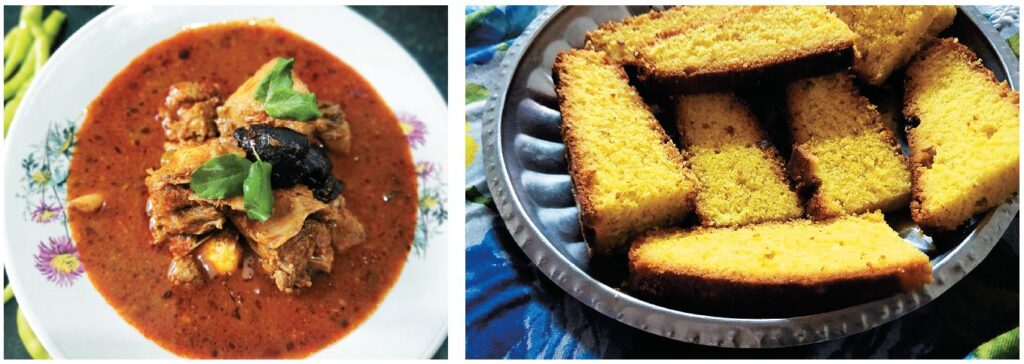
(From top left) Khatte bangde; roath, a semolina-based cake
Nujmoonnisa Parker, author of Kokni Delights (a book of recipes and history of the community) and an exponent of Kokni Muslim cuisine, explains, “The backbone of Kokni Muslim cuisine has always been what is harvested from the ground, i.e. local produce. Like the cuisine of the Goud Saraswats of Konkan and Christians in Goa, Kokni Muslim cuisine is largely dairy-free, and, in this respect, differs from the Mughlai cuisine. There are various permutations of any given recipe, based on the region, availability of ingredients and seasonality. Coconut, rice, lentils, onions, potatoes and red chilies are the main ingredients of this cuisine.”
Although a myriad spices and ingredients go into each dish, according to Shahida Khan, a Kokni Muslim from Navi Mumbai, the food is light on the stomach. “Kokum, dry mango, black sesame seeds, coconut, red chilies, turmeric—all grown in the region—are used in our cuisine. Rice, which is also common, is used in whole or powdered form in almost every dish.”
Elaborate meals are the cornerstone of this cuisine. Popular dishes include machli cha halduni, chavachi chutney (coconut chutney that is eaten as a main dish), chawrachi roti (boiled rice flour chapati), kavtacho bojar (stuffed egg), kolbi chi chutney (dried prawns chutney), alni paalni (chicken soup without salt).
“Kokni Muslim food is always a complete meal. We have roti, chawal (rice), sabzi (vegetables), saalan (gravy), kebab or talela, and tondilavayla (condiments). Many a time, the number of condiments exceeds the number of main courses, and typically include hari chutney (green chutney), sirke ka achaar (onions pickled in vinegar), kalkhand, kuldey (rice papad), thecha (chilli chutney), raita or kachumber,” says Salauddin.
Saravle, a wheat pasta
The cuisine has similarities with other Konkan cuisines and yet remains distinct. Mumbai-based home chef-turned-entrepreneur Mumtaz Kazi Pawaskar, who hails from the fishing village of Harnai in Ratnagiri and runs a catering business along with her cousin Sameera Gawandi, elaborates: “We call ourselves Kokni and not Konkani. The use of coconut milk as in other Konkan cuisines is common. But we use it instead of water to make curries, and this is one such distinction of Kokni food. So much so, that coconut milk is even used to cook rice, which gives it a glaze and extra flavour.”
Pawaskar adds that the cuisine has three broad spice combinations: Fish masala, mutton masala, and haldi (a combination of turmeric and fennel ground together). Fennel, a key ingredient of Kokni cuisine, is an example of the Arab influences. “Isan is the process of adding a few prawns to some vegetable preparations like stuffed brinjals, a yellow curry with drumsticks, and yam in garam masala for extra flavour,” she explains. “In our village, during summer, all household courtyards have whole red chillies drying in the sun, while households make and store spice mixtures for the whole year.”
Each meal has some special dishes. “Ghavne and sandan are breakfast dishes made with rice flour and a bit of jaggery. While ghavne [delicate crepes] is made on a tawa with pure ghee, sandan [similar to the Goan sanna] is steamed and is lighter in texture,” Khan explains. “Ghario, on the other hand, is an evening snack made with shredded cucumber, jaggery and rice flour, deep fried and typically served with Sulaimani chai.”
Cooking methods and ingredients vary from village to village, according to Salauddin. “Every family has their own version of the recipe. Most of the Kokni families have at least one clay pot or degh in which machli ki halduni and kalsani ka saalan (fish gravy) are prepared. The wet spice mixture—coriander, chillies and garlic—is always freshly ground. There are two extremes in our cooking: An entire meal can be fixed in 30 to 45 minutes, while others that include sandan (like idlis, made of coarse rice, coconut, milk, sugar and steamed), roath (semolina-based cake), khichda (slow-cooked meat and lentils), sarole or saravale (wheat pasta), bhakorche (like rotis), and ukdi ke kanole (rice dumplings) are laborious.”
Chonge, or sweet puris
Desserts occupy an important place in this cuisine. Pelve are rice flour crepes stuffed with grated coconut and jaggery and garnished with chironji, a variety of nut. Poppy seeds are used abundantly to garnish sweet dishes like mitli (made of rice flour and coconut), peyushi (coconut milk and cashew pudding), duderi (flour and egg pudding), chonge (sweet puris) and seviya (vermicelli in milk).
Although Kokni Muslims have traditionally cooked and enjoyed their own cuisine at home, Parker feels that in the last few decades the community has learnt to incorporate various styles of cooking into their kitchens.
Saravle, a pasta made from wheat dough moulded into tiny rings, is a favourite in this cuisine. It plays a significant role in weddings as it is part of a bride’s ‘rukhwat’ (gifts) when she leaves her parents’ home. It is cooked as a savoury dish with mutton or chicken, or as a sweet when steamed and topped with eggs.
Salauddin says, “Ukdi ke kanole, small half moon-shaped rice dumplings stuffed with freshly grated coconut, sugar and nuts, are prepared on the wedding day. These piping hot dumplings are bought in a big plate and placed in front of the couple. The groom is expected to pick up the maximum number of dumplings and gift them to the bride. The belief is that the larger the number of dumplings he picks, the more likely he is to take care of his wife.”
Religious occasions, too, call for special dishes being prepared at home. “Women prepare sandan on Ramadan Eid, and roath and malido in the first week of Muharram,” says Parker.
Until recently, Kokni Muslim food had remained restricted to homes and was not considered to be a cuisine that could be popularised beyond the community. However, many women are now making an effort to help more people become aware of their rich culinary heritage through pop-ups and curated home-dining experiences.
Since 2017, Pawaskar and Gawandi have been delivering food from their home under the name of Kokni Dastarkhwan, and have joined hands with Authentic Cook, an organisation that offers unique culinary experiences hosted by home chefs. For instance, in 2019, Neel, a popular Mughlai and North Indian cuisine restaurant with branches in Mumbai’s Mahalaxmi and Powai held a Kokni Muslim cuisine pop-up with Pawaskar and Gawandi.
Salauddin’s Ammeez Kitchen offers home dining experiences on weekends, where customers can reserve their seats in advance, and also delivers Kokni Muslim fare to the homes of customers. “Most Kokni Muslims now live in nuclear families, and with the busy lives we lead we all prefer to have quick-fix meals rather than our own cuisine, which can be quite elaborate. Families have either stopped making these dishes, or are unaware of old recipes made by our grandparents,” laments Salauddin. “This is why the transfer of knowledge from one generation to another is at a standstill. While we Koknis love our food, we have always undervalued it. It is confined within the walls of our kitchens. It is now time to let the world know.”
Check out our Festive offers upto Rs.1000/- off website prices on subscriptions + Gift card worth Rs 500/- from Eatbetterco.com. Click here to know more.
(This story appears in the 14 February, 2020 issue of Forbes India. To visit our Archives, click here.)
source: http://www.forbesindia.com / Forbes India / Home> Life> Forbes Life / by Mini Ribeiro / February 08th, 2020


.jpeg)