Category Archives: Community Involvement / Social Issues

South Africa’s highest awards given to two of its Indian-origin citizens

SOUTH AFRICA:

Ebrahim Ismail Ebrahim served time on Robben Island as a political prisoner alongside Nelson Mandela. 

Dr Aboubaker Ebrahim Dangor is known for his ground-breaking physics research.

National Orders
National Orders winners (Photo | Presidency | South Africa Twitter)

Johannesburg :

Two South African Indian-origin citizens, the late struggle icon Ebrahim Ismail Ebrahim and scientist Dr Aboubaker Ebrahim Dangor, were among the many recipients of National Orders when President Cyril Ramaphosa hosted the annual event in Pretoria on Friday.

National Orders are the highest awards that South Africa country bestows on its citizens and eminent foreign nationals who have contributed towards the advancement of democracy and have made a significant impact on improving the lives of South Africans.

The National Orders also recognise the contributions made by individuals towards building a non-racial, non-sexist, democratic and prosperous South Africa as envisaged in our Constitution.

Popularly known as ‘Ebie’, Ebrahim passed away after a long illness in December 2019, shortly before his autobiography ‘Beyond Fear — Reflections of a Freedom Fighter’ was released by his wife Shannon.

Ebrahim served time on Robben Island as a political prisoner alongside Nelson Mandela, Ahmed Kathrada and others.

After his father was arrested twice for defying laws that restricted the movement of Indians in South Africa, he joined the liberation struggle at the age of 13.

Ebrahim often shared how he had been inspired by the Satyagraha style of Mahatma Gandhi, which he used in his passionate representation of the ANC in global conflict situations in Sri Lanka, Palestine, Rwanda, Kosovo, Bolivia and Nepal.

After his release, Ebrahim went into exile to continue his work with the ANC, but was abducted by apartheid-era security police from neighbouring Swaziland, tortured and sentenced to a second term on Robben Island. He obtained two university degrees while on Robben Island.

After the release of all political prisoners and the election of Mandela as South Africa’s first democratic president, Ebrahim served in various capacities, including as Deputy Minister of Foreign Affairs and Parliamentary Counsellor to Mandela.

Ebrahim’s citation said he was receiving the Order of Luthuli in Gold for his lifelong commitment to the liberation of all South Africans. “He lived by the courage of his conviction and became a formidable opponent to the repressive apartheid government,” it read.

Shannon Ebrahim described her late husband as a “gentle giant, even to his family.”

“He inspired us with his undiluted moral values, his absolute commitment to transform South Africa for the better (even beyond political liberation), and his willingness to engage warring factions in conflicts around the world as a peacemaker. He was the essence of humility and never expected recognition for any of the hardships he endured throughout his life in the cause for freedom,” she said.

His one hope was that South Africans would read his memoir “Beyond Fear” to better understand what revolutionaries of his generation went through to bring about a new South Africa, his wife added.

“(Our children) Sarah, Kadin and I miss him dearly, but will always cherish his legacy,” she said.

“Dr Dangor was awarded the Order of Luthuli in Silver — for his admirable and distinguished contribution to the field of science through his ground-breaking research in physics,” his citation read.

Dangor has been based in the UK since he went there to continue his studies after getting his first Honours degree at Wits University in 1961.

He could not return home permanently because the white minority apartheid government denied entry to his wife from Bermuda, as she was of Black descent.

Widely published in academic journals, Dangor has also overseen scores of doctorate candidates in his career.

“It is particularly humbling for me that the first recipient of the Award was Nelson Mandela, our first post-apartheid president. I hope that being the recipient of this award will encourage the youth in the sciences in South Africa,” Dangor said.

Dangor’s niece, Zubeda Dangor, founder and director of Nisaa Institute for Women in Johannesburg, said he was very shy and did not like the limelight.

He could not attend the ceremony and his award was accepted by his grandnephew Mohammed Raees Dangor.

source: http://www.newindianexpress.com / The New Indian Express / Home> World / by PTI / April 30th, 2023

Dr. Mohammed Jameel Won the Long Grove Municipal elections, Illinois. Becoming the First Indian American Muslim elected to Long Grove.

Warangal, TELANGANA / Longrove Village Board (Illinois), U.S.A :

Dr Mohammed Jameel NRI has become the First Indian American Muslim to be elected for LongGrove village Board elections.


Speaking on this occasion in winning celebrations in Long Grove Dr. Jameel thanked the voters of Long Grove who voted for him and urged the community to increase participation in civic activities and build a strong community which thereby can lead to more participative and inclusive participation in all levels of Government.

Lake County Treasurer Holly Kim was the Chief Guest and congratulated him .

Dr Jameel is very active in Local politics heads the Americans Democratic Forum and has supported in win of the first Indian Muslim woman Nabeela Syed as a state representative in the state of Illinois.

Dr Jameel is also very active in all spheres of engagement socially and politically in India as chairman of the Indian Americans forum .

He belong to warangal India and graduated from Deccan medical college.

Many eminent personalities both from India and USA congratulated him on his success prominent amongst them is the President of DAANA Moizuddin.

Alumni association from his school Y SUNITHA, Inner wheel president Dr. Ashish Chauhan MD, Tarun Joshi IPS, Zaheeruddin Ali Khan Editor Siasat, Padmaja Shaw former prof of communications OU .

From the US Dr. Rehan khan ISPJ Washington, Holly Kim Lake county Treasurer, CK Schmidt chief Ela democrat, Roy Manthena Dalit activist Newyork, Irshad khan ex-chairman CIOGC congratulated him on being elected and wished him all success .

source: http://www.thehindustangazette.com / The Hindustan Gazette / Home> News> Election / by Shifa (headline edited) / April 06th, 2023

Nazira girl Sheikh Raisha Tabassum appointed as State Secretary of BJP’s youth wing (BJYM), Delhi Pradesh

Nazira (Sivasagar District), ASSAM :

Sheikh Raisha Tabassum from Nazira in Sivasagar district has been appointed as the youngest State Secretary of BJP’s youth wing Bharatiya Janata Yuva Morcha (BJYM) Delhi Pradesh.

Sheikh Raisha Tabassum

Sivasagar :

Sheikh Raisha Tabassum from Nazira in Sivasagar district has been appointed as the youngest State Secretary of BJP’s youth wing Bharatiya Janata Yuva Morcha (BJYM) Delhi Pradesh.

A graduate with honours in Political Science honours from Hindu College, University of Delhi, 20-year-old Sheikh Raisha is also the founder of ‘El Jeffa Foundation’ — a national NGO working with the United Nations in various parts of India.

Previously, Sheikh Raisha was also the State Secretary of the ABVP Delhi’s North East Cell, in-charge of the ‘Slum School Project’ under ‘Students For Seva’, ABVP where she focused on educating 300+ Muslim underprivileged children in Delhi.

The BJP has given her the responsibility to work for the welfare of the minority community with focus on the youth of the north-eastern region.

Sheikh Raisha is also a recipient of the prestigious SKOCH Yuva award. She was also nominated for the ‘Karmaveer Chakra Awards’ constituted by confederation of Indian NGOs & UN.

Sheikh Raisha is the daughter of Hamida Rahman, a teacher by profession of Nazira Na-mati.

source: http://www.sentinelassam.com / The Sentinel / Home> NE News> Assam News / by Sentinel Digital Desk / September 06th, 2021

Two lakh Muslim youth take to Kerala streets to mark 50 years of student group

Kannur, KERALA:

Over one and half lakh Muslim youth took the streets of Kerala’s Kannur on Saturday, marking the golden jubilee of the Sunni Students’ Federation (SSF).

The SSF was formed in Kerala on 29 April 1973 under the patronage of Sheikh Abubakr Ahmad. It is affiliated to All India Sunni Jamiyyathul Ulama.

Over two lakh students and youth attended the public conference at Jawahar Municipal Stadium in Kannur.

“It is the largest student assemblage in the country, which marked the rise and proclamation of the energetic sustenance of a moral student commune capable of leading the nation with secular values and ethical principles,” said Muslim scholar and the student body’s patron Sheikh Abubakr Ahmad.

Ahmad while inaugurating the valedictory session of the six day conference urged the state and Union governments to act against the hatred and communal disharmony.

Ahmad also demanded the ban of ‘The Kerala Story,’ a Hindutva propaganda movie which falsely claims that the southern Indian state is a hub of ‘love jihad.’

The theme of the conference was “Nammal Indian Janata” which translates to “We, the people of India”.

The main entrance to the conference was designed to resemble the Bab-e-Maulana Abul Kalam Azad, the main gate of Jamia Millia Islamia in New Delhi. The construction of the conference gate also served as a pointed response to the Hindu nationalist government’s decision to exclude the great Muslim figure’s contributions from school textbooks.

source: http://www.maktoobmedia.com / Maktoob / Home> India> Latest News> South India / by Maktoob Media Staff / April 29th, 2023

Nuh’s Niyaz Khan and his 11 daughters who swam against the tide for education

Nuh, HARYANA:

11 daughters of Niyaz Khan

When I met Shabnam and her elder sister Nafisa after a flight of 37 steps of a half-built high-rise building on the Nuh-Tawadu road, I couldn’t gauge the high spirits of these two women, their nine sisters, and late father Niyaz Khan in our brief meeting.

Niyaz Khan, a former revenue officer in the Punjab Waqf Board, has left this world, but he is remembered for bringing about the change in the mindset of Muslims in Nuh through his act of giving a good education to all his 11 daughters.

Not only he educated his daughters but 8 of them became teachers and are carrying on the mission of spreading education in one of the most backward areas of India.

In a conversation with Awaz-The Voice, Shabnam says, “I and my sisters who are teachers make efforts to ensure that girl students in our respective schools do not give up on their studies midway and drop out of school. We also make extra efforts to see that besides retaining the numbers, more girls are enrolled in the school.”

Shabnam says that to retain girl students they call the parents of students to school to make them aware of the importance of education.

Shabnam, who worked in an NGO for a long time before joining the government school, says, “Due to my experience with an NGO, I face lesser difficulties in this job (retaining girl students in school) in comparison to other sisters. My experience of working on child education in an NGO is helping me.”

She says that increasing the number of students helps in upgrading schools. Shabnam is now TGT i.e. Trained Graduate Teacher in Rithoda vuillage. The primary school where she worked earlier has since been converted into a middle school.

Shabnam and Nafisa

Shabnam’s elder sister Nafisa says that many parents come to consult her and all her teacher-siblings. They ask them how to ensure a good future for their daughters. “Many times strangers stop them at the bus stand for paying compliments and telling us that they want their daughters to be like us.”

Nuh remains one of the most backward districts of Haryana, where women are struggling to rise amidst diehard patriarchy, old-fashioned thoughts, rampant illiteracy, and a lack of basic facilities. The dropout rate of girl students is the highest in the state.

Although there are many schools and colleges in Nuh, it has no university and women must go outside for higher education.

Asif Ali Chandaini, General Secretary of Mewat Vikas Manch, says, about 70 to 80 percent of the population of the district survives by doing petty and menial jobs. In such a situation, parents have financial constrains, and safety of daughters as issues in their minds while deciding on educating their daughters. In the end they prefer to keep their girls at home.

Defying such conservative traditions in the decade of nineties, Niyaz Khan decided to send his daughters for higher education.

Nafisa, the eldest of the sisters, who spoke with Awaz-the voice said their father had a transferable job. As long as the family was living outside Mewat, he did not face any problems in educating his daughters. However, after he met with an accident, took voluntary retirement and shifted permanently to Nuh in 1993, he faced stiff opposition to sending his daughters to colleges and universities.

Her father was a resident of Chandaini village, about four kilometers from Nuh. The people there are progressive and clear about the aware of education.

Praising her father and grandfather, Shabnam says, “Both were very great people. Dada (paternal grandfather) never stopped us from going to college and school. In the nineties, when the environment was worse than what you see today, he not only continued to give higher education to his daughters but also sent them out of Nuh for studies.”

Shabnam has also studied law; her husband is a practicing advocate in Sohna.

Despite the regressive environment around them, Niyaz Khan’s eight daughters became teachers. They are employed in government schools. Shabnam says teaching was their choice.

Shabnam has five children. One of her daughters has a Master’s degree in Fine Arts from Banaras. Her other children are also into masters and other higher education courses.

Nafisa’s elder son is pursuing a Ph.D. in Physics.

Shabnam and Nafisa say that they care least about others’ opinions when it comes to their children’s education. “Our children are moving forward by choosing their careers. We are only supporting them,” they said almost in unison.

 According to Nafisa, the children of the younger sisters are also pursuing education at different levels.

She tells that things are changing for Mewati Muslims on the education of girls. However, the change is quite slow.

Nafisa says that there is a trend of girls dropping out after fifth or eighth standard and being sitting at home.

Many parents prefer to send their daughters to Maktab, local Madrasa, instead of sending them to school.

Shabnam’s disciple Mohammad Rafiq, who has done his Ph.D. on the topic of Mewat’s female Sarpanch, says that the picture of Mewat can change if the authorities present these eleven sisters as ‘role models’.

The 11 sisters becoming the face of women’s education and empowerment can bring down the dropout rate significantly. However, both the sisters do not agree on this.

They feel the thrust on women’s education has to begin from their homes of Muslims.”Everything cannot be left to the government; the politicians of Mewat have to show willpower,” Shabnam says.

She said once she invited the local politicians to a meeting of Urdu teachers, but none of them came. She also this was the most discouraging since most of them are her relatives.

Despite this, they do not show any special seriousness towards education.

Niyaz Khans’s daughters:

Nafisa: JBT & B.Ed, Govt Teacher

Shabnam: MA, LLB, JBT, government teacher

Afsana: JBT, MA, B.Ed.

Farhana: JBT, MA, B.Ed. government teacher

Shahnaz: JBT, MA, B.Ed teacher in private school

Ishrat: B.A

Nusrat: Lecturer in JBT, MA, MEd and employed in a Polytechnic

Ana: JBT, MA B.Ed, Govt Teacher

Razia: MBA and working in private sector

Nazia: Diploma in Architecture, works in private sector

Bushra: MA, B.Ed

source: http://www.awazthevoice.in / Awaz, The Voice / Home> Stories / by Malick Asghar Hashmi / May 04th, 2023

Book on ‘Contribution of Muslims in Kannada literature’ released by Vidhana Parishad Speaker Basavaraja C.Horatti

KARNATAKA:

Vidhana Parishad Speaker Basavaraja C.Horatti releasing Book on ‘Contribution of Muslims in Kannada literature’

Basavaraja C.Horatti, Hon’ble Speaker of Vidhana Parishad of Karnataka Government has released a new book in Kannada, Kannada Sahityadalli Muslim Samvedane which means ‘Contribution of Muslim Writers to Kannada Literature’.

The book was released at a colourful function at the  ‘Cochin Kannada Cultural Festival 2023’ which was  promoted by joint auspices of Kannada Sangha Cochin, Kasaragod District Kannada Journa lists Association, Karnataka Border Area Development Authority,  and Karnataka Working  Journalists Association.

Kannada speaking masses in Ernakulum and various parts of kerala and Karnataka attended the festival in large.   

The convention featured symposium, many cultural programs and a parade.

source: http://www.muslimmirror.com / Muslim Mirror / Home> Indian Muslim> Literature / by Muslim Mirror Network / May 08th, 2023

A Revolutionary Book On Islam That Non-Muslims Should Also Read

NEW DELHI :

Wealth of Muslim community and government spending on the rituals of Islam for centuries would have been better utilized for establishing universities and technical and research institutes.

A Revolutionary Book On Islam That Non-Muslims Should Also Read

Title: The Scientific Muslim: Understanding Islam in a New Light

Author: Mohammad Aslam Parvaiz

Publishers: Konark Publishers

Pages: 184

Price: Rs 595

These are undoubtedly troubled times for India. Never before were the minorities, Muslims in particular, made to face such vicious communal hostility. The Hindu rightwing is at its aggressive best, combining facts with fiction to attack almost everything Muslims hold dear – their prayers, festivals, dress, even cuisine. Muslims are constantly provoked. If they respond even verbally, they face more wrath. It could not have been worse. 

Hats off to Mohammad Aslam Parvaiz for coming out with his book on the problems Islam faces now. No, this is not a book about how to deal with Hindutva forces; far from it. A man of science, Parvaiz complains that Muslims across the world have jettisoned Islam’s true nature by sticking to parts of the Quran while ignoring much of what it says on how one must lead one’s life. 

As a student of spirituality, I am convinced that the book will make waves in India and much of the Islamic world. 

Ignoring Quran

The Quran, the author says, tells people how to lead a peaceful and meaningful life. While it asks those who read it to understand and explore nature, these intellectual pursuits are almost missing in those who claim the Quran to be their guidebook.  

Parvaiz moans that Muslims born in Muslim households are taught to ‘read’ Quran without understanding it. Over the last many centuries, Muslim society has cherry-picked certain verses of Quran as binding on them. These include five-time prayers, fasting during Ramzan, offering ‘zakat’ and making a pilgrimage to Mecca. The Quran, he says, is much more. By deserting the Quran, “we ‘Muslims’ have deserted Islam”. 

This is the main reason the Muslim society seems to have turned its back to scientific principles in which it once excelled, giving a tough competition to Europe. A sizeable section of Muslims even feels that contemporary education churns out atheists. The result? Ignorance about Quranic teachings coupled with limited ‘religiosity’ has led to the curriculum which is followed in most madrasas today. 

In the process, Muslims are widely misunderstood by others. Non-Muslims think a Muslim must be one who sports a beard and a skull cap, goes to a mosque to pray five times a day and slaughters animals to eat. But these are visible symbols. Parvaiz contends that the one who follows the guidance given in the Quran and grooms himself accordingly is alone a true Muslim.

Also, some Muslim rulers had a knack of not tolerating any criticism about themselves or their religious beliefs. Consequently, wars and persistent battles rendered the once-prized academic atmosphere unfavourable.

Based on the Quran, Muslims must draw a road map for acquiring knowledge in every sphere and put it to the service of humanity. Parvaiz details what all the Quran says for human betterment. For instance, it underlines that one must meet his needs judiciously and avoid extravagance. As long as the Muslim followed the divine way, they ruled over the world and promoted justice, equity, peace and public welfare. When they began to neglect the Quranic system, it led to their disgrace and humiliation. 

Islamic decline 

Unfortunately, Muslims are at present unable to understand or act on the Quran. According to the author, the wealth of the Muslim community and government spending on the rituals of Islam for centuries would have been better utilized for establishing universities and technical and research institutes.

The absence of these is a key reason for the decline of Muslims as a productive part of the society or country where they live. “Their love for wealth, progeny and glory have made them indifferent to patronizing knowledge… It is time that we transcend sectarianism and shed false notions about our understanding of Islam and our intellectualism.” 

According to the author, one reason why Muslims were hooked to a ritualistic lifestyle is because of the birth of a plethora of confusing and contradicting literature based on different sects that began to flourish. Slowly, Islam began to get diluted.

Also, some Muslim rulers had a knack of not tolerating any criticism about themselves or their religious beliefs. Consequently, wars and persistent battles rendered the once-prized academic atmosphere unfavourable. Muslim mobs in 1857 plundered the library of Delhi College, tearing apart books on English and science; Arabic and Persian books were looted.  

Parvaiz without doubt has complete faith in the Quran. Yet he tears to shreds those who he feels are following it selectively, ignoring all that it has said about how to be in tune with Divine creations. “Soulless rituals cannot provide any food for thought. These may arouse our sentiments. Yet they cannot produce those Muslims who may lead communities of the world.”

He goes on: “Today, Muslim localities are notorious for their filth and rubbish. We throw all rubbish outside our homes and shops. The drainage system is rotten. We encroach upon roads, making life difficult for everyone. We erect all sorts of barriers on roads. We generate various forms of disorder. The industrial smoke coming out of small- scale work units in every house and alley adversely affect the entire atmosphere. All this amounts to disobeying God’s commands.” (It is another matter that much of what the author says about Muslim neighbourhoods can be said to be true for areas populated by other communities in India too.)  

Way forward 

Parvaiz explains what needs to be done. “Water, air, earth and all that is inside the planet are God’s signs. As Muslims we should not even think of disrespecting or destroying these signs.” His complaint is not directed at one section or country of Muslims. “No group, community or country of Muslims has ever prepared its progress model which is in accordance with the Quranic principles of justice, equity and selfless service.” 

God, he says, has subjected everything to His laws. Indeed, all creatures who abide by divine commands can be called believers. Lip service and verbal claims alone will not and cannot help Muslims discharge their duty towards God. In real life, humans who are blessed by God seek to hold and hoard resources provided to them. Ownership and monopoly, he warns, are satanic concepts. 

Parvaiz feels that the time has come to free Muslim educational agenda from religious and sectarian bias. Muslims should welcome all beneficial branches of knowledge. Character development has to be encouraged. One needs to train and produce Muslims who will follow Islam in full and not confine it to only a mosque or prayers. 

“Islam will be their guide and mentor in every activity of life. This is the Muslim community which lost its way one thousand years ago.” 

Non-Muslims too must read this eye-opener of a book as much as Muslims.  

(The reviewer is a veteran journalist and author)

(Published under an arrangement with South Asia Monitor)

source: http://www.thenewsagency.in / The News Agency / Home> News Pops> India / by M R Narayan Swamy / April 28th, 2022

The Freedom Fighter and Labour Leader Abdul Bari Still Beloved in Jamshedpur

Shahbad District / Patna, BIHAR :

This May Day, remembering Abdul Bari.

Abdul Bari.

Abdul Bari is not a name that many Indians remember, but Munawwar, a committee member of the Tata Motor Workers’ Union in Jamshedpur, Jharkhand, holds the name in high esteem.

“I don’t see a leader like Abdul Bari [coming up] in the near future,” he said. “It is because of his efforts that we still get high tea at just six paisa.”

“Once, Bari went to the Tatas and he was offered tea. He asked them to first offer it to the workers, and then made an agreement which is still benefitting us. Upmaaloo chaapsamosa all for six paisa in the company’s canteens.”

Asked how they pay six paisa when currency that small no longer exists, he says, “We get token of Rs 2 or more and keep using it for weeks.”

Munawwar visits Bari’s grave every year on March 28, the death anniversary of the pre-independence labour leader, to offer flowers. This duty, he says, was assigned to him by the Tatas.

Thinking of labour in the days of capital

Despite the large numbers of workers who struggle to earn a square meal a day, major political parties remain hostile towards them. In the 55-page Congress manifesto, the words ‘worker’ or ‘workers’ appear 15 times; in the BJP’s 45-page manifesto, the words appears only five times – four while referring to Asha and anganwadi workers. ‘Labour’ figures 21 times in the Congress manifesto, and only twice in the BJP’s.

The Congress does talk about ending the workers’ exploitation and improving working conditions. The party’s manifesto details new schemes and promises to implement old ones related to organised, unorganised and contractual labour. But it is anyone’s guess how schemes that have been on hold for so long will suddenly spring to life.

Dilip Simeon, a founding member of the Association of Indian Labour Historians and former professor of history at Ramjas College, says that nobody talks about labour now because “in today’s context, the labour movement is influenced by communal sentiments”.

“If labour is with the BMS [Bharatiya Mazdoor Sangh] and Shiv Sena, then this is the weakness of the movement; if the labour movement wants to regain its power, then it has to face this challenge.”

Before independence, Simeon says, regardless of community, “leaders came together to advance the struggle of workers in India. Abdul Bari, Maneck Homi and Hazara Singh were their leaders. A Muslim, a Parsi and a Sikh could all be leaders of a workers’ movement.”

“Abdul Bari was so trusted that workers would start their protest first and then ask –what’s our demand?”

Bari was born in 1882, in Bihar’s Shahabad district. He was a student at Patna University in 1919 and was later appointed as a professor of history there, before he started studying law.

He quit to join the Khilafat movement, and actively participated in Gandhi’s civil disobedience movement and salt satyagraha. Bari did not restrict himself to the cause of one social group; he supported several political parties, including the Socialist Party and Swaraj Party, in parallel with the Congress. In addition, he was the voice of the labour movement in India and president of the Jamshedpur Tata Workers’ Union.

What Gandhi said about Bari

The journalist Afroz Alam Sahil has written a book on Abdul Bari, Professor Abdul Bari: Azaadi ki Ladaai Ka Ek Krantikaari Yodhha (Professor Abdul Bari: A Revolutionary Warrior of the Freedom Struggle). The author reveals several stories which won’t be found Indian history books. One such story is around Bari’s mysterious murder, and Gandhi’s reaction to it.

According to a report published by the Times of India on March 31, 1947, Bari was shot dead in the evening of March 28 while on his way home from Khushrupur, 24 miles from Patna. He was then the president of the Bihar Provincial Congress Committee. Following his death, a complete strike was observed, and Tata closed all its plants except essential ones.

Gandhi, in a speech on March 29, 1947, mentioned that he was struck by Bari’s simplicity and honesty. Gandhi added that he was planning to be more closely associated with Bari, and make an appeal to keep his short temper in check as it was not befitting of the highest office in Bihar. Gandhi referred to Bari in the same speech as “a very brave man with the heart of a fakir”. He declared that Bari’s death was the result of an altercation that had ensued between Bari and one Gurkha member of the anti-smuggling force, who was a former member of the Indian National Army.

The author mentions in this book that Bihar’s first Prime Minister (Premium) Barrister Muhammad Yunus had disclosed in an interview to the Orient Press of India that Bari had threatened to disclose the names of some prominent Congress leaders who were involved in the Bihar carnage – just three days before he was killed.

Yunus also said that Gandhi’s statement was given in haste. In his speech, Gandhi had told the audience that there was no politics of any kind in the death, and that it would be unjustified to associate the whole Indian National Army with Bari’s killing just because of one man’s actions.

In another incident discussed in the book, Gandhi arrives at Fatuaha station near Patna in the early morning of March 5, 1947. He travelled from Calcutta to Patna. Bari, chief minister Srikrishna Sinha and others welcomed him on the platform. As soon as Gandhi saw Bari, he laughed and said, “How is it that you are still alive?”

“This book is an attempt at bringing back his identity not just as a leader of the labour movement but a prominent leader of the freedom struggle of India,” the author says. “Professor Bari was one of the biggest leaders of the labour struggle in India. But limiting his role to even that would be unjust, because he was present in every chapter of the independence movement….The speciality of Abdul Bari is that he questioned his own party Congress when it came to the rights of workers.”

In a speech, Bari said, “We are in Congress to serve the poor of this country not to respect Gandhi, Rajendra Babu and Shri Krishna Babu…Lakhs of Indians who walk with them are not there to make them kings but to achieve freedom for this country.”

According to Sahil, “He criticised Gandhi and Rajendra Prasad many times because he was wholeheartedly committed to this struggle. He wanted to organise an all India conference for workers. He had formed the All India Mazdoor Sevak Sangh. He mentioned this in a letter written by him to Sardar Vallabh Bhai Patel on 22 June 1946.”

Why commemorate leaders like Bari today? Sahil has the answer. “Today when Muslim youth talk about Muslim representation, they must read more about Bari, the symbol of Hindu-Muslim unity, in order to understand their own political history and determine how it influences their future.”

Afshan Khan is a Delhi-based freelance journalist.

source: http://www.thewire.in / The Wire / Home> Analysis> Labour / by Afshan Syed (headline edited) / May 01st, 2019

Hockey player offers ‘Sehri and Iftar’ for fasting Muslims in Raipur hospitals

Raipur, CHHATTISGARH:

Nauman Akram and his welfare group have chosen hospitals and passenger terminals to extend help by offering food, water and juices as a moral responsibility to those fasting.

Iftar food bag given to fasting relatives of a patient at a hospital in Raipur. (Photo | Express)

Raipur : 

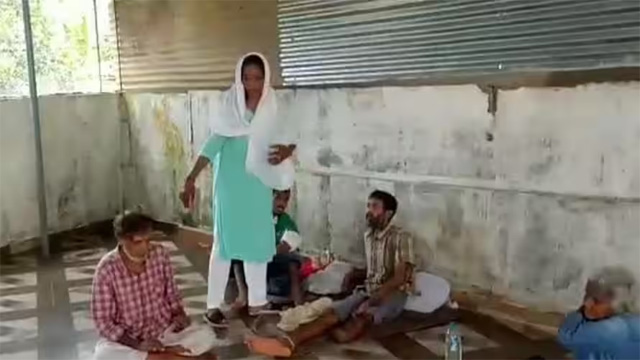
During the ongoing sacred month of Ramadan, when Muslims engage in observing fast, a former well-known hockey player devotes his time with his small team of youths to reach out to those who keep fast staying in hospitals while enduring challenging or difficult situations and provide them with Sehri (before sunrise meal) and Iftar (after sunset food) daily.

Nauman Akram’s Raipur-based welfare group believes that a large segment of the Muslim population may not be blessed with enough food and provision since they usually have little except to work hard to make ends meet during Ramadan.

Akram, also a former national hockey umpire, has chosen hospitals and passenger terminals to extend help by offering food, water and juices as a moral responsibility to the fasting people who are away from their homes and essentially need the support that brings them some solace during the pious month.

“We visit big hospitals like Raipur AIIMS, Dr Bhimrao Ambedkar hospitals among others to distribute small food bags among the patients and their fasting families. We also interact with Muslim travellers. The food packets are prepared by us daily. The distressed relatives of patients or the travellers in buses or elsewhere are already in demanding situations. So, any small support raises their morale and brings them some comfort”, he said. 

Akram also solicits assistance from various Muslim groups through social media to lend a helping hand for his noble task. “Sehri particularly remains much in demand as finding the food post-midnight is really a major problem for the fasting people in hospitals or any passenger. So we prepare and distribute it by 3 am”, he added.

The menu of Sehri usually comprised chapatis, egg curry or bhurji, biryani and fruits. Similarly, iftar food contains dates, fruits, samosa, baked items and juices among others. Religious scholars have appreciated the service citing that the month of Ramadan is also about compassion for others, caring for the needy and sharing with empathy.

source: http://www.newindianexpress.com / The New Indian Express / Home> Good News / by Ejaz Kaiser / Express News Service / April 11th, 2023

AIMPLB president Maulana Rabe Hasni Nadvi dead

Rae Bareli / Lucknow, UTTAR PRADESH:

Nadvi has been the president of the All India Muslim Personal Law Board for the last 21 years.

Maulana Rabe Hasni Nadvi
President of the All India Muslim Personal Law Board Maulana Rabe Hasni Nadvi. (Photo | Twitter)

Lucknow :

President of the All India Muslim Personal Law Board Maulana Rabe Hasni Nadvi died here on Thursday after a prolonged illness.

Senior executive member of the board Maulana Khalid Rasheed Farangi Mahali told PTI that Maulana Rabe Hasni Nadvi died around 3.30 pm at the Lucknow-based Islamic Educational Institute Nadwatul Ulama (Nadwa).

Mahali said Nadvi had been brought to Lucknow from his ancestral home in Raebareli four days ago as he was suffering from pneumonia.

He is survived by three daughters.

Nadvi has been the president of the All India Muslim Personal Law Board for the last 21 years.

His farewell prayers will be held at 10 pm in Nadwa and the body will be laid to rest in Raebareli on Friday.

source: http://www.newindianexpress.com / The New Indian Express / Home> Nation / by PTI / April 13th, 2023