Ansar Ahmed Sheikh, the son of an autorickshaw driver, became India’s youngest IAS officer at the age of 21 in 2016, inspiring millions with his journey from humble beginnings to the pinnacle of civil service.
IAS Ansar Ahmed Sheikh
New Delhi:
Ansar Ahmed Sheikh has achieved the distinction of becoming India’s youngest IAS officer after successfully clearing the UPSC examination on his first attempt. His accomplishment underscores the power of perseverance and dedication in overcoming challenging circumstances.
Facing financial hardships due to unfavorable conditions, Ansar’s family struggled to make ends meet. However, undeterred by the obstacles, he pursued his dreams relentlessly. In 2016, Ansar made history by excelling in one of the most challenging exams, surpassing all previous records.
Hailing from a modest background, Ansar is the son of Yonus Sheikh Ahmad, an auto-rickshaw driver, and his mother, who works in the fields. The family resides in a rented home in Shelgaon village, situated in the Jalna district of Maharashtra’s Marathwada region.
Growing up in extreme poverty, Ansar worked diligently from a young age to provide for his family’s basic needs. Despite the lack of emphasis on education within his family, they faced pressure to discontinue his studies due to difficult circumstances. However, Ansar, always a standout student, persisted in his pursuit of knowledge.
Against all odds, Ansar achieved an impressive All India Rank of 361 in the UPSC examination at the age of 21. Before setting the record as India’s youngest IAS officer, he had previously scored 91% in his X board examinations and attained a 73% in his graduation, where he pursued a Political Science degree at Fergusson College, Pune.
While preparing for the UPSC examinations, Ansar’s financially strapped family supported him, demonstrating their commitment to his education. His remarkable results serve as a testament to how his unwavering dedication and hard work distinguished him from the crowd.
source: http://www.zeenews.india.com / ZEE News / Home> News / by Zee Media Bureau / edited by Mahi Mishra / January 12th, 2024
Govandi’s Daughter Makes the Country Proud by Pursuing MBBS
Mumbai:
In the heart of Govandi, an area grappling with challenges like limited access to education and rising crime, a remarkable tale of triumph emerges. Khan Sadia Kawsar, a resident of this humble locality, is defying odds by pursuing her dream of becoming a doctor, thus becoming a shining example for the aspiring youth of her community.
Despite the dearth of quality educational institutions in Govandi, Khan Sadia Kawsar’s journey stands out as an inspiration. A local official highlighted the prevalent issues, noting that the area often makes headlines for crime-related incidents, with little attention from politicians or concrete initiatives from religious leaders to address the root causes. The suggestion to uplift Govandi’s image centers around establishing better educational institutions and providing improved training for the younger generation.
Khan Sadia Kawsar, a second-year MBBS student, is the daughter of Hafiz Alauddin Sahib, a respected figure in the community and a dedicated honey trader. Despite the challenges, Hafiz Alauddin spared no effort in providing religious education to his children. An accomplished computer engineer himself, he played a pivotal role in guiding Sadia towards her academic pursuits.
Sadia’s academic prowess became evident early on, consistently scoring high marks in school. Her remarkable achievement of securing 98.5% in the twelfth examination from the Govt.Jr.College in B. Kothakota, Andhra Pradesh, paved the way for her current pursuit of a medical degree at the Fathima Institute of Medical Sciences in Kadapa.
Khan Sadia Kawsar’s journey symbolises the triumph of determination and hard work. Her success challenges societal stereotypes, proving that with determination, even the daughter of a humble businessman can achieve great heights. Hafiz Alauddin Khan, reflecting on the challenges he faced to support his children’s education, emphasised the importance of unwavering faith in God and the merit of one’s children.
Originally from Basti district, Uttar Pradesh, Hafiz Alauddin Khan is not only a devoted father but also a prominent scholar and supporter of religious institutions. Along with his contributions to organisations like Darul Uloom Deoband and Jamiat Ulema, he maintained a focus on his small honey business, always expressing gratitude for Almighty’sblessings.
Hafiz Alauddin’s advice to parents echoes a belief in the inherent merit of their children. He advocates trust in God and encouragement of the youths, emphasising that success is destined for those who persevere.
In the face of societal challenges and limited opportunities, Khan Sadia Kawsar’s journey serves as a guiding light, illuminating a path of hope and possibility for the new generation in Govandi and beyond.
source: http://www.clarionindia.net / Clarion India / Home> Editor’s Pick> Features> Indian Muslim / by Mohammad Alamullah, Clarion India / December 18th, 2023
Chhatwan Village (Keotiranway Tehsil, Dharbhanga District),BIHAR:
Photo: Afrin’s success in securing the Special Survey Law Officer position reflects her dedication and hard work. The achievement has illuminated her family’s name, adding to the legacy left by her grandfather.
The festive atmosphere in her village is palpable as the news of Afrin's success spread, making her not only a source of pride for her family but also an inspiration for the younger generation in the region.
Darbhanga:
In an impressive performance, a Muslim girl from Chhatwan village in Keotiranway Tehsil of Bihar’s Darbhanga District, has excelled in the online Computer Based Test (CBT) conducted by the Bihar Joint Entrance Competitive Examination Board for the coveted position of Special Survey Law Officer in the state’s Revenue and Land Reforms Department.
Shagufta Afrin, hailing from a family with a strong academic background, secured an impressive 283rd rank out of 1947 in the examination, specifically in the General Khatoon quota for the Special Survey Law Officer position.
Daughter of Muhammad Shahabuddin Rizvi, an engineer, and Nuzhat Parveen from Chhatwan village in the Keoti assembly constituency, Afrin has made her parents proud. Her success story is on the lips of all and sundry in the village and its neighbouring areas.
The festive atmosphere in her village is palpable as the news of Afrin’s success spread, making her not only a source of pride for her family but also an inspiration for the younger generation in the region. The achievement is particularly significant as it brings recognition to the entire region.
Afrin’s grandfather, the late Muhammad Zubair, served as a joint director of agriculture, and her late grandmother was a dedicated housewife.
Afrin diligently prepared for the competitive exams after completing her civil engineering degree from Delhi.
Afrin’s success in securing the Special Survey Law Officer position reflects her dedication and hard work. The achievement has illuminated her family’s name, adding to the legacy left by her grandfather.
She attributes her success to the unwavering support of her parents. Her younger brother, Aman Rizvi, is pursuing MBBS, while her younger sister, Shumaila Rizvi, is currently in Grade 8.
Numerous well-wishers, including local leaders and activists, have congratulated and extended their good wishes to Afrin.
Prominent personalities such as Muhammad Shamim, Heera Seth, Mukhya Fateh Ahmed, Muhammad Mustafa, Faiz Muhammad, Sajjad Alam, Sagheer Alam, Phool Babu, Iftikhar Ahmed , Muhammad Aslam Khan, and Sagheer Najam have joined in celebrating Afrin’s success and have offered prayers for her continued bright future.
Afrin’s achievement not only symbolises personal success but also serves as a beacon of hope and inspiration for the community, showcasing the potential for excellence.
source: http://www.clarionindia.net / Clarion India / Home / by Team Clarion / December 23rd, 2023
Shahina Khanam, a resident of Hesla on Ramgarh-Argadda road, will be awarded a gold medal for being a topper for four years in BDS.
The medal will be awarded by Governor CP Radhakrishnan at the convocation ceremony of Ranchi University on May 2.
Topper Shahina Khanam is the sister of Rinkle Khan, the town vice president of AJSU. The family members are very happy with the news of getting the gold medal and there is an atmosphere of happiness in their house.
Shahina Khanam’s mother, father, brother, sister and other people distributed sweets.
AJSU Nagar Vice President Rinkle Khan said that earlier education was neglected in Muslim society. But now the Muslim society is also rapidly increasing its step towards education.
source: http://www.lagatar24.com / Lagatar / Home / by Manoj Sinha / April 26th, 2023
Prof. Qudsia Tahseen, Department of Zoology at Aligarh Muslim University has been named as the National Committee representative for the International Union of Biological Sciences (IUBS), announced by the Indian National Science Academy (INSA).
Commencing her three-year term on January 1 this appointment emphasizes Prof. Qudsia’s contributions to the fields of Taxonomy and Biodiversity. She has the distinction of holding fellowships in all three prestigious National Academies.
The IUBS, founded in 1919, is a global non-profit organization dedicated to facilitating and coordinating biological research worldwide. Its mission spans diverse areas, with the goal of addressing global biological challenges. Prof. Qudsia’s appointment to the newly formed INSA National Committee for IUBS, consisting of seven experts, solidifies her role as a representative for India in the realm of biological sciences.
Prof. Qudsia while acknowledging her appointment said the committee, serving as the national arm of IUBS, is pivotal in advancing IUBS initiatives at a domestic level. This includes policy advocacy, tackling global challenges, setting research priorities, fostering collaborations, and promoting the sustainable use of biological resources.
source: http://www.timesofindia.indiatimes.com / The Times of India / Home> News> India News / by TNN (headline edited) / January 05th, 2024
Being a medical doctor has always been a well cherished dream and a coveted profession, as it provides opportunity to save human lives. This public zeal towards the field of medicine gave rise to a number of academic institutions. Sensing the demand from students and parents, corporate sector also stepped in to provide courses for preparation of the NEET exam, as it proved to be a hugely profitable business for them. But this trend restricted the children of poor families from dreaming to become a doctor. However, some non-profitable institutions are rendering remarkable services to the nation by providing NEET coaching free or at a very low cost, like Ajmal Super-40 run by Ajmal Foundation.
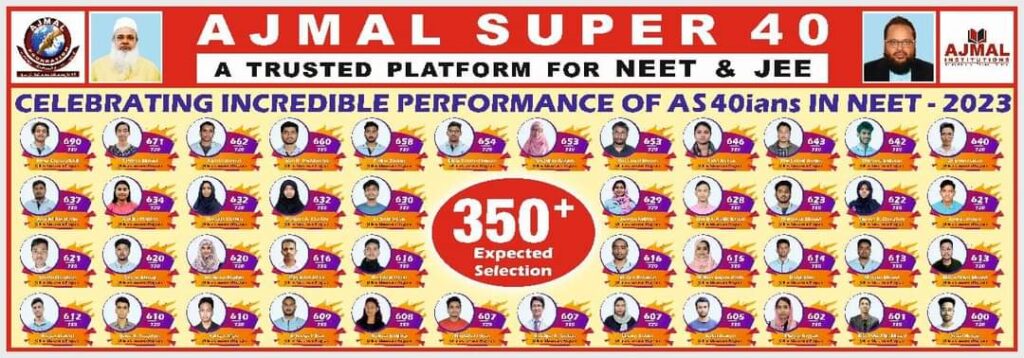
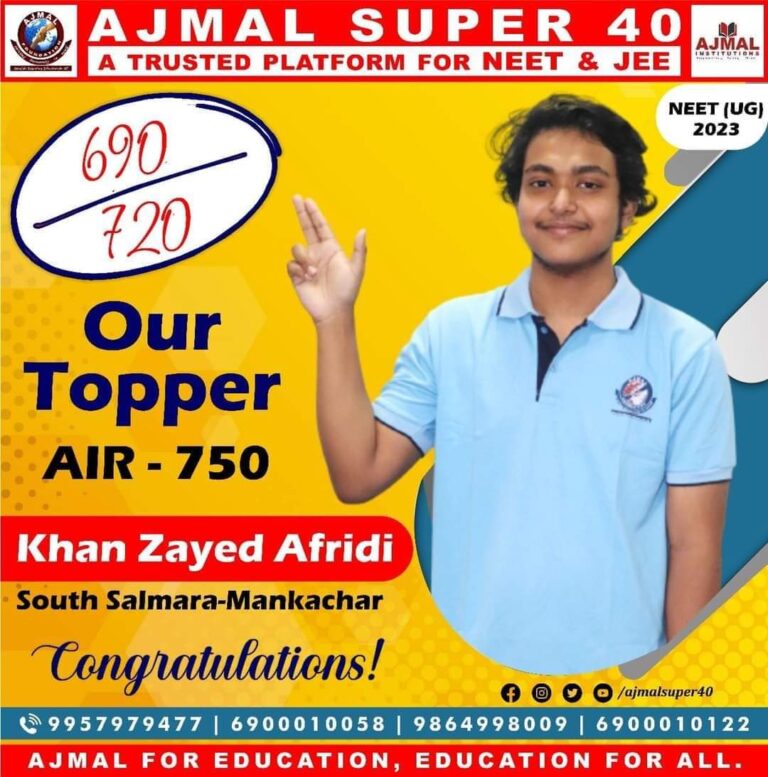
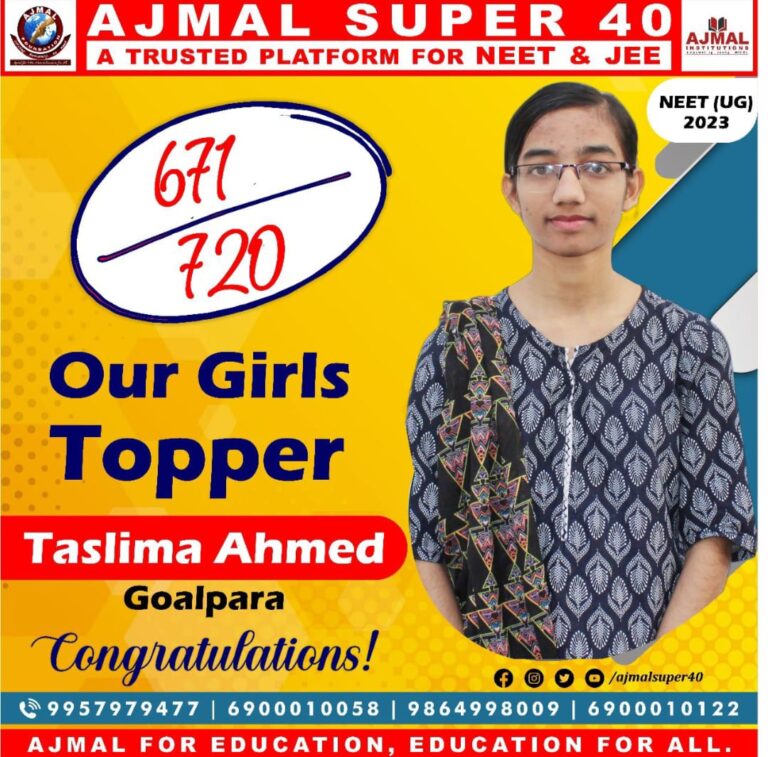
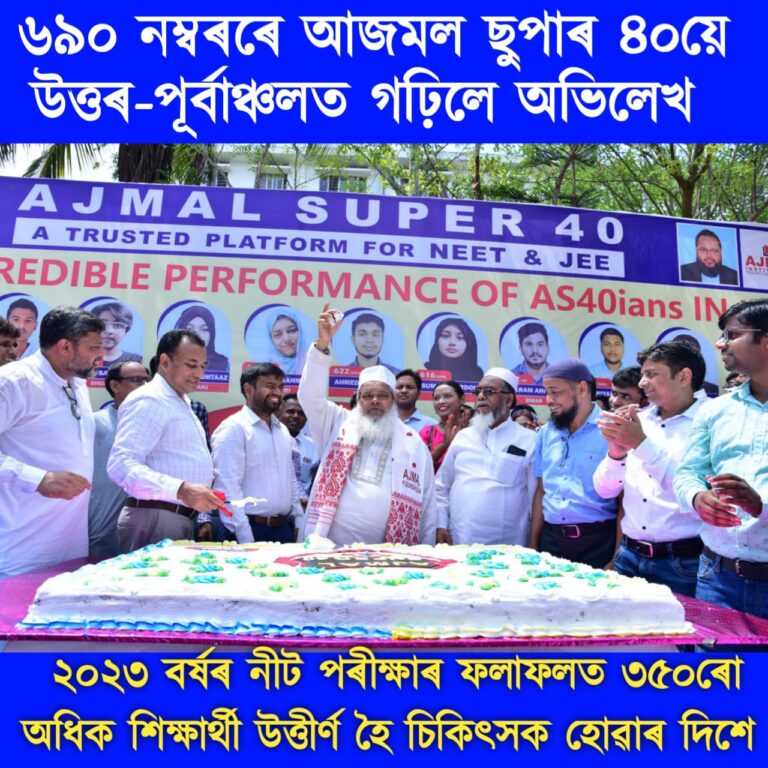
Ajmal Foundation has been running this program for the last three years and its results have remarkably been improving by each year. The number of qualifying students of Ajmal Foundation in NEET exam last year was 245 which has this year increased up to 350.
This is indeed a huge gain for the Foundation, while a great hope for the underprivileged section of the society. Other institutions running on the same pattern are Shaheen of Bidar, Al-Ameen of Kolkata and Rahmani-30 of Patna.
The results for NEET 2023 were finally announced on June 13th this year. Just like every previous years, it was finely a nerve-wracking time for all the aspiring medical students who gave their best to crack this competitive exam. Among over 20 lakh applicants from across the country, half of the candidates could be declared as qualified but due to the seats limitations in the medical colleges, all passed candidates may not be the doctors they dreamed about.
The giant coaching institutions are busy celebrating the success of their toppers. But success of the non-profitable institutions should be celebrated and appreciated by common masses. Maulana Badruddin Ajmal, CEO Ajmal CSR and the philanthropic endeavours of Ajmal family, especially in the northeast of India, are laudable.
source: http://www.easterncrescent.net / Eastern Crescent / Home> Blog> National> North East / by Eastern Crescent Desk / December 02nd, 2023
The perfume town of Hojai, nestled in the plains between Nagaon and Dima Hasao in central Assam, was once known as the trading hub of agarwood. On the other hand, Kolkata and Guwahati, the capitals of West Bengal and Assam respectively, were known to be the educational hubs of the entire Northeast India.
The picture is different today. For the aspiring NEET, JEE, CEE, and civil services examination students, Hojai is the Kota of Eastern India. Meritorious students from not only Assam but also from West Bengal, Sikkim, and all the other states of the Northeast flock into Hojai to prepare themselves to crack the competitive examinations like their counterparts from parts of the country do in Kota in Rajasthan. When a team from Awaz – The Voice traveled to Hojai, almost every alternate youngster it came across was from Guwahati or Kolkata with high hopes in their minds.
Thanks to the Ajmal Foundation, a charitable organization run by a perfume baron family of Assam the Ajmals, including Dhubri Lok Sabha MP Maulana Badruddin Ajmal and his brother Sirajuddin Ajmal, who is the MLA from Jamunamukh in Assam Legislative Assembly. The Dimasa rulers named the place Hojai, meaning priest in the Dimasa language, and the Ajmal Foundation is now producing real priests; though not to preach faith but to master science and modern education.
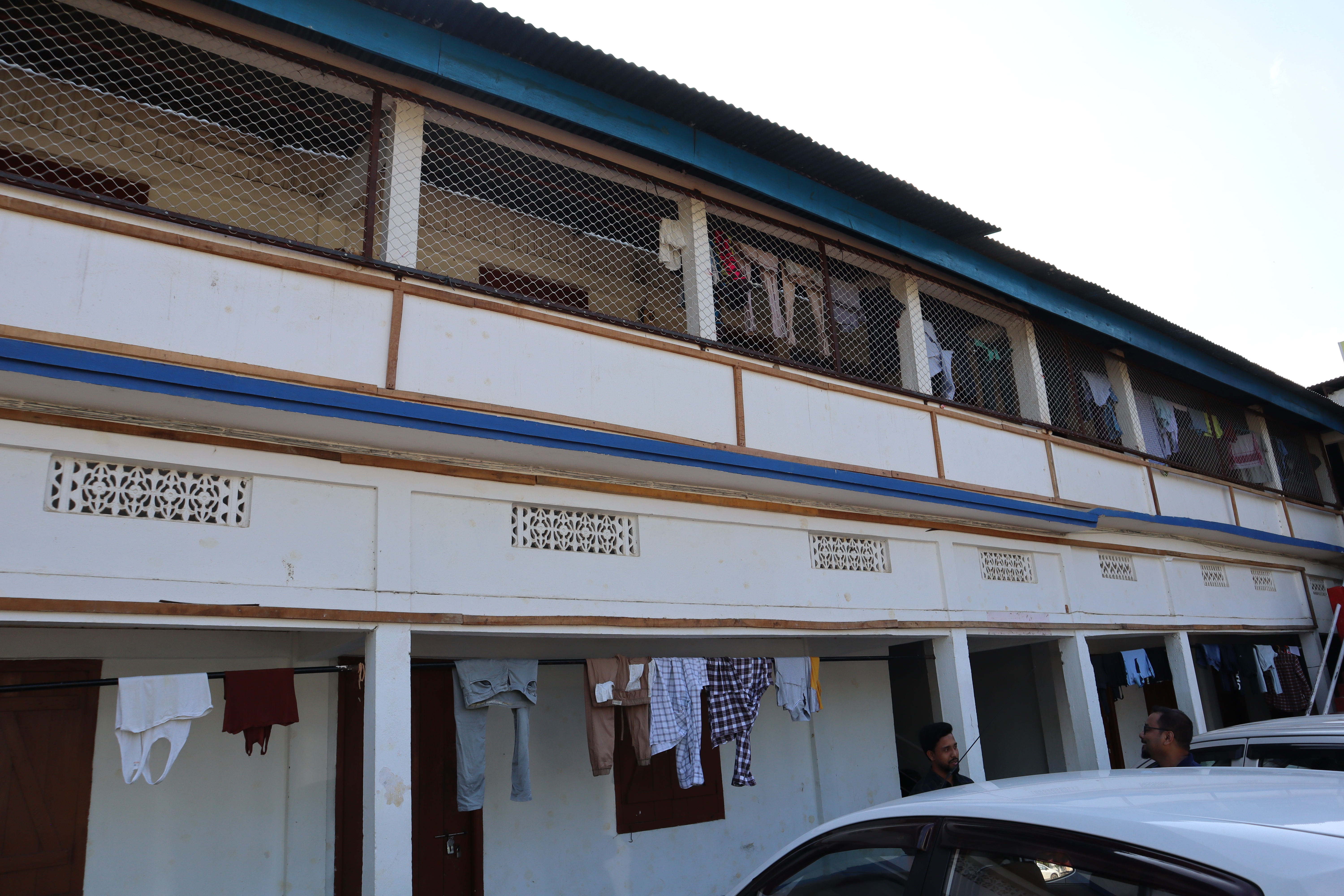
Hostel of Ajmal Super 40
Ajmal Foundation’s education empire in Hojai comprises not only a junior college and coaching institute called Ajmal Super 40, which has been one of the most successful institutions in cracking competitive examinations but also the Ajmal Residential Schools in the entire Hojai district, the Maryam Ajmal Women’s College of Science and Technology, the Najir Ajmal College of Education, Ajmal Law College, Ajmal IAS Academy and others. All the institutions are residential and impart modern education in an atmosphere where students are meant only to study and play sports physically.
It all started in the early 2000s when the Ajmal family started the Markazul Ma’arif School and the Ajmal Hospital in Hojai. After that, the Ajmal Foundation was raised in 2005 to work in the education sector for the underprivileged. The first initiative of the Foundation was to set up a college for underprivileged women.
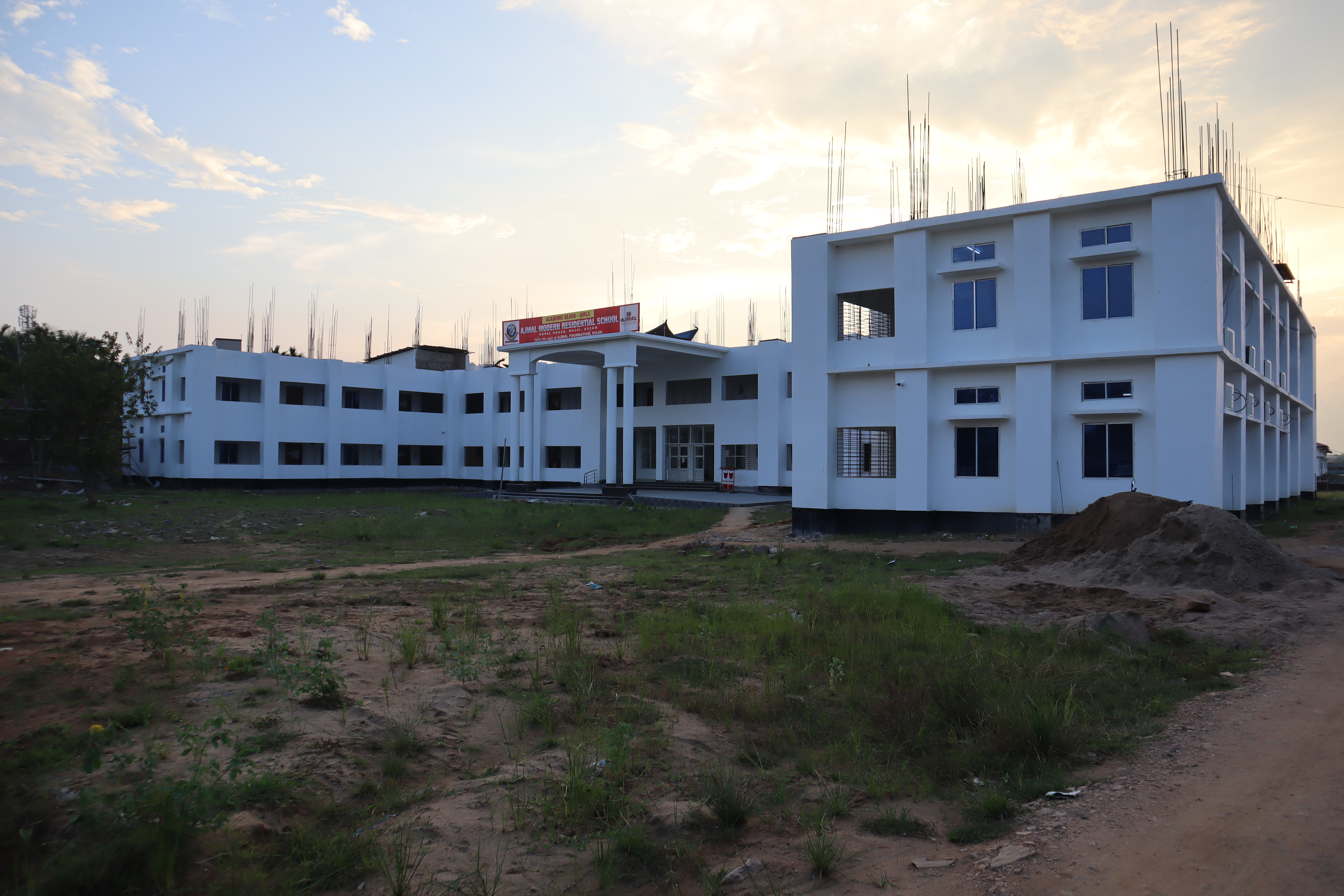
The under construction building of the Ajmal Residential school
“When I joined the Ajmal Foundation in 2005, Maulana Badruddin Ajmal told us that he wanted to see Hojai as an education hub. With only the Markazul Ma’arif School in place, it was beyond our imagination to fulfill his dream. Our journey began with the setting up of the Maryam Ajmal Women’s College of Science and Technology for those women who could hardly afford higher education … But, one must appreciate the amazing far-sightedness of this person. In hardly a decade, Hojai has become an education hub not only for Assam but also for the students of different states of the country. It gives us great pleasure and motivates us to do more. Our next objective would be to set up a Maryam Ajmal Women’s University and an Ajmal University for the underprivileged students,” said Ajmal Foundation’s director Dr Khasrul Islam.
Opportunities for celebration come to Ajmal Foundation every time the results of a competitive examination are declared. One of the secrets behind the success story is a blanket ban on the use of mobile phones in any of its educational institution campuses. Students are allowed to talk to their families on the phone only twice a week unless there is an emergency. All the campuses wear only academic atmosphere.
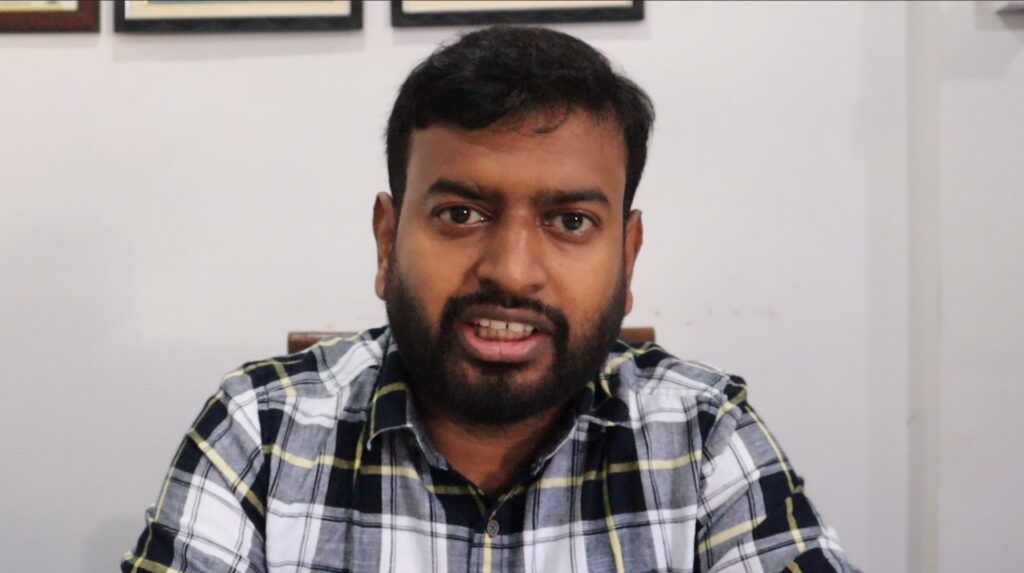
Abdul Qadir, head of Ajmal Super 40
“We get results because we have created such an academic atmosphere in our campuses. Students from different parts of eastern India come here to shape their academic careers. Last year we received applications from 21,000 candidates. However, we could accommodate only about 1500 in our limited infrastructure. Ajmal Super 40 structure now has students from Class VIII to XII and about 3000 students are studying.
“One of the major factors that has made our campuses fully academic is that they are all residential and have a completely disturbance/distraction-free atmosphere. We don’t allow any electronic devices such as mobile phones, on our campuses. During the day time, the students attend classes and the self-study time in the evening is constantly monitored by us. Thus everybody is bound to study,” Abdul Qadir, head of Ajmal Super 40 told Awaz – The Voice.
Ajmal Super 40 started as a coaching centre for 40 economically backward meritorious students in 2016 providing Class XI and XII education along with coaching for Medical and Engineering entrance examinations. It tasted success in the very first year when its student Amar Singh Thapa topped the Higher Secondary Science examination in Assam. It made the institute an instant hit in the academic circles of the state as well as the region. Demands for accommodation of more students increased rapidly forcing the Ajmal Foundation to increase it to 40 boys and 40 girls. Thereafter, pressure mounted on the Foundation to accommodate students on a payment basis.
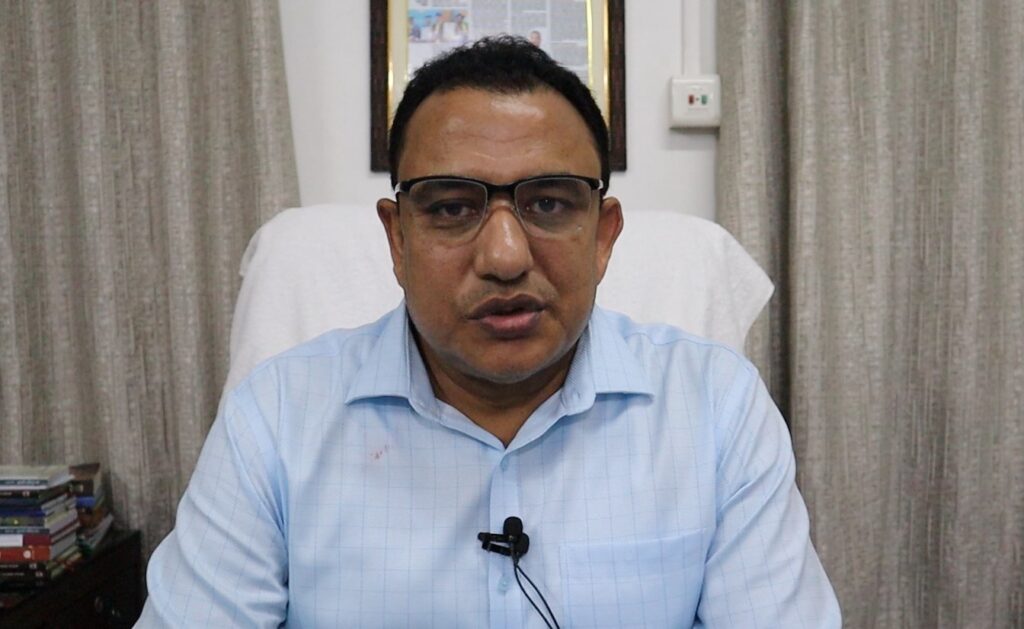
Ajmal Foundation’s director Dr Khasrul Islam
The institute has constantly been producing successful candidates in all competitive examinations ever since.
“I have chosen Ajmal Super 40 over any other college because of its student life discipline which is a key to success. Not only are we taught by very highly qualified and competent teachers, but our self-study is also constantly monitored,” said Vijay Singha of Doboka in Hojai district who aims to be a doctor.
“Ajmal Super 40 is such a place where there is great motivation for study. The study material and the mock tests here are very useful,” David of Bokajan in Karbi Anglong said, adding that his focus is on the 720 marks in NEET like almost all other students of the institute.
“The transition from Class X to XI and XII has a vast gap. But Ajmal Super 40 is a place with highly competent teachers who bridge the gap so smoothly that students don’t lose the first 3-4 months in adapting to the new course,” Rizwan Ahmed of Juria in Nagaon district said.
To prevent untoward incidents like Kota where students come under tremendous pressure to develop the tendency for drastic steps, Ajmal Super 40 has also involved psychological counselors to constantly monitor the student’s progress and keep them stress-free.
source: http://www.awazthevoice.in / Awaz, The Voice / Home> Stories / by Imtiaz Ahmed & Ariful Islam, Hojai / November 27th, 2023
In your final rest
on a rope-cot,
were you still dreaming
of a piece of bread?
Beloved one,
we the people
of this country,
of that country,
can make anything
but a piece of bread
for you.
--Evening with a Sufi: Selected Poemsby Afsar Mohammad, translated from the Telugu by Afsar Mohammad & Shamala Gallagher, Red River Books, 2022.
These lines send shivers down the spine and recreate an empathetic longing for immigrant souls in search of succour. They also swiftly draw an image laced with poignancy — a loss, a regret, the economics that deny innovative young men their keep and force immigration in search of sustenance. Would the poet have been one of them?
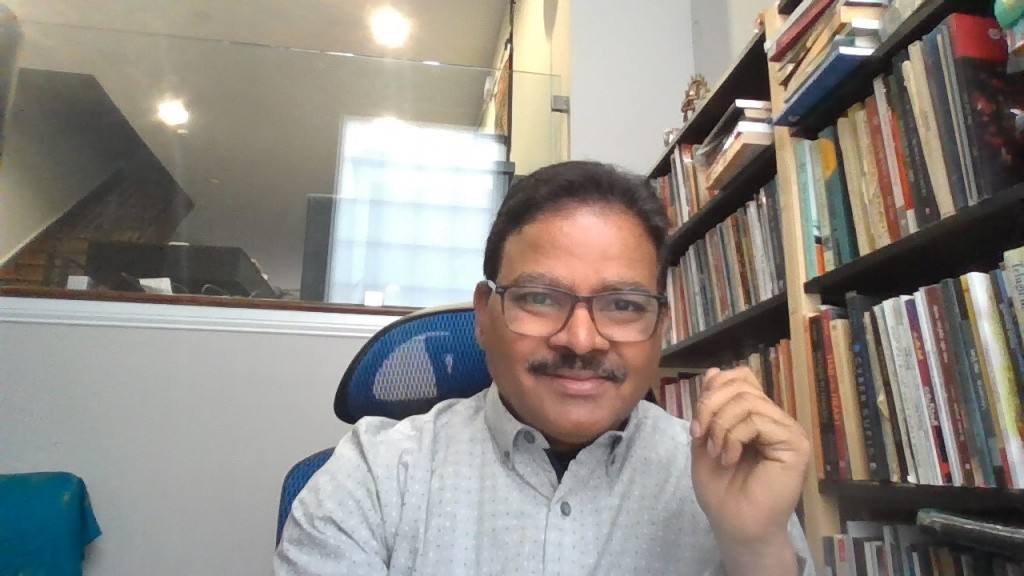
Travelling from a small village in the South Indian state of Telangana, Afsar Mohammad has journeyed across continents and now teaches South Asian Studies at the University of Pennsylvania. Known as a trendsetting poet and literary critic for post-1980s Telugu literature, Afsar has brought out five volumes of poetry, one collection of short stories and two volumes of literary theory essays. He is also a distinguished scholar of Indian studies and has published extensively with various international presses, including Oxford and Cambridge. He is currently working on a translation of Sufi poetry from Telugu to English. In this interview, we trace his growth as a writer and editor of the webzine, Saranga, which now seems to be transcending linguistic barriers to give voice to multiple cultures…
Tell us about your journey as a writer. When and how did it start?
It’s a long story, but to cut it short — the beginnings were somewhat puzzling… Inspired by Shakespearean sonnets, I first wrote some sonnets in English, and then switched to free verse. Since most of my friends in my high school started pushing me to write something in Telugu, I had to migrate to Telugu. Quite surprisingly, I was first published in English, and then it took me a while to get something published in Telugu. I had hard time getting published in Telugu due to its newness in expressions and most editors felt that there was nothing “Telugu” in that kind of writing. So, my early writings quite naturally found their home in some English journals!
Your poetry rings with the pain of distance, the pain and struggle from others’ suffering transcending your own self. What is the source of your inspiration — is it your past or your present?What affects you more — your being an immigrant or a Sufi?
We’re distanced by many things — not just physically! We live in many shattered and scattered worlds, and sometimes we fail to reflect on those worlds. I feel like I’m a constant immigrant — despite my formal citizenship and legal boundaries. Sufism is merely a segment of this expansive realm. Both past and present define our destiny, right?! Of course, I try to live in the present rather than in the past, but never deny the baggage of the past.
Why do you subscribe to the Sufi school of poetry? What is Sufism all about?
I come from an extremely local rural setting where such Sufi mystical practices openly defined my everyday life. It’s not about the technicalities and theories or institutionalised Sufi schools of their philosophies, this is more about what I learned from my childhood, and its physical surroundings dotted by several hybrid shrines. I’ve described this cultural setting in my 2013 Oxford University Press publication, The Festival of Pirs: Popular Islam and Shared Devotion in South India. This version of Sufism has more to do with everyday life rather than a spiritual domain.
You have lived away from your country for long, and yet the past seems to still haunt you. What is the identity you seek as a poet? Is it necessary to have a unique identity or can one be like a drop that flows and moulds as per the needs of the vessel?
In a way — physically– I’m away from my birth place, but in many ways, I’m also closer to my homeland than in my past. When I moved away from the actual picture, I see many dimensions from a new lens. Each dimension contributed to my rethinking and reconsidering the idea of India. As I wander around and meet totally different places and people, I learn more about my birthplace and moved a little closer to it. I totally understand this as a process to reconcile with the past and connect it to a new present intensified by many factors, not just personal. We’re living in a virtual world, which also looks like “real” in its sounds, colours and words. Every moment it makes me realise that I’m actually not that far. On the other hand, I also see the people in my homeland who are far more removed by their immediate reality and everyday experiences. We need to read this conditionality more in terms of perspective rather than physical distance.
You are fluent in Telugu, Urdu and English. You started writing in English and then moved to Telugu. And all your poetry collections have been in Telugu. Why? Would the outreach of English not have been wider? What made you pick Telugu over English?
Great question! My literary graph is neither linear nor simplistic. When I look back and reflect on it, it’s a quite messy roadmap — actually, there’s nothing like a map to get its contours. Yes, I started writing in English and then suddenly stopped sending out the poems to magazines. In fact, I write more in my personal journals rather than in print journals. Theoretically, I saw poetry as a personal diary for my experiences for many years. Due to financial concerns within my family, I had to start working very early on and left most of my journals at home. Then, my friends found them by chance and put them together that became my first collection of poems in Telugu. The collection was an instant success for its innovative style and then that opened up my career in Telugu rather than English which was my first language of literary expression.
You are now bringing out a bi-lingual online magazine, Saranga? What made you think of a magazine in two languages?
Before entering into teaching career, I worked as an editor of the literary supplement and Sunday magazine for a largest circulated Telugu newspaper. When we moved to the USA, I thought it would be better to have some outlet to engage with my home language and literature. In the early phase, Saranga was primarily a Telugu webmagazine. When I started teaching South Asian literature, then I realised the importance of making Indian literary texts available to contemporary generation in the USA. That was just one reason, but there’re were many factors as our team saw a rise in the Indian diaspora writings in the new millennium. Luckily, we got wonderful support from writers and poets in various Indian languages. The humble beginnings have actually ended up as a rewarding experience.
What is it you look for in contributors from two languages? Is it the same guidelines or different?
We’re still learning how this works! As it appears now, these two sections require two different approaches and guidelines. Since the English section has been now attracting writers from various languages, it’s moving more towards a multi-lingual base. We’re trying to accommodate more translations into English from different Indian languages. We still need to do lots of work there.
Is the journal only aimed at South Asian diaspora or would you be extending your services to all cultures and all geographies?
Saranga, as we see it right now, is more about South Asia and its diaspora. As you know, we need more such spaces for South Asia and its diaspora. Not sure about its future directions at this point, however, if the situation demands, we will extend its services further.
You have number of essays and academic books in English. But all your creative writing is in Telugu. Why? Would you be thinking of writing in English too because proficiency in the language is obviously not an issue?
Most of my academic writing came out of my teaching experience. As I started teaching new courses, I then realised that we need more material from South Asia. I started focusing on producing such materials primarily for my courses and then gradually, they became useful for many academicians elsewhere too. I still believe creating writing as a more personal space — that enables me to articulate more about myself. However, the publication of Evening with a Sufi, brought a new change — as I’ve been getting more requests for more writing in English for the last two years. As you know pretty well, I’m an extremely slow writer.
How do you perceive language as a tool for a poet?
I see language working many ways since I dwell in multiple languages. I started my elementary education in Urdu, and my middle school was in Telugu, and the subsequent studies were in English. Through the last day of her life, my mother was extremely particular about me learning Arabic and Farsi. So, I believe that helped me so much to understand how language works in a poem. When I published my first poem in Telugu, the immediate critique was it was a not a “Telugu” poem. Telugu literary critics labelled me as a poet who thinks either in Urdu or English, then writes in Telugu. Of course, most of them were also fascinated by the new syntax of my Telugu poems and the new images and metaphors—that totally deviate from a normative or mainstream Telugu poem of those days. The uses of language in a poem varies for each poet. If you’re reading, writing and thinking in just “one” language, that might be a safe condition. A contemporary or modern poet, however, belongs to many languages and cultures. We also migrate from one language to another in our everyday life.
Do borders of nationalism, mother tongue and geographies divide or connect in your opinion? Do these impact your writing?
The response to this question might be an extension to the above conditionality of a person. Anyway, I’m not a big fan of those ideas of nationalism, mother tongue and singular geographies. They don’t exist in my world. Most of my writings both creative and academic contest such boundaries and borders. To describe this in a single term- borderless. In fact, I believe we’re all borderless, but unfortunately, many boundaries and borders are now being imposed on our personalities.
(The online interview has been conducted by emails by Mitali Chakravarty)
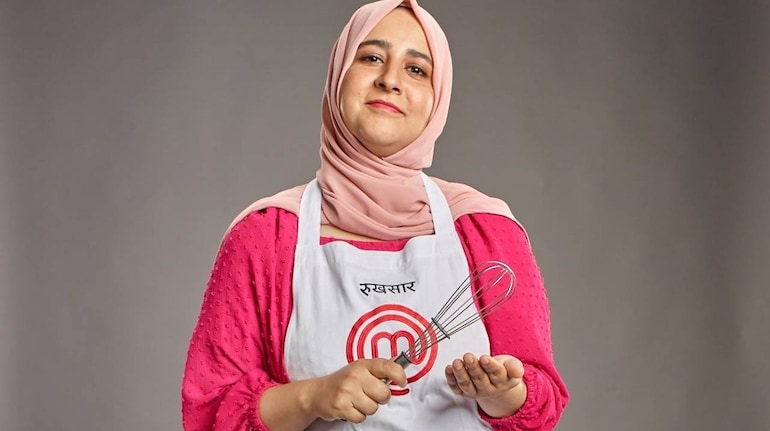
Rukhsar Sayeed wishes to see a lot more young Kashmiri girls and boys in MasterChef India.
Kashmir’s Rukhsar Sayeed.
A 34-year-old woman food entrepreneur has become the first contestant from Kashmir to participate in MasterChef India, a cooking reality show which is being broadcasted on SonyLIV.
Hailing from south Kashmir’s Pampore, where India’s 90 per cent saffron is cultivated, Rukhsar Sayeed has shown a tremendous culinary passion and determination by reaching among the top 12 contestants of the show.
“Breaking barriers and stereotypes I have finally made it to MasterChef India to fulfil my dream. I no doubt had culinary passion since I was a teenager, then the food-specialised education was also at my back but on top of all the support shown by my family was unwavering,” says Sayeed who is currently in Mumbai for the shooting of the show.”
Born and brought up in Srinagar’s Hyderpora, in the year 2010 Sayeed was watching the shows of MasterChef Australia from which she developed the culinary passion and decided to study food technology. “I am on the top of the world to see myself among the top 12 contestants of MasterChef India, the country’s favourite cooking reality show. I am really proud of where I am standing today. I am also overwhelmed to find the support of my family including my husband, parents and in-laws, ” Sayeed tells Moneycontrol.
Calling herself an avid foodie Sayeed has two children while her husband Saqib Javaid Qadri is an assistant executive engineer.
After completing B.Tech in food technology from Islamic University of Science and Technology, Awantipora Sayeed did M.Tech in food technology from Amity University and finally completed her PhD in food technology in 2020.
Sayeed has not only made J&K Union Territory proud by being selected to compete in the prestigious MasterChef India but also expressed her feelings through Kashmiri cuisine and eventually impressed the judges. “So far I had a roller-coaster ride with ups and downs in the kitchen like other contestants but I have made some very good dishes which impressed the judges sitting in the show. I am confident to become the winner of the show because for the first time Kashmiri food is being presented on a large platform. I am trying my best to innovate something with our Kashmiri food. For example, I made Rogan Josh, (mutton dish with red gravy) which apparently does not look Rogan Josh but it does taste like Rogan Josh.”
So far in 11 episodes Sayeed says she made mouth watering cuisines like Babri Boul Falouda (basil seeds drink) usually served during Ramadan in Kashmir, Kashmiri Dhaniwal Korma (lamb curry bursting with coriander) and Kashmiri Dodhe Aal (pumpkin chutney), mesmerizing the judges and celebrity chefs like Vikas Khanna, Ranveer Brar, and Pooja Dhingra.”
Her father M Sayeed Shah says, “It is a dream come true for the whole family. It is a great honour to see her in Masterchef India. I don’t have words to express my happiness. I wish a great future and good luck to my darling daughter.”
Her mother Naseema Kirmani while expressing her happiness says that she is the happiest person to see her daughter in MasterChef India and wishes her best of luck for the show.
Before reaching the MasterChef India show in 2019, Sayeed emerged as the first woman from the Valley to start a frozen food venture — Khalis Foods. “After doing my PhD I was not interested in conventional jobs and therefore I opened a startup to provide people with unadulterated snacks and other healthy foods mainly for children. I along with my six employees are operating from my home in Pampore.”
The young food technologist explains that she is getting to see some of the ingredients for the first time in her life. “I am using some ingredients which are new to me in various foods. For instance, I use some of the popular food ingredients from down south with Kashmiri food.”
Sayeed maintains that being a mother of two children the decision to become a part of Masterchef India show was not easy. “It was a big sacrifice to leave behind my two children at home and participate in the show in Mumbai. I miss my children a lot but I am confident that I will return home as the winner of the show.”
Before getting selected for Masterchef India, Sayeed had participated in the state-level culinary competition and bagged second position in the competition.
She had also served her homemade snacks at an exhibition held at Sheri Kashmir International Convention Centre (SKICC) Srinagar, tickling the taste buds of people around.
In June this year, Rukhsar went through a rigorous audition process before being among the 12 contestants.
For young techie, the MasterChef India journey is a stepping stone in realising her dream of setting up a culinary school in the Valley and creating a chain of restaurants to provide healthy food for the food lovers. “I hope this show can give me limelight and help to boost my food business venture, currently operating in Srinagar. I am also thinking of creating a chain of restaurants in the Valley to provide healthy dishes to people. As a food technologist I am fully conscious of the hazardous preservatives, taste enhancers and food colours that go into our daily food and which is why I lay emphasis on healthy, pure and safe food.”
Regarding her favourite food Sayeed names Hakh (collard green; the staple diet of Kashmir) and Wazwan, (Kashmir’s famous multi-course meal). “Every dish is special but I am in love with Kashmiri food, mainly Hakh especially prepared by my mother and Wazwan prepared by our amazing cook locally known as Waza. From the beginning of my childhood the dishes prepared by my mother in the kitchen have been unmatched.”
Sayeed wishes to see a lot more young Kashmiri girls and boys in MasterChef India. “Since I am the first Kashmiri woman who has reached the famous cooking reality show I would want more people from my homeland to come here and show their food skills.”
She also claims that despite facing criticism from the people in Kashmir she managed to participate in the show to represent the Kashmiri cuisine and culture to a larger audience.
source: http://www.moneycontrol.com / Money Control / Home> News> Trends> Lifestyle / by Irfan Amin Malik / November 05th, 2023
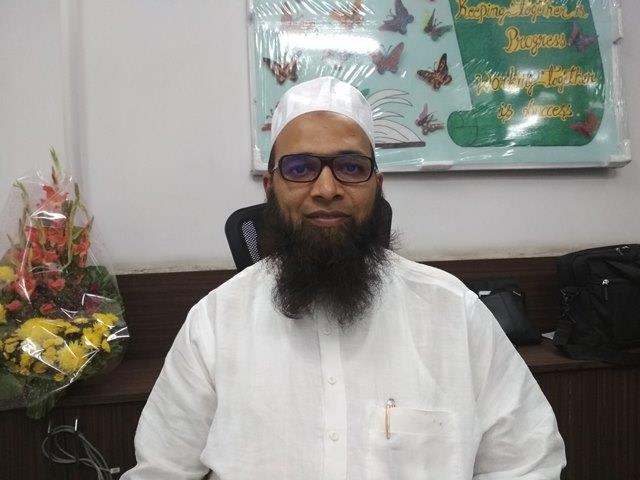
Mohammed Abdul Lateef Khan, Founder Trustee and Chairman MS Academy. / Muslim Mirror Photo
“You are not meant for crawling, so don’t. You have wings. Learn to use them and fly,” this inspirational quote of Rumi is best suited for Mohd Abdul Lateef Khan, Chairman and managing director of Hyderabad based MS Education Academy.
His team under his leadership has successfully created a brand name in the field of education and revolutionized the concept of education across the country.
Khan is a man who believes in ‘education as a social service and moral responsibility than a profession to earn money’.
MuslimMirror spoke to Khan, exclusively. In this tete-e-tete, he spoke about his journey.
A young Khan right after finishing his 12th had a strong urge to serve the community.
Recognizing his talent, one of his friends suggested him to enter in the field of education. Hence, to materialize his dream Khan started a coaching institute that was operated from a two-room rented house and with only 15 students. This was in the year 1990.
However in the first year, Khan had to face a loss of Rs 30,000, but he did not lose his heart. He continued his journey with same vigor and subsequently during the initial three years he faced the loss of more than one lakh rupees and still he did not give up.
Khan continued to pursue his engineering course and completed his BE in Electronics and Communication Engineering from Osmania University.
During those years, his institute grasped a respected position in the area and people started trusting his institute. This boosted his morale and gave him confidence.
After completing his engineering degree, Khan thought of pursuing his studies in a foreign country but later changed his mind.
He decided to continue his journey in the field of education.
In 1998, Khan collaborated with renowned Urdu daily, Siasat, which started publishing model SSC exam papers which was widely accepted and became an instant hit. It resulted in popularizing his method of education and unique technique to crack medical and engineering examinations.
(HERE WHAT IS THE POPULAR TECHNIQUE HE USED AND HOW COME HIS TECHNIQUE BECAME A HIT IS MISSING!)
Later with the support of Zaheeruddin Ali Khan, the managing editor of the newspaper he shifted the institute to a bigger space. It was Zaheeruddin Ali Khan who inaugurated the first branch of MS Academy. After that Lateef Khan never looked back and the popularity of his coaching institute continued to soar by each passing day.
Two years later, Khan started to look out for a school for his son but in vain. Unable to find any such, later in the year 2000 he opened his own school and named it MS Academy, with the aim to facilitate thousands of children with education.
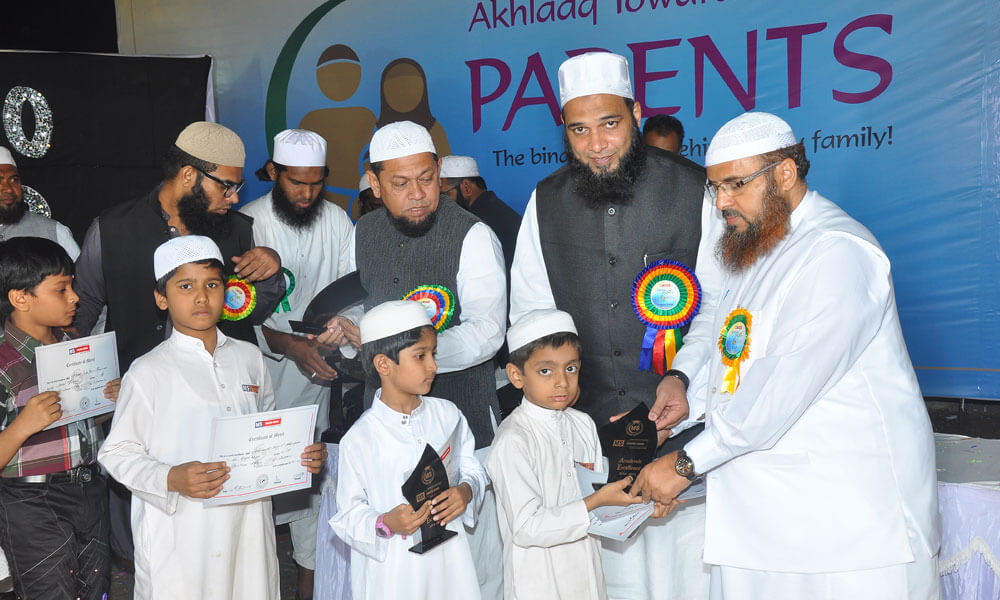
Khan introduced the junior school (intermediate) in the year 2002; they successfully produced their first batch in 2004, while their second batch (2005) grabbed the first position in the state of Andhra Pradesh.
Later, the then chief minister of the state visited the school and decided to declare four percent reservation for the Muslim minority.
While interacting with Muslimmirror.com, Khan said, “Since 2005 our academy has continued to remain in the top ten list of the state board. In our academy, we admit a student on the basis of his or her merit performance and not by asking for any donation.”
“Currently, MS academy has 80 branches in 20 cities across eight different states with more than 27000 students enrolled. We have produced over 1200 MBBS doctors , 5000 engineers and shaped the life of 78000 youths who are alumni of our institutes, Only this year 150 students from our institutions cracked NEET ” he added.
Explaining further, he said “We never invested in purchasing of land or any property. We never focused on that, we have continued to run our educational institutes in rented spaces which is our uniqueness.”
Khan’s academy also has focused on modern and Islamic education. On this he said, “We stress on imbibing Islamic moral and values to shape the personalities that can lead tomorrow. Islamic environment facilitates Muslim students to compete and turn them into achievers.”
Khan, is a pioneer in integrating Modern and Islamic Education with academic excellence.
A certified mind map instructor and an international memory trainer, he is a visionary entrepreneur, positive thinker, an able administrator and a good decision maker.
A firm believer in team work Khan has a team of reliable professionals who are committed to achieve the vision Khan shared and inculcate the spirit of generative thinking, creativity, positive approach and mind mapping.
He devised many innovative methods to help students excel in competitive exams and face real life challenges. He also designed and introduced Memory Curriculum in Schooling that helps students learn ‘How to Learn and Remember’.
In Khan, one can definitely see Sir Syed and his thoughts!
source: http://www.muslimmirror.com / Muslim Mirror / Home> Exclusive Reports> Indian Muslim> Positive Story / by Khusboo Khan , Muslim Mirror / July 12th, 2018