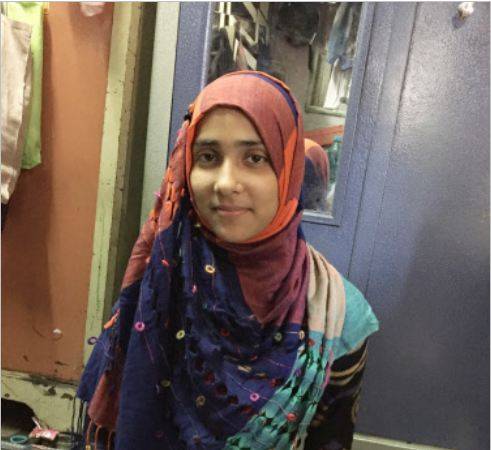
In an instance of triumph of will over circumstances, Raushan Jawwad, the fiesty 24-year-old from Jogeshwari who lost both her legs to a train accident in 2008 and later moved the Bombay high court to study medicine, managed to get the prefix of “doctor” attached to her name on Tuesday evening.
Jawwad Shaikh, her vegetable vendor father, and mother Ansary Khatoon, a homemaker, had tears in eyes when they saw people clap for their daughter while she was being conferred with the MBBS degree during the convocation ceremony.
Nine years after the accident, Raushan has become the first doctor in her family.
A bright student, she scored 92.15% in her Class X exam in 2008. A few months later, on October 16, 2008, she was pushed out of a crowded local train near Andheri station. She was on her way home after writing her college exam papers at Bandra’s Anjuman-i-Islam Girls College in the train when she fell on to the tracks and lost her legs under the moving train. Hearing Raushan’s screams, some commuters pulled the chain and the train was stopped. It took her a year to pull herself out of the trauma and resume her education.
“I am thankful to Allah for giving me the courage to continue my studies. I am now preparing for MD entrance. I want to start a hospital in my ancestral village in Azamgarh where many people face medical problems due to non-availability of good hospitals,” Raushan told TOI on Wednesday. She has expressed willingness to work for the poor in villages near Mumbai too. Last year, Raushan secured a first class in the final-year MBBS exam at KEM Hospital.
While the law allows only people with “up to 70% handicap” to study medicine, she was found to be 88% handicapped post the accident. To continue her education, Raushan had to put up a fight. She approached the Bombay high court seeking its intervention to secure an admission. Despite qualifying for the entrance exam, the government found her “unfit” to study medicine. The then high court Chief Justice Mohit Shah directed the state to give her admission. “When she can come all the way to court, why do you think she won’t be able to come to class?” asked Justice Shah.
Raushan stays with her parents, an older brother and younger sister in a 10-by-10-foot rented room in a Jogeshwari chawl.
“While studying at KEM, I used to stay in a college hostel. All my classmates, colleagues and teachers helped me a lot. The credit for my success goes to them too. They would always be very helpful and I never felt disabled when in their company,” said Raushan. When TOI first reported the accident, several people came forward to help Raushan financially. But her family did not even have a bank account.
source: http://www.timesofindia.indiatimes.com / The Times of India / News> City News> Mumbai News / by Mateen Hafeez / TNN / March 12th, 2017
You might have read stories of a diamond merchant in Surat gifting cars to his employees.
Here is a similar feel-good story in Mysuru district where a school has gifted cars to its teachers who have rendered more than 25 years of dedicated service.
The occasion was the birth anniversary of Javeed Ahmed, the Founder of Citizen’s Group of Institutions, Nanjangud, which the school celebrates as “Founders Day” on Feb. 2. This year, however, the celebration was special and five teachers had a pleasant surprise as the school management handed over the keys of Maruti Altos, recognising their services.
The school, located on the Ooty Road and started by Javeed Ahmed 25 years ago with seven students, has provided quality education to thousands of students.
The cars, each costing about Rs. 4.3 lakh, were handed over by Mashooda Javeed Begum, now President of the institutions, to Head Mistress Hena Kannan, Accountant Shantha, Assistant Teacher Sandhya, Assistant Head Mistress Kutub Tara and Principal Mythili Lakshman.
Receiving the car keys, the teachers appreciated the school management’s gesture and said that it was a pleasant surprise. They said that though people say that teaching is a thankless job as teachers remain in the background, their institution was different in recognising their efforts in shaping children’s lives. “Every year all the staff receives gifts and this year five of us have got cars,” they said.
Hena Kannan said the School Secretary Noor Mohammed Ali studied in the same school and he was her student. Both her daughters studied in the same school. The School President said that they had decided on gifting cars as the teachers had put in more than 25 years of service.
source: http://www.starofmysore.com / Star of Mysore / Home> General News / February 04th, 2017
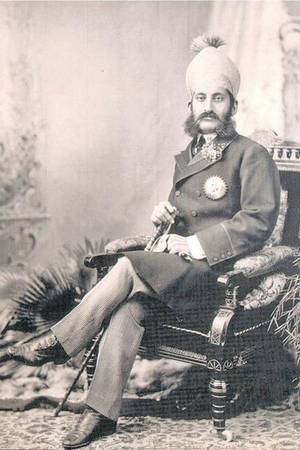
The sixth Nizam Mahboob Ali Pasha is remembered for combining tradition with modernity
Among the rulers of all the native states in British India, Mahboob Ali Pasha, the sixth Nizam of Hyderabad is reputed to have had the most lavish court. Born in August, 1866, Mahboob came to the throne at the age of three after the death of his father, Afzal ud Daulah. Mahboob Ali, thus knew no day when he was not the King.
A Regency under Sir Salar Jung I was set up for the young Nizam till he came of age. The Viceroy, Lord Ripon came to Hyderabad for the investiture ceremony held on February 5, 1884 and presented the Nizam a diamond-studded gold sword on the occasion.
Mahboob Ali was a perfect example of a Victorian Prince. He had a great taste for western culture and modern ways of life.
His English tutor, Major John Clark (who had earlier tutored the Duke of Edinburgh) had instilled in young Mahboob the customs and manners of high English society. As a result he imbibed great taste for all that was western. His western etiquette was so perfect that there was a rumour among the courtiers that the Nizam visited European countries incognito without the knowledge of any one!
His obsession for clothes and cars was legendary. His collection of garments was one of the most extensive in the world of his time.
The best English tailors were brought to Hyderabad to stitch the Royal robes combining tradition with modernity. There was a new dress for every day and he never wore the same dress for the second time.
It is no wonder that Mahboob Ali had a huge wardrobe in his palace that ran for more than hundred feet in length, considered to be the longest in the world. As his wardrobe was on the first floor of the palace, a lift was fitted for the Nizam to access his wardrobe every day with ease.
It is interesting to note that this hand-operated wooden lift at the Purani Haveli palace, in its shining best is still in perfect working condition.
His passion for cars was unparalleled and owned a good fleet of them. A Rolls Royce Silver Ghost that was made to order but delivered after he died in 1911, is now on display in the Chowmahalla palace fully restored, due to the efforts of Princess Esra Jah wife of the present Mukharam Jah.
The resources of the Nizam as well as the spirit of the times to which he belonged never discouraged lavish spending of money. Hyderabad came to be known for Mahboob Ali’s extravagant entertainments and lavish hunting expeditions.
Interest in medicine
It was under Mahboob Ali’s patronage, that Hyderabad Chloroform Commission was set up in 1889 and Chloroform as a safe anesthesia agent in surgeries was proved by Dr. Edward Lawrie, Principal of Hyderabad Medical School. The Nizam was personally interested in the work of the Commission. Two Hyderabadi doctors, Dr. M.G. Naidu (husband of Sarojini Naidu) and Dr. S. Mallanna (father of the future Gen. S.M. Srinagesh) were sent to England with funds provided by the Nizam to prove the efficacy of Chloroform in surgeries.
The British Medical Association journal, Lancet, hailed the work of this Commission. Mahaboob Ali, personally being interested in healing was famously known to administer a herb-based medicine to cure snake bite. During his reign, the first Hyderabad- Nagpur Railway line was laid in 1874. The advent of telegraph, telephone and electricity opened up Hyderabad towards economic growth.
Chirag Ali, a well known educationalist from Aligarh was invited by Mahboob Ali to spread English education in the Nizam’s dominions. Mahboob College in Secunderabad and Nizam College in Hyderabad stand testimony to the development of higher education initiated by Mahaboob Ali Khan. Aghornath Chattoadhyay, the father of Sarojini Naidu, the first Indian to have obtained Ph.D in Biology from Edinburgh University, was the first principal of the Nizam College.
Mahboob Ali Khan was a good polo player and an excellent marksman. He was probably the first Indian prince to have a court photographer, Deen Dayal. With his wonderful skills in photography, Deen Dayal, on whom the Nizam conferred the title, Raja, immortalised the Nizam and his times. Raja Deen Dayal employed in his studio an English lady to help him in taking the photos of the women members in the Nizam’s Palace.
Mahaboob Ali passed away on August 29, 1911 when he was hardly 45 years and was succeeded by his son, Mir Osman Ali Khan, regarded as the world’s richest man but the most frugal of all the Nizams, an antithesis to his flamboyant father.
Among the numerous expensive jewels that Mahboob possessed during his reign was the famous Jacob Diamond weighing 162 Carats, bought from the reputed London jeweller, Jacob.
Years later, Osman Ali Khan used this fabulous diamond, said to be next only to Kohinoor, as paper weight, the purpose for which Mahaboob Ali bought it.
Mahboob Ali also ever lives in the minds of the gastronomists, be the natives or visitors to this city for the aroma and the taste of the distinct Hyderabadi dhum biryani, the perfection for which the Nizam, Mahboob Ali Pasha justifiably took pride.
source: http://www.thehindu.com / The Hindu / Home> Society> History & Culture / by K.S.S.Seshan / February 02nd, 2017
A number of graduates who received gold medal at the 12th convocation of King George’s Medical University on Sunday would prefer to work in government sector-academics or practice to help the under privileged.
“Millions die every year for lack of proper treatment of neurological disorders, so I look forward to help those in need,” said Imran Rizvi, who bagged the Dr A M Kar centenary Gold Medal for best performance in DM (Neurology).
Recipient of the highest honour, Mohammad Tabish too wants to work in his home district comprising villages of Muzaffarnagar. Resident of Basti, BDS topper Abhishek Kumar Gupta said he ultimately wanted to open a clinic in Basti and serve in his home town. Similarly, Chancellor’s gold and university honours medal winner Avinash D Gautam too wants to serve the poor.
Sharing the dream of going abroad, Harsha A H and Shiva Rajan wish to work for the welfare of the society. “I wish to make discoveries and invent technologies that would help treat patients,” said Harsha, who received the ‘Sursari Dayal Memorial Gold Medal’.
The gold medal in the name of Vice Chancellor Prof Ravi Kant was conferred on Himanshu Yadav who believes in healing patients, rather than treating them. “I want to put in whatever I have learnt till date in serving impecunious,” added Yadav.
One of the gold medallists said she took up medical studies only to relieve the poverty-stricken. Vikram Holla, who will soon be joining as an assistant professor in a government medical college, said, “I am ready to work with any organisation that works ethically, and prioritises needs of the under- privileged.”
There was a good number of passouts who wanted to work in the government sector but Madhusudan Patodia, recipient of Prof T C Goel Gold medal said he would like to work in a private hospital since they are technologically more advanced. Patodia’s field of specialisation is kidney transplant.
source: http://www.timesofindia.indiatimes.com / The Times of India / News> City News> Lucknow News / TNN / January 30th, 2017
The winds of change started blowing when Sabbah Haji decided to do something for her homeland and subsequently opened the family-run Haji Public School.
At some 8000 feet above sea level, this school on picturesque hills in Chenab valley is setting new standards of education in Jammu and Kashmir. Apart from securing excellent grades in academics, the students here enjoy watching movies, learn activities like rock-climbing, and speak fluent English from kindergarten, something otherwise unusual for this “traditionally-conservative” Doda district.
The winds of change started blowing a decade ago, when Sabbah Haji a young woman, born and brought up in Dubai, decided to do something for her homeland and subsequently opened the family-run Haji Public School in Breswana village, some seven hours drive from the winter capital of Jammu.
After spending her childhood in UAE where her parents worked back then, Sabbah had shifted to Bengaluru for further studies. While her parents returned to Doda in 2000, Sabbah, after completing her studies, stayed back in the metropolitan, working with the multi-national companies.
But it in 2008 when Sabbah went visited Doda to meet her parents that things changed. Incidentally Sabah’s Singapore-based uncle, Nasir Haji was also in the town then. During a get-together, the family discussed their charity trust providing assistance to the needy. This was when Nasir bounced off the idea to do something big for the homeland by opening a school and proposed that he would also fund the project.
The idea was well taken. Sabbah’s mother Tasneem, who worked as a teacher in the Middle-East, was already an experienced hand. Her father Saleem Haji was equally willing. But “aged minds” needed “support of young energetic hands.”
Sabbah Haji
And this was where Sabbah’s need was felt. A post graduate in English, she willingly agreed. Giving up her lucrative career in the MNCs, she started working on the new dream in this remote hamlet.
As the school started, Sabbah was appointed as its Director and her mother its principal. But irrespective of designations, both mother-daughter duo work as teachers as well. Saleem Haji, a former manager in a shipment company abroad, is the now the village Sarpanch and ensures inspecting the school officially.
The Haji Public School had started with just one student in the kindergarten, who qualified her class 8th board exams last year with over 90% marks. Over the years the school has over 350 students and counting. “We didn’t start all the classes at one time as we wanted to groom our kids from the very beginning,” Sabbah told InUth.
Interestingly, while the co-educational institution bears a Muslim name, it has a big number of students from other communities as well. Sabbah takes classes on religious and moral teachings too.
The school has a variety of specialised facilities including a movie projector where kids love watching movies in the company of their favourite “Sabbah Mam”. Blockbuster Dangal is scheduled to be screened when the school reopens in spring after ongoing winter vacations.
But then is this 34-year-old woman, who gave up her promising career abroad happy to work in the remote Valley? “Yes of course. It’s our home,” she says adding that internet keeps her connected to the entire world.
Having been recently awarded by the state government for her contribution in “Social reforms and empowerment”, Sabah gives credit to her family. “We are in love with this place because even when we were abroad, my father always kept us connected to our roots. He is a very grounded person for that matter.”
She says the Haji family is happy and satisfied to see the kids improve. But then Sabbah takes a deep breath: “A lot more needs to be done!”
source: http://www.inuth.com / InUth.com / Home> India / by Majid Hyderi / January 27th, 2017
Roshni Misbah is pursuing an MA in Arabic & Culture Studies at Jamia. Photo Piyal Bhattacharjee
New Delhi :
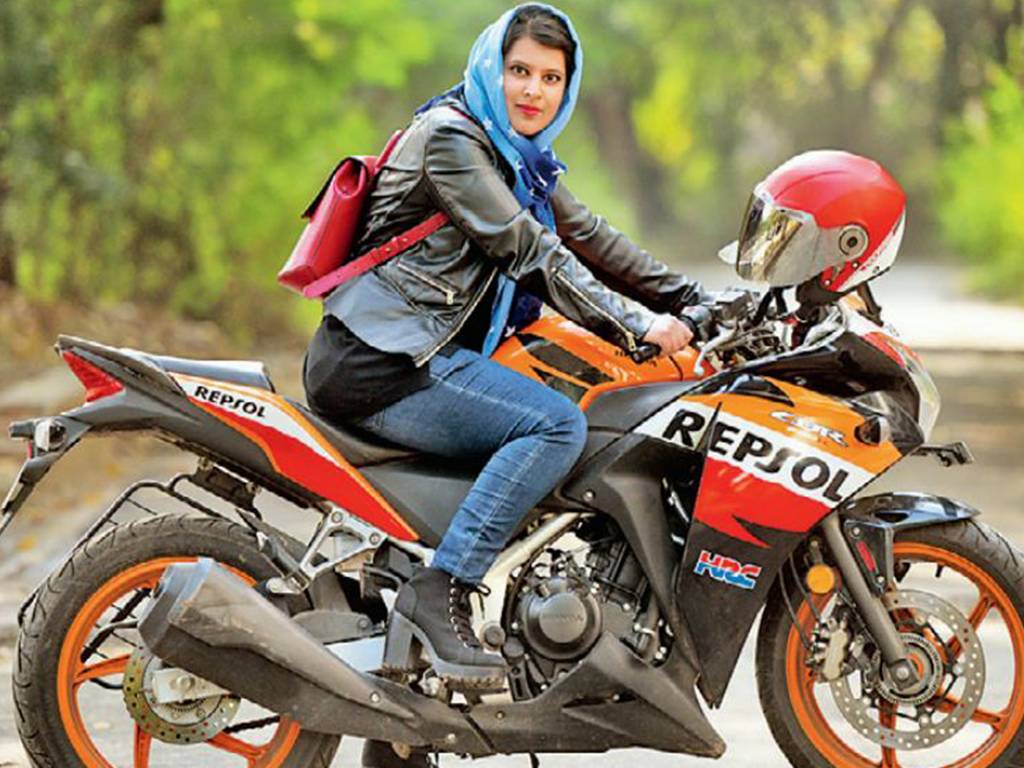
She oozes attitude in her black leather jacket, jeans and high-heeled boots, her head covered in a hijab. But that is not why Roshni Misbah makes heads turn in Jamia Millia Islamia. What does is the way she moves — on a mean orange-red-and-black motorbike that leaves behind a trail of throaty retorts when she zooms by.
People unaccustomed to such derring-do on a tradition-bound campus are slowly coming to terms with the phenomenon of Misbah, a 22-year-old who is pursuing an MA degree in Arabic and Culture Studies at the university. She is also an online sensation. For those who think a woman should, at most, aspire to a scooter, she is a slap in the face.
“I am a member of groups like the Windchasers and Delhi Royal Enfield Riders, and was part of the Bajaj Avengers Club at the time I owned an Avenger bike,” said the girl from Ghaziabad. She also believes that she is one of the youngest members of Bikerni, an all-woman biker group in Delhi that aims at gender empowerment through female motorcyclists.
These days, she flashes by on a Rs 2-lakh, 250 cc Honda CBR Repsol. It has been a longish journey since the time her father, himself a lover of motorcycles and owner of, among others, a monstrous Suzuki Intruder 1800, said he would get her a Vespa when she declared pillion rides with him had whetted her keenness to become a biker.
She was in Class IX at Cambridge School when her wish was fulfilled. She learnt to ride a bike by herself and later managed to buy the Avenger, on which she perfected her skills. Her embracing of an unusual pursuit made her an immediate heroine for her two younger siblings and their friends.
Misbah knew she was doing something different, especially for a girl from a conservative community. But everyone around her — from family to friends and teachers — rallied around her. “My teachers even gave me a special parking slot near the Indo-Arab Centre on the campus,” she said. Her teacher, Jawed Khan, director, Centre for West Asian Studies, described her as a sincere student who remained attached to her culture despite being passionate about bikes. A friend, Fareed Farooqui, who too is a superbike rider, felt that “other girls should do whatever they wish to, like Roshni”.
Thankful to the vast majority who have endorsed her passion, Misbah also recalled that there were a few who criticised her for not conforming to the accepted image of a woman. The confident super biker believes that she is doing her bit to break down such stereotypes and hopes instead “to inspire more and more girls to follow their desires”.
source: http://www.timesofindia.indiatimes.com / The Times of India / News> City News> Delhi News / by Mohammad Ibrar, TNN / January 28th, 2017
Shabuddin Shaik, research scholar, department of Zoology, Acharya Nagarjuna University, has been conferred with young scientist award by Dr. K.V Rao Scientific Society in the stream of biological sciences.
Mr. Shaik’s paper ‘Enigmatic Indian Cave Biodiversity,’ under the guidance of Professor Emeritus, Y. Ranga Reddy, won him the award, a citation and a cash award of Rs.10,000.
He received the award from the Director, National Institute for Interdisciplinary Science and Technology, Thiruvananthapuram at the 16th Annual Science Awards function at B.M Birla Science Centre, Hyderabad on June 11.
source: http://www.thehindu.com / The Hindu / Home> News> States> Andhra Pradesh / by Staff Reporter / Guntur – June 14th, 2016
“While I offer this service for free, I do ask for something in return from my students – a promise that they will pass on the kindness by helping other needy students. It might surprise you, but I don’t have to spend a single rupee on faculty as all my past students are training my current students,” says Professor Hidayat Saiyed of Ahmedabad who believes that if you have knowledge, you must share it.
From a time when he could not succeed in a competitive exam because of the lack of money to afford proper guidance, to today when he is guiding students free of cost, in 13 centres all over Gujarat – this is his story:
Meet Professor Hidayat Saiyed who is an epitome of kindness. He runs Sarovar Education Society. The social work he has been doing since last one decade is beyond appraisal.
“After completing my college I decided to appear for competitive exams but I couldn’t afford private coaching classes and nobody was their to guide me. Lack of proper environment and guidance made me fail in exams just by few marks. This incident left a big impression on me and I thought that there would be so many young and bright students who want to appear for career-oriented examinations but do not have the financial means to secure admission in coaching classes. And soon I decided to start this social activity to train students for exams without charging a penny from them.
I started training my first batch of students for Gujarat Public Service Commission exams in the year 2006 in a small rented house and to my surprise out of those 24 students, 18 cleared the prelim exams and 1 of them got selected for the job. This gave me a big boost. Soon some young boys who were doing odd jobs in our locality came to me and said that if we get proper guidance than even we can clear such competitive exams. This success boosted my desire to set up an institute where I could give free guidance to needy students.
So in the year 2008, I officially started this Institute and at present we have 13 centers all over Gujarat with 1000 students being trained for the competitive exams. While I offer this service in free, I do ask for something in return from my students- A promise that they will pass on the kindness by helping other needy students. It might surprise you, but I don’t have to spend a single money on faculty as all my past students are training my current students.
In our community usually girls don’t come out and appear for such exams but I am proud to say that I’ve managed to break that stereotype and today 60 percent of my students are girls and remaining are boys. There are girls who have been posted in different parts of Gujarat and are getting finest of jobs. Those who get selected for jobs donate reading material and have even helped set up a well-equipped library for students.
My classes are open for anyone who cannot afford coaching. There was this one time a female student in my class had reached the final stages of a competitive exam when her parents decided to get her married. Two years later, she delivered a baby but her husband died in a road accident and she returned to her parents’ house here. She was shattered and upset. Her mother brought her to me and I encouraged her to resume studies. Soon she passed four competitive exams and today she works with Employee’s State Insurance Corporation. So what I am trying to say is that students dedication and professors proper guidance can change students lives. Every young fellow has an undying desire to study and get a good job, it’s just that they don’t get a helping hand.
Any Message?
If you have knowledge then share it among the students. If you have money then put it for the good use. Make the best use of what you have and try to help as many people as you can. You only get one life, don’t waste it on useless thing instead be useful to others. ”
source: http://www.thebetterindia.com / The Better India / Home> Education> Unsung Heroes / by Tanaya Singh / 2016
Educational Excellence Celebrated at AFMI’s Silver Jubilee Convention in Delhi
American Federation of Muslims of Indian Origin’s Silver Jubilee convention held at the Kedar Nath Sahani Auditorium in New Delhi Dec.31-Jan.1st celebrated the accomplishments and marked a milestone in the organization’s history. The convention was held in co-ordination with the Delhi Youth Welfare Association.
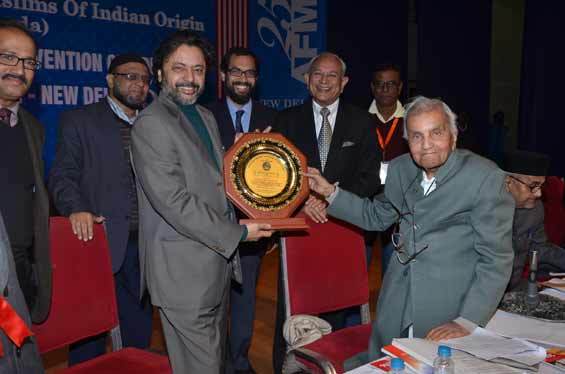
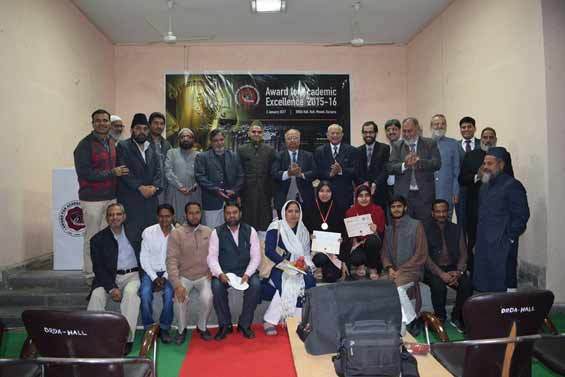
More than 120 Muslim students from across India were awarded with gold, silver, and bronze for attaining meritorious distinction in the board exams. In addition, the prestigious Sir Syed Ahmed Khan Award conferred about leading Mumbai philanthropist Dr. Abdul Kader Fazlani Sopariwala. The Mir Taqi Mir Award was given to Mr. Sanjiv Saraf, founder of the popular web portal www.rekhta.org, for his contributions in promoting the Urdu language. The website now features more than 22,000 titles of Urdu books. Excellence Awards were given to former Chief Electoral Commissioner S.Y.Quraishi and the historic Anglo Arabic Senior Secondary School.
Sanjiv Saraf accepting his award from Justice Sachar
In a first for AFMI convention all the medallists were interviewed by Dr. Fazlani’s philanthropic organization and scholarships worth Rs.4 crore were pledged.
Awards to top students were given at the hands of Delhi Deputy Chief Minister Manish Sisodia. He praised the work of AFMI and that more such efforts need to be undertaken to uplift the society. He mentioned that education remains the top priority of the Delhi government with as much as 25% of the state government’s budget dedicated to it.
AFMI’s flagship awards program has been instrumental in spreading awareness about educational excellence and empowerment across the country. Dr.A.R. Nakadar, AFMI’s founding trustee, said that the fruits sown by AFMI at its inception are now bearing fruit. He said that due to such efforts there has been a remarkable improvement in the educational scenario of Indian Muslims. Citing the latest census reports, published in Indian Express, he stated that there has been a 98.8% increase in the number of Muslim graduates between 2001 and 2011. During the same period the Indian Muslim literacy rate has increased from 59.1% to 68.5%. He said that the day is not too far when, through the collective efforts of all, AFMI’s dream of 100% literacy will be realized.
Dr. Nakadar urged the students to not to rest on the laurels but to use the award as a motivational tool to attain even grater heights of educational excellence. He also asked them to not to forget those who have been left behind and to spread the message of educational empowerment everywhere.
AFMI’s incoming president Dr. Khutb Uddin, a practicing psychiatrist from Indiana, in his remarks applauded the students for their hard work. He urged them to not to be distracted by negative thoughts and to focus on their education. He also pointed out that everyone from the individual to the government should be involved in raising the quality of education in the country and that it should be everyone’s top most priority.
The inaugural session of the convention was addressed by Justice Rajinder Sachar, Mr. Anil Swarup, Secretary Education & Literacy (Government of India), Mr. Naseem Ahmad, Chairman of National Commission for Minorities, and convention chairman Mr. Mohammad Naeem, president of Delhi Youth Welfare Association. The session was ably moderated by AFMI Trustee and leading scholar Dr. Aslam Abdullah.
The convention was also addressed by Prof. Akhtarul Wasey (Vice Chancellor of Maulana Azad University, Jodhpur); Mr.Siraj Hussain, IAS, former VC Jamia Hamdard, Dr. S.Y.Qureshi (former Chief Election Commissioner), Justice Fakhruddin, Mr. Ali Quraishi (New Mexico), Mr. Tayeb Poonawala (New York), Mr. Siraj Thakore (Canada), Mr. Farhad Rahmani, Mr. Ayub Khan, Prof. Janaki Rajan, Dr. Shabistan Gaffar, Mr. Mohsin Siddiqui, Mr. Suhel Tirmizi (Editor, Gujarat Today), Dr. Husain Nagamia (Florida), Mr. Shafi Lokhandwala (Detroit), Mr. Khalil Ahmad, etc.
The convention also featured an AFMI Alumni session in which previous year’s medalists spoke on their experiences after winning the award. They also offered their guidance for the students in choosing their career pathways. Among those who addressed this session include Dr Nurul Islam (pediatric cardiologist), Mrs. Darakshan Khan (IT consultant), Dr. Suhail Qureshi (oncologist), Dr. Naseem Ahmed (Orthopaedic surgeon), Dr. Nabeel A.K., Ms. Samreen Siddiqui, Mr. Uzair Khan, among others.
In his closing remarks Dr. Nakadar thanked all the organizers and volunteers of Delhi Youth Welfare Association, under the leadership of Mr. Mohammad Naeem, for organizing a very memorable convention.
A seventeen member delegation of the American Federation of Muslims of Indian Origin, led by Dr. A.R.Nakadar, met the Vice President of India Mr. Hamid Ansari on January 2, 2017 and appraised him of AFMI’s activities. Mr. Ansari appreciated the efforts of AFMI and the concerns and care of NRIs for improving the quality of education in India.
An AFMI delegation met the Deputy Chief Minister of Delhi Mr. Manish Sisodia on January 3rd and discussed the current situation of education in Old Delhi.
AFMI’s Regional Awards Program in Mewat
AFMI held its regional awards program in Nuh, Mewat in coordination with the Human Welfare Foundation. One of the key organizers of the program is Uzair Khan, a former AFMI medalist, who is now carrying its message to the interiors of Mewat region. He is presently pursuing MBA from Jamia Millia Islamia.
Reviving Delhi’s Educational Institutions
AFMI’s NRI delegates visited a number of educational institutions in Old Delhi which have held aloft the banner of education among trying circumstances. The schools visited include Anglo Arabic Senior Secondary School, Mazhar ul Islam School, and the Fatehpuri School. AFMI’s governing board will soon formulate a a plan for help in the revival of these historic institutions.
source: http://www.milligazette.com / The Milli Gazette / Home> Online News> Education and Careers / January 23rd, 2017
It has been a tough battle for Faiza Nisar Ali who helped steer the entry of girls into the male bastion of the Anglo-Arabic School.
New Delhi
It has been a tough battle for Faiza Nisar Ali who helped steer the entry of girls into the male bastion of the Anglo-Arabic School.
Her struggle of that of many other Muslim women created history when the school admitted girls for the first time this year in its more 300-year-old existence.
Ms Ali’s fight began in March when she was appointed to prepare a feasibility report on why Muslim boys and girls should study under the same roof.
She had to contend with numerous pitfalls along the way, including frantic phone calls from community hardliners trying to dissuade her, being blamed for scripting something “un-Islamic”, countless sleepless nights and the trauma of a miscarriage.
“After months of research, consultations with educationists, psychologists and parents, I concluded in my report that co-education among Muslims would result in greater progress and help them in the later stages of life,” Ms Ali, who has been the business studies teacher at the same school for more than six years, told IANS.
She recounted the events with moist eyes.
“After the report was done, the staff became very resistant. The teachers went against me and I was held liable for being un-Islamic,” she said.
The report spoke on how co-education could boost academic performance of both the sexes, the structure of the Anglo-Arabic school, located as Ajmeri Gate, in the old quarters of Delhi, and its importance. The report also highlighted that Muslim parents wanted their girls to go to a co-ed institution.
Despite facing internal resistance from the predominantly male school staff, the managing committee of the school on March 26 decided to open its doors to girls.
However, the landmark decision did not end Ms Ali’s agony. While her family was supportive, the mental pressure due to the angry reactions sent her to hospital.
Then eight weeks pregnant, Faiza went through a miscarriage.
“I had this invisible pressure about how to face colleagues in the school. I had gone through a lot, but I did not want to leave it in the middle,” the mother of a five-year old said, adding that her “mother had even suggested [she] distance herself from all the activities”.
Her cause to turn the school coed gained strength when a Jawaharlal Nehru University student, Fatima Alvi, filed a petition in the Delhi High Court.
On May 24, the court backed their cause. The school management swung into action and has so far admitted more than 30 girls in Classes 6 to 11.
For many Muslim girls studying in nearby girls’ government schools, the move is a dream come true as they can switch to the Anglo-Arabic School that has had among its students Liaqat Ali Khan, the first prime minister of Pakistan, Sir Syed Ahmad Khan, founder of Aligarh Muslim University, JN Dixit, former national security adviser and foreign secretary.
Burqa-clad Darakshna Fatima, 17, beams with joy for having made it to the school.
“I lost my father 6 years back, since then my mother has been the pillar of strength for me,” Darakshna, who aspires to become a chartered accountant, told IANS.
The Class 11 student added, “Our relatives had reservations, but I am proud that my mother fought for my education.”
Darakshna’s sister Gulafshan has also secured admission to the school, that started off as Madrasa Ghaziuddin around 1692.
However, Ms Ali says the fight is not over yet. Though girls have been admitted, the resistance among many staff members remains.
“Let’s hope there is an attitudinal shift and changes begin to happen,” Ms Ali said.
source: http://www.thenational.ae / The National / Home> World> Asia / IANS / June 04th, 2017