My next aim is to win gold medal for my country in Olympics, Tajamul Islam said.
Tajamul Islam, 13, from Tarkpora in Bandipora defeated Argentina’s Lalina in the under-14 finals. Credit: Tajamul Islam
A teenage girl from a remote village in north Kashmir’s Bandipora district recently scripted history by winning a second gold medal in World Kickboxing Championship held in Egypt’s Cairo on October 22.
Tajamul Islam, 13, from Tarkpora in Bandipora defeated Argentina’s Lalina in the under-14 finals. “I had represented India in Italy in 2016 too, in the under-9 category in which players from 90 other countries had participated. I won gold in that event also,” she told DH.
A class 7 student of Army Goodwill School in Bandipora, Tajamul won national recognition when she bagged the gold medal in the sub-junior category at the 2015 National Kickboxing Championship in New Delhi. Her achievement at the national level got her an entry to the World events.
A six-year-old Tajamul started her kickboxing journey in 2014 from a local martial arts academy for young boys and girls. “I was watching kickboxing on TV and decided that one day I too will do something big in this sport. And when I saw young boys and girls training, punching, I told my father that I want to join them,” she said.
But the initial journey was not so easy for the little girl. “I faced a lot of taunts from my relatives and neighbors initially when I started practicing the game. But my mom supported me and somehow persuaded my dad to allow me to continue my practice. Martial art was also the passion of my elder siblings and their support was crucial,” she said.
Daughter of a businessman based in Mumbai, the gold-medalist has a word of advice for parents and children. “Parents should understand that sports keep children away from negativity like drug addiction and other activities and allow them to participate. Kids should also not hide anything from parents and take their consent before choosing any game,” she said.
Asked how difficult her journey was being a girl, she replied, “Girls can do better than boys if they are given equal opportunities. My next aim is to win a gold medal for my country in the World Olympics.”
Tajamul is also a brand ambassador of ‘Beti Bachao Beti Padhao’ scheme. She also concentrates on her studies and wants to become an orthopedic surgeon. “I want to break as well as join the bones by becoming an orthopedic surgeon,” she said laughingly.
source: http://www.deccanherald.com / Deccan Herald / Home> National> North and Central / by Zulfikar Majid, DHNS / November 01st, 2021
A screen grab of the online inauguration of English-speaking course at Jamea-tul-Hidaya, Jaipur.
Bhopal :
A Jaipur-based seminary, namely Jamea Tul Hidaya, will commence a one-year online English-Speaking Course from October 16.
The formal online inauguration of the Online course was held the other day wherein Islamic clerics from Canada and UK were also guest speakers.
The function was presided over by Maulana Syed Mohammed Rabey Hasani Nadvi, Chancellor Darul Uloom Nadwatul Ulama, Lucknow, and president of All India Muslim Personal Law Board.
It may be recalled here that Jamea Tul Hidaya recently has started an Online Ifta course and is now starting a one-year online English-Speaking Course.
Jamea Tul Hidaya is a seminary well-known worldwide for imparting theological and contemporary education to its students.
In his key-note address, Maulana Mohammad Fazlur Rahim Mujaddidi, Chancellor Jamea Tul Hidaya, said: “Today is the golden day in the history of Jamea Tul Hidaya. Although the English language is included in the syllabus of the Jamea from primary classes to Aalim, yet feeling its significance, English Speaking Course is going to be started for the alumni of Madaris.
He also said: “Six schools are running under Maulana Abdul Rahim Educational Trust in Jaipur, and more are in the pipeline.
For civil services exams, Crescent Academy for civil services exams was established, where free coaching is being provided to the students. To get benefits from government schemes, and for the political and educational awareness, conferences and seminars were organized in the whole country.”
“In modern times, English has become an international language. Therefore, to ward off religious misunderstandings, it is becoming more and more important to learn this language for economic stability and trade and employment,” he further said.
Maulana (Dr.) Iqbal Masood Nadvi, who was Professor at King Saud University, Riyadh, and is presently living in Toronto (Canada), in his speech said: “Translation cannot be equal to the language from where it has been translated, so we should have the capacity to understand the text in its original language. He also said: “The person who learns the language of others defends himself from any cheating.”
Abdur Raheem Kidwai, Prof. of English and Director UGC Human Resource Development Centre, AMU, said: “Growing numbers of Madrasas are introducing English as a very good subject. But practically there are no trained English teachers as there is total lack of teachers training program, absence of syllabus and textbooks and no language labs”. But he said he has many hopes from this Course of Jamea Tul Hidaya.
He also advised to arrange a comprehensive program integrating all the four skills of the language LSRW, i.e., Learning, Speaking, Reading, and Writing. He assured of giving any support to this program from him and his colleagues.
In his presidential address, Maulana Syed Mohammed Rabey HasaniNadvi said: “It is a congregation of much importance. It is the high courage of Maulana Fazlur Rahim that he took this work on his shoulders. I hope it will encircle the whole world and benefit the alumni as well as the objective of the Madrasa.” Recalling his association with the founder of Jamea Tul Hidaya, the late Maulana Abdur Rahim, he acknowledged the works done by this institute. He appreciated the endeavours of Maulana Fazlur Rahim Mujaddidi.
Abdul Kareem Gheewala, Islamic scholar and social activist from Leicester (UK), emphasized the importance and significance of the English language. It can help clarify the doubts and criticism about Islamic teachings and practices and propagate Islam’s right spirit and message to the world.
He congratulated Jamea and all those behind the program and appreciated the commitment and dedication shown by Maulana Fazlur Rahim. He was confident that it would become a top-rated course and benefit Islamic scholars in many ways.
Dr. Saud Alam Qasmi, Dean Faculty of Theology in Aligarh Muslim University. (AMU), said: “Maulana Fazlur Rahim Mujaddidi is not only the torch-bearer of Islam in India but has progressive thinking towards the issues related with Muslims. He has taken the initiative for so many things to uplift Muslim society, particularly the younger generation.
He said that the On-line programs, Ifta and English-Speaking Course, are marvellous and this program will help our younger generation acquire the current world knowledge and literature. He also called English the language of opportunities. He said Maulana Fazlur Rahim is a magnetic personality and congratulated him and his team on initiating this English Speaking online course.
Mohammad Iqbal Khan, Director of Crescent Academy for Civil Services Exams, New Delhi, and organizer of this one-year online English-speaking course, described the brief history of Jamea-tul- Hidaya and its founder. He addressed mainly to the students and shared his views on how to learn to speak English better.
The program concluded with Dua to Almighty Allah by Maulana Fazlur Rahim. At the outset, he rendered recitation of the Holy Quran in his melodious voice.
source: http://www.indiatomorrow.net / India Tomorrow / Home> Education / by Pervez Bari / October 10th, 2021
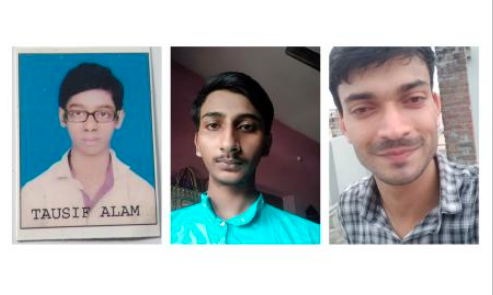
Tausif, Zuarez and Qaif have qualified for admission at India’s prestigious institutes. | Photos by arrangement
At least 65 students, including one girl, of Rahmani 30 – an educational movement for underprivileged students started in Patna, Bihar by late Wali Rahmani, have qualified for admission in the prestigious Indian Institutes of Techonlogy (IITs) this year. TCN features some of them.
Bihar :
Zaurez Ahmed (17) has secured 393rd rank this year in India’s topmost engineering entrance test known as Joint Entrance Exam (Advanced). His father Shakeel runs a modest general store in Jalwara, Kewti of Darbhanga, one of the most backward areas of Bihar. His family was in no position to afford the expensive private coaching for such exams. It was Rahmani 30 that came to his rescue.
Like Zaurez, there are atleast 65 students, including one girl, of Rahmani 30 who have qualified for admission in the Indian Institutes of Technology (IITs) this year from the main centre at Patna. All 93 aspirants from Rahmani 30 qualified for JEE (Main). Across India, there are 23 IITs having 16000 seats for which more than 1.6 lakh applicants participated in the JEE (Advanced). These are shortlisted from one million aspirants of JEE (Main).
Rahmani 30 is modelled on Super30, the first such centre for coaching students for the IIT entrance test. Rahmani 30 was founded by the renowned Islamic scholar late Hazrat Maulana Wali Rahmani in 2008. Since 2009, Rahmani 30 boasts of more than 400 successful students who have qualified for admission in different IITs. Apart from this, nearly 1000 students have qualified for JEE (Main) and the National Institutes of Technology (NITs), the second most prestigious engineering institute of India.
Rahmani 30 offers the top 30 students free stay, food and education which costs around Rs. 60 lakhs for two years.
What is special about Rahmani 30? “Apart from the low cost or no cost stay at Rahmani 30, the ever availability of teachers and mentors here is immensely helpful,” Zaurez told TwoCircles.net.
He said that teachers at Rahmani 30 are “quite supportive.”
Zaurez cites ‘deeni mahaul (religious atmosphere)’ at the centre as helpful in having a ‘useful break’. His EWS (Economically Weaker Section) category rank is 28 and he is quite hopeful to get Computer Science at IIT, New Delhi.
Rahmani 30 has its branches at Aurangabad (Maharashtra), Bangalore and Hyderabad. Apart from the main centre, there is a girls unit in Patna. The main centre is being run in a rented apartment ‘Anand Palace’ at Anisabad, Patna.
A normal day for studies starts at 7 in the morning and continues till 9 in the evening.
Mantasha Firdous (17), who qualified this year, is the first female student of Rahmani 30 since its establishment to compete successfully for JEE (Advanced). Generally, the girl aspirants join Rahmani 30 for the medical entrance test NEET. However, Mantasha has a knack for mathematics. She has secured an EWS rank of 4074 and hopes to get “a good branch at a good IIT’. She said that the “group of girls” at the centre was quite helpful for her to remain focused on studies.
At Rahmani 30, the aspirants are admitted for a two-year residential course. As Covid-19 hit their preparation, an online mode was learning was started in 2020. Most students attended online classes on mobile phones though there were network issues for those residing in remote areas.
Tausif Alamhas (17) secured CRL (Common Rank List) 7169 and a category rank of 1339. His father Mohammad Rashid works as a tailor and his mother is a homemaker. His family could not send him to study at any coaching centre as they charged a hefty fee. He came to know about Rahmani 30 from one of his senior and passed the test to get admission.
Talking to TwoCircles.net, he said the most helping part of Rahmani 30 is “group study where peers help in doubt clearing.”
“My motivation level only rose with the continuous encouragement from the teachers. It helped increase my willpower too,” Tausif said. His next aim is to crack the country’s top exam for civil services U.P.S.C.
Seventeen-year-old Qais Alam’s success has a twist. His father is a small farmer and suffers from poor eyesight. Qais hails from Marar, a remote village in the Khagaria district of Bihar. He didn’t have much of an idea about IITs. He appeared for Aligarh Muslim University’s entrance test for a three-year Engineering diploma course and qualified. He studied there for two years, and quit before completing his degree. This was during 2016-17. He came to know about Rahmani 30 and was selected for its two-year preparation course. He appeared for JEE (Advanced) in 2020 in his first attempt but was not satisfied with his result. He reappeared for JEE again in 2021. He bettered his All India Ranking to 6025 from his 2020’s performance of 28000th rank. His EWS rank also improved to 639 from above 3000. He is hoping to get admission at IIT Delhi or IIT Madras. He too aims to clear U.P.S.C. after graduation from the IIT.
Twenty-three-year old Atif Hussain is in his 3rd year at IIT Guwahati. He originally hails from Bihar but his family is settled in Kolkata, West Bengal. Atif’s father Phool Mohammad sells Lahti bangles (lac bangles) which and his business has been hit due to Covid-19 lockdown. His mother is a housemaker. Atif studied in Urdu medium Howrah High School and got 84% marks in his 10th Board examination. He came to know about Rahmani 30 from a senior. He said that getting admission in Rahmani 30 was the ‘turning point’ of his life. “Teaching guidance and peer study environment at Rahmani 30 was very useful,” Atif, who is fond of research and coding, said.
Though Rahmani 30 was started for helping underprivileged students crack the IIT entrance test, it has ventured into other top examinations like Medical, Commerce and Law. In its CA/CS program, out of 10 successful candidates this year, five were girls.
Rahmani 30 calls itself “a movement, not an institution” which hankers “to demonstrate that economically, socially and educationally backwards and suppressed students when given the opportunity rise to the occasion.” It is “established to be the catalyst for inspiring the minorities to aim high to seek their rightful places.”
Rahmani 30’s founder late Maulana Rahmani had a clear vision about this centre. He was of the opinion that, “Utmost service to the religion during these times is to educate our youth and upcoming generations with contemporary subjects while keeping their faith firmly established and their self-confidence high; so that, they excel in religion, are adorned with education, have an appreciation of hard work and therefore are able to navigate and make confident decisions in their life.”
Bihar’s former Director General of Police (DGP) Abhayanand has been a great help for Rahmani 30 as a mentor since its beginning. Known for his Physics teaching skills, Abhayanand is credited with starting super 30 along with Anand Kumar, to teach poor students of Bihar to crack IIT JEE.
Talking to TwoCircles.net, Abhayanad was delighted that Rahmani 30 is expanding in size and dimension in the right direction.
Late Maulana Wali Rahmani had approached him to be the mentor of this centre and he readily accepted the proposal. “There didn’t exist a good trend for education in Muslim community, particularly in the weaker sections. I thought it would be in the broader interest of the country to help such students,” Abhayanand said.
His only and interesting condition was, “I will not interfere in the administration of the centre and Maulana will not interfere in teaching at the centre.”
Maulana Fahad Rahmani, the younger son of late Maulana Wali Rahmani is the current CEO of Rahmani 30.
He told TwoCircles.net that Rahmani 30 initially started with 10 students and “in 12 years the number of students has gone up to 900.”
Maulana Fahad aims to increase the number to 15000 across India at the end of this decade. “If we consider the total number of institutions of national importance to be one lakh, its corresponding number for the Muslim community should be 15 % of it, which is roughly the population of the community in India,” he argues, adding, “To achieve this goal the community support needs to be increased. If we can arrange one donor for one student we will need 15000 donors, which is not beyond reach.”
Maulana Fahad insists that he doesn’t believe in the traditional fund collection.
On the success rate of girl students of Rahmani 30, Maulana Fahad said that it was his father and the late chairman Maulana Wali’s wish to see the girl students excel in engineering too. “Alhamdulillah, this year it has started, and it get better in the coming years.”
Sami Ahmad is a freelance journalist based in Patna, Bihar. He tweets at @samipkb
source: http://www.twocircles.net / TwoCircles.net / Home> Lead Story / by Sami Ahmad, TwoCircles.net / October 23rd, 2021
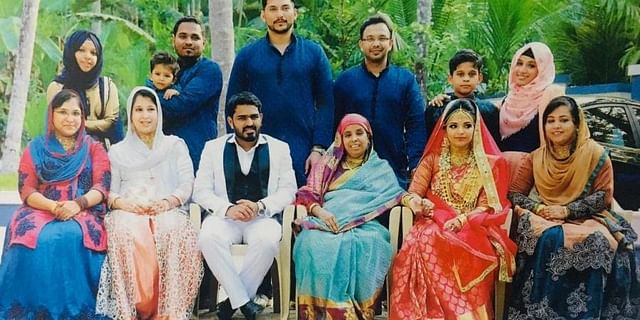
Interestingly, the spouses of Fathima, Hajra, Ayesha, and Faiza are also doctors. Kumhamed Kutty and his wife were also against dowry.
Zaina (third from right) flanked by her doctor family. (Photo | Special Arrangement)
Sometimes fact is stranger than fiction. This is true in the case of Ahamed Kunhamed Kutty and his wife Zaina Ahmed of Nadapuram in Kozhikode district of Kerala.
When Zaina Ahamed gave birth to six daughters, Ahamed and his wife didn’t despair. Rather they were happy. Ahamed was a progressive thinker. He envisioned a life for his daughters in which they would serve society better and be role models for others.
His wish did not take long to turn into reality. All the six daughters of the couple did well in their studies and would go on to be doctors. Wait, we are getting ahead of ourselves.
Four daughters namely, Fathima Ahamed 39, Hajra Ahamed 33, Ayesha Ahamed 30, and Faiza Ahamed are already practicing doctors. Raihana Ahamed 23 is doing her final year MBBS in Chennai while the youngest Ameera Ahamed is in the first year of her MBBS course in Mangalore.
Interestingly, the spouses of Fathima, Hajra, Ayesha, and Faiza, namely, Dr Rishad Rasheed, Dr Ajnas Mohammed Ali, Dr Abdurahman Padiyath Manapat, and Dr Ajas Haroon respectively are also doctors.
Zaina was only 12 years old when she was married off to her cousin Ahamed. At the time, he was running a business in Chennai. After the birth of their first daughter, Ahamed went to Qatar with his wife and daughter where he was employed in a refinery.
Hajra, who did a BDS course while all the others opted for MBBS, recalls the evenings in Qatar when their parents used to infuse them with the importance of doing well in their studies and serving society.
Once they returned from school, there used to be a family gathering when their parents chatted with their daughters about several things, particularly their studies and future.
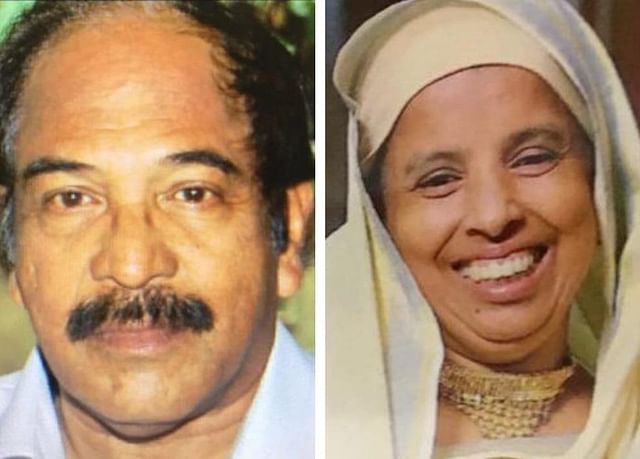
Ahamed Kunhamed Kutty and his wife Zaina Ahmed
My Uppa liked medicine. When he couldn’t become a doctor he dreamt of making his brother a doctor. But his brother went on to become a teacher and he’s known as Soofi teacher in our place,” Hajra said.
So, naturally, Ahamed wished that one of his daughters would fulfill his dreams. Fathima opted for MBBS and she took to the course like a duck to water. The positive feedback from Fathima inspired her other sisters also to go in for medicine. Behind it, all was the advice of their parents.
In fact, one of the sisters, Ayesha was interested in doing law. But her parents told her she can pursue it after completing her MBBS course.
Similarly, when it came to the marriage of their daughters, Ahamed and his wife were specific that their daughters should marry someone from the same profession so that it would help the young couple understand each other better. They were also against the practice of dowry. They didn’t want to “sell off” their daughters but marry them off to a person who understood and loved them.
After working in Qatar for nearly 35 years, the couple with their daughters returned to Kerala. About two years later, Ahamed suffered chest pain and passed away. At the time, only two of the daughters were married off. Thereafter, Zaina encouraged and inspired her daughters to pursue their courses and married off two other daughters.
Fathima is presently working in a military hospital in Abu Dhabi. Hajra said she had returned from abroad and is planning to do her PG course.
Ayesha is serving in a hospital in Kodungallur while Faiza and her husband work in Kochi.
This story would read like a dream. But, as they say, Rome was not built in a day. The six women doctors and their mother would testify.
The sisters don’t have a photograph taken together with their Uppa. They carry an image of him in their hearts.
source: http://www.newindianexpress.com / The New Indian Express / Home> Good News / by Gladwin Emmanuel, Online Desk / October 20th, 2021
Haris Sumair secured All India Rank of 270 in UPSC 2020
Bidar, KARNATAKA :
Haris Sumair
Earlier this month the Union Public Service Commission (UPSC) declared the results of UPSC examination 2020 wherein 761 candidates who appeared for the exams, cleared it. One of the names that made the headlines in Karnataka was that of Haris Sumair, a young engineering graduate hailing from Bidar city who secured the All India Rank of 270 bringing laurels to his city and the State.
What is more interesting in Haris’ story is that he has not received any professional or paid coaching for clearing, which is touted to be one of the toughest exams in the country. Although he was helped by his brother who cracked the UPSC exams last year and is an IPS Officer, Haris believe there are enough content and topper strategies on the internet to help anyone crack the exams without any professional coaching.
Less than a week after the UPSC declared the results, Haris says he was elated when he saw his name in the list adding that he was expecting a positive result but felt on cloud nine when he came to know that he had secured All India Rank of 270.
Vartha Bharati spoke to Haris in an interview and spoke to him about different aspects of clearing the UPSC and his personal life. Below are the excerpts from the interview:
Q: Did you expect this result? What was your reaction to the result?
A: I was very hopeful of a positive result however since the examination of UPSC has cutting edge competition. There is always doubt in mind that doubt was still there but I was very hopeful and very positive about the result. When I saw my name on the list, I was on cloud nine and I was feeling very elated.
Q: Please tell us about your family, education, and childhood.
A: I have done my schooling from grade 1 to grade 10 in Kendria Vidyalaya A-4 station Bidar. To pursue my intermediate, I went to Shri Chaitanya College in Hyderabad, and later I pursued my Engineering from Ramaiya College in Computer Science and Engineering. Most of my childhood was spent in Bidar city itself in the Northernmost part of Karnataka. I was a very playful kid I used to play sports as a kid and I encourage students even now to play sports along with their studies.
My father is a retired lecturer, my mother is a housewife and my brother also cleared UPSC last year and he is an IPS officer.
Q: Was cracking UPSC and becoming a civil servant your first ambition? If not, what was it?
A: Since childhood, I would play with computers, I used to play computer games while growing up I was very fond of them. In 12th std, I decided that enough with playing computer games now I will create new computer games and do software programming so I pursued computer Science engineering with that dream in my mind and did well in it as well and I got a job at Intel.
But as I went through the journey I learned more about civil services and the power and responsibilities that come with it. With the platform which civil services provide using which we can change the face of society. The role played by IAS officers like Shri Harsh Gupta ji he was the District Collector in my area he made a master plan of the city and revamped the entire city so this was very inspirational for me. This also motivated me to aspire for civil services. I am hopeful that the knowledge that I have learned in CS Engineering about artificial Intelligence, blockchains, and newer technologies I will implement this knowledge as a civil servant when I enter bureaucracy.
Q: Please tell us about your first inspiration that prompted you to take up UPSC exams?
A: There isn’t a particular incident as such, however, my friend Abdul used to stay in a rural village called chidri it is very near to my city. I used to see him and his condition that he had to walk for around 2 km just to be able to attend school. I was sad about his situation only because of a lack of good road his studies were getting affected. He has to spend most of the time completing the trek to be able to attend school. So, this was one of the reasons that motivated me that if only a single road connecting from village to town can empower so many students so what a DC can do if he can connect all the villages and make them smart villages, so this inspiration also was there in me.
Q: How old were you when you first thought about clearing UPSC and how did you shape yourself accordingly? What were the major changes in your life that you brought in to prepare for UPSC?
A: I was 21, I was in the final year of my engineering where I decided that I need to do this and I want to be able to do civil services. I had to change my schedule because in my Engineering final year it was supposed to be interactive, if I could use the word, it was not so hard. When it comes to civil services it is tough, cracking civil services examination requires consistency and hard work. I had to make some changes for instance we have to inculcate the habit of being able to read for long hours. What I did was even besides the studies I ensured that I played some sports like football and badminton because physical health and mental health are as much important along with your studies.
Q: Please tell us about how you prepared for UPSC exams? How did you select your subjects etc.?
A: For my optional, I took political science and international relations, there was a multitude of reasons why I took political science one of the reasons was this particular optional had converged with other subjects as well. If you study political science in international relations as optional it helps you cover your general studies paper almost entirely you do not have to do much effort for other papers and it also helps you in ethics as well as essays. So, I took political science in international relations as an optional. It is a dynamic subject you are supposed to be aware of current happenings around the world, so this was also a reason because it is an interesting subject it’s not just like history where some events are recorded. In political science in international relations, you are supposed to be up to date about how India’s foreign policies work Vis a Vis another country. So, it was very interesting it helped me and today I think the choice was right that’s why I have been able to clear the exams.
Q: If you have to put the struggle of clearing UPSC in one word, what would it be?
A: I would use the word consistency. It is the single most important thing when it comes to cracking any competitive examination you need consistency. Because of your little efforts each day, even an atom’s worth of efforts, even if it is as small as an atom together cumulatively, they add up to create a mountain so consistency is the key.
Q: Did COVID and lockdown hamper your preparations in any way?
A: Certainly, being humans, civil service aspirants are not robots they are also humans they also have emotions they see things around them and get depressed. So, when the covid pandemic happened then the lockdown started it was very depressing to see the number of casualties everywhere. I was looking for hope and positivity which I found in my friends and family. They supported me and motivated me to study during the covid 19 period. Some of my friends lost their relatives and parents, negative news was there around that, but the other aspect was because of the covid 19 pandemic the exams were delayed and there were three months to prepare more, I became resilient and studied despite the covid 19 pandemic.
Q: If you had to choose one, what would you choose as your biggest challenge throughout the process of clearing UPSC?
A: The biggest challenge if I were to choose one would be the lack of motivation sometimes people get demotivated and they are not motivated enough to study. It is hard work; it is smart hard work you need some motivation at times people do tend to be demotivated that is certainly a challenge continuing that momentum being motivated throughout the year because the examination process is long and all the three stages of the examination take around nine months so, being motivated thoroughly and consistently is the single biggest challenge I faced. I was very positive and I kept a positive attitude and because of this, I could ace through this challenge.
Q: Did you take any coaching for these exams? Do you think it’s necessary?
A: I did not take any coaching at all; I did not take any paid coaching or any professional coaching. However, I stayed at different study circles if you could say Hamdard study circle in New Delhi and Jamia Milia’s residential academy. So, I stayed at these places but I have not taken any coaching my brother helped me because he is an IPS officer so he knew how the examination procedure works, so he helped me a lot, and apart from this internet is available. So my advice to the students is they do not need paid coaching at all because all the resources and toppers strategies are free of cost available on YouTube. So, you can use the medium of YouTube for a good purpose and listen to the toppers on how they are reading and how they are doing and using this strategy you can make the best use of the internet and without any coaching, you can clear this examination.
Q: Apart from the actual preparation, what should be the mindset of a UPSC aspirant?
A: I will tell you, there is a quote in Telegu language, very small phrase that goes like Vishwasam, Prayatnam, Vijayam so the three words mean you should first have trust in yourself, then Prayatnam, efforts, and consistency should be there then Vijayam or success will come. So, our attitude should be like this, we should first trust ourselves if there is a lack of trust then obviously the result may not be positive. So, first, you need to trust yourself that I can do this. Read with a very positive mindset and open mindset so that is the important key apart from this examination is not about studying in a closed room alone it is not like that you are supposed to interact with people and that builds up your personality as well and learning from other peers helps you a lot. Apart from studying you should take care of playing some sports and taking care of your health. Overall these things are required for UPSC or any competitive examination for that matter. You should have a positive attitude and the right guidance is required. The right guidance can be sought from the toppers. On YouTube toppers strategies are available. So be positive, seek toppers guidance, and do Prayatnam then Vijayam or victory will automatically come.
Q: Tell us something about your UPSC interview?
A: As I previously told you that my background is in computer science engineering, so after you clear the main examination, you are supposed to fill a detailed application form. So, in that detailed application form, I had filled out various things I did academically in computer science and engineering like reading about AI, interest in blockchain technology so I had filled those things. Most of my interviews went talking about these technologies. I was asked how AI or machine learning can impact society, our economy, and what is my vision of how I will implement this when I come into a bureaucracy?. My advice to you students would be doing not to prepare for the interview after passing the mains examination have that vision in mind and preparation for the interview before you write prelims. Have a vision in your mind as a bureaucrat what aspirations you have after you become a bureaucrat. So, that vision you can share with the interview panel and they will ask you questions on that and that would ace you through and build up confidence in you.
Q: Now that you have achieved one of your most important ambitions in life, of clearing UPSC, what is your ambition as an IAS officer?
A: First of all I would like to say that becoming an IAS officer was an important ambition but it was not the only goal, my goal is to serve society and contribute to national integration and Rashtra Nirman. So even when I wanted to become IAS I had that in mind, for instance, the full form of IAS is Indian Administrative Service, in the end, we use the word service so it is a service to the society and the nation. So my ambition is I will serve in key areas that would take my nation forward, key areas like education, rural development and poverty, and women empowerment as well. These are the key areas in which I want to work using my technical abilities and the responsibility that is given to me. So, this is the actual ambition that I want to serve and change the society in these key areas to take my state Karnataka forward and take my nation forward.
Q: There is a lot of hue and cry about the alleged side-lining of minority candidates in government services. What do you have to say about this?
A: I think this is a myth that people have created, article 16 of the Indian constitution gives equal opportunities to everyone so there is no discrimination in UPSC or any government services. If some communities are there whose educational factors or poverty or these things are there so, what they need to do is work on these areas and through education, any community and section of society can develop themselves. So, my message is to all the vulnerable communities and all the disadvantaged sections of societies, work on education because Nelson Mandela the former president of South Africa said that education is the most powerful tool to change society and change the world. So, if you want to change yourself, your family or the society or your section of the society then pursue educational excellence in education can change and improve the socio-economic indicators we can be active drivers of Rashtra Nirman or contribution to national integration.
Q: What is your advice to youngsters?
A: In general my advise my advice to the youngsters is this is the best phase of your life and this phase of your life will determine the growth trajectory of our nation, family and society so make it productive, make it count pursue various fields of education be it law, journalism for that matter this is an important field it could be defence services, civil services or any service or any job whenever you are doing any work or anything think besides me and my family how can I contribute to society and the nation. So keep that vision in your mind and enjoy this productive phase of life and also learn in this productive phase of life. Because learning and education are key things that can change you as a person can change society can improve the development factors of the nation as well.
Q: Your advice to those preparing for UPSC.
A: One important piece of advice I would like to share with the UPSC aspirants or any competitive exam aspirants is some people do the error of counting the number of hours they have studied. They keep a count on saying I have studied 12 hours or 13 hours this is not the right way is instead of counting the number of hours count the number of chapters you have read. Make some weekly targets and daily targets and stick to them consistency and honesty to yourself and those targets are required sometimes it may be that you might take 8 hours or sometimes only 4 hours to complete a target so the study should be of quality, qualitative and not quantitative, so, this is the main thing that could make your hard work smart work so please pay attention to this.
source: http://www.english.varthabharti.in / Vartha Bharati / by Vartha Bharati / September 30th, 2021
Majaz, uncle of lyricist Javed Akhtar, was one of those rare gems whose poetry reflected two most important aspects: romance and revolution.
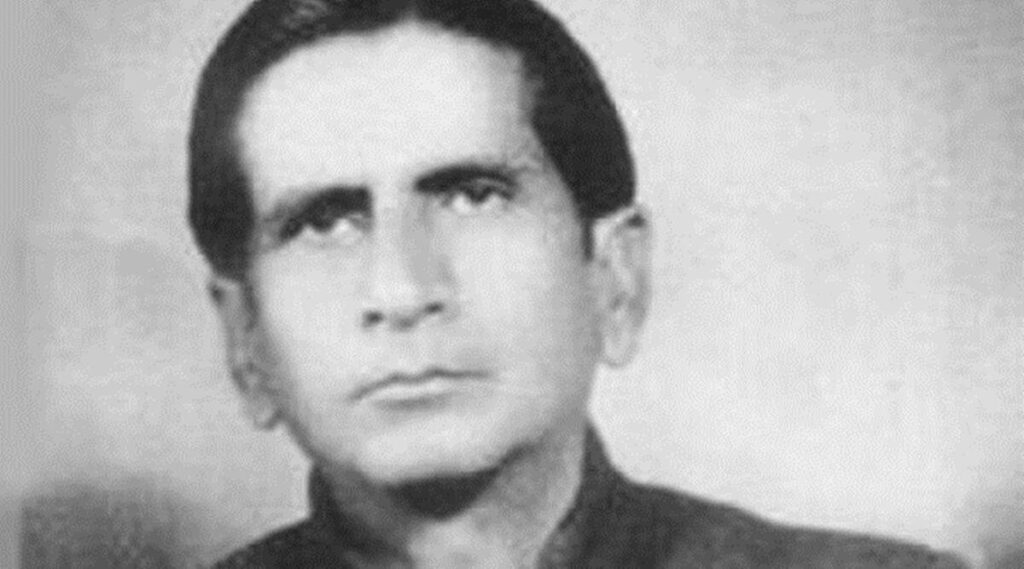
Born in Rudauli (then in Barabanki, UP) during Diwali celebrations, he was named Asrarul Haque and later took up the name ‘Majaz Lakhnavi’. (Photo: Wikimedia Commons)
Two days ago, a nazm reverberated across Aligarh Muslim University as the institution celebrated its founder’s day on October 17. Alumni across the globe, who proudly address themselves as ‘Alig’, sang: Ye Mera Chaman, Ye Mera Chaman.
The author of this famous nazm, Asrarul Haque, popularly known as ‘Majaz Lakhnavi’, whose poetry still rules the heart of millions, was born on October 19, 1911.
Regarded as the Keats of Urdu poetry, Majaz was one of those rare gems whose poetry reflected two most important aspects: romance and revolution. In an era when legendary Urdu poets as Faiz, Jazbi, Sardar Jafri, Sahir Ludhiyanvi were in their prime, Majaz rose to fame and carved a niche for himself.
Born in Rudauli (then in Barabanki, UP) during Diwali celebrations, he was named Asrarul Haque and later took up the name ‘Majaz Lakhnavi’. He belonged to a zamindar family. At a young age, Majaz had an inclination towards Urdu poetry. His fame came when he reached AMU as a student where he got the company of literary legends as Ali Sardar Jafri, Ismat Chugtai, and others. During one of the mushairas, Majaz, dressed in sherwani, delivered his famous poem:
Khoob Pehchan lo Asrar Hoon Main, Jinse-Ulfat ka talabghar hoon, Main, Ishq hi Ishq hai Duniya Meri, Fitna-e-Aql se Bezar hoon Main, Ek Lapakta ho Shola ho, Ek Chalti Hui Talwar Hoon Main.
The audience was mesmerised; the silence established that Majaz had arrived on the scene. There was no looking back. Majaz gave his alma mater a famous nazm, which is now the university tarana (anthem).
Majaz’s popularity rose by leaps and bounds and there were more females than males among his admirers. At AMU, girls used to keep his book ‘Aahang’ beneath their pillows. They would commit to keeping ‘Majaz’ as the name of their children.
Himanshu Bajpai, Daastango, who has rendered several daastans on Majaz, recalls one incident: “Once, Ismat Chugtai told Majaz that girls love him and Majaz quickly replied, ‘And they marry a rich person’.”
Truly, Majaz had a failed love life, and the dejection got him admitted to a mental asylum at Ranchi. His addiction to liquor took its toll. Chugtai asked him, “Liquor or wine, who destroyed your life, Majaz?” Witty and humorous as always, he replied, “I have given this right to both of them.”
His poem Awara was also an instant hit.
Shahar ki raat aur main naashaad o nakara phirun Jagmagati jagti sadko pe awara phirun Ghair ki basti hai kab tak dar-badar maara phurin Ai Gham-e-Dil kya karun, Ai Vahshat-e-Dil kya karun.
Majaz had recited this nazm on the request of people at White Baradari in Lucknow, which eventually turned out to be his last public gathering before his demise.
His poetry, as said earlier, had both romance and revolution. Some of his lines for women empowerment are still relevant.
Tere Mathe pe ye anchal bahut hi khub hai lekin, Tu is aanchal se ek parcham bana leti toh achcha tha.
Bajpai narrates an incident: “Once, famous film actress Nargis came to meet Majaz. She requested for his autograph and Majaz obliged by writing the above lines on her white dupatta. He identified himself with every deprived person — perhaps this brought him closer to the progressive movement.” In his poetry, Majaz had raised the issues of women liberation and feminism, which are still discussed today.
Majaz’s revolutionary couplets, too, ruled the masses. While other poets raised the pitch in their revolutionary couplets, Majaz rendered his lines that could be sung with revolution. ‘Bol, Ari O Dharti Bol, Raj Sinhasan Daanwa Dol‘ is one such poem. It is simply unbelievable to see anyone write on the worldly intricacies so beautifully — ‘Bahut Mushkil hai Duniya ka Sanwarna, Teri Zulfo ka Pencho Kham nahi Hai‘.
Alas, Majaz remained a loner. Josh Malihabadi even advised him to keep a ghadi (watch) with him while drinking, but Majaz laughed it off, saying, “You drink keeping a ghadi, I drink keeping a ghada (pitcher).”
In December 1955, his end came abruptly, after he collapsed in Lucknow, and passed away before reaching Balrampur Hospital. The present generation may recall him as the uncle of Bollywood lyricist Javed Akhtar.
The poet, whose kingdom was in the hearts of millions, is buried in a six-feet grave at Nishatganj graveyard with his own lines from a nazm on the epitaph.
Ab iske baad subah hai aur subah-e-Nau Majaz Ham par hai khatm Sham-e-Gareebaan-e-Lucknow
source: http://www.indianexpress.com / The Indian Express / Home> Books & Literature / by Faisal Fareed, New Delhi / October 19th, 2021
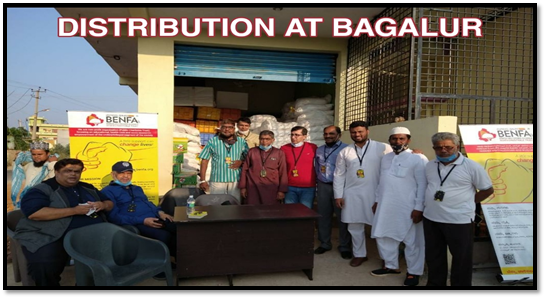
AS they say – think individually, act globally – BENFA is doing just that. BENFA (Bengaluru Friends Alliance) was born with the common goal and the collective efforts of a group of doctors to help the underprivileged section of society. The organization extends financial help to the poor and helps them overcome their financial hurdles in education and healthcare.
Talking about the organization Dr. Saleem Mehkri, Vice President and Trustee, said, “We were already into helping poor Muslim population with their education and health issues.
Then, it was planned by Dr. Suhel Pasha to establish an umbrella organization to facilitate their charity works on a large scale. The organization primarily addresses a large number of poor Muslims and deserving non-Muslims, too.”
Dr. Suhel Pasha, President, BENFA, said, “Twenty percent of the city’s population lives in slums with the lowest standard of education, inefficient healthcare, lack of necessities, and most importantly low standard of living. Even today, one-third of the slum dwellers fall below the poverty line with an income of less than Rs. 2500 per month. So, to help these poor populations, BENFA was established in October 2020.”
BENFA is a registered charitable trust focusing on education, healthcare, and socio-economic empowerment of underprivileged parts of society. How BENFA assists in empowering the disadvantaged? Answered Abdul Mateen, BENFA General Secretary, “We have recently launched a micro-credit scheme to provide loans to the deserving women and men to start their small trades. The loans we give are free of interest. So, they have to return only the principal loan amount without any interest.”
Dr. Saleem informed, “We have launched schemes not only to empower poor men and women financially, but we also aim to empower them through adult education schemes. We provide education and training to unemployed youngsters/adults as per their skills and help them get government or private jobs. We have helped students to pay their fees and paid hospital bills too.”
According to Dr. Saleem, around five people are benefitted every week through their microcredit scheme. So, how does the organization arrange its finances? Replied Dr. Saleem, “We have around 500 members, including 400 male members and 100 female members, who voluntarily contribute and help run the organization successfully. Nobody is forced to contribute.”
Besides these programmes, BENFA actively distributes rations during Eid-Ul-Fitr, performs Qurbani/sacrifices during Eid-Al-Adha, and distributes meat amongst low-income families. Furthermore, BENFA has several groups focusing on different areas, namely-BEEP for education, BHCP for healthcare, BSSP for socio-economic support, BMCS for microcredit schemes, and BALP for adult learning programs.
That is not all. BENFA is slowly and steadily adding more to its activities for the betterment of society. Lately, in collaboration with the field experts, BENFA has organized several webinars related to health and education topics. Pointed out to Dr. Suhel, “We organized webinars to educate people on several issues that focus on health, education, amongst others. We also organize career counselling for youth. We invite experts to address the relevant topics.”
BENFA also played an active role amidst the raging COVID 19 by supplying oxygen to the patients. As Dr. Pasha said, “We supplied oxygen cylinders during COVID 19 and spread awareness regarding the vaccine and also organized a webinar to help people prepare themselves during COVID crisis.”
Dr. Saleem urged people to join the organization as members to extend help to a large number of underprivileged people.
source: http://www.indiatomorrow.net / India Tomorrow / Home> Development> Features / by Rashida Bakait / October 16th, 2021
KEAM Entrance Exam is conducted every year for admission in Engineering, Pharmacy, Architecture, Medical, Medical allied courses.
KEAM 2021 Toppers:
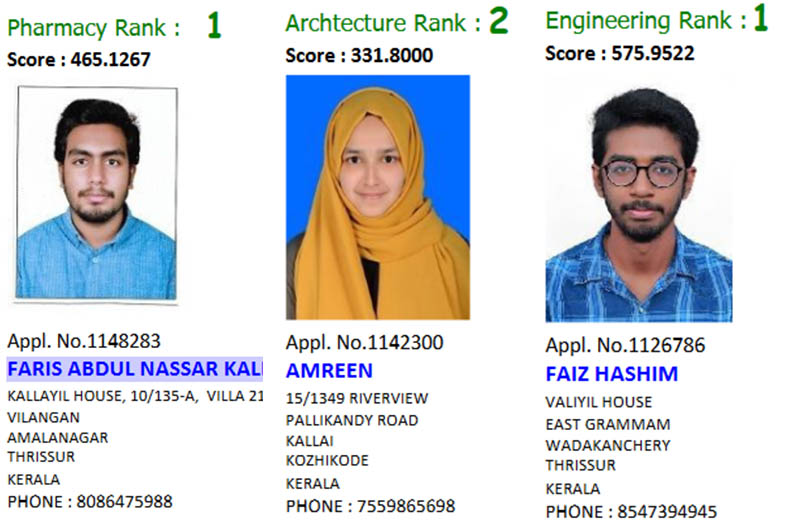
In a spectacular academic performance in KEAM 2021, three Muslim students Faiz Hashim, Faris Abdul Nassar Kallayil and Amreen have bagged the top ranks in Engineering, Pharmacy and Architecture of the important entrance exams.
While Faiz Hashim and Faris Abdul Nassar Kallayil secured the 1st rank respectively in Engineering and Pharmacy, Amreen, a Muslim girl student, bagged the 2nd rank in Architecture.
According to the KEAM rank list released by CEE Kerala on Thursday October 7, 2021, Faiz scored 575.9522 to bag the 1st rank in Engineering, Faris Abdul Nassar scored 465.1257 to secure the top rank in Pharmacy whereas Amreen got 331.8000 score to get the 2nd rank in Architecture.
KEAM Entrance Exam is conducted every year for admission in Engineering, Pharmacy, Architecture, Medical, Medical allied courses. KEAM 2021 was held on August 05 and the result was declared on September 17, 2021.
KEAM 2021 rank list and detailed of toppers however have been released today.
Before the declaration of result, the CEE Kerala had released the Answer Key of KEAM 2021 on its official website.
After the declaration of KEAM result, CEE Kerala had asked students to complete option registration through official website before October 09, 2021.
“KEAM 2021 First Allotment date”
As per the schedule released by CEE Kerala, KEAM 2021 First Phase Allotment will be published in on October 11, 2021 at 09:00 pm.
Candidates who get allotment shall have to remit the fee shown in the allotment memo at any of the Head/Post Offices in Kerala or by way of online payment and confirm their admission between October 12 to 16, 2021.
Office of the Commissioner for Entrance Examinations (CEE) Government Kerala had earlier asked the candidates who had appeared for KEAM 2021 to verify, and make correction if any, in their profile.
The CEE Kerala on October 02 published category list for reference. The list can be accessed on the official website.
source: http://www.ummid.com / Ummid.com/ Home> India> Education & Career / by ummid.com news network / October 07th, 2021
Muhammad Shahid, a boy from Bihar’s Bhagalpur and an inmate of Kozhikode Mukkam orphanage cracked Kerala SSLC exam with A+ in all subjects.
His stellar academic performance comes in the background of odds he encountered in his personal life.
Muhammad Shahid, son of Irshad and Beevi, entered the Mukkam Muslim orphanage in 2011. He joined school in first standard, along with 100 other students from various states of India. Though many of them returned to their native state, interest in pursuing education held him back. Those who returned opted for daily wage jobs.
When Muhammad’s father passed away in 2020 January, he was unable to go home to grieve his death. But even that tragedy did not let him down. “It is the moral support given by my teachers and officials at the orphanage that helped me to achieve this result,” says Muhammad.
The boy who brought glory to Manassery MKHMMO Higher Secondary School, plans to pursue commerce stream for his higher studies. He aspires to become a bank manager.
source: http://www.english.mathrubhumi.com / Mathrubhumi / Home> News> Good News / July 15th, 2021
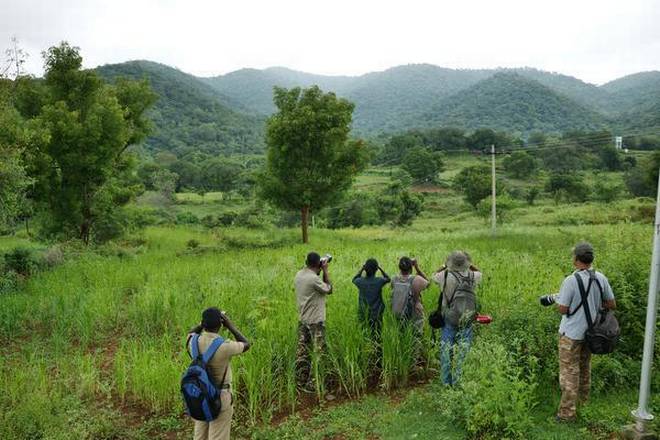
A team of naturalists participating at a forest department survey | Photo Credit: Special Arrangement
A new species of fruit fly discovered for the first time has been named after Siruvani in the Western Ghats
A fruit fly has created a buzz with its maiden show in Siruvani, a biodiversity hotspot of the Western Ghats. It turns out to be a new species that has been reported, named, and documented for the first time ever. The fruit fly is now scientifically named as Euphranta siruvani, after the place where it was first collected.
A research student at Annamalai University, H Sankararaman, first spotted this unusual visitor on a light trap which he had set up to capture moths at a non-forest space near Siruvani. “The fruit fly was attracted towards light and I was lucky enough to have spotted it. It has a distinct V-shaped black band on its forewing,” recalls Sankar.
The discovery now appears in Zootaxa journal in a paper authored by David K J and Sachin, K, ICAR-National Bureau of Agricultural Insect Resources (NBAIR), Bengaluru, DL Hancock from the UK, Sudhir Singh from Forest Research Institute, Dehradun and H Sankararaman from Annamalai University. According to David, there are 104 recognised species in the genus Euphranta that are distributed across the world. “Of this, 14 are recorded so far from India. The discovery of Euphranta siruvani is the brand-new addition to the checklist.”
“This fruit fly is a rare species and a valuable addition to the diversity,” says David K J, scientist at ICAR-NBAIR, one of the National Institutes with several taxonomists of international repute. “We first check with the regional/world catalogue, then refer to available literature, and connect with authorities around the world over mail before confirming it as a new species,” explains David.
A species can be named after the ‘type locality’ (the place from where the holotype was collected), a specific characteristic feature, after the collector or after an eminent taxonomist for his contributions. In this case, they chose the place, a thriving ecosystem of rich fauna and flora and also the source of drinking water for Coimbatore.
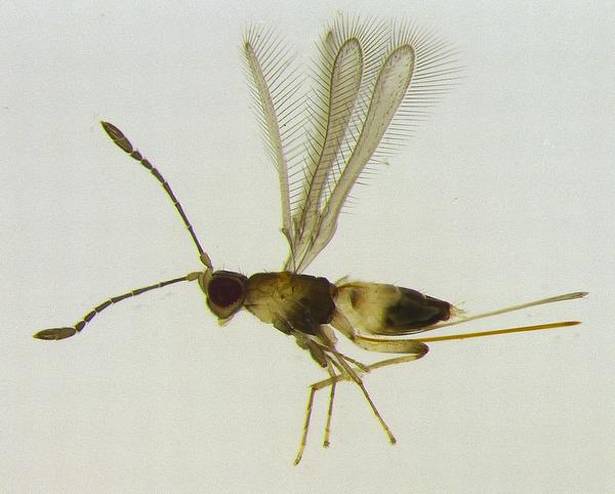
Apart from the fruit fly, additionally a brand new fairy fly species was found at Siruvani. The species Omyomymar hayati is named after Professor Mohammad Hayat of Aligarh Muslim University for his contributions to insect taxonomy.
“I have described several species after the type locality for example Acidoxantha galibeedu in 2014 based on specimen collected near Coorg. Later, I had collected the same species from other parts of Karnataka and Kerala. Similarly, may be the E.siruvani can be seen across the Western Ghats and Kerala in South India. We have to study further to understand its distribution,” explains David, who has identified and described 28 new species of fruit flies of India.
The genus Euphranta comprises many fruit/seed infesting species, including Euphranta cassiae that feeds on the pods of Kanikonna (Cassia fistula) trees. “There are 5,000 species of fruit flies across the world. In India, we have nearly 290 species so far; we keep adding to the list.”
K D Prathapan, an expert on beetles, who works at Kerala Agricultural University, says fruit flies have an average lifespan of three to four weeks. “By infesting fruits, they damage the reproductive capacity of plants. Some species breed in bamboo shoots. And then there are cucurbit fruit flies that are pests of cucurbits such as cucumber, gourds, and pumpkins.”
The study of fruit flies is important for the agricultural economy, as they infect mangoes, melons, gourds, and guavas, says Sankararaman. “It lays eggs in fruits and the larvae feed on the pulp. We are yet get insights about the biology of the species discovered in Siruvani.”
K Mohan Prasath, founder of Act for Butterflies, says there are also many parasitic insects that are helpful to farmers in pest control. Mohan and his team have compiled a list of over 1,000 species of moths across Tamil Nadu and plan to bring it out in a book form soon. “We hope such discoveries build interest in entomology that covers insects, butterflies, and moths. Identification of new species is especially relevant now as there is habitat destruction of many species because of climate change.”
source: http://www.thehindu.com / The Hindu / Home> Sci-Tech> Environment / by K Jeshi / January 12th, 2021