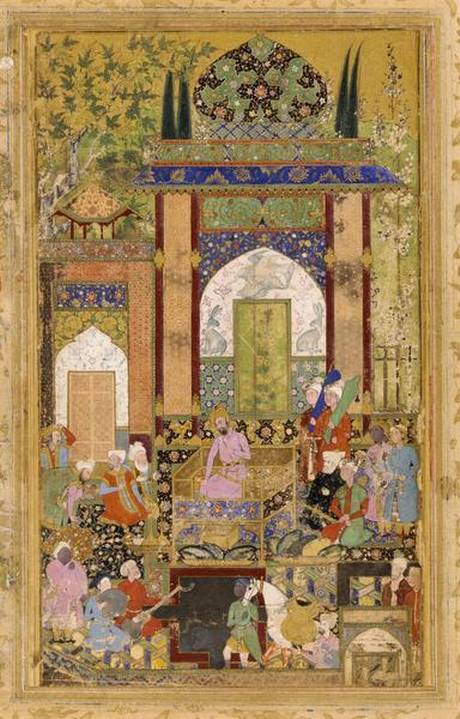
Resplendent: ‘Babur receives a courtier’ (1589) by Farrukh Baig. | Photo Credit: Wiki Commons
Babur was a sensitive memoirist with the rare ability to distance himself from his writing
Babur’s memoir did not have a name but is referred to as Baburnama or Tuzuk-e-Baburi. It is the first autobiography from the subcontinent and one of the first in the world. Babur came from two different cultures, of which one was literate and aspired to high culture. This was his father’s ancestral family, which was Timurid. His mother came from the nomadic Mongols, who weren’t literate. Babur describes his maternal uncles in his memoir.
The Timurids had a tradition of poetry, hawking, music, and, of course, war. Babur was from a family of minor nobles who had inherited the governorship of Ferghana. His autobiography begins with a description of the geography and tells us that his father, Umar Shaikh Mirza, died in an accident when he was 39 and Babur 12. The young Babur struggled to hold on to his inheritance, losing several battles, including one in Ferghana, which he had to give up to the victor.
Babur describes these decades of his life in an unemotional and direct way: he hardly valorises his own achievements. Like the great Caesar, whose books on his wars in Gaul and against Pompey may as well have been written by a non-partisan observer, Babur has the ability to distance himself from his life.
Keen naturalist
Babur’s life turns when he is found to be the only living heir to the throne of Kabul. He takes it and turns his eyes to India. For 20 years, he campaigns against India, being held back at the borders each time.
Then, as we know, he defeated the Lodi dynasty (introducing firearms to the subcontinent for the first time) and captured north India in 1526 after a decisive battle at Panipat. Babur died four years later, spending much of this time travelling across India and writing his memoir in the afternoons.
These paragraphs show how much of a keen naturalist he was. “The elephant, which the Hindustanis call hathi, is one of the wild animals peculiar to Hindustan. It inhabits the western borders of the Kalpi country… the elephant is an immense animal and very sagacious. If people speak to it, it understands. If they command anything from it, it does it. Its value is according to its size — the larger it is, the higher the price. On some islands an elephant is rumoured to be as tall as 20 or 30 feet, but here it is not more than 10 feet. It eats and drinks entirely with its trunk. If it loses the trunk, it cannot live. It has two great teeth (tusks) in its upper jaw, one on each side of the trunk. By setting these against trees and walls, it is able to bring them down; with these it fights and does whatever hard tasks fall to it. These teeth are called ivory and are highly valued by Hindustanis.’
‘Like a goat, the elephant has no skin hair. It is relied on to accompany every troop of their armies. It crosses rivers with great ease, carrying a mass of baggage, and three or four can drag without trouble a special piece of artillery that takes four or five hundred men to haul. But its stomach is large. One elephant eats as much as a dozen camels.
Elegant and clean
Babur’s book was not freely available till a British amateur linguist named Annette Susannah Beveridge translated it. She taught herself the particular version of Turkish that Babur wrote in (later Mughals wrote in Farsi) and published it in four volumes from 1912 to 1922.
At the time of the first British census a century and a quarter ago, India was 4% literate. Most Indians even today don’t have four generations of literacy: in fact, the proportion of those of us who can claim to have had great-grandparents who could write is tiny. Babur came from a tradition that already had centuries of literacy.
His is elegant and clean writing of the sort that one would expect from a very literate and sensitive person. Babur’s daughter, Gulbadan Begum, sister of Humayun and aunt of Akbar, also wrote a lovely memoir in which she describes her father’s attention to detail which he passed on to his family.
These two works, along with Jahangir’s autobiography, are some of the best material available on the Mughals. It’s a shame that these books are not taught in India’s schools today.
Aakar Patel is a columnist and translator of Urdu and Gujarati non-fiction works.
source: http://www.thehindu.com / The Hindu / Home> Books – Leather Bound / by Aakar Patel / January 16th, 2020
Shabera Ansari, a resident of Indore, is posted as DSP (Women’s Cell) at Dewas in Madhya Pradesh.
New Delhi:
Parents in middle-class Muslim families generally believe that their children would hardly get a government job. Hence, they find it better to engage them in some work rather than letting them pursuing studies. But a young woman from a middle-class family has busted such myths by becoming the Deputy Superintendent of Police.
Shabera Ansari, a resident of Indore, is posted as DSP (Women’s Cell) at Dewas in Madhya Pradesh and her father is posted as a Sub-Inspector at a police station in Indore.
Shabera said she had a normal childhood and there were never big dreams to pursue. When she went to college, at the age of 19, marriage proposals started coming in but fire in the belly to do something egged her on. Finally, she joined the police forces and became a DSP. Currently, she said, she is preparing for civil services exams.
The young woman said that soon after passing her out of a government school in Indore, she enrolled in a college and started preparing for Union Public Service Commission (UPSC) examinations along with her regular studies.
From SI to becoming DSP
She was selected as Sub-Inspector in 2013, and in 2018 posted as Trainee DSP in Sidhi.
Shabera’s family originally hails from Ballia in Uttar Pradesh, but settled down in Indore about 30 years ago due to his father’s job in state police.
“I was an average student in school and also failed in Mathematics once,” she told IANS with a chuckle.
“A marriage proposal came when I was just 19. I was scared and decided to do something. I started my journey and never looked back. I started preparation for the state government services during college and tasted success in the first attempt… I have continued studying ever since,” she said with confidence.
Shabera further added:
“My mother always supported me. Initially, it was not clear if I will opt to join the police, though there was always an interest since my father is in police service.”
A Successful Journey
Surprisingly, Shabera is the first woman in her family to crack state civil service exam and has now become an inspiration for her community.
Many times, she was honoured as chief guest in various functions, including school programmes where she interact with children who are always curious to know about her journey.
“I always try to encourage children and motivate them to do something in life,” Shabera said.
“Little children seem very fond of taking selfies with me,” she smiled.
She said:
“I often do counselling of children of Muslim families, especially boys. I tell everyone to trust themselves and study seriously; hardwork will definitely change things.”
Shabera said she also got to learn a lot from her father. It could be a coincidence that Shabera was incharge of a police station during lockdown where her father was posted.
In fact, her father had gone for some work to Uttar Pradesh when the lockdown was imposed and he got stuck. Shabera tried to somehow bring her father back but to no avail. Eventually, the police authorities issued direction that he could do duty from wherever he was stuck.
She said that she had many times gone out on patrol duty at night with her father. However, once back home, she used to cook for him.
She said that her father respects her as an officer but Shabera has to many times remind him that she is an officer at office not at home.
source: http://www.ummid.com / Ummid.com / Home> Life & Style / by Mohammad Suaib / IANS / January 17th, 2021
Praising Kamal Amrohi’s iconic film Pakeezah, KBC host Amitabh Bachchan revealed that the filmmaker used rose water for the fountains in a scene that had Meena Kumari’s dance sequence.
Meena Kumari dances in a sequence from Pakeezah.(YouTube)
Bollywood actor Amitabh Bacchan has revealed that legendary filmmaker Kamal Amrohi used real rose water in all the fountains installed on the sets of his iconic movie, Pakeezah. Amitabh was speaking on his popular game show, Kaun Banega Crorepati.
Contestant Afseen Naaz, an assistant professor at a Bilaspur university faced a question about the meaning of the Urdu word, Pakeezah. Host Amitabh fondly remembered the iconic film and praised the stars, as well as the filmmaker of the Meena Kumari-Raaj Kumar-starrer.
Talking about a scene that featured Meena’s dance in front of a fountain, similar to the fountain at the Taj Mahal, Amitabh revealed that Kamal wanted the scene in a certain way. And, to ensure it, he used rose water for the fountains.
According to Meghnad Desai’s book Pakeezah, Meena Kumari charged just a token amount of Re 1 for her role in the Kamal Amrohi-classic. It turned out to be her last film. She died battling liver cirrhosis just a few weeks after the film released.
Written, directed and produced by Kamal, Pakeezah released in 1972 and also featured Ashok Kumar and Nadira in lead roles. It took 16 years for the film to complete and remains a cult rromance to date.
Recently, Amitabh hit 45 million followers on Twitter and shared a throwback picture with his father Harivansh Rai Bachchan, thanking his fans. He wrote, “The caption informs of 45 million on Twitter .. thank you Jasmine, but the picture says a lot more… Its the moment I came home surviving death after the ‘Coolie’ accident ..Its the first time ever I saw my Father breaking down! A concerned little Abhishek looks on!”.
source: http://www.hindustantimes.com / Hindustan Times / Home> Entertainment> TV / by HT Entertainment Desk / January 12th, 2021
Khurja (Bulandshahr District) UTTAR PRADESH / NEW DELHI :
New Delhi:
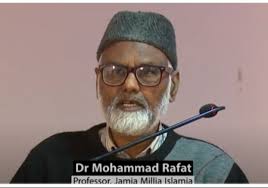
Islamic scholar, prolific writer and senior ideologue of Jamaat-e-Islami Hind (JIH), Dr Muhammad Rafat, who recently retired as a professor from Jamia Millia Islamia has passed away on Friday evening at the Al-Shifa Hospital, New Delhi.
He was 65 years of old and is survived by three sons, two daughters and his widow. His widow-Nusrat-is the daughter of former President of the JIH and a well-known Islamic scholar, Maulana Syed Jalaluddin Umari.
In the presence of hundreds of mourners, he was laid to rest today at the graveyard in Shaheen Bagh area. His funeral prayer was be held on Saturday evening here at the JIH Markaz mosque (Masjid Ishat-e-Islam).
Expressing condolences over his death, JIH President Syed Sadatullah Husaini said: “The demise of Dr Rafat is a great loss for the Muslim Ummah, the Islamic Movement and the entire country. He was a leading intellectual, tremendous leader, firm ideologue and a benevolent mentor. He was an erudite scholar of Islam and a prolific writer. He was blessed among many qualities with a razor sharp memory and an unmatched ability to give speeches on a myriad of topics without any notes in such a coherent manner that it would appear as if he is reading a written essay. He led an extremely simple life and had a very pleasant disposition. He was a teacher of theoretical physics. This subject of science has a deep connection with philosophy, so he made a direct study of philosophy and important ideas of science from its original sources. As one of the foremost ideologues of Jamaat, he always upheld and acted on the basic and core principles of Islam. May Allah forgive his sins and grant him the highest Paradise.”
A native of Khurja in Bulandshahr district of the Western UP, Dr. Rafat did his MSc in Physics from the Aligarh Muslim University in 1976 and PhD from IIT-Kanpur. He joined Jamia Millia Islamia in 1985, one year after receiving his PhD degree. He retired as Professor- Department of Applied Sciences and Humanities from the Jamia Millia on July 31, 2020.
Dr. Rafat, who was associated with the Islamic movement ever since his student days, was a member of the Central Advisory Council, the highest decision-making body of the Jamaat-e-Islami Hind from 1999 till his death. He wrote more than 15 books on various subjects in Urdu and English languages.
Besides being director of the Centre for Study and Research (CSR) of JIH, for the last two years, he had also previously worked as chairman of the JIH’s Tasneefi Academy (Authors Academy) and all India secretary of the Jamaat’s Tarbiyah Department (Training Dept.). He also served as the JIH President of Delhi and Haryana from 1995 to 2011. He had also worked as honorary editor of Urdu monthly, Zindagi-e-Nau, an Islamic research magazine, from 2009 to 2019. Besides, he headed several important committees of the JIH for policy-formulation and the creation of new institutions and allied organizations.
source: http://www.muslimmirror.com / Muslim Mirror / Home> Indian Muslim / by Special Correspondent / January 09th, 2021
As students, brothers Khalid and Akram, bubbling with enthusiasm would dream of building a business of their own. They would experiment with entrepreneurship and were raring to do something.
After several small ventures such as zamber, a social networking site, hostelneeds.com – an online e-store for dorm supplies and others – they finally succeeded in establishing www.yourlibaas.com
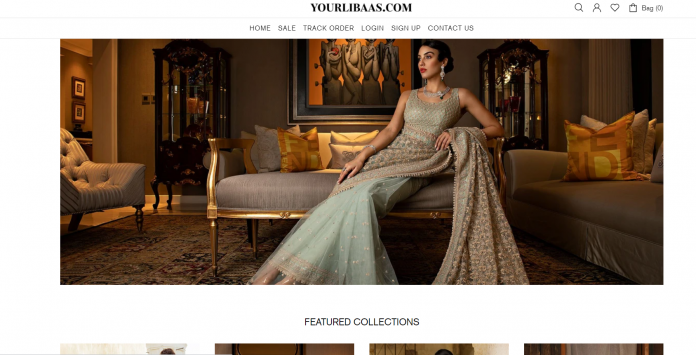
In 2014, Khalid – then 24 years-old, was in Pune Institute of Computer Technology (PICT) while his younger brother Akram, 19-years old then, had just joined Engineering in Aligarh Muslim Univsersity, the duo established yourlibaas.com, which is an online store for designer ethnic apparel bringing the best of Pakistani fashion to India. Their site has now gone global with top Pakistani and UAE Designers, including Sana Safinaz, Maria.B, Gul Ahmed, Sapphire, Zara Shahjahan, Élan, Faraz Manan, Charizma, Baroque, and Motifz, among others.
“When we began in 2014, ecommerce was in a nascent stage with the market being fragmented and multiple small players existing. Amazon and Flipkart were yet to emerge as market leaders. We now have an office in Noida but after the lockdown we have shifted to Jasola Vihar, New Delhi” said Akram while talking about their early days.
YourLibaas is an Urdu word that means your “garment or attire”. Today, the brothers claim that their online store is the market leader within the lawn suit market in India (by total revenue and market share).
“What began as a small start-up in New Delhi quickly transformed into a strong brand with an international presence. If you search for all related terms for apparel, we rank on the top position at Google. Today we have 23 employees on our payroll,” said Khalid Raza Khan, the founder and CEO of YourLibaas.
But it was not so easy to achieve success. Managing a business with college was difficult. There were several obstacles when they began.
They started off with inadequate capital pooling in their savings from the pocket-money they received from parents. Initially, they contacted small retailers and listed the suits on their site. When an order came in, they bought it from them and shipped it.
Khalid used to ship packages daily and often missed college because the courier offices and post-office closed by evening and packages would be delayed. In order to not miss college, he began sending the parcels from a post office that was 25 kmts from where he lived. This particular post office was open for 24 hours which was a good thing for the boys. During the nights, he would go on his scooty and send the parcels. And to save on costs, the duo delivered local orders themselves searching out the addresses while roaming on their two wheelers.
But missing classes had an adverse effect. Khalid could not cope with the lessons and failed in his exams due to which he had to repeat a year. The university in which he studied had different rules known as ATKT system wherein you have to repeat a year upon failing in a subject (unlike other colleges where you are promoted).
Akram who was pursuing engineering at AMU, handled digital marketing and technical development. And his studies also went downslide and he had a backlog of 14 papers.
As if that was not enough, they also suffered another set-back when they were duped by a wholesaler who didn’t send the products even after receiving full advanced payment of around Rs. 1.2 Lakh from them. This was a major setback and it took some time for them to bounce back.
They did the sourcing and packing themselves travelling in an auto rickshaw to the wholesaler bringing in heavy ‘katta bags’. As they slowly grew and as profits increased, they hired their first full-time staff named Sarfaraz for packing and logistics and 3 interns from Aligarh Muslim University for customer support and content writing.
However, they still were not in a position to pay handsome salaries due to which the staff left and they were back to looking after the packing and logistics till they could find replacements. In this way – slowly and bit by bit and through sheer perseverance, the brothers kept going.
With time as the business grew, so did their team.
“I remember how we generated enough profit to buy our own catalogue for around Rs. 60000. And we slowly moved to an inventory-model. Now, we completely own all the inventory displayed at the portal. It is imported from UAE as the majority of the dress designers are headquartered there” said Akram Tariq Khan, co-founder of YourLibaas.
Apart from these glitches they also had market regulations and compliance to overcome.
In 2015 they set up a basement office-cum-warehouse in Sector 50, Noida. The products arrived in Delhi and inter-state logistics was proving to be difficult. The brothers shifted to Jasola Vihar, Delhi.
Another major problem was dead stock or unsold items lying in their warehouse. This blocked their capital. To deal with the unsold stock, they started attending trade fairs and managed to sell the stocked clothes.
But after 2018, they stopped attending the fairs when Akram moved to Jamshedpur to pursue MBA.
Why specific focus on Lawn apparels and Pakistani suits?
Lawn fabric is purest form of cotton and is lightweight. It is produced in bulk in Pakistan as 90% of the lawn producing centres were located in Pakistan at the time of partition. Lawn suits have gained huge popularity due to it being lightweight, wrinkle free and soft. Mostly due its suitability to the hot Indian climate.
“Awareness regarding lawn suits primarily developed through Pakistani TV serials that were aired on Zee Zindagi in 2017,” feels Khalid.
“Pakistani suits were a rare commodity in India back then. The demand was high and supply limited. It wasn’t sold on marketplaces (and still isn’t) like Amazon, Flipkart, Myntra, and so on,” he added.
“Pakistani brands had tried entering the market through official partnerships that failed to materialize (like Sana Safinaz partnering with OCM Fabrics), and they chose Indian actresses to model for the latest collections (like Kareena Kapoor, Jacqueline Fernandes, Madhuri Dixit, and so on). We realized how a niche store specializing in Pakistani suits could be set up and that is what inspired YourLibaas” explained Akram.
Despite logistical hurdles and a rather negative connotation attached with Pakistani suits, the market size in India of Pakistani apparel is estimated at over INR 400 Crore.
Even though they set up YourLibaas and sell genuine Pakistani brands, they have competition from imitators. Many fashion houses and sites have replicas of the Pakistani designs selling at a lesser price.
But YourLibaas stuck to the originals even though they were expensive. Customers who preferred authentic designs from the original designers continued to buy from YourLibaas.
We have at least 40% repeat buyers, disclosed Akram.
“Designers and their team put in a lot of efforts and months of planning to launch a collection which the replica makers imitate thereby stealing the credit. Fortunately seasoned customers can easily make out an original from a replica. Moreover, selling replicas alongside originals hurts the brand equity. Replicas are a nuisance in India as these are manufactured by registered Indian companies and sold openly. A first time online buyer who is unaware of this would buy a replica since both display the same picture, but a replica is priced at 20-25% of the original cost. This leaves a bad impression of “Pakistani Suits” and the consumer never returns back to buying lawn suits. Further it creates trust issues especially if you’re selling online. We have maintained our reputation and people largely buy from us since local shops and sellers usually sell replicas and fool buyers especially new customers, ” elaborated Akram Khan.
Due to international demand, the duo made inroads into the global market by establishing a Dubai, UAE subsidiary and setting up a Freezone company. They have plans to also establish a physical office in Dubai.
Leveraging technology to their advantage
Being from a technical background proved to be an advantage and the duo used their technological skills to thwart competition wherever possible and establish a strong market presence.
For instance – they introduced cash on delivery as many of their customers where women who were non-working. They took this risk despite knowing that there could be cancellations and also non acceptance of goods when they arrived at their door step. They also offered no-questions asked returns. All this bolstered confidence amongst the customers.
Next was introducing ‘Order on WhatsApp’ & ‘Order on Phone’ options which made it easier for the women to order instead of logging on to websites. The YourLibaas WhatsApp commerce at YourLibaas employs AI-based NLP chatbots with human agents who answer the queries of the customers guiding them to successful shopping
Why do people prefer buying from YourLibaas rather than the brand itself?
“We provide multiple brands with easy accessibility, free shipping and easy returns on a single platform. Most of the consumers aren’t comfortable with buying online, so we have WhatsApp chatbots alongside human agents that assist them making the ordering process seamless. Secondly, buying from brands directly isn’t a feasible option – the shipment might get stuck at customs, or it could end up being delayed otherwise. Even in a normal scenario, the delivery timelines will be longer than what a domestic player can offer,” concluded Khalid Raza Khan.
Today, Khalid is totally dedicated to YourLibaas while Akram has his fingers in several pies. He writes for Entrepreneur.com a business magazine and has developed an online browser game called ‘Bhag Corona’ and is also part of entrepreneur’s leadership network in which he delivers lectures based on his experiences.
His game ‘Bhag Corona’ has received millions of hits and this game was hosted on ShareChat, a social network site.
Akram continues to explore new venues while his brother, now married, is steadily managing YourLibaas which they had begun as students.
source: http://www.twocircles.net / TwoCircle.net / Home> India News / by Nikhat Fatima, TwoCircles.net / January 01st, 2021
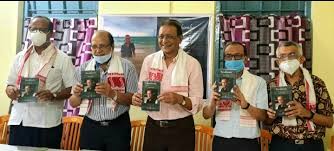
“Barakhmba And The Journey Ahead, Autobiography” authored by senior lawyer Nazrul Islam was released at an austere but dignified function in Guwahati on Tuesday. The release coincided with the centenary celebration of Modern School, Barakhmba, New Delhi, the alma mater of the author.
The autobiography chronicles the author’s memories of childhood in Assam, schooling in Delhi, two decades of community service mainly through the Rotary International, and three decades and more as a lawyer. Many incidents, many adventures, interactions with clients and interesting cases dealt by Islam form an exhilarating part of the book.
Following a minute of silent invocation at the beginning of the function, the welcome address was delivered by Nazia Islam, executive at Invest India, New Delhi. Delivering his address as the chief guest on the occasion, BP Todi, former Advocate General of Meghalaya, said, “I’m an admirer of Nazrul Islam since the time I got to know him as a lawyer. There is something to learn from everybody, but when it comes too Nazrul Islam, there’s always a lot to learn from him.” He expressed the hope that the book will quest the thirst for knowledge to a great extent. Among others who spoke on the occasion were PK Kedia, former District Governor of Rotary International; BM Choudhury, former Principal, JB Law College Guwahati; and Gitanjali Kalita, advocate, Gauhati High Court.
Following the release of the book, Nazrul Islam, shared his experiences about writing the book. He completed the entire book within a very short time, making the best use of the pandemic situation. He said, “Today there are many lawyers who practise on the TV channels, so I decided let me do it by writing a book!”
The book has been brought out by the North Eastern Justice Baharul Islam Foundation for Law, Justice & Social Welfare (NEJBIF), founded in memory of the author’s late father who was a Member of the Parliament and a Justice at the Supreme Court of India.
The function ended with a vote of thanks offered by Rosida Begum.
source: http://www.muslimmirror.com /Muslim Mirror / Home> Indian Muslim / by Nurul Islam Laskar / Guwahati – October 22nd, 2020
₹8 crore project for ‘one of its kind’ Azad Gallery will tell the story of revolutionaries in the Indian freedom movement.
From the spirit of the Ghadarites to the sacrifice of Durga ‘Bhabhi’, a section of historians and the political class feel that the contribution of revolutionaries to the Indian freedom movement has not been well-documented. In a bid to strike a balance, the Allahabad Museum is in the process of creating a “one of its kind” Azad Gallery, where the story of the revolutionary struggle of the Indian freedom movement would be told through artefacts and interactive displays.
Named after Chandra Shekhar Azad, who attained martyrdom at about 300 metres from the museum, the gallery is expected to be complete by July 23, 2021, the 115th birth anniversary of the revolutionary.
Backed by the Ministry of Culture and the National Council of Science Museums (NCSM), the infrastructure for the “multi-pronged project is being developed with a budget of around ₹8 crore in 7,500 sq. ft. of space where the revolutionary struggle will be specially depicted, starting with 1857’s First War of Independence to the Azad Hind Fauj,” said Sunil Gupta, Director in-charge of the museum.
Dr. Gupta, who has spent three decades at the museum in different capacities, said the story of this struggle had not been comprehensively told through curatorial display and was being done for the first time by the Allahabad Museum.
Promising a “world-class experience”, Dr. Gupta said the infrastructure would be ready by January and the NCSM would then take over to implement the design.
One of the highlights of the museum has been the .32 caliber Colt pistol which belonged to Azad. It is showcased in a bulletproof case and is guarded by U.P. police personnel. “As per our records, the pistol is said to have been received from John Knott Bower, the police officer who led the encounter against Azad,” said Dr. Gupta.
One of the highlights of the museum has been the .32 caliber Colt pistol which belonged to Chandra Shekhar Azad. It is showcased in a bulletproof case and is guarded by U.P. police personnel. | Photo Credit: Special Arrangement
On the theory that although the Colt could have belonged to Azad, it was a Mauser he used during the shoot out, Dr. Gupta said the records of Azad’s associates were being looked into. “Revolutionary Manmath Nath Gupta, in his book They Lived Dangerously, has recounted an incident in which a Mauser pistol owned by Azad went off accidentally. Gupta [the author] also recounted that Azad was also loading other pistols and revolvers that he had with him,” Dr. Gupta said.
Dr. Gupta recalled Durga (Devi Vohra) ‘Bhabhi’, who assumed the identity of Bhagat Singh’s wife to help him escape from Lahore after Saunders’ assassination, grew up in Kaushambi near Allahabad before being married to revolutionary Bhagwati Charan Vohra. “She was no less than Bhagat Singh. A day after Bhagat Singh and his associates were sentenced to death, she fired at a British police officer and his wife from a moving car in Bombay,” he said.
Dr. Gupta argued it was not that she was not celebrated at all but that she was never made an icon. “She almost remained incognito till she died in 1999. She ran a small school in Lucknow and we are in the process of acquiring documents related to her,” he said.
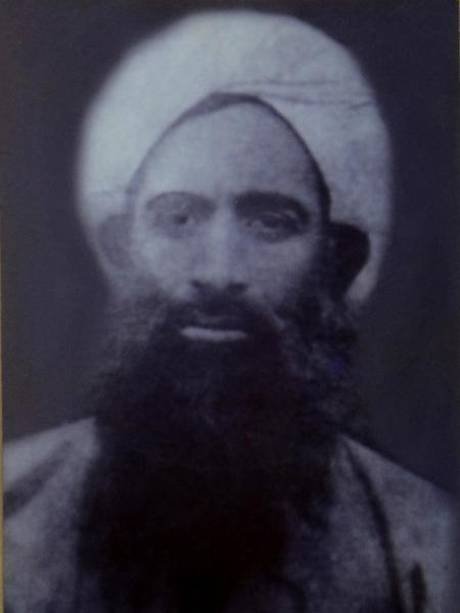
Liaquat Ali | Photo Credit: Special Arrangement
The museum also has a kurta–pyjama and sword of Maulvi Liaquat Ali, who was the leader of revolutionaries in 1857 in Allahabad. “Under him, Allahabad was liberated for at least 10-15 days. His headquarters was the historic Khusro Bagh, where he unfurled the flag of the Mughal emperor,” recounted Dr. Gupta.
In the arms and armoury gallery of the museum, there is a submachine gun of the First World War, “the kind which would have been used by Ghadar revolutionaries in 1915 had the rebellion not been thwarted because of international conspiracies,” Dr. Gupta said.
There are a number of welcome addresses as well which were “gifted to Pandit Nehru when he visited Singapore, Malaya and Burma in 1937-38 before the Second World War. They were given by Indian-origin merchants, who a few years later funded the INA (Indian National Army),” said Dr. Gupta.
There is also an original letter by Vishnu Sharan Dublish, an accused in the Kakori case.
World over, Dr. Gupta said, artefacts are backed by virtual experiences. “It excites children and helps fill the gaps in the narrative. Seven short films made by the Satyajit Ray Film and Television Institute will be on show,” he said.
On the ideological slant of the gallery, Dr Gupta said, “We already have galleries devoted to Gandhi and Nehru. As a student of history, I could say the revolutionaries have been horribly sidelined and in some cases, such as Durga ‘Bhabhi’, I would say it was consciously done. However, we were clear the museum is not just about the freedom struggle and have not parted with the [museum’s] Central Hall. We are located in the middle of the Gangetic civilisation and our sculpture collection is amazing. We are sending six-seven of them [sculptures] for an exhibition in the Metropolitan Museum, London.”
source: http://www.thehindu.com / The Hindu / Home> News> National / by Anuj Kumar / Prayagraj – January 03rd, 2021
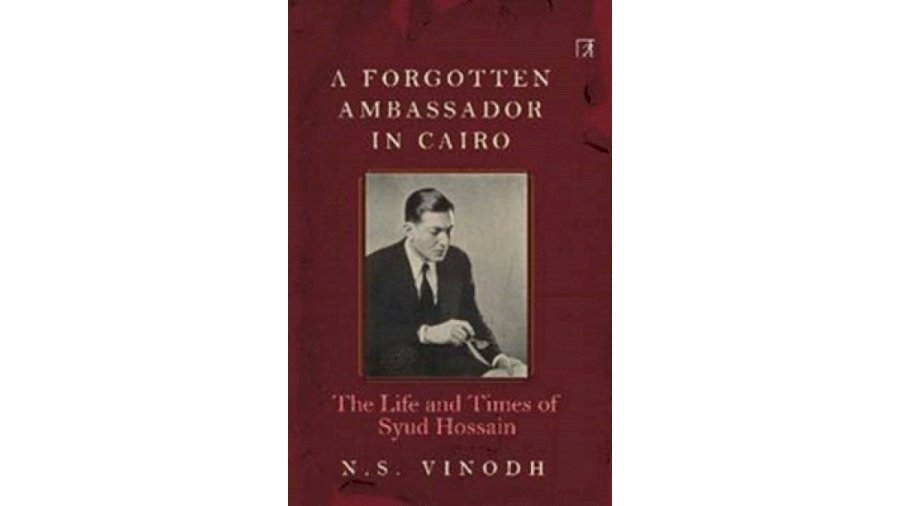
Among the multitudes of tombs in the City of the Dead in Cairo, there lies buried a lone Indian — an eminent scholar, writer, debonair statesman and a leader of the Indian freedom movement. Who is he? How did he get there? For a man who used both the lectern and the pen to devastating effect in the cause of the Indian Independence movement led by the likes of Mahatma Gandhi, Sardar Patel and Jawaharlal Nehru, very little is known of Syud Hossain.
Born to an aristocratic family in Calcutta, he started a career in journalism early in life and became the editor of Motilal Nehru’s nationalist newspaper, “The Independent”. After a brief elopement with Nehru’s sister, Vijaya Lakshmi Pandit, Hossain, under immense pressure from Motilal Nehru and Gandhi, annulled the marriage and was asked to stay away from the country for a few years. Thus began several years of exile.
Eventually, he landed in the US where he imparted Gandhi’s message far and wide across the country. Gathering a group of Indian freedom fighters around him, he fought for India’s freedom from afar, decrying British oppression and garnering support in the US for his cause. Flitting from one place to another, making homes of hotel rooms, Syud Hossain inspired and irked in equal measure. With every speech he delivered and every editorial he penned, he sent a shiver down the spine of the colonial rulers.
Adding to his formidable list of causes, Hossain also took on the fight for Indian immigrant rights in the US, one that successfully culminated in President Harry Truman signing the Luce-Celler Bill into an Act in 1946. He returned to India to witness the triumph of her Independence, as well as the tragedy of Gandhi’s assassination. He was appointed the first ever Indian ambassador to Egypt, where he died while in service and was laid to rest in Cairo.
“A Forgotten Ambassador in Cairo” (Simon & Schuster) offers an illuminating narrative of Hossain’s life interspersed with historical details that landscapes a vivid political picture of that era. Through primary sources that include Hossain’s private papers, the British Intelligence files, letters of his friends and contemporary newspapers, N.S. Vinodh brilliantly brings to life a man who has been relegated far too long to the shadows of time. Vinodh, is a civil engineering graduate from IIT, Madras, and a M.B.A. from IIM, Lucknow. In a corporate career spanning 25 years, he has held senior positions in corporate real estate with leading multi-national financial services companies such as ANZ Grindlays Bank, HSBC, and Fidelity Investments. He opted for early retirement to start his own boutique real estate company, as well as pursue his passion of travelling and history. He is married to Sheela and they have two sons, both based in the United States. He is based in Bangalore.
IANS
source: http://www.thehawk.in / The Hawk / Home>Lifestyle / by IANS / December 30th, 2020
Thachanattukara Panchayat (Palakkad District), KERALA :
His physical limitations made him a target of ridicule by CPM candidate Shaheer Ali during campaigning.
Salaam
Palakkad :
Salaam, who is all set to be elected the president of Thachanattukara panchayat in Palakkad on Wednesday, will be a bitter reminder to the LDF that making fun of someone’s disability is never a good idea. Fondly called Salaam master, the IUML candidate who won from ward 11, moves around in crutches. His physical limitations made him a target of ridicule by CPM candidate Shaheer Ali during campaigning.
At ‘kottikalasham’, Ali, who was in the fray from ward 10 of the panchayat, ridiculed Salaam asking, “If there is a marriage in Thachanattukara, can Salaam master help in putting up a pandal? Can he play football?” The insults went on. Ali’s derisive comments spread like wildfire on social media, generating a lot of sympathy and empathy for Salaam, a Malayalam teacher at the Mannarkad DHSS here.
The result: Ward 11, which was won by the LDF candidate in the 2015 local body polls by just one vote, went to Salaam this time by a margin of 315 votes. Adding insult to LDF’s injury, Ali lost to IUML’s Iliyas Kunnumpuram in ward 10 by 127 votes. In the 16-member panchayat, UDF won 11 seats, nine of them won by IUML. LDF won five seats this time.
source: http://www.newindianexpress.com / The New Indian Express / Home> Good News / by A Satish / Express News Service / December 30th, 2020
He moved away from politics in 1962 and resumed his academic career at Aligarh Muslim University.
Aligarh (UP):
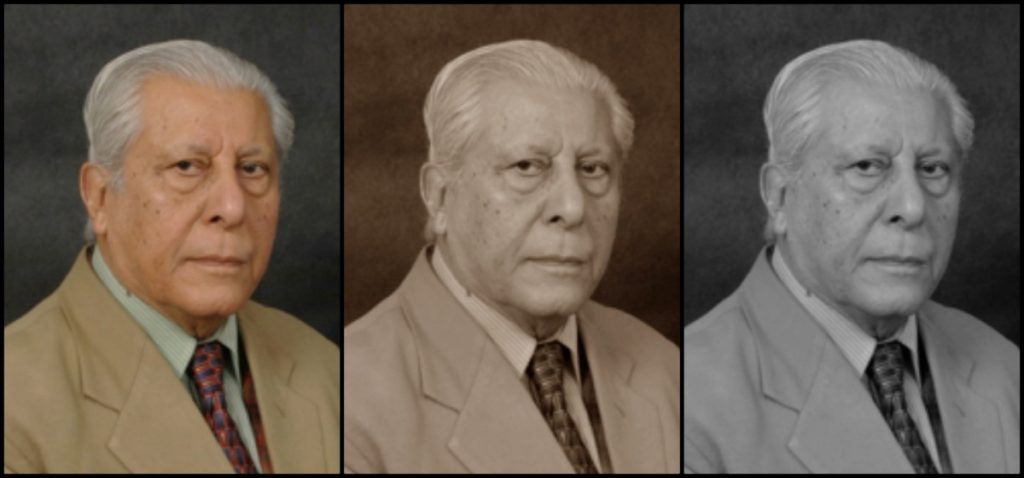
Noted scholar Jamal Khwaja, one of the last surviving members of the 2nd Lok Sabha, passed away at the age of 92 after a prolonged illness, according to his family.
Khwaja died on Thursday and his last rites were performed the same night.
He was elected to Lok Sabha from Aligarh in 1957.
He led the Indian cultural delegation to Afghanistan in 1960.
He moved away from politics in 1962 and resumed his academic career at Aligarh Muslim University.
Khwaja joined the department of philosophy at AMU in 1953. He was the Dean of Faculty of Arts at AMU in 1980.
He authored more than a dozen books, including Five Approaches to Philosophy, Quest For Islam and Living the Quran in Our Times.
Khwaja is survived by three sons and a daughter.
source: http://www.thewire.in / The Wire / Home / by PTI / December 25th, 2020