Abu Asim Azmi had won from the Mankhurd Shivaji Nagar seat in 2009 and 2014 assembly elections
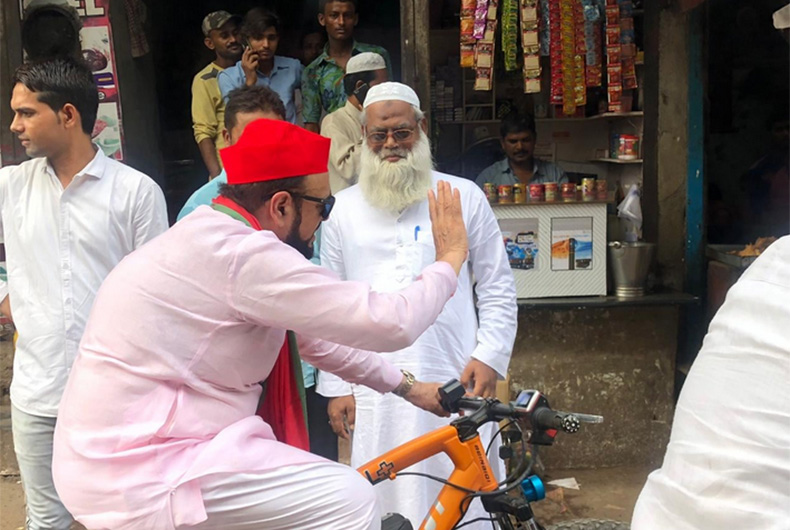
Mankhurd Shivaji Nagar Assembly Election Result 2019: Abu Asim Azmi, sitting MLA and Maharashtra Samajwadi Party (SP) President, has won in the Mankhurd Shivaji Nagar Assembly seat.
Abu Asim Azmi has got 63,697 votes and defeated his nearest rival of Shiv Sena in the seat he held since 2009.
Abu Asim Azmi had won from the Mankhurd Shivaji Nagar seat in 2009 and 2014 assembly elections.
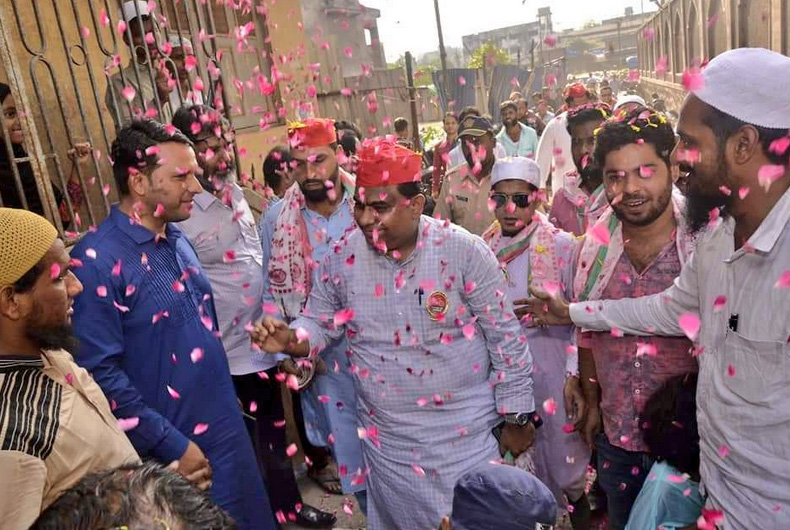
Rais Shaikh, sitting Samajwadi Party (SP) corporator in Mumbai, has also won the 2019 election in Bhiwandi East.
In Bhiwandi West however, Shoeb Khan of Congress and Khalid Shaikh of AIMIM are trailing behind Mahesh Chougale of BJP.
Elsewhere in Mumbai, Waris Pathan of AIMIM is trailing in Byculla. But, Mufti Ismail of AIMIM is leading in Malegaon Center seat with more than 10,000 votes.
Mankhurd Shivaji Nagar Assembly Election Result 2019 Live Update
11:45 am Abu Asim Azmi, sitting MLA and Maharashtra Samajwadi Party (SP) President, is leading in Mankhurd Shivaji Nagar Assembly seat, trends available at 11:45 am said.
According to the latest trends, Abu Asim Azmi has got 53,773 votes after 4th round of votes. His nearest rival of Shiv Sena is struggling with 14,772 votes.
08:00 am The Election Commission of India has started the counting of votes in all 54 assembly constituencies, also known as Vidhan Sabha seats, of Mumbai and Thane districts polling for which was held Monday, October 21, 2019.
The porcess started at 08:00 am with counting of Postal Ballots. Postal Ballots contain the votes of government servants who are posted in different areas of the state on the polling day. Postal ballots also contain votes of army men and natives of Haryana on government duty at any other place on the polling day.
After counting of postal ballots, counting of votes stored in Electronic Voting Machines (EVMs) has started. Special arrangements have been made for the purpose by the state election department in all 90 Vidhan Sabha seats of Haryana.
Counting of votes stored in EVMs is taking place round-wise on multiple tables one at a time. While trends and lead position is expected to trickle in by 08:30 am, the final results are expected by today afternoon.
Mumbai had registered around 50.67 per cent in by and large peaceful polling on Monday.
Mumbai and Mumbai Suburbs together have a total of 36 seats. Mumbai city, which has 10 seats, recorded 48.63% voter turnout whereas the Mumbai suburban district, which has 26 seats recorded 51.17%.
Assembly seats results of which will be announced today are Byculla, Colaba, Dharavi, Mahim, Malabar Hill, Mumbadevi, Shivadi, Sion Koliwada, Wadala and Worli in Mumbai city.
Assembly seats in Mumbai Surbs results of which will be announced today are Andheri East, Andheri West, Anushakti Nagar, Bhandup West, Borivali, Chandivali, Charkop, Chembur, Dahisar, Dindoshi, Ghatkopar East, Ghatkopar West, Goregaon, Jogeshwari East, Kalina, Kandivali East, Kurla, Magathane, Malad West, Mankhurd Shivaji Nagar, Mulund, Vandre East, Vandre West, Versova, Vikhroli and Vile Parle.
Counting of votes has also started in 18 Vidhan Sabha seats of Thane district in Maharashtra. Prominent among them are Bhiwandi East, Bhiwandi West, Thane, Ulhasnagarm Mira Bhayanadar, Mumbra Kalwa, Kalyan East, Kalyan West, Kalyan Rural and Belapur.
Election resultsof Panvel, Alibag, Shrivardhan, Chiplun, Ratnagiri and other seats in Raigad district will also be announced today.
source: http://www.ummid.com / Ummid.com / by Ummid News Network / October 24th, 2019
Rais Shaikh, a Commerce graduate from Sydenham College of Commerce and Economics, had started political career in 2012
Bhiwandi East Assembly Election Result 2019: Rais Shaikh, a sitting corporator of Mumbai Municiapl Corporattion (BMC), has won the Bhiwandi East Assembly Sea, according to final result announced by state election commission.
Rais Shaikh, a Commerce graduate from Sydenham College of Commerce and Economics Mumbai, had started political career in 2012 when he had won the Mumbai Municipal Election for the first time.
Rais Shaikh has won Bhiwandi East seat by 45,133 votes. He defeated Rupesh Mahatre of Shiv Sena and Santosh Shetty of Congress.
In Bhiwandi West however, Shoeb Khan of Congress and Khalid Shaikh of AIMIM are trailing behind Mahesh Chougale of BJP.
Elsewhere in Mumbai, Abu Asim Azmi, SP Maharashtra president, is leading.
Bhiwandi East Assembly Election Result 2019 Live Update
11:15 am Rais Shaikh, a sitting corporator of Mumbai Municiapl Corporattion (BMC), is leading in Bhiwandi East Assembly Seat, trends available at 11:15 am said.
Rais Shaikh, a Commerce graduate from Sydenham College of Commerce and Economics Mumbai, had started political career in 2012 when he had won the Mumbai Municipal Election for the first time.
Trends showed that Rais Shaikh is leading in Bhiwandi East with 15,350 votes. Rupesh Mahatre of Shiv Sena and Santosh Shetty of Congress are trailing with 9,595 and 6,842 votes.
08:00 am The Election Commission of India has started the counting of votes in all 54 assembly constituencies, also known as Vidhan Sabha seats, of Mumbai and Thane districts polling for which was held Monday, October 21, 2019.
The porcess started at 08:00 am with counting of Postal Ballots. Postal Ballots contain the votes of government servants who are posted in different areas of the state on the polling day. Postal ballots also contain votes of army men and natives of Haryana on government duty at any other place on the polling day.
After counting of postal ballots, counting of votes stored in Electronic Voting Machines (EVMs) has started. Special arrangements have been made for the purpose by the state election department in all 90 Vidhan Sabha seats of Haryana.
Counting of votes stored in EVMs is taking place round-wise on multiple tables one at a time. While trends and lead position is expected to trickle in by 08:30 am, the final results are expected by today afternoon.
Mumbai had registered around 50.67 per cent in by and large peaceful polling on Monday.
Mumbai and Mumbai Suburbs together have a total of 36 seats. Mumbai city, which has 10 seats, recorded 48.63% voter turnout whereas the Mumbai suburban district, which has 26 seats recorded 51.17%.
Assembly seats results of which will be announced today are Byculla, Colaba, Dharavi, Mahim, Malabar Hill, Mumbadevi, Shivadi, Sion Koliwada, Wadala and Worli in Mumbai city.
Assembly seats in Mumbai Surbs results of which will be announced today are Andheri East, Andheri West, Anushakti Nagar, Bhandup West, Borivali, Chandivali, Charkop, Chembur, Dahisar, Dindoshi, Ghatkopar East, Ghatkopar West, Goregaon, Jogeshwari East, Kalina, Kandivali East, Kurla, Magathane, Malad West, Mankhurd Shivaji Nagar, Mulund, Vandre East, Vandre West, Versova, Vikhroli and Vile Parle.
Counting of votes has also started in 18 Vidhan Sabha seats of Thane district in Maharashtra. Prominent among them are Bhiwandi East, Bhiwandi West, Thane, Ulhasnagarm Mira Bhayanadar, Mumbra Kalwa, Kalyan East, Kalyan West, Kalyan Rural and Belapur.
Election resultsof Panvel, Alibag, Shrivardhan, Chiplun, Ratnagiri and other seats in Raigad district will also be announced today.
source: http://www.ummid.com / Ummid.com / Home> India / Ummid News Network / October 24th, 2019
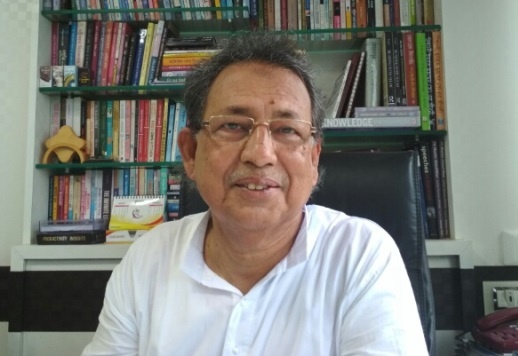
Education advocate M Nurul Islam, who started coaching seven students in small room of a madrasa where he was a teacher, never knew he would be once compared to great education reformer Sir Syed Ahmad Khan.
Through hard work and a commitment towards his moral compass, he was able to set up a learning center which is credited to have produced more than 2400 doctors (MBBS & BDS) and 2500 engineers so far apart from scores of researchers, administrative officers, teachers and professors.
Islam’s journey began in 1986 when he started teaching a group of seven students in a small room of a madrasa in Hawrah district of West Bengal. Now his Al-Ameen Mission has produced more than 2400 doctors (MBBS & BDS) and 2500 engineers apart from scores of researchers, administrative officers, teachers and professors.
Today Al-Ameen Mission has over 17000 residential students and more than 3000 teachers as well as non-teaching staff in their 56 branches across 15 districts of the state.
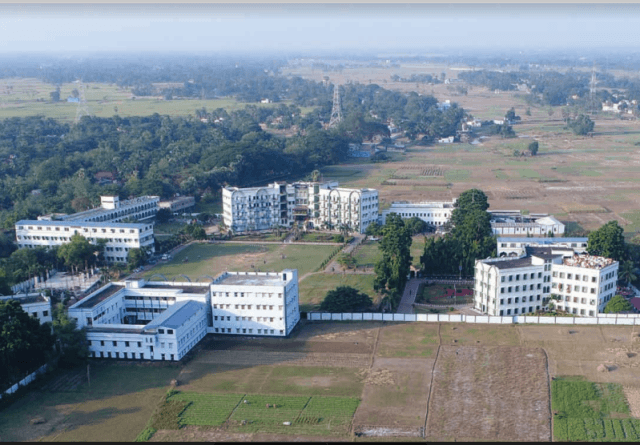
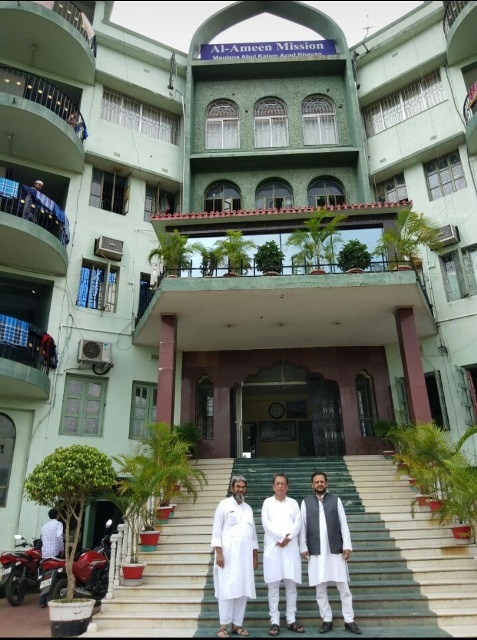
The main campus of Al-Ameen Mission located at Khalatpur village in Howrah district of West Bengal
It was in 1976 that Nurul Islam, Secretary General of the Al Ameen Mission, set up the Khalatpur Junior High Madrasa when he was still studying his 10th standard. The idea was educational empowerment of poor and backward minority sections.
The journey was tough and tiresome. In May 1984, he started the Institute of Islamic Culture, setting up a hostel for the institute in 1986 in the Madrasa building itself with the help of door to door collections of fistful rice in his village, Khalatpur. In January 1987, it was renamed as Al-Ameen Mission.
“I started coaching with 7 students of fifth class in 1986. In 1993 there were 11 students, four became doctors, four became engineers. Then came a feeling of satisfaction that I am doing the right thing. I never looked back,” reminiscences Islam who had revolutionized the concept of education among one of the most unprivileged community in one of the most backward region in India.
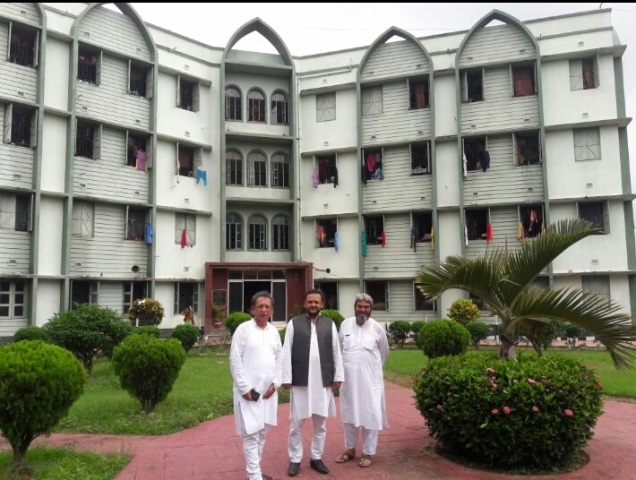
L-R, Inamul Haque, Nurul Islam and Syed Zubair Ahmad at Khalatpur campus .
“The motto was to give modern education with moral values in a fully residential system where students from all strata of the society, irrespective of their financial condition, would live, learn and grow together,” adds Islam.
The mission of the institute is to “achieve quality and excellence in the field of education and to support meritorious students who are socio-economically disadvantaged, following the principles of Fairness, Equality, Equity and Transparency.”
The main campus of Al-Ameen Mission is located at Khalatpur (Udaynarayanpur) in Howrah district of West Bengal. It has 56 branches spread across 15 districts of the state. It has 12000 residential students now. It also runs residential coaching classes for engineering and medicine aspirants across West Bengal and in neighboring Assam, Bihar, Jharkhand and Tripura.
The Al-Ameen Mission also has a facility for girls at Khalatpur, Howrah from class fifth to 12th.
Girls hostel at Khalatpur campus
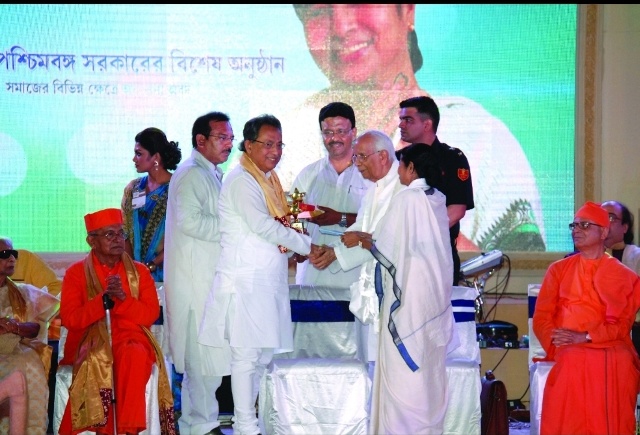
Al- Ameen Mission has bagged many awards for their excellent work in the field of education in West Bengal. They have been winners of The Telegraph School Award for Excellence in 2002 & 2009. The Mission has also been awarded The Telegraph School Award for the best academic performance in competitive examinations in the year 2004 and the Certificate of the Honour in the year 2005, 2006 & 2008. In 2018 Mr. M Nurul Islam also received the prestigious ” Banga Bhushan Award” from Mamata Banerjee,the Chief Minister of West Bengal.
M Nurul Islam receiving the prestigious ” Banga Bhushan Award” from Mamata Banerjee , the chief minister of West Bengal and Governor Keshari Nath Tripathi
The Mission is mostly run by donation and zakat. Muslims throughout the country contribute their zakat to the Mission, which takes care of 25% of seats reserved for poor, destitute and orphans.
A part from education Al-Ameen Mission does charitable works for the Muslim community. It has helped unemployed Muslims with loans and has scholarship programs to help other communities’ needy students.
Al-Ameen gives full financial support up to six months to those needy students of Al-Ameen who get admission in medical colleges.
The Mission has a unique feature of having different fee-structure for the students of different categories depending upon their financial conditions. The students from well to do families pay their fees in full whereas remittance is given to those who can’t pay the full amount. Those, who can’t pay at all, are exempted of all kinds of fees. Moreover, a considerable number of seats are reserved for meritorious orphan students.
At present 5338 students (42%) enjoy half-free studentship and 3432 students (27%) enjoy full free studentship facilities from the Mission.
The flexible fee –structure of the Mission had made it possible for many students from most poor background to achieve their dream and become doctors and engineers.
This year too Al-Ameen Mission has broken all its previous records as its 422 students cracked NEET, out of which 128 (30.5%) students are from poor and BPL families, 133 (31.5%) are from middle and upper middle income group and 161 (38%) from lower middle income group.
Above all 62 students of the Mission got AIR within 1500, 147 within 25000, 246 within 35000, 367 within 45000 and 422 within 55000.
Most surprisingly 105 students from Murshidabad and 80 from Malda who were enrolled in different branches of Al-Ameen Mission among those who cracked NEET this year.
Out of 422 qualifiers 360 were boys and 62 girls.
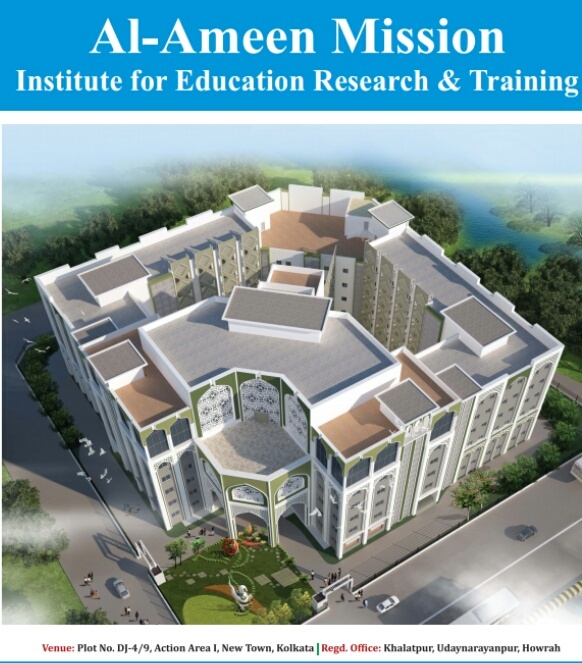
This year in February Al-Ameen Mission Trust has taken up a new project, ‘Al-Ameen Mission Institute for Education Research and Training’. This foundation stone of the institute has been laid in the Newtown. Here, under one roof there will be facilities to provide coaching for the Medical post-graduation course and Residential Training Centre for competitive examinations like IIT,IIM, CLAT,CAT,MAT,UPSC and WBCS. Besides, there will be facilities to train teachers as well as non-teaching staff. Moreover, there would be provision for higher research in different fields of social sciences. In future , it will be the leading center of the Al-Ameen Mission; the Centre of Excellence, said Islam about his future plan.
Proposed Al-Ameen campus.
source: http://www.muslimmirror.com / Muslim Mirror / Home> Editor’s Pick> Education> Indian Muslim> Interviews> Positive Story / by Syed Zubair Ahmad / October 08th, 2019
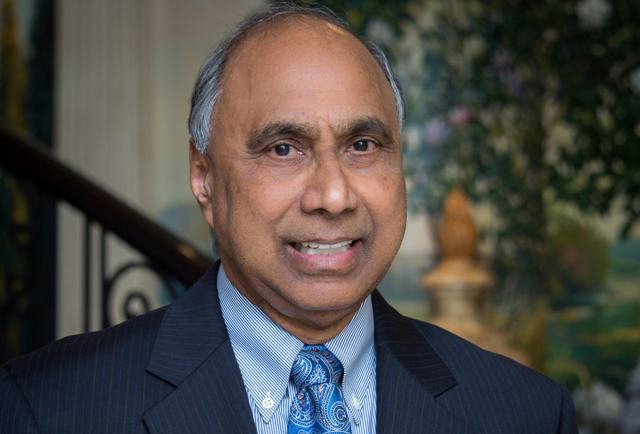
Jamia Hamdard, an institute of higher education announced that it will confer Honorary Doctorate to Dr. Frank F. Islam.
Islam will be formally conferred Doctor of Science (Honoris Causa) by the Jamia Hamdard University in a Special Convocation on 15th October, 2019, the registrar of the institute, S. S. Akhtar said in a statement.
Islam is an information technology entrepreneur, investor, philanthropist, civic leader, and writer who heads the FI Investment Group. He was the founder and CEO of the QSS Group and has served on numerous boards and advisory councils including the Board of Trustees of the John F. Kennedy Center for the Performing Arts, Board of Directors, Strathmore Center for the Arts, Ford”s Theater Society Board of Trustees and Kennedy Center International Committee on the Arts.
Islam joins the list of other distinguished recipients who have been honoured by Jamia Hamdard which includes N. R. Narayana Murthy (Co-Founder of Infosys), Bharat Ratna C.N. R. Rao, Sheila Dikshit (Former Delhi CM).
Inaugurated by late Rajiv Gandhi, former Prime Minister of India on August 1, 1989, Jamia Hamdard has recently been recommended by the Empowered Committee appointed by the Government of India for recognition as an “Institution of Eminence” and placed at the 5th rank among the 500 or so privately funded Universities of India.
–IANS
source: http://www.muslimmirror.com / Muslim Mirror / Home> Education> Indian Muslim / by IANS / October 12th, 2019
Farha emphasized on hard work, and smart work aimed at achieving goals with quality, to qualify competitions
Aligarh:
The popular myth that it takes a superior, distinctive and an elite school background and perfect coaching institutes with record selection percentage to crack competitive exams was broken by Farha Naaz Parveen.
Farha is a law student of Aligarh Muslim University (AMU) Malappuram Centre. She has qualified the Uttar Pradesh Judicial Service Civil Judge [UP PCS (J)] 2018 exam without attending a coaching institute.
“I did not attend a regular coaching for my exam preparation,” said Farha adding that she comes from a UP Board schooling background during an interaction with students in Malappuram Centre where she was also felicitated.
Farha, who clawed her way to success with sheer dedication, die-hard determination, commitment and proper guidance from teachers, urged students to have self-study routines for qualifying competitive exams.
“One of the major advantages of self-study is that students can take control over their own learning. It can be hard to get into the self-study right routine, but with the right approach, anyone can set themselves up with an unbreakable study routine,” said Farha.
Farha emphasized on hard work, and smart work aimed at achieving goals with quality, to qualify competitions.
Giving the credit of her success to the teachers at the Department of Law, Malappuram Centre; Farha also shared tips for successful competitive exams preparation with the students.
Felicitating Farha for the success, Dr Faisal KP, Director, Malappuram Centre said that Farha’s success story has inspired and motivated students.
In the welcome address, Mr Ghalib Nashter, Co-ordinator, Department of Law said that Farha’s success is testimony to the quality education and student mentoring at the Malappuram Centre.
source: http://www.ummid.com / Ummid.com / Home> Business & Economy / by ummid.com News Network / October 01st, 2019
Fouaad is currently the highest ranked in Group G for Asia Pacific Zone with 34 points on Fernhill Facetime, 30 points on Touchingwood and at present qualifying his third horse, Dajara.
Fouaad Mirza will next compete at the events in Montelibertti ITY CCI3*S (Italy) and Le Pouget FRA CCI4*S (France). – SPECIAL ARRANGEMENT
India’s double Asian Games silver medallist Fouaad Mirza bagged the top honours at the CCI3*S, an Olympic qualifying event, held in Strzegom, Poland.
Fouaad is currently the highest ranked individual in Group G for Asia Pacific Zone with 34 points on one horse Fernhill Facetime, 30 points on the second horse Touchingwood and at present qualifying his third horse, Dajara.
The eight-year-old Dajara, procured by the Embassy Group, is a promising German Holsteiner with an excellent track record of wins including a German National Championship, Bundeschampionat.
“I am very excited about our new horse Dajara, which has immense potential for success at the Olympics. Through the event CCI3*S, we were able to level up the horse rider combination to 4* and building up my points to qualify for the Olympics,” Fouaad said on Sunday.
Fouaad started the week with a solid dressage score of 26.8 which placed him second with a very close score to Germany’s Antonia Baumgart, who was one penalty better at 25.8.
This was followed by the showjumping event where Fouaad maintained the second position with a clear round. He finished the deciding cross-country round in four seconds over time, leading him to the gold in the Strezgom CCI3*S in Poland.
Fouaad has completed Renswoude NED CCI 4*S placed 11th, Jardy FRA CCI4*S, Strzegom POL CCI4*S placed 15th, Sopot POL CCI4*S placed seventh so far for Olympic Qualifying Events.
He will next compete at the events in Montelibertti ITY CCI3*S (Italy) and Le Pouget FRA CCI4*S (France).
source: http://www.sportstar.thehindu.com / SportStar / Home> More Sports / by PTI / Bengaluru – October 14th, 2019
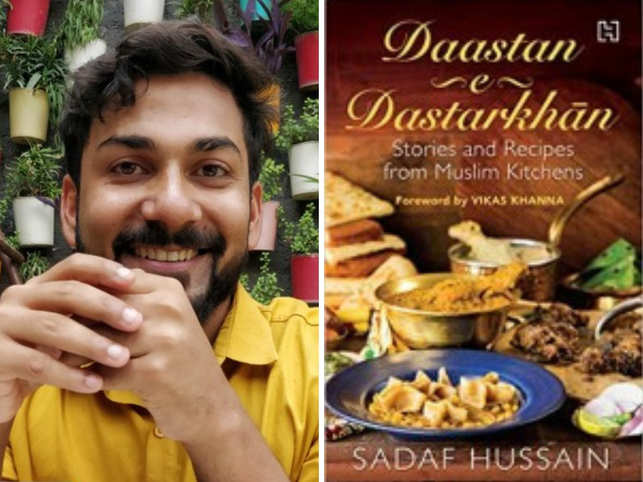
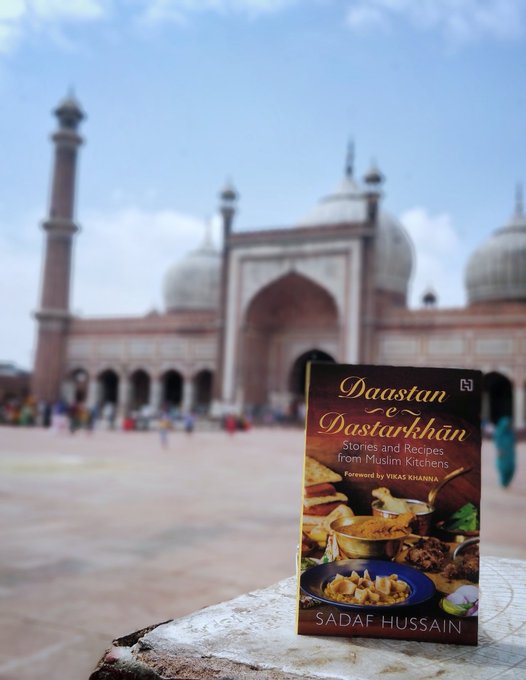
Sadaf Hussain chronicles home-made food in his new book Daastane-Dastarkhan.
Sadaf Hussain’s charming new, first book Daastane-Dastarkhan has been published by Hachette India.
Sadaf Hussain’s charming new book Daastane-Dastarkhan starts with the story of a pir who, every Thursday, visited his mother’s family in Sasaram, Bihar. But one day he appeared on a Wednesday, throwing his grandmother into panic because there was no meat for the aloo-gosht she always fed him. She had to be inventive. She used dried figs and poppy seed paste, to make a salan, threw in fried potatoes, balanced it with garam masala and chillies, and served it with rice and besan rotis. The pir was delighted: “May Allah bless you with an abundance of food and may no one ever leave your home hungry.
A recipe like this is not what many would think of as Indian Muslim food. Where is the intense meat focus? Where are the kebabs and biryanis? The problem starts with thinking there is something that can be neatly labelled Indian Muslim food. The fact that people do this might be just another way in which Indian Muslims are diminished by clubbing their many communities into one and ascribing easy stereotypes to them.
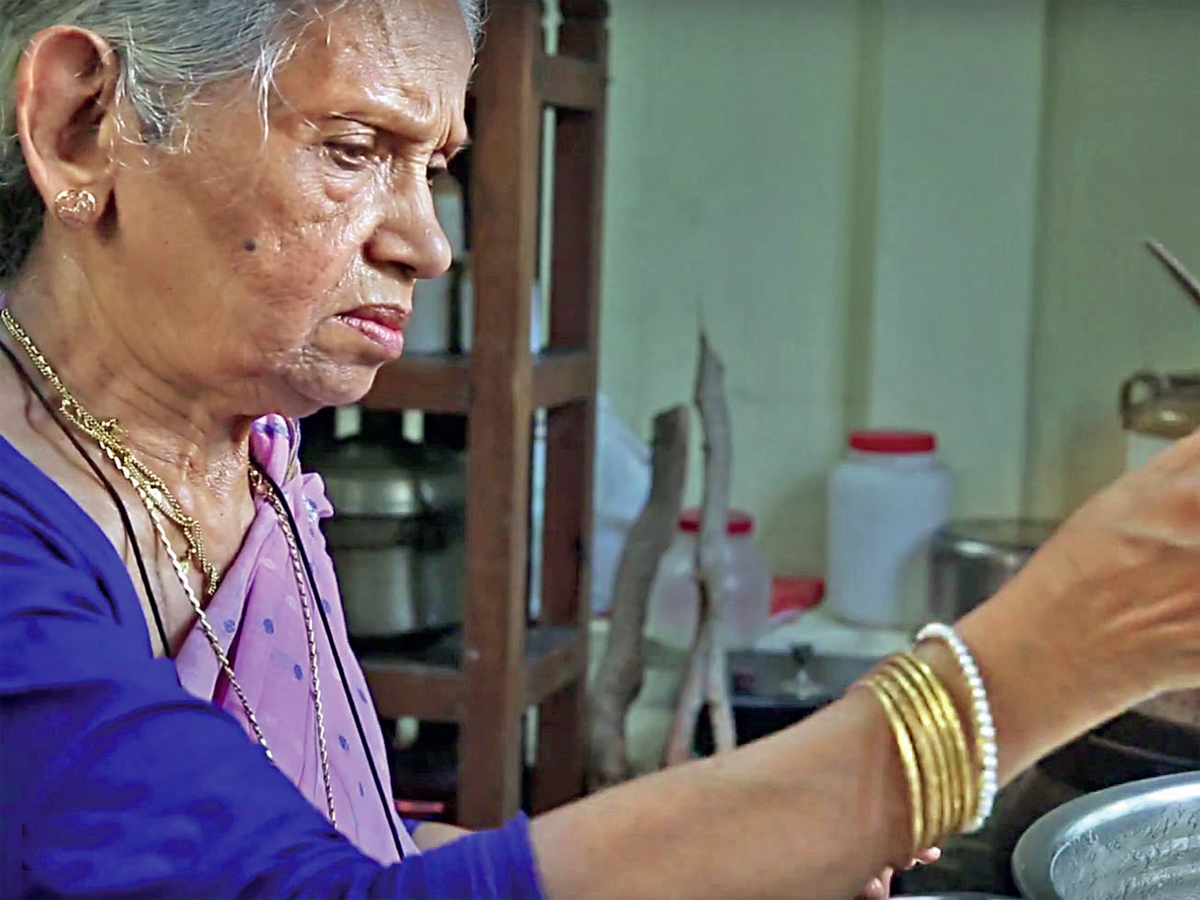
Ummi Abdulla, who has documented the food of Malabar Muslims, makes mutta mala or egg threads.
Part of the problem is that there is a market in catering to such stereotypes. Once a year during Ramzan, many people decide to have an iftar experience and go out — without fasting — to eat the rich food cooked on street sides for the occasion. But this has as little relation to regular home food in Muslim communities across India, as does a Diwali or Christmas feast have for Hindu or Christian home food.
One way people get exposed to home food of different communities is when they share food with neighbours, especially as kids. But as housing becomes increasingly segregated, this is becoming harder.
This lack of knowledge has been compounded by a curious lack of cookbooks from different Indian Muslim communities.
There are cookbooks from cities like Lucknow and Hyderabad where certain types of Muslim food dominate, but what’s presented tends to be street food or special occasion dishes, both mostly made by men. These are important, but it means that the daily, home dishes get left out.
There have been a few exceptions. Ummi Abdulla made a pioneering contribution by documenting the food of the Malabar Muslim, or Moplah, community, with all its complex interactions between the local ingredients of Kerala and influences from Arab traders.
Bilkees Latif ’s Essential Andhra Cookbook captured similar interactions from Hyderabad. Mumbai’s Inquilab newspaper brought out a collection of booklets, in Urdu and English, on Memon, Kokani, Bohra and Kashmiri food. There were a few other books printed privately or abroad, but little else.
Adil Ahmad’s Tehzeeb chronicles the home food of an upper-class Lucknow family.
Doreen Hassan’s Saffron and Pearls does the same for her husband’s family from Hyderabad, but with roots in both Persia and Uttar Pradesh. Zaiqa e-Kadwai provides a very different perspective. It is a team effort to document the food of a village in Ratnagiri district, where most of the families just happen to be Muslim, but their food is quite typically Konkani. Hazeena Syed’s Ravathur Recipes: With a Pinch of Love shows, in a very impressively produced volume, the food of this Tamil Muslim community.
These books show the food of these communities to be, as with all communities in a region, primarily dictated by what’s locally available, but with small tweaks. As Hassan’s husband’s family shows, at a more upper-class level there were more likely to be interactions with communities across countries, and recipes travel with daughters-inlaw, who are one of the least acknowledged agents for social change.
There is certainly a lot of meat eaten in all these communities, but the recipes are much simpler and subtler than what is served up to unthinking eaters as “Muslim” food. Meat is often cooked with vegetables as in the chuqandar gosht, beetroot and mutton; or keema kakdi, cucumbers and mince, given in Tehzeeb. There are inventive egg dishes, like boiled eggs stuffed with mince and then skewered, that Hassan discovers in Hyderabed, or eggs fried in gravy that are a favourite in Kadwai.
Other similarities might be slightly more use of some spices, like star anise, and less of others — hing rarely features since onions are widely used. Chefs will tell you that Muslims in their kitchens are particularly adept at frying, and that copper, with its excellent heat conduction, is the metal of choice for utensils. Many traditional vessels shown in these books are copper, and careful distinctions are made in types of frying: shallow, deep, braising and so on.
Books like these are important because, apart from the problems of unthinking stereotypes, the food of Indian Muslim communities faces another kind of obliterating pressure. Many cooks from the communities have gone to work in the Gulf and have picked up the kind of Lebanese-Arab food that is becoming a standard across the world. It is easy to produce, cheap and tasty enough and has the allure of being modern, rather than old-fashioned, labour-intensive home food. People shouldn’t be faulted for opting for what’s cheap and convenient, but it is important to remember, as these books remind us, that there are also other ways to nourish our roots.
source: http://www.economictimes.indiatimes.com / The Economic Times / Home> Business News> Magazines> Panache / by Vikram Doctor / ET Bureau / October 13th, 2019
A detail of the ‘House of Bijapur’ genealogical painting depicting most of the rulers of the Adil Shahi dynasty of Bijapur. (Photo: Wikimedia Commons)
Although the Adil Shahi dynasty of Bijapur was formally Muslim, it was influenced by multiple religions and different identities
Such complicated realities were not unusual in the subcontinent, from Vijayanagar in the south to further north in Kashmir
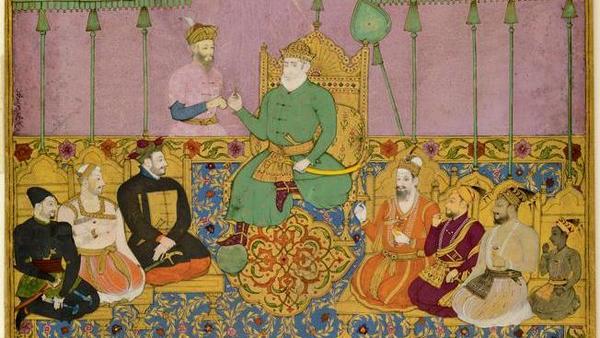
In 1680, a few years before emperor Aurangzeb swallowed up the sultanate of Bijapur, two court artists in that city produced a striking genealogical painting. Rich in quality, with ink, watercolours, as well as gold and silver generously employed, the picture shows all the rulers of the doomed Adil Shahi dynasty, save for one who was blinded and discarded for not being up to the mark.
In the centre, on the throne, for instance, sits Yusuf, the man who sailed from Persia and founded the house with his Maratha wife in the 15th century: In a mark of the kingdom’s allegiance to the Shah of Iran (as opposed to the Mughals), Yusuf is shown receiving a key of sovereignty from the Iranian emperor. Then there is Ali, who appears in armour—a symbol of the role he played in the defeat of Vijayanagar in 1565—just as there is the boy-king Sikander, the smallest figure in the group, who would spend much of his life as Aurangzeb’s dethroned prisoner.
Created on the eve of the kingdom’s demise, the painting is at once a family tree but also, as one scholar puts it, a “painted curtain call” for the extraordinary Adil Shahi dynasty.
But the portrait is significant also in another way, in that it depicts the contrasts that can develop in the same ruling house and in interpretations of its official ideology. The Adil Shahi state was formally Muslim. From the start, however, it was influenced not only by multiple religions but also by different identities. So, for instance, Ismail (reign 1510-34) chose to highlight the family’s Persian heritage—he made his troops wear Iranian uniforms and himself adopted the 12-pointed cap, a reference, as the scholar Deborah Hutton notes, to the 12 imams of Shia Muslims.
Ibrahim II (reign 1580-1627), on the other hand, was Sunni and is depicted in a style associated with the Indian faction at court, a reflection of his own attitudes. He was, for example, not only a lover of Marathi (much to the horror of a Mughal envoy, who found Ibrahim’s Persian weak) but also a great admirer of Hindu traditions. It was he who proclaimed himself son of Saraswati and Ganapati, studied Sanskrit, and went to the extent of renaming Bijapur “Vidyapur” to honour his favourite goddess.
Only two generations divided the orthodox Shia Ismail from Sunni Ibrahim (who was rumoured to be secretly Hindu) but there was a world of difference in their outlook.
The Adil Shahs certainly presented themselves as good Muslim rulers—indeed, even Ibrahim’s grave carries an inscription denying rumours that he was an apostate, affirming that he was a true believer of the Prophet’s message. But as this column showed previously in the case of Hindu Vijayanagar, official identity and self-image did not preclude the absorption of multiple influences, or even contradictory practice. The Adil Shahs, even as Muslims, alternated between Sunnism and Shiism, and it was their latter identity that often supplied the Mughals an excuse to invade in the name of religion—this when even Aurangzeb, who led the final charge against the “heretics”, was himself the son of a Shia mother. Add to this a give and take of culture from not only the Marathas (including Shivaji’s father, who served the Adil Shahs) but also Ottomans, Europeans and African grandees at court, and Bijapur was confirmed as an eclectic, mixed universe—one where the king had a formal identity that he could interpret strictly or with deliberate laxity, depending both on his predilections and official necessities.
But in this the Adil Shahs were hardly unique. The rayas of Vijayanagar shaped their self-image in Sanskritic terms and declared themselves consciously Hindu. And yet, one of them sought a marriage alliance with Catholic Portugal; many of them used the title “sultan”; and their sartorial tastes and everyday lives were influenced visibly by Persian culture. A raya might keep the Quran in court so that his Muslim nobles could prostrate before it, even as he destroyed mosques in enemy territory—policy depended on the context in which the king found himself. Further north, in Kashmir too, as Richard Eaton shows in his India In The Persianate Age, we witness such ironies.
Sultan Sikander (reign 1389-1413), for instance, was a destroyer of Hindu shrines and burner of Sanskrit books. But his son Zain al-Abdin (reign 1420-70), officially as devout a Muslim as his father, implemented the opposite policy: Not only did he resume temple grants, but under him the court also witnessed an unprecedented production of Sanskrit literature, as well as translation of Hindu texts into Persian for the ruler’s edification.
The greatest controversy, of course, arises in understanding Tipu Sultan of Mysore. To some, he is a giver of grants to Hindu temples and a protector of his non-Muslim subjects. Others cite his cruel conquest of Malabar, where Hindus were forced to renounce their religion, their temples demolished. But, simply put, the question is not one of either/or: The same king could act in opposite ways in different settings.
In Malabar, its chiefs and people were “infidels”, but in his settled territories in Mysore, Tipu had no qualms employing “infidel” Brahmins (including the celebrated Purniah) as officials. One was a land of conquest, where destruction of significant shrines was, to him, legitimate, while forced conversions were a method of flaunting to the Islamic world his commitment to their faith; but in his home territory, he was king in a broader sense, accepting of the land’s realities as well as its people. A villain in one reading, he could be a hero in another, employing his religious identity in different degrees, determined largely by the contingencies of politics.
It was this complicated reality that the painters of that Adil Shahi family portrait inadvertently conveyed in their work: a house of Muslim kings with Maratha blood, who cheerfully switched sects as they desired, and whose dynastic roster included all types—those whose faith guided them to extremes, and others for whom religion was more a formality, engaging as they did with a land of diverse realities.
Medium Rare is a column on society, politics and history. Manu S. Pillai is the author of The Ivory Throne (2015) and Rebel Sultans (2018).
Twitter – @UnamPillai
source: http://www.livemint.com / Live Mint / Home> Explore> Medium Rare / by Manu S. Pillai / September 05th, 2019
The NCPA was keen to host it and Shapoorji Pallonji, the business conglomerate, keen to finance it. And both wanted a “big production”.
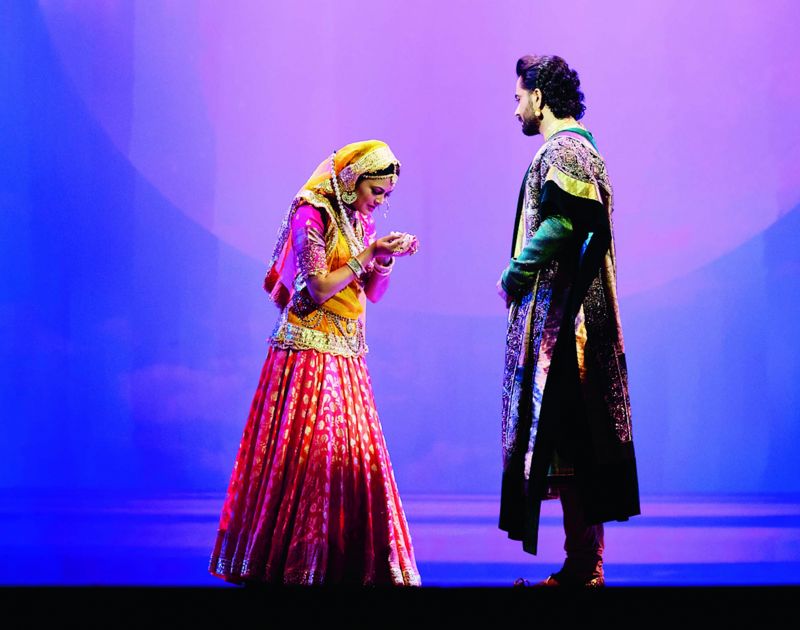
Priyanka Barve as Anarkali.
Mostly, perfection is elusive, unattainable. And yet, every society, every culture has something that is, simply, perfect.
Buildings, bridges, monuments, pieces of art, a song, a book, an athlete, a sportswoman or sportsman, a performance, an inning and, sometimes, a movie.
Based on Imtiaz Ali Taj’s 1922 play about the fictional love story of Salim and Anarkali, K. Asif’s Mughal-e-Azam — whose shooting first began in 1946, with Nargis as Anarkali and D.K. Sapru playing Salim, but released finally in 1960 with Dilip Kumar, Madhubala and Prithviraj Kapoor — is one such piece of perfection.
Feroz Abbas Khan, the first artistic director of Mumbai’s Prithvi Theatre and a veteran director with several plays to his credit, including Tumhari Amrita, admits as much. “Mughal-e-Azam, from the play to the script to the screenplay is a piece of literature. The script of Mughal-e-Azam is pitch perfect… It’s one film where everything is perfect. The acting, the screenplay, the dialogue, the music, the lyrics, the performances… And it has a dream cast — you can’t get a cast like that… Madhubala ko dekhiye, aur khatam uske pyaar mein… Mughal-e-Azam ek bahut badi cheez hai,” he says.
And yet, Khan dared to touch this piece of perfection, this sacrosanct icon.
In 2004, Khan was watching the colour version of Mughal-e-Azam when he had an audacious thought: It’s structured like a play and can be staged. But then there were other thoughts. “Sheesh Mahal kahan se aayega?”
It was something he wanted to do, but it didn’t seem possible. It needed a financier with deep pockets and deeper love for Mughal-e-Azam, a stage large enough, skilled production and lighting designers… And, yes, there was also a sense of what a gustakhi it would still be.
“You can do things which, agar nahin bhi theek hua toh log aapko muaf kar denge. Isme toh muafi ki koi gunjayesh hi nahin hai. Sazaye maut!” says Khan.
So for years, the idea of staging Mughal-e-Azam stayed in some corner of his head, circling around his restless to do a huge production, till a casual discussion at Mumbai’s NCPA sometime last year took him to Shapoorji Pallonji, the producers of the film who owned the rights.
The NCPA was keen to host it and Shapoorji Pallonji, the business conglomerate, keen to finance it. And both wanted a “big production”.
The sense of what a gustakhi it was now became a motivator.
“Gustakhi nahin… bewakoofi. Dekhiye aisa hai, ke aapki jo imagination hai, uska size chota kyun hona chahiye? Usmein toh koi paise lagte nahin hain? You have to aspire to be the biggest, the best, and then, somewhere between reality and utopia, you may get to the point of possibility… For me, unless I feel that this is going to go to a point that it could be the biggest disaster, unless I feel that it is something that is really challenging me, toh maza nahin aata mujhe.”
The challenge was to recreate the magic of Madhubala-Dilip Kumar romance, the high drama of a kaneez challenging Akbar the Great in bhari sabha, to pull off in two-and-a-half months of rehearsals what K. Asif had taken 14 years to do.
How do you do that, even if you find the same white ostrich feather and can play the recording of Bade Ghulam Ali Khan sahab? And are lucky enough to find an art designer who can simulate the heady dazzle of Sheesh Mahal which, in the original, required the headlights of 500 trucks?
You don’t. Because you can’t.
Because of the limitations of stage and time, because it’s all live, and because you have neither Dilip Kumar nor Madhubala, you don’t go for drama.
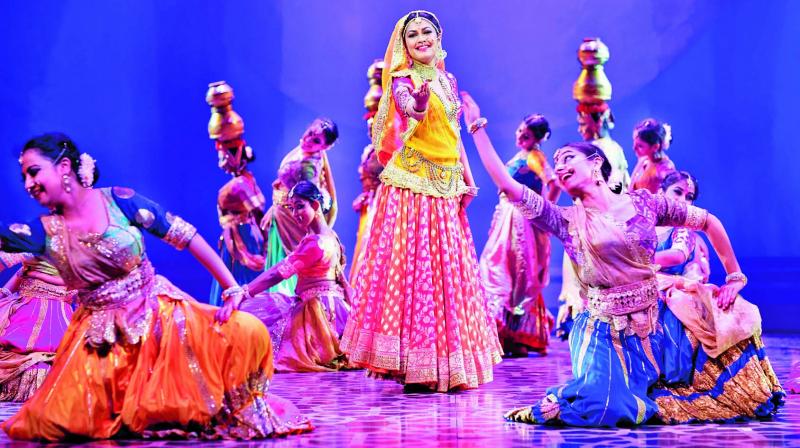
So Khan did the next best thing. He took 38 kathak dancers, added live singing and turned the epic romance into a stunning, spectacular musical.
With 350 cast and crew, 550 dresses, The Great Mughal became The Grand Musical which has run to full houses for four seasons (about 57 shows) in Mumbai, and, since September 9, has had packed shows at the 2,000-seater Jawaharlal Nehru Stadium.
According to Wikipedia, the premiere of K. Asif’s Mughal-e-Azam was held at the 1,100-seater Maratha Mandir in Mumbai where the Sheesh Mahal, transported from the studio, was on display. Outside the hall stood a 40-foot cut-out of Prithviraj Kapoor, and the film’s reels arrived on an decorated elephant, accompanied by the sound of bugles and shehnais.
In Delhi’s Jawaharlal Nehru Stadium, Khan had to remake all his sets from scratch because the stage here is 60 feet, whereas NCPA’s was 36 feet.
And to make the experience palatable and comfortable for the audience, who would be paying anywhere between `500 to `10,000 for a ticket, he had to redo the carpeting, improve the air conditioning, paint the facade and get the loos fixed.
The response has been so overwhelming that Khan has had to extended the Delhi schedule, adding five more shows over three days.
Mughal-e-Azam, the two-hour-15-minute musical is an opulent, nostalgic dance-drama which is beautiful and mesmerising when it’s singing and dancing. Its spectacle is spectacular.
But in moments of intimacy, in scenes with dialogue, it irritates those who have watched Dilip Kumar and Prithviraj Kapoor go head-to-head, and that despite a Salim (played by Dhanveer Singh), whose dialogue delivery and body language are mostly impressive.
The play’s scale is both, its strength and weakness.
The stark sparseness of two characters talking on a huge stage, arriving immediately after sensational dances that rise to an impressive crescendo, needed more drama. But that’s missing.
The actors, though well-rehearsed and speaking in trained diction, often sign off on a lame note. The exits are limp, especially Akbar’s. Anarkali’s body-language and energy is often the opposite of what’s required. In Pyar Kiya Toh Darna Kya, there was no defiance in her body movements, and in a dramatic scene, Salim walked as if on a languid stroll in a park.
Admittedly, this is nitpicking. These are just tiny details. But these small, careless moments get magnified when all that is happening on a 60-foot stage is two characters talking, or an angry Salim walking, and yet his heel-toe movements say nothing.
As Khan himself says, “Ek second bhi hamare liye agar galat hoga, ek empty second can become a minute on stage.”
But, he adds, his musical play works well at both levels — spectacle, and when it’s sparse — and that’s why it is so successful.
Khan credits that to the dialogue which, he says, at once have scale and invoke personal intimacy. “Jab Jodha bolti hai ke, ‘Hamara Hindustan koi tumhara dil nahin ki laundi jiski mallika bane’, and Salim says, ‘Mera dil bhi aapka Hindustan nahin jispar aap hukumat karein…’ Yeh kya hai? Large and personal. It’s in the dialogue.”
But then adds, “See, I’m never going to be totally happy. Because I think there’s still room to do better. But I think, finally, a nice balance has come and the girls are absolutely brilliant.”
After the scene where he irritates with his listless walk, Salim faints and falls so perfectly that it gets a round of applause. And then another song-dance comes on, and the play rises. Till it dips, to rise again… So it goes, dipping and rising, leaving you at the end with admiration for Salim, Anarkali’s live singing, a smile for the chirpy Suraiya, but above all teary-eyed respect for the 38 kathak dancers who create moments so perfect and magical with their feet and ghungroos that Lachhu Maharaj would be proud.
Feroz Abbas Khan attends most rehearsals, often with his eyes closed. Listening and moving his arms around, like a music conductor. He’s simultaneously conducting and imagining the rest — music, lights, costumes, the backdrop, the screens, the impact and the applause.
During the shows he makes notes in his diary under each character’s name and after the curtain call these notes are handed over.
“Har ek character ke naam pe notes bane hote hain, aur hamein end pe woh notes milte hain, ki, okay, tum yahan kamzor the, tumhein ye better karna hai… Mujhe last mila tha ki main jhuk ke chal raha tha… energy kam lagi,” says Dhanveer Singh.
The Mughal-e-Azam script that Khan loves so much was also subjected to his directorial nitpicking.
Khan, who has worked on women empowerment in entertainment, and whose TV serial on DD, Main Kuch Bhi Kar Sakti Hoon, is one of the most watched TV shows in the world, refused to let his female characters be shown as less than his male characters, whatever the hierarchy, situation.
“In the film Saleem slaps Anarkali. Bahar usko jootiyan pehnati hai… I cannot, just cannot, I cannot do this… Mere liye yeh gawara nahin tha ke main aaj ke time mein yeh karoonga. After all, it is imagined history,” says Khan.
So he took these bits out and added an extra dollop of chutzpah and ambition to Anarkali.
Khan’s Anarkali owns her ambition with impressive spunk when she wears the crown and says, “Hindustan ki Mallika toh main hi banongi.”
“Jodha also gives it to Akbar, nor does Anarkali stop at it. When she says, ‘Shahenshah ki behisaab baksheshon ke badle mein, yeh kaneez Jalaluddin Mohammad Akbar ko apna khoon maaf karti hai’, she doesn’t do it, pithy — Ki, ‘Maaf karti hoon’. Aise nahin. She’s (he gestures) “Jaa! Teri kya aukat hai. GO!”
“Ab dekhiye, yeh meri choice hai. Jo main kehta aa raha hoon, even for entertainment, you don’t necessarily have to do good, but you can do a little bit not bad. Maine jhapad nikal diya, toh play kuch kum hua kya?”
Priyanka Barve and Dhanveer Singh as Salim.
But before these girls, and boys, can flex and flaunt their characters’ chutzpah on stage, they had to undergo some mind games, or what Khan calls “exercises”, for him to gauge whether they can act, and if they can, then “kis gehrai tak”.
Khan, says Singh, is the kind of perfectionist who will not let his actors go to the next word till the previous one is to his satisfaction.
“Unko agar 100% chahiye, toh unko 100% hi chahiye. 99.9% bhi nahin chahiye.”
Khan is not short tempered, says Singh, “but everything about him is grand… unka gussa bhi, pyaar bhi, daant bhi”.
“Woh Mughal-e-Azam se itni mohabbat karte hain ki woh kehte hain, ‘Main kuch bhi bardasht kar sakta hoon, lekin Mughal-e-Azam itni bhi kutahi (negligence) nahin bardasht kar sakta’.”
This perfection ki khoj began early for Khan, and those he thought were not up to putting in the work, or would get distracted by the glamour were weeded out. Like a B-grade Hindi film star who was pretty, a decent dancer and a very decent singer, but had “started celebrating playing Anarkali without going through the process”.
Worse, she wanted to be treated like a star. “She was told in advance ki yahan, if I tell you to come at 8, and you come at 8.05, the gates are closed. You are standing out.”
The starlet was let go. She didn’t have it in her to become Feroz sahab’s Anarkali.
The ones who stayed had to go through the “exercises” for Khan to see if he could actually make them act.
Apart from the basic requirements of the play — that the girls had to be very good singers, very graceful — what was especially important to Khan was that they be sensitive enough to be prodded to become actors if they were not already. And many were not.
“They need to have the sensitivity for me to take them to those areas… they should be neither very cold nor very knotted, because then I won’t be able to access them,” says Khan.
Accessing, he says, is very important because “if you stop yourself from feeling, then how will you believe”.
“The most fundamental thing in acting is believing. When I look at an actor, I first understand the person, what’s gonna tick with him or her, and then trigger that. According to what the person is, I tailor my exercises…”
These exercises, which often push his actors to a point of breakdown, are necessary, he says, to also see if there is vulnerability.
“I don’t like sure-footed characters. Jab tak usmein vulnerability nahin hai, usmein aap ko dimension nahin milta hai. Jab woh bolta hai, ‘Taqdeerein badal jaati hai, zamana badal jaata hai, mulkon ki tarikh badal jaati hai, Shahenshah badal jaate hai… Magar mohabbat jis insaan ka daman thamti hai, woh insaan nahi badalta…’ Jab-tak usmein vulnerability nahin hogi, toh kahan se bolega?”
The applause will come, he says, because these dialogues were written for wah-wah and taaliyan, but without vulnerability in the character, “dialogue bus dialogue reh jayenge.”
After much insistence, Khan reluctantly relents and agrees to share one exercise.
“Bahut saari exercises hain, but I’ll just give you one example. It’s very interesting. This girl, Bahar, the second Bahar, I told her, tomorrow you come, I’m going to do some exercises with you… I had a girl with her. So you take her to a place, a room, where she has come to meet somebody. She meets somebody, and the guy says, I’m going to come back, I’ll leave you here. Then it’s dark… And then somebody comes and puts a cloth around her eyes and then on her mouth and now she is put around a chair and then… I’m giving her the suggestion that five men are now abusing her. One after the other, one after the other, one after the other… It’s all imagination. So I start saying that… they are abusing her, and abusing her… I keep seeing her, and putting up the temperature… to see how far, because some of them refuse to do anything. They think, it’s fun, nothing real. And some of them start believing, get affected immediately, so I know I need to stop there… This girl broke down very badly and for another hour
she just could not get over it. So I realised that she has that sensitivity.”
Zil-e-Elahi, as Khan’s actors refer to him behind his back, narrated two more exercises which were, thankfully, slightly less scary.
Boys get different types of exercises because “Ladkon ki sensitivity bahut kum hoti hai. Ladkon ko zayada waqt lagta hai. Unko bahut mujhe le jana padta hai, but le jata hoon unko bhi main.”
All this because, Khan believes, “agar aap nahin jalenge, toh audience kaise jalegi, zara mujhe bataiye…”
“Jab tak tum khud ko Salim nahin samjhoge, tum kuch kar nahin paoge. Jab tak tum us mohabbat mein nahin jaloge, toh dekhne waale nahin jalenge. Feroz Sir ki is line ne mujhe bahut help ki. Woh paseena jab tak mein apne hathon mein, body mein jalan mehsoos nahin karta hoon toh us din mujhe lagta hai ki maine achcha nahin kiya,” says Singh.
“Main sab ko ye kehta hoon. It’s a simple line… It goes to the heart of the problem. Like, for example, I also tell them, aap ko karna kya hai, aap soch leejiye — you want to impress or you want to actually express…”
Most of Feroz Abbas Khan’s actors picked one. The gustakh director decided that he would do both.
Mughal-e-Azam
Director: Feroz Abbas Khan
Presenters: NCPA, Shapoorji Pallonji
Cast: Nissar Khan (Akbar), Dhanveer Singh (Salim), Priyanka Barve and Neha Sargam (Anarkali), Ashima Mahajan (Bahar), Sonal Jha (Jodha)
Costumes: Manish Malhotra
Production Design: Neil Patel
Projection design: John Narun
Lighting design: David Lander
Choreography: Mayuri Upadhya
Music: Piyush Kanojia
Shows at Jawaharlal Nehru Stadium on Sept. 22, 23, 24, at 3 pm and 7 pm (except on Friday)
source: http://www.asianage.com / The Asian Age / Home> Life> Art / by Suparna Sharma / September 22nd, 2017
The HDW, which has been organized by the Telangana government in partnership with India Design Forum (IDF) and the World Design Organisation (WDO), is being held parallelly with the World Design Assembly
A trailer titled, ‘Ma Saheba – The queen of Hyderabad’, explores 360-degree VR animation as the latest technology of film
The technology enables the viewer to visit the Qutb Shahi tombs (necropolis) from the comfort of their own location, interacting with the landscape as if almost they were physically present there
Hyderabad:
A team from the Indian Institute of Technology-Hyderabad’s (IIT-H) department of design has created a Virtual Reality (VR) experience for an oral historical narrative of Begum Hayat Bakshi, one of the most influential historical figures of the Qutb Shahi dynasty (1518-1687), which founded Hyderabad (in 1591).
The story of Hayat Bakshi Begum is considered to be of women empowerment, given that she lived through the rule of three kings of the Qutb Shahi dynasty. A trailer titled, ‘Ma Saheba – The queen of Hyderabad’, explores 360-degree VR animation as the latest technology of film. Begum was the daughter of Mohammed Quli Qutb Shah (1580-1611), the founder of Hyderabad.
She was married to Mohammed Qutb Shah (1612-26), the nephew of (and king after) Mohammed Quli Shah. After the death of her husband, though her son Abdullah Qutb Shah (1626-71) became king, Hayat Bakshi Begum had a considerable influence over the affairs of the Golconda (or Qutb Shahi) kingdom, which was founded in 1518. The VR oral history narrative will be available for the public on 11 and 12 October in Hyderabad, as part of the ongoing (9 to 13 October) Hyderabad Design week (HDW).
The HDW, which has been organized by the Telangana government in partnership with India Design Forum (IDF) and the World Design Organisation (WDO), is being held parallelly with the World Design Assembly, which will be held in Hyderabad on 11 and 12 October.
“Using the premier technology in immersion, IIT-H developed a virtual exploratory landscape which lets the user experience the historical monuments (tombs, where the founders of Hyderabad and others from the kingdom are buried) of Qutb Shahi like never before. The use of virtual reality-based technology to preserve and explore history is a method that provides results with almost lifelike experiences,” said a press release from IIT-H on Wednesday.
Speaking about the initiative, Prof. Deepak John Mathew, head, department of design, IIT-H said, “This project is initiated with the support of the Design Innovation Centre at IIT Hyderabad. The objective is to create a Visual Model of the monuments in India. This is the first attempt in this series. This will be exhibited at the airport as well as HICC during the WDO Conference. This is a fusion of art and technology.”
The technology enables the viewer to visit the Qutb Shahi tombs (necropolis) from the comfort of their own location, interacting with the landscape as if almost they were physically present there. The installation aims at raising awareness about the intricate history of Hyderabad. The IIT-H’s department of design undertook a high-resolution scan of the tomb complex for the project.
source: http://www.livemint.com / Live Mint / Home> Explore / by Yunus Y. Lasania / October 09th, 2019