Islamic scholar Abdul Salam Sullami, 67, died in Sharjah on Wednesday.
His body will be brought to his home at Edavanna, near Manjeri, on Friday. The funeral will take place at the Edavanna Juma Masjid at 4.30 p.m. on Friday.
A leading Mujahid scholar, Sullami wrote several books on Shariat, Koran, and Hadith.
His books on comparative religious study and Madhabs are popular. His commentary on Sahih-ul-Bukhari and translation of Riyad-u-Swaliheen earned him much fame in Kerala .
source: http://www.thehindu.com / The Hindu / Home> News> States> Kerala / by Staff Reporter / Malappuram – February 01st, 2018
It is one of the most sensational archaeological discoveries in Karnataka. Over a 100 war rockets from the 18th Century were found recently during the desilting of an open well in Shivamogga. The rockets used by the Mysore kingdom, during the Anglo-Mysore Wars, especially in the last two of them during the reign of Tipu Sultan, are considered the most-advanced of their age. Only five known specimens of the rockets were known to be in existence till now; three in the Government Museum in Bengaluru and two in the Royal Armoury, Woolwich, UK.
The rockets discovered were being studied outside of public glare for a few months now. When Bangalore Mirror asked Shejeshwara Nayak – the assistant director and curator of the Government Museum, Shivappa Nayaka Palace in Shivamogga (where some of these rockets are now being kept for display) – he said: “When they were discovered a couple of months ago, these were thought to be some kind of shells. Dr HM Siddhanagoudar [historian] has identified them as rockets.”
“Rockets have been used in battles for 700 years. But it was only in Mysore, under Hyder Ali, that iron casings were first used. Before that, rockets had wooden or paper casings. The iron casings drastically improved their efficiency and range. Mysore rockets were the most advanced ones during the second half of the 18th Century,” said Nayak.
Hyder Ali’s father Fath Muhammad worked for the Nawab of Carnatic before moving on to work for the Mysore Kingdom. Under the Nawab, he handled a rocket corps. Back then, these rockets were used for signalling during battles, not as weapons. Hyder became the first to use rockets with iron casing, and that’s how they became deadly battlefield weapons.
After the fall of Tipu Sultan in 1799, hundreds of rockets of various kinds fell into the hands of the British. The Congreve rockets developed by the British in 1804 (and later used against the armies of Napoleon) were based on the Mysore rockets.
THE INITIAL FINDING
The rockets discovered in Shivamogga are likely to be put up for public display in March-April this year. However, how the discovery was made is not being revealed by authorities. The rockets are said to have been found in a well in Nagara of Hosanagara taluk, 60 km from Shivamogga, in a farm belonging to one Nagaraja Rao.
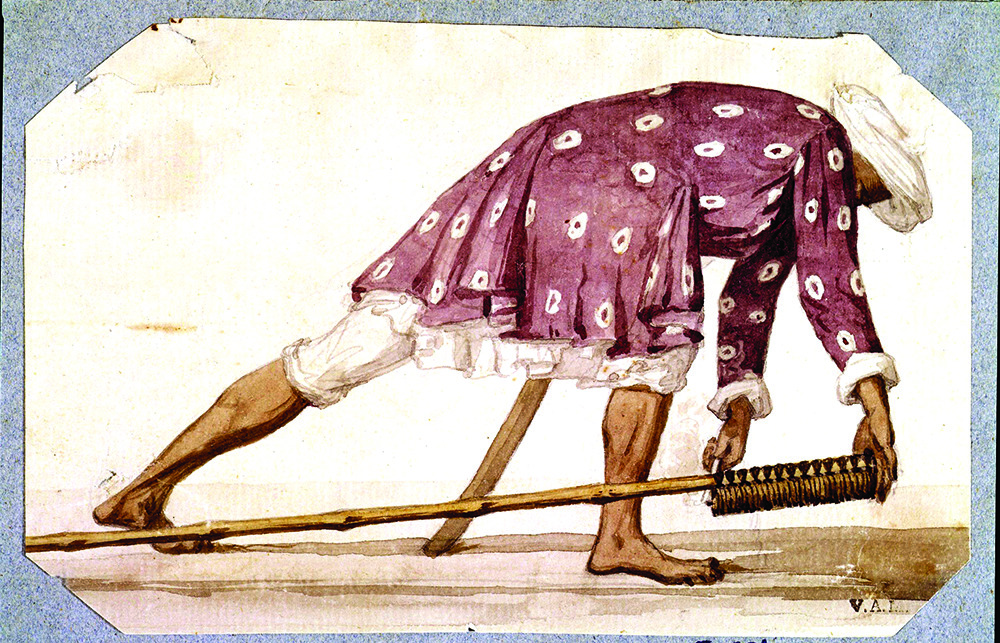
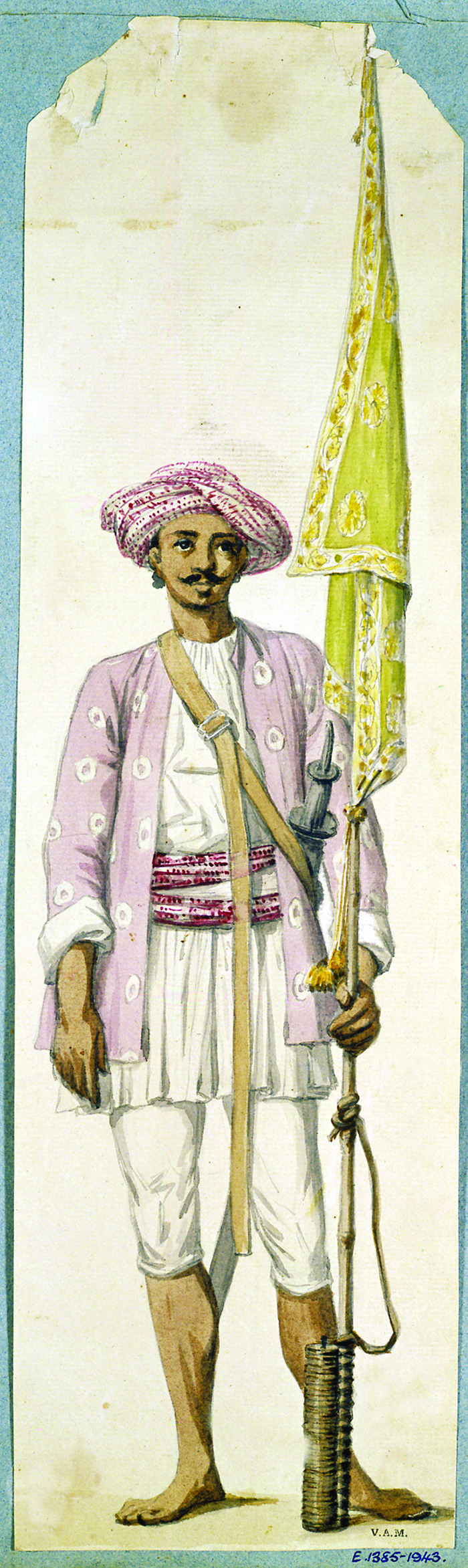
The rockets were basically metal cylinders that were filled with gunpowder and then strapped to a bamboo pole, sometimes up to 30 feet long. Mysore rockets had the highest range of around 1 km. During Tipu’s time, more changes were made to these rockets. From a few hundreds, the ‘cushoons’ – or regiments handling rockets – reached a high of 5,000 men during his time. During the battles of the III and the IV Anglo-Mysore Wars, the rocket cushoons had a terrifying impact on the British forces, as recounted in several accounts of the period.
The area where these rockets were found was part of the Keladi Kingdom, one of the bigger principalities in Karnataka and was annexed to the Mysore Kingdom in 1763 by Hyder Ali. His successor, Tipu Sultan built a mint and an armoury at Nagara. Thus, these rockets are from between 1763 and 1799.
Nidhin George Olikara, a historian with specialisation in Tipu’s era, said: “These rockets were found sometime ago but were identified as rockets recently. Nagara in Shivamogga district earlier was home to an armoury and mint during Tipu Sultan’s rule. The work of researchers is now over and scientists should step in to find out what kind of iron has been used to make rockets.”
THE REMAINS
The newly discovered rockets are actually the iron casings. Those are the only part of the rocket that could have survived being buried for 200 years. The other parts, such as the bamboo pole and straps, are long gone. Like the records of that age which mention Mysore rockets of various sizes, the Shivamogga rockets are also found in various sizes. Most of the rockets are 7-8 inch long. A few of them are longer. The circumferences are 1, 2 or 3 inches.
source: http://www.bangaloremirror.indiatimes.com / Bangalore Mirror / Home> Bangalore> Cover Story / by Bangalore Mirror Bureau / by S. Shyam Prasad & Gururaj B R / January 20th, 2018
Bharatiya Janata Party (BJP) NationalSecretary and Spokesperson, Syed Zafar Islam, will be felicitated with Jamia UrduAligarh’s (JUA) highest award, the “Daktoor-e-Adab”, on the occasion of its Foundation Day on April 16.
The Vice-Chancellorof the institution, Musaid Kidwai, invited Islam as the Chief Guest of the ceremony commemorating the 79th anniversary of JUA’s Foundation Day, wherein he will be bestowed upon with the award, whose previous recipients include high-profile names like Indira Gandhi, VP Singh, Dilip Kumar, Dr Zakir Husain, Mahesh Bhatt, etc.
JUA is the first distance educationinstitution in the country which provides educationto the deprived classes through Urdumedium since 1939. It has around 1100 centres across the country. The institution is also engaged in modernising the madarsa educationin the country.
(This story has not been edited by Business Standard staff and is auto-generated from a syndicated feed.)
source: http://www.business-standard.com / Business-Standard / Home> News-ANI> National / by ANI / Aligarh (Uttar Pradesh) / April 15th, 2018
APM Mohammed Hanish took over the reins on Thursday as Elias George bowed out from the top job after successfully completing five years with Kerala’s prestigious project. After assuming office, Hanish said his primary aim will be to smoothen the path ahead for KMRL. “Our main focus will be the extension of Kochi Metro up to Tripunithura.
Along with that, we will also launch the second phase of the project, from Jawaharlal Nehru Stadium to Kakkanad.
Another project we are carrying forward is the Water Metro, which is expected to revolutionise the transport sector in Kochi,” Hanish said.
However, the newly appointed managing director of KMRL said there are certain challenges in front of KMRL. “These include the land acquisition hurdles,” he said.”We need to speed up the land acquisition proceedings for completing the project in a time-bound manner. I believe my experiences with the Kerala Roads and Bridges Development Corporation (RBDCK) and PWD will help me in achieving the goals. Kochi Metro is, of course, a prestigious project and I’m happy to become a part of it.
The work culture, as well as the office environment, is quite different at KMRL. The young brigade consisting of vibrant staff members is the real strength of KMRL.” The outgoing MD, Elias George, said the new chief will have to undertake some key challenges, including the second phase of expansion of Kochi Metro.
“Personally, I will say that my tenure with KMRL as its MD is one of the most satisfactory jobs that I have undertaken in my whole career,” he said.
Hanish, who also holds the top position with Supplyco, had served as the nodal officer for the FIFA U-17 World Cup matches in Kochi.
He is also the officer-in-charge of the Kochi Smart City Mission.
source: http://www.newindianexpress.com / The New Indian Express / Home> Cities> Kochi / by Express News Service / November 03rd, 2017
The 65th National Film Awards were announced on Friday by Shekhar Kapur, the head of the Jury for feature films.
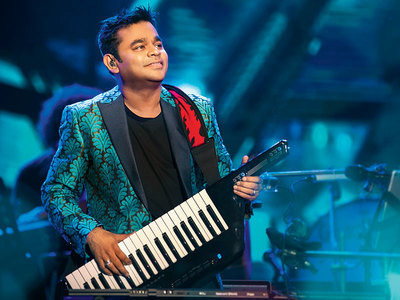
Music director AR Rahman has been honoured with two prestigious National Awards for the year 2018. He has bagged the Best Music Director award for ‘ Kaatru Veliyidai ‘ directed by Mani Ratnam and also won the Best Background Score award for the film ‘ Mom ‘ starring the late Sridevi.
The 10-member-panel reportedly comprised of screenwriter Imtiaz Hussain, lyricist Mehboob, actress Gautami Tadimalla and Kannada director P. Sheshadri among others.
source: http://www.timesofindia.indiatimes.com / The Times of India / Home> E-Times – Entertainment News / News> Entertainment> Hindu> Music> News / TNN / April 13th, 2018
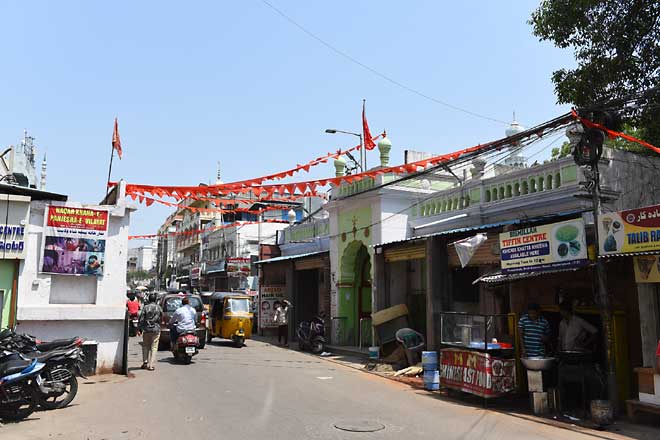
The area of Panje Shah houses relics of saints and the Messenger of God and many stories of forgotten riches .
Kali Kaman road in Panje Shah. — Photos: Surya Sridhar
The area of Panje shah has a rich history behind it. The word, ‘Panja’ means an ‘imprint of hand’. It is located on the left of the main road leading towards Kaali Kamaan from Aitbaar Chowk. The story goes that during the reign of Sultan Abdullah Qutb Shah, a person named Ibn-e-Sher Ali came to Golconda from Najaf-e-Shareef in Iraq, where Hazrat Ali is buried.
He brought an imprint of the Hazrat’s hand and gifted it to the Sultan, who built an Aashoor Khana and installed the imprint there. The imprint is an amalgamation of metals and resembles solid wax. Light brown in colour, it is about 15 inches in length and 8-10 inches in width. The holy names of Prophet Mohammed, Hazrat Ali, Hazrat Bibi Fatima, Hazrat Hasan and Hazrat Hussain are engraved on the Panja. It is covered with a piece of cloth. Above the Panja on a platform is an alam(standard). Since it was installed by the king, the area came to be known as Panje shah.
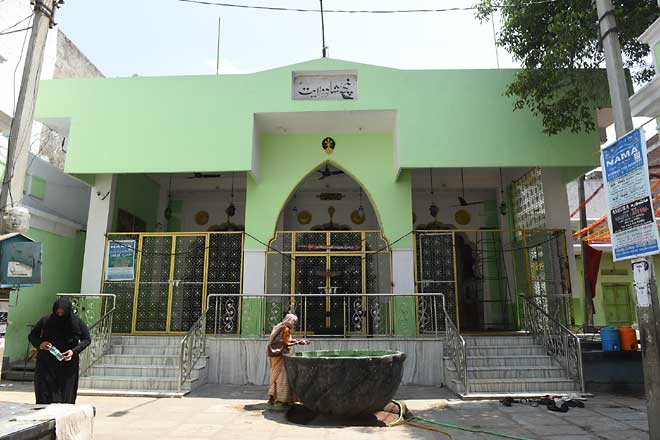
During the mourning month of Moharram, more alams are set up around it. A round stone cistern is placed in the courtyard, where the sharbat prepared during this month is stored and distributed to the visitors.
On the walls are some paintings depicting the martyrs of Karbala, scenes of strange phenomena like bleeding trees among other subjects of the artworks.
Opposite this holy place is another place of faith called ‘Qadam-e-Rasool’, where a foot-print of Prophet Mohammed is placed. Sayyad Mohammed Ali is said to have got it from Isfahan, Iran, in 1575, along with adequate proof of its authenticity. He bought a large house, got it decorated and installed the footprint there. (Qadam-foot, Rasool-Prophet Mohammed). There are two stone reservoirs at the gate which are filled with milk beverage (sharbat) and distributed to the devotees during Moharram.
The annual Bibi ki Sawari, which arrives on an elephant stops here on the 10th day of Moharram. It is said Bibi Fatima, the daughter of the Prophet and mother of Hazrat Hussain, laments and woes about the merciless killing of her son in Karbala. This scene is so heart-rending that it leaves everybody present in tears and inconsolable.
Apart from the holy footprint, relics such as the hair of Hazrat Ali and Hazrat Hussain are also kept here.
A round stone cistern in the courtyard, where the sharbat prepared during the month of Muharram, is stored and distributed to the visitors. — Photos: Surya Sridhar
Gurvanna gali
Opposite Panje shah is a lane named after Hakeem Guruvanna, which leads to Mir Alam Mandi. An important landmark of this lane is Kashmiri Qivam factory, established by the descendants of Guajarati businessman Poorandas Ranchoddas, in 1973. Qivam is a paste made of saffron, tobacco, cardamom and other spices which is added to paan to give it a kick. This Kashmiri Qivam was a favourite with film stars like Sunil Dutt, Meena Kumari and Nargis. Shaik Mujeeb-ur-rahman, the first President of Bangladesh was also a customer. Apart from Qivam, a hair oil named ‘Zulf-e-Kashmir hair oil’ is also prepared here. The factory is spread over a vast area of 3,700 sq yards and is managed by the grandsons of Poorandas ji. A Shivalaya has been constructed here near a large peepal tree.
Deghchi galli
This lane is situated close to Guruvanna galli and owes its name to a fantasy like story. Long ago, a deghchi (a vessel) full of rich gems and jewellery was found here during digging. Close to Panje shah is another lane called Kotaah galli (narrow lane) which is erroneously called Kotta galli.
On the way to Panje shah from Aitbaar Chowk, lies the haveli of Raja Mahipat Ram, an army commander and a minister of the second Nizam. It was called ‘baawan darwaazon ki haveli’ since it had 52 doors. The havelis of Raja Vithal Pershad and Raja Shainblum Pershad were also located here and came on the way to Kaali Kamaan and Gulzar Houz.
Upon crossing the Kaali Kamaan, one also gets to see several shops selling kites, thread, maanja and charqas. The kites have many fascinating names like dulhan, pachchisi, langot, aiyyawar, ek qakam, gola suleman, chand-tara, singhada, and lehanga. Similarly, the names of maanja are also very interesting like motiya, gandhak, feroza, and angoori to name a few.
source: http://www.telanganatoday.com / Telangana Today / Home / by Dr. Anand Raj Varma / April 15th, 2018
Going With the flow: Mansoor Khan. —Photo: Sushil Kumar Verma
Filmmaker Mansoor Khan on the cinema of his illustrious father and his comeback plans
Director Mansoor Khan puts his father Nasir Husain’s contribution in perspective following the release of Music, Masti, Modernity – The Cinema of Nasir Hussain by author Akshay Manwani in New Delhi recently. Excerpts from an interview:
The book mentions that you criticised the kind of films your father made. What then made you take up filmmaking?
I always thought I wanted to do engineering. I pursued it for 5 years, but when in my last year at MIT, I felt I did not want to be in a 9 to 5 job. I dropped out and returned to India. Around this time, I wrote a short film and shot it with friends. It turned out well and my father felt I could direct. He did not guide me formally, but I learnt a lot sub-consciously when I was in school and college and that is what I recalled while working along with him on the script of Qayamat Se Qayamat Tak.
Your dad was a dynamic personality. As a son, how do you remember him best, as a writer, producer or director?
I always think of my father first as a writer, director and then producer. That is the order in which he emerged as a film personality. His forte was writing and he developed a unique style that was fresh and counter-current to the times. That is apparent from the movies he wrote and directed.
He wrote dialogues for a number of films but his dialogue writing was always under appreciated?
I feel that he wrote dialogues with subtlety, without being overly melodramatic. Audiences tend to remember dramatic dialogues and that is why he is under-appreciated. That applies to his sense of humour too.
What are the elements that made him standout in the league of top filmmakers?
The primary focus of my father was to entertain the audience with finesse, and leaning towards the new. This combined with excellent music and hilarious situational comedy made a tasty concoction that worked time and again. He made no bones of the fact that he repeated the basic plot in most of his films.
Nasir Husain changed the way Hindi film heroes behaved on screen. Did you have any particular image in mind while writing the role for Aamir Khan in Qayamat Se Qayamat Tak and Jo Jeeta Wohi Sikandar ?
In QSQT he had to play an honest man who loved his father and family, and also stayed true to his girl. These counter forces created the endearing moments in the film. Sanjaylal inJo Jeeta…. is a brat who wants the easy way out in life and has a justification for all his antics. He needs to grow up and understand what character and hard work are all about. This he learns the hard way when his actions almost result in his brother losing his life and shattering his father’s dream of him winning the cycle race. So it is not as though I have a particular hero in mind. It has to be true to the premise of the story.
What kind of music he used to listen to? Who were those singers who influenced him?
He had a tremendous intuitive sense of a good melody. It is hard to pin down which singer he liked particularly, because he went mainly for was a good melody. It could be in any genre of music from western pop to Indian folk. He did not advise me as such but he led me to listen to some bands in the early ‘70s like Pink Floyd and Emerson, Lake and Palmer that influenced my taste. He bought their albums on trips abroad. That is how I ended up listening to them.
Aamir Khan assisted your father before becoming an actor. But the kind of cinema he makes is different from Nasir’s cinema.
Aamir has a tremendous love for cinema and a great sense of script. He goes by his inner instinct and belief in a good script.
Are you planning for a comeback!
I live peacefully in Coonoor and I am following my heart. I was clear about this even before I made my first film. I will continue to follow my heart and if that leads to a film then so be it.
I will make a film if it comes to me but that has to emerge from within. As of now, I am not planning ,it but be optimistic about the future.
source: http://www.thehindu.com / The Hindu / Home> News> Cities> Mumbai / by Atif Khan / November 10th, 2016
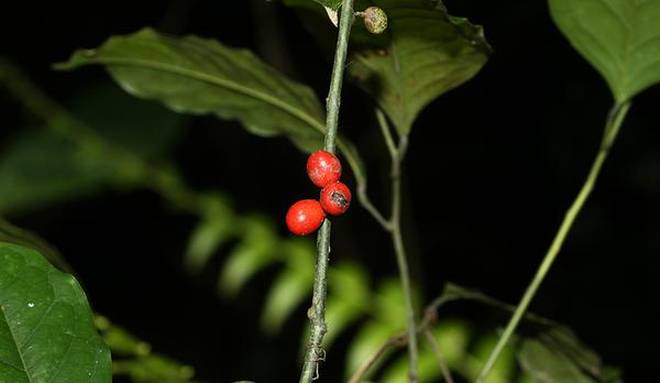
Drypetes kalamii: The plant is found in the wet, shaded areas of subtropical, moist semi-evergreen forests, at heights of 50-100 metres.
The plant is named after former President Abdul Kalam
Scientists from the Botanical Survey of India have identified a new plant species from two protected National Parks in West Bengal. Named Drypetes kalamii, it is a small shrub found to be shorter version of its close relative Drypetes ellisii. This adds to the rich floral wealth of India.
Standing just 1 metre tall, the newly described plant is unisexual in nature, which means they have separate male and female plants.
“During the survey and documentation of the flora of Buxa National Park, West Bengal (core area of Buxa Tiger Reserve), in 2011, I came across these plants, but could not identify them. Another author of the paper had collected a new female plant with fruits from Jaldapara National Park, West Bengal. The fruiting specimen can be easily identified in Drypetes. We later found that both the plants belonged to the same species. Further consultations with plant biologists from India and abroad helped us confirm its new identity,” says Dr Gopal Krishna from BSI who is the first author of the paper published in Phytotaxa. The researchers compared the new plant with other Drypetes species and found differences in the leaf, flower and fruit structures. There are about 220 species of Drypetes identified across the globe of which 20 have been reported from India.
Medicinal cousin
“The new species is a close relative of a medicinal plant known in Sanskrit as Putrajivah”, says Dr K. Karthigeyan, scientist at BSI and corresponding author of the work. “NASA had recently named a new bacterium after Dr Kalam, and we also chose his name as he is a big inspiration for students and young researchers,” adds Dr Karthigeyan.
The new species is found in wet, shaded areas of subtropical moist semi-evergreen forests, at a height ranging 50-100 metres. With pale yellow flowers in clusters and bright orange to red fruits, the plant is exclusive to the two national parks.
By following the IUCN (International Union for Conservation of Nature) rules, the scientists have provisionally assessed the plant to be “Critically Endangered”. The report states forest fires and grazing as two plausible threats to the new species.
source: http://www.thehindu.com / The Hindu / Home> Science / by Aswathi Pacha / February 24th, 2018
A file photo of the iconic Moazzam Jahi Market, photos of which were part of the exhibition organised by the Deccan Heritage Trust in partnership with Heritage Buffs at the Ibrahim Mahal during Nizam VII’s 132nd Birth Anniversary celebrations.
Hyderabad:
Ninety rare still photographs depicting the public buildings constructed by Mir Osman Ali Khan, the Nizam VII were put on display as part of his 132nd Birth Anniversary celebrations.
The images, drawn from private collections, date back to the Nizam’s rule and include a picture of the Osmania Hospital in the 1920s, and an aerial view of Hussainsagar, showing a functioning thermal power station dating back to the 1940s.
On display was also a picture of the inauguration of a church in Secunderabad, and even rarer images of restoration and conservation work commissioned by the Nizam, of the Ajanta and Ellora caves, undertaken between 1914 and 1932.
“These photographs provide a glimpse of the grandeur of the Asaf Jah and bring to life the many influential and multi-faceted contributions of Osman. The photographs also highlight the treasures that Hyderabad is gifted with,” said Sajjad Shahid, convener, Centre for Deccan Studies.
The intention of organising the event was to raise awareness and kindle hope and optimism for the sustainable conservation of Hyderabad’s iconic heritage for the benefit of all.
The event was held at a heritage building, Ibrahim Mahal, La Palais Royal, and was hosted by the Deccan Heritage Trust in partnership with Heritage Buffs, a WhatsApp group of heritage lovers.
“We were delighted to host this first-in-a-series of events to catalyze a beneficial change and make meaningful contributions to the sustainable conservation of Hyderabad’s heritage and highlight its culture,” said Mohammad Safiullah, Head of the Deccan Heritage Trust.
Meanwhile, the members of the Nizam Family Welfare Association and other historians paid floral tributes at the grave of Mir Osman Ali Khan, at Masjid-e-Judi, King Kothi.
source: http://www.deccanchronicle.com / Deccan Chronicle / Home> Nation> Current Affairs / Deccan Chronicle / April 07th, 2018
The Small Industries Development Bank of India (SIDBI) commemorated its foundation day as day of Sampark (connect), Samwad (interaction), Suraksha (security) and Sampreshan (dissemination).
The bank’s chairman and managing director Mohammad Mustafa launched a series of initiatives from Lucknow headquarters. “The occasion is an opportunity to look within and reinvent our strategy for course correction and development,” he said.
While flagging off the bank’s MSME contact programme, he called upon bank’s officers to use the day long stay at MSMEs to come closer in understanding their opportunities, challenges and the eco system to comprehend what can be done to ease the way they do business. This is what SIDBI has been created for and learning with footprints at field level is the true spirit of the organisation, he said.
A new step forward in commencing Bancassurance services for MSMEs was also taken.
An MoU was signed with New India Assurance and two MSMEs were issued insurance policies.
While launching the revamped SIDBI website (www.sidbi.in) on the occasion the CMD mentioned that it is an attempt to reimagine the site to reflect the new vibrant face of SIDBI aiming to transform the MSE ecosystem.
Besides providing crisp and precise information about the various strategic interventions made by SIDBI, it exhibits potential for the MSE aspirants through its other offerings in the form of a “Contactless Loan Platform” likely to be introduced on the website shortly.
source: http://www.dailypioneer.com / The Pioneer / PNS, Dehradun / April 04th, 2018