Category Archives: Leaders

Tall Islam and Short Muslims – Book by Mumtaz Ali Khan Released

Bengaluru , KARNATAKA :

ProfMumtazMPOs30mar2017

Bangalore:

A book titled, Tall Islam and Short Muslims by former minister Prof. Mumtaz Ali Khan was released by Karnataka Governor, Mr. H. R. Bharadwaj at a brief ceremony at Raj Bhavan here on September 5. Published by Concept Publishing Company, New Delhi, the book deals with misperceptions about Islam among people consequent to deviations in practices by Muslims. It runs into 240 page and is priced at Rs. 700.
Speaking at the occasion, Prof. Khan who is a BJP MLC currently and was a minister for three and half years under the Yeddyurappa Ministry, said he had dealt with issues such as status and rights of women in Islam, marriage and divorce, rights of children, language, loan and interest, wealth generation, gambling and drinks, fatwas, violence and religious harmony where he has seen dichotomy between what Islam preaches and what Muslims practice. He said teachings of Islam in their pristine form were still alluring for the people, but the character of Muslims breeds repugnance.
Governor Bharadwaj said there must be an all-round effort to promote harmony in the society and people should not engage in hurtful talk about others’ religions. He said Islam promoted love and he had extremely cordial relations with Muslims while living in Old Delhi for decades together. He attributed the divisive tendencies to modern communal and competitive politics.
Shri Shivarudra Swami of Beli Mutt highlighted the concept of equality and equity in Islam and the Prophet’s life and said no religion preached hatred. Maulana Maqsood Imran of Jamia Masjid, Bangalore city also spoke at the occasion. Prof. Ziauddin Ahmed welcomed the gathering.
Prof. Mumtaz Ali Khan has taught rural sociology in the University of Agricultural Sciences, Bangalore for over two decades. He has authored 18 books on various aspects of Dalit and Muslims society and has been engaged in welfare activities through his Khawaja Gharib Nawaz Centre for Harmony and Development. He also runs the Salamat Kannada School in Chamundinagar area of Bangalore.

source: http://www.islamicvoice.com / Islamic Voice / Home> Community RoundUp / by Admin / October 17th, 2017

The Riyasat Of Raja Mehmoodabad

Mehmoodabad (Sitapur District), UTTAR PRADESH :

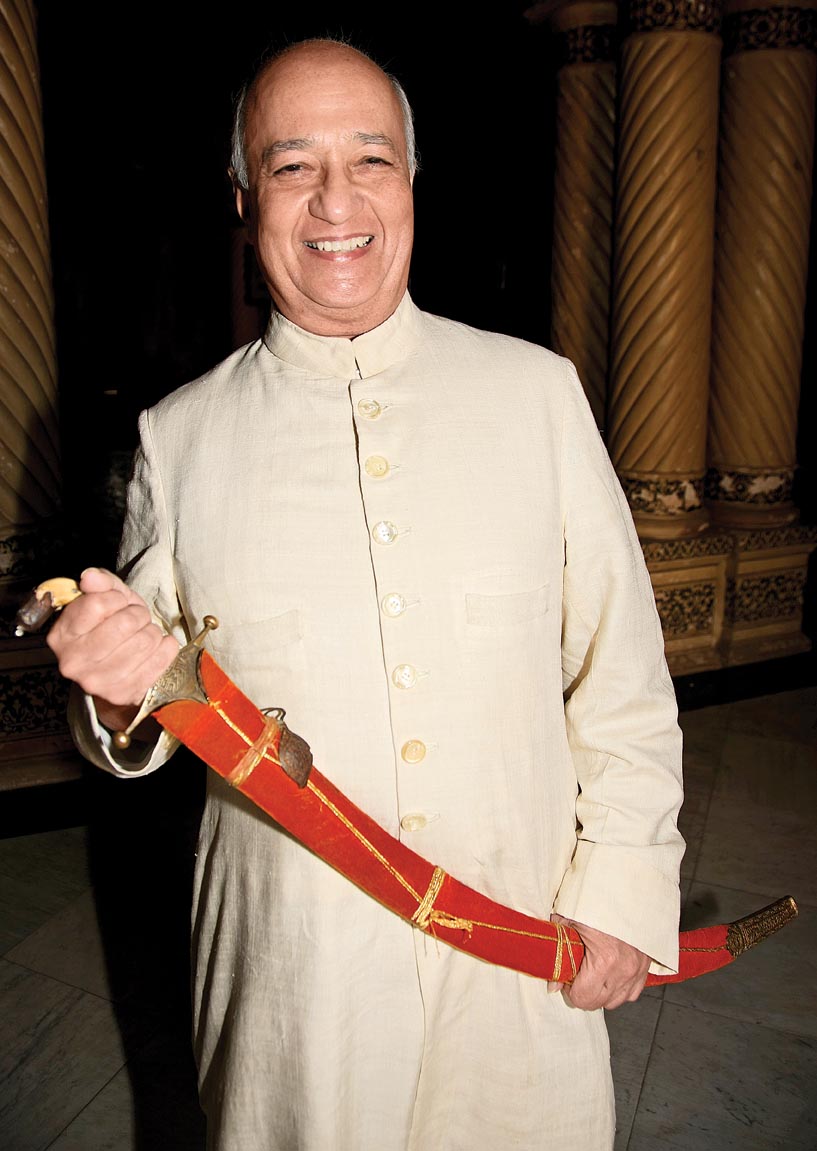
It is a formidable lineage. And the huge responsibility must wear heavy on the elegant shoulders of the suave and articulate, Cambridge educated Raja of Mehmoodabad. Farzana Behram Contractor comes away a fan of the Raja – Amir Mohammad Khan, Suleiman to friends.
Raja01MPOs30mar2017

We all have days in our lives we count as memorable. Spending a day in the life of the Raja of Mehmoodabad is one such in mine. It was special because I saw a part of life so removed from the ordinary, yet so similar because of the simplicity and warmth lent to it by a human being who is nothing if not extraordinary.

I suppose all the questions I asked– and I asked questions all day long, sent the Raja of Mehmoodabad on a trip to nostalgia. He spoke non-stop, till he was hoarse by nightfall. It was for him, an emotional journey. Let me recount it for you.

I was chatting with all the chefs, while at breakfast at The Sahib Cafe of the beautiful Taj Residency where I was staying. I had already received the message from the Reception – the Raja had called to say ‘he would be five minutes late, please bear with him.’ Five minutes! And he called to say that!

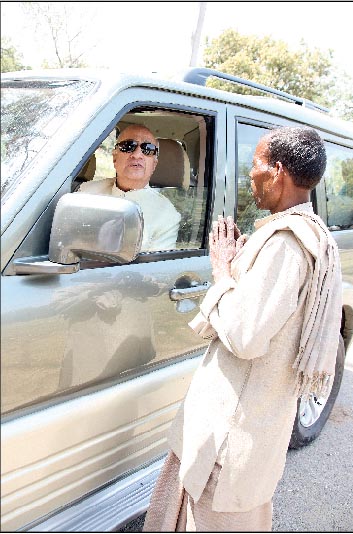
Within minutes I heard a gentle, soft-spot spoken, enquiring voice,  “You are Farzana.” I looked up and he continued, “I am Suleiman, sorry I got a bit late.” Flustered, I sprang to my feet. I was expecting the chauffeur to come fetch me, not the Raja himself! Talk about the Lucknow tehzeeb. It’s so humbling. As we walked to his jeep he said smilingly that he had done his ‘due diligence’ on me. Checked me up on the net and therefore recognized me in the restaurant. Phew, long live the internet.

We started to drive towards Mehmoodabad, the Raja’s erstwhile principality. We were going to eat lunch at his mahal, which I was really looking forward to. I had heard that there were none better than the khansamas at his palace. Cruising along rural Lucknow was new to me. And I found the sights rather pleasant. It was already so relaxing.
Raja02MPOs30mar2017

Raja03MPOs30mar2017

“Tell me about your family…” I began, and the first thing the Raja said, rather strangely, was, “My father was fond of itr(attar), though within limits. We had our own itr unit, never ever bought any from the market except occasionally some which was made in Mehmoodabad. There is a special method of processing it, so as not to lose its scent. Silver pot, silver ladle.” And he went quiet for a while. I got the feeling he began to speak about his father in association with fragrance because he may have got a whiff of him in his mind. Happens you know, when you are very close to someone, you remember their personal smell, long after they are gone.

His father, Raja Amir Ahmad Khan was a special man, to his son as well as to a multitude of people. He was known as Raja Sahib of Mehmoodabad. He was born in 1914 and was educated in Lucknow and later in England. Raja Sahib’s father Maharaja Sir Mohammad Ali Mohammad Khan (1877-1931), was a great landowner of Uttar Pradesh and a trusted friend of Mohammad Ali Jinnah.

Raja Sahib succeeded to the estate of Mehmoodabad on March 23, 1931, on his father’s death. At that time Mehmoodabad was one of the richest estates of the Awadh. He was keenly interested in the Muslim renaissance and associated himself with the Muslim League at an early age. He was at one time the youngest member of the Working Committee of the All-India Muslim League. In 1937, he formed the All-India Muslim Students Federation, which mobilized the Muslim Youth for the cause of Islam. It soon became the vanguard of the Pakistan Movement.

Raja Amir Ahmad Khan also served as Honorary Treasurer of the League for several years. He was a puritan and ascetic in personal life and placed all his wealth and ancestral estate at the disposal of Muslim League.
Raja04MPOs30mar2017

Disillusioned by the political turmoil in the country in the wake of the Independence struggle, he migrated to Iraq. From there, much after Independence, he went to live in Pakistan. Subsequently he settled in London where he remained Director of the Islamic Culture Centre until he died on October 14, 1973 in London. He  was buried at Mashhad in Iran.

“The late Raja of Mehmoodabad, Raja Amir Ahmad Khan, was a worthy member of the long line of Maharajas of Mehmoodabad. The family took part in the uprising of 1857 for which it was punished with confiscation of a large part of its estate.” This is what Indira Gandhi had to say about his father in 1984 in a book entitled The Life and Times of Raja Sahib of Mehmoodabad by Syed Ishtiaq Hussain. In 1965, the same fate was to recur.

 A very rich ancestry for the present Raja. “Yes, I feel humbled by my ancestors. They were at the highest levels of civilization. They were poets, writers, educationists, men of letters who possessed a strong spirit of enquiry. The responsibility is enormous. Especially the moral legacy,” pondered the Raja. And then continued, mysteriously smiling at some thoughts that went through his mind, “My father was wonderful. He studied at La Martiniere and then had private tuitions. He was like a son to Jinnah, who told him, ‘I will be your university’. It was my grandfather who conducted the marriage of Jinnah and Ruttie. One, an Isnasari, the other a Parsi. They went to Metropole for their honeymoon!” Metropole, incidentally is a hotel in Nainital owned by the Mehmoodabad royals.
Raja05MPOs30mar2017

“Father was deeply involved in Pakistan’s struggle. Nehru and our family go back to Motilal days when my father, 22 years old and an idealist, became a member of the National Party. He was committed to the Islamic Cause, but was getting disillusioned by and by. He was shattered when the great slaughter took place and realized how mistaken they were in their assessments. He was saddened seeing the lust for money, property and power which were destroying human values.  In 1945 when he exiled himself to Iraq, he took his family, cooks, servants and the library and built himself a house and stayed on till 1957 when he shifted to Pakistan. He was a real scholar, a poet, a writer, both secular and religious. He spoke Urdu, Arabic, Persian, Hindi, Sanskrit and French.”

Speaking of his own involvement in politics, the Raja said, “I wanted to serve the country. Rajiv Gandhi chose me to stand from Mehmoodabad. I won the election in ’85 when the Congress came to power and again in ’89 when it did not. But when they wanted me to stand for a third term I declined. I was unhappy. I did not leave the party, just faded away, so to say. To be religious which I am, is not a bad thing. But to use it as an instrument to attain political power is not what I stand for. It involves lies, corruption. By ’91, I saw no more proof was needed, catastrophe in the country was imminent. There was communalisation of politics, criminalisation of politics, commercialisation of politics. Politics became a transaction! When I was an MLA, I toured a lot in the state and I see no quantum difference between ’85 and now. There is destruction of environment, all this monstrosity, who is responsible for it? Where is the prosperity in rural life, it is hardly noticeable.” He turned to the driver and enquired, “Kya farkh hua hai?” “Koi nahi, Sahib,” the driver replied, earnestly.

The Raja looked visibly disturbed. We know how the political system works in our country; ‘enrich our own selves’, ‘exploit caste’, ‘play the communal card’,  I could hardly visualise someone with his kind of sensibility surviving it. I quickly changed the subject, “What about your mother?” “Oh!” exclaimed. “She was a gem. A very moral lady, she passed away in ’91. My wife Vijaya (the pretty daughter of Former Foreign Secretary, Jagat Mehta), was very close to her. She was a Rani in her own right. Rani Kaniz Abib of Belahra. She had no brothers and so succeeded her father. She was in purdah, but highly educated and she was very interested in my education. She always said, ‘Nothing will remain except education. That will be with you, forever in this transient life’,” he trailed off.
Raja06MPOs30mar2017

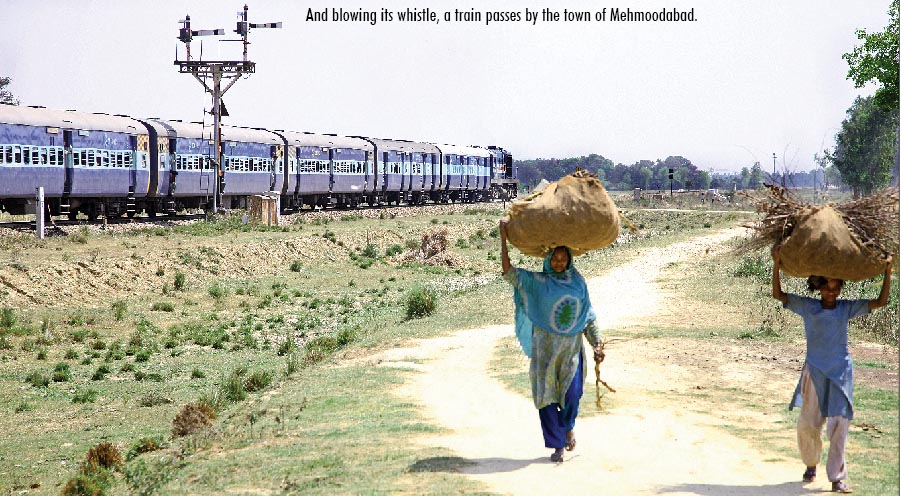
We were now approaching Mehmoodabad. And I was happy we were stopped by the red light at the railway crossing. It’s been a while since I had a chance to see the signal drop, watch a train pass by. I hopped out of the air-conditioned comfort to feel the warm air outside, walk on mud, look at the local people, shoot some pictures, hear the whistle blow, to know it was all clear and we could drive on through the metal gates. The small, forgotten pleasures of childhood come alive in such places.

Well, soon we entered the town of Mehmoodabad. Driving through the straight but narrow and crowded lane I saw people fold their hands together in a namaste when they saw the Raja’s vehicle. Some bowed in greeting, some raised their hands to their foreheads, yet others placed them on their heart. And in response the Raja kept doing an aadaab, nodding ever so slightly. It was touching. To them he is still their king. When I was foolish enough to make a passing comment about them being subjects once upon a time, he retorted, “We are all subjects of God, how dare we call them our subjects. And we are not subjects; we are all children of God.”

And so we discussed the subject of God and nature. “There is so much you take in faith. Though science is a deterministic theory it does not have all the answers related to life. Solace, grief, love. Two people look at the same thing differently. The beauty of the world is in its difference. Look at the diversity in nature, it’s beautiful. Look at the rainforest, each lives in its own niche.” I let him carry on, it was nice listening to him.“Love of God is first love of man. From there you go stage by stage. In every suffering God suffers with you, although you are his creature. He has a resonance. There is no answer to that. It transcends human rationality. Humari taqleef mein Allah ki tasbi hai. He is one whose name is itself a curative and whose remembrance itself cures one…” When I asked him if he prayed regularly, he answered, “Subject to my communication with God, that day. Sometimes I have a fight with him, like a child sticking his tongue at his mother, I sulk. But it’s a constant remembrance not of God only but of Him through his creations.
Raja07MPOs30mar2017

The gates of the palace were now in front of us. Nothing spectacular, on either side vendors had usurped the space. One of them was selling beautiful earthen pots, surais they are called. We drove through the vast driveway which had old mango trees spread out over the grounds. There was no pomp, no ceremony. It was apparent to me by now that the Raja, a tech-savvy, reserved, low profile man, is an intellectual who lives in the real world in an unfussy manner. He is someone who can stand in a queue for movie tickets, can and even does earn a living the honest way. He is an occasional professor of astrophysics at Imperial College, London, and the Instituteof Astronomy at Cambridge University, from where he had earlier done his mathematical tripos. “Mathematics,” he said to me, “is a language. There is such beauty in it.” I didn’t dare tell him at the time that I knew zilch about math and hated it the most at school.

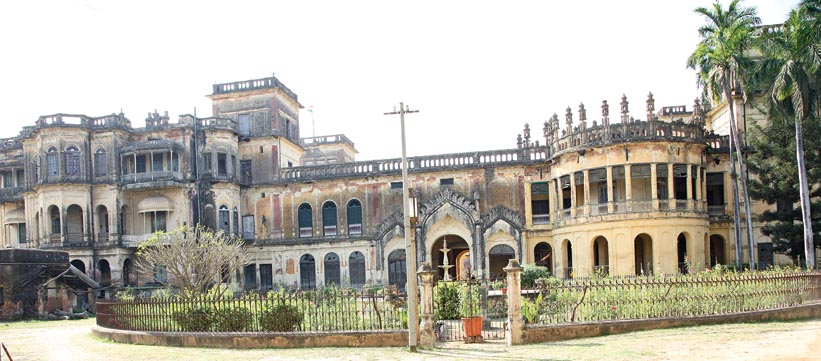
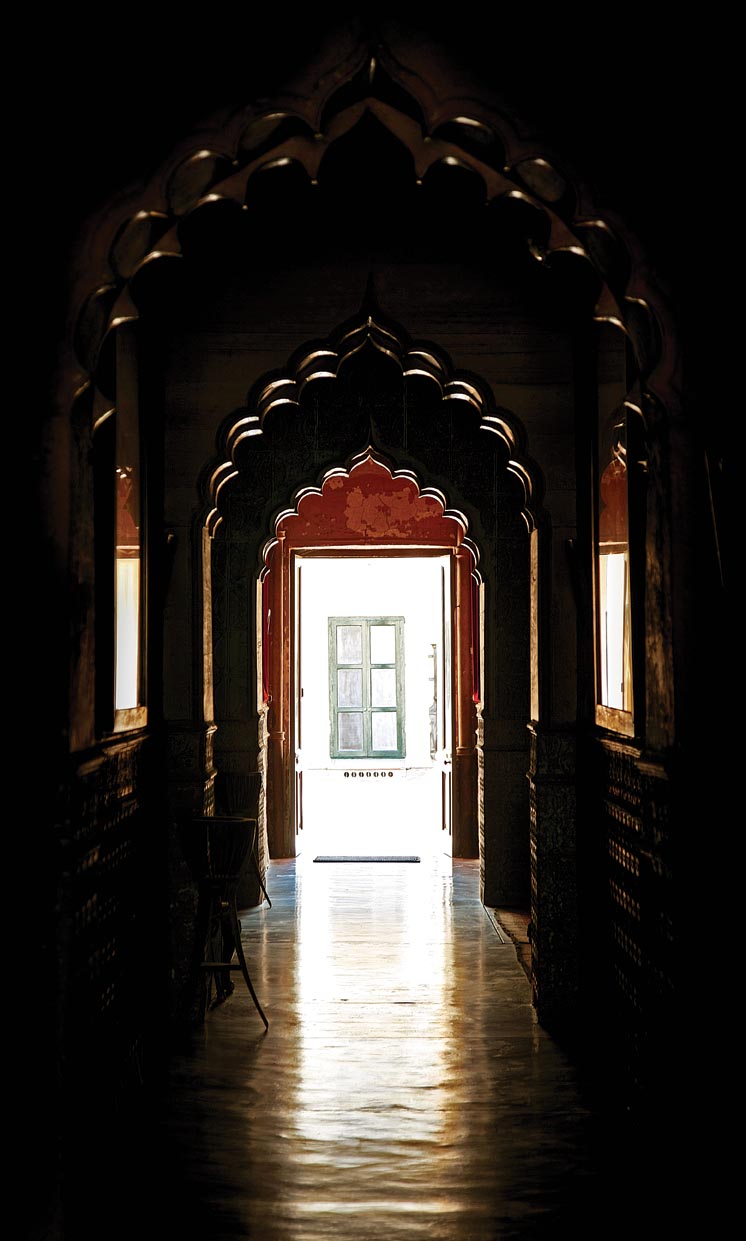
But here I was now, admiring beauty of another kind. The architectural one. The first thought that hit me as I stood watching the palace in front of me was: What a shame that all this was snatched away from the rightful owners and kept locked away for the longest period of time! I felt a surge of anger that such a monumental place was kept in a state of neglect, that it was allowed to go to seed! It is common knowledge that a vast amount of property owned by the royal family was impounded in 1965 by the government, as ‘Custodian Enemy Property’ – all because his father lived in Pakistan at the time.
Raja08MPOs30mar2017

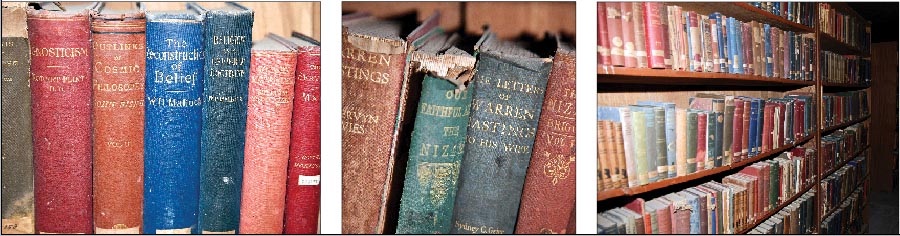
After a tour of the entire place (the Library has thousands and thousands of rare books), I requested the Raja to tell me about the horrible truth and his feelings now that he had won the 32 year long legal battle and got back all his properties spread over not just Mehmoodabad, but Lucknow, Sitapur, Lakhimpur Kheri and Barabanki districts in UP and Nainital in Uttarakhand: the impressive Butler Palace and the Metropole, among others.  “In 1965 when the war with Pakistan began, overnight they took over all our property. Surrounded it and sealed it. I was at Cambridge, at Pemberly then, and I was shattered. News didn’t get through so easily in those days. There were seals on every lock. When the Qila (that’s how he refers to the palace) was opened after one and a half years and conditional access was given to us, it was found that things were missing. A hundred quintals of silver, crystal, what not. My mother’s embroidered clothes were burnt just to extract the silver and gold embroidered in them. There was deep sadness in the family. We continued to battle, struggling against anger and depression. Eventually and only recently, we got all our properties back. But it will be a long haul before we sort out the complicated affair, for many properties have passed on to the third and fourth line of owners. What can I say; my friends had warned me that it was going to be a can of worms. But I felt that it was a can worth opening.”

I couldn’t agree more. It will baffle the reader to know that this property we are talking about is valued at thousands of crores of rupees. Half of the prime structures in upscale Hazratganj and Jopling Road which include Butler Palace and its lake are part of his ancestral property. When you view this injustice and unfair play against the backdrop of what this family has contributed, it is all the more disturbing. His great, great grandfather Raja Nawab Ali Khan-Muqeem ud Daula’s contribution to the first war of independence is recorded even in Surendranath Sen’s official history of the uprising brought out by the Information and Broadcasting Ministry during the centenary year in 1957. His grandfather was the first Vice-Chancellor of Aligarh Muslim University, an institution he helped set up.

“My family contributed so much to the country – Lucknow University, King George Medical College, Amir Daula Library and so many premier educational institutions. In fact, my great grandfather set up a school in Mehmoodabad way back in 1885. And here I was struggling year after year to fight a mindset which saw us as traitors,” said the Raja and added with a sigh, “But finally it is all over now.

Raja09MPOs30mar2017

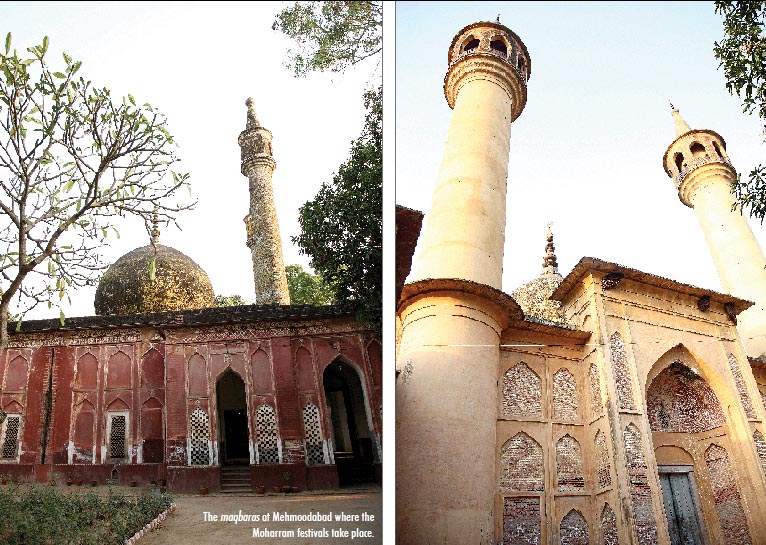
Lunch was announced. We walked through many halls to reach the dining room. Restoration work is an ongoing task, and beneath all the dust lay much beauty. I couldn’t help thinking what a beautiful hotel this Qila would make. The Raja makes only occasional visits here. But always during Moharram and Ramzan, to perform the many religious rituals that take place every year.

At lunch we discussed food. “Raja Sahib, my father, was very aware of the hunger and poverty around him and he was influenced by the finer teachings of the Caliphs. He was governed by, ‘no morsel you take is free from the hunger of another person’. But while he was always conscious of that fact, he was also gifted with discerning taste buds. He could and did appreciate the quality, fragrance and delicacy of the food cooked at home. But he could also deny himself the pleasures and often did.”

“We had a battery of cooks, all male. I remember three names, Hazari, Behraiji and Rasheed. Under them were many younger ones. Some from their families are still serving us. None of my ancestors drank, but served wines and liqueurs, with great finesse.They were not bigots, but would also make sure they did not affect the sensibilities of the orthodox. I personally never paid much attention to food. It was an ordeal to get through. One couldn’t eat what one wanted and vice versa. But everything was always cooked at home, including the breads. Kulcha, sheermal, taftane… Describing how food would be sent to his father wherever he was, he said, “Food was prepared and placed in a large octagonal container, with a seenee over it and then covered with shaal baat, a red cloth. The chamberlain would put his stamp on it and then send it to wherever my father was. It was carried on a khasa, on the server’s head. Ah, what a ceremony. At other times there would be a takht, a dwasterkhan, where the chamberlain would sit in the middle of the takht and pass things around, asking for comments!”
Raja10MPOs30mar2017

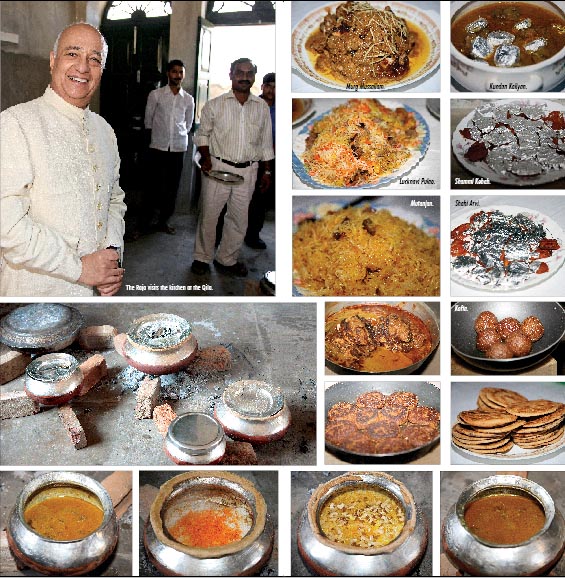
If the chamberlain was still around I would have thumped him on the back, the food I ate at the Qila was so exquisite. In his absence, I went looking for the cooks, found them in the kitchen with the last of the dying embers in the log and brick stoves and told them “Shabash, bahut acha pakaya aap sab ne, shukriya.” It went down well, but not enough for them to part with the mutanjan recipe I wanted. Instead very courteously they invited me to come again! “Phir zaroor aaye,” they said to me respectfully, not looking up.

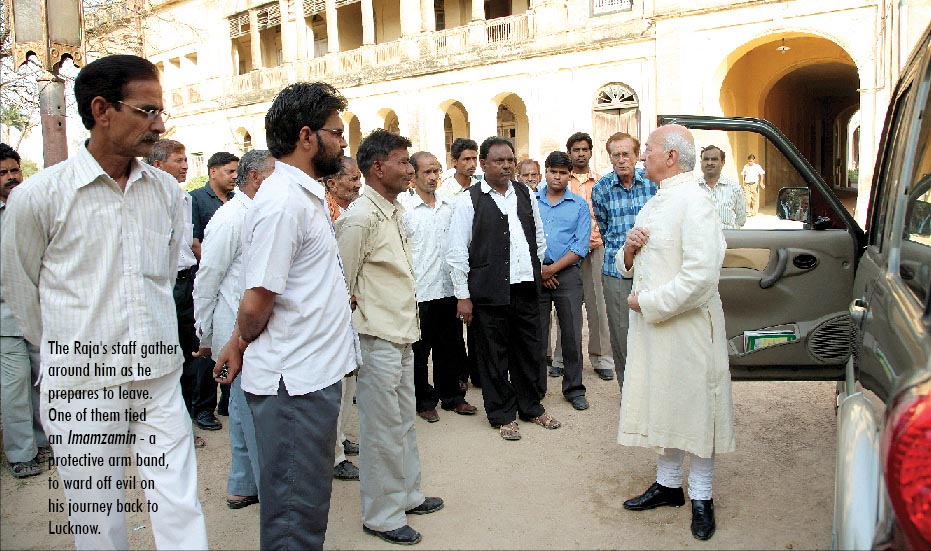
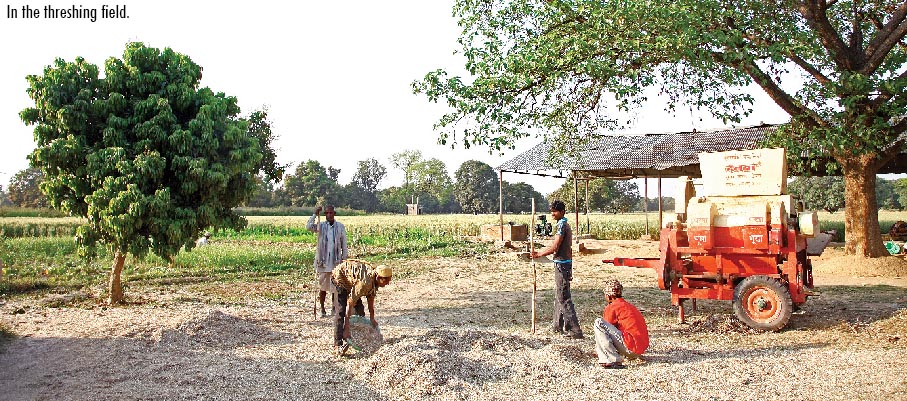
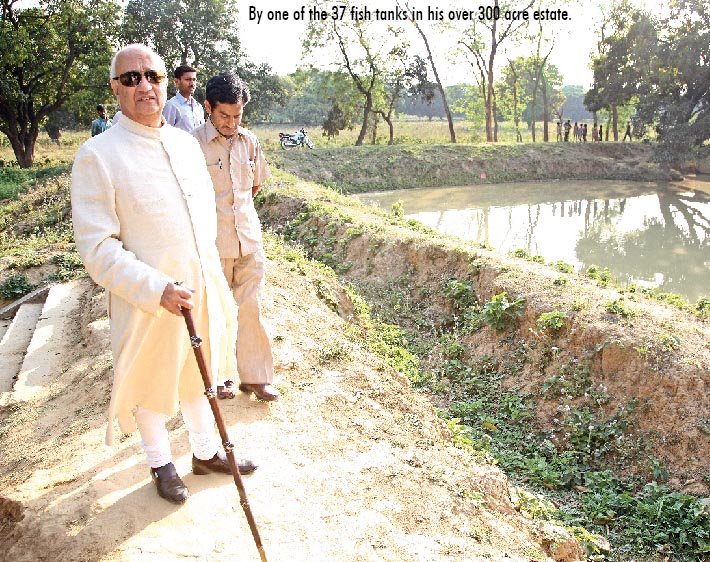
Soon it was time to leave, but not for Lucknow. We were first going to drive around the Raja’s fields. Just 300 acres! And we were not doing it for my sake as much as to listen to the tales of woe of his people and to check what was happening on his land. So we went and visited a group of cowherds and then walked alongside one of the 37 fish tanks (not your aquarium variety, but massive ones where his staff is breeding fish), we checked out a ‘party spot’ where marquees had been set up many decades ago, when the servants of the house wished to give the young Raja a farewell treat when he was going away to school (they made pastries which he was so fond of), and lastly we landed up at a field where mustard was being threshed. This was a historic moment of sorts. It was the first crop grown in over 35 years since the Government take over. The Raja of Mehmoodabad emotionally said a dua over the small wicker daliya full of tiny mustard seeds that the farmers presented to him. Later he chewed on a few of these tiny seeds and declared, “The mustard doesn’t taste so good, but it will improve.” He is like that – honest and egoless.
Raja11MPOs30mar2017

We were now driving back, but via Belahra, in memory of his mother. Her palace was charming. Looking at it and with my usual forthrightness, I blurted “This will make an even better hotel; there is so much character here.” The Raja merely smiled, but I got the feeling it may just about happen. His sons Ali and Amir may do so.

Our last halt was Dewa Sharif. A sufi durgah. We stopped to pay our respects. The smell of roses at the shrine was so dominant. My parents often used to visit this shrine and I have a faint recollection of being taken there as a child. I remember distinctly, the mitti ke bartan – tiny mud utensils we used to play with on our holidays in Lucknow. They were a speciality of this place. Meandering through the lane that leads to the durgah, I chanced upon a shop selling these. I was so delighted. Life always comes full circle.

The Raja of Mehmoodabad, Amir Mohammad Khan, who was now Suleiman to me, thanked me for a nice day as he dropped me back at the Taj, before driving off to Mehmoodabad House in Qaiserbagh, his home in Lucknow. It is I who would like to thank him. For a peek into history, for an insight into his private life and for showing me what grace and graciousness and true old world charm are all about. replica cartier, replica cartier watches, , womens cartier watches.
Raja12MPOs30mar2017

source: http://www.uppercrustindia.com / Upper Crust / Home / by Farzana Behram Contractor / July-Sept 2015 issue
Muslim League chief Banatwala dies

Mumbai (MAHARASHTRA)  / Thiruvananthapuram (KERALA) :
Mumbai / Thiruvananthapuram

Indian Union Muslim League (IUML) president Ghulam Mohammed Banatwala, 74, the national face of the minority community and a seven-time Lok Sabha MP from Kerala, died in Mumbai on Wednesday after a brief illness.

A gifted parliamentarian and orator, Banatwala espoused the cause of Muslims in Parliament on crucial issues like the Shah Bano case, demolition of the Babri Masjid and minority rights, including the personal law.

Ismail Banatwala, his nephew, said the Muslim League leader lived with his brothers after the death of his wife. They had no children. He had attended the platinum jubilee celebrations of IUML in Chennai last Saturday. “When he returned home early this week, he felt uneasy, restless and feverish. This morning he had breakfast with all of us.

At about 2.30pm he experienced uneasiness and breathed his last on the way to hospital,” Ismail said. The mortal remains of Banatwala is to be brought to his Agripada home in south Mumbai. Several of his colleagues from Kerala are expected to attend the funeral.

Born in Mumbai, Banatwala was returned to Parliament with very high margins reflecting the trust people in the north Kerala area, dominated by Mappila Muslims, reposed in him.

That this scholar who served one term in Maharashtra assembly and never spoke in Malayalam in his Ponnani constituency in Kerala did not dilute his charisma. People used to listen to him with rapt attention when he addressed them in English.

Despite these constraints, he struck a chord with the common man as he was always at the forefront of taking up their problems, both in Parliament and outside. Banatwala was the national face of IUML, especially after Ibrahim Suleiman Sait left the League and floated Indian National League (INL) following differences with a section in the party over continuance of ties with the Congress after the Babri Masjid incident.

Banatwala was one of the Muslim leaders who vociferously argued for implementation of the Sachar Committee report for social and educational support to the Muslim community. IUML state president Panakkad Muhammadali Shihab Thangal, state general secretary P K Kunhalikitty and other leaders expressed sorrow at the passing away of Banatwala. Black flags were put up in Muslim League offices across Kerala as the news of Banatwala’s death spread.

source: http://www.timesofindia.indiatimes.com / The  Times of India / News Home> India / PTI / June 26th, 2008

Suleiman, After Vanvas

Mehmoodabad (Sitapur District), UTTAR PRADESH :

Awadh. Princes always return to reclaim lost kingdoms here. Epic repeats itself—it’s a long-fought victory in Mahmudabad.

RajaMehmoodabadMPOs30mar2017

The modern age is replete with tales of kingdoms and empires lost. So when the erstwhile ruler of a state in Awadh suddenly regains the splendid accoutrements of his princely past, it’s a tale with a deliciously ironic twist. But since this is a modern fairy tale, it was a judicial decision—and not a magic wand—that restored to the Raja of Mahmudabad his vast properties and land holdings in Uttar Pradesh.

The Mahmudabad properties were confiscated as “enemy property” under the Defence of India Rules in 1962, when the then raja migrated to Pakistan, leaving his wife and young son behind in India.

After the old raja’s death in 1974, his son, the present raja, launched a long struggle to reclaim his inheritance.
He petitioned prime ministers from Indira Gandhi to Rajiv Gandhi, and fought a series of court battles that finally ended in late September 2005 with a Supreme Court judgement. In its landmark decision in a case called Union of India and Another versus Raja Mohammad Amir Khan, the court gave directions to release the properties to the only living heir of the late raja. In the months since then, the raja has been busy trying to get back possession of his properties, many of which have been occupied by the government all these years.
The Mahmudabad assets make an impressive list.
There’s the Metropole Hotel, occupying 11 acres of prime flat land in Nainital, built by the British in 1880, and purchased by the current raja’s grandfather in the 1920s. It’s now back in possession of the family.
Another jewel in the Mahmudabad crown is a Lucknow landmark and architectural gem built by his grandfather in 1919—the Butler Palace, which includes a lake. The raja now plans to turn it into a heritage hotel and reveals that top hoteliers, including those who restored the Neemrana properties, have shown a great interest. “But I may do it on my own,” he says.
Valuable real estate of which the raja has yet to get possession include the Lawrie Building and the Mahmudabad Mansions in Hazratganj—Lucknow’s main shopping hub.
Then there are sprawling acres scattered across what was once the kingdom of Awadh. In his family’s ancestral seat, Mahmudabad, the raja now owns a sugar mill on 80 acres of land, a textile mill on 30 acres, the Jawaharlal Nehru Polytechnic on 50 acres and five lakes.
In the town of Sitapur, he now becomes the legal owner of the district magistrate’s residence on 17 acres, the superintendent of police’s residence on seven acres, the chief medical officer’s bungalow on 13 acres, in addition to a huge chunk of the town’s civil lines and 70 acres of urban and rural land.
In Lakhimpur district, he gets around 60 acres of urban and agricultural land, including the SP’s bungalow. In Barabanki district, there are 40 acres encompassing a degree college.
What is the combined worth of the assets? “Value is a relative thing,” replies the raja, revealing the typical disdain of his class for commercial calculations. “God knows the value. These are all encumbered assets. And how do you value a history, a past?” Property dealers, however, give estimates upwards of Rs 200 crore.
Yet the tale of the House of Mahmudabad is more than the value of their miraculously restored assets, a tale that cannot be reduced to real estate figures and property prices. It is a tale that reveals those old wounds, some self-inflicted, which North Indian Muslims still bear—a tale of divided family, of a search for a Land of the Pure that would remain elusive.
It is about the fast-fading elite nawabi culture of Lucknow, now swamped by mercantilism and the competing forces of caste and communal politics. It is about the loss of a way of life, of manners, language, a people and a culture. It is the saga of a family whose history is closely intertwined with that of India’s march to freedom and Partition. The props in this story are a magnificent but decaying fort, an ancient library filled with small treasures, a fading old palace with labyrinthine corridors in Lucknow’s Kaiserbagh; and now, suddenly, fabulous riches.
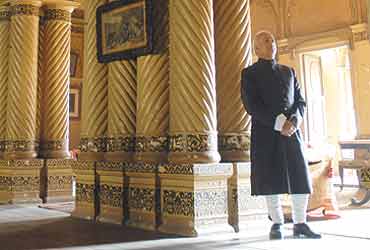
Raja Mohammad Amir Khan, known as Suleiman bhai, is a diminutive, elegant figure who has long been a fixture in Lucknow society. He has been seen as the epitome of high Shia culture in a city now known for breeding political mediocrity. With his elaborate courtesies or adabs, the purity of speech, be it in Persian, Arabic or Urdu, the impeccable Oxbridge English, he is the last of a fading breed of Lakhnavis, known for their tameez (manners) and tehzeeb (culture).
The uninitiated may see him as a caricature of Lakhnavi culture; the old residents of the city see him as a repository of Awadh Shia traditions. He is not a polo-playing raja, with an English nickname and a stiff upper lip. His family is known for its scholarship and establishment of several institutions of learning.
But equally, old residents and modern Indian historians know the Mahmudabad family for its dramatic history. Taluqdars settled in the region of Mahmudabad—now in Sitapur district—and were given the hereditary title of ‘Nawab’ by the Mughal emperor Akbar.
During the great rising of 1857, the forces of Mahmudabad fought with Begum Hazrat Mahal against the British, and were defeated just as the last Nawab of Awadh, Wajid Ali Shah, was exiled to Calcutta.
In order to demonstrate the “magnanimity and compassion of the British towards their defeated enemies”, the family was settled in an old palace built by Wajid Ali Shah in Lucknow’s Kaiserbagh, now known as Mahmudabad House.
The family continued to prosper and build institutions such as the Amir-ud-Daula College in Lucknow (1888), the Amir-ud-Daula Library, Lucknow, and Colvin College in Mahmudabad, besides being one of the founders of Lucknow University and King George’s Medical College.
As one of the most prominent families of the region, they were inevitably associated with the Nehru family from nearby Allahabad and the Indian National Congress. The 1916 Lucknow Pact was signed in Mahmudabad House, Kaiserbagh.
But it was the current raja’s father, the late Mohammad Amir Ahmad Khan, who would change the family’s trajectory. “(Mohammed Ali) Jinnah was a close friend of my grandfather and took my father under his tutelage,” says Suleiman bhai. His father would eventually become one of Jinnah’s most ardent supporters, and treasurer of the Muslim League.
The son recalls: “Yet he first chose to remain an Indian after Independence. Instead of Pakistan, he headed to the shrine of Imam Hussain in Karbala, Iraq.” Having witnessed the horrors of Partition, the raja sought a religious sanctuary. Ten years later, the old raja acquired Pakistani citizenship while his wife and only son remained in India.
Subsequently, the raja became something of a wanderer. He lasted in Pakistan only four years and, towards the end of his life, chose to live in London. There he worked for nine years as paid director of the Islamic Centre before his death in 1974.
Meanwhile, the great properties of Mahmudabad were seized by the Custodian of Enemy Property in India. It was after his father’s death that Suleiman bhai took up his legal battle. Decades later, the central question that must haunt him is: why did his father choose Pakistan? Was it merely because it was known that the zamindari system would be abolished in India and preserved by Pakistan, which some see as a state created by reactionary feudal forces? Replies the raja: “Material goods did not interest him greatly, else he would never have abandoned so much in India. In fact, he wrote critically of the feudal classes.”
The raja sees his father as symbolising dialectical tension in a man. “There was a sense that the British had deprived Muslims of political power that may explain his early enchantment with the idea of Pakistan. Yet he was a tormented soul, restless, unhappy and always disappointed.”
The family’s tortured history has been a magnet for writers, and Suleiman bhai has played host to the best and the brightest—V.S. Naipaul, Vikram Seth and William Dalrymple.
Naipaul writes in India: A Million Mutinies Now, “Amir (the current raja) was born in 1943.
When he was two years old his ears were pierced. It was the custom in Muslim countries for slaves’ ears to be pierced: the piercing of Amir’s ears meant he had been sold to the Imam: the child had been pledged to the service of the Shia faith.”
Later, of the journey to Iraq in 1948, as the subcontinent was being partitioned, Naipaul writes: “They went, in Iraq, still with Indian passports, to Karbala…sacred ground to Shias. On this sacred ground there arose in the father’s mind some idea of having his son become an ayatollah, a Shia divine.” But the raja would change his mind and give his son a secular education after all. La Martiniere in Lucknow, it was (later he would attend university at Cambridge). “Culture upon culture,” writes Naipaul.
Vikram Seth too had been a guest for two weeks at Mahmudabad House. The powerful character of the Nawab Sahib of Baitar House in A Suitable Boy is clearly based on the Mahmudabad clan. In the build-up to a scene, where the custodian of evacuee property arrives with a notice, Seth writes: “With Partition things had changed. The house had become lonely. Uncles and cousins had dispersed to Karachi or Lahore…. The gentle Nawab sahib remained. He spent more and more time in his library reading Roman history or Persian poetry or whatever he felt inclined to on any particular day.”
For all the new possessions Suleiman bhai will now reclaim, the greatest wealth of the family is still stored in the Qila (fort) at Mahmudabad, a two-hour drive from Lucknow. In mid-February, the Qila briefly regained vestiges of its lost grandeur when it was all lit up for a Bollywood crew—Aishwarya Rai and Abhishek Bachchan had arrived there, to shoot for J.P. Dutta’s Umrao Jaan.
We had gone there a few days earlier. The raja escorted us through a great gate into a vast courtyard, then through huge halls that have clearly seen better days. William Dalrymple described the Qila’s air of decaying splendour in The Age of Kali: “It was magnificent but the same neglect which had embraced so many buildings in Lucknow had taken hold of the Mahmudabad Qila. Dust lay thick underfoot, as if the qila was some lost castle in a child’s fairy tale.” As the raja took us up a winding staircase, he explained: “We sold and lived. What could one do but sell one’s treasures—chandeliers, paintings and artifacts?”
We reach the top floor of the tower. Like the library in Umberto Eco’s The Name of the Rose, one is walking through corridors of ancient volumes and manuscripts. Blow off the dust and discover treasures—a 150-year-old volume of Shakespeare, all the old editions of Punch carefully bound, every Indian district gazetteer, an entire wing devoted to Persian and Urdu literature. The library was started in 1868. “Now I can preserve these books which are my biggest inheritance,” says Suleiman bhai.
It is Moharram, the long period of mourning for Shias, and the raja must address a majlis at his Qila. Minutes before, he is recounting to Outlook his long legal and political battle. “I petitioned everyone, saying my mother and I are Indians, not ‘enemies’. I have been a Congress MLA. Yet the battle dragged on.” He accepts that the land ceiling act and related laws will come into effect on some agricultural lands. “I am not a strongman who is forcing tenants to vacate after so many years. I’m looking for an honourable renegotiation of terms,” he says with deliberate vagueness. “I am perhaps not as practical as I should be. I hope I don’t make a mess of it.”
The raja then dons his black robes, sits gracefully on the pulpit and recites a marsia, epic poems written in memory of the heroes of Karbala, composed by his father: “Himmat ke sile ko aam karna hai hamein (We have to make tales of heroism commonplace)<>i/Maidan-e-waghah mein naam karna hai hamein (We have to make a great name in the battlefield)/Rona hi nahin hai asl maqsad (To shed tears is not our purpose)/Kuch isse bhi badh kar kaam karna hai hamein (We have to achieve tasks greater than these). As the majlis proceeds, tears roll down the raja’s cheeks.
source: http://www.outlookindia.com / Outlook Magazine / Home / by Saba Naqvi / March 13th, 2006

Muslim leaders exhort youth to join civil services

Mumbai, MAHARASHTRA :

Mumbai :

Muslim community leaders are trying to inspire the youth to aim for the civil services. Three days after the Haj Committee of India launched its coaching centre for civil services exams at Haj House near CST, another initiative kicked off on Wednesday. The community leaders presented some IPS officers as role models.

The officers, who lauded the efforts of civil society in motivating youth, asked students to shed their defeatist mentality and try to crack the civil services exams.

Organised by NGO Milli Council, in association with the vocational and career guidance cell of the Central Mumbai-based Maharashtra College, the meet saw Ahmed Javed, additional DGP, Qaiser Khalid, DCP (railways), and K Moeen Jeelani, superintendent of customs, enthuse the students, a majority of whom comprised burqa-clad girls from middle and lower middle class families.

Besides reiterating the need for hard work, Javed dwelt on the importance of Marathi for those students who want to succeed in the exams conducted by the Maharashtra Public Service Commission (MPSC). “I have put in 30 years of service in the police and I know how knowledge of Marathi can make the task of policing easier,” said Javed who hails from Lucknow but learnt Marathi after he joined the Maharashtra cadre.

Khalid, a 1998 batch IPS officer, quoting poets, philosophers and paragons of peace like Mahatma Gandhi, underlined the importance of civil servants and said that planned studies was the key to crack the civil services exams. “Despite the importance of liberalisation, privatisation and globalisation, civil services command importance and respect because it is these officers who help plan and execute the the government’s policies,” said Khalid.

Referring to a popular instance in Hindu mythology, he said: “Like Arjuna, who aimed his arrow at the eyes of the moving fish, you should focus on your goal. Cracking civil services is tough, but not impossible,” he said.

Jeelani, a former national champion in yachting before he joined the customs department, recalled the background in which he grew up: “My locality was a breeding ground for criminals. But sheer determination helped me excel in my chosen field, which also helped me land me a job in the customs department.”

M A Khalid, general secretary of Milli Council, exhorted Muslim youth to give up their negative attitude and appear in the civil services exams in large numbers.

source: http://www.timesofindia.indiatimes.com / The Times of India / News Home> City>Mumbai / by Mohammed Wajihuddin / TNN / December 08th, 2009

Nation salutes 1965 war heroes

Dhamupur Village (Ghazipur District), UTTAR PRADESH :

New Delhi  :

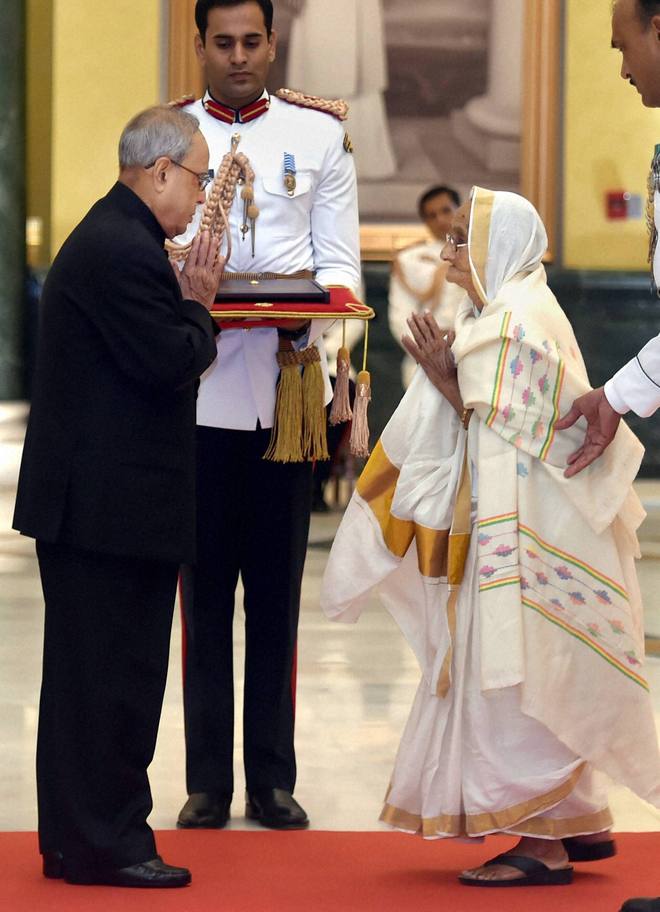
President on Tuesday felicitated 1965 war veterans as he hosted a high tea at Rashtrapati Bhawan.

President Pranab Mukherjee felicitates Rasoolan Bibi (L), widow of Param Vir Chakra awardee Abdul Hameed, and Marshal of the Indian Air Force Arjan Singh in New Delhi on Tuesday. PTI

Among those honoured were: Air Marshal Arjan Singh, a Five-Star General; Rasoolan Bibi, wife of Company Quarter Master Havildar Abdul Hamid, a recipient of Param Vir Chakra; and Zarine Mahir, daughter of Lieutenant Colonel AB Tarapore, a Commandant of Poona Horse, among others.

Prime Minister Narendra Modi paid tributes by laying a wreath at Amar Jawan Jyoti.

source: http://www.tribuneindia.com / The Tribune / Home> Nation / September 23rd, 2015

The fight has not left Cavalry Khandan of Jhunjhunu

Nuah Village (Jhunjhunu District), RAJASHTAN :

CavalryKhandaanMPOs30mar2017

Jaipur :

Eighty five-year-old Muraad Ali Khan, a native of Nuan village in  Jhunjhunu district of the state, gets all animated whenever trouble starts brewing on the border.

His family, popularly known as ‘Cavalry Khandan’ (Cavalry family), and his six cousins had participated in India-Pakistan wars in 1965 and 1971. Though all his cousins died over the past three years following old-age problems, Ali is an active participant in the ongoing discussions and debates on deteriorating Indo-Pak relations.

Some hours after the Indian Army carried out the surgical strikes in Pakistan occupied Kashmir (PoK), 10 days after the Uri outrage, TOI spoke to Ali for his reactions to the conflict.

Not surprisingly, Ali, who has been following developments through television and newspapers like the rest of the country, was happy and congratulated the government of India and Army. “I must congratulate our forces for the act. I think our Prime Minister Narendra Modi’s tactics to isolate Pakistan is yielding results and the cancellation of the SAARC summit is proof fir it,” Ali said on Thursday.

His cousins — Captain Mohammed Ayub Khan, Captain Gaus Mohammed Khan, Captain Mohammed Sadiq Khan, Captain Yusuf Khan and Captain Gulaam Sarvar — had served the Indian Army in the 1965 and 1971 wars against Pakistan in various capacities.

He is the only surviving member of the ‘Cavalary Khandan’ who had served the Indian Army as a subedaar.

Captain Ayub was a Union minister who died on September 16 following a massive cardiac arrest. He was 85 and a recipient of Vir Chakra for his acts of valour during the 1965 India-Pakistan war. Ali’s village Nuan has at least one member from every family serving in the Army in various capacities.

“My opinion of the ongoing scenario is that India should isolate Pakistan financially, diplomatically and should continue with these surgical operations. They don’t deserve any mercy,” he added. In between, he wanted to know the number of casualties in surgical operations carried out by India. “Humari fauj Pakistan ki harqaton ka maqool jawab de sakti hai (Our Army can give appropriate answer to Pakistan). Humare sabr ka imtihaan na le Pakistan (Pakistan should avoid testing our patience),” he added.

Mohammed Shariq Khan, son of late Captain Sadiq Khan, who works as a teacher, said, “Whenever he (Ali) gets news of an army man being martyred, he gets pumped up. His blood pressure goes up. All his brothers had done a lot for the country. Our village has a good number of Qayamkhani muslims and from other communities who had fought in battles with Pakistan.”

source: http://www.timesofindia.indiatimes.com / The Times of India / News Home> City News> Jaipur / by Ashish Mehta / TNN / September 30th, 2016

My dream is to have women’s team in 2020 Olympics: Ismail Baig

Hyderabad, TELANGANA :

National chief rowing coach Ismail Baig.

Hyderabad:

National chief rowing coach Ismail Baig is a man on a mission. With 2020 Tokyo Games coming in three years, he is closer to his dream of having an Indian women’s team in Olympics. Baig is confident that if the women rowers continue to persist with the game with dedication, they can qualify for the Olympics. He also says that the Telangana rowers have started carving a niche for themselves with their exploits. He also revealed his next assignment as coach in an interview with Shiva Krishna Gundra.


On India’s Next Assignment


We are conducting Indian camp for the upcoming Asian Championship and next year’s Youth Olympics next year. The camp has started three weeks. If our rowers do well in World championship or Asian Championship, they can book the Youth Olympics quota. However, there are only two categories for each country and that too, one quote is reserved for women. Right now, we have 19 boys and 14 girls training in the camp. For the first time, we have eight rowers from our State which is remarkable.


On State Rowers


Our state rowers are doing great at nationals especially in sub-junior and junior level. We topped the nationals in the junior and took second place in seniors. These results assures of a bright future for the State. We have good support from SATS (Sports Authority of Telangana State) as well. We were never on the rowing map in the country in the combined State. But after formation of the new State, we started from the scratch as most of the rowers left for the other States. Most of the kids are from army families. But we are concentrating more now on our own athletes.


On Target 2020


There are good girl rowers like Sitamahalaxmi. Youngsters like Geetanjali and Hemalatha are very impressive. Both these girls won gold in junior category. They won bronze in the senior category as well. So I am working on this combination for the 2020 Olympics. I am pretty sure the men’s team will qualify but my dream is to have a women’s team for the Olympics for the first time in rowing history. I’m happy with the way the girls are making progress. I am confident that if they stick to the game, they can qualify.


On Infrastructure


I can’t say we have world class infrastructure. But this is one of the best facilities in the country. We have federation’s equipment. We have a good water body in the city.


On International Events In The City


The quality of the water in Hussain Sagar is not good. The government is also doing a lot to clean the water. But it also depends on the citizens of the twin cities. If we can do that, we can have international tournaments in the city. We conducted an international tournament in 2005. If the water condition improves in the future, every year we can conduct an international tournament.


On Game’s Popularity


I have been coaching since 18 years. The game was not so popular then. The game was introduced in the Asia in 1980s. We used to win only bronze medals. But under my coaching we have won gold and silver at Asian Games and qualified for the Olympics for five consecutive times. Dutt also finished good in the last Olympics. That is a great achievement. So the craze for the sport is increasing slowly.


On Future Rowers


We started three years ago with few rowers who were of 10 and 11 years. Now they are producing results. Rowers like Sairaju won international silver medal in pair category. It is a great achievement. He also won gold in the nationals. So our rowers are producing good results at national levels and also competing at international level.


On Government Support


We need more funding. We need more local camps and talent hunts. We have to start two or three centres in other parts of the State. We can establish a centre in Karimnagar. There are other places where we also can start. We can get more talent and give advanced training in Hyderabad. That will help for larger pool of talented rowers.

The Bhopal water sports has 15 crore budget. We don’t have that much budget in the State. Our rowers have won first gold medal for the State in National Games in Kerala. We won five medals from rowing alone. That is 40 to 50 per cent of medals that won State was from water sports. A medal from hockey or other games will give lot of attention. But medals from water sports are not treated in the same way. Ours is an Olympic sport. We need to change our thinking.

source: http://www.telanganatoday.com / Telangana Today / Home> Sports> Other Sports / by Shiva Kumar Gundra / March 23rd, 2017

Who is Mohsin Raza, the lone Muslim face in Yogi Adityanath’s cabinet?

UTTAR PRADESH :

Before making his foray into politics, Raza tried his hand at cricket, modelling, and is a known socialite in Lucknow. He has had the odd TV acting stint and even tried his luck at an entry in Hindi films.

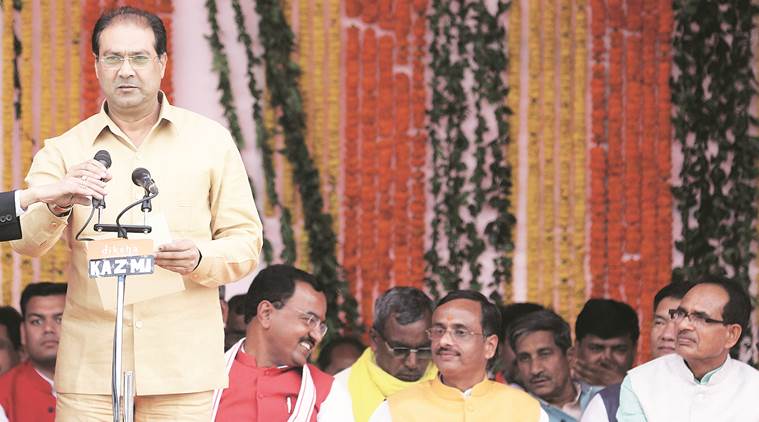
Mohsin Raza taking oath of office in Lucknow on Sunday.

The  Bharatiya Janata Party fought the Uttar Pradesh Assembly election on a carefully crafted electoral strategy that was meant to polarise and consolidate Hindu vote. The party didn’t field any Muslim candidate out of the 403 in the elections. But, firebrand leader Yogi Adityanath, who took oath as Uttar Pradesh Chief Minister on Sunday, has included a lone Muslim leader in his cabinet – Mohsin Raza. Though he may seem the odd entrant into Adityanath’s cabinet, the multifaceted Raza, crowned Prince of Lucknow in a pageant in mid 1990s, has a more interesting past than most seasoned politicians.

Before making his foray into politics, Raza tried his hand at cricket, modelling, and is a known socialite in Lucknow. He has had the odd TV acting stint and even tried his luck at an entry in Hindi films.

Raza is married to Fozia Sarwat Fatima and belongs to a zamindar (wealthy landowners) family that hails from Safipur town in Uttar Pradesh’s Unnao district. He was born on January 15, 1968 in Lucknow.

Raza trained at the MRF Pace Foundation based in Chennai and went on to play two matches in the Ranji Trophy representing Uttar Pradesh. He didn’t have a great showing as a bowler picking only 4 wickets in 2 first class matches with an average of 42.75. Batting figures were worse with five runs scored in two first class matches. His first class cricketing career ran between 1987-89.

Raza has alo participated in beauty pageants and in 1995 he won the Prince of Lucknow crown. He also acted, though not in a prominent role, in the Doordarshan’s acclaimed TV series ‘Neem ka Ped’ written by award winning lyricist and poet Rahi Masoom Raza starring thespians like Pankaj Kapoor and Arun Bali. He persistently kept trying his hand at Hindi film industry but did not get any break.

In 1999, he was made the chairman of Congress’ sports cell but after he was given the position of convener, rifts emerged and it meant his stay had come to an end. He suspected foul play against him and felt it would be best to leave.

His wife fought local elections independently a few years ago and lost by a margin of 125 votes. Then, in 2010, Raza floated his own political outfit by the name of Safipur Vikas Manch but that did not prove to be a successful endeavour.

After so many failed attempts, he joined the BJP ahead of the General Elections in 2014 and was made the party spokesman in 2016.


Ayub Khan: A war hero who rose to become a union minister

Nuah Village (Jhunjhunu District) , RAJASTHAN :

AyubKhanMPOs22mar2017

Jaipur :

A decorated soldier of the 1965 Indo-Pak war who rose to become a union minister, Capt Ayub Khan was laid to rest at his village Nuah in Jhunjhunu district with full military honours on Friday. He was born in 1932 in a Kayamkhani Muslim family of soldiers. His grandfather and father too served the Indian Army and now his cousins and their sons are continuing the family tradition.

Capt Ayub, the state’s first Muslim to win a Lok Sabha election and twice be a Congress MP from Jhunjhunu, was also a recipient of the Vir Chakra from President Dr S Radhakrishnan for destroying four Pakistani Patton tanks and capturing one in the Sialkot sector of J&K. Prime Minister Lal Bahadur Shastri had hugged the brave soldier and remarked, “I never met the Pakistani President Gen Ayub Khan but I’m proud to meet the Indian Ayub.”

In the 1965 war, Ayub was posted in the Sialkot sector that was under Lt-General P O Dunn. The 26th Infantry Division was ordered to capture Sialkot. The 18th Cavalry’s Bravo squadron, led by Risaldar Ayub Khan, was ordered to clear the Sialkot Road from Pakistan’s occupancy. The squadron moved upfront facing enemy fire. On September 9, the squadron confronted a large column of Pakistani forces with Patton tanks.

The Pakistani tanks attempted to encircle Indian troops, so the squadron commander ordered his troops to turn about and check the enemy encirclement. Ayub moved back and headed to close up with the enemy tanks that were threatening to cut off Indian troops from the rear. Ayub led from the front and destroyed four tanks before Pakistan could realize that an Indian troop had turned back to attack it.

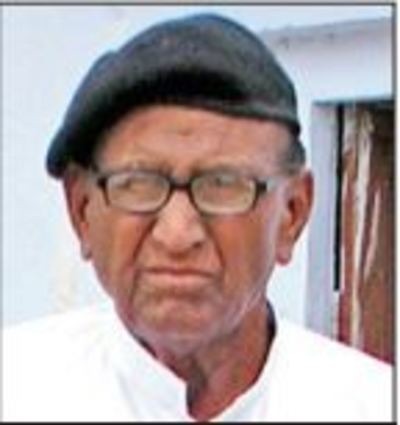
In 1983, Ayub retired from the army and was granted the rank of Honorary Captain. Later, he joined politics and became a union minister in the cabinet of Prime Minister PV Narasimha Rao. Ayub Khan chose to wear white kurta-pyjama and sported the black army cap of the 18th cavalry, minus the crest. At 84, Capt Ayub used to sit at home and enjoy life with his family. He was no longer active in politics, as he hated the present day caste-based politics.

source: http://www.timesofindia.indiatimes.com / The Times of India / News Home> City> Jaipur / by Prakash Bhandari / TNN / September 17th, 2016