More than 600 years after a seven-foot tall Chinese naval explorer touched the shores of Calicut (now Kozhikode), a bustling international port city in northern Kerala, an attempt to find his relics and perhaps his final burial place is in order in the state.
Last month, two professors, working in different countries, arrived in Kerala with the aim of finding more information about Zheng He, a fleet admiral of China’s early Ming dynasty and one of the world’s earliest navigators, much ahead of the likes of Christopher Columbus and Vasco da Gama. According to credible historical accounts, Zheng He, who had led seven naval expeditions in the Indian Ocean, was buried at sea off the coast of Calicut after he died of illness in the course of a voyage.
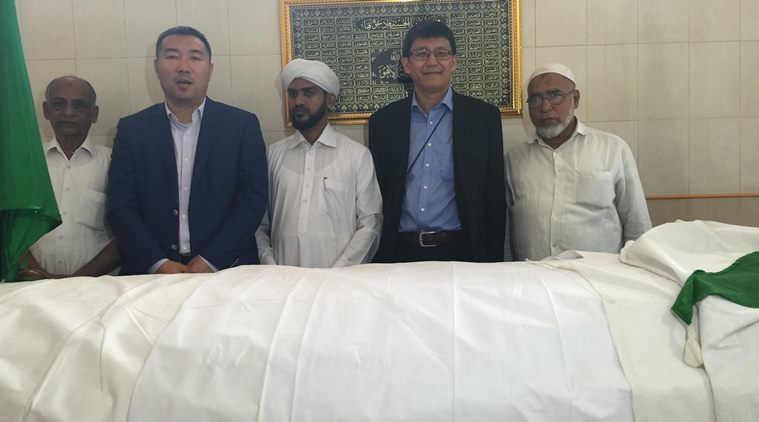
“We came to Kerala on January 7-9 to find information about relics and stories of Zheng He and his crew in Calicut. It was an official trip of Zhenghe International Peace Foundation,” said Shaojin Chai, a senior research fellow at the Ministry of Culture in UAE.
While history books are replete with the exploits of Columbus and Gama, not much is known about Zheng He, whose fleet was considered to be ten times bigger than his contemporaries. In fact, National Geographic magazine described the naval armada of Zheng He off the coast of Sri Lanka as a ‘massive shadow on the horizon’, that moved like a ‘floating city’ and stretched across miles and miles of the ocean.
Zheng He, who is venerated almost like a God in several parts of China and has temples dedicated to him in Malaysia and Indonesia, was born in China’s Yunnan province in 1371. Born into a Muslim family, Zheng He was ritually castrated at the age of ten at the hands of an invading Ming army. But his life as a eunuch turned out for the better after he was sent to serve in the household of Zhu Di, who would later go on to become the Yongle Emperor. History says Zheng He was able to gain the trust of the emperor in a short period of time and convinced him to let him embark on naval trips that would extend China’s trade potential to Southeast Asia, the Indian subcontinent and the far-away Middle East.
Zheng He’s first voyage, according to several accounts, began in the year 1405, sailing from China through Indonesia and Malaysia to finally end at Calicut via Cochin. His fleet was estimated to be more than 20,000 men travelling in more than 60 treasure ships – numbers described astonishing in most accounts. His subsequent trips took him as far as Iran and eastern Africa to the shores of Mogadishu.
For the Chinese explorer, Calicut, then a prosperous trading port that dealt extensively in eastern spices under the rule of the Zamorin, was an ideal base to conduct trade across the Indian Ocean and the Middle East.
“Chinese historian Ma Huan, Zheng He’s translator, described Calicut as very friendly, harmonious and a dynamic place where trading was fair and the Hindu king consulted with Muslim ministers to conduct state affairs,” said Professor Chai, who was accompanied to Kerala by Haiyun Ma, a professor at Frostburg State University, Maryland, US.
During their short visit, both professors visited a few mosques which had Chinese connections and inspected tombstones, but could not unearth any reliable clues that could point to Zheng He’s period.
However, CK Ramachandran, convenor of the Calicut Heritage Forum, dismissed claims that the Chinese naval commander had been buried under land.
“According to early Chinese traditions, a eunuch, after death, cannot go to heaven with a deformed body. That’s why he was ceremonially buried at sea,” said Ramachandran, who has meticulously collated several historian accounts of the Chinese in Kerala.
“I did visit Nanjing in China where a tomb has been erected in Zheng He’s memory. But it is more of a memorial. It is empty,” he added.
Nevertheless, undeterred, Professors Chai and Ma are planning to organise a conference next year in Kerala which would throw light on Zheng He’s exploits for which they have spoken to state government officials as well.
“Zheng He was considered one of the greatest statesmen and explorers in Chinese history and was our national pride for promoting peace and trade with other countries (sic),” said Prof Chai.
source: http://www.in.news.yahoo.com / by Vishnu Varma, The Indian Express / February 20th, 2016
“He established Dewsbury as a centre for European Muslims in Britain as far back as 1978. He was also a strong believer in British home—grown Islam,” Mr. Ahmed said.
Gujarat – Drewsbury, West Yorkshire / United Kindgom :
An Indian—origin cleric who was the leader of Tablighi Jamaat sect in Britain and Europe, and who played an important role in the creation of Markazi Mosque, the European headquarters for the movement, has died aged 92.
Thousands on Sunday turned out for the funeral of Hafiz Yusuf Patel who died in Drewsbury, West Yorkshire, on Thursday.
Mourners came from across the UK and flew in from European countries including France, Germany, Spain and Portugal.
Patel had been invited from India in the 1960s by Gujarati Indian Muslims who wanted a religious guide for the movement.
“He was a pioneer, a visionary when it comes to the Islamic identity and the place of the Muslim community in Britain,” Ishtiaq Ahmed, of the Bradford Council for Mosques, told The Huddersfield Daily Examiner.
The cleric, who was the leader in Britain and Europe of Tablighi Jamaat sect, was instrumental in the creation of the Markazi Mosque in Dewsbury in the late 1970s. The mosque is now the European headquarters for the Tablighi movement.
“He established Dewsbury as a centre for European Muslims in Britain as far back as 1978. He was also a strong believer in British home—grown Islam,” Mr. Ahmed said.
After an open air service, relayed on a public address system, Patel was buried in a private ceremony at Dewsbury Cemetery. Free buses ran from surrounding towns for mourners to gather in the rain to pray side by side.
Patel is said to have gone door—to—door in the early years promoting the message of Islam and encouraging people to go to mosque.
The Tablighi Jamaat organisation was founded in India in 1926 and is closely linked to the conservative Deobandi school of Sunni Islam.
Estimates for its global membership range from 12 million to 80 million, with European members thought to number at least 150,000.
source: http://www.thehindu.com / The Hindu / Home> International / PTI / London – February 21st, 2016
by Prof. A.V. Narasimha Murthy, former Head, Department of Ancient History & Archaeology, University of Mysore
I had the good fortune of serving the Numismatic Society of India, Varanasi, as its President, Secretary and Editor. I used to attend the annual conferences of this Society regularly. I once noticed that scholars attending the Varanasi Conference from South India could be counted on finger tips. The reason, I learnt, was that North India was very far and travel would be difficult and many scholars suggested ‘Why not a South Indian Coin (Numismatic) Society be started?’ It was a good suggestion and I contacted Dr. R. Krishnamurthy, Editor of Dinamalar (Tamil Daily) from Chennai and he welcomed the idea but told me that his business as the Editor of a Daily would not allow him to devote full time and energy for this. But he hastened to add, ‘If you can take that responsibility, my full support to you is there.’
Prof. K.V. Raman of Chennai gave me his support. The Head of the publication of New Era, Dr. Srinivasan Srinivasan agreed to print and publish the Journal of the Society on the condition ‘I should be its Editor.’ I agreed and South Indian Numismatic Society came into existence in 1990. So far it has conducted 26 conferences at different centres in Karnataka, Andhra, Tamil Nadu, Kerala. This time it met at Thiruvananthapuram in Jan. 2016. About 150 Numismatists attended.
It was our good fortune that it was hosted by the Centre for Heritage Studies under the Cultural Affairs Department of Kerala. K.C. Joseph, Minister for Rural Development, Culture and Planning, who inaugurated the conference, extended full cooperation to this conference which was a success.
There was a time when barter was the system of trade. People realised its limitation and began using coins. Coins as such have not been noticed in the Indus Valley Culture. However, Rig Veda mentions coins like Nishka, Rukma, Khadi, in the sense of coins. But actually Nishka means a necklace and hence, it has been taken as a necklace made of gold coins (kasinasara). Anyway, that is the earliest coin of our country.
South India had a period which is generally referred to as Sangam age and it was considered as a literary imagination or even bunkum. Suddenly, Dinamalar Krishnamurthy discovered a coin belonging to a Sangam King called Peruvalathi. For the present, this is considered to be the earliest coin of South India. Barring this, the Satavahana (Andhra) coins are the earliest coins of Deccan and South India.
However, we have had uninscribed punch marked coins all over the country including South India and Karnataka. These silver coins had 5 symbols punched on them and one of them represented the government or the king. At this time, Roman merchants came to South India and gave their gold and silver coins and purchased our spices, especially black pepper, which was considered as an antidote for malaria. Thus the large number of Roman coins gave an impetus for the minting of coins in South India.
Kadambas of Banavasi are considered to the actual inaugurators of coinage in Karnataka. They issued what are called Padmatanka coins. A Padmatanka is a gold piece which has a central punch of a lotus or Padma with some symbols and letters like ‘Sri’ with or without the name of the issuer. The Pallavas of Kanchi issued their own coins in gold and copper. This system was continued by the Cholas of Thanjavur. They minted the portrayal of the king with Nagari or Tamil legends. Chola coins have been discovered in plenty as to fill up them, in gunny bags. In Andhra area, Vishnukundins minted coins. In Karnataka, the Chalukyas minted coins and their most popular coin is called Varaha. This word survives even today in traditional parlance. In fact, the coin name Varaha is a contribution of Karnataka in general and that of the Chalukyas in particular.
The Western Gangas of Talakad minted gold and copper coins with elephant as the important symbol. Unfortunately, Rashtrakuta coins have not been discovered in plenty. Later, Chalukya coins have been found in plenty. The Hoysalas minted coins in gold and copper. Vishnuvardhana minted coins with lion and the legend Talakadugonda symbolising the defeat of the Cholas. One interesting coin is the one which has a portrait of Saint Ramanujacharya. The Sevunas or the Yadava coins include those of Bhillama, Singhana and Ramachandra.
Kings of Vijayanagara introduced innovation in coinage. It is not only a golden age but a golden period for Karnataka coinage. Their coinage has been praised by foreign travellers also. They introduced legends in Kannada and Nagari. The most important coin of Krishnadevaraya are the coins representing Lord Venkateswara of Tirumala and Sri Krishna holding a lump of butter in his hands. Krishnadevaraya performed Kanakabhisheka to Balaji of Tirupati by minting gold coins which had the representation of Venkateswara with Sridevi and Bhudevi and his name in Kannada or Nagari. Nayakas of Madura imitated the coinage of Vijayanagara. Their coins contain legends in Kannada and Tamil.
We may turn our attention to the coinage of Muslim kings — the Bahamani dynasty, Adil Shahi dynasty and Barid Shahi Sultans. They minted coins with legends in Arabic and Persian on both sides. Hyder Ali and Tipu Sultan occupy an important place in Karnataka history. Tipu’s innovation in coinage is amazing. He established seventeen mints in different parts of South India and minted coins in gold, silver and copper. He gave each coin a name after the Islamic Saints. His gold coins contain the Persian legend ‘The religion of Ahmad is illumined in the world by the victory of Hyder.’ The reverse has the legend ‘He is the Sultan, the unique, the just, the third of Bahari, cyclic year Azal 2.’
The Wadiyars of Mysore (now Mysuru) began issuing coins with legends. The representation of Hindu Gods by Krishnaraja Wadiyar is unique. They also minted coins with portrayals of lion and elephant with legends in Roman, Kannada and Persian. Once the British took over, they began to follow the British coinage. After independence, the entire country, including South India, is following the system which we are now seeing. Thus, South India followed a unique system of coinage which has a history of over 2,000 years.
source: http://www.starofmysore.com / Star of Mysore / Home> Feature Articles / February 21st, 2016
Dr. T.N. Prakash Kammaradi (second from right), Chairman, Karnataka Agriculture Price Commission, Government of Karnataka, Bengaluru, is seen releasing a brochure during the inauguration of workshop in city this morning. Also seen are (from left) AIR Mysuru Programme Executive N. Keshavamurthy, AIR Bengaluru Station Director M.A. Ahmed and AIR Mysuru Programme Head M. Raghavendra.
Mysuru:
A one-day workshop on ‘Agricultural Finance Management’ organised by Prasar Bharati – India’s Public Service Broadcaster, All India Radio (AIR), Mysuru, on the eve of Radio Kisan Divas, began at Central Institute of Indian Languages (CIIL) auditorium, Manasagangotri, this morning.
Speaking after inaugurating the workshop, M.A. Ahmed, Station Director, AIR, Bengaluru, said that AIR Mysuru ‘Kisan Vani’ programme has been a hit among the farming community.
Giving a brief on the objective of observance of Radio Kisan Diwas, Ahmed said that the programme has enabled the farmers to get clarifications for their doubts and problems. He called upon the farming community to maintain a balance between expenses and income and to utilise available resources in a most judicious manner.
Karnataka Agriculture Price Commission Chairman Dr. T.N. Prakash Kammaradi, who delivered the keynote address, explained the meaning, scope and significance of agricultural finance. Pointing out that Agricultural finance deals with the financial aspects of farm business, including macro and micro financial aspects of an agricultural economy, he observed that such workshops, seminars, etc., will help the farming community to improve productivity, increase profitability and fulfil their long term goals.
Since Indian Agriculture is capital intensive, the farmers’ dependence on lending Institutions, such as banks, has considerably risen, Kammaradi said and called upon the lending institutions to come together with society in setting an overall framework in which the individual farmer can appropriately manage his finances.
Noting that natural disasters and other calamities have put the farmers at great risk with crop loss and un-remunerative prices, he expressed displeasure over media’s hyped reporting whenever prices of agricultural and horticultural commodities shoot up and at the same time remaining silent when prices of agricultural produces crash, resulting in great loss to farmers.
He called upon banks and other financial institutions to chalk out the best cash flow analysis that helps the farmers in determining period wise quantum of loans needed and a proper repayment channel that benefits the farming community.
Stating that agricultural production in the country stands at 250 million tonne per year, he called upon the farming community to judiciously use farm savings and not to spend on unproductive assets.
source: http://www.starofmysore.com / Star of Mysore / Home> General News / February 15th, 2016
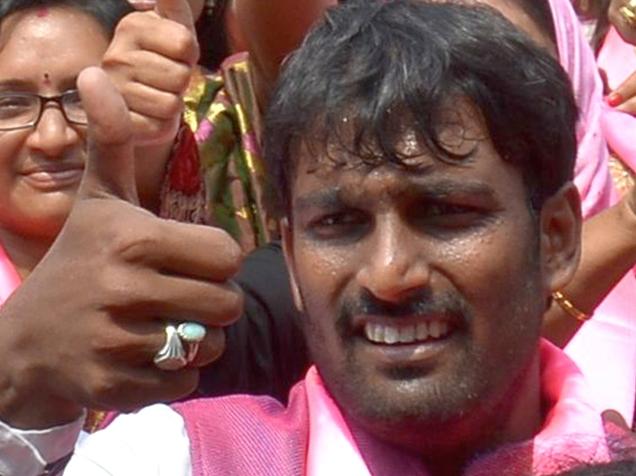
Borabanda Corporator Deputy Mayor, Mohammed Baba Fasiuddin at Gun Park Matyrs’ Memorial in Hyderabad on Thursday. – Photo: Nagara Gopal / The Hindu
Borabanda, Hyderabad:
The newly elected Deputy Mayor Mohammed Baba Fasiuddin represents the Borabanda Ward of Greater Hyderabad Municipal Corporation. He was unanimously elected as Deputy Mayor as only one nomination was filed.
A graduate in Commerce, Mr.Fasiuddin played a key role in the Telangana movement as well as in the student and youth wings of the Telangana Rashtra Samithi. He is a close confidant of Chief Minister K. Chandrashekar Rao. His father is a retired Government employee.
His family hails from Polcharam Mandal in Medak District. He is presently the president of the TRS Student wing of Greater Hyderabad unit. His mother was an employee in Osmania Hospital. Mr. Fasiuddin is married and has a son and a daughter.
source: http://www.thehindu.com / The Hindu / Home> Cities> Hyderabad / R. Ravikanth Reddy / Hyderabad – February 11th, 2016
Fahad Bin Abdul Samad from Uppuguda set a record on Thursday when he became the youngest municipal councillor in the country to take oath.
At 21, Mr. Fahad beat his nearest rival by 4,000 votes on AIMIM ticket to get elected to GHMC’s Council of 150 corproators. He attributes his entrance into politics and early electoral success to his father, a former corporator of the ward, and his party leaders. The minimum age to contest in a local election is 21 years.
“The party was keen on promoting educated youngsters. Doctors, pharmacists and engineers are today among those elected from AIMIM,” said Mr. Fahad, who is pursuing his final year of civil engineering. Entry into politics was a pleasant surprise for the youngster who said he had to drop his plans for education abroad.
“I had planned to pursue masters abroad. But I will now pursue education here,” he said, quickly adding that politics and education will not clash. “Nearly a third of my ward comprises people under poverty line. Besides discharging regular duties of a corporator to ensure civic infrastructure, I want to help the poor get education,” he said.
source: http://www.thehindu.com / The Hindu / Home> Cities> Hyderabad / by Rohit P.S / Hyderabad – February 12th, 2016
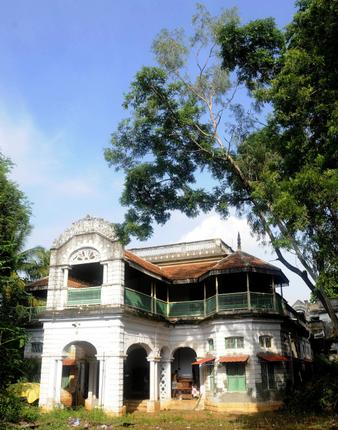
A view of the M.K. Maaligai in Khajamalai, Tiruchi. Photos:A. Muralitharan
Behind the façade of this heritage residence in Tiruchi lies the story of its enterprising owner, M.K. Mohamed Ibrahim Ravuthar.
It is an arresting sight on the Race Course Road in Tiruchi. A stately home, complete with gabled roofs and stained glass windows peeks out demurely from behind black granite walls, willing you to stop and take a closer look.
“It’s a unique building just like the man who built it,” says Dr. M.A. Ansar, describing the mini 11-roomed palace and his grandfather M.K. Mohamed Ibrahim Ravuthar in one breath.
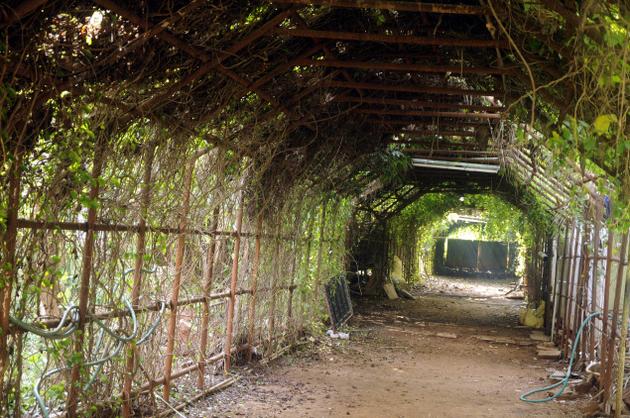
Built in 1928, the M.K. Bungalow was actually the main home in a complex of four residences in this quiet nook off the Race Course Road in Khajamalai. It resembles a structure straight out of a Jane Austen novel, especially when you walk through the green corridor (an iron trellis walkway that is still covered with the ‘December Poo’ or Philippine Violet vines planted by the patriarch) to reach the main entrance.
A trellis ‘green corridor’ leads up to the bungalow. Photo: A. Muralitharan
The garden is overgrown, and the annexes that once housed a live-in washerman, stables for horses and cattle, huge bathrooms and an elaborate pantry and storehouse, clearly have seen better days. Even so, when Mrs. Najma Begum, the current resident of the house and one of M.K.M. Ibrahim’s granddaughters, opens the main door, it is possible to see flashes of another, more flamboyant world that once existed here.
“When Thatha was alive, this house used to be called ‘M.K. Maaligai’ (Palace), today I can hear people calling it the ‘Pei (Ghost) Bungalow,’ when they walk past on the other side of the walls,” says Mrs. Najma.
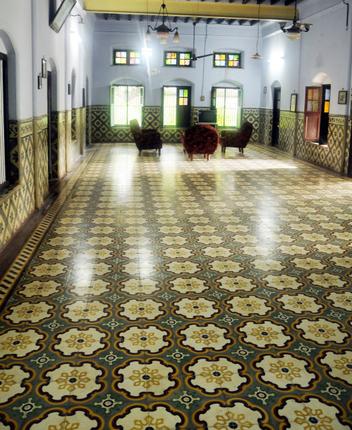
Keeranur tiles brighten up the interior of the M.K. Maaligai. Photo: A. Muralitharan
As room leads to room, each with Keeranur floor tiles and wide windows fitted with cooling coloured glass, the other tales about the house are dusted off and narrated too.
Tales of how chandeliers with red glass and gold paintwork imported from Austria used to adorn the halls. Records that were played on a Polyphon, a coin-operated music box which played metal discs measuring 195/8 inches in diameter, for dance parties hosted for British guests. And how a fountain and a ‘chaukhandi’ (gazebo) used to be star attraction of the garden.
The M.K. Maaligai was the entertainment venue not just for M.K.M Ibrahim’s friends and business acquaintances, but also guests of the State from Britain. On average, some 15-20 people would gather for the daily repasts, made with the finest of produce sourced from nearby towns.
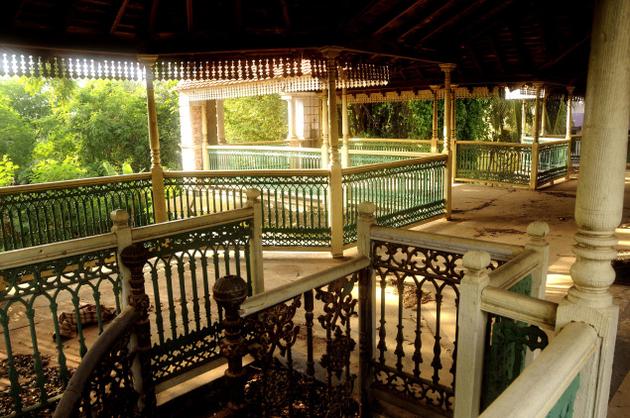
Elaborate decorative work done on the verandah’s eaves and railings. Photo: A. Muralitharan
As the tour continues, up an imported cast-iron spiral staircase (one of two), to the first floor where the master suite looks out on a large decoratively gabled verandah, it becomes clear that this house was meant to be a personal work of art.
Hands-on leader
“My grandfather used to be known as the ‘Prince of Tiruchi’ for his lavish lifestyle,” says Dr. Ansar, whose late father M.K. Abdul Salam was the eldest son of M.K.M. Ibrahim. “Though he didn’t have much education, he used speak English fluently because of his close association with the British. He was among the invitees to a special assembly to commemorate the coronation of King George VI in May 1937.”
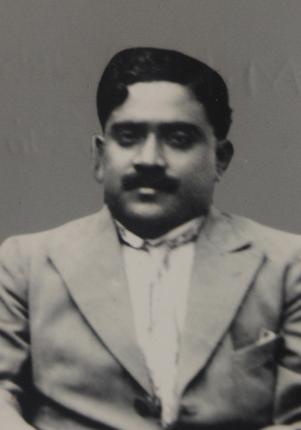
M.K.Mohamed Ibrahim Ravuthar.
Born in 1885, M.K.M. Ibrahim was the second son of M. Kasiappa Ravuthar, a wealthy businessman and landowner who migrated to Tiruchi from Ettayapuram, Tirunelveli district (see related story on Page 4).
Taking over his father’s kerosene dealership and leather tanneries after his elder brother Yusuf died, Ibrahim diversified the family business rapidly, branching out into petrol supply (he owned 18 petrol stations in his heyday), bus transport, and construction, besides starting a third tannery near Hyderabad.
The family made the Palakkarai area in Tiruchi its base.
The contracting projects that his M.K. Constructions company is associated with are still in use – the Erode Railway Junction, a part of Erskine’s Hospital Madurai (now renamed Government Rajaji Hospital), the Kakinada port (Andhra Pradesh), Chikmaglur Railway Station (Karnataka) and Railway staff quarters in Dindigul, besides a number of highways.
He also built a four-storey building in Chennai, close to the harbour, between Angapannaickan Street and Moore Street, where the leather from his tanneries used to be transported to by coal-fuelled lorries, and then exported to Britain.
Despite not being a part of the Independence movement, Ibrahim commanded a lot of popular support in Tiruchi. He served the city as its Municipality Vice-Chairman from 1925-28 and as Chairman from 1928-31.
He was a close friend of veteran freedom fighter P. Rathinavel Thevar, and co-operated with him on numerous occasions to preserve communal harmony in the city.
Known as a hands-on leader who once paid Municipality workers their salaries from his own funds, he donated the land for Ibrahim Park on West Boulevard Road on the condition that it would be put to public use.
He owned homes similar to M.K. Maaligai in Dindigul, Kodaikanal and Courtallam, which became summertime resorts for the family.
A poignant reminder
“The bungalow was still under construction when there was an epidemic of cholera or typhoid in the inner city areas in the late 1920s,” recalls Dr. Ansar. “Thatha decided to shift the entire family to this place from Palakkarai.”
Despite the love with which he built the residential complex, M.K.M Ibrahim was able to spend only around two to three years there, as he passed away at the age of 55 years on December 2, 1940 due to a heart ailment.
“It is astonishing to see how much this person achieved in a short period of 20-25 years,” says Dr. Ansar, whose father grew up in the complex of four residences along with his siblings. “He was inspired by the things he saw and people he met on his travels, and always tried to recreate the best of it for himself.”
Following the partition of his properties, the M.K. Maaligai was bequeathed to his second son M.K.M. Abdul Hakeem in 1949, whose children still maintain ownership of the heritage building.
After a brief spell as a student’s hostel, the M.K. Maaligai is now back to its original role as a family home.
“We clean it out for family functions, and whitewash it sometimes,” says Mrs. Najma Begum, who stays alone on the ground floor of the vast house.
“Even though it needs a lot of effort to maintain, we’d rather not demolish it. This residence is tied to many people’s lives.”
***
Snippets from an eventful life
M.K.M. Ibrahim fell in love with Rukkaiyya Bi when he saw her coming from the Madrassa (Islamic school) while he was working in Palakkarai. She was 9, he was 15. They married two years later, despite initial parental disapproval. They went on to have three sons and two daughters.
Tiruchi observed an unofficial day of mourning when M.K.M. Ibrahim died on December 2, 1940. Shops were closed as the public thronged to catch a sight of the cortege that was taken out from the family home in Palakkarai, through Main Bazaar to Rock Fort, NSB Road, and Main Guard Gate and to the burial ground just a few yards away from where the procession started in Palakkarai.
In the middle of the four homes that he built around the M.K. Maaligai, M.K. Ibrahim had left space for a tennis court that was never completed. The yard has since been sold to a scrap merchant.
His eldest son M.K.M. Abdul Salam showed an aptitude for public office, and was the first Congress Member of Parliament from Tiruchi in 1957.
***
Founding father
It is easy to see where M.K.M. Ibrahim got his penchant for largesse and flamboyance from. His father, M. Kasiappa (a merging of ‘Kasim’ and ‘Appa’), Ravuthar was an businessman who made his fortune in the early 19th century after migrating to Tiruchi from Ettayapuram.
He was the kerosene agent for Tiruchi and Thanjavur districts, and owned residential properties in the city centre called ‘stores’. The ‘Kasiappa Ravuthar Store’ was one such property near the Rock Fort area.
Besides that he had nearly 500 acres of agricultural lands near Samayapuram and Maruthur.
Kasiappa Ravuthar built two tanneries, one for goatskin and another for buffalo skin which used to be sent to Chennai and then exported to England, in the 1880s. Since the British didn’t allow outside sales, the leather used to be auctioned in England, and the money would be sent back to him in India.
As an expression of gratitude for recovering from a severe skin abscess on his back, Kasiappa Ravuthar dedicated a gold ‘kalasam’ to the main stupi (pillar) of the Nagore Dargah weighing 1,000 sovereigns, that stayed intact until it was knocked down by cyclonic winds in 1958.
source: http://www.thehindu.com / The Hindu / Home> Features> MetroPlus> Society / by Nahla Nainar / November 13th, 2015
The recently retired judge of the Madras high court, Justice K N Basha, has been appointed chairman of the Intellectual Property Appellate Board (IPAB). He succeeds Justice Prabha Sridevan, who retired from the post a few weeks ago. At present S Usha has been holding the acting chairman post.
An order appointing him to the national body was issued on August 23 by Chandni Raina, director of the department of industrial policy and promotion (IPR section) under the Union ministry of commerce and industry.
The salaries and allowances payable to Justice Basha and conditions of service shall be in accordance with the provisions of the IPAB (Salaries and Allowances Payable to, and other terms and conditions of service of chairman, vice-chairman and members), Rules, 2003, the appointment notification said.
Justice Basha was born in May 1951 and he studied in Madras Christian College and Madras Law College. He enrolled as advocate in 1976 and joined the office of senior advocate N T Vanamamalai. In 1985 he established independent practice in criminal and civil side.
Justice Basha was appointed judge of the Madras high court on December 10, 2005, and retired on May 13, 2013.
source: http://www.timesofindia.indiatimes.com / The Times of India / News Home> City> Chennai / TNN / August 25th, 2013
QuaideMillath Documentary Film Released and Screened in Kuwait
A special historic documentary film, explaining the chronicle, virtues of Marhoom Honorable QuaideMillathSaahib, was Launched in Kuwait on the cool pleasant evening of Thursday, 08.01.2015.
Muhammad Ismail(1896–1972) was an Indian politician belonging to the Indian Union Muslim League. He was a member of the Tamil Nadu Legislative Assembly, and a member of the Indian Parliament – both Rajya Sabha and Lok Sabha. He was also a member of the Indian Constituent Assembly which framed the Indian Constitution. He is popularly known in his native states of Tamil Nadu and Kerala by the title “Quaid-e-Millat” (Leader of the Nation).
For More details please click: http://en.wikipedia.org/wiki/Muhammad_Ismail /http://ta.wikipedia.org/wiki/முகம்மது_இசுமாயில்& http://ml.wikipedia.org/wiki/മുഹമ്മദ്_ഇസ്മായിൽ
The program was initiated and well organized by the Kuwait Tamil Islamic Committee (K-Tic), whose executive members are key associates in forming QuaideMillath Forum in Kuwait and candid members of Indian Union Muslim League, Tamilnadu State.
This documentary movie, was published by Muslim League Publication, and was directed by Aloor Sha Nawaas, renowned as “Ilam Oodaga Pooraalee” (Young Media Gladiator)a title conferred by K-Tic during his first visit to Kuwait. He was further designated as “AavanappadaAalunar” (Biopic Commandant), in the Grand Seerathun-Nabi (sal.) Convention, held at Masjid Al Kabeer on 02.01.2015.
The documentary was screened at the “Sirajul Millath” hall at Rowdha. This event was presided by K-Tic President, Moulavee Al-Haaj M.S. MuhammadMeeraShaFazilBaaqavee, and anchored by K-Tic’s General Secretary Moulavee A.B. Khaleel Ahmed Baqqavee M.A., The program started with Qur’anic Recitation by K-Tic’s Vice-President MoulaveeM. MuhammedNizamudeenBaaqavee, welcome speech by K-Tic’s Deputy General Secretary Al-HaajA.K.S. Abdul Nazar.
The Key Note was delivered by the Director of the Film, Aloor Sha Nawaas, where he mentioned the struggle on making the movie, for the great leader, whose roots are lost or forgotten by the blooming generation.
He mentioned, this movie was created from zero to this level, so that it shall be an immense tribute to the noble leader – not only for Tamil speaking community nor only for Muslims but for whole regions and religion allover India.
The movie enlightened the strengthening of early Indian Union Muslim League, when QuaideMillath, joined and servedearnestly.
The spectators astonished and shed tears on watching the movie.
Executives of Indo-Kuwait Friendship Society, Kuwait Kerala Muslim Cultural Committee, ThaimanKalaiIlakkiyaPeravai, Kuwait Tamizhosai Poet Association, Islamic Guidance Centre andTamil Nadu Islamic Student Association witnessed and greeted the outcome & efforts on the documentary and each observer was presented with a DVD copy of the film.
Representatives of various Tamil Associations, businessmen, social workers, community activists, admired on the missioned by Honorable leader of QuaideMillath. The event concluded with vote of thanks and Dua’a by K-Tic’s Deputy Treasurer Al-Haaj H. Mohammed Nasar.
——————————
Media & News Wing, Kuwait Tamil Islamic Committee (K-Tic), Kuwait.