Category Archives: Leaders

Life and times of Iqbal

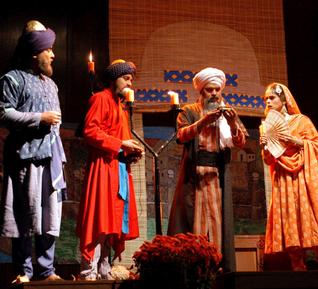
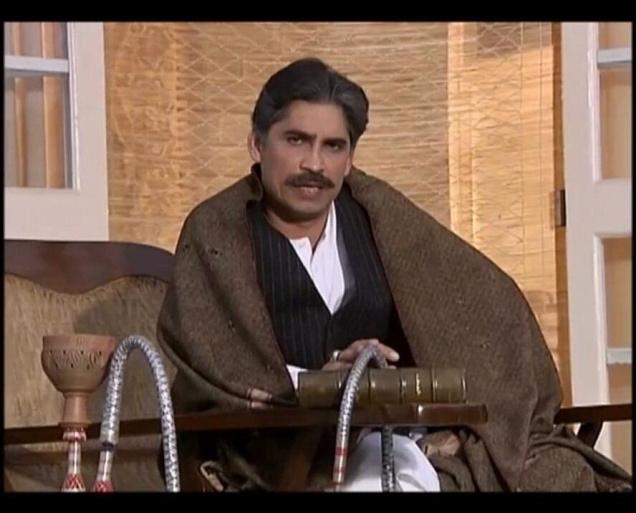
A scene from Sir Iqbal.

M. Sayeed Alam’s “Sir Iqbal” will be staged in the Capital this Sunday

The most sung poet and perhaps the most sung song in India “Saare Jahan Se Accha” written by Allama Muhammad Iqbal is all set to ignite the imagination of theatre lovers in Delhi. Playwright and directors, M. Sayeed Alam and Danish Iqbal’s spring time production ‘Sir Iqbal’ is a biographical work on the life, times and scholarship of Allama Iqbal who continues to be misunderstood in India but is celebrated in Pakistan as the man who came up with the idea of a separate nation for Muslims.

“Iqbal’s love for India which clearly comes through in the poem ‘Saare Jahan Se Accha’ and yet his choice of living in Islamic Pakistan over a secular India is in itself a study in contrast, a paradox that has pushed him far away from public memory in India. Iqbal died in 1938 much before the idea of Pakistan even took shape. Doctored history, misapprehensions about Allama being a fanatical Muslim who chose to live in a Muslim dominated undivided India needs to be closely looked into. My play is an effort to demystify Iqbal and clear some perceptions about the great poet, philosopher and politician and above all a humanist who has given India its most enduring patriotic poem yet remains forgotten in the country,” said Alam in the midst of rehearsals for the play which opens to public on March 20 at Sri Ram Centre.

“From what I have read about Iqbal’s political philosophy, he never demanded a separate home for Muslims outside India. Iqbal’s formulations somehow suited the supporters of Pakistan and they hailed him as the ideological father of the country – something that many Indians came to detest and therefore Iqbal remains forgotten whereas his poem as a song is sung everyday in schools all over the country. Our play brings out this dichotomy,” said Alam.

“Sir Iqbal” had first premiered in Kolkata in November last year to much critical acclaim. The one and half hour play with a 15-member cast will see Alam himself essay the role of Iqbal. The play is centred around the poet and philosopher’s life. In the play, Iqbal’s story is narrated by his trusted servant Ali Baksh who enjoyed Iqbal’s confidence and had witnessed many events in his life. Set in British India in the backdrop of the first half of the 20th Century, ‘Sir Iqbal’ will mirror the socio-political churnings during Allama’s times till his death in 1938 in undivided India. The play will perhaps set some records straight and clear many perceptions about Iqbal, who for many Indians still remains an enigma.

source: http://www.thehindu.com / The Hindu / Home> Features> MetroPlus / by Anasuya Basu / March 18th, 2016

At Sufi meet, Modi lauds Islam as a religion of peace

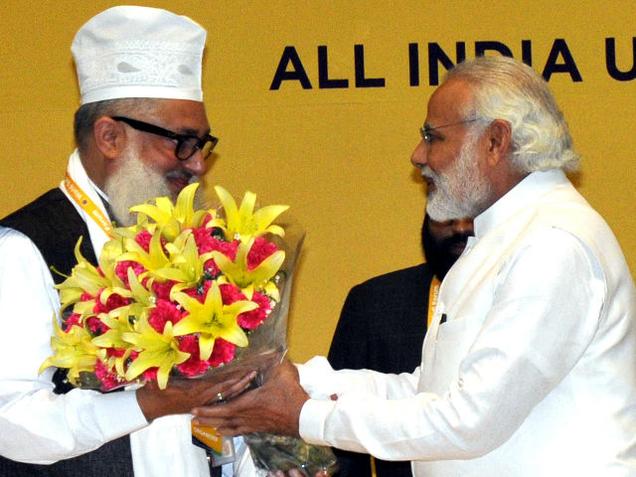
Prime Minister being welcomed by AIUMB founder-president Syed Mohammad Ashraf Kichuachwi at the inaugural ceremony of the World Sufi Forum in New Delhi on Thursday. / The Hindu

The Prime Minister quotes from Koran and makes a strong pitch against terrorism.

Prime Minister Narendra Modi said on Thursday that all Indian communities were an integral part of India, making a pitch for pluralism and diversity.

Mr. Modi was addressing delegates of a global Sufi meet here at a time when shrill statements from many within the BJP and the Sangh Parivar have created controversies in the past few months.

Rejecting terrorism, Mr. Modi hailed Islam as a religion of peace, citing the Koran and also paying rich tributes to the eclecticism of the Sufi tradition.

“Welcome to a people with an abiding belief in Vasudhaiva Kutumbakam, the world is one family,” Mr. Modi said. Mr. Modi said leaders like Maulana Abul Kalam Azad chose not to side with the idea of division based on religion after Independence.

“This is the spirit of India. This is the strength of our nation,” he said. “All our people, Hindus, Muslims, Sikhs, Christians, Jains, Buddhists, the micro-minority of Parsis, believers, non-believers, are an integral part of India.”

He sought to draw a parallel between these values and his own policies, saying, “The values of harmony, welfare, compassion and love for human beings are the foundation of a just society. That is the principle behind my creed of Sab Ka Saath, Sab Ka Vikas.”

The Prime Minister made a strong pitch against terrorism, underlining that “terrorism divides and destroys us”. “Indeed, when terrorism and extremism have become the most destructive force of our times, the message of Sufism has global relevance,” he said.

“Sufism is a celebration of diversity and pluralism, expressed in the words of Hazrat Nizamuddin Auliya, that every people has its own path of truth, beliefs and focus of reverence. These words reflect the divine message of the Holy Prophet that there is no compulsion in religion; and also that to every people, we have appointed ways of worship which they observe,” Mr. Modi said amid applause.

In reading Islam as a religion of peace, the Prime Minister may, however, have broken with many Hindutva outfits that, academic studies have argued, have tended to highlight Islam as an “invader” in India.

The PM also saw the basic attributes of Sufism among Indian Muslims: “It is this spirit of Sufism, the love for their country and the pride in their nation that define the Muslims in India.”

“They are shaped by the values of the Islamic heritage of India. It upholds the highest ideals of Islam and has always rejected the forces of terrorism and extremism,” he said.

Underlining that Islam is a religion of peace, Mr. Modi said: “When we think of the 99 names of Allah, none stand for force and violence, and that the first two names denote compassionate and merciful. Allah is Rahman and Raheem.”

While asserting that the fight against terror was not a fight against any religion but one between humanism and inhumanity, he hit out at terror as a threat to religion itself. “Terrorists distort a religion whose cause they profess to support. They kill and destroy more in their own land and among their own people than they do elsewhere. Those who spread terror in the name of religion are anti-religious.”

source: http://www.thehindu.com / The Hindu / Home> National /by Vikas Pathak / New Delhi – March 18th, 2016

Return of the prince

THEATRE Playwright Danish Iqbal tells SWATI DAFTUAR about “Dara Shikoh”, a play that takes a look at one of Mughal India’s great lost names.

The cerebral MughalA scene from the play; (left) Danish Iqbal

It is 1653, and the siege of Kandahar is raging. Dara Shikoh sits in his tent at night, writing his treatise on comparative religion. His general, a veteran and a contemporary of his great grandfather, enters with the request to discuss battle strategy for the next day. Dara Shikoh explains that for him, the treatise is more important. He doesn’t ask the general to sit down, showing him this respect only later, when the general’s conversation takes an intellectual turn.

This is a scene from “Dara Shikoh”, the modern classic directed by M.S. Sathyu and written by Danish Iqbal, which encapsulates the play’s portrayal of the young Mughal prince and heir apparent to Shah Jahan. The play, being performed after three years, is once again being directed by the eminent director and stage designer and art director M.S. Sathyu and presented by Impressario Asia. After a recent show in Gurgaon’s Epicentre, it will be performed this Friday at the India Habitat Centre in New Delhi.

The play, Iqbal believes, cannot be considered a revival. “It’s been performed on and off over the years. This time, it’s only got minor changes. It’s a little shorter now, and there are a few new scenes.”

It was ten years ago, in 2004, that Iqbal, who confesses that he only works on commission because he needs to know that the words he pens will be performed, was approached by K.K. Kohli of Impressario Asia, the play’s producer. It could easily have been action oriented, a harsh, blood and gore portrayal of a prince whose life ended brutally and violently, killed in a succession struggle by his own brother. Iqbal and Kohli, though, decided to go a different way. The Dara Shikoh that Iqbal has penned is a prince who respects intellect over privilege. He is an egoistical, liberal, peace loving man who ignored war and translated scriptures.

“Dara was, in my opinion, the greatest person in Mughal history. I think he was greater than Akbar too.” Iqbal, while researching his play, says that he was surprised to see that this giant had been ignored by history. In this play, he has been careful to highlight Dara to the maximum, not allowing Aurangzeb or Sufi Sarmad, Dara Shikoh’s mentor, to take the stage. “I was questioned about this, but I think that in the case of Aurangzeb, the fear of the invisible and unknown would be much greater. Plus I didn’t want Dara overshadowed in any way.”

The playwright also goes on to admit that he owes more than half his knowledge about writing and stage skills to Sathyu. “He’s a grand old man of Indian theatre. He has a terrific sense of aesthetics. He makes sketches of every scene before the performance, to work out how the stage characters, headgear, beards, dresses, everything would look. He’s a very meticulous person. It’s a pleasure working with him. His art work is tremendously beautiful.” Iqbal adds that while he has indeed provided the dialogues, characters and content of the play, they’ve been given shape by Sathyu.

The shape this play has taken seems strangely placed in the past and the present. For Iqbal, the play holds a sort of every day importance. “In the past 10 years the challenges to inclusiveness and coexistence have increased in a big way; people are more fanatic. And terrorism is a bigger threat than before. The play has actually become more relevant.” He terms Dara as the first prince who died for his ideals, and adds that “Dara Shikoh” is today’s play. “It is a metaphor. We discussed if this play, because of how it ends, was becoming too sad and tragic, but it was in his defeat and death that Dara’s principles emerged victorious. This is what we wanted the play to show.”

Iqbal, a student of philosophy, has written a work that plays with many concepts and ideas that affect and influence human existence. Of death, a quote from the play says, “ Maut kya hai, maut hai fakth ek dehleez ”, which loosely translates to mean that death is ultimately the first step to a door between one chamber and the next. That death, ultimately, is nothing.

In a play packed with such layered, ambiguous dialogues, Iqbal confesses that it has become hard to cast the right actors for the roles. “It’s a great challenge. We don’t have very good actors, and especially young actors lack the capacity to understand the nuances of the play, absorb its ideas and translate them into emotions and gestures. This requires intellectuals of a certain calibre, and not all actors can deliver. Often, the average actor only sees the superficial meaning of a dialogue. To overcome this, we have conducted workshops with the actors, to explain the multilayered aspects of play.” Iqbal adds that there are hardly any professional actors hired for this season of the play. “They have their jobs, and (we have) amateur actors who wanted to be part of the production.”

He’s holding a book on Pataudi, and as a closing remark, adds that he’s working on another story that gives him the goose bumps, that of Mansoor Ali Khan Pataudi. “Like Dara Shikoh, his story is also inspiring, and can reach people in manifold ways.”

Director M.S. Sathyu says, “We’ve only made minor changes in the play, and this time there is a new choreographer (Astha Dixit) and they’ve got trained Kathak dancers. The casting is always a problem, because this play requires a lot of Urdu and there are very few actors who can speak good Urdu. They can speak in Hindi and Punjabi but Urdu is a challenge.”

source: http://www.thehindu.com / The Hindu / Home> MetroPlus / by Swati Dastur / January 23rd, 2014

Tansen lives! Ghulam Mustafa Khan

Hailing from the senia tradition of Tansen, Ustaad Ghulam Mustafa Khan is that gem that Hindi filmdom can still boast off. Rubina P. Banerjee salutes the maestro whose journey started at the age of 8 and continues even today at 82!

Coke Studio recently witnessed the magic meandering of the golden voice of Ghulam Mustafa Khan Sa’ab as he sang Rahman’s composition ‘Aao balma…’. The studio rebounded with the sonorous depths of Khan Sa’ab’s voice while Prasanna, on the Carnatic guitar, kept pace with his vocal dexterity. At 82, the Padmabhushan awardee is keeping in tune with the times while keeping alive the tradition of the Rampur Sahaswan Gharana.

What can one ask an Ustaad, who started singing at 8 and is still going strong at 82! All my questions seemed banal when it came to his art but one has to start somewhere so we started at the very beginning with his first concert…

“My journey into music had started with the music inherent in my family. At the time, every city had a Victoria Garden and it was the custom that on Janmashtami, the first public performance of those interested in music be performed as a debut. Ali Maqsood Sa’ab, who was the Chairman of the Municipality, organised the Janmashtami function every year and asked me to perform. I was only 8 then and it was the January of 1950 but my performance was much appreciated and people lauded me for my courage to perform at this tender age in front of such a well-informed audience!”

If he performed so well at 8, at what age did he start learning music?

My question brings a smile to his lips…

“I started learning to sing before I had even started talking! My father used to hold me on his chest and teach me sa re ga… even as I was starting to lisp my first words. After a point, I began saying sa re ga… before any other word. My mother was the daughter of the great Inayat Hussain Khan and music was the legacy of my family. Our seniya traditions go back to the times of Tansen and my great great grandfather Ustaad Qutubuddin Khan Sa’ab was the court musician of the Nawab of Oudh, Wajid Ali Shah. My father, Ustaad Waaris Hussain Khan was my first guru. Both my parents wanted me to be a singer.

I started so young that I could remember the tune but not the words! After my father I was trained by Ustaad Fida Hussain Khan who was the court singer at the Baroda royal durbar. And then I learnt with none other than the great Nissar Hussain Khan Sa’ab himself. I never had to find a guru outside my family as there were so many eminent musicians in my family itself.”

Does he look back on his childhood with laughter?

“I have only one complaint with my childhood – that my parents never allowed me to play. Studies and riyaaz; that’s all I did! My father had told all the elders in my family that if I stepped out they should discipline me and make sure I was back inside. Even my mother, who loved me immensely, would complain to my father and ensure I got a sound beating when I played truant. So I have no idea what it is to play and never learnt any sport. I only play with my tanpura.”

When did he realise that he could also sing well?

“You know you are good if the people who are in this field praise you, as they minutely observe and know your strengths and weaknesses. I was indeed very lucky as my brother, Hafeez Ahmed Khan became a producer for All India Radio and I came over to Mumbai. He had organised a programme with all the great performers of the time and I had the privilege of singing with Ustaad Bade Ghulam Ali Khan Sa’ab for four hours at a stretch!

“At the end of the performance, Ustaadji asked me how I managed this deep sonorous voice when my frame was so thin! – and he blessed me. It was a wonderful moment for me.”

The path of music which he embarked on now saw him perform for Dr. Rajendra Prasad (former President of India) in 1952. He was named Junior Tansen in the Haridas Sangeet Sabha in 1969 and awarded the Ustaad Haafiz Ali Khan and Ustaad Chand Khan awards. He performed in India and abroad in the presence of the Queen and Lady Diana and was awarded the Padmashri in 1991, the Sangeet Natak Academy Award (2003) and the Padmabhushan in 2006.

How did he then find his way into the Hindi film world?

“The first film I sang for was in Marathi, ‘Chand Pretticha’. I was here from 1957 and started singing playback for Marathi and Gujarati films but if you ask me if I know the languages, I don’t. At a function, a lady came up to me and said, ‘Khan Sa’ab, aap ga rahi thi, main sun raha tha,’ Yeh mujhe ek aurat keh rahi thi!” His laughter fills the room.

Getting back to films, he says he started with Mrinal Sen’s ‘Bhuvan Shome’ and sang ‘Sajanaa kahe nahi aaye…’  for ‘Badnaam Basti’ under the same music director, Pandit Vijay Raghav Rao. It was Muzaffar Ali’s ‘Umrao Jaan’ that saw him sing the immortal ‘Jhoola kinne dala…’ and ‘Pratham dhar dhyan…’ under Khayyam’s music direction. The ambience of the kotha and the plight of the little Umrao as she is sold into the life of a courtesan, are made all the more poignant by the soulful rendition of the song by Khan Sa’ab.

His connection to Hindi filmdom doesn’t end there. From the late ’50s, he has been a guru to Asha Bhosle, Manna Dey, Geeta Dutt and today, Hariharan, Shaan and Sonu Nigam are among his students. “They have all given me a lot of love and respect and brought me fame as a teacher,” says the Ustaad. On their part, his shagirds acknowledge that their singing skills have been greatly enhanced by their guru.

The most satisfying part of his life is perhaps knowing that he has done his best to keep alive the tradition of the Rampur Sahaswan Gharana; a gharana known for vocal dexterity. His four sons Ghulam Murtaza, Ghulam Qadir, Ghulam Rabbani and Ghulam Hasan Khan are singers as well and have been trained by him.

Today they are professional singers in their own right and have sung for the renowned Rahman in films like ‘Fiza’, ‘Meenakshi’ and ‘Saathiya’. Rahman himself is a student of Khan Sa’ab’s and says he has a lot to learn from his guru. The mellifluous Ustaad Rashid Khan is his nephew as well as his shagird.

However, it is his grandsons who make him proud. Little Faiz and Shoaib have received taalim from the great Ustaad that is their grandfather. Watching Rahman’s song ‘Soz o salaam…’, I see Khan Sa’ab’s eyes light up as Faiz sings the verse flawlessly. His eyes wander wistfully as if seeing in his grandson, his own 8-year-old avatar, performing at his first concert in Victoria Gardens!

source: http://www.freepressjournal.in / The Free Press Journal / Home> Entertainmen / by FPJ Bureau / February 16th, 2014

K.K. Muhammed – Digger of truth

kkMuhammedMPOs27feb2016

KERALA :

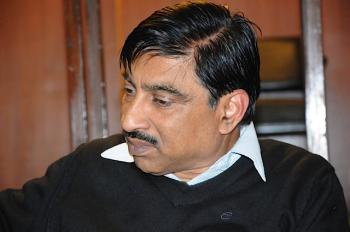
LAST year, a young journalist friend, Rajeev Mangottil, invited me to speak at the Onam Day celebrations at Jamia Millia Islamia. The name of this venerable institution is derived from the Urdu language in which Jamia means ‘university’ and Millia means ‘national’. That is where I first met the youthful-looking K.K. Muhammed, Director of the Archaeological Survey of India (ASI).

Rajeev whispered into my ears that Muhammed would soon be retiring and his story on him was scheduled to appear in the Malayala Manorama supplement. Since the Malayalam daily is fond of showcasing every Malayali as an achiever of sorts, I was not greatly impressed.

One reason why I underestimated him was that I have a poor opinion of the ASI. Just last fortnight a friend from Punjab SMSed to say that he had visited Nangal and seen the glass case which commemorates Chinese leader Chou en Lai’s visit and the discussions he had with Prime Minister Jawaharlal Nehru while formulating Panchsheel or the five principles of peaceful co-existence. I had visited the place a couple of times and was shocked by the fashionable sofa in the glass case. I checked and found that the two leaders had used caned, wooden chairs, which the officials concerned did not find impressive enough to be showcased.

In contrast, I saw at Potsdam, near Berlin, the large table and the chairs used by Stalin, Churchill and other victors of the Second World War, while deciding to divide Berlin into four zones and to constitute the United Nations, preserved in the same manner in which they were used, attracting thousands of tourists every year. But the first time I visited Shimla, I was unable to see the table and the chairs used by Indira Gandhi and Z.A. Bhutto for finalizing what is known as the Simla Agreement because no official had any clue about their existence.

Muhammed preferred to speak after J. Gopikrishnan, the ‘Pioneer’ reporter who unearthed the Spectrum scam, and I had our say. He spoke extempore and quoting the Vedas and the Upanishads, he took the listeners on a conducted tour of ancient Kerala, where the persecuted Jews found asylum and Semitic religious ideas flourished and enriched the native cultural practices and traditions. It was apparent that he had an excellent command of Sanskrit, the language of the gods. No, he did not say anything about the ASI or the work he had been doing.

He gave me his visiting card, which said that he lived in the Red Fort. He certainly could not have found a better place to live in than the fort the Mughals had built and from which they ruled the country. No other monument has witnessed history as the Red Fort from the ramparts of which the Prime Minister addresses the nation on Independence Day. It would not be an exaggeration to say that Muhammed breathes history and archaeology, rather than air.

So when I received an invitation for his lecture on the ancient churches of Goa at the Kerala Club, I could not resist the temptation to attend. What makes Muhammed stand out as an archaeologist is the passion he has for archaeology. We have all studied about Akbar the Great and Din-i Ilahi, the divine faith, he propounded by incorporating the best from Islam, Hinduism, Christianity, Buddhism, Jainism and Zoroastrianism.

It was at Ibadat Khana, the House of Worship, that the Emperor used to hold discussions with religious scholars. Miniature paintings that depict Akbar meeting Christian theologians exist. But where exactly was Ibadat Khana?

Mohammed studied the painting thoroughly and believed that it could be excavated at a particular spot in Fatehpur Sikri. He was in his late twenties and could not, therefore, convince his seniors, who all had a different belief. But he started excavating on the spot and found that the dome, the antechamber, the different layers and the gate depicted in the painting matched his excavation. It was a great archaeological discovery for which then Prime Minister Indira Gandhi congratulated him. What’s more, he also discovered a Christian chapel and a bazar in the same area.

Ask Muhammed and he will tell you that restoration of the 1300-year-old Bateshwar temple in Madhya Pradesh as the high-water mark of his career. He found hundreds of temples in a state of ruin, devastated as they were by an earthquake. Restoring them was a challenging task. Nobody seemed to be bothered. He had heard that dacoits would occasionally drop in to worship at the Hanuman temple there.

One day while returning to his workplace, he found a person smoking beedi in the temple. Muhammed rebuked him for smoking in a sacred place, little knowing that he was none else but dacoit Nirbhay Singh Gujjar! Fortunately, the dacoit did not pull his trigger and he left only after he was told by Muhammed that he belonged to the Gujjar-Pratihara dynasty that had once ruled the region.

He found that he could not carry on his work without the cooperation of the MP government, which was disinterested. Then he hit upon the idea of writing a letter to the then Rashtriya Swayamsevak Sangh (National Volunteer Corps) Sarsanghachalak, V.S. Sudarshan, telling him that though the BJP ruled the state, its government was not at all interested in restoring the ancient temples.

The RSS chief took up the matter with the Chief Minister, who ensured that he received the full support of the state government. He also had to contend with the mining mafia, which took a dim view of the restoration work. Finally, he was able to restore about 80 temples while the work is still going on.

I recently saw a documentary telecast by Asianet on the Bateshwar temple complex, which has started attracting tourists. Restoring a temple from the ruins is not an easy job. One should have a great knowledge of the art of temple construction. On TV, I heard Muhammed explain to the viewers how he came to the conclusion that a statue of Nandi could only have been at that particular spot. Rome was not built in a day. Nor had he learnt archaeology in a day.

Muhammed is modest when he says, “I have always been inspired by the Upanishads”. He knows important texts like Manasara Shilpa Shastra and Mayamata Vastu Shastra by heart. He is unabashed when he says: “I must have been a Namboodiri Brahmin in my previous birth”. I would have certainly believed him, if I had not heard his lecture on the ancient churches of Goa, where he was posted for about six years. He showed slides of various churches before and after restoration. That any ASI official could have done.

What no non-Christian could have done with such finesse was give a graphic account of the religious traditions and practices of Christians. He showed the picture of a temple, which gave Vasco da Gama the impression of a church. He went on to explain how the builders of churches in Goa liberally followed the motifs and styles used in Hindu temples and architecture.

For instance, lotus enjoys a pride of place in Hinduism. Vishnu’s feet are always qualified as the “lotus feet”. But in Christianity, no such importance is given to the lotus, which is like any other flower. Yet, he found that many of the churches in Goa sported lotus paintings and motifs.

There were many other features from Hindu temple architecture that were freely adopted by church builders. In temples, leftover water was always allowed to flow through a pipe the mouth of which resembled a crocodile’s. He showed with slides how the idea had been freely incorporated in church construction also. Of course, Muhammed had an explanation for it. The artisans who built churches came from the same class, which built temples in the area.

I was not surprised by Muhammed’s statement because a Malayalam journal had recently published a photo feature on one Govindan Gopalakrishnan, who specializes in mosque construction despite never having studied at a school of architecture, and never having seen the Taj Mahal, let alone the Jama Masjid in Delhi. He has so far built 88 mosques, including the magnificent Palayam mosque in Thiruvananthapuram and the strikingly beautiful ones along the highways in the state. Gopalakrishnan, who is a practicing Hindu, considers mosque construction as his “karma”.

Mohammed’s knowledge of church architecture was as splendid as his knowledge of the life and work of St. Francis Xavier, whose mortal remains are preserved in a church in Goa. When he spoke about him, I felt there was a devout Catholic in him.

And when he explained the various Stations of the Cross that he helped preserve in a church, and recited a line from the Bible “Elahi Elahi Lama Sabachthani” (My God, my God, why have you forsaken me?), I could see that he was overwhelmed by the enormity of emotions. I would not be surprised if he claimed that he was a bishop in his previous birth.

You and I may brand him as a Muslim or a Hindu or a Christian but Muhammed is a professional archaeologist, who ensures that wherever excavation is carried out, the local children and youth are involved in it so that when they grow up they will not leave vandal-like imprints of “Pappu loves Pappy” on the monuments they visit. In his case, wrong perceptions turned out to be far too costly.

When the post of Vice-Chancellor of Calicut University fell vacant, many knowledgeable people suggested Muhammed’s name but some thought that he was too close to the Sangh Parivar to be trusted with such a job. Instead, a person of lesser merit was chosen. Muhammed would not, however, be bothered for he knew that “an archaeologist is one whose career lies in the ruins”.

It was just the other day that historian M.G.S. Narayanan lamented that in Kerala, the Archaeology Department was headed by people who could not spell the word “archaeology” and would ask whether Alexander Fleming and Alexander Cunningham were the same.

For Muhammed, work is worship and it does not matter that he has not been adequately recognized for his contributions. However, he has many anecdotes to recount. Like the one of the time when he took President Barack Obama and his wife Michelle round the Humayun tomb and answered their questions.

Muhammed has in a recent interview expressed his distress over the low priority archaeology enjoys in the country. When he was in charge of the ASI’s work in Northern India, his budget was a puny Rs 6 crore. How many people know that it took 20,000 workers and artisans 16 years to construct the Taj in 1647-48 at a cost of Rs 50 lakh? This, when it is India’s tourism showpiece and the foremost Indian monument that spurs the international visitor to visit the country!

Do they know that parts of the Taj had fallen into disrepair? It was Lord Curzon, who ordered a comprehensive restoration project, which was completed in 1908. If anything, it shows how restoration is important for any historical site. Instead, we are good at spreading myths. One such myth is that Shah Jahan ordered the amputation of the hands of the architect of Taj Mahal in order to ensure that nobody made such a magnificent monument again. Another such myth is that the Emperor started building his own tomb on the other side of the Yamuna in black marble. Excavations across the river revealed no foundations.

Thus archaeology has its use in not only proving historical facts but also in exposing falsehoods. Muhammed showed how he transplanted a temple brick by brick using a numbering process. At the end of the project, not a single brick had become surplus. In retrospect, the most enduring image from the lecture was a gate, which he restored without spending a single penny from the state exchequer. Instead, he involved the local youth in the preservation work. They were only too happy to join him in his noble endeavor.

In all his pursuits, one thought that has guided Muhammed is “Om Lokah Samastah Sukhino Bhavantu”! (May all the people be happy!). What a pity that in a country where all and sundry are given Padma awards, a person like K.K. Muhammed has not been given such a recognition because to some, he is a Muslim and to some others, a Hindu. Rather like the poet Kabir over whose body the two communities fought only to find that he had transported himself to the realm of the sacred and the holy. K.K. Muhammed’s scholarship belongs to none, because it belongs to all.

The writer can be reached at ajphilip@gmail.com
Courtesy: Indian Currents

source: http://www.heraldofindia.com / The Herald of India / Home> Article / by A.J. Pinto / 2012
Karnataka Urdu Academy Chairperson passes away

Bengaluru , KARNATAKA :

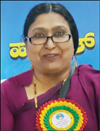
Dr. Fauzia Choudhry collapsed while speaking at a programme in Kannada Bhavan, Bengaluru

DrFauziaMPOs26feb2016

Mysuru :

Dr. Fauzia Choudhry (52), Chairperson of Karnataka Urdu Academy, passed away yesterday in Bengaluru following a heart attack.

She leaves behind her husband, three daughters and a host of relatives and friends.

Dr. Fauzia Choudhry, who collapsed while delivering the presidential address at a programme held at the Urdu Library in Kannada Bhavan, was rushed to St. Martha’s Heart Centre, where she was declared brought dead.

Namaz-e-Janaza will be held today after Zohar at Masjid-e-Khadria, followed by the burial at Khudus Saheb Makhan in Bengaluru.

Condoled: MLA Tanveer Sait, Secretary of Mysore District Relief Committee Mohammed Mumtaz Ahmed and others have condoled her death.

source: http://www.starofmysore.com / Star of Mysore / Home> General News / Thursday  – February 25th, 2016

A student and a corporator too!

Hyderabad, TELANGANA :

ShireenMPOs23feb2016

Clad in a burkha and with a scarf covering her head , Shireen Fatima looks like any other woman from the old city. But what distinguishes her from others is that she is a GHMC corporator representing Nawab Sahab Kunta division at the tender age of twenty one.

A D.Pharm student of Mesco College of Pharmacy at Mustaidpura, Shireen attends college and devotes her remaining daytime to ensure overall development of the ward. After nightfall she gets back to her studies. Her father Abdul Hannan, a well-known public figure in the area, guides her in the day-to-day affairs. AIMIM party president Asaduddin Owaisi is her role model. In an interview with The Hindu, she outlines her plans for her ward.

What are the main problems in your constituency?

See I represent an area which has many slums. There are quite many civic problems pertaining to sanitation, water scarcity and sewerage. A few storm water drains need to be widened or remodelled.

How are you going to solve them?

Along with my father I have prepared an action plan. I will be discussing with the Bahadurpura MLA Mohammed Moazam Khan and then meet the GHMC officials concerned to ensure their redressal. My emphasis will be on development of local government educational institutions.

I will also be writing to officials of various government agencies to increase the manpower allotted for the area so as to attend regular civic works including health and sanitation. People are also requesting for a library and I will take up the issue with the party leadership as a few thousand students will benefit if it is set up.

How will you help improve the city’s infrastructure?

I will cooperate with officials and other public representatives to ensure overall development of the city infrastructure. My main focus will be developing my ward.

source: http://www.thehindu.com / The Hindu / Home> News> Cities> Hyderabad / by Asif Yar Khan / Hyderabad – February 22nd, 2016

NFHRC branch opened

Vizianagaram, ANDHRA PRADESH :

National Federation of Human Rights Council opened its branch at Three Lamps junction in the town on Sunday.

Federation State president Mohd. Ali Sheik, who inaugurated the branch, said the council with an intention to create awareness among the general public about their rights as per the legislations in force and to standby those in distress would be setting up its branches at all district headquarters.

He said that Chief Minister N. Chandrababu Naidu too had given his consent for construction of the council’s own building.

State Bar Council vice-chairman Kolagatla Thammanna Setty, who was present, emphasised on the need to know about Right to Information Act, Consumers’ Act, Human Rights, etc. in detail to assert their rights.

source: http://www.thehindu.com / The Hindu / Home> National> Andhra Pradesh / Vizianagaram – February 22nd, 2016

Touch, and go

Mumbai, MAHARASHTRA :

WomensRugbyMPOs22feb2016

Rugby in the country, and in Asia, has a lot of picking up to do, writes TANAY APTE

In our cricket-crazy country, it would be safe to assume that all other sports fall under the minority category. In their fight for more recognition, football, hockey, badminton and even kabaddi now have glitzy, cash-rich leagues — modelled, ironically, on the IPL. These have gone some way in increasing the sports’ fan following, but are nowhere close to dislodging cricket off its pedestal.

And then, we have rugby. The first rugby match was played on Indian soil nearly 150 years ago, in 1872, in Kolkata — a team of Englishmen took on another with Scottish, Welsh and Irish players. Almost a century later, the Indian Rugby Football Union (IRFU) was founded in 1968. But, it received recognition from the International Rugby Board only in 1999.

The sport is a huge hit among Western European countries, Oceanic countries and, of course, in South Africa. To increase its popularity in Asia, the governing body, Asia Rugby, introduced the Asian Seven Series in 2009. Although it has not set the world alight by any means, the quality of rugby has definitely improved.

After the success of last year’s Asian Rugby Sevens Olympic Pre-Qualifiers in Chennai, the city was given a chance to host the Asian Rugby Development Sevens Series as part of the Asia Rugby Sevens calendar. The tournament took place at the Jawaharlal Nehru stadium on February 20 and 21.

Nasser Hussain, the General Manager of Rugby India, had said, “Riding on the success of last year’s edition, the top teams in Asia are well prepared to raise the bar of the competition. We will witness some of the best Rugby in Asia, during the course of the tournament.” He was not wrong.

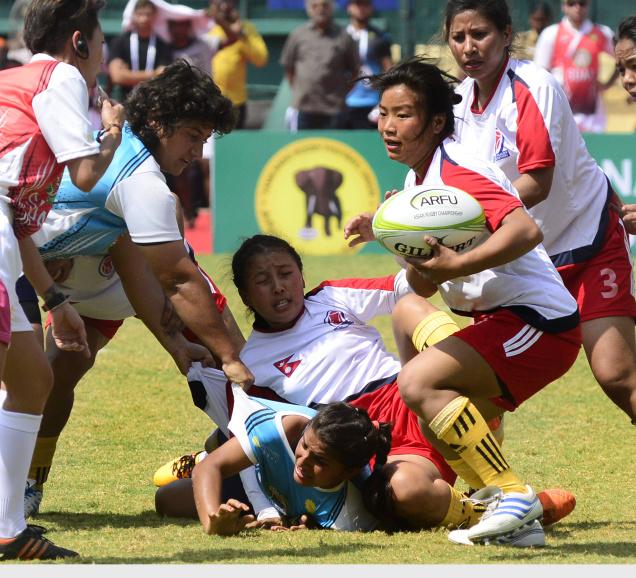
Hosts India competed against the likes of South Korea, the Philippines, Thailand, Indonesia, Kazakhstan, Saudi Arabia, Syria, Guam, Bangladesh, Nepal, the UAE, Lebanon, and Chinese Taipei, which eventually emerged victorious in the men’s section, beating Thailand 36-21 in the final, with a powerful display. The women’s final was a cracking affair, in which South Korea defeated Guam 24-19, via a golden try after the game ended in a tie at the full-time whistle.

The Indian women’s team won the bronze medal match against Nepal in a lopsided encounter, in which the score read 39-0. The men’s team ended up with a sixth-place finish.

In a country of more than a billion, you would expect some semblance of a crowd at an international sporting event. But, although their numbers were scarce, the locals turned up the volume throughout the tournament. With drum beats, whistles and loud cheers, the atmosphere at the stadium egged on the players to give it their all.

Rugby is still not a professional sport in India (though there are roughly 50,000 men and women playing it), and the sport finds it hard to attract the investment needed to take it to the next level.

Asia Rugby’s tournament consultant, Aaron Stockdale, however, believes there is light at the end of the tunnel. “Over the past decade, India has consistently been developing as a serious contender in the Asian rugby circuit. With an event of this stature being held here, it is only a matter of time before the youth of this nation help build a formidable line-up that will compete amongst the best.”

The 2019 Rugby World Cup is scheduled to take place in Japan — the first time an Asian country will host the event. Japan’s stunning win over South Africa in the World Cup last year sent shockwaves throughout the sport. It put Asia on the rugby map and, more importantly, gave hope to the Asian rugby nations that they can mix it up with the big boys and not feel out of place.

However, that date might be a bit too soon for India, as the sport is still in its infancy. But, with careful nurturing, we can one day see ourselves staring at TV sets as the national team goes toe to toe with rugby’s finest.

source: http://www.thehindu.com / The Hindu / Home> Features> MetroPlus / by Tanay Apte / February 22nd, 2016

Polling peaceful in Kodagu, Chikkamagaluru districts

Chikkamagaluru – Kodagu, KARNATAKA :

The zilla and taluk panchayat elections held in Kodagu and Chikkamagaluru districts were peaceful on Saturday.

The polling received a lukewarm response in plateau region in Chikkamagaluru district till afternoon.

Twenty-three per cent polling was recorded at Karthikere in Kuruvangi zilla panchayat constituency at 11 am. The polling percentage similar at Kalasapura in Ambale constituency at 11.30 am.

A 95-year-old Jayamma was carried to the polling booth by her son Siddalingappa at Pillenahalli.

The labourers left for their work after exercising their franchise in Malnad. The political parties had even arranged vehicles to ferry the voters to the polling booths at a few places.

District Congres Committee President D L Vijaykumar exercised his franchise at Balegadde polling station.

Report from Kodagu

Elections were held in 29 zilla panchayat and 50 taluk panchayat constituencies in Kodagu district.

A total of 117 candidates are contesting in the zilla panchayat election and 169 candidates are in the fray in taluk panchayat election.

Technical glitch was experienced was an elctronic voting machine at Athooru polling station at Somwarpet taluk. There was brisk polling since morning in the district.
Women and men were seen standing in long queues to exercise their franchise at Kedakal, Suntikoppa, Guddehosur, Nanjarayapatna, Kambibane, Chettalli, Nelyahudikeri, Siddapura, Ammathi, Moornadu, Mekeri and other areas.

Ninety-six-year-old Ponnamme arrived to exercise her franchise at Kedakal polling station.

Krithika, who excercised her franchise for the first time at Suntikoppa, said, “I am feeling happy that I have excercised my franchise for the first time. Voting is a sacred right.” Jayalakshmi, a first-time voter, expressed similar views at Guddehosur.

People were seen discussing about the election in groups outside 100 metre radius of a few polling booths in the district.

Deputy Commissioner Meer Anees Ahmmed visited Kadagadalu, Abhyathmangala, Chettalli, Nelyahudikeri, SIddapura, Makkandoor, Madapura, Athooru, Guddehosoor and other polling booths. The counting of votes will be held at 8 am on February 23.

source: http://www.deccanherald.com / Deccan Herald / Home> District / Chikkamagaluru – Kodagu / DHNS – February 21st, 2016