Category Archives: Leaders

Inauguration of Mysore University Centenary celebrations: PREZ. Visit – Behind the scenes

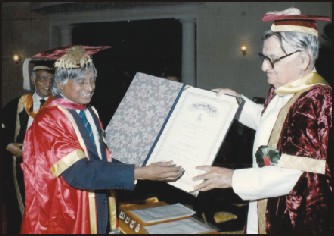
 A file photo of former President of India Dr. A.P.J. Abdul Kalam receiving the Honorary Doctorate from the then Governor-Chancellor Khurshed Alam Khan during the 75th Convocation of University of Mysore on Feb.25, 1995. The then Vice-Chancellor Prof. M. Madaiah is partly seen.
A file photo of former President of India Dr. A.P.J. Abdul Kalam receiving the Honorary Doctorate from the then Governor-Chancellor Khurshed Alam Khan during the 75th Convocation of University of Mysore on Feb.25, 1995. The then Vice-Chancellor Prof. M. Madaiah is partly seen.

by N. Niranjan Nikam, Senior Journalist & Consultant, Centenary Celebrations 

It was an oft repeated utterance for the past one year. “We are on the threshold of celebrating the Centenary of the University of Mysore.” July 27 is the Foundation Day. It was on the same day in 1916, 99 years ago that the University of Mysore was founded. The day to herald the year-long celebrations had finally arrived. The hard work, dedication, devotion, sincerity and above all, commitment to the cause of the celebration of centenary on the part of the Vice-Chancellor Prof. K.S. Rangappa has made it possible.

The day dawned with a slight drizzle in the morning and we were worried. The clouds cleared at the right time. Hectic activity was going on to prepare the stage. Last minute instructions were flying back and forth. The countdown had begun for the arrival of the President of our country.

As the clock struck one, people started arriving. There was palpable tension in the air for most of us involved in organising the event. “Will the 10,000 seating capacity Amphi Theatre that was all decked up to receive the President be filled?” was the question uppermost in all our minds. However, the VC was fully confident that there would not be an inch of space left.

By 2’O clock, his predictions had come true. It was a sight to behold. The hard work of the past one year was paying off. I was worried whether the side wings would be occupied. But it was a joy to see every inch of space filled and also to see the real commoners and students sitting patiently for the arrival of the President.

Meanwhile, early in the morning, the names of the dignitaries who were to be seated in the front two rows had been identified and all their names pasted on the sofas. The students of the University College of Fine Arts, who were singing the Centenary Theme Song, came to the venue three hours before and rehearsed with the compere Prof. C. Naganna. The audio-visual team had set up their equipment and were testing. Lot of content had been provided to them to play while the audience waited for the function to commence.

The Police Band arrived well in advance and as the place for them was already earmarked, they went straight there and took up the position. Instructions were given to them that the moment the President arrives and walks to the centre of the dais to his designated chair, the National Anthem should be played.

Even as the clock ticked, came the news from the State Protocol Deputy Secretary that there would be a delay of at least half-an-hour as the President was visiting the Chamundi temple. It was also disclosed that he would change his dress at the Mandakalli Airport to dhoti and jubba to offer pooja to Goddess Chamundeshwari and then would change to formal dress at the Guest House of Abdul Nazir Sab State Institute of Rural Development (ANSIRD) on Lalitha Mahal Road. Hence, the delay was inevitable. We had no choice and hence we took the available time to fine tune the programme.

Backstage

First to arrive was R.V. Deshpande, Higher Education Minister and Pro-Chancellor, University of Mysore. Then the other dignitaries started arriving. All the six former Vice-Chancellors and Eminent Lexicographer Centenarian Prof. G. Venkatasubbaiah had arrived and were seated in the newly-furnished green room in the Amphi Theatre at Manasagangotri.

The messages were coming from the State Protocol Officer every ten minutes about the President’s convoy. Finally, the President arrived. The tall figure of Governor and Chancellor Vajubhai Rudabhai Vala emerged from the car and I thought that the President would be coming next. But when the diminutive figure of the President, Pranab Mukherjee, neatly dressed in a close-collared coat stepped out from the same car, our joy knew no bounds, as at last our objective to have the function on the day the University was founded (July 27, 1916), had been achieved.

However, more drama was to unfold. The State Protocol Officer, the moment he arrived, announced that the Vote of Thanks had to be dropped, as the President was running late and he had to be in Bengaluru for the next function in the evening. The instructions to him had come in the form of a message from the President’s Secretariat. I had to run to tell the Police Band that they had to play the National Anthem the moment the President finished his address.

Just a few days before the function, the VC had to visit the Rashtrapati Bhavan to finalise the programme details with the President’s Secretariat. He told me, “I had spent a pleasant half-an-hour when I had gone to invite the President earlier. But sitting with Private Secretary, who was insisting on every minute details, made me sweat.” The VC had suggested two more names for the President to honour but it was turned down. Even though the VC had made a promise to the two prominent personalities, it had to be dropped.

Former Prime Minister H.D. Deve Gowda, who was also to participate in the function, opted out at the last minute as he had to go to Delhi. The VC then wrote to the President’s Secretariat to include the name of Registrar Prof. C. Basavaraju. Incidentally, his name had been proposed along with other dignitaries to be included in the first list itself. The President’s Secretariat had, however, instructed us to drop his name to be seated on the dais. The permission was given at the last minute to seat the Registrar on the dais.

The decision to publish the book “Era of Enlightenment” (One hundred years of History of University of Mysore), penned by historian and former Vice-Chancellor of Goa and Mangalore Universities, Prof. B. Sheik Ali, was a really good one. However, the decision to also honour him was dropped as the President’s Secretariat said that there would not be enough time to do it as the list was already long. Hence, the VC had to reluctantly leave out his name.

It was also a momentous sight when the President saw the two centenarians Dejagow and Venkatasubbaiah. He looked at them open-mouthed as I escorted them and Prof. Rangappa briefed about their achievements.

The VC had asked the President’s Secretariat that Chief Minister Siddharamaiah should felicitate the President. But they were clear that the VC himself should felicitate the President.

In spite of the delay, the minute-to-minute programme was adhered to the last minute. One of those in the President’s Secretariat in the Navy Uniform, who was also giving instructions to us, told me in Hindi, “Kya Sir, aap itne buzurg log ko laye hain (referring to the two centenarians). Maine aisa function kahan be dekha nahin hoon.”

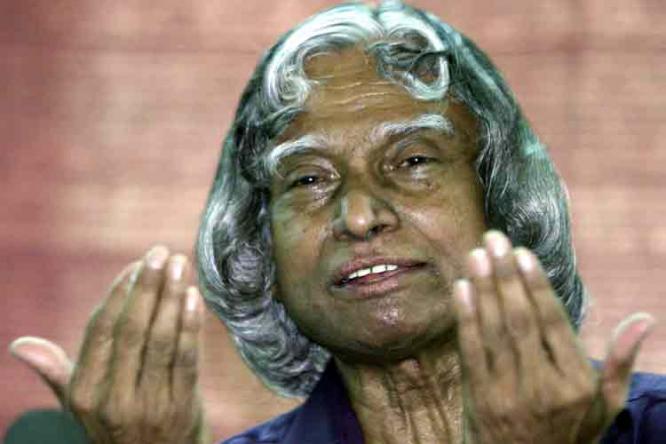
Even as the inauguration ended on a grand note by evening as we were mulling on the success, came the news that the former President Dr A.P.J. Abdul Kalam was no more.

The memories went back to 1995 when the Missile Man, and the Teacher as he would like to be remembered, was conferred the Honorary Doctorate by the University of Mysore.

Incidentally, Dr. Kalam was to inaugurate the Children Science Congress, in January next, during the Indian Science Congress to be hosted by the University of Mysore. Now, it is not to be.

NOTE: All things considered, it would have been most appropriate to have seated Prof. B. Sheik Ali on the stage since he was a Professor and Head of the Department of History in Manasagangotri, was the VC of two Universities; more than that he had authored the centenary remembrance book “Era of Enlightenment,” apart from being a venerable old man of 90 years age.— Ed

source: http://www.starofmysore.com / Star of Mysore / Home> Feature Articles / Friday – July 31st, 2015

House of Dr. Kalam at Rameswaram

HouseofKalamMPOs05aug2015

This is the house of Dr. A.P.J. Abdul Kalam, former President of India and a missile scientist, who passed away on Monday, 27th July and whose funeral was held this afternoon at his native place Rameswaram attended by PM Narendra Modi.

This photograph was taken on Thursday, 23rd July, 2015 by Emmanuel Suresh of Mysuru city and his wife Shirley, who was formerly working in Star of Mysore as a staffer, when they had visited the Christian pilgrimage centre Velankanni in Tamil Nadu from where they travelled to Rameswaram on hearing about Dr. Kalam’s house and a very good museum housed in the upstairs.

Shirley tells us that Dr. Kalam’s elder brother, 99-year-old Mohd. Muthu Meera Lebbai Maraicker still lives in the ground floor of this house.

The first floor is converted as museum where records and materials related to Dr. Kalam’s achievements, the rewards and recognitions he received from across the world are on display.

The second floor of the house is converted into an art gallery by Dr. Kalam’s elder brother’s son.

source:  http://www.starofmysore.com / Star of Mysore / Home> General News / Friday – July 30th, 2015

US media highlights Kalam’s role in India’s nuclear programme

Washington:

Describing him as one of the most “exuberant boosters” of India’s nuclear capabilities, the US media on Tuesday highlighted the contribution of ‘missile man’ A P J Abdul Kalam to the country’s atomic and space programme.

Kalam, who would have turned 84 in October died after suffering a massive cardiac arrest during a lecture at the IIM Shillong on Monday, plunging his country into overwhelming grief.

Describing him as one of the most "exuberant boosters" of India's nuclear capabilities, the US media on Tuesday highlighted the contribution of 'missile man' A P J Abdul Kalam to the country's atomic and space programme.
Describing him as one of the most “exuberant boosters” of India’s nuclear capabilities, the US media on Tuesday highlighted the contribution of ‘missile man’ A P J Abdul Kalam to the country’s atomic and space programme.

“He was one of the most exuberant boosters of the country’s nuclear program,” The New York Times wrote in a rare obituary for Kalam.

“He used the spotlight to urge India to build up its military strength and to free itself from the threat of domination by outside forces,” the daily said.

The Times said that Kalam spent little time outside India. “For him, it was a point of pride that India had developed its bomb without much help from foreign powers. And he described himself as thoroughly Indian,” it said.

Kalam has been credited with helping develop his country’s first space satellites. In the 1980s, he helped design the nuclear-capable ‘Prithvi’ and ‘Agni’ ballistic missiles, The Washington Post said.

“He played a crucial role when India tested its nuclear weapons in 1998. The test resulted in sanctions against the country but helped elevate Mr Kalam to the status of folk hero in his country,” the Post said in its obituary.

The Wall Street Journal reported that Kalam, who was born into a poor Muslim family in Tamil Nadu, was at the forefront of the country’s efforts to develop a space programme and a strong advocate for India’s self-reliance in defence technologies.

“He encouraged the development of India’s first indigenous satellite launch vehicle that brought the country into an elite club of space-faring nations and guided India’s missile-development programme,” the daily said.

“Dr. Kalam also played a key role in boosting India’s nuclear capabilities, leading to nuclear tests in 1998, a technological achievement seen as pivotal in asserting the country’s place in global politics,” the WSJ said.

“He was the first scientist to hold the office, and was widely viewed as an apolitical figure,” the CNN said.

source:  http://www.ibnlive.com / IBN LIVE / IBN Live> World / Press Trust of India / July 28th, 2015

Tribal people in B.R. Hills fondly remember Abdul Kalam

The passing away of the ‘People’s President’ and the ‘Missiles Man’ A.P.J. Abdul Kalam has shocked the Soliga tribal people in the B.R. Hills, who fondly remember him as he used to frequently visit the Vivekananda Girijana Kalyana Kendra (VGKK) there, when he was working as scientist at the Defence Research and Development Organisation (DRDO).

In fact, Dr. Kalam’s first visit to Chamarajanagar district was in 1998 and the last one was on October 16, 2006, when he participated in the silver jubilee celebrations of the VGKK. Incidentally, the day had a special significance as it coincided with the 76th birthday of Dr. Kalam.

Dr. Kalam was attracted by the beautiful environment of B.R. Hills. The tribal reminisce the way Dr. Kalam interacted with their children, including the youths. He was pleased to see the establishment of the New Tribal Hospital and development of roads, besides creation of facilities for their education. It was Dr. Kalam’s ideology to have “One Village One Product” for a comprehensive development of 128 tribal podus. He had advocated this ideology to ensure that the products produced by the tribal people by using modern technology could become viable and competitive commercial products at national and international levels.

Dr. Kalam had suggested the tribals in the B.R. Hills to embark on a bamboo mission. According to him, the mission should envisage an integrated programme of expansion bamboo plantations, their scientific management and promotion of value-added products of bamboo at community levels, besides development of entrepreneurial skills of tribal people. He had also suggested cultivation of Jatropha in about 1,000 acres of land, particularly on wastelands in hilly regions, to bring about rural prosperity through production of bio-diesel.

Another novel programme suggested by Dr. Kalam to VGKK was to consider creation of B.R. Hills PURA, encompassing all the 128 tribal hamlets and the 20,000-population. According to him, PURA was “providing urban amenities to rural areas”, envisaging provision of physical, electronic and knowledge connectivity for achieving economic connectivity. This would, according to Dr. Kalam, bring into focus the development of skills in cottage industry, dry-land agriculture, production of honey, handicrafts and processed food for which core competence was existing among tribal communities. The most important aspect of PURA concept was to create market avenues for the products.

His visit on October 16, 2006 to participate in silver jubilee celebrations of the VGKK coincided with the 76th birthday of the ‘People’s President’

source: http://www.thehindu.com / The Hindu / Home> National> Karnataka / Correspondent / Chamarajanagar – July 30th, 2015

TRIBUTE – Dr. Kalam: An idea, a vision and a dream

Former President A.P.J. Abdul Kalam

I write this obituary from the C-130 Air force plane with Dr. Kalam’s mortal remains a few feet behind me to be taken to Rameshwaram. He is draped in the national flag, the tricolor he served and deserves. He was the hero of my generation – I remember how I used to be glued to his Presidential address just as I was finishing school. He was an ocean of experience, ideas and motivation and to capture his personality and contributions in a few hundred words is a near impossible task. But as Dr. Kalam always said, “don’t stop trying” so here goes my attempt.

Srijan Pal Singh
Srijan Pal Singh

 “Funny guy! Are you smashing?” This is what I would hear from Dr. Kalam at every single dinner or lunch we had together. “Smashing” was the typical “Kalam call-sign” for asking whether the food was good. “Funny guy” was of course a more complicated expression, which could mean a whole variety of things. Depending on the tone in which it was said, it could mean good, not good, embarrassing or simply a casual reference. If you were working with Dr. Kalam, being able to decipher his usage of the word “funny” was almost a mandatory art to know which could be learnt only through experience. It took me a good one year to figure it out! Funny!

Dr. Kalam was a teacher, mentor, guide, co-author, friend, boss from whom I received care like a mother and concern like a father. I had the great fortune of working with him closely, travelling with him so frequently for over six years, till the point he left us all. He was infectiously optimistic, to him there was never an end. He never really watched TV, but still was a cricket fan – asking me scores on matches when we travelled between functions. His favorite cricketers were Dhoni and Sachin. I remember if I told him India was not doing well in a particular match, he would reply, “Watch! Our captain will come and do something unique.”

Uniqueness was so common to him. He had a voracious appetite for knowledge. The library and reading room occupying half of his 10 Rajaji Road House would be spilling books into bedroom and sometimes right upto the garden. He never departed on a journey without carrying a couple of books in his hand baggage. On the very last day of life, I remember lifting his hand baggage – it was heavy. I said, “Sir! Your bag is getting heavier!” He replied, “That is because I am reading more!”

To me the line which separated Dr. Kalam from the rest was not just his knowledge. It was his sensitivity and humility. He always introduced everybody as friend — whether it be his secretaries, his driver, his gardener, his cook or the people who maintained his house or even a stranger he just met. To him the world was truly flat, and there was no place for hierarchies and ranks in his life. I have had lunch and dinner with him at least 2000 times – often being the second to come to the table. Not once did he start eating on his own, not once did he miss asking whether I was liking the food.

He had the gift of empathy – and his memory of other people’s difficulties was impeccable. That was his art of winning over people. If he saw anyone with even with a small cold on a day he would offer you medicine or hot soup. The next day his first words would be – “Are you repaired?” No matter what you replied, his reaction would be, “Funny fellow you are!”

Dr. Kalam’s greatest faith was the nation and its youth. Even in the final two hours of his life, we discussed on terrorism as a threat to sustainability and the issue of Parliament becoming dysfunctional – two recent pieces of news which had pained him the most. He trusted the youth, particularly his students, to come up with a solution for these issues. He was an eternal believer in the power of the ignited mind of the youth – which he termed as most powerful, on the earth, above the earth and under the earth.

What next? We are bereft of Dr. Kalam as a physical form but we are still blessed with Dr. Kalam as an idea, a vision and a dream. His thoughts and missions about empowering rural areas, about clean energy, about value based education, about creativity, innovation and integrity are still flying high.

When I was his student in 2008 at IIMA, he told me in an after-class conversation, “If you are blessed with intelligence, and empowered with education – it is your responsibility to change the world”. That statement changed my life. He often said, “my dream is to see a billion smiles on billion faces”. Let us give our eternally optimistic, grand old friend, inspiration, mentor and beloved People’s President of the nation a reason to smile, wherever he is now. Salute you Kalam sir!

Srijan Pal Singh was an advisor to Dr. A.P.J. Abdul Kalam.

source: http://www.thehindu.com / The Hindu / Home> National / by Srijan Pal Singh / July 29th, 2015

At last, Tipu armoury in ASI care

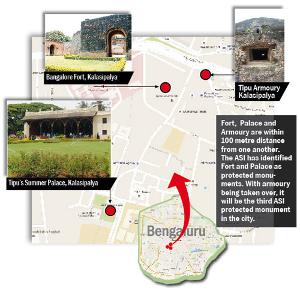
At this non-descript place hidden in the chaotic Kalasipalyam, Mysore ruler Tipu Sultan had stacked his ammunition cache. The 200-year-old armoury of Tipu Sultan behind Bangalore Medical College, which till now was treated like nobody’s baby, will soon be taken over by the Archaeological Survey of India (ASI) and declared a protected monument.

Fort,  Palace and Armoury are within 100 metre distance from one another.  The ASI has identified Fort and Palace as protected monuments. With armoury being taken over, it will be the third ASI protected monument in the city
Fort, Palace and Armoury are within 100 metre distance from one another. The ASI has identified Fort and Palace as protected monuments. With armoury being taken over, it will be the third ASI protected monument in the city

It will be the third ASI-listed protected monument in the city after Tipu’s Palace and Tipu’s Fort, all situated near KR Market.

The three monuments – armoury, palace and fort – are situated within a 100 metres of each other. Commissioner, state department of archaeology, museums and heritage, C G Betsurmath wrote to ASI approving the takeover about three weeks ago.

For several years now, the armoury has been in news, albeit for wrong reasons. Lack of upkeep resulting in condition of the structure deteriorating; the unkempt place turning into a gamblers’ den; the state archaeology department and BBMP passing on the buck of responsibility to each other, and so on. Only in 2002, it was, that the 18th century armoury saw some conservation by Indian National Trust for Art and Cultural Heritage (Intach), Bangalore Chapter. The not-for-profit non-governmental organisation shifted a retaining wall and exposed the original steps leading to the monument after removing the compound wall. A toilet illegally built on the southern wall of the structure was also removed.

Of the recent development, Arun Raj T, superintending archaeologist, ASI, Bengaluru circle told Bangalore Mirror: “The state government wrote to us saying they have no objections in ASI taking over Tipu’s Armoury. It is good news and a result of continuous effort of Intach. This is the first step and we have a process to follow. We will have to write to our Delhi office and complete some formalities with the Bruhut Bengaluru Mahanagara Palike. Given the historical importance, it is necessary to protect the armoury and connect the three monuments (fort, palace and armoury) as these three are remnants in the city that date back to Tipu’s period.”

However, there is a small hitch – a school building adjacent to the armoury. ASI and BBMP will have to conduct a joint survey of the place and find a solution. “The school almost abuts the armoury and once the armoury is declared a protected area, the school will have to be vacated considering that a buffer has to be maintained around our monuments. In that case, we would need BBMP’s help in relocating the school,” added Arun Raj.

Intach, Bangalore Chapter, which has campaigned for the armoury is overjoyed. In fact, a month ago, Intach had written to BBMP suggesting that they hand over the armoury to ASI. “ Once it is declared a protected monument, there will be no threat to the armoury in terms of encroachment and will be well maintained. We have been pushing for this for a long time and finally, the move has come through,” said Meera Iyer, co-convener of Intach.

History has it that this armoury was built below the ground level to store ammunition and the structure style is so relevant that it still being followed by the army. Armoury also called magazine is always built below the ground level, has just one entrance and is not exposed to the outside world by growing grass on the exteriors.

According to historian Suresh Moona who has chronicled the city’s history, this armoury in Kalasipalyam housed missiles and ammunitions and in a nearby area, Taramandalpet, rockets were experimented. Taramandalpet is close to Jumma Masjid Road near Raja Market where Tipu’s missile manufacturing unit functioned. Every night, rockets would be fired, which looked like a cluster of stars in the sky – hence the name Taramandalpet.

Pride of the city

» Under ASI Bangalore Circle of ASI, there are 207 monuments.

» In Bengaluru, there are two ASI-listed monuments – Tipu Fort and Tipu Palace; Bengaluru district houses six monuments including the fort at Devanahalli and Hunting Lodge on Nandi Hills.

» Monuments in Hampi are the most well-known; Tipu’s properties in Srirangapatna have also become popular tourist attractions.

source:  http://www.bangaloremirror.com / Bangalore Mirror / Home> Bangalore> Others / by Kushala S, Bangalore Mirror Bureau / July 30th, 2015

People’s President APJ Abdul Kalam Laid to Rest at Rameswaram

ANI Photo
ANI Photo

Rameswaram :

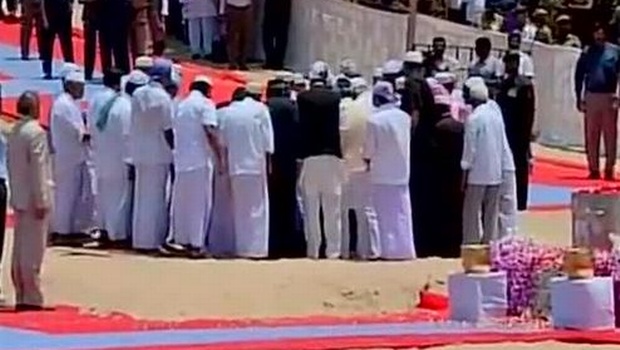
Former president A.P.J. Abdul Kalam was laid to rest on Thursday here with full military honours in the presence of Prime Minister Narendra Modi and several other leaders.

The People’s President’s body, draped in the Indian tricolour was brought to the burial site at Pei Karumbu in a flower-bedecked gun carriage, escorted by columns of the three armed services.

A gun salute was accorded to the former supreme commander of the armed forces and a military band played the haunting Last Post.

Modi, who arrived here on Thursday morning, paid his last respects to the country’s youth icon and most popular president by laying a wreath.

Tamil Nadu Governor K. Rosaiah, union Ministers M. Venkaiah Naidu, Manohar Parrikar and Pon Radhakrishnan, Tamil Nadu ministers like O.Panneerselvam, Natham R. Viswanathan and others also paid their last respects to Kalam.

Kerala Governor P. Sathasivam, Kerala Chief Minister Oommen Chandy were also present, as was Andhra Pradesh Chief Minister N. Chandrababu Naidu.

Congress vice president Rahul Gandhi and other party leaders also paid their last respects to Kalam – also known as India’s Missile Man.

Earlier the mortal remains of Kalam were taken to the family mosque for prayers.

His family members also reached here.

“All our relatives have also arrived to attend the last rites,” A.P.J.M.K. Sheik Saleem, the former president’s brother’s grandson, told IANS.

The Tamil Nadu government declared a public holiday on Thursday under the Negotiable Instruments Act. Banks, insurance companies, schools and colleges are closed throughout the state.

The government has also ordered closure of liquor shops and bars throughout the state.

Around 30,000 jewellery shops would also remain closed, while petrol bunks stopped sales for an hour between 10-11 a.m. as a mark of respect for Kalam.

Movie-theatre owners too have decided to shut down for the day while fishermen have decided not to venture into the sea.

Political parties like the DMK and the AIADMK have cancelled their functions.

Interestingly, the decision of private sector organisations to voluntarily shut shows that Kalam was truly a People’s President.

Born in Rameswaram on October 15, 1931, Kalam, as a boy, hawked newspapers to supplement his family’s income. His father owned a boat and his mother constantly struggled to keep the family sufficiently fed and clothed.

His sister pawned jewellery with a moneylender so that the studious Kalam could carry Rs.600 when he left Rameswaram to join the Madras Institute of Technology.

source: http://www.newindianexpress.com / The New Indian Express / Home> States> Tamil Nadu / by  IANS / July 30th, 2015

Efforts on to get GI recognition for Ooty ‘Varkey’

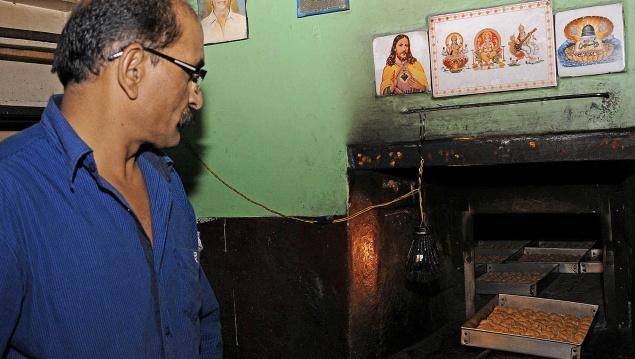
Wheat varkey being prepared in a bakery in Udhagamandalam.- Photo: M. Sathyamoorthy

Rajkumar starts work at 3 a.m. every day at his baking station, preparing and baking the “Ooty Varkey” for nearly six hours daily. Their family has been making varkey in Ooty for more than seven decades now and they have customers coming in from different parts of the State and also from Bangalore and Puducherry. They make about 100 kg of Varkey a day and have added more varieties to cater to the demands of the customers.

This is one of the popular products that tourists to the Nilgiris want to take home. There are nearly 150 bakers in Ooty who make Varkey and they plan to submit details soon to get the Geographical Indication certificate for “Ooty Varkey”. Some of them, such as Rajkumar, follow the recipe that the family has used for several years now.

K. Mohammed Farook, President of Ooty Bakery Owners Association, told The Hindu that there were many in the plains who sell the product as “Ooty Varkey”. Getting the certificate will benefit the bakers in Ooty. The bakers in the Nilgiris procure the raw materials locally.

The quality of water and the weather in the Nilgiris give a special taste to the Varkey, he says. “We have collected the details and will submit the final copy to the officials soon for the GI certificate,” he said.

source: http://www.thehindu.com / The Hindu / Home> News> Cities> Coimbatore / by M. Soundariya Preetha / Coimbatore – July 27th, 2015

‘I was with him for 26 years’

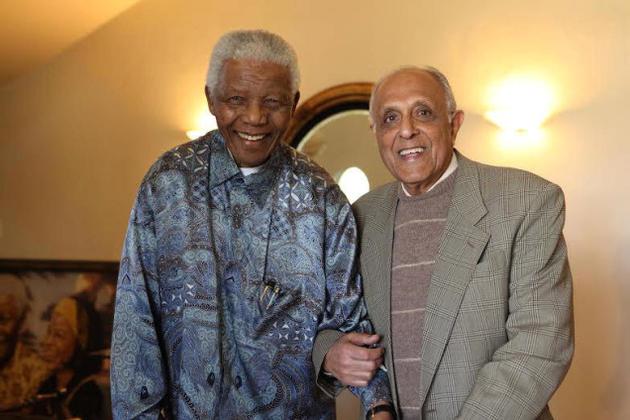
Special Camaraderie: “Throughout, Mandela retained hope, confident that sooner or later, the battle for equality would will be won.” Picture shows Nelson Mandela and Ahmed Kathrada. / by Special Arrangement / The Hindu

Ahmed Kathrada, who was on Robben Island with Nelson Mandela, recalls his famous co-prisoner’s eternal optimism.

As the world celebrated Nelson Mandela International Day on July 18 — Mandela’s birth anniversary — the air of mystery surrounding his long years of imprisonment is slowly being lifted. Mandela once called his time in prison “a long holiday”, a picture belying a life of denial and discrimination. For 10 years, Mandela was denied bread, his food was rationed, and he had to wear a humiliating uniform. Yet, according to new accounts of his time at Robben Island, where he spent 18 years in detention, Mandela was a picture of positivity.

Ahmed Kathrada was his fellow prisoner for 26 years. Prisoners with brown skin, many of whom were of Indian descent, were given preferential treatment over black prisoners. For instance, they wore trousers, while Mandela was only permitted to wear shorts. Yet, there was a sense of common cause and camaraderie. Mr. Kathrada and other prisoners would happily share their bread with Mandela and rejoiced when, three years into detention, Mandela was allowed to wear trousers. Throughout, Mandela retained hope, confident that sooner or later the battle for equality would be won.

These and other moments of joy and companionship were shared by Mr. Kathrada in a telephonic conversation with The Hindu. Mr. Kathrada also spoke of his latest book Triumph of the Human Spirit, in which he has written about his 300 visits to Robben Island as a tour guide since his release in 1990.

He is also updating his book No Bread for Nelson Mandela. “I am writing about our prison days. I was there for 26 years, Mandela for 27. I know him from 1962,” he says.

Mr. Kathrada, whose ancestors hailed from Surat, says Mandela’s personality came to the fore when hostilities were at their peak. “Mandela remained optimistic all along. When the Defiance Campaign and other movements of boycott were launched, it was with the sense that they would be successful. One does not expect immediate results. Success takes time. As an Indian you would know freedom cannot be attained in a matter of a year or two. We took heart and inspiration from the Indian struggle,” he says. “We understood that the protest had to be continuous. In South Africa, the Defiance Campaign helped in rousing public opinion. For instance, before the campaign, African National Congress had 5,000 members but following the campaign the numbers rose to over 1,00,000 members.”

___________________________________________________________________

“Prisoners with brown skin, many of whom were of Indian descent, were given preferential treatment over black prisoners.” 

___________________________________________________________________

Mr. Kathrada and others were arrested in July 1963 in Rivonia, Johannesburg, after which the famous Rivonia Trial began in October that year. The accused were charged with sabotage and attempts to overthrow the government by violent means. The trial ended a year later, after which Mr. Kathrada was sentenced to life imprisonment along with Mandela, Walter Sisulu, Govan Mbeki, Andrew Mlangeni, Billy Nair and others.

“For 26 years, eight of us of were together. We were sentenced to life imprisonment. When we reached the prison, Mandela was already there. As we interacted, I realised that he was a natural leader of leaders. He had already emerged as a force to reckon with in the early 60s,” he says. In the Defiance Campaign, whose aim was to get rid of six unjust laws, Mandela was the chief leader, Mr. Kathrada explains. “Thousands of volunteers were taken prisoners. It made no difference to the Apartheid government. In a prison trial, most were found not guilty. The case went to the Supreme Court. Mandela went underground and continued his political work. He was arrested in 1962 on a tour of African countries and England for mobilising support for our struggle. He continued his work underground for a year, got solidarity and financial support in England.”

Mr. Kathrada reveals that when all the important leaders were in jail in South Africa, the African National Congress policy was to continue the struggle with the support of the world, especially India and other countries. “The aim was to force the government to come to the negotiating table. Mandela started talking to the government from prison. One of his demands was to release all political prisoners, legalise the urban spots, and allow exiles to come back. The government acceded to all the requests. The ANC was allowed to function. It was in the 60s and was a big moment for us back then.”

Looking to India

Mandela and other leaders drew inspiration from India’s non-violent path to freedom, he says. “The enemy does not concede anything in a hurry. Our struggle took a long time. Contrary to what many people believed, we had a peaceful transition from apartheid to democracy.”

Mr. Kathrada left school when he was 17 to join the Transvaal Passive Resistance Council to work against the Asiatic Land Tenure and Indian Representation Act, which was popularly called the Ghetto Act. The Act, like many piecemeal concessions given by the British to Indians during the freedom movement, sought to give Indians limited political representation and defined the areas where Indians could live, trade, and own land. It was during the phase of increasing association between the African Congress and the Indian Congress that Mandela became close to Indian leaders.

Mr. Kathrada is hopeful that the path shown by Mandela is the one that South Africa will follow in the years to come. “We are only 20 years old as a democracy, but we have made considerable progress. Most of the children are now in schools; clinics and hospitals have been established. Electricity and sanitation have reached a majority of the population. Yes, challenges remain: we have hunger and poverty. But at the level of ideology, yes, it has percolated down to everybody.”

ziya.salam@thehindu.co.in

source: http://www.thehindu.com / The Hindu / Home> Opinion> Comment / by Zia Us Salam / July 21st, 2015

Fake or real? A royal riddle

A mighty fracas is raging between the descendants of Nawab Wajid Ali Shah in Calcutta and an Iranian woman who claims to be married to a scion of the Awadhi family. Hemchhaya De investigates the rumpus

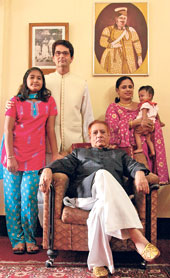
REGAL ROOTS: Shahebzade Wasif Mirza and his family pose before the portrait of Nawab Wajid Ali Shah;

A king-size portrait of Nawab Wajid Ali Shah will catch your eye the moment you step into the grand, old living room of Wasif Manzil on Talbagan Lane in Calcutta. “That’s my ancestor,” says Shahebzade Wasif Mirza, a dignified septuagenarian, pointing at the portrait — the pièce de resistance in a room bristling with Awadhi heirlooms.

“Satyajit Ray once asked me, ‘Why did the Nawab choose to move to Bengal after his kingdom was annexed?’ At that time, he had just made a film calledShatranj Ke Khiladi,” recalls the patriarch, a registered descendant of Wajid Ali Shah (1822-1887). “I told Ray that perhaps the Nawab felt he would get the respect he deserved only in Bengal.”

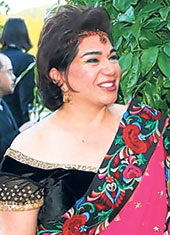
For Shahebzade Mirza, it’s a matter of family honour that he takes on what he calls “pretenders” to the Awadh legacy. In recent months, he has been fighting a fierce battle against Fay Ary, an Iranian woman who divides her time between Monaco, Paris and Dubai, and claims to have married a direct descendant of Nawab Wajid Ali Shah and his second wife Ronakara Begum.

Fay Ary
Fay Ary

But she refuses to disclose her late husband’s name for “fear of being drawn into family feuds.” Ary also wishes to do something for the underprivileged in India through her charity organisation, Royal Awadh Cultural and Heritage Foundation (RACH).

“All this sounds very nice. But she calls herself Her Royal Highness Princess Jehan Ara Fay Ary. I have the complete family tree and she figures nowhere. I’d like to know where her imaginary kingdom is located,” says Mirza. In a recent letter to the French ambassador to India, Jerome Bonnafont, he complained against Ary and RACH. “Our objection is to the use of our family’s name …for large monetary gains,” wrote Mirza.

Fay held a charity auction in Paris this May where her “personal collection of jewellery” went under the hammer. “We don’t know what she auctioned as her Awadhi legacy. And we don’t know where the proceeds are going,” says Ibrahim Ali Khan, a descendant of a 19th century Awadhi vizier, who heads the Royal Family of Awadh Foundation in Lucknow.

It all began a couple of years ago when Nawab Jafar Mir Abdullah — who reportedly claimed to be the Awadh rulers’ “direct descendant” — came under media glare. Abdullah, who’s on the RACH advisory committee, was accused of faking his nawabiheritage and arranging Awadhi banquets for foreign tourists in collusion with “unscrupulous” travel operators in Lucknow. It was also alleged that he charged tourists hundreds of dollars for banquets and mujras (dances) at his Lucknow home. His partner in this enterprise is said to be Prateek Hira, who heads a tour operating agency called Tornos India and is also associated with RACH.

Hira maintains that Khan and others have launched a malicious campaign to defame Ary, Abdullah and his agency. “Abdullah is well respected in Lucknow,” says Hira.

_________________________________________________________________

Dramatis personae
■ Shahebzade Wasif Mirza, descendant of Nawab Wajid Ali Shah (1822-1887) of Awadh (Oudh).

■ Fay Ary, an Iranian who claims to have married a direct descendant of Wajid Ali Shah and his second wife Ronakara Begum. Ary runs a charity, Royal Awadh Cultural and Heritage Foundation (RACH).

■ Ibrahim Ali Khan, a descendant of a 19th century Awadhi vizier, who heads the Awadh Royal Family Foundation in Lucknow. Does not support Ary.

■ Jafar Mir Abdullah, who is described as Wajid Ali Shah’s direct descendant and is on the RACH advisory committee.

■ Prateek Hira, who heads a tour operating agency called Tornos India and is associated with RACH.

____________________________________________________________

Fay Ary gained some publicity in Lucknow around this time after announcing her charity projects. “She wants to do something for the poor — like arranging cleanliness drives in various Indian cities and providing slum dwellers with clean drinking water. She sought my help to implement the projects,” says Hira.

Ibrahim Ali Khan and others tried to blow the lid off what they called a “nexus” between Abdullah, Hira and Ary last year. “The issue was almost dying down when a freelance journalist from Delhi wrote to Hira and threatened action against his activities. He wrote to me as well,” says Khan.

Fay didn’t take it lying down. In an email dated June 29 this year, she wrote to her friends in Lucknow, Dubai and Paris, “A very nasty activity is being undertaken …(by a journalist)… for want of some money to sustain himself …ignore this man who keeps changing his name to fool people.”

Speaking from Paris, Ary expresses her “anguish and disappointment” over the “concerted efforts to pull down RACH.” “I claim nothing from the Indian government or from the Awadh families. I auctioned my own jewellery in Paris. I am hankering after no title. All I wanted to say to these people was that I had the resources to do some good work in India,” says Ary.

She wants to start her “slum cleanliness drive projects” in early October. She will also host a gala event in Dubai this November to seek support for her charity work. “People who claim to be true nawabs in India should stop bickering and do something for their country.

There seems to be another point of clash between Ary and Shahebzade Mirza. Ary told the media last year that she would renovate Nawab Wajid Ali Shah’s mother’s grave in the Père Lachaise cemetery in Paris. The Nawab’s mother, Aliya Begum, went to England to plead with Queen Victoria for returning Awadh to her son. On her way back, she fell ill and died in Paris in 1856 and was buried in Père Lachaise. Ary wants to project her grave as a site of historical significance.

The Shahebzade Mirza family, on the other hand, wants to rectify an inscription near the grave which says that her son Wajid Ali Shah was killed by British forces in 1856. “The Nawab died of natural causes in 1887. We have written to the French consulate in Calcutta to do something about it,” says Mirza. A spokesperson from the French consulate, who prefers not to be identified, confirmed receiving the letter.

“I accompanied Fay to the Paris cemetery this year. She is planning a renovation,” says Abdullah, the controversial ‘nawab’ who refutes all allegations against himself. “She doesn’t lay any claim to the Awadh royalty. She is herself related to Farah Diba Pahalvi, the queen of the last Shah of Iran who ruled till 1979.”

Abdullah also goes on to say that he will go on hosting banquets for tourists in order to interact with people and entertain them. “I tour the world and get invited by top officials. I will also continue to be part of RACH and the commendable work it does,” says Abdullah. “I never claimed to be a descendant of Wajid Ali.”

Agrees Rosie Llewellyn-Jones, a British scholar who’s writing a biography of Wajid Ali Shah. “Abdullah does not really claim descent from Wajid Ali Shah, but from Nawab Mohammed Ali Shah, who ruled Awadh from 1837 to 1842,” she says. She adds that it’s important to remember that “Wajid Ali Shah’s descendants are not the only descendants of the royal family of Awadh.”

“Each Nawab, from the time of Asaf-ud-daula (1775 to 1797), had a number of wives, and inevitably, a large number of children and grandchildren. These people are also descendants of the Awadh royal family. On Wajid Ali Shah’s death he left about 45 sons, and a larger number of daughters, and the descendants of these sons and daughters can obviously claim direct descent from him.” On Ary, she says that unless she is prepared to reveal her husband’s name “we can’t really check out her claim.”

Indian historian Ravi Bhatt, who penned a book called The Life and Times of the Nawabs of Lucknow, begs to differ. “Just as Nagpur is famous for oranges and Benaras for silk, Lucknow is known for its nawabs,” says Bhatt. “Every Tom, Dick or Harry calls himself a nawab these days. But let me tell you there is no descendant of the Awadh royal family in Lucknow now,” says Bhatt.

Meanwhile, Shahebzade Mirza is gearing up for the next round of battle. “We hope the French government will act on our complaint against Ary. The war is far from over.”

source: http://www.telegraphindia.com / The Telegraph, Calcutta,India / Front Page> 7 Days> Story / Sunday – August 23rd, 2009