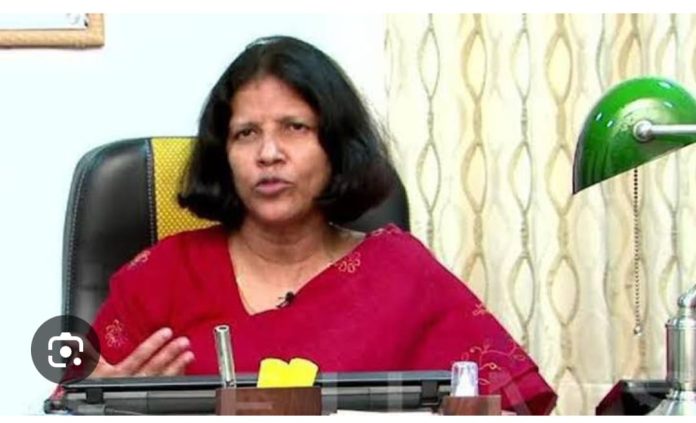
The President of India, Droupadi Murmu has appointed Prof Naima Gulrez new Vice Chancellor of Aligarh Muslim University (AMU) out of three names sent to the visitor (President of India) by the AMU court.
Prof. Naima Gulrez, who served as Professor and Chairperson of the Department of Psychology before joining as Principal, Women’s College in July 2014, also taught at the National University of Rwanda, Central Africa. A PhD in Political Psychology, she worked at Centre for the Study of Developing Societies, Delhi, and served as Deputy Coordinator of UGC assisted Special Assistance Program on Spiritual Psychology in the Department of Psychology, AMU.
She has authored, co-authored and edited six books and published many papers in journals of national and international repute. She has supervised 15 Ph.D. theses and a large number of dissertations. Her area of specialization is in the field of Clinical, Health, Applied Social and Spiritual Psychology.
Apart from academics, Prof. Naima Khatoon has vast experience in Educational Administration. She served as Provost in Indira Gandhi Hall and twice in Abdullah Hall. She also served as Deputy Director, Residential Coaching Academy and Deputy Proctor of AMU. She was elected twice to the Women’s College Student Union. She also worked as Literary Secretary and Senior Hall Monitor of both Abdullah Hall and Sarojini Naidu Hall. She was awarded the Papa Mian Padma Bhushan Best Girl Award for all-around excellence.
source: http://www.radiancenews.com / Radiance News / Home> Latest News / by Radiance News Bureau / April 22nd, 2024
Jalalpur Town (Ambedkar Nagar District) , UTTAR PRADESH :
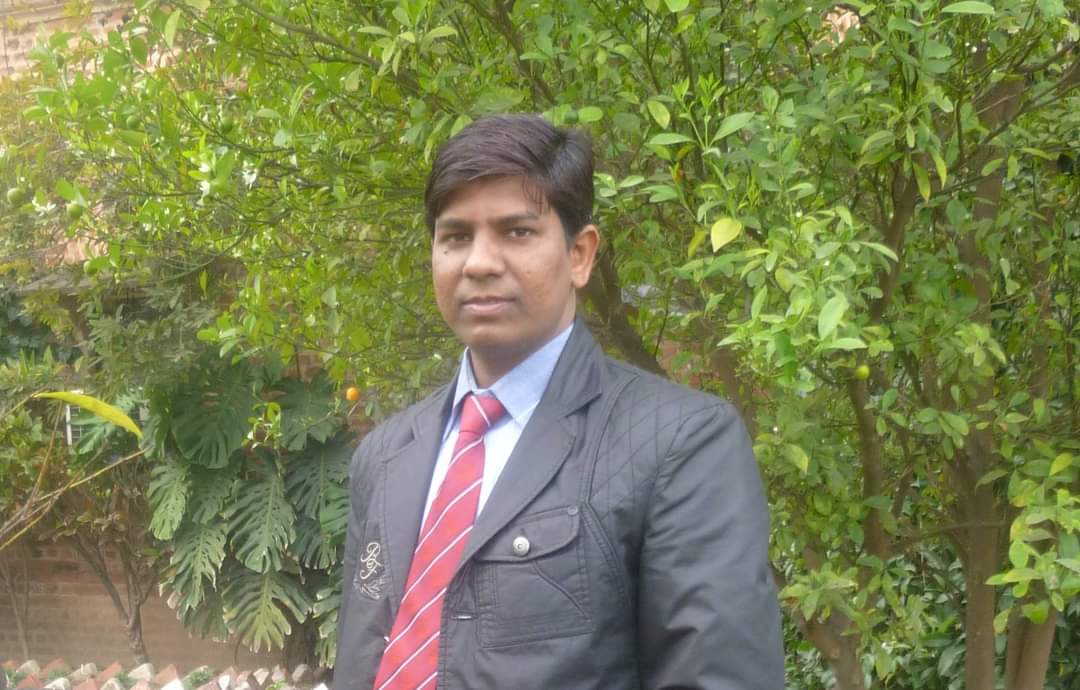
Agricultural scientist Dr. Moinuddin
Dr. Moinuddin’s life is a testimony to the fact that education is the key to changing lives and resolving the present-day problems of societies. This Madrasa-educated agricultural scientist Is an inspiration for those who want to grow in life no matter how many odds are stacked against them.
Dr. Moinuddin was born in Ambedkar Nagar, Jalalpur town, Uttar Pradesh. He joined Madrasa Nida Haq in his town where he completed his primary education. Driven by a desire to study, he continued his education beyond the Madrasa.
He completed his Ph.D. degree from Allahabad (Prayagraj), UP and is today posted as an Associate Professor in the Department of Agricultural Sciences, Sri Guru Ram Rai University of UP.
Not that his journey was smooth. Moinuddin says that during his student days, life was quite hard for him. When he was studying at the NPG College Barhalganj, run by Deen Dayal Upadhyay Gorakhpur University, he was not able to rent out a house. “Wherever I went for renting a house, I was met with refusal, and finally had to live in the Bhimsawa Ashram for two years.”
Thereafter a kind-hearted Hindu family offered him their house for rent.
Dr. Moinuddin
Dr. Moinuddin obtained his Ph.D. from Sam Higginbottom Institute of Agriculture, Technology, and Sciences, Allahabad on the topic “Effect of different organic sources of nitrogen on growth, yield and oil content of groundnut”. He also presented his thesis for his MSc degree on ‘Growth and yield behavior of mustard under different sowing methods and sulfur levels’.
Today Dr. Moinuddin is working as a teacher and also continuing his research. He is currently posted as an Assistant professor of Agriculture at Maya College of Agriculture Science and Technology, Dehradun, College of Agriculture and Technology, Dehradun, Uttarakhand.
Dr. Moinuddin received many national and international awards for his work on agricultural research. He was awarded the Young Scientist Award for the first time by the Bioweed Research Institute of Agriculture and Technology, Allahabad, Uttar Pradesh on the occasion of the “15th Indian Agricultural Scientists and Farmers Congress” at Allahabad University in 2013.
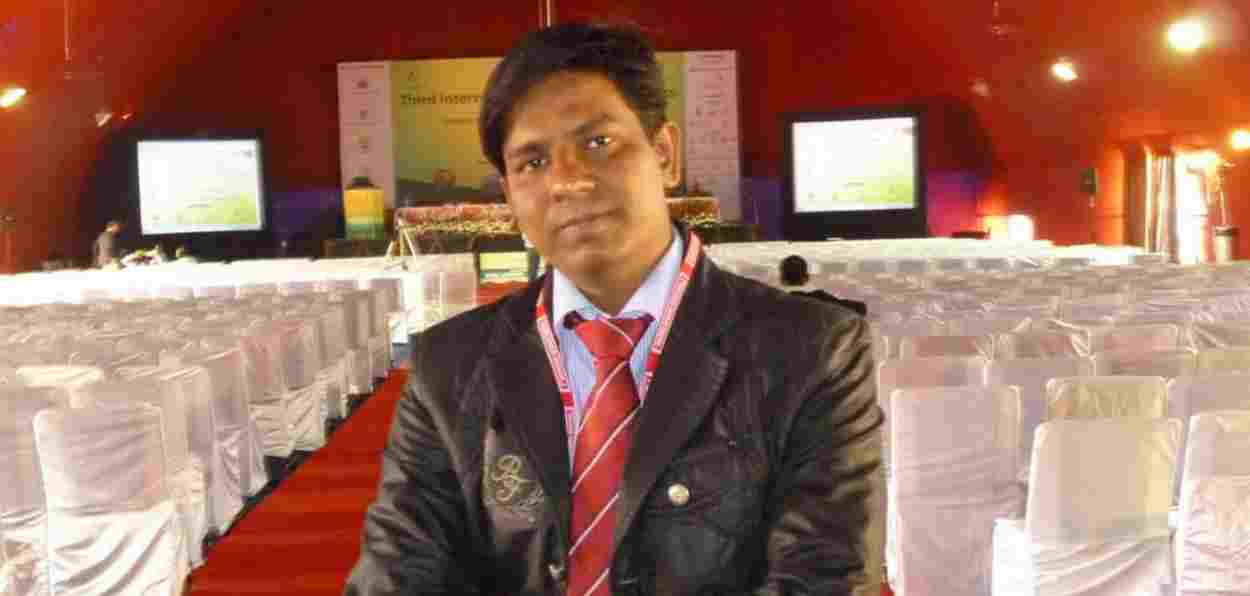
He attended the 3rd International Conference on “Global Initiatives in Agriculture and Applied Science for Green Environment”.
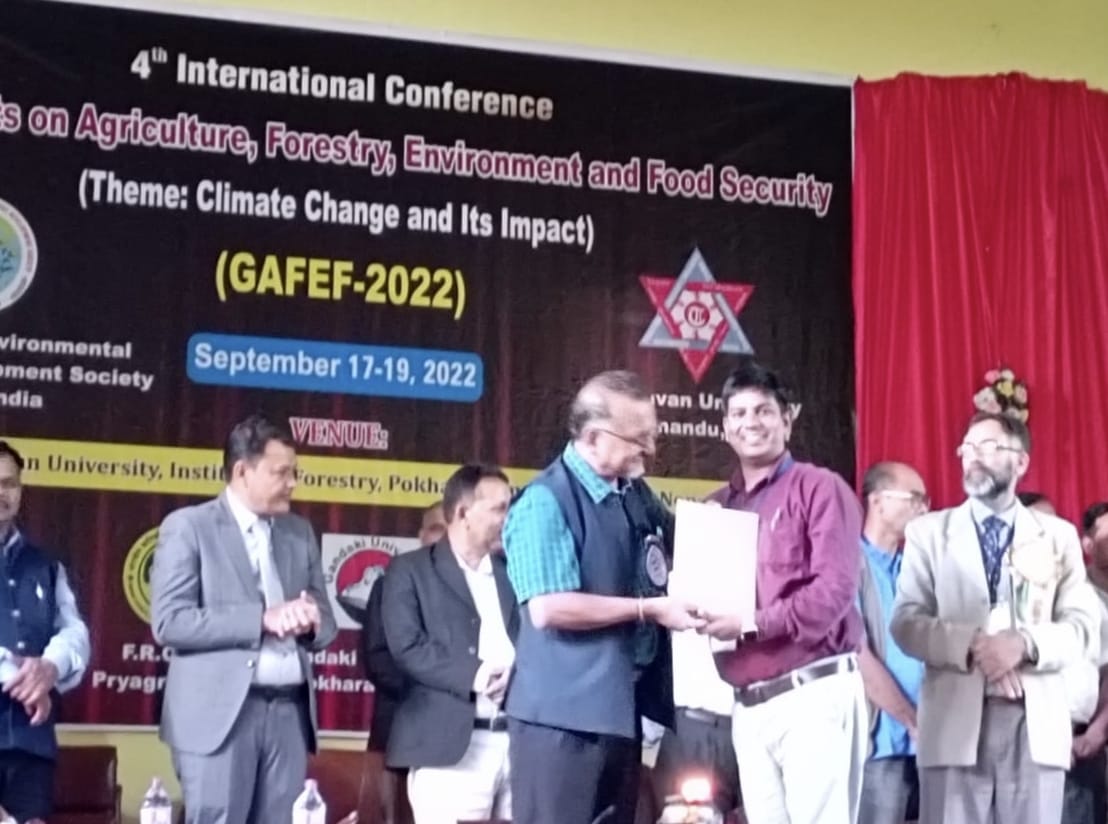
He was awarded the Best Agricultural Scientist Award at Shobhat Deemed University, Meerut, Uttar Pradesh in 2021 on the occasion of the 4th International Conference on Global Perspectives in Climate Smart Agriculture Natural Resource Management during the coronavirus pandemic. He was awarded the Outstanding Scientist Award at the Institute of Forestry, Tribhuvan University, Pokhara, Nepal in 2022 on the occasion of the 4th International Conference on Global Efforts on Agriculture, Forest, Environment and Food Security.
Dr Moinuddin receiving an award
Dr Moinuddin says, “I cannot explain my feelings of gratitude at the respect I have received from people at such a young age. Today if I am considered worthy, it is because of my education. Education can lift anyone from the ground to the sky. Everything was not easy for me when I was getting my education. Rather often have to face adverse environments. But I completed my studies. And today this education made everything suitable for me.”
Dr. Moinuddin is also a life member of the Indian Society of Agronomy, Agronomy Division, Indian Agricultural Research Institute, New Delhi. He is also an active member of the Society of Agronomy, Department of Agriculture, Sam Higginbottom Institute of Agriculture, Technology and Sciences, Allahabad. He is also an active life member of the Agricultural Technology Development Society, Ghaziabad, Uttar Pradesh.
Dr. Moinuddin has participated in several important seminars, and conferences including the National Seminar on “Livelihood Generation in Hill Statistics of India based on Agriculture and Allied Sectors” organized by Uttaranchal (P.G.) College of Technology and Biomedical Sciences, Dehradun, UK in 2014.
Dr. Moinuddin asks the youth “to recognize the value of time and avoid wasting it; always be in good company. Also, those who don’t value their time will be left behind.”
His father Haji Munir Ahmed was the Principal in Mirza Ghalib Inter College Jalalpur and now leads a retired life.
He told me on the phone that his son Dr. Moinuddin was always a studious child. Unlike other children of his age, he did not make many friends and never wasted his time hanging out and having fun.
He was always focused on his education. He says that his early studies were in the madrasa till the fifth grade. “After he completed his matriculation, a friend told me that “your son is very intelligent and extremely sincere in studies”. He advised me to put him in the field of agriculture studies. After this, I discussed it with my son and he also agreed. And with his hard work today, he is a scientist in agriculture and serving the country,” the proud father said.
(The Author is a Lucknow based Freelance Journalist)
source: http://www.awazthevoice.in / Awaz, The Voice / Home> Story / by Irshad Saqafi, Lucknow / April 15th, 2024
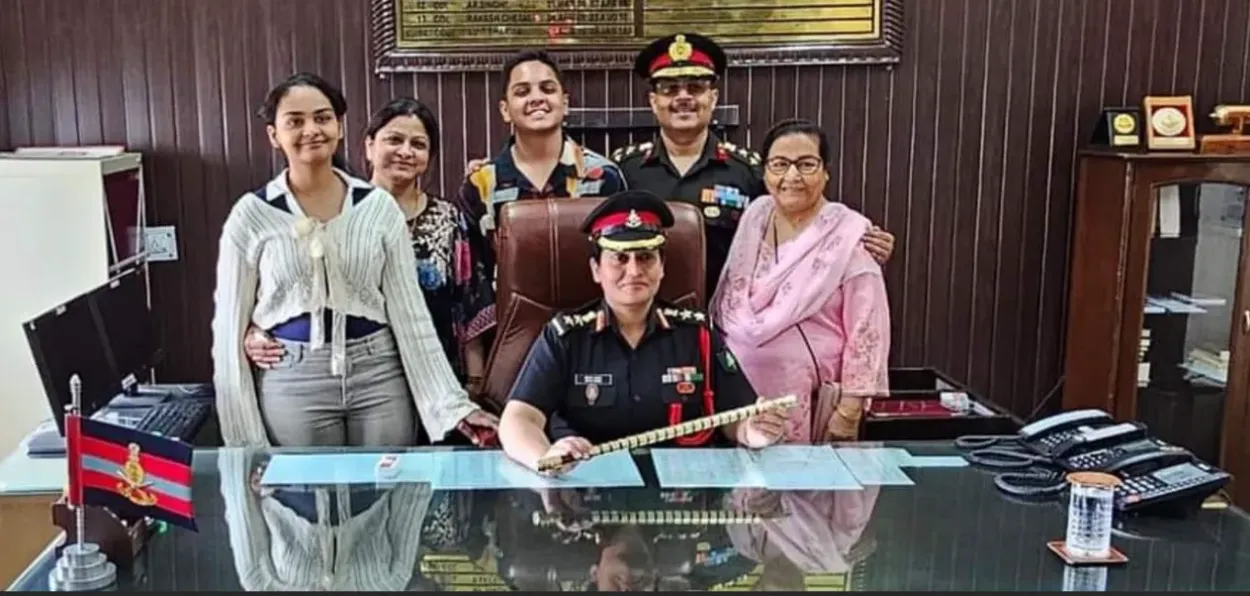
Col Ishrat with her family in her office (Facebook)
Ashfaq Kayamkhani/Nua (Jhunjhunu) Rajasthan :
Colonel Ishrat Ahmed has become the first Muslim woman to hold such position in the Indian Army.
She took over the command of the Ordnance Army unit in Meerut on Thursday.
Col Ishrat belongs to the Kayamkhani Muslim community that prides itself in higher educational levels and military, administration and Police Services being their first choice of careers.
Col Ishrat hails from a prominent family of Nua village in Jhunjhunu district of Rajasthan. Though the Indian Army doesn’t highlight the religion of officers, her community posted the news of her appointment on social media and took pride in a woman from the community reach such a top position.
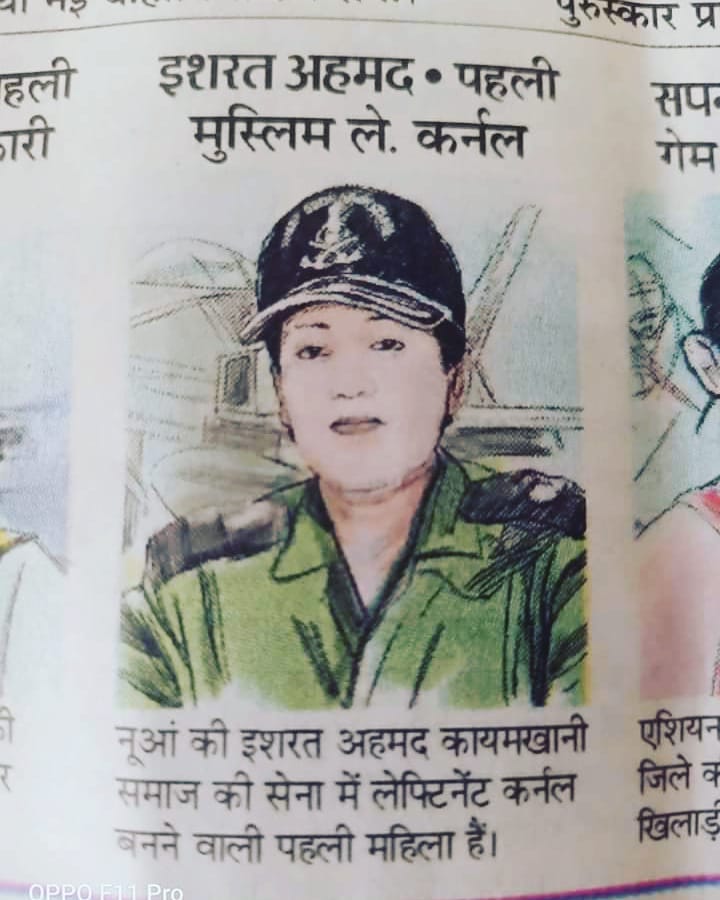
An old news clipping on Col Ishrat (Facebook)
Colonel Ishrat is the daughter of Colonel Zaki Ahmed and, sister of Brigadier Saqib Hussain. IGP Liaquat Ali Khan also comes from her family.
Col Ishrat’s family boasts of many civil servants in the State administration who have reached top positions.
Expressing happiness over this achievement of Colonel Ishrat, Kamkhayani Bidri said, “The community also feels proud of such a family.” The community expressed hope that this family would prove helpful in the advancement of their children as well.
source: http;//www.awazthevoice.in / Awaz, The Voice / Home> Story / by Ashfaq Kayamkhani, Nua / April 19th, 2024
A local court has recently amended its ruling to allow former Delhi Congress councillor Ishrat Jahan to practice law outside the National Capital Region (NCR). Jahan, who is a defendant in the 2020 Delhi riots case, was granted regular bail on March 14, 2022, with the condition that she does not leave the jurisdiction of the National Capital Territory (NCT) of Delhi.
Now, as Jahan is a practicing advocate registered with the Bar Council of Delhi, she requested the aforementioned permission. She stated that since being granted bail, she has consistently adhered to the court’s orders without any violations. “Considering the applicant’s (Jahan) good conduct, it is requested that the bail order be modified to grant the relief sought by the applicant,” noted Additional Sessions Judge Sameer Bajpai of Karkardooma Court.
The prosecution objected to Jahan’s application, contending that the court had already granted her reasonable freedom and, considering her past behavior during the alleged offenses, she should not be given further leniency. However, Judge Bajpai observed that since the bail was granted, the investigating agency or the prosecution had not presented any information to the court indicating that Jahan had violated any bail conditions.
source: http://www.radiancenews.com / Radiance News / Home> Latest News / by Radiance News Bureau / April 16th, 2024
The Karnataka Pradesh Congress Committee (KPCC) has appointed Anwar Manila as the social media committee coordinator of the Dakshina Kannada District Non-Resident Indian (NRI) cell of the KPCC. The appointments were made through an order issued by KPCC President DK Shivakumar on Saturday.
In addition, the party has also appointed Vice President of non-resident Indians forum and All India Congress Committee’s Indian Overseas Congress (IOC) secretary in-charge Dr. Arati Krishna as the chairperson of the KPCC NRI Cell.
Anwar, a non-resident Kannadiga residing in Dubai for the past 18 years, has been an active member of the Congress party for a decade, particularly within its social media unit. He is also serving as the member of the social media unit of INCAS. In 2019, he served as a member of the publicity committee for the 150th birth anniversary of Mahatma Gandhi, attended by former AICC president Rahul Gandhi in the UAE.
Alongside, Anwar has also been actively serving in social, religious and educational fields and is also recognised by several non-resident Kannadiga organisations.
source: http://www.english.varthabharati.in / Vartha Bharati / Home> Karavalli / by Vartha Bharati / April 13th, 2024
Kairana (Shamli District) , UTTAR PRADESH / NEW DELHI :
New Delhi:
“I don’t comment on numbers, but it’s for sure that I got blessings of people who want me to represent them in Parliament,” said Iqra Hasan who seemed confident of her victory after her fate was sealed in electronic voting machines (EVMs) following first phase of the ongoing general elections that was held on April 19.
What led her to believe that she is poised to win? “There was no political wave unlike 2014 and 2019. Electorates were largely maintaining silence about which party or candidate they would vote for. Attempts to polarise voters on communal lines did not work,” she listed out.
Talking to TwoCircles.net, she claimed people this time voted on local problems. “I don’t see any major obstacles in this election as it is clear from engaging with people that there is no prevailing national narrative, unlike the narrative being pushed by the BJP,” she added.
The thirty-year-old belongs to a well-known political family of Kairana. Along with her grandfather Chaudhary Akhtar Hassan, father Chaudhary Munawwar Hasan and mother Tabassum Hassan, Iqra has a political legacy since they were all elected members of Parliament.
The Hasans and the Singhs (Hukam Singh and his daughter Mriganka Singh of the Bharatiya Janata Party or BJP) have over a century-old political rivalry. They were once a single Gujjar family connected to the Kalshyan Khap. This was more than a century ago.
But the Hasans chose to secede and convert to Islam, which led to a slew of disputes. This family’s descendants, Chaudhary Munawwar Hasan of the Samajwadi Party (SP) and Hukam Singh fought elections against each other in the 1990s.
In a similar vein, after their dads’ deaths, their offspring Mriganka and Nahid carried on the rivalry.
Thirty-year-old Iqra, Nahid’s sister, got back from London. She fought against BJP’s Pradeep Chaudhary — who had defeated her mother Tabassum Hasan in the 2019 general elections.
Though her family’s century-old feud with the Singhs has taken a short hiatus, she is still a competitor even though she has a new opponent.
The Hasans and Singhs have dominated the Kairana Assembly segment since the 1970s, with the exceptions of Rajeshwar Bansal in 1989 and Bashir Ahmed in 1977. Notably, starting in 1996, late Hukum Singh won the seat four times in a row.
In 2014, he moved to represent the constituency in the Lok Sabha. Since then, Nahid has won the Kairana Assembly seat twice, defeating Mriganka in 2017 and BJP candidate Anil Kumar in the 2014 by polls.
Iqra completed her primary education at New Delhi’s Queen Mary School and graduated from Delhi University’s Lady Shri Ram College in arts. She later went to London’s School of Oriental and African Studies (SOAS) to get her master’s degree in international politics and law.
Having been brought up outside Kairana for studies because the constituency lacks higher education institutes for women is one of the major issues around which Iqra contested elections.
In addition to other issues, one of the main components of her election campaign was providing resources for the women in the constituency to pursue higher education.
Iqra is one of the most talked-about candidates in this election because of her poise, positive outlook and grounded manner. She is also among this year’s youngest Muslim female candidates.
“Iqra might be a Muslim by faith, but she is a Gujjar first. She belongs to our community and is like a daughter to us. All 36 biradari (communities) supported her wholeheartedly. And therefore, only she will win and go to Lok Sabha. There are no longer any ifs and buts,” said an elderly man amid applause from the crowd that had gathered at a square in the constituency after the polling was over.
Others said she travelled from England to take over the Assembly election campaigning of Nahid who faced “unfair” imprisonment. Although Iqra is a new contender in this race, her experience with politics is not. While her brother Nahid was imprisoned by the UP government, she ran an effective campaign for him in the state Assembly elections of 2022 and secured a seat on his behalf.
“She has been a prominent character in this race, having devoted more than two years to her campaign. She is obviously in the lead in the race,” he said.
The Uttar Pradesh Police accused Nahid and his mother Tabassum Hasan of being Gangster Act suspects in February 2021. He was conspicuously absent from campaign events and meetings, even after being freed on bond.
The town with the largest concentration of Muslims — nearly 80%, many hold to the prophecy of the man quoted first.
Fifty-four-year-old Jitendra Singh, a former member of Zila Panchayat and a resident of Kandhla village, said, “She is young, dedicated and smart. We think highly of her.”
source: http://www.twocircles.net / TwoCircles.net / Home> Elections Update> Indian Muslim> Lead Story> April 20th, 2024
For the unversed, Rooh Afza was originally created by a Unani hakim as a herbal concoction to beat the heat, however, it went on to become a staple across India and Pakistan.
Hakim Hafiz Abdul Majeed is the founder of Hamdard that created Rooh Afza as a herbal drink that would help people stay cool in the summer.
Hakim Hafiz Abdul Majeed’s education
Born in 1883, Hakim Hafiz Abdul Majeed studied the origin of Urdu and Persian languages. He went on to acquire the highest degree in unani system of medicine.
Hakim Hafiz Abdul Majeed’s career
In 1906, Hakim Hafiz Abdul Majeed decided to set up a herbal shop at House Qazi in Delhi. In 1920, his small shop turned into a production house. Selecting herbs and syrups from traditional Unani medicines, Hakim Hafiz Abdul Majeed created a drink to fight heat strokes – He named it Rooh Afza, which in Urdu means ‘something that refreshes the soul.”
In 1910, an artist called Mirza Noor Ahmad prepared the labels of Rooh Afza in several colours. It was printed under special arrangement by the Bolton Press of the Parsees of Bombay (Mumbai) since there were no coloured printers at that time.
Journey of Rooh Afza
The partition of India in 1947 played a role in the journey of Rooh Afza. Hakim Abdul Majeed’s eldest son decided to stay in India, but his younger brother Mohammad Saeed wanted to live in Pakistan. He started Hamdard from two rooms in Karachi and in no time the business flourished. As per Sadia Rashid, Hakim Mohammad Said’s daughter, her father gifted the business to the people of Bangladesh after their independence in 1971.
Having said that, Rooh Afza gained more popularity in India. The bottles were deigned in Germany and were initially introduced in a glass bottle, but was later changed to plastic. In 2019, Rooh Afza faced shortage in supplies owning to the lesser availability of herbs needed to make the drink.
Other brands under Rooh Afza
Over the years, Rooh Afza launched products like Pachnaul, Safi, Rogan Badam Shirin.
source: http://www.financialexpress.com / Financial Express / Home> FE Leisure> Business News> Lifestyle / by FE Lifestyle / May 13th, 2023
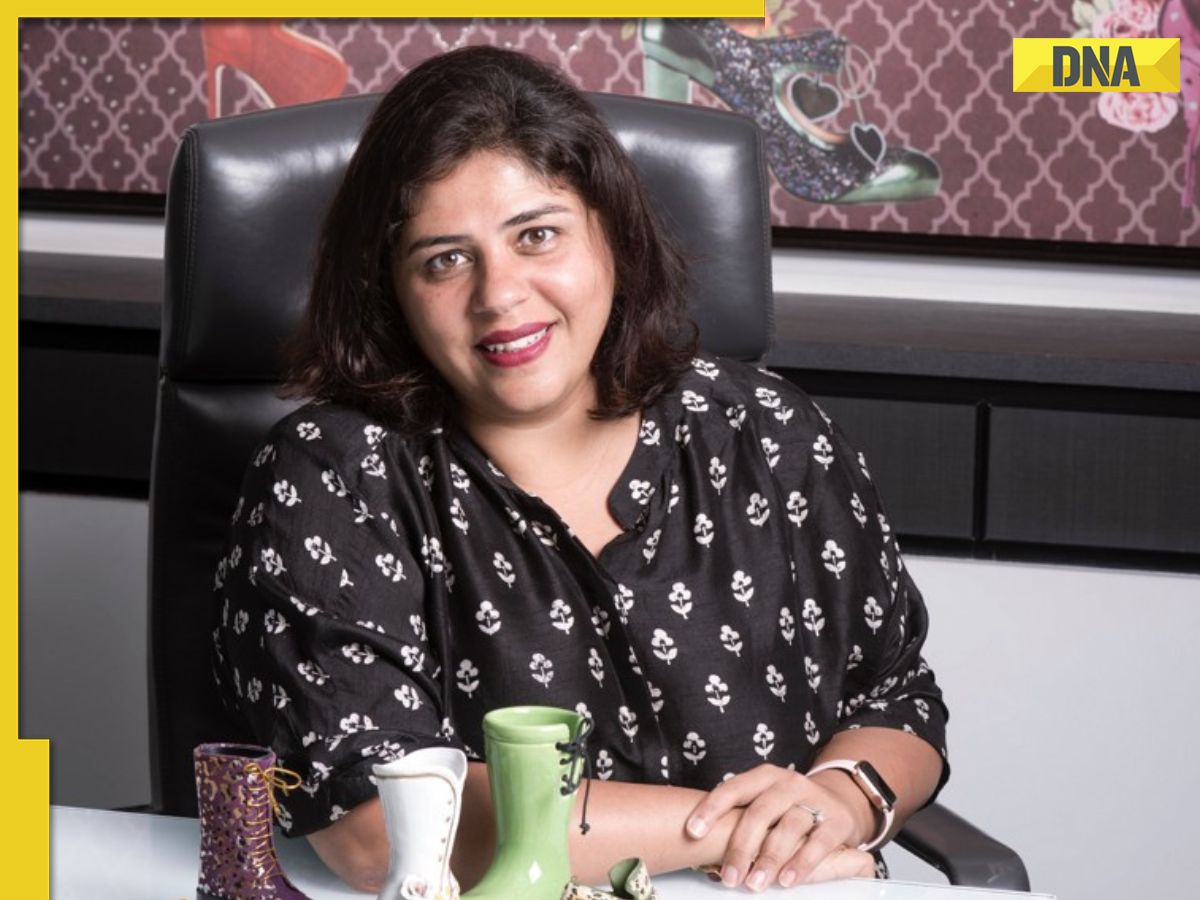
She is the daughter of billionaire Rafique Malik, the company’s chairman. Her grandfather, Malik Tejani, founded it in 1955 in Mumbai. Farah has guided Metro Shoes into a new era of modern retail. The company’s brands include Mochi, Metro, and Walkway.
(Image source: LinkedIn)
Eid Ul Fitr was celebrated throughout the country. Amid celebrations, you may be left wondering if you are asked about the wealthiest Muslim woman in the country. The name of the country’s richest Muslim woman is Farah Malik Bhanji. She is the managing director of the Metro brand, which sells premium shoes. Her net worth is more than Rs. 26000 crore. Farah Malik plays an important role in giving the Metro brand a new identity.
She is the daughter of billionaire Rafique Malik, the company’s chairman. Her grandfather, Malik Tejani, founded it in 1955 in Mumbai. Farah has guided Metro Shoes into a new era of modern retail. The company’s brands include Mochi, Metro, and Walkway.
As of December 8, the company’s market capitalisation was Rs 35,117 crore. Farah is the second of five daughters. His father, Rafique, has a real-time net worth of Rs 21697 crore as of 12 April.
Farah has more than 20 years of experience in the footwear industry. She has played a key role in reimagining the company for the new era. She began her career in marketing before moving on to revamp Metro Brands Limited’s technology roadmap and supply chain. The company was listed in December 2021. The late billionaire investor Rakesh Jhunjhunwala’s wife, Rekha, owns a minority stake in Metro Brands.
She pays close attention to detail, is well-versed in business, and has a sense of style. The footwear company has experienced growth for both the company and its employees under her leadership. She has played a crucial role in forging connections with international companies like Skechers, Crocs, and Clarks in addition to forging close bonds with more than 250 reliable vendors. She contributed to the network’s growth from 100 stores in 2010 to 598 locations across 136 Indian cities.
At the close of trading on Wednesday, Metro Brands Ltd. saw a rise to Rs. 1058. Rs. 1,440.45 is the stock’s 52-week high level, and Rs. 784.45 is its 52-week low. Metro Brands’ shares opened at Rs 1044 at the start of the trading session on Wednesday. Subsequently, it increased by over 20 rupees, closing at 1058. The company cap is of Rs 28,773 crore.
source: http://www.dnaindia.com / DNA / Home> Business / by Varnika Srivastava / April 12th, 2024
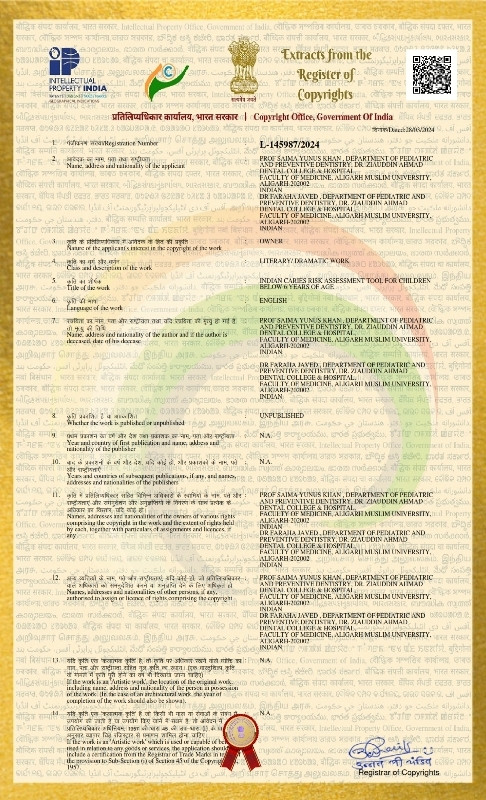
Prof Saima Yunus Khan, Chairperson, Department of Pediatric and Preventive Dentistry, Dr. Z.A. Dental College, Aligarh Muslim University has been awarded the Copyright by the Government of India for her original innovative work on an evidence based Indian Caries Risk Assessment tool for the children up to 6 years of age.
She started to work on the project in 2021, on receiving the John Clarkson Fellowship from the Prestigious International Association for Dental Research.
Being the first Indian to receive this fellowship, she worked in collaboration with Dr. Gerald Niznick, College of Dentistry, Rady Faculty of Health Sciences University of Manitoba, Canada.
According to Dr. Saima, the CRA tool would be beneficial to the Indian children as it addresses the risk factors of early childhood caries of Indian preschoolers. It’s a small compact tool form which can be used with ease by the masses in hospital or field settings.
The Dean, Faculty of Medicine and the Principal, J.N. Medical College, Prof Veena Maheshwari, and the Principal, Dr. Z. A. Dental College & Hospital, Prof R.K. Tewari congratulated Prof. Saima on her exemplary achievement.
source: http://www.amu.ac.in / AMU, Aligarh Muslim University / Home> Public Relations Office (headline edited & additional pix edited) / April 02nd, 2024

)