Representation of Muslims in the Karnataka Assembly has marginally increased in this election compared to the last.
As many as nine candidates were declared elected on Saturday, compared to the seven in 2018. That was a steep fall from the 11 Muslim MLAs who were elected in 2013. All of them are from the Congress.
The JD(S) said 23 of its 211 candidates were Muslims, but none won.
BJP did not field any Muslims.
Those elected include:
-Rahim Khan from Bidar
-U.T. Khader from Mangaluru
-Tanveer Sait from Mysuru
-Asif (Raju) Sait from Belagavi north
-Rizwan Arshad from Shivaji Nagar
-B.Z. Zameer Ahmed Khan from Chamarajpet
-Kaneez Fatima from Gulbarga north
-Iqbal Hussein from Ramanagara
-N.A. Haris from Shanti Nagar.
All of them have been re-elected, except Asif (Raju) Sait and Iqbal Hussein, who are entering the Assembly for the first time.
source: http://www.thehindu.com / The Hindu / Home> Elections> by The Hindu Bureau (headline edited) / May 13th, 2023
In the run-up to 2024, with the pendulum poised between a secular or theocratic state, we need to revisit this forgotten chapter of history.
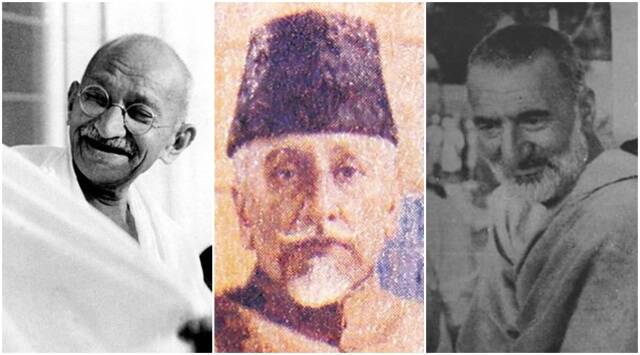
In the end, only three Indians spoke against Partition: Mahatma Gandhi, Maulana Abul Kalam Azad (centre) and Khan Abdul Ghaffar Khan (right). (Express Archives)
The hall of the Bharatiya Bhasha Parishad on Calcutta’s Shakespeare Sarani was fully packed when I arrived for the Hashim Abdul Halim Foundation International Seminar. The Foundation is named after a man who was the speaker of the West Bengal Assembly for 29 years. The Iran Society which brings out the journal Indo Iranica is located in his ancestral home. Fuad Halim and Saira Shah Halim, along with their group, were the spirit of this event.
The overhead banner read “Muslims for a United India — Unvisited Histories: Remembering the Azad Muslim Conference, April 27-30, 1947”. Each word of the banner was part of my life although I had never thought of framing it in this way.
In 1947, my family was forcibly evicted from our ancestral place, Panipat, where we had lived for 800 years. No one asked them if they wanted to go to a newly carved country named Pakistan. The women of my family left notes pasted on their front doors, “We are going for a short time; we will return”. Keys were handed to neighbours, tears flowed on both sides. All they could carry were bundles and potlis. They were mostly women; the men of Panipat worked in nearby cities. They would join later. Young men who were studying abroad did not “opt” for the new country until it became inevitable. Seventy-six years later in 2023, I live in Delhi, near the campus of a university, Jamia Millia Islamia. Those who established it in 1920 were fortunately not evicted; they stayed on amidst the communal frenzy because they believed in a united India.
That day I heard speaker after speaker in a hall which remained packed for almost eight hours. They spoke on topics like ‘The Case for a South Asian Union’, ‘1857 Joint Heritage Joint Martyrdom’, ‘Muslims against Partition – Carrying Forward the 1857 Legacy’, ‘Challenging the Two Nation Theory: Maulana Azad and Nationalist Muslims’, ‘The Two Nation Theory: One Thought of Hindu Mahasabha RSS and Muslim League’, ‘Muslims who opposed the Partition of India’, ‘Allah Bux Soomro and Muslim Politics’. These were academics from universities across West Bengal, plus a few from the US and the UK.
The Azad Muslim Conference was the cord that held it all together. It was organised in Delhi in 1940 for three days, its objective: Advocacy for composite nationalism and for a united India, and unequivocal opposition to Partition and the Two Nation Theory. Participants were from the Krishak Praja Party, the Jamiat, Majlis e Ahrar ul Islam, All India Momin Conference, Khudai Khidmatgar, All India Shia Political Conference, Anjuman i Watan Baluchistan and others. Wilfred Smith, a world-renowned orientalist from McGill University in Canada wrote that this conference represented the vast majority of India’s Muslims. The Bombay Chronicle reported that the Muslim attendance was five times that of any event organised by the Muslim League. Allah Bux Soomro, twice premier of Sindh, was its leading light. Born in 1900 in Shikarpur, his fierce commitment to a united India led him to return the honours bestowed on him by the Empire. An equally unequivocal opposer of the two-nation theory was Maulana Abul Kalam Azad. He was born in Mecca, lived in Kolkata and joined the struggle with the guerrilla movement of Jugantar with Rash Behari Ghosh and Shyam Sundar Chakravarty. Azad spoke from every platform, the highest being his addresses as President (twice) of the Indian National Congress , against Partition and for a united India. In his first presidential address in 1923, he spoke for Hindu-Muslim unity, even if it meant a delay in attaining Swaraj.
Three years after the AIMC, Allah Bux Soomro was assassinated by an assailant said to belong to the Muslim League.
As the conference proceeded, layer after layer opened up and, to reword John Keats, I felt as if a “new planet swam into my ken”.
In the last decade, I have heard the following refrain from many quarters: “They demanded Pakistan. So why are they here? The Muslims — expunge, expel, exorcise them.”
Questions: Who asked us? Was there a plebiscite? Was there a “rai shumari”? Who made it happen? Elite Muslims, colonial masters — who suffered?
In his excellent work, Muslims Against Partition, Shamsul Islam writes, “The people of India, Hindus, Muslims, Sikhs, unitedly challenged imperialist power. This unprecedented unity naturally unnerved the firangis and made them conscious that their rule could flourish only if Hindus and Muslims were divided along communal lines.” The Minister of Indian Affairs, Lord Wood wrote to Lord Elgin, ‘We have maintained our rule in India by playing off one part against another.’ John Lawrence, Administrator of the East India Company, wrote, ‘If Muslims and Hindus have quarrelled, so much better for us; let them slaughter each other…’”
In the end, only three Indians spoke against Partition: Mahatma Gandhi, who said “over my dead body” but succumbed to the Congress; Maulana Abul Kalam Azad who stood his ground and Khan Abdul Ghaffar Khan, who wrote to Gandhi, “We Pashtuns stood by you and had undergone great sacrifices for attaining freedom. But you have deserted us and thrown us to the wolves.”
In the run-up to 2024, with the pendulum poised between a secular or theocratic India, we need to recall this forgotten history. In the current din of Muslim hatred is heard the rasping voice of the Minster of State for Law and Justice. At Delhi’s Maharashtra Sadan, he said, “There are very few tolerant Muslims; those who pretend to be tolerant do so to grab the offices of the Vice President, the governor as well as vice-chancellors. As soon as they retire they start spitting poison. They wear the mukhota (mask) of tolerance; tolerant Muslims can be counted on fingers. The basic structure of the nation is Hindu Rashtra.”
I’m ending with two lines from Hafiz Shirazi, quoted in S Abid Husain’s prophetic work, The Destiny of Indian Muslims: “If sorrow raises its dire legion/ To overwhelm people of faith / The Saqi and I will join hands /To wipe it off the face of this earth.”
The writer is former Member, Planning Commission
source: http://www.indianexpress.com / The Indian Express / Home> News> Opinion> Columns / by Syeda Hamid / May 11th, 2023
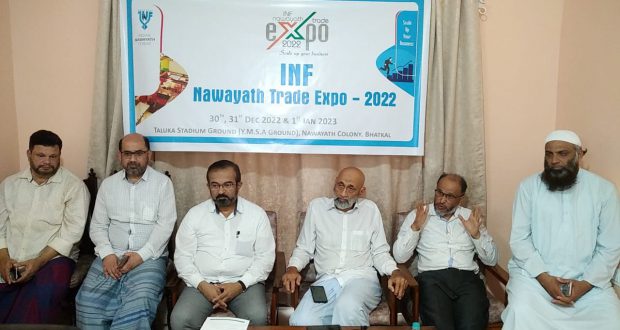
The Indian Nawayath Forum (INF) formed in 2018, is a non-profit charitable organization that is a joint Federation of 8 Indian Bhatkali Jamaaths Associations located across India, outside Bhatkal, to serve the community.
Since its inception in 2018, INF has been at the forefront to serve the people driving various activities in healthcare, education, promoting business and employment, providing scholarships, budget housing projects and NOW, INF is organizing a Trade Expo with 180 Stalls, in 25 categories of businesses at (YMSA Ground) Taluka Ground, Bhatkal, for 3 days from December 30th, 2022 to Jan 1st, 2023, one of its kind for the trade community of Bhatkal.
You are all invited to the trade expo and Inauguration ceremony to witness our businesses and promote and encourage our community businesses and help them to prosper.
The inauguration is scheduled InshaAllah this Friday, December 30th at 4:45 PM sharp.
Our Primary objectives of conducting the Trade Fair Expo were: • To promote and give more exposure to the business/services rendered by our Nawayath business community. • To encourage and promote entrepreneurship for our community youngsters. • To identify new business ventures instead of the present trend of starting/ repeating similar existing businesses. • To scale up the existing business by giving inputs/know-how in marketing and packaging of products. • To set up R&D for increasing the shell life of local food products. • To foster and encourage collective investment for carrying out business requiring larger Capex investments. • To promote local home products and increase their footprint in other areas/cities. • To impart knowledge and information for getting required permission/ licenses for carrying out legal trade practices
Ebrahim Ismail Ebrahim served time on Robben Island as a political prisoner alongside Nelson Mandela.
Dr Aboubaker Ebrahim Dangor is known for his ground-breaking physics research.
National Orders winners (Photo | Presidency | South Africa Twitter)
Johannesburg :
Two South African Indian-origin citizens, the late struggle icon Ebrahim Ismail Ebrahim and scientist Dr Aboubaker Ebrahim Dangor, were among the many recipients of National Orders when President Cyril Ramaphosa hosted the annual event in Pretoria on Friday.
National Orders are the highest awards that South Africa country bestows on its citizens and eminent foreign nationals who have contributed towards the advancement of democracy and have made a significant impact on improving the lives of South Africans.
The National Orders also recognise the contributions made by individuals towards building a non-racial, non-sexist, democratic and prosperous South Africa as envisaged in our Constitution.
Popularly known as ‘Ebie’, Ebrahim passed away after a long illness in December 2019, shortly before his autobiography ‘Beyond Fear — Reflections of a Freedom Fighter’ was released by his wife Shannon.
Ebrahim served time on Robben Island as a political prisoner alongside Nelson Mandela, Ahmed Kathrada and others.
After his father was arrested twice for defying laws that restricted the movement of Indians in South Africa, he joined the liberation struggle at the age of 13.
Ebrahim often shared how he had been inspired by the Satyagraha style of Mahatma Gandhi, which he used in his passionate representation of the ANC in global conflict situations in Sri Lanka, Palestine, Rwanda, Kosovo, Bolivia and Nepal.
After his release, Ebrahim went into exile to continue his work with the ANC, but was abducted by apartheid-era security police from neighbouring Swaziland, tortured and sentenced to a second term on Robben Island. He obtained two university degrees while on Robben Island.
After the release of all political prisoners and the election of Mandela as South Africa’s first democratic president, Ebrahim served in various capacities, including as Deputy Minister of Foreign Affairs and Parliamentary Counsellor to Mandela.
Ebrahim’s citation said he was receiving the Order of Luthuli in Gold for his lifelong commitment to the liberation of all South Africans. “He lived by the courage of his conviction and became a formidable opponent to the repressive apartheid government,” it read.
Shannon Ebrahim described her late husband as a “gentle giant, even to his family.”
“He inspired us with his undiluted moral values, his absolute commitment to transform South Africa for the better (even beyond political liberation), and his willingness to engage warring factions in conflicts around the world as a peacemaker. He was the essence of humility and never expected recognition for any of the hardships he endured throughout his life in the cause for freedom,” she said.
His one hope was that South Africans would read his memoir “Beyond Fear” to better understand what revolutionaries of his generation went through to bring about a new South Africa, his wife added.
“(Our children) Sarah, Kadin and I miss him dearly, but will always cherish his legacy,” she said.
“Dr Dangor was awarded the Order of Luthuli in Silver — for his admirable and distinguished contribution to the field of science through his ground-breaking research in physics,” his citation read.
Dangor has been based in the UK since he went there to continue his studies after getting his first Honours degree at Wits University in 1961.
He could not return home permanently because the white minority apartheid government denied entry to his wife from Bermuda, as she was of Black descent.
Widely published in academic journals, Dangor has also overseen scores of doctorate candidates in his career.
“It is particularly humbling for me that the first recipient of the Award was Nelson Mandela, our first post-apartheid president. I hope that being the recipient of this award will encourage the youth in the sciences in South Africa,” Dangor said.
Dangor’s niece, Zubeda Dangor, founder and director of Nisaa Institute for Women in Johannesburg, said he was very shy and did not like the limelight.
He could not attend the ceremony and his award was accepted by his grandnephew Mohammed Raees Dangor.
source: http://www.newindianexpress.com / The New Indian Express / Home> World / by PTI / April 30th, 2023
Sheikh Raisha Tabassum from Nazira in Sivasagar district has been appointed as the youngest State Secretary of BJP’s youth wing Bharatiya Janata Yuva Morcha (BJYM) Delhi Pradesh.
Sivasagar :
Sheikh Raisha Tabassum from Nazira in Sivasagar district has been appointed as the youngest State Secretary of BJP’s youth wing Bharatiya Janata Yuva Morcha (BJYM) Delhi Pradesh.
A graduate with honours in Political Science honours from Hindu College, University of Delhi, 20-year-old Sheikh Raisha is also the founder of ‘El Jeffa Foundation’ — a national NGO working with the United Nations in various parts of India.
Previously, Sheikh Raisha was also the State Secretary of the ABVP Delhi’s North East Cell, in-charge of the ‘Slum School Project’ under ‘Students For Seva’, ABVP where she focused on educating 300+ Muslim underprivileged children in Delhi.
The BJP has given her the responsibility to work for the welfare of the minority community with focus on the youth of the north-eastern region.
Sheikh Raisha is also a recipient of the prestigious SKOCH Yuva award. She was also nominated for the ‘Karmaveer Chakra Awards’ constituted by confederation of Indian NGOs & UN.
Sheikh Raisha is the daughter of Hamida Rahman, a teacher by profession of Nazira Na-mati.
source: http://www.sentinelassam.com / The Sentinel / Home> NE News> Assam News / by Sentinel Digital Desk / September 06th, 2021
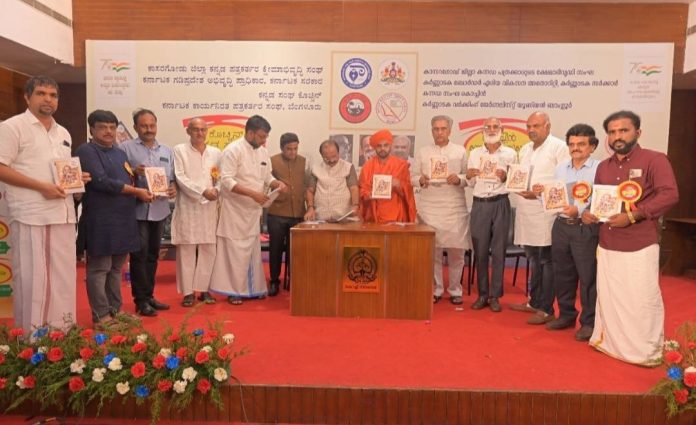
Vidhana Parishad Speaker Basavaraja C.Horatti releasing Book on ‘Contribution of Muslims in Kannada literature’
Basavaraja C.Horatti, Hon’ble Speaker of Vidhana Parishad of Karnataka Government has released a new book in Kannada, Kannada Sahityadalli Muslim Samvedane which means ‘Contribution of Muslim Writers to Kannada Literature’.
The book was released at a colourful function at the ‘Cochin Kannada Cultural Festival 2023’ which was promoted by joint auspices of Kannada Sangha Cochin, Kasaragod District Kannada Journa lists Association, Karnataka Border Area Development Authority, and Karnataka Working Journalists Association.
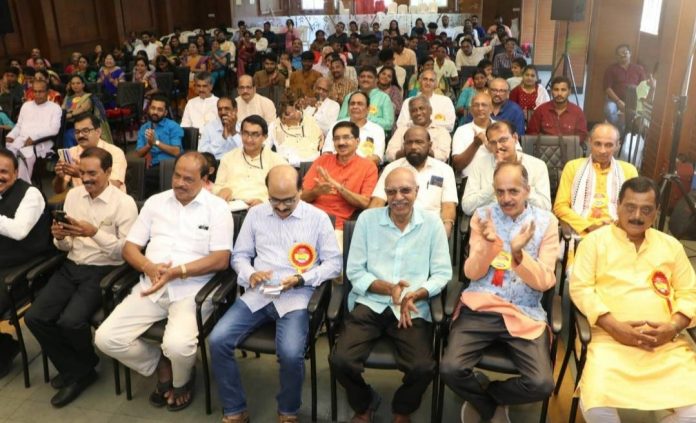
Kannada speaking masses in Ernakulum and various parts of kerala and Karnataka attended the festival in large.
The convention featured symposium, many cultural programs and a parade.
source: http://www.muslimmirror.com / Muslim Mirror / Home> Indian Muslim> Literature / by Muslim Mirror Network / May 08th, 2023
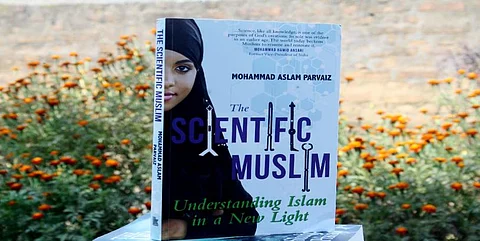
Wealth of Muslim community and government spending on the rituals of Islam for centuries would have been better utilized for establishing universities and technical and research institutes.
Title: The Scientific Muslim: Understanding Islam in a New Light
Author: Mohammad Aslam Parvaiz
Publishers: Konark Publishers
Pages: 184
Price: Rs 595
These are undoubtedly troubled times for India. Never before were the minorities, Muslims in particular, made to face such vicious communal hostility. The Hindu rightwing is at its aggressive best, combining facts with fiction to attack almost everything Muslims hold dear – their prayers, festivals, dress, even cuisine. Muslims are constantly provoked. If they respond even verbally, they face more wrath. It could not have been worse.
Hats off to Mohammad Aslam Parvaiz for coming out with his book on the problems Islam faces now. No, this is not a book about how to deal with Hindutva forces; far from it. A man of science, Parvaiz complains that Muslims across the world have jettisoned Islam’s true nature by sticking to parts of the Quran while ignoring much of what it says on how one must lead one’s life.
As a student of spirituality, I am convinced that the book will make waves in India and much of the Islamic world.
Ignoring Quran
The Quran, the author says, tells people how to lead a peaceful and meaningful life. While it asks those who read it to understand and explore nature, these intellectual pursuits are almost missing in those who claim the Quran to be their guidebook.
Parvaiz moans that Muslims born in Muslim households are taught to ‘read’ Quran without understanding it. Over the last many centuries, Muslim society has cherry-picked certain verses of Quran as binding on them. These include five-time prayers, fasting during Ramzan, offering ‘zakat’ and making a pilgrimage to Mecca. The Quran, he says, is much more. By deserting the Quran, “we ‘Muslims’ have deserted Islam”.
This is the main reason the Muslim society seems to have turned its back to scientific principles in which it once excelled, giving a tough competition to Europe. A sizeable section of Muslims even feels that contemporary education churns out atheists. The result? Ignorance about Quranic teachings coupled with limited ‘religiosity’ has led to the curriculum which is followed in most madrasas today.
In the process, Muslims are widely misunderstood by others. Non-Muslims think a Muslim must be one who sports a beard and a skull cap, goes to a mosque to pray five times a day and slaughters animals to eat. But these are visible symbols. Parvaiz contends that the one who follows the guidance given in the Quran and grooms himself accordingly is alone a true Muslim.
Also, some Muslim rulers had a knack of not tolerating any criticism about themselves or their religious beliefs. Consequently, wars and persistent battles rendered the once-prized academic atmosphere unfavourable.
Based on the Quran, Muslims must draw a road map for acquiring knowledge in every sphere and put it to the service of humanity. Parvaiz details what all the Quran says for human betterment. For instance, it underlines that one must meet his needs judiciously and avoid extravagance. As long as the Muslim followed the divine way, they ruled over the world and promoted justice, equity, peace and public welfare. When they began to neglect the Quranic system, it led to their disgrace and humiliation.
Islamic decline
Unfortunately, Muslims are at present unable to understand or act on the Quran. According to the author, the wealth of the Muslim community and government spending on the rituals of Islam for centuries would have been better utilized for establishing universities and technical and research institutes.
The absence of these is a key reason for the decline of Muslims as a productive part of the society or country where they live. “Their love for wealth, progeny and glory have made them indifferent to patronizing knowledge… It is time that we transcend sectarianism and shed false notions about our understanding of Islam and our intellectualism.”
According to the author, one reason why Muslims were hooked to a ritualistic lifestyle is because of the birth of a plethora of confusing and contradicting literature based on different sects that began to flourish. Slowly, Islam began to get diluted.
Also, some Muslim rulers had a knack of not tolerating any criticism about themselves or their religious beliefs. Consequently, wars and persistent battles rendered the once-prized academic atmosphere unfavourable. Muslim mobs in 1857 plundered the library of Delhi College, tearing apart books on English and science; Arabic and Persian books were looted.
Parvaiz without doubt has complete faith in the Quran. Yet he tears to shreds those who he feels are following it selectively, ignoring all that it has said about how to be in tune with Divine creations. “Soulless rituals cannot provide any food for thought. These may arouse our sentiments. Yet they cannot produce those Muslims who may lead communities of the world.”
He goes on: “Today, Muslim localities are notorious for their filth and rubbish. We throw all rubbish outside our homes and shops. The drainage system is rotten. We encroach upon roads, making life difficult for everyone. We erect all sorts of barriers on roads. We generate various forms of disorder. The industrial smoke coming out of small- scale work units in every house and alley adversely affect the entire atmosphere. All this amounts to disobeying God’s commands.” (It is another matter that much of what the author says about Muslim neighbourhoods can be said to be true for areas populated by other communities in India too.)
Way forward
Parvaiz explains what needs to be done. “Water, air, earth and all that is inside the planet are God’s signs. As Muslims we should not even think of disrespecting or destroying these signs.” His complaint is not directed at one section or country of Muslims. “No group, community or country of Muslims has ever prepared its progress model which is in accordance with the Quranic principles of justice, equity and selfless service.”
God, he says, has subjected everything to His laws. Indeed, all creatures who abide by divine commands can be called believers. Lip service and verbal claims alone will not and cannot help Muslims discharge their duty towards God. In real life, humans who are blessed by God seek to hold and hoard resources provided to them. Ownership and monopoly, he warns, are satanic concepts.
Parvaiz feels that the time has come to free Muslim educational agenda from religious and sectarian bias. Muslims should welcome all beneficial branches of knowledge. Character development has to be encouraged. One needs to train and produce Muslims who will follow Islam in full and not confine it to only a mosque or prayers.
“Islam will be their guide and mentor in every activity of life. This is the Muslim community which lost its way one thousand years ago.”
Non-Muslims too must read this eye-opener of a book as much as Muslims.
(The reviewer is a veteran journalist and author)
(Published under an arrangement with South Asia Monitor)
source: http://www.thenewsagency.in / The News Agency / Home> News Pops> India / by M R Narayan Swamy / April 28th, 2022
Abdul Bari is not a name that many Indians remember, but Munawwar, a committee member of the Tata Motor Workers’ Union in Jamshedpur, Jharkhand, holds the name in high esteem.
“I don’t see a leader like Abdul Bari [coming up] in the near future,” he said. “It is because of his efforts that we still get high tea at just six paisa.”
“Once, Bari went to the Tatas and he was offered tea. He asked them to first offer it to the workers, and then made an agreement which is still benefitting us. Upma, aloo chaap, samosa all for six paisa in the company’s canteens.”
Asked how they pay six paisa when currency that small no longer exists, he says, “We get token of Rs 2 or more and keep using it for weeks.”
Munawwar visits Bari’s grave every year on March 28, the death anniversary of the pre-independence labour leader, to offer flowers. This duty, he says, was assigned to him by the Tatas.
Thinking of labour in the days of capital
Despite the large numbers of workers who struggle to earn a square meal a day, major political parties remain hostile towards them. In the 55-page Congress manifesto, the words ‘worker’ or ‘workers’ appear 15 times; in the BJP’s 45-page manifesto, the words appears only five times – four while referring to Asha and anganwadi workers. ‘Labour’ figures 21 times in the Congress manifesto, and only twice in the BJP’s.
The Congress does talk about ending the workers’ exploitation and improving working conditions. The party’s manifesto details new schemes and promises to implement old ones related to organised, unorganised and contractual labour. But it is anyone’s guess how schemes that have been on hold for so long will suddenly spring to life.
Dilip Simeon, a founding member of the Association of Indian Labour Historians and former professor of history at Ramjas College, says that nobody talks about labour now because “in today’s context, the labour movement is influenced by communal sentiments”.
“If labour is with the BMS [Bharatiya Mazdoor Sangh] and Shiv Sena, then this is the weakness of the movement; if the labour movement wants to regain its power, then it has to face this challenge.”
Before independence, Simeon says, regardless of community, “leaders came together to advance the struggle of workers in India. Abdul Bari, Maneck Homi and Hazara Singh were their leaders. A Muslim, a Parsi and a Sikh could all be leaders of a workers’ movement.”
“Abdul Bari was so trusted that workers would start their protest first and then ask –what’s our demand?”
Bari was born in 1882, in Bihar’s Shahabad district. He was a student at Patna University in 1919 and was later appointed as a professor of history there, before he started studying law.
He quit to join the Khilafat movement, and actively participated in Gandhi’s civil disobedience movement and salt satyagraha. Bari did not restrict himself to the cause of one social group; he supported several political parties, including the Socialist Party and Swaraj Party, in parallel with the Congress. In addition, he was the voice of the labour movement in India and president of the Jamshedpur Tata Workers’ Union.
What Gandhi said about Bari
The journalist Afroz Alam Sahil has written a book on Abdul Bari, Professor Abdul Bari: Azaadi ki Ladaai Ka Ek Krantikaari Yodhha (Professor Abdul Bari: A Revolutionary Warrior of the Freedom Struggle). The author reveals several stories which won’t be found Indian history books. One such story is around Bari’s mysterious murder, and Gandhi’s reaction to it.
According to a report published by the Times of India on March 31, 1947, Bari was shot dead in the evening of March 28 while on his way home from Khushrupur, 24 miles from Patna. He was then the president of the Bihar Provincial Congress Committee. Following his death, a complete strike was observed, and Tata closed all its plants except essential ones.
Gandhi, in a speech on March 29, 1947, mentioned that he was struck by Bari’s simplicity and honesty. Gandhi added that he was planning to be more closely associated with Bari, and make an appeal to keep his short temper in check as it was not befitting of the highest office in Bihar. Gandhi referred to Bari in the same speech as “a very brave man with the heart of a fakir”. He declared that Bari’s death was the result of an altercation that had ensued between Bari and one Gurkha member of the anti-smuggling force, who was a former member of the Indian National Army.
The author mentions in this book that Bihar’s first Prime Minister (Premium) Barrister Muhammad Yunus had disclosed in an interview to the Orient Press of India that Bari had threatened to disclose the names of some prominent Congress leaders who were involved in the Bihar carnage – just three days before he was killed.
Yunus also said that Gandhi’s statement was given in haste. In his speech, Gandhi had told the audience that there was no politics of any kind in the death, and that it would be unjustified to associate the whole Indian National Army with Bari’s killing just because of one man’s actions.
In another incident discussed in the book, Gandhi arrives at Fatuaha station near Patna in the early morning of March 5, 1947. He travelled from Calcutta to Patna. Bari, chief minister Srikrishna Sinha and others welcomed him on the platform. As soon as Gandhi saw Bari, he laughed and said, “How is it that you are still alive?”
“This book is an attempt at bringing back his identity not just as a leader of the labour movement but a prominent leader of the freedom struggle of India,” the author says. “Professor Bari was one of the biggest leaders of the labour struggle in India. But limiting his role to even that would be unjust, because he was present in every chapter of the independence movement….The speciality of Abdul Bari is that he questioned his own party Congress when it came to the rights of workers.”
In a speech, Bari said, “We are in Congress to serve the poor of this country not to respect Gandhi, Rajendra Babu and Shri Krishna Babu…Lakhs of Indians who walk with them are not there to make them kings but to achieve freedom for this country.”
According to Sahil, “He criticised Gandhi and Rajendra Prasad many times because he was wholeheartedly committed to this struggle. He wanted to organise an all India conference for workers. He had formed the All India Mazdoor Sevak Sangh. He mentioned this in a letter written by him to Sardar Vallabh Bhai Patel on 22 June 1946.”
Why commemorate leaders like Bari today? Sahil has the answer. “Today when Muslim youth talk about Muslim representation, they must read more about Bari, the symbol of Hindu-Muslim unity, in order to understand their own political history and determine how it influences their future.”
Afshan Khan is a Delhi-based freelance journalist.
source: http://www.thewire.in / The Wire / Home> Analysis> Labour / by Afshan Syed (headline edited) / May 01st, 2019
Nadvi has been the president of the All India Muslim Personal Law Board for the last 21 years.
President of the All India Muslim Personal Law Board Maulana Rabe Hasni Nadvi. (Photo | Twitter)
Lucknow :
President of the All India Muslim Personal Law Board Maulana Rabe Hasni Nadvi died here on Thursday after a prolonged illness.
Senior executive member of the board Maulana Khalid Rasheed Farangi Mahali told PTI that Maulana Rabe Hasni Nadvi died around 3.30 pm at the Lucknow-based Islamic Educational Institute Nadwatul Ulama (Nadwa).
Mahali said Nadvi had been brought to Lucknow from his ancestral home in Raebareli four days ago as he was suffering from pneumonia.
He is survived by three daughters.
Nadvi has been the president of the All India Muslim Personal Law Board for the last 21 years.
His farewell prayers will be held at 10 pm in Nadwa and the body will be laid to rest in Raebareli on Friday.
source: http://www.newindianexpress.com / The New Indian Express / Home> Nation / by PTI / April 13th, 2023
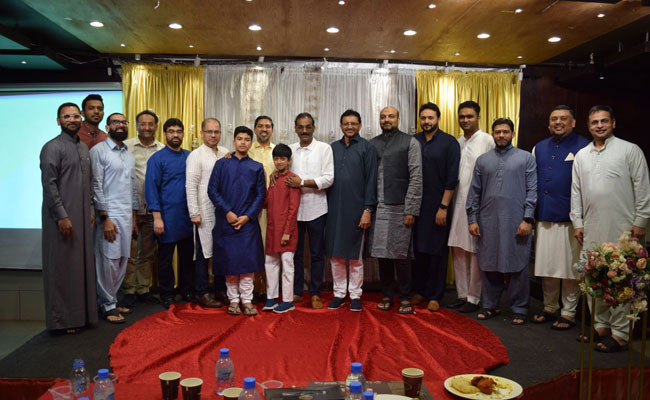
The Karnataka Muslim Cultural Association (KMCA) held its annual general body meeting on April 8th, during which elections were conducted for the executive committee for 2023-24.
The program, held at MRA Restaurant in Doha, began with a recitation of the Holy Quran by Master Rehan Rashid.
Following the dissolution of the executive committee for 2022-23, Ahmed Saeed Assadi, the election commissioner, conducted the process of electing the new committee members.
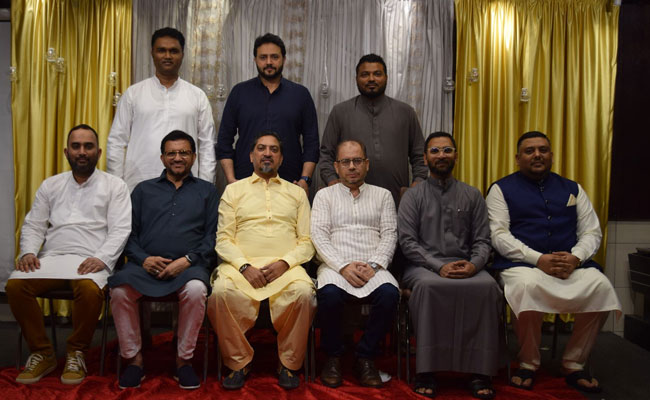
The KMCA has announced that Saquib Raza Khan has been elected as the new president, while Suhaib Ahmed has been elected as the new vice president. Shahim Mohammed Sheikh is the new general secretary, Khaleel Ahmed is the new treasurer, Mohammed Yunus is the new joint secretary, Sayed Ashfaque is the new cultural secretary, and Shakeel Mohammad is the new sports secretary.
In his acceptance address, the newly elected president, Saquib Raza Khan from Mangaluru, put forth the future plans of the KMCA. He also stated that the other office-bearers would be elected soon during the first meeting of the new executive committee.
The outgoing president of KMCA, Fayaz Ahmed, welcomed the gathering, while outgoing general secretary Suhaib Ahmed presented the annual report of the events organized by the KMCA in the last year. Khaleel Ahmed presented the treasure report. Abdullah Moideen was the Master of Ceremony.
The meeting concluded with a vote of thanks by Ahmed Saeed Assadi.
Following the elections, a quiz contest was held, and the top five winners were awarded prizes.
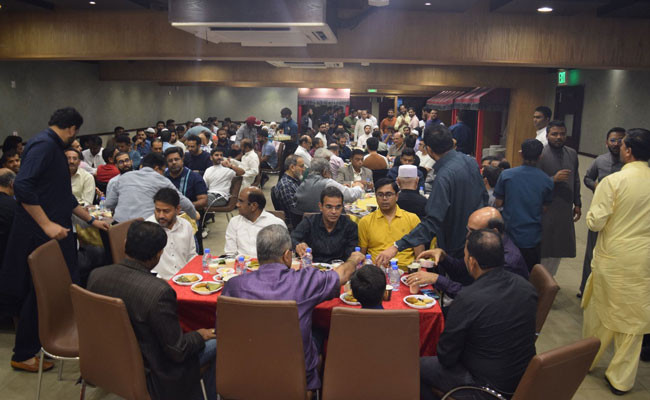
The KMCA also held an Annual Iftar for its members and heads of other organizations, which was attended by approximately 150 people.
Dignitaries from other associations and community leaders, including Hassan Chougle and Ikhlas Farid, ICC President Manikantan, and officials of the ICC, ICBF, and ISC Subramanian Hebbagilu and Deepak Shetty, graced the occasion.
Leaders of Karnataka-based organizations such as Mahesh Gowda, Ravi Shetty, Arun Kumar, Dr. Sanjay Kuduri, Abdul Razzak, Ibrahim Beary, Mumtaz Hussain, Abdul Rahiman Saab, and Abdullah Khatri were also present.
source: http://www.english.varthabharati.in / Vartha Bharati / Home> Gulf / by Vartha Bharati / April 11th, 2023