I have been visiting Shah Jahan Mosque and the Brookwood cemetery in Woking for a few years now.
Woking, is a small town almost 30 miles from London. The town is famous for it’s first purpose build mosque in the UK .
During, the two great wars this mosque served a purpose of spiritual centre for Muslim soldiers in Britain.
A few miles from the mosque lies a burial ground which was a designated ground for Muslim soldiers of WWI. Later, it has been transformed into a memorial park.
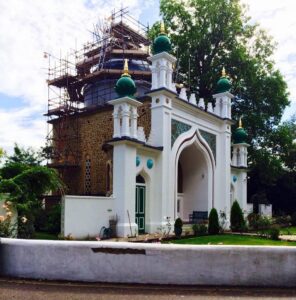
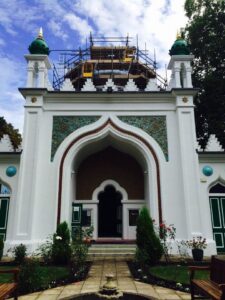
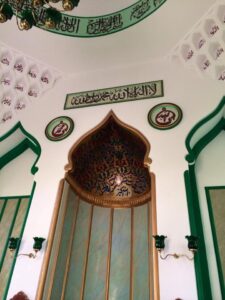
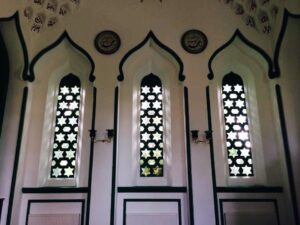
Shahjahan Mosque, Woking
Brookwood Cemetery is situated almost five miles from the Shah Jahan Mosque. The Cemetery is one of the largest in Europe. There are a number of famous Victorian Muslims resting here. Today, Woking has large Muslim population, mostly from Pakistan and they are very active in the community and maintaining the mosque very well.
My, very first trip was unplanned and somewhat impulsive. Though it was incredibly enlightening as well as moving. In 2016 after Eid prayer, on a spur I decided to drive my family to Woking. At the time I had only two boys; My eldest was 3 and his brother a year old. I had no idea how to reach to the mosque and locate graves of the early ‘Victorian Muslims.’ However I was committed to do both on the same day. On my SatNav I entered the postcode of Shah Jahan Mosque.
After two hours of drive we reached the Shah Jehan Mosque. There, we saw young and old, boys and girls in Asian Eid costumes. Contrary to the typical British cloudy weather it was a sunny day. Green dome of the mosque and good size open space with another impressive brick building gave an impression as if we are in a small but an affluent village of India.
The festive mood and the perfect sunny day was inviting us to explore and finish the target. After spending an hour there, we decided to drive to Brookwood cemetery.
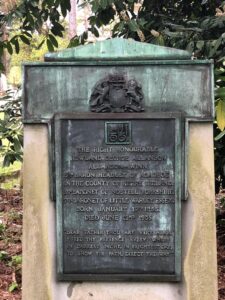
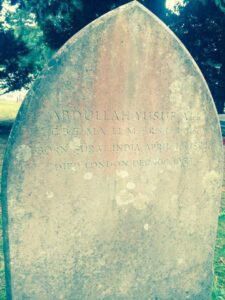
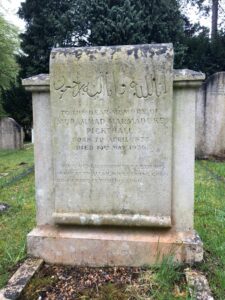
The most challenging part was to locate the old Muslim section of the cemetery, where I wanted to the visit graves of Abdullah Yusuf Ali, Marmaduke Pickthall and Lord Headley.
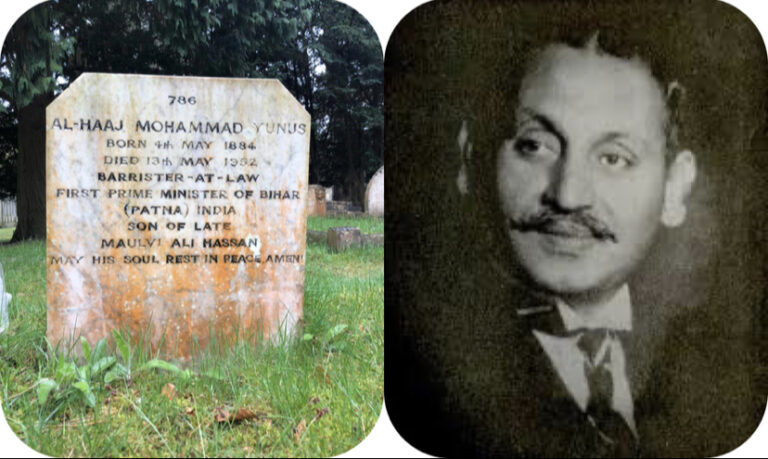
To solve the problem, after reaching the cemetery gate; my intuition suggested me to drive only on the road which took us to the right side of the cemetery. First right, second right and then the third right. After a very short drive it was evident that the direction of graves has started changing, Muslim names with some Islamic symbols – crescent and stars on grave stones reassured me that we have entered into the Muslim section of the cemetery. In the end I reached to the place I wished. It was not easy to recognise Mr. Pickthall’s grave, three rows further, very close to the road is buried my favourite Abdullah Yusuf Ali the well known translator of the Holy Qur’an in today’s contemporary world who passed away in 1953. I was in search of another unmarked grave of Mr. Abdullah Quilliam, when my wife called me to show something. She excitedly pointed to a marked grave of the first Prime Minister of Bihar.
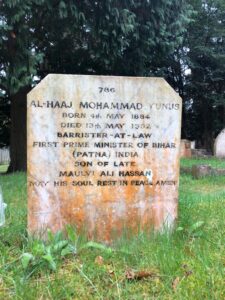
Grave of Mohammed Yunus
My wife is born and brought up in the UK. However she is fluent in Urdu and has enormous interest in her Indian roots. She located the grave of the ‘First Prime Minister of Bihar’ – Haji Mohammad Yunus. It was a huge surprise for me.
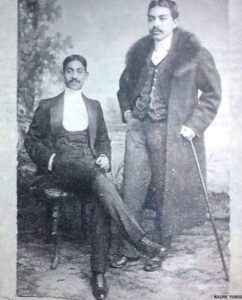
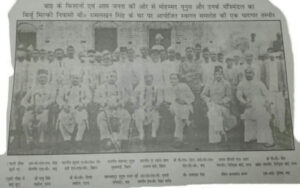
Barrister Mohammed Yunus (Sitting)
I don’t have any direct relationship with Late Haji Mohammad Yunus Saheb. However one of his nephews was my grandfather’s junior in the court and was a very close friend of his. My paternal grandfather was a successful and famous criminal lawyer who practiced in a small town in Bihar. Both of them worked in the same Court. In the 1940s my grandfather’s friend (Haji Yunus’s nephew) was the only Muslim in the town who had a Radio.
Barrister Mohammed Yunus
In fact in our ancestral town it was his radio that broke the bad news of Mahatma Gandhi’s cold blooded murder. Broadcasts from his Radio clarified that the murderer of Gandhi was ‘not a Muslim but a right wing Hindu’ . Which was a momentous relief for the frightened local Muslim population during the violent and uncertain communal climate of the partition of India.
So, finding his grave reminded me of the old story of partition. When I was in school, our eldest uncle shared his experience as a child and narrated us with many stories of the partition; further, how they were taken to a safe place in Bengal for a short period of time by train.
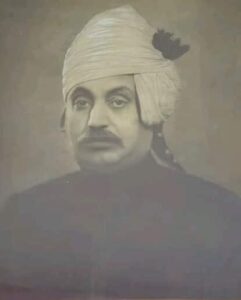
Barrister Mohammed Yunus as Prime Minister of Bihar
Below are photographs of Haji Mohammad Yunus grave stone and other famous British Muslims residents of the Brookwood Cemetery. May they all rest in peace; may Almighty Allah accepts their deeds and grant them highest place in Paradise. Ameen.
source: http://www.heritagetimes.in / Heritage Times / Home> Bihar> Heritage / by M S Siddiqui / July 29th, 2020
The earliest Persian and Arabic inscriptions are seen on the tombstones and walls in the olden graveyards of Kashmir
The historic tombs of the most famous Shahmiri period sultans and nobles, which included Sultan Sikander and Sultan Zain ul Abideen are also in this historic cemetery. [Tomb of Zain ul Abideen in Srinagar’s old city–Representational Image]File/ GK
With the establishment of Muslim sultanate in Kashmir, in late fourteenth century, the Sanskrit language and Sharda alphabet were also taken over by Persian and Arabic alphabet. The tradition of Sharda epigraphic culture also declined considerably and it gave way to Persian and Arabic inscriptions.
The earliest Persian and Arabic inscription are seen on the tomb stones and walls, in the olden graveyards, Khanqahs and mosques of Kashmir. Number of such inscriptions are documented in my book titled, Kashmir inscriptions of Kashmir, which was published in the year 2013 by Gulshan Books, Srinagar.
Persian inscription on a stone slab at the historic graveyard of Khanqah-e-mu’llah old Srinagar.
Epigraphs of royal graveyard at Mazari Kalan
Mazari Kalan popularly known to public as “Mazari Shiekh Bahau-ud-Din Ganj Baksh (RA)” lies in the foot of Kohi Maran to the west of Malkah. The history of the Mazar reveals that the site originally was proposed by Zain-ul-Abideen Badshah in 1421 AD for housing the only burial of her beloved wife called Ashama Bibi who belonged to a noble family of Bahaqi lineage. But when Sheikh Baha-ud-Din (RA), the reputed saint and Murshid of the Sultan left for heavenly abode in December 11, 1439 AD, he was laid to rest in this proposed site. Over the resting-place a shrine was also then erected.
Stone inscription in a dilapidated condition
The shrine looks to have been renovated, but it has lost most of its interesting architectural features. Adjacent to the shrine is seen the grave of a poet, Mir Illahi, who is saidto be the court poet of the Budshah. A beautiful inscription bearing few lines of his lyric is erected over the grave.
The grave of Asaha Bibi lies near the gate of the Mazar. The other burials it houses of the reputed saints and nobles of their times include; the grave of Solman, Sayyied Habib Shah Kashani, Moullana Mohammed Anie, Baba Qayim, Khwaja Mohammed Kakroo, Moullana Mohammed Balkhji, Sheikh Mohammed Trabali, Mulla Sarf-ud-Din Farhat, Mulla Nurullah Kath, Molvi Amir-ud-Din, Molvi Qulam-ud-Din Jami, Sayyied Mohammed Kermaniand others.
These all graves are very old and are crowned with gravestones, which are brilliantly carved in beautiful Arabic and Persian inscriptions.
Epigraphs of royal graveyard at Zain kadal
The royal graveyard of Zainkadal, locally called Mazari Salateen, enshrines the final resting places of Shahmeri Sultans. The historic tombs of the most famous Shahmiri period sultans and nobles, which included Sultan Sikander and Sultan Zain ul Abideen are also in this historic cemetery.
The tomb of Mirza Haider Dauglat, who administrated Kashmir as a Mughal governor for about 11 years during 1540-1552 AD, is also found in this historic graveyard.
There is a brilliant epigraph in Persian characters laid over his grave which is believed to have been installed by Moorcraft a British traveler during his vest of Kashmir in 19th century.
Persians inscription stone slab on the tomb of Mirza Haider Daughlat, Zainakadal Srinagar.
Zaindeep Epigraph
Persian stone inscription of Zain ul Abideen, SPS Museum Srinagar
Although there is no evidence of any standing Budshah’s Palace found anywhere in Kashmir valley but there is a magnificent stones slab inscription housed in the SPS museum at Lalmandi Srinagar which the experts claim provides vital information about Zaindeep, one of the famous Palaces of the Budshah’s period. Experts claim that this stone slab inscription, besides other details, has also provided the date of construction of this highest palace.
This inscription is Persian Nashk style. It is learnt that the inscription way back has been recovered from the Zianlank island of world famous Wullar lake in Bandipura district and later was shifted to this museum for its proper preservation. The inscription gives AH 841 as the date of construction of this world famous Zaindeep.
While providing description of this stone slab inscription experts say that this inscription is in Persian characters and is divided in four panels. The first two lines mentions the majesty, strength and the name of the Palace as Zaindeep and also describes it as the world famous, while as the date of foundation in Muslim calendar is mentioned in the last two lines in Persian words, which is calculated as 841.
Inscription of the palace
Ene bakha chun faluk muhakum bad
Mashoor ba zain deep dar alam bad
Shah Zain ibad ke daru jashin kunand
Pai vasta Chun tareekh khurdesh kahrum bad.
84l the inscription dates to 841 AH.
(The fort built by Shah Zain ul Abieein is so high and strong as the sky; and it is famous by the name of Zain deep. The king was very happy and celebrated the event when this palace was built)
Broken Stone inscription at Mazare Salateen old Srinagar
Besides these royal graveyards, the other historic and royal graveyards also carried brilliant epigraphs either engraved on tomb stones or on stone walls, these included Mazari Kalan, Mazari Salateen, Mazari Khanqah Mu’llah, Mazari Madine Sahib, Mazari Malik Sahib, Mazari Safakadal, Mazari Malkah and Mazari Bijbehra,.
But these human records are not preserved anywhere in these historic cementers. These inscribed records have fallen prey to the unchecked weathering and human vandalism.
Most of their inscriptions have defaced and it is very difficult to identify and decipher their epigraphs; steps are required to be taken to conserve this unprotected and unconcerned epigraphic heritage.
Disclaimer: The views and opinions expressed in this article are the personal opinions of the author.
The facts, analysis, assumptions and perspective appearing in the article do not reflect the views of GK
source: http://www.greaterkashmir.com / Greater Kashmir / Home> Op-Ed / by Iqbal Ahmad / February 20th, 2022
Indian-born South African writer Shubnum Khan’s new book is about the hope and magic we can find in life if we are brave enough to push for it.
Apart from ideas of hope and courage, Shubnum Khan explores the theme of walking in her book. (iStockphoto)
What does it mean to be a young, Muslim, desi woman walking the streets of Shanghai alone, sometimes in a hijab? What’s it like going off on your own to the mountains to teach children in a remote village in Kashmir when you have never travelled alone? And most importantly, what happens when you decide to be brave and do those things and, in a sense, “step off the edge”?
“You think you are going to fall, but you actually fly,” says Shubnum Khan, the South African writer of How I Accidentally Became A Global Stock Photo, a collection of odd and funny stories of her travels around the world, and of learning to be soft and vulnerable, particularly to herself.
In this breezy, delightful read, Khan packs in descriptions of experiencing travel and living abroad with a good dose of earnest reflections that tap into being a Muslim woman in the modern world, with bearings rooted in faith and family. The stories are resonant not because they are common or relatable (they are, rather, strange and wonderful) but because she contextualises them by revealing something of her life and herself.
For instance, Khan takes us through her life as the fourth of four sisters in an Indian Muslim family in Durban, where, at a point in her life, she had started feeling trapped and frustrated. So when an opportunity to go to Kashmir in 2013, to teach village children, came along, she took it up. “I immediately saw that this was the first step towards doing something different with my life as compared to everyone telling me to get married and have children,” says the 36-year-old on Zoom.
That experience and move away from a sheltered life catalysed other events and happenings, travels and sometimes bizarre incidents. Her new book straddles genres in that it’s as much a memoir as it is a travelogue and, together, transcends both. While it started as a collection of her experiences during travels—from turning into a “bride” on a rooftop in Shanghai to being trapped in a house in Delhi during an earthquake—it grew into much more. “As I was writing the book, I realised I was also telling the story of my life,” she says.
Shubnum Khan.
Khan is vulnerable in her stories and, in contrast to trope-filled memoirs and travelogues that spotlight strength and bravery, owns up to her less-than-brave feelings. She describes being anxious and nervous throughout most of her trips. But vulnerability and sharing one’s life (whether in a book or on social media, where Khan first found an audience for her stories) can involve treading a fine line. How does she decide what to share and what to keep to herself?
“Distance and space give you a clearer idea of the bigger picture,” she says. “You are sharing so you don’t feel lonely but you are also sharing so that other people don’t feel lonely,” she says. “I really wanted to share who I am but I also wanted to protect who I am.” When Khan says “anything could happen” if you step off the edge, she’s also aware that this doesn’t only mean good things. Neither does she ignore the presence of threat or danger. Instead, she confronts it with humour.
Even as Khan grapples with ideas such as living and travelling as a Muslim woman, she tells her stories with charm and wit. “In the book, I talk about being interrogated about my secret marriage. At the time I was so scared, it was such a serious situation. Now when I look back at it, I find it ridiculous,” Khan says. She doesn’t think of herself as a funny person but does believe that you can only laugh at certain situations in life to get through them. “Once you start seeing how ridiculous those are, you can pull out the humour from them,” she adds.
Apart from ideas of hope and courage, the book explores the theme of walking. It seems to be Khan’s primary way of experiencing any place she is visiting, especially because South Africa itself doesn’t allow her that freedom. She writes about how, in her home country, she has to watch what she wears even when going out to jog, how she can’t even carry her phone with her, and how she has to be hyper-aware of her surroundings, no matter where she goes.
How I Accidentally Became A Global Stock Photo: By Shubnum Khan, Pan Macmillan India, 256 pages, ₹650.
Her travel stories detail experiences and encounters of walking and getting lost in the streets of Istanbul, Casablanca, Seoul and Shanghai. A chance meeting with a weeping woman. Going down out-of-sight alleys full of possibilities. Discovering a mosque. “There’s such beauty in being able to get lost, and I can’t do that in South Africa,” she rues.
It’s an arresting vision, to imagine a young Muslim woman walking in cities of the world alone, and Khan is aware of it. “We have so many books about men walking in cities, and books about white women walking,” she says. “We don’t have too much about the Muslim woman walking.” Given the many places she has visited, it’s not unfair to think about Khan’s privilege, which she acknowledges. Does it mean adventures are possible only if certain things are aligned? “You should keep pursuing what you need to do and try to make it happen in whatever way possible,” she says. She had to fight her father to be able to travel, for instance. Some of her trips had some expenses covered. “You have to dream big but you also have to follow them with practical steps,” she says.
It’s a curious book to have been written in 2020, when the pandemic was blazing and travel was far from our minds. And yet, it was also the perfect time for the book, which has been as much influenced by the pandemic as it is a product of it. Khan says that were it not for that strange, isolating, terrifying time, she might not have come to some of the conclusions and reflections she did in her book.
“It started making me think intensely about who I am and my role, the kind of experiences I have,” she says. “In my stories I am talking about travelling by myself, being by myself, being single, doing things alone. And then, when I was writing this book (during the pandemic), I was by myself, and I was missing everyone. I felt isolated. I think it helped tell a more intense story.”
That time in 2020 was also a period when, amid the despair and grief, we were all looking for hope. Because it wasn’t around her while she was writing, Khan says she tried to write that hope into her book. “Everything felt hopeless and writing the stories felt like I was trying to inject that magic back into life,” she says.
That is the book’s mainstay: the idea that there is hope and magic to be had from life, for anyone who wants it and is brave enough to push for it. Khan calls her book “part memoir, part travelogue, part love letter to anyone who has been afraid”. It’s essentially about choosing your own path in the face of conventionality but it is the heart and humour with which she tells her tales that make the smile already on your face linger a little longer.
I ask her what advice she would give to someone who carries the weight of dreams in her heart—and it’s usually a her—except that she’s afraid. Khan’s reply is tender and full of warmth. “It will be scary and hard but you should never stop dreaming. People will always be telling women how to be, how to act and what to do. But you have to follow what you want to do because you are living your life,” she says. “You are going to be on the journey with you. No one else will live your life.”
Tasneem Pocketwala writes on culture, identity, gender, cities and books. She is based in Mumbai.
source: http://www.lifestyle.livemint.com / Mint Lounge / Home> News> Big Story / by Tasneem Pocketwala / November 04th, 2021
Arif Mohd Khan, of India, leads their team in during the opening ceremony of the 2022 Winter Olympics, Friday, Feb. 4, 2022, in Beijing. | Photo Credit: AP
Arif is the first Indian to secure qualification in two events of the same edition of the Games and his competitions are slated for February 13 and 16
Beijing Skier Arif Khan led a small four-strong Indian contingent during the Winter Olympics opening ceremony here on Friday amid a diplomatic boycott of the event by the country.
The 31-year-old Arif will be the lone Indian competitor at the Games, having qualified in Slalom and Giant Slalom events. India sent a six-member contingent to the Games including a coach, a technician and a team manager.
Arif is the first Indian to secure qualification in two events of the same edition of the Games and his competitions are slated for February 13 and 16.
India was the 23rd contingent to walk in during the grand ceremony at the iconic Bird’s Nest stadium here as China welcomed athletes from 84 countries amid a diplomatic boycott by powerful nations such as the USA and Britain over its alleged human rights violations in the Xinjiang region.
India announced a diplomatic boycott of the Games after China fielded Qi Fabao, the regimental commander of the People’s Liberation Army, who was injured during the 2020 military face-off with Indian soldiers in the Galwan Valley in eastern Ladakh, as a torchbearer for the event’s Torch Relay.
India said China’s move was “regrettable” and it has chosen to “politicise” the Olympics.
Born in Kashmir’s Baramulla district, Arif took up skiing quite early in life, winning his first national slalom championship at the age of just 12.
He later went on to win two gold medals in the Slalom and Giant Slalom events of the South Asian Winter Games in 2011.
He has also participated in both the editions of the Khelo India Winter Games held in Gulmarg, Jammu and Kashmir.
Arif’s inspiration was his father Yasin Khan, who owns a ski equipment shop in Gulmarg, a popular tourist destination in Jammu and Kashmir.
Previously, India’s Winter Olympics campaigns have been identified with one man — veteran luge athlete Shiva Keshavan, who represented the country in six editions of the mega-event.
The 40-year-old from Manali, Himachal Pradesh has now taken up the role of promoting winter sports in India.
source: http://www.thehindu.com / The Hindu / Home> Sport / by PTI / February 04th, 2022
Hyder Ally (Anglicised version of Haidar Ali) was a popular exotic name in the 1770s when the fledgling United States of America was fighting for its independence from Britain. There were racehorses named after this ruler of the Mysore Kingdom in South Asia as well as his warrior son Tipu Sultan.
In the early 1780s, Haidar Ali’s bravery was invoked in one of the earliest documented recruitment for the US Navy. A ship named after him gave the USA one of its greatest naval victories during the same time. His name was chanted on the streets of America, in 1781. Let’s travel back in time to understand this.
In 1775, a great upheaval shook thirteen British colonies on the east coast of North America as its residents rose against the Government of Great Britain, declared independence and flew their own flag (1, 2). Apparently, the first flag of the Union, now the US national flag- the Stars and Stripes, sent to the state of Maryland was hosted on a sailboat by teenager Joshua Barney at Baltimore in October 1775. Barney had just started his service with the US Navy.
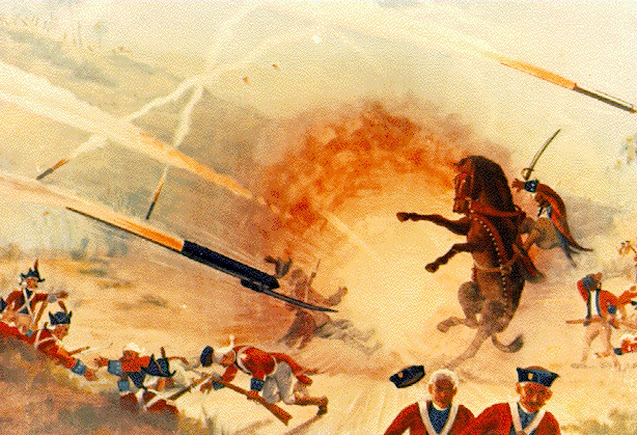
Rocket Warfare, by Charles H. Hubbell (1898–1971) captures the humiliation of the British at the Battle of Pollilur (Sep. 1780) by Mysorean war rockets.
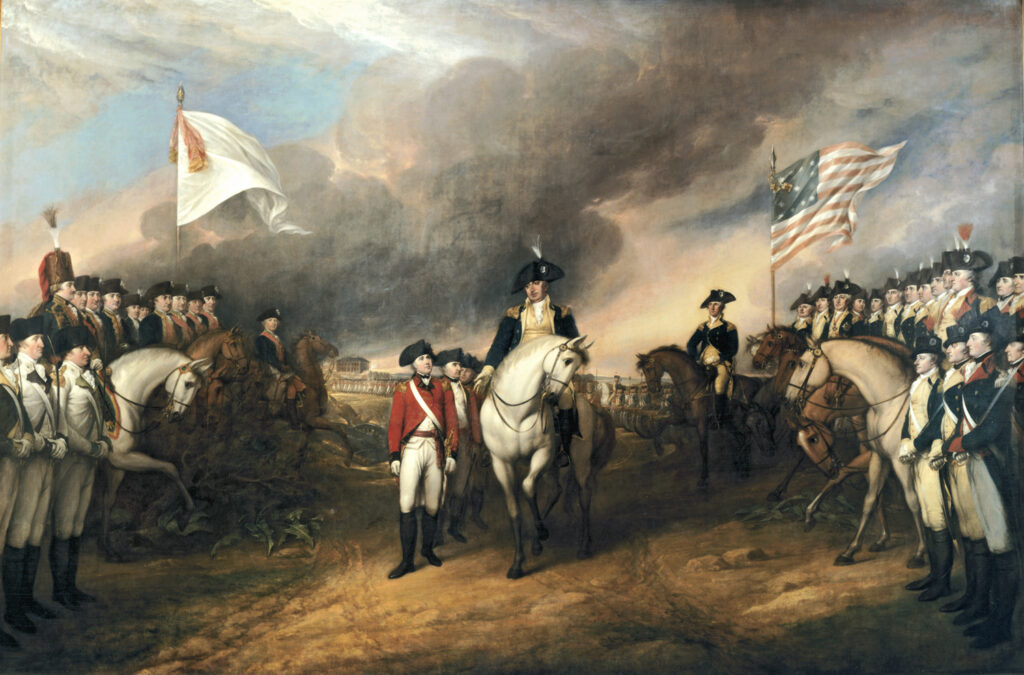
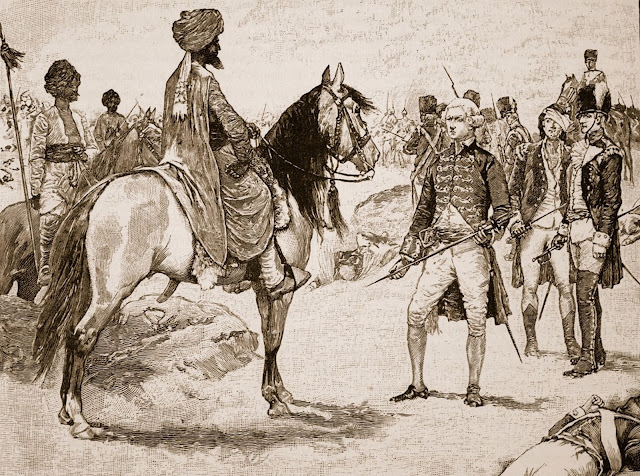
A few years later- in 1780, in the far-away Mysore Kingdom, the East India Company was suffering one of the worst reverses in its military history. This was at the hands of Haidar Ali and his son Tipu Sultan who were supported by the French, an ally of America. The humiliation of the British at the Battle of Pollilur in September 1780 reverberated in America where the news reached the country (3). On 19 October 1781, the British land force led by Charles Cornwallis surrendered to the Americans led by George Washington (incidentally a decade later in India, Cornwallis gave EI Company and its Indian allies victory over Haidar Ali’s son Tipu Sultan in the 3rd Anglo Mysore War). Nine days later Cornwallis’ surrender, along with that of Haidar Ali’s victories in India, was celebrated at Trenton, New Jersey. The town on that day was decorated with American colours. Inhabitants including the Who’s Who attended a service at the Presbyterian Church, where a discourse highlighting the occasion was delivered by a Reverend. In the afternoon the gathering drank 13 toasts accompanied with a discharge of artillery, number eleven of which was for ‘The great and heroic Hyder Ali, raised up by Providence to avenge the numberless cruelties perpetrated by the English on his unoffending countrymen, and to check the insolence and reduce the power of Britain in the East Indies‘ (ibid., ref. 3).
The other toasts were raised and artillery was discharged for the below. Quote: 1. The United States of America; 2. The Congress; 3. The king of France; 4. General Washington and the American army; 5. The Count de Rochambeau and the French army; 6. The Count de Grasse and the French fleet; 7. General Greene and the Southern army; 8. The friends of liberty throughout the world; 9. The memory of Generals Warren, Montgomery, and all the other heroes who have fallen in the defence of the liberties of America; 10. Peace on honorable terms, or war forever; 12. The governor and State of New Jersey; 13. The glorious 19th of October, 1781. At seven in the evening the company retired, and the rejoicings were concluded by a brilliant illumination. Unquote. (ibid., ref. 3).
Hyder Ally and America’s struggle to reclaim its seas from the British
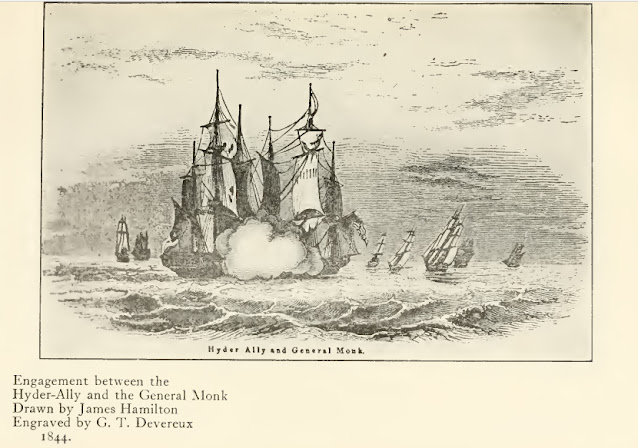
Sketch of action between American naval ship USS Hyder Ally and English warship General Monk in 1782. Source: Life of Commodore Joshua Barney, Hero of the US Navy (1776-1812), 1912.
Despite this, America was far from being an independent nation. The British still ruled the seas. They kept a keen watch on the ships entering and exiting the ports of northeast USA, often capturing the vessels and looting goods. General Washington an American sloop-of-war was captured by Admiral Arbuthnot, and placed in the king’s service under a new name The General Monk, which was then used to pirate American ships. By 1782 the commerce of Philadelphia City, as well as the ordinary life of the residents of the coast and nearby streams, was deteriorating. The fledgling American Union was not in a position to protect the affected vessels. Therefore the State of Pennsylvania, at its own expense, fitted a number of armed vessels that operated in waters leading to Philadelphia. The state purchased Hyder Ally, a small sloop (single mast ship) equipped with sixteen six-pounder guns to help protect the American vessels. 23-year old Lieutenant Joshua Barney, now in the US navy, arrived at Philadelphia where he was honoured with the command of Hyder Ally (4). Assigned with recruiting men, Barney used a poem penned by Philip Morin Freneau to attract young American men to the ship. The poem exalted Haidar Ali’s bravery against the British with the following lines (5):
Come, all ye lads who know no fear,
To wealth and honour with me steer
In the Hyder Ali privateer,
Commanded by brave Barney.
From an eastern prince she takes her name,
Who, smit with freedom’s sacred flame,
Usurping Britons brought to shame,
His country’s wrongs avenging;
Come, all ye lads that know no fear.
With hand and heart united all
Prepared to conqueror to fall.
Attend, my lads! to honor’s call —
Embark in our Hyder-Ally!
And soon Barney led a force of a hundred and ten men. On April 8, 1782, he received instructions to protect a fleet of merchantmen to the Capes just before the sea, at the entrance of Delaware Bay. Dropping the convoy at Cape May road he was awaiting a fair wind to take the merchant ship to sea when he saw three ships (6) which he realised were waiting to plunder the convoy. Barney immediately turned the convoy back into the bay, using Hyder Ally to cover the retreat. Soon the bigger General Monk under the command of Captain Rogers of the Royal Navy nearly doubled his own force of metal, and nearly one-fourth superior in number of men caught up with Hyder Ally. Despite being fired upon, Barney held Hyder Ally’s fire till within pistol shot when both the two vessels got entangled. A short but desperate fight ensued. Lasting 26 minutes, it resulted in the lowering of flags by General Monk indicating her surrender. Both vessels arrived at Philadelphia a few hours after the action bearing their respective dead. The Hyder Ally had four men killed and eleven wounded. The General Monk lost twenty men killed and had thirty-three wounded including Captain Rogers himself, and every officer on board, except one midshipman ! (7)
‘Surrender of Baillie to Hyder Ali, 1780’, illustration from Cassell’s Illustrated History of England (20th century), 1780.
A hero is celebrated
Philadelphia burst in celebrations. Ballads were made upon this brilliant victory and sung through the streets of the city! And echoing with Barney’s name was that of Hyder Ally (ibid., ref. 1).Here are some lines:
And fortune still, that crowns the brave
Shall guard us over the gloomy wave —
A fearful heart betrays a knave!
Success to the Hyder-Ally!
While the roaring Hyder-Ally
Covered over his decks with dead!
When from their tops, their dead men tumbled
And the streams of blood did flow,
Then their proudest hopes were humbled
By their brave inferior foe.
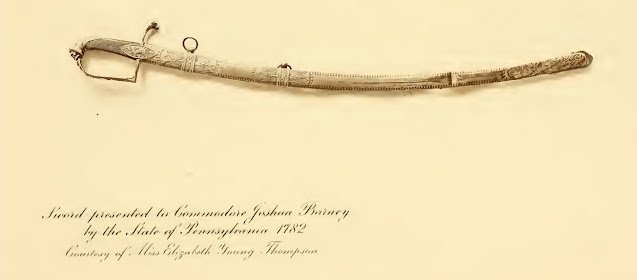
A small sword with mountings of chased gold- the guard of which on the one side had a representation of the Hyder Ally, and on the other the General Monk was ordered by the Legislature of Pennsylvania and a vote of thanks was passed for Captain Barney in 1782. This gold-hilted sword was presented to him in the name of the state by Governor Dickinson. Source: Life of Commodore Joshua Barney, Hero of the US Navy (1776-1812), 1912
In 1782 the Legislature of Pennsylvania passed a vote of thanks to Captain Barney and ordered a gold-hilted sword to be prepared, which was afterwards presented to him in the name of the state by Governor Dickinson. It was a small sword with mountings of chased gold- the guard of which on the one side had a representation of the Hyder Ally, and on the other the General Monk (ibid., ref. 1). Barney was the last officer to quit the Union’s service, in July 1784, having been for many months before the only officer retained by the United States.
Barney was sent by the American Government to Paris. A reception was given in France him as a hero of dashing naval exploits during the Revolutionary War (8). A painting representing the action between the two ships was executed in 1802 by L. P. Crepin in Paris by order of Barney, while in the service of the French Republic. The same was presented by him on his return to the United States, to Robert Smith, Esquire, then secretary of the navy (9). The painting is now in the United States Naval Academy, Annapolis, Maryland (ibid., ref. 1). Barney was an intimate friend of Count Bertrand, one of Napoleon’s generals (ibid., ref. 2). Napolean incidentally had an alliance against the British with Haidar Ali’s son Tipu Sultan, during the latter’s lifetime (10).
Barney was appointed a Captain in the Flotilla Service, US Navy on 1814 April 25 (11). He took part in seventeen battles during the Revolutionary War and in nine battles during the War of 1812. A British Musket-ball lodged inside his body in battle at Bladensburg, Maryland in August 1814 (12). He passed away on December 1, 1818, aged 60.
The world today is considered a global village thanks to the scaling down of boundaries between nation-states and individuals alike. But it may surprise us even in the 18th century seemingly local political events and humans made an impact on lands and societies far away. The name Haidar Ali, after an adventurer from an obscure place in the erstwhile Kingdom of Mysore who gave many a lesson in military and political strategies to global colonial powers of England and France, echoing across the proverbial seven seas in distant North America for nearly a century is a testament of this (13, 14).
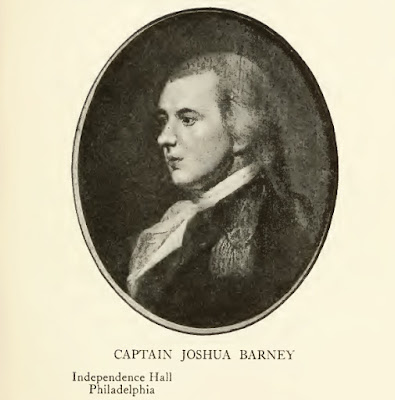
Painting of Commodore Joshua Barney at Independence Hall, Philadelphia, Life of Commodore Joshua Barney, Hero of the US Navy (1776-1812), 1912.
70 years after Hyder Ally’s victory over General Monk, James Cooper wrote “This action has been justly deemed one of the most brilliant that ever occurred under the American Flag. It was fought in the presence of a vastly superior force that was not engaged, and the ship taken was in every essential respect superior to her conqueror.” (ibid., ref. 4)
Sources/ Notes:
1. Barney, Mary., A biographical memoir of the late Commodore Joshua Barney, 1832, Mary was a sister of Joshua Barney. Her book provides in-depth information about the latter’s personal and military life. Born on July 6, 1759, 13-year old young Philadelphia Joshua Barney set sail on his maiden merchant ship journey to Ireland in 1771 with his brother in law Captain Thomas Drysdale. He sailed back home the following year and made trips to ports in Europe again. He set sail for Nice, France in December 1774 during which journey Captain Drysdale died. He took control of the ship which needed urgent repairs and therefore docked at Gibraltar, Spain instead. In a few months, he sailed to Algiers, Algeria from Alicant, Spain to deliver Spanish troops during which he witnessed the annihilation of these troops by the Algerians which made him return to Alicant soon. He immediately set sail across the vast Atlantic Ocean for Baltimore, USA. As he entered the Chesapeake Bay on 1st October he was surprised by the British Sloop of war Kingfisher. An officer searched his ship and informed him that Americans had rebelled and that battles were being fought. He was fortunate enough to escape detention. Returning to Philadelphia he was determined to serve the Americans fight against the British. At that time a couple of small vessels were under at Baltimore ready to join the small squadron of ships stationed then at Philadelphia and commanded by Commodore Hopkins. Barney offered his services to the commander of the sloop Hornet, one of these vessels. He was made the master’s-mate, the sloop’s second in command. A new American Flag, the first ‘Star-spangled Banner’ in the State of Maryland, sent by Commodore Hopkins for the service of the ten gun Hornet, arrived from Philadelphia. At the next sunrise, Barney unfurled it in all pomp and glory. In 1776, Robert Morris, President of the Marine Committee of the Congress offered him a letter of Appointment as a Lieutenant in the Navy of the United States in recognition of his efforts during a naval battle engagement in Delaware. 2. Adams, William Frederick., Commodore Joshua Barney: many interesting facts connected with the life of Commodore Joshua Barney, hero of the United States navy, 1776-1812, 1912. Adams provides a good summary of Mary Barney’s book in this book. 3. Moore, Frank., Diary of the American Revolution, Volume 2, 1860. 4. Cooper, James Fenimore., History of the Navy of the United States of America, 1853. 5. Freneau., Poems written and published during the American Revolutionary War, 1809. 6. Two ships and a brig- a sailing vessel with two masts. 7. As explained by Barney himself in his painting of this war commissioned later. 8. Bowen, A., The Naval Monument,1815, Concord, MA. This book gives an account of the reception received by Barney in France. 9. The painting was accompanied by a description, in the handwriting of Commodore Barney, which is reproduced in Mary Barney’s book. 10. Ahmed, Nazeer., https://historyofislam.com/tippu-sultan/ (downloaded October 13, 2017). 11. Record of Service, Bureau of Navigation, Navy Department, United States Navy. 12. The conduct of Commodore Barney, at the Battle of Bladensburgh, was appreciated by his military opponents as well. He was wounded in the engagement and was taken prisoner by General Ross and Admiral Cockburn but paroled on the spot. At the time of his death in 1818, the ball was extracted and given to his eldest son. For the valuable services of her husband, Congress granted Mrs. Barney a pension for life. 13. Goold, William., Portland in the past, 1886. This book has information on at least one more well-known ship named Hyder Ally built in the US in the 1800s after the one described in this story. This ship, like many other US ships, resorted to pirating British ships in the Indian Ocean all the way up to the island of Sumatra and around the Cape of Good Hope in South Africa in the run-up to the British-American War of 1812. 14. Corbett’s Annual register (1802) documents the ship ‘Tippoo Saib’ registered in Savannah, Georgia, the southernmost of the 13 colonies that declared independence from the British in 1776 and formed the original ‘United States of America’.
source: http://www.thecognate.com / The Cognate / Home> History / by Ameen Ahmed / December 27th, 2021
The team had 15-members, all women, of whom Shahana had acquaintance with only a single member, Suhaila T, the trip coordinator
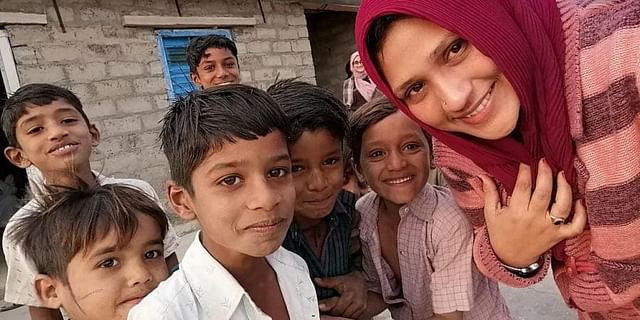
Shahana Nizar with children at Pandhi Ka Par village in Rajasthan
Kozhikode :
The story of 32-year-old Shahana Nizar has a slight similarity to Mudrita, the noted Malayalam novel of 2021 penned by Jisa Jose. Mudrita unfolds through the train trip of nine women who were strangers to each other but got together through an online group. Shahana’s maiden 10-day trip, without the company of her family, to Rajasthan by train concluded on December 30.
The team had 15-members, all women, of whom Shahana had acquaintance with only a single member, Suhaila T, the trip coordinator.
Hailing from a conservative Muslim family of Koyilandy and mother of 10-year old and four-year-old boys, she had many odds against taking such a trip. But finally, she pulled it off. “Till the moment I boarded the train from Kozhikode railway station, I was not sure I would make it. There were so many obstacles. But my passion for travelling self-liberating me besides, the solid support from my spouse made it happen,” beams Shahana.
The group had 16-year old Haniya Haris to 39-year old Kadeeja, who were from Kozhikode and Kannur districts. Resorting to a budget tour, the women used public transport service and stayed mostly in youth hostels and residences of acquaintances in Rajasthan.
“It was difficult for me to travel in train for so many days. I was a person who loathed using public toilets. But during the trip, I had to even spend my period days on the train. Surprisingly, I myself adjusted to all of these due to the sheer pleasure travelling gave me. After reaching home and looking back, I found I had discovered myself, the liberal soul in me who wants to fly farther, recharge and come back,” says Shahana, an English Literature graduate.
“Don’t want to be like mother’
Shahana reminisces that throughout her life, she saw her mother tied up in domestic chores and taking care of kids and her husband at home. “Watching her life, I had taken a strong decision then that I will not be like her. That spark was within me which poured out in the form of musings and scattered lines on Facebook. But there was not an attempt till now. But for my marriage, I think I cannot make a free trip without the ‘care’ of family or relatives. Now, I am brimming with confidence and ready to backpack any moment,” she says.
While Shahana was on tour, her four-year old son was hospitalized for a day but she came to know it after reaching home only as her husband Nizar Mullasserry managed it.
The women team’s travel was not all smooth. They had to run with heavy bags through railway platforms in Ajmer in odd hours and many such hardships. The team roamed around Mount Abu, Jodhpur, Ajmer, Udaipur, Barmer and had spent wonderful days at remote Rajasthani villages like Pandhi Ka Par and Viradka Par.
source: http://www.newindianexpress.com / The New Indian Express / Home> States> Kerala / by Amiya Meethal / Express News Service / January 24th, 2022
Khan achieved the rare feat recently by qualifying for the his second event — giant slalom — a month after booking his first Winter Olympics ticket in alpine skiing slalom category in an Olympic qualifier in Dubai.
Alpine skier Arif Mohammed Khan. (Twitter/jswsports)
Jammu and Kashmir-based alpine skier Arif Mohammed Khan has become the first Indian athlete to qualify for two different events of the Winter Olympics, set to be held in Beijing from February 4, next year.
Khan achieved the rare feat recently by qualifying for his second event — giant slalom — a month after booking his first Winter Olympics ticket in alpine skiing slalom category in an Olympic qualifier in Dubai.
The news was confirmed by his promoter JSW Sports.
JSW-supported Alpine skier Arif Khan, who had earlier earned a provisional quota for the Slalom event at the 2022 Winter Olympics, has now qualified for the Giant Slalom event as well. ??#BetterEveryday ???? #Beijing2022pic.twitter.com/Ua6EfIRJ65
— JSW Sports (@jswsports) December 29, 2021
“JSW-supported Alpine skier Arif Khan who had earlier earned a provisional quota for the slalom event at the 2022 Winter Olympics, has now qualified for the giant slalom event as well.
“For the first time in history, an Indian will be competing in two different events at the Winter Olympics,” JSW Sports wrote in a facebook post on Wednesday night.
While India was represented by two athletes — Jagdish Singh (cross country skiing) and Shiva Keshavan (luge) — in the 2018 Winter Games, Khan is the only person to have qualified for the 2022 Winter Games so far.
Khan is a professional alpine skier from north Kashmir’s Tangmarg and has qualified for giant slalom event at Kolasin, Montenegro recently. He has represented India in more than 100 ski events held across the world and has been undergoing training in Europe for the most part of this year.
source: http://www.indianexpress.com / The Indian Express / Home> Sports / December 30th, 2021
Dr Sharmeen Mushtaq Nizami is a J&K-based philanthropist and adventure trekker who helps cancer patients, widows and orphans. (Waseem Andrabi)
Dr Sharmeen Mushtaq Nizami, a J&K-based philanthropist and adventure trekker, feels that a girl can do big things in life when her parents support her; she has set up a charity trust that helps cancer patients, widows and orphans.
Whatever life throws at Dr Sharmeen Mushtaq Nizami, she takes it as a challenge, overcomes it and moves on. She believes one’s life should be an inspiration for others.
Dr Nizami, in her early 40s, works at a Srinagar hospital and runs a trust for cancer patients besides pursuing her hobby of being an extreme mountain trail motor-sport traveller. Since childhood, she has pursued her passion whether it was studying medicine in the 1990s when militancy was at its peak in Jammu and Kashmir or her love for jeeps.
Her biggest challenge in life came when her husband was diagnosed with cancer and died in 2007 within six years of their marriage, leaving her to bring up their two children, a three-year-old son and a year-old daughter.
“It was a traumatic phase. I struggled but my parents supported me. Initially, being a single parent appeared tough but gradually I came to terms with reality,” she says.
As time went by, she decided not to remarry and moved back to her ancestral home in Srinagar from her husband’s house in Jammu.
Dr Nizami, who is now the medical officer in-charge at a Srinagar hospital and on Covid duties, says that her experience during her husband’s illness pushed her towards helping patients and the needy.
“Though we were relatively well off, we had to go outside for treatment as he was suffering from pancreatic cancer. We realised that the treatment is expensive and drains most families’ savings,” she says.
Even before her husband’s death, she would collect money from attendants using charity boxes outside OPDs. Later, friends and colleagues asked her to setup a trust with a separate account where people could donate money. “We get a lot of donations during Ramazan, which are primarily used to help cancer patients and those needing a kidney transplant. The trust also helps widows and orphans who have no source of income,” she says.
Nizami, the eldest of four siblings, says that her parents Mushtaq Nizami, a military contractor, and Shahida Parveen, a homemaker, have been her strength. “Any girl can do big things in life when her parents support her,” she says.
Ask her what got her interested in jeeps, and she says, “I have imbibed my father’s passion for driving jeeps. In 2018, I came upon some videos of the Kashmir off-road club which organises competitive events and overland expeditions, and decided to participate in a snow-race event (Frozen Rush) at Gulmarg.”
Nizami, who always wears a hijab, was the only woman to participate in the adventure sport and created quite a buzz on social media. “I hadn’t realised that I was breaking stereotypes , until I saw people’s reactions,” says Nizami, who has since participated in dangerous events like mud race and river crossing.
“Some people tried to dissuade me saying it was risky, but I remained unafraid,” says Nizami, adding that she gets a lot of messages from young girls who admire her.
She says her faith in the Almighty has never wavered despite the many challenges in her life. “Not just driving, but life in general throws a lot of challenges at us. We have to accept the challenges and move forward,” she says.
source: http://www.hindustantimes.com / Hindustan Times / Home> Cities> Others / by Ashiq Hussain, Srinagar / September 16th, 2021
The story of what used to be Bengal’s highest seat of power and of some who braved the ascent
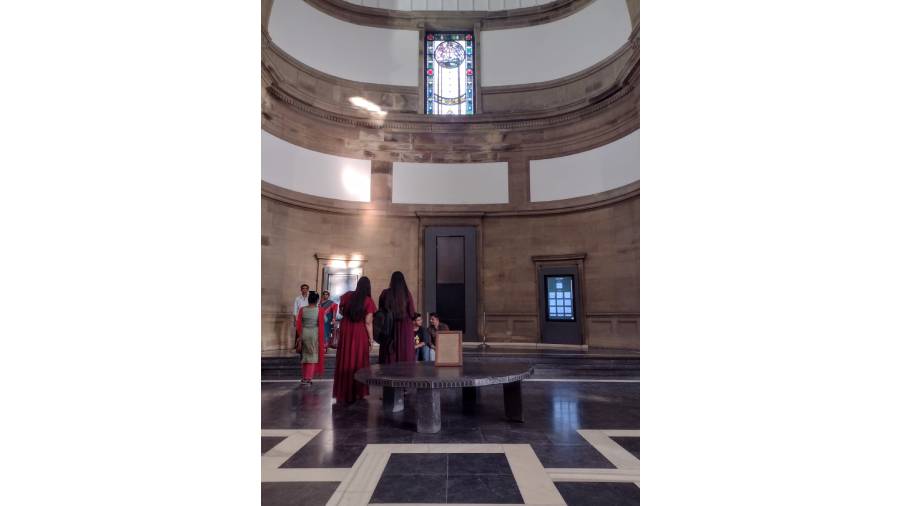
SOVEREIGN STONE : The throne of the Subedars of Bengal (in the foreground) at Victoria Memorial Hall in Calcutta / Paromita Sen
In the circular throne room of Hazarduari, or the palace of a thousand doors, in Murshidabad sits a solid silver chair on a marble platform whose fretwork shows signs of having once been gilded. That intricately carved chair, shaded by an intricately worked silver umbrella, used to be the seat of the nawabs of Bengal.
The maroon velvet cushioned throne, no bigger than a dining chair, might make one wonder how comfortable Siraj ud-Daulah would have been seated on it — after all, it is believed he was nearly seven-feet tall. It most definitely could not have been shared by two as was the black stone throne of Bengal.
In 1766, Robert Clive shared the black stone throne with Najm ud Dowla, second son of Mir Jafar. The East India Company had been granted the dewani of Subah Bangla by the then Mughal emperor. “Clive, as a representative of the company, sat on the throne because he had the right to collect revenue, while the Nawab had the right to dispense justice,” explains Santanu Biswas, amateur historian and Murshidabad resident.
Should you wonder into the Durbar Hall of Calcutta’s Victoria Memorial, you will find a low black table. You might be tempted to put your feet up on it — it is that inconspicuous. But that is it — the erstwhile musnud or throne of Subah Bangla. The throne that was once Shah Shuja’s, son of Shah Jahan; Murshid Quli Khan’s, after whom Murshidabad is named; Alivardi Khan’s, who stopped the Bargi attacks; Siraj ud-Daulah’s, the last independent Nawab of Bengal; the infamous Mir Jafar’s and Clive’s.
The throne is not round but 16-sided; each facet has a simple design inscribed and one of them bears a Persian inscription that declares it was made by “humblest of slaves, Khwajah Nazar of Bokhara” in Munger, Bihar, on November 11, 1641.
How did someone from Bukhara in Uzbekistan end up in Munger? Says Jayanta Sengupta, secretary and curator of Victoria Memorial Hall, “The Mughals were originally from that region. A lot of people came with them. Some kept the place of their origin as part of their name even after having lived in India for generations. It had prestige value.” So, Nazar may never have seen Bukhara.
Back to the musnud. The 18-inch-high platform, six-feet in diameter and sitting on four fat legs, is carved from a single block of black slate from the Kharkpur or Kharagpur Hills. A framed write-up at the memorial states that the throne must have belonged to Sultan Shuja and had originally been kept at Rajmahal (in what is now Jharkhand) before being moved to Dhaka and then Murshidabad (by Murshid Quli Khan) as the capital of Subah Bangla changed.
In Murshidabad too, the throne often changed residence. Mir Jafar, for instance, was enthroned in his palace in Mansurganj, on the western bank of the Bhagirathi, while Clive was enthroned in Motijheel Palace on the eastern bank. It seemed to be the practice for the throne to be moved to wherever the Nawab resided.
The throne is an austere structure. “In India it was always a takht or platform,” says Urvi Mukhopadhyay, associate professor at West Bengal State University. The chair-like throne is a European concept and came later. According to Mukhopadhyay, who is a medieval history expert, the king would always kneel on the throne as it was rude to display his feet.
The throne itself was not made of valuable material, its value derived from the post of the man who sat on it. Says Mukhopadhyay, “It was usually made of stone. You can still see Shah Jahan’s marble throne at the Red Fort, though guides are likely to tell you that it is a platform on which the throne was placed.” There was also a beautifully-embroidered chandoya or canopy over the throne and a richly embroidered screen behind it. The musnud of Murshidabad had four holes in four corners through which the poles that held the canopy were set.
The only readily-available photograph of the black stone musnud shows it in its unadorned state on the terrace before the Moti Mahal of Murshidabad’s Mubarak Manzil. This area was once called Findallbagh after the Briton who developed it.
Mubarak Ali Khan II, better known as Humayun Jah, was the great great grandson of Mir Jafar and the man who built Hazarduari. He bought Findallbagh in 1830 and built the Moti Mahal and the pleasure garden around it that he named Mubarak Manzil. He gave the throne of the Nawab Nazims of Bengal pride of place, but he held court in Hazarduari, on the silver throne that is called the chair of judgement of Humayun Jah.
In The Musnud of Murshidabad (1905), Purna Chandra Majumdar writes, “Drops of reddish liquid issue from certain parts of the stone which when dried up leaves stains, perhaps due to the presence of iron. These are, however, popularly regarded as tears which have flowed ever since the Subadars of Bengal handed the dewani over to the East India Company.”
At the height of their power the nawabs of Bengal sat on a simple platform of black stone, but when they turned puppets of the British their chair of power was solid silver. Perhaps there is a lesson in there somewhere.
source: http://www.telegraphindia.com / The Telegraph Online / Home> Culture / by Paromita Sen / November 28th, 2021
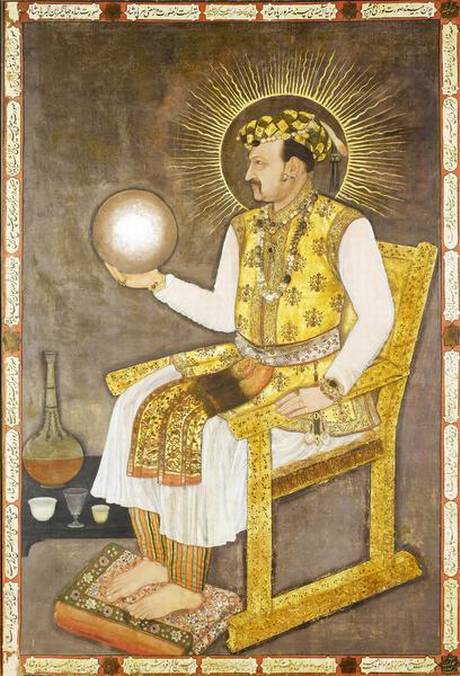
Emperor Jahangir’s inquisitive mind is revealed in his conversations with Mutribi al-Asamm Samarqandi
The 18 decades of the Great Mughals (1526-1707) produced some first-rate literature.
Many fine books came from the rulers themselves, steeped in a tradition of high culture that required them to be literate. The Baburnama, the first memoir/ autobiography of the subcontinent, is as readable today and as modestly written as Julius Caesar’s books (Cicero said of Caesar’s prose that it is unadorned, like a classical statue). The Tuzuk of Jahangir is filled with bombast, vanity and anger, but it is so honest and has so much detail, particularly on the side of his interests as a naturalist, that it is a work of the highest order.
And then there are the works that are smaller but sparkling, like little jewels. One such is the life of Humayun by his sister, Babur’s daughter and Akbar’s aunt, Gulbadan Begum. Written in Persian, as opposed to the Chagatai Turk that Babur wrote in, it is clear and direct, and as thorough a portrayal of Babur and Humayun as what they produced themselves. The story we know of Babur circumambulating the bed of a very ill Humayun and asking, in pagan fashion, to be taken instead of him, is from her book.
Courtly manners
The work we are looking at this time is from a lesser noble, a traveller from Samarqand called Mutribi al-Asamm, who spent time in Jahangir’s court. It is available in translation as Conversations with Emperor Jahangir. The Mughals loved having people over from their ancestral lands, which they would never see again, and lavished them with gifts and honours. Mutribi came to India (Jahangir was based in Lahore) roughly 400 years ago in 1627, when he was 70 and the emperor 58, only a few months away from his death.
Mutribi’s writing reveals a lot about the flowery manner of the court. He visits Jahangir a month after arriving in India and the emperor asks why he has waited this long. Mutribi refers to himself in the text as the “incompetent narrator” and Jahangir as possessing “a tongue of pearls”. At that first meeting, Jahangir gives him a thousand rupees and Noor Jahan (“may her chastity be preserved”) another five hundred, possibly the equivalent of crores in our time.
At their next meeting, Jahangir inquires about the hue of the black stone from which his ancestor Timur’s sepulchre is made in Samarqand. The emperor produces stones which Mutribi compares unfavourably to the original (“it is so bright you can see your face in it”).
Lord bountiful
The transactional manner of the exchanges is apparent from another meeting in which Jahangir asks Mutribi which of the Iraqi thoroughbred horses on display he would like to be given. Mutribi says, “whichever is more expensive,” possibly to make the emperor feel that he is being generous rather than his supplicant greedy. Again, when Jahangir offers him a choice of saddle — velvet or broadcloth — the answer is velvet, because it is more expensive. Jahangir says velvet gets wet easily, to which Mutribi says that the monsoon is far off. The two meet 24 times in two months before Mutribi returns. Towards the end, the following conversation is held:
“The pleasantness of Samarqand was being discussed. The Emperor asked me, ‘Is Samarqand spelled with a ‘q’ or with a ‘k’?’
‘Either way is correct,’ I replied. ‘In Tabari’s history and several other books it is referred to as Samarkand, but in popular usage it has become known as Samarqand. Some say that the name comes from Samar and Qamar, two slaves of Alexander the Great who built the city which was then named for them. Their graves are situated in the main market square of Samarqand.”’
Then Jahangir inquires about an ancestral tomb, asking how much it requires to be maintained. ‘“If you want to do it properly, 10,000 rupees,’ I [Mutribi] said, ‘otherwise 5,000 rupees just to keep it going.’
‘If 10,000 rupees will maintain it,’ he said, ‘then we have decided that in accordance with your information we will send 10,000 rupees, in order that that blessed station be maintained.’
I said, ‘O God, as long as the Sun and the Moon shall be, may Jahangir son of Akbar remain King.’”
Aakar Patel is a columnist and translator of Urdu and Gujarati non-fiction works.
source: http://www.thehindu.com / The Hindu / Home> Books / by Aakar Patel / November 13th, 2021