Category Archives: Travel & Tourism

The merchant who bought a mosque

NEW DELHI :

Chunnamal Haveli carries many fascinating tales about the change in lifestyle and architecture of Delhi after 1857

Chunnamal Haveli carries many fascinating tales about the change in lifestyle and architecture of Delhi after 1857

The redone arterial road of Shahjahanabad has attracted attention towards conserving the historical architectural facades of several buildings along the stretch that connects Sri Digambar Lal Jain Mandir to Fatehpuri Masjid.

Along with the facades of heritage homes, there is an urgent need to conserve family and lifestyle histories as part of intangible heritage. In this regard, Lala Chunnamal, the largest living mansion on the iconic street, illustrates a fascinating account.

The Chandni Chowk and surrounding lanes and by-lanes represent, along with several other layers, the lifestyles of the landed elites, merchant classes and evolving middle-class professionals. Several mansions reflect the Mughal period and the British rule in Delhi. Many of these families aligned with the Mughals for practical reasons and changed their allegiance to the new British masters, impacting the nature of lifestyles and architecture.

‘Lalacracy’ era

The period and predominance of merchants and the new landed class in different cities have been described as ‘Lalacracy’ by eminent historian Narayani Gupta in Delhi Between Two Empires 1803-1931: Society, Government and Urban Growth.

Built in 1864, the Chunnamal Haveli continues to be used by Lala’s sixth-generation descendant Anil Pershad and his family. A successful trader, Chunnamal was primarily a cloth merchant (indicative of the exact location of the house in Katra Neel) and had significant trade links in Kolkata, and a summer home in Shimla.

Soon after 1857, Lala Chunnamal bought a large part of the present-day Chandni Chowk and the Fatehpuri Masjid in an auction for a pittance. “Most mosques were closed for a couple of years after the rebellion; many Muslims fled the city. My grandfather, a practical businessman, watched out for the shops around the mosque. The family-owned shops built Shivalayas, dharamshalas and drinking water kiosks in Shahjahanabad, Mehrauli, Nangloi, etc. So why could he not manage a mosque,” remarks Pershad.

He says the family owned the shops from the erstwhile Majestic cinema to the Baptist Church and the area behind the present Bhagirath Palace. “After some years, the family returned the Fatehpuri mosque to the Muslim community. The British recognised the gesture and gave us some villages as a gift,” adds Pershad.

Unlike many others, knowingly or inadvertently, the Chunnamal family saved a mosque from being demolished or turned into a bakery shop or a garrison for the armed forces when the British took over after the First War of Independence.

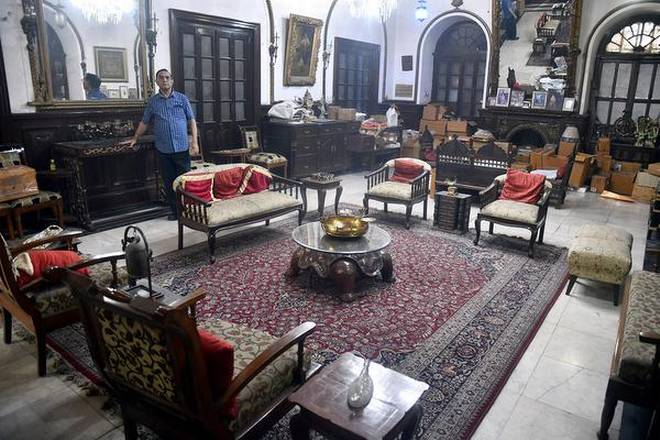
The grand mansion integrated sturdy cast-iron balconies and spun spiral staircases, wooden Venetian windows, and used stained glass. The interiors characterise Indo-Western aesthetics decor like the famed Osler glassware chandeliers for candles, Belgian mirrors, European furniture, clocks, telephones, fireplaces, and even maintenance tools for the fireplace. Sophisticated crafts to embellish the interiors include clay tiles from Sindh that provide a carpet look. The gold-plated stucco work in the ceiling is offset with natural indigo. The roof is decorated with ceiling cloth that displays the best of Indian crafts.

Ice emerged as a much-wanted product since the British required it to cool their drinks and water. Chunnamal owned the famous Baraf Khana or the ice-making unit in North Delhi, the Old Subzi Mandi and Pul Bangash. “Twice-elected to the Municipal Corporation, he was one of the few Indians who were granted membership of the exclusive Delhi Gymkhana Club during the British days,” remembers Pershad. He was also a member of the Roshanara Club, Delhi Race Club and the National Sports Club.

High life

The Chunnamal family bred horses, some were housed in their home stables, while others were in the Delhi Race Club. Members of the family rode horses from Chandni Chowk to New Delhi. A special place for the family was their Rambagh Garden near the Roshanara Club. Viceroys visited, Indira Gandhi came to dine, and the family participated in horse races, including winning the Aminabad horseshow in Lucknow. Some members of the family even came to be members of the secret society of the Freemasons, who continued to meet in the Qudsia Bagh in Civil Lines.

The courtyard hosted gatherings of courtesans, which women of the family watched from behind the bamboo curtains. Pershad’s daughter-in-law Swetcha Pershad described how female service providers like washerwomen and barbers transmitted ‘news’ from one zenana or women quarters to other havelis. The hustle-bustle of the home saw the women under the guidance of a Parsi governess acquire skills in cooking western dishes, accessing recipes from the Woman & Home magazine launched in the 1920s.

Organisations like the UNESCO and urban governments in different parts of the world attempt to formulate policies to balance development with preserving historic urban landscapes. They involve stakeholders, incentivise owners of heritage homes to retain facades while making the inside of dwellings modern.

The remaking of the Chandni Chowk requires holistic policies and their execution before many of more than 30 private-public owned heritage buildings are replaced by buildings that do not go with the character of the historical landscape.

(The author is an expert on cultural heritage)

source: http://www.thehindu.com / The Hindu / Home> News> Cities / by Navina Jafa / October 10th, 2021

Rejimol: The Muslim woman who is a role model in Kerala’s Kannur

Kannur District, KERALA :

Rejimol, 46, is known as “Thatha”, or elder sister, by everyone in and around her hometown

Thiruvananthapuram: 

A burqa-clad, highly-religious woman in Kerala’s Kannur district has become a role model for women and youngsters for her entrepreneurial spirit and philanthropic activities.

Rejimol, 46, is known as “Thatha”, or elder sister, by everyone in and around her hometown. She is not a teacher, doctor, advocate, or social worker, but exemplifies courage, determination, and a kind heart while being owner – and worker – of a private bus service.

She, and her husband Mohammed, bought a bus for plying in Kannur, and while several people joined as attendants, all used to leave after serving for one or two months. This led to the determined Rejimol taking up the job by herself, while her husband became the driver and her son, Ajuwad who has completed his plus 2, the conductor for collecting money.

In Kerala, private buses have an attendant who rings the bell after people enter and exit at their respective stops. It has been a male bastion, as the job also involves cleaning the bus after the daily trips as well as changing tyres as and when they puncture, as also guiding the driver while overtaking a vehicle or when negotiating a curve.

All these jobs are now taken up solely by Rejimol, who has become a role model for women and youngsters alike by the determination, grit, and love for the job that she had shown.

“This is a job like any other job and when people first found a burqa-clad woman entering a male bastion, they were surprised. Some were laughing and I asked them whether they were insulting me, they said no and that they were just surprised and were full of respect and admiration for me. This made me carry on and I now have the courage and strength to face the society and life during any upside or downside,” Rejimol told IANS.

She said that life has been tough during Covid-19 times but in all, her life has been good and she used to save money for her pilgrimages to Makkah, and has done the Hajj as also the Umrah.

She said that daily she saves a portion of her income to be distributed to orphanages, adding that she was also supporting two orphanages. Rejimol also said that she intervenes in any social issue at her neighbourhood and also helps people as much as she can.

She said that she has allowed her daughter to study as much she can before giving her off in marriage.

“Education is important and marriage can come after that,” she maintains.

Her stand is in contrast to the prevailing situation in certain villages of Kerala where Muslim girls are being married off at an early age. However, signs of changes are slowly being seen in the community with more and more Muslim girls studying hard and coming up in academics and entering prestigious institutions like AIIMS, IITs and even qualifying for Civil services. However, there is still a trend of marrying off the girls at a tender age and Rejimol is strongly opposed to this.

Rejimol’s daughter, Ajinas A.M. is a PhD scholar doing her research in political science at the prestigious Karyavattam Campus of Kerala University. She did her Masters in political science from Central University of Puducherry.

The highly-determined woman entrepreneur maintains:

“Life is woven around love and without love and mutual help, nobody can survive and my policy is to love everyone and support everyone in whatever means we can. Women must be hard-working and not sit idle at home but chip in for the support of the family.”

source: http://www.ummid.com / Ummid.com / Home> India> Life & Style / by IANS / September 05th, 2021

Anjum Parwez appointed BMRCL managing director

Bengaluru, KARNATAKA :

He has been transferred from the Transport Department

The State government, on Wednesday, appointed senior IAS officer Anjum Parwez as the new Managing Director of the Bangalore Metro Rail Corporation Ltd. (BMRCL).

Mr. Parwez will relieve Rakesh Singh who has been holding the post as concurrent charge for over three months. Mr Parwez is a principal secretary ranking officer and is transferred from the Transport Department. He told The Hindu that expediting the ongoing phase II Namma Metro project will be his priority.

Challenges ahead

The new MD has various challenges before him including the timely execution of the metro tunnel network between Dairy Circle and Nagawara which has faced several hurdles in the past, resumption of metro work between Kalena Agrahara and Swagath Cross Road that was stalled and expediting much delayed 58-km Outer Ring Road – Airport metro line to Kempegowda International Airport (KIA).

“After taking the charge, I will study the developments in the Namma Metro project and measures will be taken to expedite the ongoing projects. Focus will also be given to integrating various modes of public transport in the city, thereby shifting people using private modes of transport to public transport,” he said.

With BMTC

Mr. Parwez, a 1994 batch IAS officer, has also worked as the MD of the Bangalore Metropolitan Road Transport Corporation (BMTC).

Senior IAS officer Rajender Kumar Kataria has been placed in concurrent charge of principal secretary of the Transport Department, the post that fell vacant after Mr. Parwez’ transfer.

source: http://www.thehindu.com / The Hindu / Home> News> Cities> Bengaluru / by Special Correspondent / Bengaluru – July 15th, 2021

From Kerala to Kashmir: A young woman’s solo adventure

SAUDI ARABIA / Kozhikode, KERALA :

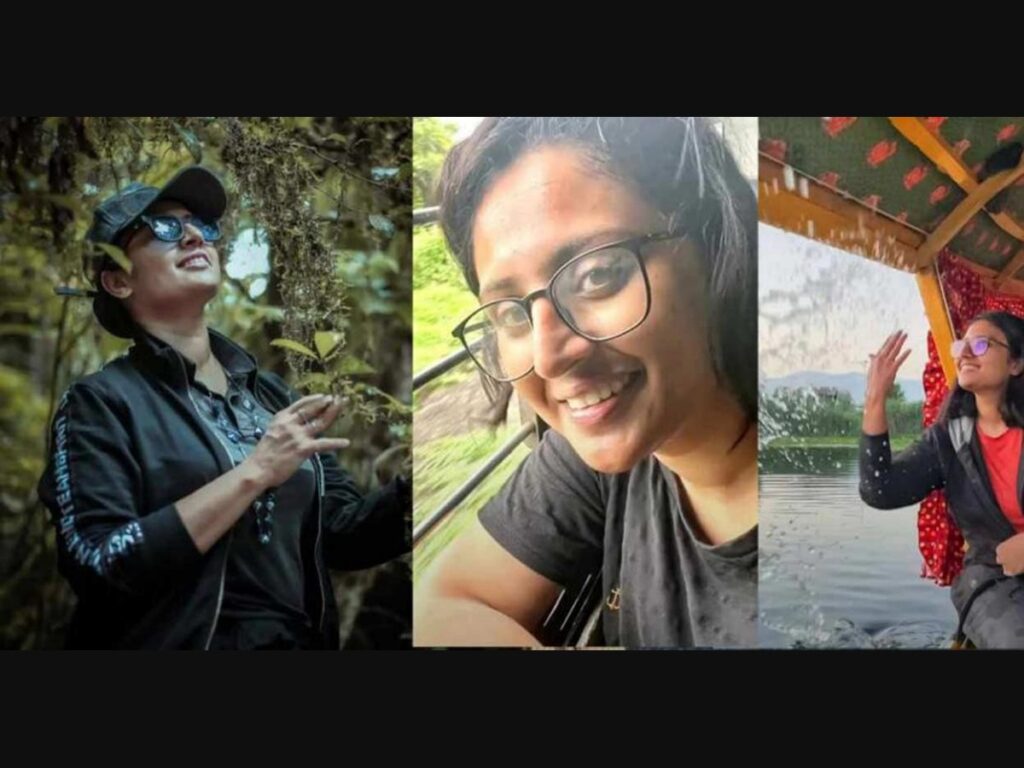
She was not allowed to go on school trips. There was a reason behind it though. She had a habit of wetting her bed at night. Since then she wanted to travel, savour in the free-spiritedness of exploring the world alone. And Amish Mushabir has come back after embarking on a solo trip to Kashmir.

This entrepreneur and mother of two kids took to Kashmir without any prior planning on a stringent budget. She savoured the snow-capped mountains, luminous lakes, and the gorgeous gardens before heading back.

Love for travelling is hereditary

Amis is Tirur Kainakkara Mohammed Ibrahim’s second daughter. Till the age of 40, Ibrahim travelled travelled the world. He came back and married at the age of 40. Her mother hails from Kozhikode. Five years ago he passed away. Amis has inherited his love for travelling.

Amis after finishing her MBA got married at the age of 21 and settled in Saudi Arabia. She worked in an American Company in Saudi for 10 years. Her husband Mubashir, who works as an HR Manager in a Saudi company is aware of her wanderlust.

From Saudi to home

There was a restriction for women to drive alone in Saudi. But Amis would take time off to travel despite the restrictions at GCC.

Two years ago, she came back to India. She had two things planned- a place to pursue her psychology and another to take up her love for travelling. Through a vlog called Travel Badaais, she hoped to chronicle her solo travels. But lockdown put a lid on her plans. Earlier she would book the best of resorts, chart route maps to ensure safety before getting ready to travel. But this time she decided to dodge such safety measures and travel like a common man.

Heaven on earth

So Amis decides to travel to Kashmir without any prior plans. From Kerala, she reached Delhi by train. The plan was to reach Srinagar from Delhi by road. But they weren’t allowing tourists to take the road to Srinagar. That’s why she decided to take a flight to Srinagar. From Srinagar, she hired a scooter and scouted the length and breadth of Kashmir. While travelling to Gulmarg and Pahalgam, she would meet villagers on the way and uploaded them in her vlog. In 8 days she covered 800 km. She would make do with the offered food and lodging and explore Kashmir. No wonder it turned out to be one of the most memorable days of her life.

A few unusual places to see in Kashmir

Kokernag: Which translates as “Hen shaped springs” is 80 km from Srinagar and 25 km from Anantnag and is situated 7,000 feet above the sea level. You can see a collection of freshwater springs, which is also the largest freshwater spring of Kashmir. Trout fishing is hugely popular in this part of the world, and they are even sold to tourists. It’s also famous for Namdah, handicrafts, Gabbah carpet and shawl weaving. You can also catch several places of worship like Hazrat Baba Reshi, Shilagram Temple, Goswami Gund Ashram, Hanuman Temple, Sita Temple, Nila Nag, Ganesh Temple, and Shiva Temple.

Daksum valley: This valley is located in Bhringi River which is ahead of the Mughal Gardens of Achabal. It offers something for everyone—stunning scenery, mountains, picnic spots, plenty of romantic getaways, cone-bearing forests; hidden grassy meadows and snowy mountains. You can see the beauty of natural springs and embrace the lifestyle of traditional villages. It is also a perfect place for camping and trekking. The path that leads to the Simthan Pass is exquisite so are the wooden slopes on either side of Daksum which are covered with grass coating. It’s also a great place for trout fishing.

Gurez: This high-altitude Himalayan village is perched at a height of around 2400m and is 86km from Bandipore and 123km from Srinagar. The valley is encircled by snow-coated mountains and presents a spectacular view of the Kishanganga River flowing through the valley. It’s considered as one of the most amazing places to visit in Kashmir as this valley gives shelter to a small number of exotic wildlife including snow leopard and brown bear. Due to heavy snowfall, Gurez is cut away from the world from November to May. By this time Razdan Pass will be completely snowed out. The tourism department of Kashmir provides Gurez Helicopter services for tourists to promote tourism. Trekking can be dangerous due to its close proximity to the border. However, the scenic landscapes, the beautiful green turf on the woodlands, fishing in Kishen Ganga River, Potato and maize fields posses distinctive charms of their own. Endless forests cling from the bottom of the valley to the peaks; mesmerizing beauty of the Habba Khatoon Peak offers a blissful experience to the tourists. It is difficult to describe the colours of Gurez valley without visiting it once in life.

Tulail Valley: Adding Tulail Valley to your Kashmir Tour list is a great idea. In fact, it can be covered on the same day trip from Gurez as it is a Himalayan sub–valley of Gurez. The road to Tulail from Gurez passes through the scenic landscapes of the Kishanganga River. En route, you will cross the villages of Barnai, Chakwali, Kashpat, Zargai and finally, you can get to see the Purani Tulail Village. The scenic landscapes are a visual treat to your senses. The virgin valley which keeps flourishing in summer is ideal for Instagramming. Again, you can find a lot of freshwater trout here. The green mountains and the flower meadows add a special beauty to this valley. You need a permit to enter the Tulail region from Dawar Police Station. As the village is on the LOC, it is compulsory to seek a series of permissions from Army Camps and SP of this area.

Bangus Valley: This hidden gem is located in the north of Kashmir in the Kupwara district and lies within the Handwara sub-district. The valley is positioned close to the line of control between India and Pakistan and has some really interesting ecological areas surrounded by green grasslands,, meadows, and springs. It is even proposed to be a biological reserve as it produces a fine quality of grass for cattle which also has a medicinal value. Try the spring and summer seasons (April to June) as the weather is pleasant and even monsoon months (July to September) are favourable.

Poonch: Undoubtedly one of the most beautiful places in Kashmir, you can see lush green meadows, snow-capped mountains and the eighteenth century Poonch Fort which is spectacular to say the least. The seven lakes of Girgan Dhok have to be in your itinerary, alongside many religious shrines like Baksh Sahib and Gurudwara Nangali Sahib.

Jama Masjid: This mosque, situated in Nowhatta is considered a pivotal one in Srinagar. This was constructed by Sultan Sikandar during the 1400 AD and was expanded by Sikandar’s son, Zain-ul-Abidin. You’ll find 370 wooden pillars in this mosque and a mesmerizing courtyard – both of them are considered to be the major highlights of this mosque.

Aru Valley: Aru Valley, put together against the snow-clad peaks of the Himalayas is only 12 km from Pahalgam. The valley serves as a base camp for several treks and lakes including Tarsar Lake and Kolhoi glacier. It is also home to the Aru River which is a tributary of the Lidder River. Apart its scenery, you can also try horse riding and hiking. During the winter months, the view of the whole valley covered with snow is a comfort to the eyes.

Amis will be the guide

That’s her dream! A travel institution along with her training academy. She wants to organize travel vacations for single and group tourists. Thankfully, both her children (Faila and Faas) enjoy travelling. Her next plan is a trip with her daughter.  

source: http://www.onmanorama.com / OnManorama / Home> Travel / by V Mithran / July 08th, 2021

Column | Exploring Kerala’s links with Yemen

KERALA :

Representational image: Pikoso.kz/Shutterstock.

Forgotten amidst waves of bad news, including geopolitical conflicts, environmental disasters and the global pandemic, is the humanitarian crisis caused by a civil war that began in 2014 in the fabled country of Yemen. For several centuries, the southern Arab country was a bridge between Kerala and lands to the west such as West Asia, Africa and Europe.

It was enterprising merchants from modern-day Yemen who began to make use of the monsoon winds to come to Muziris. The word monsoon comes from the Arabic mawsim, which means season. These businessmen lived a pretty globalised lifestyle by splitting their time between the Malabar Coast and southern Arabia at a time when there were no identity cards, passports, visas or even a concept of a nation-state. Some of these Arabs chose to settle down in the Malabar Coast and marry local women.

In a paper for the Indian History Congress in 1976, noted historian S M Mohamed Koya was able to trace the origins of the Malabar Muslim community.

“Some of these Arabs may have come from Hijaz, Oman and Bahrain. However, they were chiefly businessmen from Yemen and Hadramaut and many .Mappila families, particularly those known as ‘tangal’ families trace their origin to this area,” Mohamed wrote.

Interestingly enough, at the time of their migration to India, these merchants probably spoke Hadramautic, a language that belongs to the Old South Arabian subgroup of Semitic. “A large number of Mappila families find their origin in the interior Hadramaut town of Tarim, a wealthy town dominated by Sayyids which was once the intellectual and religious centre of Hadramaut,” Mohamed, who was a professor at the University of Calicut for decades, added.

In the paper, Mohamed stressed the fact that the traders started coming to India well before the advent of Islam, but their presence and established relations with the people of Malabar helped spread the religion in Kerala. “As pre-Islamic traders, the Arabs provided a friendly situation that facilitated the introduction of Islam and as Muslims, they introduced the faith,” he wrote.

Ponnani’s Makhdum family

Ponnani, a historic town that was once a major trading port, is also linked to Yemen. The town, at the peak of its glory, was home to the revered Makhdum family of Islamic theologians. Under Zain-ud-Din Makhdum and his grandson Zain ud-Din Makhdum II, Ponnani became a major centre of Islamic studies and is believed to have attracted students from Java, Sumatra, the Malay Peninsula and Ceylon.

It was also in this coastal town that the Arabi Malayalam or Ponnani script was invented. Since only 28 letters of Arabic orthography were available for 53 phonemes of Malayalam, additional letters established for Persian were used for this script.

Several old Mappila folk songs and works of literature were written in the Ponnani script, which stayed popular among Kerala’s Muslim community until the middle of the 20th century.

It has been on the wane since Indian independence and is taught mainly in a few madrassas in northern Kerala and the Lakshadweep Islands. There is no clear evidence though that this script has a Yemeni connection, but it was the script of choice for the Makdhum theologians.

This brilliant article by Kozhikode-based journalist Nijeesh Narayanan provides insights into the script, which is now in serious peril.

Zain ud-Din Makhdum II’s Tuhfat Ul Mujahideen chronicles the struggles between the people of the Malabar Coast and the colonial Portuguese. The book, originally written in the Ponnani script, describes the fierce resistance put up by the Kunjali Marakkar’s navy along with the Zamorin of Calicut against the Portuguese.

Culinary and cultural impact

There is little doubt that Yemeni elements have given an extra layer of depth to Kerala cuisine. Meen Pathiri and Irachi Pathiri are the results of Malayali and southern Arabic cuisine coming together.

Another dish that found its way from Hadraumat in Yemen to Kerala is Mandi or the famous Malabar Biriyani. Interestingly enough, the Yemeni version of the dish is usually made with chicken or lamb, and not with beef. If the Yemenis did bring Saltah, their delectable stew and the national dish, to Kerala, it did not manage to survive in its original form in the state, although many Malabari families have their own variations with different names.

Professor Mohamed in his paper wrote about how the mingling of the Yemeni immigrants with Malayalis has enriched the society of Kerala. He wrote, “Culturally the Malayalis were as far removed from the Arabs as the high topical scenery of Kerala is removed from the austere landscape of Arabia. But once wedded, the offspring of that union, the Mappilas have remained loyal to both parents.”

Before Yemen slipped into its latest civil war, there was a small and vibrant Malayali community in the country. One can only hope that the geopolitical puppet masters that have brought so much misery to the country allow it to once again live in peace. It is only when peace returns to the country that its millennia-old links to Kerala can be traced and re-established.

(The writer is the author of ‘Globetrotting for Love and Other Stories from Sakhalin Island’ and ‘A Week in the Life of Svitlana’).

source: http://www.onmanorama.com / OnManorama / Home> Lifestyle> Column / by Ajay Kamalakaran / June 28th, 2021

An Indo-American’s pursuit for vanishing Islamic heritage sites

Toronto, CANADA :

Chennai:

Mr. Siraj Thakor, from Toronto, Canada, has undertaken the monumental task of creating an online database of all the Islamic Heritage Sites of India. He likes to preserve it digitally and make it available to all to cherish the Islamic past of this great country.

Mr. Siraj is looking for volunteers to assist him with the information on Islamic Heritage Sites in India. In response to his call, someone wrote to me with detailed information about a graceful mosque that lies in ruins in the Gaya district of Bihar.

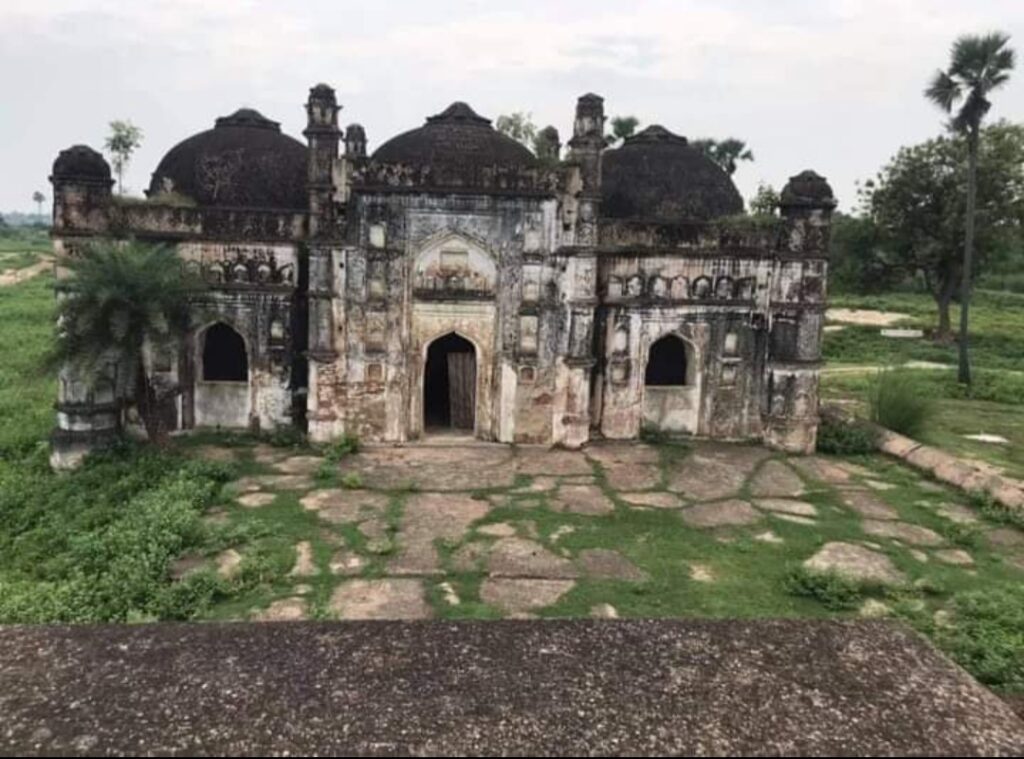
This mosque popularly called ‘Lodi mosque’ was built around 1536 AD during the Lodhi rule in India. It is believed that Sultan Ibrahim Lodi, one of the rulers of the Lodhi dynasty had taken initiatives to get this mosque constructed.

This mosque is about 25 km from Gaya on Gaya-Patna road. It is exactly near Kundwa village at Khijrasarai block in Gaya district. It is situated on the banks of the river Falgu, a kilometer from village Kundwa. On the West of the river is Lodhipur village colloquially called Lodpur, while on the east is Kundwa village.

The mosque becomes functional only during ‘Eid’ and ‘Bakrid’ festival when some Muslims from Kundwa village come to offer prayers in this mosque.

For the rest of the years, this mosque remains a picture of neglect and want for maintenance. There is no Azaan called from this mosque as there is no one to take care of this house of worship. Some people have illegally occupied the land around this mosque but there is none to challenge such encroachments.

This historical mosque comes under the Archaeological Survey of India but neither ASI nor the Bihar government nor the Waqf Board, have any concern in protecting this Islamic heritage site.

It is in this context people like Mr. Siraj Thakor, who is Past President of the American Federation of Muslims of Indian Origin (AFMI), comes into the picture.  He wrote to me:

“Dear Brother Syed Ali Mujtaba, ASAK, I am a Past President of the American Federation of Muslims of Indian Origin (AFMI), We have undertaken the monumental task of creating an online database of all the Islamic Heritage Sites of India to preserve it digitally and make it available to all. I would take this opportunity to request you to be part of our team to collect info on Islamic Heritage Sites in your area. Alternatively, can you put in touch with someone or the organization which would be interested in such a historical task and leaves a legacy for the Indian Muslim generation to come? Wassalaam- Siraj Thakor.”

Mr. Siraj has started an All India campaign to document such historical Islamic heritage sites in ruins. If you have any similar story of any such Islamic heritage site near you, please write to him directly with photographs; (thakorsiraj@hotmail.com. You can even contact him on ‘WhatsApp’ -+1 416-277-7082.

This is a huge initiative and the efforts of people like Mr. Siraj needs to be strengthened by giving him a helping hand. Anyone, anyone where in the country who feels concerned about vanishing  Islamic Heritage Sites in India must come forward and join his team.

 Maiñ akelā hī chalā thā jānib-e-manzil magar– log saath aate gae aur kārvāñ bantā gayā –

(Translation: I set off alone towards my goal, but, people came along and it began to turn into a caravan!)

Syed Ali Mujtaba is a journalist based in Chennai. He can be contacted at (syedalimujtaba2007@gmail.com)

source: http://www.muslimmirror.com / Muslim Mirror / Home> Indian Muslim / by Syed Ali Mujtaba / June 19th, 2021

Find out why Aslam TP and Mujeeb Rahman are walking from Kasargod to Kanyakumari

Kasaragod, KERALA :

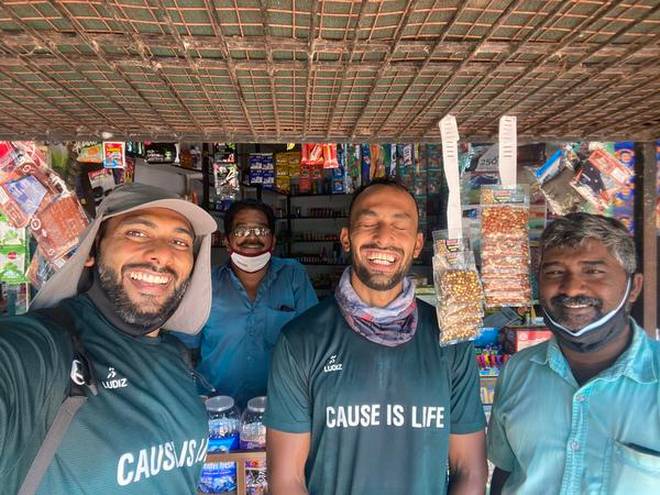
Mujeeb (left) and Aslam share a laugh with locals along the highway   | Photo Credit: Special Arrangement

The two will cover a distance of 600-odd kilometres on foot, to raise money for children’s education

Ambling through the streets of Kozhikode, a visibly tired Aslam TP and his childhood friend Mujeeb Rahman are intercepted by an auto driver.

He wants to know where they are heading, and why they looked so drained. When Aslam tells him about the cause they are trying to raise money for, the auto driver promptly pulls out ₹100 from his pocket and hands it over.

In just seven days of their walk, Aslam and Mujeeb have been met with overwhelming tales of generosity, and as a result, 62% of their target amount (₹7 lakh) has been raised. They are covering a distance of 600-odd kilometres on foot, from Kasargod in Kerala to Kanyakumari in Tamil Nadu, to raise money for children’s education in Kasargod for the Najath Educational and Charitable Society. With the amount raised, they will buy smartphones for online classes. “We walked from Vadakara to Kozhikode on Monday, covering around 49 kilometres, the longest stretch so far,” say Aslam over a call from Kozhikode, Kerala. A serial fund raiser, Aslam took up a similar challenge in Bali last year, where he cycled 397 kilometres to support the education of 45 Balinese children. Currently, he runs a company called Yourfitrip in Bali, which encourages fitness holidays. These include surfing, kayaking, volcano trekking… activities that have helped Aslam stay fit over the years.

He also runs a community called Cause is Life that connects blood donors to receivers. It kept him and his pan-India volunteers busy through the second wave of COVID-19. Just before the lockdown this year, Aslam was in Nagaland, setting up Yourfitrip there, running up hills and walking from one village to another meeting the locals.

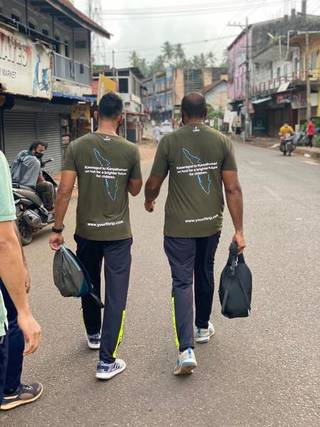
“For this walk, Mujeeb and I trained in Kasargod, our hometown, walking 15 to 18 kilometres everyday. We are training our brain to know that we are good to go, even when we are tired,” he laughs. They prepare a chart, based on which their daily route is fixed. “We average about 30-35 kilometres a day. On somedays, it goes up to 45 to 48.”

They start walking at 6.30am and wind up for the night by 7pm. “In case of emergency, we have a backup car that stays 15 kilometres ahead of us,” he adds. They take the highway, spilling into Tamil Nadu from Nagercoil before heading to Kanyakumari. With everything functional in Kerala and food available for takeaway, things have so far been under control.

Aslam says he will complete the walk in 21 to 23 days. Though planned as a 21-day project, the end date is uncertain as they get enveloped by hospitality from people they come across. So far, the duo has been pleasantly surprised by receptions planned in their honour, invites for meals from strangers, and the willingness of people to contribute even if it means handing over the last penny in their pocket. At one of the villages, a group followed them in a car as they wanted to be part of this mission. “I want people to know that we are collectively strong and can do so many things to give others a better future,” he says as he and Mujeeb stretch, lunge and soldier on, with the rain for company.

For details, check out Aslam’s Instagram handle @aslucha

source: http://www.thehindu.com / The Hindu / Home> Society / by Priyadarshini Paitandy / June 30th, 2021

Mohammed Mubin Mallick: Meet The Man Behind Delivery-Robot That Served Food At COVID 19 Quarantine Center In Beijing

Kolkata, WEST BENGAL / KUWAIT :

Robotsman’ Mohammed Mubin Mallick.

Bengaluru :

When his friends were busy playing with toy guns, Mohammed Mubin Mallick was building robots like a pro.  For Mubin, robotics was a passion that eventually became his profession.

From an amateur innovator to a global leader in robot solutions, 39-year-old Mubin has come a long way to earn a sobriquet of `Robotman’ of India and middle east. A native of Kolkata, he holds MBA degree from Cardiff University, United Kingdom.

Being the school captain, Mubin grew up as an achiever, bagging awards in various recreational activities like sports, dance, speech, etc. He continues to be an achiever even today. Recently, he received Agata Lo Tauro Special International Award 2020 and a certificate for being the Mentor for ROBOCON 2020.

Mubin ventured into digital solutions and robotics solutions with his IT service company `Kiran Smart’. Always on the lookout to cater to the market’s needs, he set out to innovate and take steps beyond what others already offered.

Since the time he realized that he had the power to think out-of-the-box and innovate, Mubin dreamt of building a company that he could run depending on his ideas. The cradle for his innovation comes from very munificent thoughts of wanting to create job opportunities and donating the profits. It is for this reason that Mubin doesn’t want to leave any stone unturned to make his firm a global leading light.

“Our company Kiran Smart is into IT Solutions and Services for the past 15 years. We have been looking for diversification in our business portfolio. We did diversification into Digital Transformation and then recently we launched and started Robotics and Artificial Intelligence. Our market research on Humanoid Service Robots indicated a considerable demand for Robots. Therefore, our company decided to launch a brand Called Mi-Robots,” he said.

The pandemic, however, came as a blessing in disguise for Mubin and his company. “One of our delivery Robots serving food in China in 2019 December to COVID 19 quarantine centre became breaking news around the world. This news around the world helped us gained the trust of the people,” he said.

It was in 2017 that he came across a humanoid robot. He invested time in GITEX technology and ultimately made his passion and childhood dream come true. Understanding the working of robots and offering solutions related to them is Mubin’s only focus now.

“To be very honest, there were many challenges which cannot be listed here. Apparently, the major aspect was the financial crunch. Firstly, it is very crucial to survive in the local market. Secondly, we need smart and loyal team members who can run the company,” he said.

Over the years, Mubin learned both professional and personal lives play a considerable role in making an achiever or a failure. According to him, success in personal lives has a direct and positive impact on professional lives.

“To overcome these challenges, we adopted different strategies like inviting investors locally and globally. Apart from in-house human resources, we tied up with international firms to induct more innovative people to work with us remotely. Finally, our satisfied customers are our revenue. We do the regular follow-ups and technology updates with our customers so that we can fulfill their needs as per their growing needs,” he said.

Mubin is dealing with different kinds of Robots. These include Delivery Robots for restaurant and hotels, Educational Robots for Schools, hospitality Robots for hotels, UVC Disinfection Robots for all, Spray Dry Mist Disinfection Robot, Humidifier Robots for Home and Office, and Robots for children. 

“Robots have played a major role during the pandemic as they helped people tremendously. For example, Disinfection robots are used to disinfect the places and those robots are UVC Lights Robots and Dry Mist Spray Robots. Many robots are used to check the temperature of people. Robots are used in hospitals to carry hand sanitizer, masks, and gloves in hospitals, hotels, shopping malls, restaurants, and many places,” he said.

Even corporates are using to communicate with their remote employees so that managers and team leaders can stay focused on live meetings. “Many universities across the globe have launched courses for Robotics and Machine Learning. There is data supporting the popularity of Robot installation in restaurants, hotels, hospitals, warehouses, home delivery, and schools,” he said.

Headquartered in Kuwait, Mubin’s Robots are going places. From all GCC to Africa, UK, Canada, Mexico and few European countries, Mubin is trying to introduce technology for making the life of the common man easy.

“It is really difficult to define the demand or maximum interest was shown by any specific country in this future technology because most of the countries are working on all the innovative technologies to lead the world. So, according to me, I see South Korea, China, Japan, Singapore, Canada, and UAE from the Middle East. The global market for robots is expected to grow at a compound annual growth rate (CAGR) of around 26 percent to reach just under 210 billion U.S. dollars by 2025,” he said.

His company, `Kiran Smart’, is a reflection of Mubin’s achievements. It has been recognized as the Top Most Robotics Company of 2020. The firm also received awards from the Ministry of Awqaf as the Most Innovative Company. KISR honored Kiran Smart for being their Most Innovative Supporter in Science and Technology for their Children’s Exhibition.

His message for the youth who aspire to reach as far as he has is boosting, “Don’t give up even if you fail. Failure teaches you a lesson and makes you stronger. Accept the reality, believe in yourself, and try again! Caring for humanity and seeing a smile on people’s faces keeps us motivated in life. People should be thankful to God, respectful to their parents, and be humble,” he said.

*The author is a Bengaluru-based freelance journalist.

source: http://www.indiatomorrow.net / India Tomorrow / Home> Education> Featured / by Rashida Bakait / February 10th, 2021

Decoding history cast in stone

Birur town (Kadur taluk-Chikkamagaluru District), KARNATAKA :

It became an abiding interest  while studying Kannada at the pre-university level at Pandit Jawaharlal Nehru Memorial College.

Shivamogga :

To D Ismail, the mastigallu (masti stone) is a fascinating storyteller. It talks about the history and the people as he peers into the inscrutable inscriptions whether it is in Modi lipi or Halegannada (ancient Kannada).

The epigraphist from Birur town in Chikkamagaluru district took a fancy to the knowledge hidden in stones, and is one among a small number of people who can understand ‘Modi lipi’, a cursive script used to write several languages, including Kannada. It is just like English running hand, he says. It became an abiding interest  while studying Kannada at the pre-university level at Pandit Jawaharlal Nehru Memorial College.

Ismail (63) says Modi lipi is a kind of early Kannada writing found from the times of Ashoka to the 18th century, which was used to record events and facts about emperors and their empires. In English, it is termed ‘cacography’, which according to the Kannada dictionary, means ‘illegible handwriting’, seen mostly in ancient stone inscriptions called mastigallu and veeragallu (hero stone).

Ismail is studying stone inscriptions to analyse their contents for anything related to astronomy and is compiling a research paper on the subject ‘Astronomy in Inscriptions’. Other issues that he is studying include natural calamities, music and life events, recorded in inscriptions to understand the culture of people going back to the Cholas, Gangas, Rashtrakutas and others who ruled South India.

The curiosity that drew him to these stones soon became his passion. “I studied various books related to Modi script, and under the guidance of epigraphist Shambhu Lingappa, I visited ancient sites in and around Birur, Kadur and Chikkamagaluru with him. I learned to read inscriptions in Modi script and also in Halegannada. I started reading books written by famous epigraphists like M M Kalburgi, Chidanandamurthy, A V Narasimhamurthy and others.”

Though Ismail could not pursue his education after pre-university, he never missed an opportunity to upgrade his Halegannada-related knowledge. Today, he is a well-known epigraphist who offers guidance to students of Kannada literature researching inscriptions and Halegannada in various universities. He has a rare collection of more than 5,000 books related to epigraphy, Halegannada, mastigallu and veeragallu.

He has written a book titled ‘Madhya Karnatakadalli Beeradevaru’ (still a manuscript) about Beeradevaru, a deity worshipped by the Kuruba community. The book throws light on the community, where they came from, and how they settled in Shivamogga, Chikkamagaluru and Chitradurga districts. He has travelled the length and breadth of these districts to collect information and did a field survey for more than two years.

He suggests that people interested in inscriptions read the book ‘Kannada Lipiya Ugama Mathu Vikasa’ by A V Narasimhamurthy, and ‘Lipi, Lipikara, Lipi Vyavasaya’ by Shettar, for those who want to learn Halegannada.

Ismail is one of the four sons of E M Dastagir Saab and Razia Begum of Birur, who have had a grocery business at M G Circle in Birur town for many decades. Even today, Ismail is the one who opens the grocery shop in the morning and takes care of the business.

He has a rare collection of more than 5,000 books related to epigraphy, Halegannada, mastigallu and veeragallu.

source: http://www.newindianexpress.com / The New Indian Express / Home> States> Karnataka / by Ramachandra V Gunari / Express News Service / June 27th, 2021

Meet Sofia Khan: Covid Warrior of West Bengal

WEST BENGAL :

Kolkata :

The world is in chaos. The pandemic happened when none of us were expecting it. It has been one of the most disastrous and depressing things throughout history. It wasn’t in our plans, but it happened. People have lost their jobs and their loved ones. Moreover, people are losing their will to live. The lower class of society is struggling. They are even lacking the necessities needed to survive. However, the pandemic has given rise to people who have come forward to help poor, needy, and unarmed people to fight the pandemic. These people are the warriors of the nation and Sofia Khan is one such warrior.

Sofia Khan cleared School Service Commission in 2009 and was the topper of her zone as well. Then, she was appointed as a government school teacher. However, she is also a social activist, chairman, and founder of the ‘Sufi Humanity Foundation,’ a no cash or fund transfer NGO. She is a very active participant in the improvement of our society. She has been given the post of secretary in the NGO named ‘Udaan Empowering Women’ in the year 2016 and then in the Rotary Club of Kolkata in 2018. Her performance was remarkable in the two organisations. She then joined the TMC Minority Cell, West Bengal, as a general secretary.

Sofia Khan has organized various literacy awareness campaigns in different states of the country as she is the president of the Sarparast Literacy Awareness Movement in West Bengal. She has also participated in many debates in national media as a panelist from the TMC. She conducted campaigns and rallies for TMC during the 2021 West Bengal elections. She has continuously been a keen supporter of girls, always ready to support and empower them. She helped the girls of the Milli Al-Ameen College for Girls by joining their protest against injustice to the college students. These girls were not being allowed to sit for their exams due to the college’s internal disputes. Sofia fought for them and got them justice.

It’s commendable and worth mentioning how she did not waver from her motive of helping the people even in lockdown. Sofia Khan has helped many people by providing them food amidst the lockdown. She sent back numerous migrant labourers to their native places during the first phase of the lockdown in 2020. This year when second wave was on its peak and people were dying without oxygen she was there to help people across West Bengal with free oxygen cylinders. She later extended the help and converted four cars into free ambulance service with oxygen cylinders for Covid patients.  When the state was hit by a deadly tropical cyclone called the ‘Amphan’, Sofia Khan, along with her team distributed tarpaulins and ration to almost a thousand families. She also showed her support during the Yaas cyclone. She sent relief materials like biscuits, cakes, drinking water containers each of 20 litres, clothes, etc. to the affected families. Her works and contributions have also been recognized by the Sanmarg Hindi daily, Echo of India, Awami News, etc.

Life has been tougher than usual for all of us but that doesn’t stop some of us from being an inspiration to others. While our nation and the world are fighting against the pandemic, it is important that we stay alert and be responsible for each other. We need to support and help those who are unable to survive on their own. Warriors like Sofia Khan do not wait for a chance rather they create the opportunity to help others because they realize that ‘Warriors are not born, but self-made’.

(The author of the article is a freelance journalist).

source: http://www.indiatomorrow.net / India Tomorrow / Home> Featured> National Interest / by Meer Faisal / June 18th, 2021