Category Archives: Travel & Tourism

Spectacular beauty of a serene mausoleum

Hyderabad, TELANGANA :

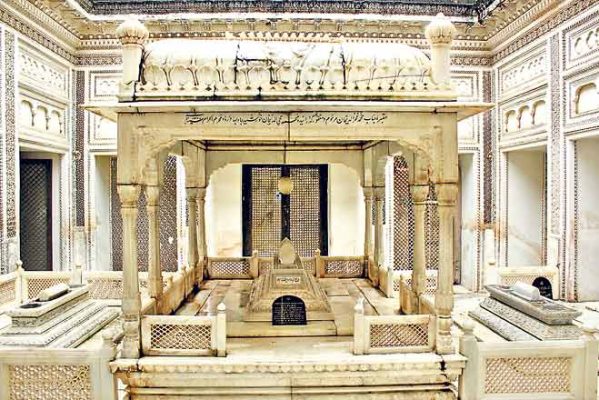
The Paigah Tombs not only symbolise the nobility’s love for magnificient edifices but also represent different styles of architecture.

PaigahTombMPOs26nov2018

Tucked away in the quiet bylanes of the Phisal Banda suburb near Owaisi Hospital, Santosh Nagar, is an architectural marvel, a serene mausoleum which is the final resting abode of erstwhile Hyderabad’s celebrated nobility – The Paigahs. The word Paigah, which means pomp and rank in Persian, was a title given by the second Asaf Jahi Nizam of Hyderabad to the estate of Abul Fateh Khan Taig Jung Bahadur in appreciation of the royal services rendered by him. He was also conferred with the title of Shams-ul-Umra, which gives the tombs their name.

Although the Paigahs were noted and rewarded for their contribution as army officers, ministers and aristocrats, Sir Viqar-ul-Umra is popularly remembered as the man behind one of the finest masterpieces of Hyderabadi architecture – the Falaknuma Palace. Legend has it that the 6th Nizam Mahboob Ali Khan loved the palace so much that Viqar-ul-Umra gifted it to him.

One such masterpiece symbolising the Paigahs’ love for architectural edifices are the Paigah Tombs. The spectacular beauty of the mausoleum is said to have earned it a title of the Taj Mahal of South India among connoisseurs of art and architecture. The Paigah Tombs also include a mosque where prayers are held every day.

The Paigah Tombs were constructed in the late 17th century, and later it was made a family maqbara by his son Fakhruddin Khan Amir-e-Kabir – I. Later, some additions were also made by Sir Viqar-ul-Umra, Sir Asman Jah and Sir Khurshid Jah. The tombs are magnificent structures decorated in stucco work and represented the Mughal, Greek, Persian, Asaf Jahi, Rajasthani and Deccani style of architectures.

PaigahTomb02MPOs26nov2018

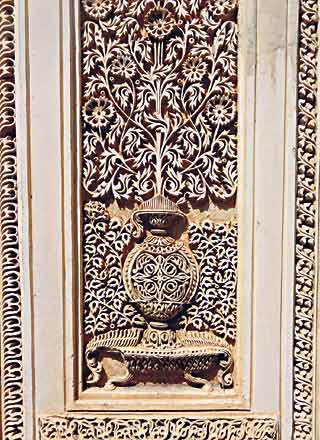
The geometric designs in the Paigah Tombs are unique and the perforated screens are examples of the finest craftsmanship. Some screens have flowers and motifs of fruits; others have serpents, drums, and vases.

There is a great amount of effort put into the detailing of the walls, arches, pillars and even of the graves. Floral and geometric patterns are characteristic of medieval Islamic architecture.

The most striking element of the Paigah Tombs is the intricately carved teakwood doors as entrance to each tomb. The carving of the doors is so fine and so regal it only makes one wonder the way art was encouraged and appreciated in the Asaf Jahi era.

The tomb of wife of Khursheed Jah is the most beautiful of the tombs with exquisite marble inlay work. One can still see the hollows in the marble carvings where precious gems were once encrusted on the grave.

Nawab Bashir-ud-Daulah’s grave stands out with a beautifully carved marble chowkhandi which is adorned by a carved mysterious green stone. Legend has it that the lighting doesn’t strike the place where it is placed.

The Paigah Tombs are under the care of the Department of Archaeology and Museums. As one of the most marvellous symbols of Hyderabad’s rich culture and royal heritage, the Paigah Tombs deserve nothing less than the government’s attention to ensure that it is not just preserved and valued but also promoted and highlighted.

Historian Dr Anand Raj Varma says, “I don’t see much improvement and restoration taking place at the Paigah Tombs; it is in the same state for years now. If you see the entrance, it’s in a very shabby state. There is no significant deterioration but there is also no tourist attraction or promotion of Paigah Tombs either. Most people don’t even know that the Paigah Tombs are located there.”

However, says the historian, the contribution of Rahmatullah, the caretaker of the Paigah Tombs, is appreciable as he keeps it going thanks to his passion and love for the Paigah family and the tombs. “The Tourism Department or the government should take this up as a project. It is the heritage which connects us our past and to our present. It is our treasure, heritage our virasat, and it should be protected,” he adds.

Mohammed Safiullah, managing trustee of The Deccan Heritage Trust, says, “The Paigah Tombs are in desperate need for restoration as the structure is in a dilapidated state and deteriorating. Some places have grown moss all over.  The government should invest in the restoration of the Paigah Tombs because there is a scope of return on investment. Once proper restoration work is done, there will be easily about a 1,000 visitors every day.”

A nominal entry ticket would become a means for generating revenue which would help in future maintenance. Simple things like a cafeteria, a souvenir shop and proper toilets could make it more tourist-friendly.

(The writer is a heritage enthusiast)

source: http://www.telanganatoday.com / Telangana Today / Home> SundayScape> Telangana Diaries / by M D Taher Hussain / November 25th, 2018

Lucknow: Now, ‘water gateway’ to Chattar Manzil unearthed

Lucknow, UTTAR PRADESH :

Slice of history: Nawabs probably used fish-shaped boats for transport in 17th century, says historian.

The ongoing excavation work at Chattar Manzil reached another level on Monday as workers unearthed a ‘water gateway’ leading to this iconic structure.

The UP Rajkiya Nirman Nigam (UPRNN), the construction agency engaged in the restoration of the structure, termed it one of the major discoveries so far.

Officials said workers engaged in the excavation stumbled upon a ‘cylindrical structure’ that was lying buried for years.

On clearing the debris, it was found that the structure made of lakhauri bricks was a tunnel, which connects the over 200-year-old Chattar Manzil to river Gomti, flowing just a few metres away.

“This tunnel is around nine metres beneath the ground,” said Nitin Kohli, the contractor supervising the excavation work.

The task is being performed under the supervision of a high-powered committee comprising Archaeological Survey of India (ASI), Abdul Kalam Technical University (AKTU), State Archaeology Department and officials of the civil engineering department, IIT BHU.

Experts said once they are done with the excavation work, they would explore details like the total length of the tunnel and where it leads to.

Officials said the discovery of the tunnel would unravel another chapter from the history of Chattar Manzil and Kothi Farhatbaksh.

The tunnel would also demystify myths and folklore about the Nawabs using water boats to sail within the palace complex, they added.

However, historians have a different take on this tunnel.

PC Sarkar, a noted historian, said: “The structure seems more of a water gate than a tunnel.”

He said some old timers who have been to Kothi Farhatbaksh (Lakhi Pera), residence of major general Claude Martin, had mentioned the structural uniqueness of the twin structures. “In fact, it is on record that the structures were easily approachable from the northern (river Gomti) side by boat also,” added Sarkar.

“After Nawab Saadat Ali Khan bought the fortress-like structure, it was remodelled into a palace-like structure. However, the river side entrance remained the principal one, with the Nawab adding pavilions in the middle of the river itself,” he said.

He said Gomti was the main channel of transport – the nawabs used barges (boats) of various shapes and sizes, some looking like fishes, crocodiles, for transport in the 17th century. The famous ‘More Pankh’ boats were in vogue during that era, said Sarkar.

He said ‘water gates’ may sound unique now, but they were common in the olden days.

The Lucknow Residency too had a ‘water gate’. But it became defunct when Gomti changed its course and more means of road transport came up, he said.

source: http://www.hindustantimes.com / Hindustan Times / Home> Lucknow / by Oliver Fredrick, Hindustan Times,Lucknow / November 20th, 2018

A common man’s labor of love: A mini-Taj Mahal for his beloved wife

Kaser Kalan (Bulandshahr District) , UTTAR PRADESH :

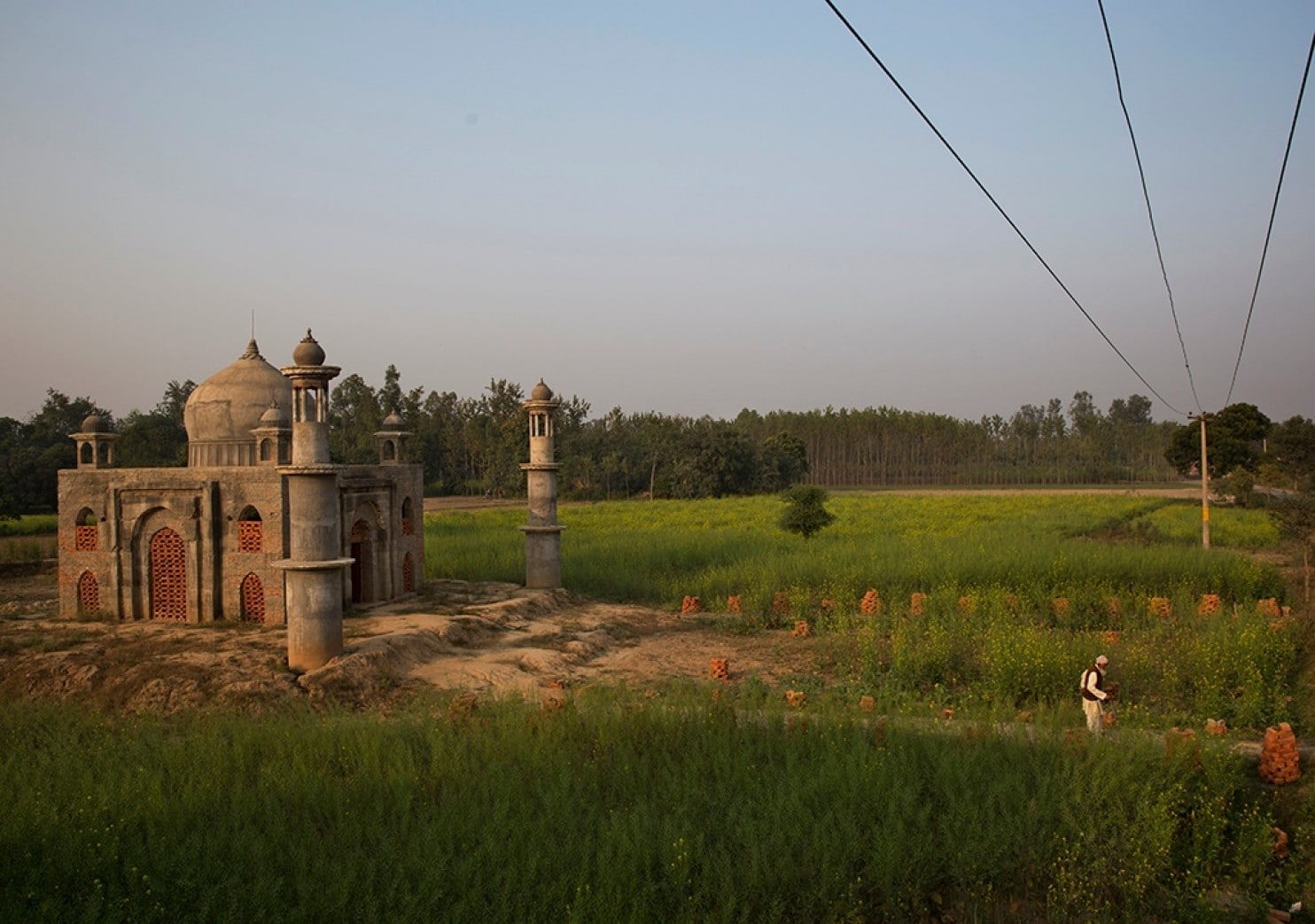
Retired postman Faizul Hassan Qadri walks out out the monument he is building for his late wife, Tajammuli, in the town Kaser Kalan in India’s Uttar Pradesh on Nov. 27, 2014. (AP Photo/Bernat Armangue)

With 80 years of wrinkles and a beard that has long turned white, Faizul Hassan Qadri has been working away his golden days on what he calls a labor of love — a grave for his wife, his “begum.”

For years, the retired postmaster has been building a monument reminiscent of India’s ancient shrines outside his home in Kaser Kalan, a village in India’s Uttar Pradesh, pausing from time to time when he runs out of money for materials. He has sold farmland and his wife’s finest jewelry to get enough rupees to finish the job, according to the Hindustan Times . But it’s a promise he made to his wife, Tajammuli, who died from throat cancer in 2011.

Tajammuli had asked him who would remember her when she died.

“I will build a tomb that everybody will remember,” he replied.

The tomb has become known as a “mini Taj Mahal” and Qadri as a common man’s Shah Jahan, the Mughal emperor who built the original at Agra during the 17th century for his Persian empress, Mumtaz Mahal.

Visitors from all over have traveled to see Qadri’s mausoleum that sits on 5,000 square feet of ground in his garden, Press TV reported. “I traveled almost [15 miles] with my friends just to get a glimpse of this structure,” Pahasu resident Zakir Ali told Hindustan Times . “The efforts put in by him is really commendable.”

Qadri and Tajammuli married as teens in 1953, according to the newspaper.

“We were just a normal couple,” he told the Associated Press  last year.

Since Tajammuli’s death, Qadri has dedicated himself to preserving her memory. He said he designed her tomb on his own but got help with the construction from a local mason who “prepared the dome and constructed the four ‘minars’ around the central building, which is a little more than 27-feet in height,” he recently told the Hindustan Times. “The structure is built on my own land and I have also tried to plant some trees around it and have a small water body at the back side of the building.”

But construction has been touch-and-go, coming to a halt last year.

“Initially, I sold a piece of land for Rs 6 lakh [about 600,000 rupees or $9,000] and my wife’s gold and silver jewelry for Rs 1.5 lakh and got the ‘makbara’ [mausoleum] constructed with the help of a local mason named Asgar,” he recently told the Hindustan Times. “A total of Rs 11 lakh was spent, but now I have to get marble studded on the monument and also to build a lush green park around it, both of which is likely to cost me another Rs 6-7 lakh.”

Many, including the state’s chief minister, have offered him help but he won’t accept.

“The chief minister wants to meet Qadri to appreciate his efforts and to offer some financial help so that he can complete his unfinished building,” additional district magistrate Vishal Singh told the Hindustan Times.

“It is a proof of love,” Qadri told the Associated Press last year. “I have to do it on my own.”

He wants to finish the tomb before he dies, he said, and then he wants to be buried in it too.

“I have told my brother to bury me here by the side of my wife,” he told the Hindustan Times . “Everything that comes has to go away some day. My wife is dead. I will also die some day. The monument too might not stand forever. I just wish to see it complete before I die.”

source: http://www.washingtonpost.com / The Washington Post / Home> Sections> Modern Mix / by Lindsey Bever / August 21st, 2015

The last of eight generations of Rogan art in Kutch

Nirona Village, (Kutch District ),  GUJARAT :

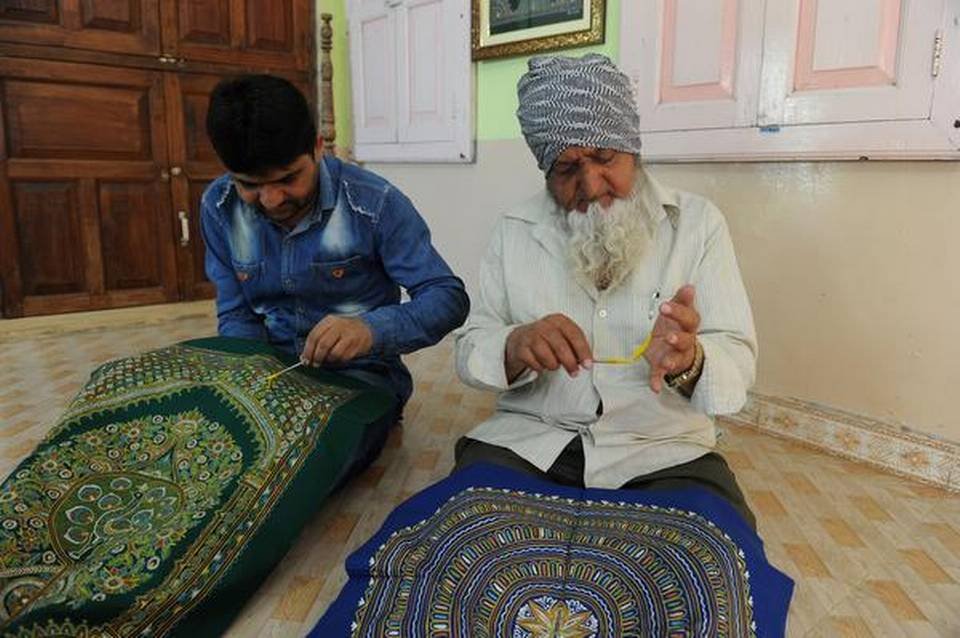
Abdul Gafur Khatri at work at his residence in Nirona village, Kutch | Photo Credit: Vijay Soneji

The Khatris have practised the art for eight generations now

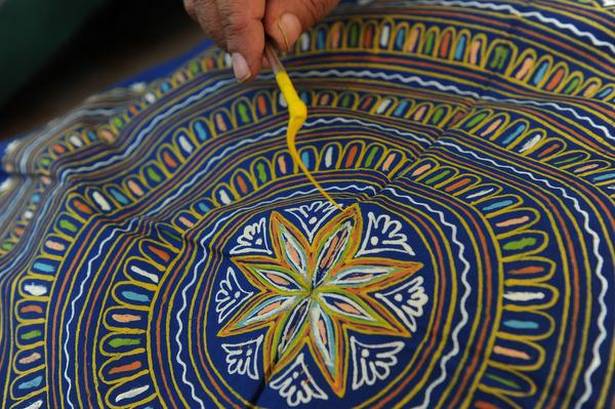
Sitting on the floor, Abdul Hamid carefully twists a thick spool of yellow paint around a metal pin. Stretched out before him is a piece of red cloth, pinned on either side to the legs of his trousers. He dabs the paint on the heel of his left palm — it’s a gummy mass and has to be worked into something more malleable. Hamid then brings the tip of the pin a few inches above the cloth, and as it hovers, an elastic strand of colour streams on to the surface. And the magic begins: an intricate pattern grows beneath the swirling pin that never touches the cloth. The floral design looks like needlework.

Hamid then folds the cloth and, just like that, a flawless mirror-image of the pattern appears and an exquisite piece of Rogan art is born.

“We have practised Rogan for eight generations now,” says Hamid. “The first six generations did not get their due for preserving the art, but now, finally it is widely recognised and we couldn’t be happier.”

‘Rogan’ in Persian means oil: the paint is made with castor oil. Rogan art is believed to have originated in Persia some 300 years ago and was traditionally used to embellish bridal trousseaus. As it crossed borders, it began fading from the collective memory of its creators. But nine members of the Khatri family in Nirona, a small village in Gujarat’s Kutch district, are the last surviving custodians of the art form.

The Khatri community once did Rogan work on the clothes of local animal herders and farming communities. But as machine-made textiles became a more affordable alternative and Khatri youth lost interest in learning the art, Rogan began to disappear. “But our family revived it in 1985,” says Hamid. In fact it is Hamid’s elder cousin, Abdul Gafur Khatri, a national award winner, who is credited with resurgence of Rogan art.

P.M.’s pick

The ‘Tree of Life’, an intricately patterned tree with hundreds of dots and dashes, is their signature painting and most in demand. A 14×17” painting can take 12 days to complete— Prime Minister Narendra Modi chose one to gift to the then U.S. President Barack Obama during his U.S. visit.

“Rogan art is 100% an artist’s imagination on a piece of cloth,” Gafur bhai, as he is better known, explains. “There is no tracing, no drawings to refer to.”

But preparing the base from castor oil is a laborious process and can take two days. The oil is heated and cooled in a (special) vessel and continuously stirred so it doesn’t burn. After two days, the residue left behind is mixed with cold water and it thickens into a sticky paste called rogan. Natural colour pigments are then added to the oil base. “Yellow, for instance, comes from a particular stone that is ground,” says Hamid. The pigments are added to the castor oil base and stored in earthen pots.

Wall pieces made by Abdul Gafur Khatri in Nirona village, Kutch | Photo Credit: Vijay Soneji

The nine artists have six national awards and six State awards between them. They proudly show me photographs of celebrities — politicians, film stars, sports stars — who have either bought their art work or felicitated them at awards functions.

Men last longer

It strikes me as odd that all nine members of the family working on the art form are men. This could perhaps do with the belief that women, once they get married, would pass on their knowledge to their husband’s families, threatening the art with dilution. But as Rogan faces extinction, Gafur bhai, has taken upon himself the task of teaching the technique to 200 girls from his village. And this has breathed fresh life into the dying art.

“We taught most of these girls for free. They can now create at least the basic designs,” Gafur bhai says, adding that 25 girls also help the family with their work. In another effort to popularise Rogan, the family conducts live demonstrations for every visitor at their doorstep. During the 30-minute demonstration, artists patiently answer questions and explain the techniques they use. On an average, the family gets 150 visitors a day. And between November and February, during the Rann Utsav — the Kutch desert festival — the numbers shoot up to 250 or 300.

No tough competition

Unlike other forms of textile art such as Ajrakh that face are under threat by factory-made products, Rogan faces no such competition, but meeting market demand has been a challenge.

“You will not find Rogan art the way you find other arts in the markets. It’s not because we don’t want it to go out to the people, it’s because we have limited resources,” says Gafur bhai. We go to five or six exhibitions around the country in a year, and rest of the time we are at home, working.”

It has been a long journey for the Khatri family: from reviving the art to creating public interest to recovering from the Bhuj earthquake setback. But today, they are only seeing a huge resurgence of interest.

The writer is an independent journalist based in Gujarat. When not researching her stories, she is busy spinning tales for her toddler.

source: http://www.thehindu.com / The Hindu / Home> Society – Rubric / by Azera Parveen Rehman / January 20th, 2018

The Pathan who saved Pathra’s temples

Pathra, Midnapore District, WEST BENGAL :

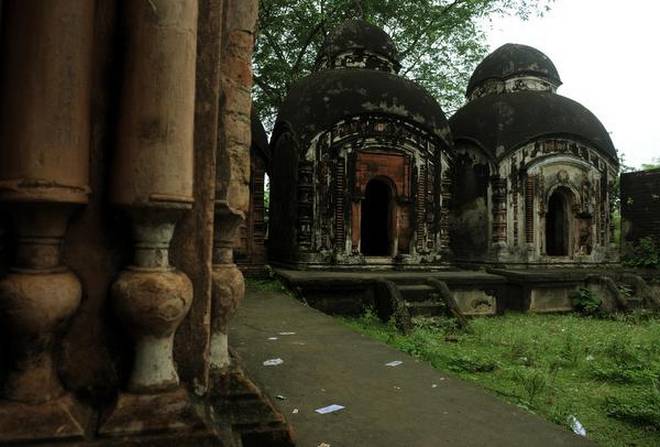
Pathra’s ancient temples | Photo Credit: Ashok Nath Dey

Today, 19 of the 34 temples in Pathra in West Bengal have been restored to their former glory

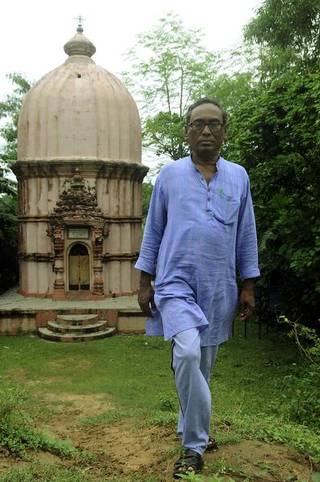
“Bash on.” That’s probably what Yeasin Pathan says to himself when he wakes up every morning. You just can’t miss his never-say-die attitude when you meet the frail 66-year-old. How else do you explain the grit of a Class IX dropout, and a devout Muslim, who has been crusading for the conservation of 34 temples for the last 42 years?

Pathan has been in love with Hindu temples ever since he was a child. Looked upon with suspicion by both Hindus and Muslims for this long love affair, Pathan is today inured to the jibes, threats and hurdles.

The story begins when Pathan was a child. Captivated by the terracotta temples he chanced upon in Pathra, a village close to his own, in Midnapore district of West Bengal,  their dilapidated condition set him thinking. And by the time he was 17, he had kick-started his ‘save the temples’ mission. This was in 1971. He had no archaeology or history degree to show on his CV, but Pathan realised the temples were “part of our heritage, and people should be prevented from walking away with bits of it.”

Garnering support

To start with, Pathan got the villagers together, Hindus, Muslims and Adivasis. He told the people of Pathra it was in their hands to preserve their heritage for posterity. As expected, Pathan found himself up against opposition. People from his community were enraged he was advocating the preservation of structures where idols are worshipped. “The Hindus of the area were miffed too, because I prevented them from stealing the bricks off the temples and selling them,” he says, smiling.

Statues for sale

Even the descendants of the zamindars who had built the structures were trying to make money by selling carvings and statues. Pathan was, clearly, surrounded by a ring of fire. That’s when innate wisdom told him he must give the locals a vision to aspire for: that if Pathra became a tourist destination, “the village and its adjoining areas would get roads, electricity, water, and business.” The semblance of a truce followed.

Under his leadership the local community set about first clearing the wild growth of weeds around the monuments. Then, Pathan mobilised rallies at the district headquarters in Midnapore to demand funds. There were scuffles, and he would rush to Midnapore to bring the police to Pathra.

Yeasin Pathan | Photo Credit: Ashok Nath Dey

But his efforts began to bear fruit.

Money started trickling in; IIT Kharagpur stepped in to help with the conservation. Pathan set up an NGO, Pathra Archaeological Preservation Committee, which, apart from its core agenda, also became a forum for communal harmony. The then Planning Commission Deputy Chairperson, Pranab Mukherjee, sanctioned ₹20 lakh for Pathra. The biggest victory for Pathan was when the Archaeological Survey of India (ASI) took over restoration work in 2003.

Guide for tourists

Meanwhile, Pathan realised he needed a steady source of income. He now had a wife and four children. To make ends meet, in 1974 he became an attendant in a school in Hatiholka, his village. He also worked as a stringer for newspapers, and when curious tourists visited Pathra, Pathan became their guide. But he never wavered in his mission to conserve the temples.

Although Pathra’s residents acknowledged his pioneering work over the years, he has faced testing times. Gasping for breath ( he has two blockages in his heart), he recounts how he had to go into hiding after the Babri Masjid demolition in 1992. “Muslims wanted to lynch me for protecting temples while Hindus were breaking mosques.”

Only one guard

Today, 19 of the 34 temples in Pathra have been restored to their former glory. All under the eagle eye of Pathan, who says ruefully: “Such a big area, and only one guard to protect it.” Some 9.5 acres around the temples are being beautified by ASI. Pathan’s new fight is to get 70 farmers their compensation for the land they had to give up around the temple.

“You know how it is… unless we make a noise, the state will take its own sweet time,” he says.

Dressed in a cotton shirt, trousers and chappals, the bespectacled Pathan retired from his school job in 2012, and gets a pension of ₹9,600 per month. His family wants him to take it easy now. The years of travel, the erratic sleep and irregular meals, have all taken a toll on his health. He can’t afford treatment for his heart and kidneys.

“Stay at home; rest, they say. But if I stop now, all those years of fighting will go down the drain. Now is when everything should fall into place,” says a tired but eternally optimistic Pathan.

Professional procrastinator and looker out of window, the writer works at O.P. Jindal University.

source: http://www.thehindu.com / The Hindu / Home> Society> Rubric / by Priya Kannungo / October 27th, 2018

A monument of generosity

Lucknow, UTTAR PRADESH / NEW  DELHI  :

BadaImambaraMPOs28oct2018

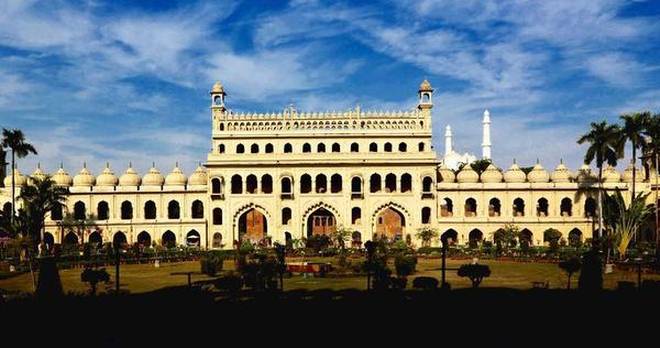
In the Bara Imambara which was built to employ people struck by a famine in 1784

I grew up in Lucknow amidst magnificent Nawabi architecture, in the syncretic and gentle culture of Awadh. It was a way of life where others were given more importance over the self. “Pehle aap (you first)” was a commonly used phrase while speaking. It is always a pleasure to return to the city that is said have once been ruled by Lakshman; where excavations show a continuous settlement dating from the first millennium BCE through the early Gupta, medieval and modern periods.

In 1732, Mughal emperor Muhammad Shah appointed Saadat Khan Burhan-ul-Mulk as the governor of Awadh. With Faizabad as his capital, Burhan-ul-Mulk was first in the line of rulers, known as the Nawabs of Awadh, whose contribution to Indian culture and history is invaluable. Asaf-ud-Daula, the fourth Nawab of Awadh, shifted the capital from Faizabad to Lucknow, and from 1775 to 1856, Lucknow was built by the Nawabs as a unique architectural city with a syncretic culture.

Features of Nawabi architecture

The geography of Lucknow meant that stone and marble, the main features of Mughal architecture, had to give way to lakhauri brick-and-lime plaster buildings. The main features of Nawabi architecture were bulbous domes, vaulted halls, chhatris and double arches, with the inner one pointed and the outer one foliated, but the main improvisation given the resources and the unavailability of stone was the beautiful stucco ornamentation on buildings along with plaster decoration in the interior. The stucco work gave a deep relief even on flat walls, but unfortunately, much of it has been lost in repairs and whitewashing. The variety of motifs ranging from floral designs, false arches and false domes that produce an exceptional surface articulation of walls, columns and ceilings remain for us to marvel at.

Many stunning religious and secular buildings were constructed, but as the Nawabs were Shia, magnificent imambaras were their special contribution to architecture. An imambara is the place where congregational assemblies are held to commemorate the sacrifices of Imam Hussain, the grandson of Prophet Muhammad who was martyred along with friends and male members of his family in the Battle of Karbala by Yezid, the ruler of Syria.

Of these buildings, nothing is grander than the Bara Imambara, built as a relief measure for a populace stricken by famine in 1784. Construction continued till the famine ended. It was a hard time for all, including the elite. To ensure that they were not embarrassed to be seen working for daily wages, it is said that payment was made at night. This gave rise to the saying, “Jisse na de Maula, use de Asaf-ud-Daula (he who doesn’t receive from Allah is provided for by Asaf-ud-Daula)”.

Nawab Asaf-ud-daula (1775-1797 CE) chose Kifayatullah as the main architect. The place chosen had the hut of an old woman, Laso Saquum, in which she kept a small tazia, a replica of the shrine of Imam Hussain. She was reluctant to give her land but when Asaf-ud-daula promised to keep her tazia in the imambara, she gave the land for free. The tazia is kept there even today. The architect only asked for land for his burial as fees. He is buried, along with Asaf-ud-Daula, in the central hall of the imambara.

Inside the Imambara

One can enter it through one of the two three-arched gateways separated by a grassy forecourt. Once you enter the second gateway, the sheer size and magnificence of the Bara Imambara affects you. On the left is the exquisite seven-level Shahi Baoli (stepwell), initially dug as a well during construction. As it was a perennial source of water, it was built as a guesthouse later. On the right is the Asafi mosque on a raised plinth flanked by minarets with an impressive flight of steps. It faces Mecca.

The main hall with its vaulted roof is one of the largest of its kind in the world. It is unsupported: no column, pillars, wood or iron was used here. Its unique architectural design gave birth to the famous bhool bhulaiyya, which is above the hall and came about unintentionally to support the weight of the building. This is a labyrinth of more than 1,000 passageways and 489 identical doorways. It is among the few existing mazes in the world. Its acoustics are such that a match being struck on the other side of the hall can be heard. I like exploring it but always with a guide. After all, one must live to explore another day!

source: http://www.thehindu.com / The Hindu / Home> Opinion> Columns> Where Stones Speak / by Rana Safvi / October 28th, 2018

Ateeqa Bano And Her Collected Pieces Of History | #IndianWomenInHistory

Sophore, Srinagar , JAMMU &KASHMIR :

AteeqaFPMPOs27oct2018

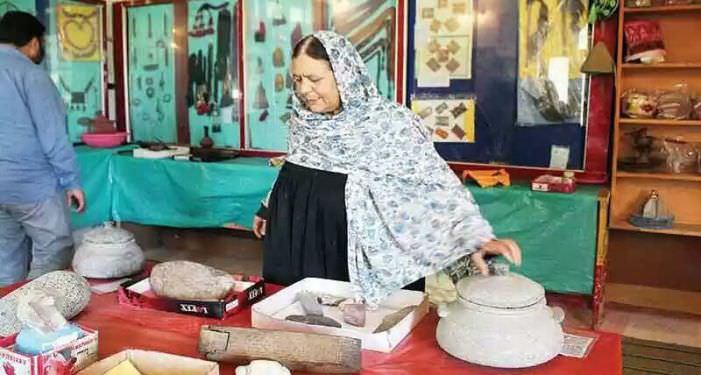
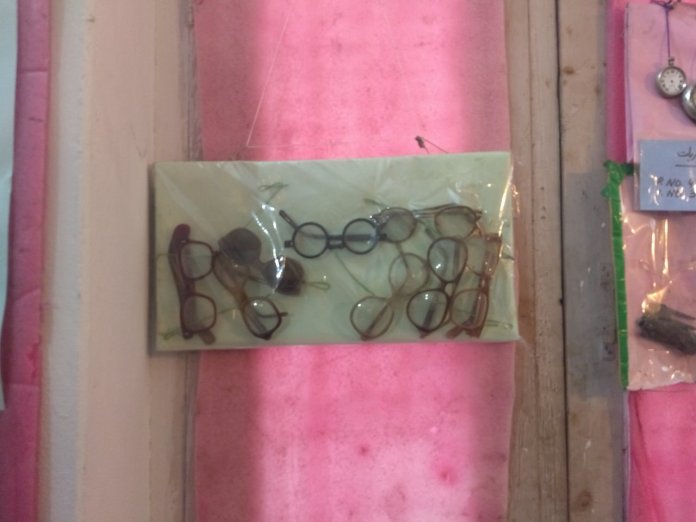
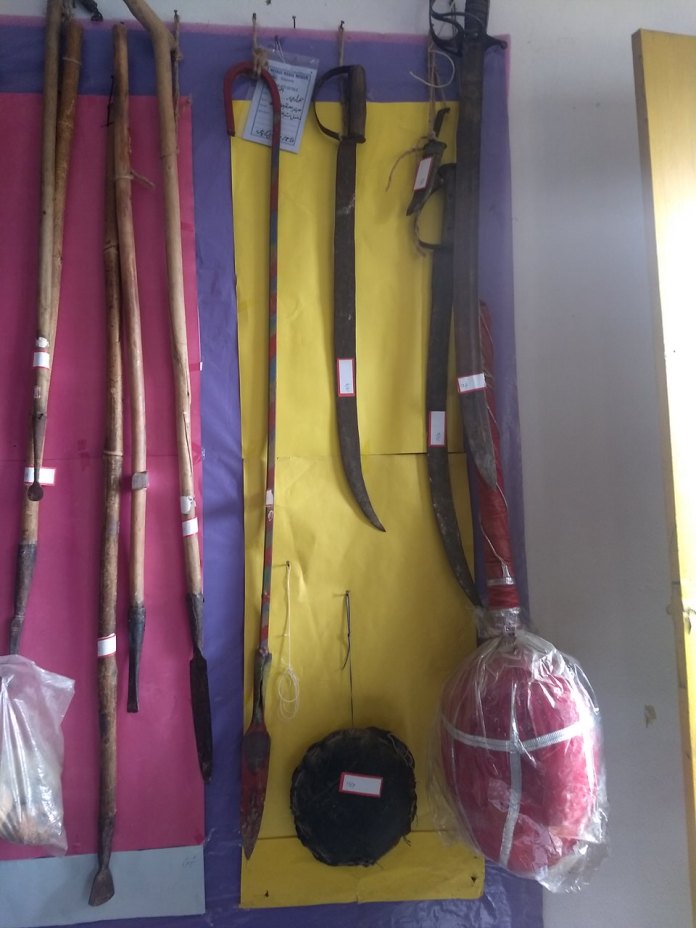
In the summer of 2014, as I walked past colourful stalls at Srinagar’s exhibition ground, the quiet and less colourful one in a corner caught my attention. Its tables were decorated with vintage Kashmiri crafts, coins, and manuscripts. The stall belonged to Meeras Mahal, a privately run museum.

Image Credit: Meeras Mahal Blog

As I and a fellow acquaintance went closer, we were warmly welcomed by an elderly woman. She made us sit and introduced herself humbly. “Ateeqa Bano, founder of Meeras Mahal,” she said. She walked us through the collection and told us stories about her journeys to get each of these artefacts.

Ateeqa’s narration clearly revealed her love for her collection. She also learnt that my friend had preserved a handwritten Quran at his place. She took his contact and invited us to her museum at Sopore, nearly 52 km from Srinagar.

Weeks later, she appeared at his doorstep with a hope to acquire the handwritten Quran. She was unable to strike a deal here but she never gave up on her other pursuits. Her failure here demonstrates how difficult the curation of items was.

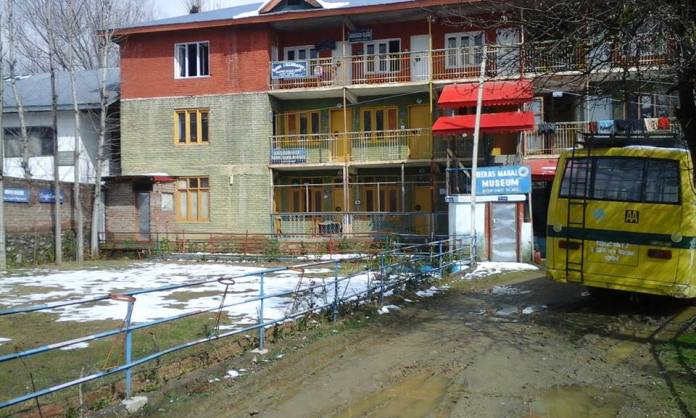
The journey of forming a museum took a shape after Ateeqa’s retirement from government services in 1998. 2001 onwards when the museum was set up, it meant everything. It was initially set up in a small room in BEd college at Noorbagh in Sopore and later shifted in 2008 it to present building, all run and maintained by her expenses.

AteeqaMPOs27oct2018

She would convince people to donate things to them and when the days weren’t all sunny, she would offer something in return. The goods would then be indexed and preserved.

Ateeqa’s looks resembled that of an ordinary Kashmiri woman but her hard-work and foresight went way beyond. I was never lucky enough to hear her story from her but even months after her death, the museum and the collection are reminiscent of her.

A corner in photo gallery contains collage pictures of famous women from Kashmir or who are in some ways associated with Kashmir. The wall, very diligently, compels one to think about the women from Kashmir who always remain unrecognized and unacknowledged and teaches us something that most other museums or schools don’t.

Her compassion for women’s rights was also revealed to me through the caretaker of the museum who said that Ateeqa had given her space to live close to the museum along with her children after she had been ousted by her in-laws. She recalls her days with Ateeqa Bano as a golden phase that she would never forget.

Ateeqa02MPOs27oct2018

Ateeqa Bano chose an unorthodox way of life. After her father’s death, she decided to live forever with her mother and never marry. The decision to not marry is still a rebellious one in Kashmiri society and for her to make this choice decades back must have invited criticism from all. Apparently, she never budged and continued doing what she loved doing the most – her work.

From Sopore in the North to Shopian in the South to every district in Kashmir, Ateeqa travelled to collect things that represented Kashmir in many ways. She would travel for days and nights to obtain seemingly mundane goods and preserve them as a way to preserve the past for forthcoming generations.

The travels were not always easy. “At times, she would walk for miles altogether and ride a horse too when roads were not motorable,” says Maryam Masoodi, wife of her nephew. At times, she would be dissuaded by family, considering the effort it required. Maryam remembers how she would tiptoe inside the house in evenings when she got back home late from her work, fearing reproval from the family members.

On one occasion when Maryam accompanied her to her house in Kupwara, she went to rooftops to look for collectables. Maryam and others at the museum were fascinated and realized that no one else could have done it.

Image Credit: Kashmir Life

Today, at the museum, the caretakers refer to visitors as guests and regale them with stories of Ateeqa Bano. Before her death, she would spend days here. She had also built a blueprint to develop the museum on modern lines. However, because of her illness, she couldn’t accomplish this task. Her nephews are very keen to make her dream come true while she rests in her grave in the lawns of the museum.

source: http://www.feminisminindia.com / Feminism In India – FII / Home> History / by Arshie Qureshi / December 27th, 2018

Uncommon gesture: Minister tips cook Rs. 25k, trip to Umrah

KARNATAKA :

Image Courtesy: The News Minute

Mangaluru :

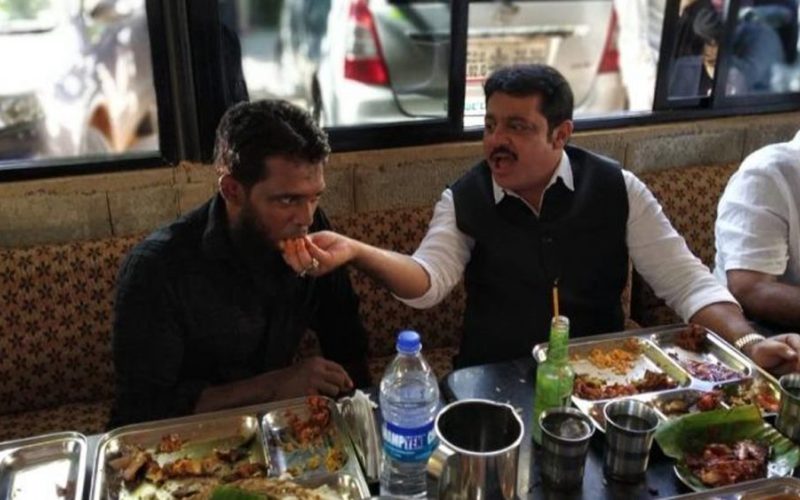
Impressed by the culinary skills of a Mangaluru cook, Karnataka minister gifts a cash of 25,000 as a tip and a pilgrimage to holy Makkah to perform Umrah.

According to reports, the Minister for Food and Civil Supplies BZ Zameer Ahmed Khan on Thursday (October 18) was in the coastal district for an official review meeting.

He went to ‘Fish Market,’ a seafood restaurant in Lower Bendoor for lunch along with the President of Wakf Committee UK Monu, Former MLA Mohiuddin Bawa and UT Iftikhar Ali, brother of minister UT Khader.

Haneef Mohammed, the 48-year-old chef and co-owner of the restaurants served the minister the local delicacies such as stuffed Pomfret and Green Tawa Pomfret along with rice preparations.

Such was the flavour and aroma of the sumptuous meal that the minister made the cook sit next to him, fed him a mouthful from his own plate.

“As I entered, the minister greeted me warmly. He made me sit next to him, fed me a mouthful of food and told me that he had never eaten such an appetising course of fish,” said the father of six, reported TNM.

Post lunch, he promptly handed over a hefty tip of Rs 25,000 to Haneef with a promised that he would pay for his Umrah (Islamic pilgrimage) as well.

Haneef, who has been a chef for the last 18 years, serving fish as his speciality said he never come across by such benevolent offer.

He distributed Rs 25,000 out of the tip to all the employees at his restaurant.

The legislator, who holds the post of Minority Welfare alongside the portfolio of Hajj and Wakf, famed for his generosity.

source:  http://www.siasat.com / The Siasat Daily / Home> Bangalore> Featured News> News> Top Stories / by Safoora / October 23rd, 2018

British Currency May Soon Have Picture Of Noor Inayat Khan, A British-Indian Spy During WWII

UNITED KINGDOM :

British Indian World War II spy Noor Inayat Khan may be the next face of British currency. A campaign for the same is gaining momentum wherein people are demanding the spy to be featured on a redesigned 50-pound currency note.

The Bank of England had recently announced plans for a new polymer version of the large denomination note to go into print from 2020 and indicated that it would invite public nominations for potential characters to appear on the new note.

An online petition in favour of the campaign has already garnered over 1,200 signatures by Wednesday, calling for Khan, a descendant of Tipu Sultan and daughter of Indian Sufi saint Hazrat Inayat Khan, to be considered as the first ethnic minority British woman to be honoured on the currency.

“I am absolutely delighted that the story of Noor Inayat Khan has inspired so many people and that she has become an icon. Noor was an extraordinary war heroine,” said Shrabani Basu, the author of Khan’s biography ‘Spy Princess’ and founder-chair of the Noor Inayat Khan Memorial Trust.

NoorInayatKhan01MPOs21oct2018

The trust was set up in 2010 to campaign for a memorial in honour of the war-time spy, who had been recruited by Britain’s Special Operations Executive (SOE) and infiltrated beyond enemy lines before being captured and killed by the Nazis in 1944, aged only 30.

Khan’s memorial bust now has a permanent home at Gordon Square in central London, with the trust also lobbying for a commemorative blue plaque to mark the house nearby where she spent time with her family.

“I am very happy to support the campaign for Noor Inayat Khan on the 50-pound note. It is a way of keeping her memory alive and taking this story to the next generation. It will certainly make a big statement internationally because Noor was someone who believed in breaking down barriers,” Basu said.

The campaign has found the backing of prominent political leaders, historians and academics in the UK, with many taking to social media to voice their support.

“The new 50-pound note could have anyone on it. I’m backing Noor Inayat Khan. She volunteered for SOE, served bravely as an agent in occupied Europe, was eventually captured and murdered. A Muslim, a woman, a hero of WWII. This would celebrate her courage and all SOE,” said Conservative Party MP Tom Tugendhat, who is currently leading the UK Parliament’s Global Britain and India Inquiry.

NoorInayatKhan02MPOs21oct2018

“Just returned from both East Africa and the Western Front and am more than ever aware of the shared service and sacrifice of men and women of many backgrounds. I would love to see Noor Inayat Khan on the new 50-pound note,” said Melvyn Roffe, Principal at George Watson’s College in Edinburgh.

Noor Inayat Khan, born in Moscow to an Indian father and American mother, was raised in Paris and Britain. As a Sufi, she believed in non-violence and also supported the Indian independence struggle.

But she felt compelled to join the British war effort against fascism and went on to become the first female radio operator to be infiltrated into Nazi-occupied France before she was captured, tortured and killed at the Dachau concentration camp in Nazi Germany.

“In this age, when we see a rise in anti-semitism, anti-Muslim hatred and intolerance, it is important that we continue to build bridges and show positive contributions from Britain’s ethnic and religious minorities, not least one of World War II’s almost forgotten heroes, a British Muslim woman,” said social activist Zehra Zaidi in the online petition she started to campaign for Khan as the face of the new banknote.

The 50-pound currency will be the final redesigned note to go into circulation after notes in the denomination of 5 and 10 have already been reissued in polymer. The new 20-pound polymer note will go into circulation from 2020 when the 50-pound is set to go into print to be circulated later.

“The bank will announce a character selection process for the new 50-pound note in due course, which will seek nominations from the public for potential characters to appear on the new note,” the Bank of England said.

With Inputs From PTI

source: http://www.indiatimes.com / India Times / Home> News> India / October 18th, 2018

Mohammed Hussain’s Mawa jalebi is a huge hit in the month of Ramzan

Mumbai, MAHARASHTRA :

In a narrow lane, Burhanpur Mawa Jalebi is a 4×4 sq ft shop, no bigger than a kiosk.

Peak hours of business during Ramzan begin after 10 pm for Burhanpur Mawa Jalebi. (Source: Express photo by Vasant Prabhu)

Tight coils of pale yellow turn dark brown within minutes. As soon as they rise to the surface in the kadhai of hot oil, cooked to their thick core, Mohammed Hussain scoops them out with a frying ladle and deposits them in a shallow dish of thick sugar syrup. Immediately, the customers that have, until now, been watching Hussain intently, close in for the mawa jalebi.

During the month of Ramzan, Mohammed Ali Road in Mumbai wears a festive look. By 6 pm, the air is thick with a mix of aromas as all shops and stalls in the Khau Galli light up with fairy lights. Walk down the crowded lane and one notices that the jalebi is curiously missing from the scene. “That is because Mohammed Ali Road has only one jalebi shop, and not the regular variety but mawa jalebi, available at Burhanpur Mawa Jalebi,” says the cashier at Suleman Usman Mithaiwala, which sits at the Khau Galli junction.

In a narrow lane, Burhanpur Mawa Jalebi is a 4×4 sq ft shop, no bigger than a kiosk. Hussain and his brothers Mohammed Yusuf and Mohammed Hissar cater to the thickening crowd. “Mawa jalebi is a specialty from Madhya Pradesh,” says Yusuf between taking orders. “Our shop introduced Mumbai to this sweet, which is distinct,” he adds.

Made using mawa, arrowroot and milk, it is closer to gulab jamun in taste. “Its crispness comes from arrowroot, which gives the batter a better hold. Unlike the other jalebi, this doesn’t have the tinge of sour taste,” says Hussain.

Burhanpur Mawa Jalebi was started a decade ago by his uncle Nooruddin. “The recipe is original, passed on by a karigar in Mathura to our maternal grandfather,” says Hussain. This shop is a branch of the original, which has been in Burhanpur, for 45 years.

Open from 3 pm to 3 am during Ramzan and till midnight on other days, Burhanpur Mawa Jalebi prices its specialty at Rs 240 a kg. “With a hike in the rates of mawa and other ingredients, we will increase its price after Ramzan,” says Yusuf. Why not during the festive season, when they are bound to do good business? “Ramzan is a holy month; a time to reflect, cleanse self and do good. Acting greedy will bring us sin,” says Yusuf. Upon hearing the azaan at the nearby Minara Masjid, he takes a break and heads in the direction. It is time for namaaz before he breaks his fast.

source: http://www.indianexpress.com / The Indian Express / Home> Lifestyle / by Dipti Nagpaul D’Souza, Mumbai / July 09th, 2015