The date of inauguration of the exhibition hasn’t been decided yet, but most of the groundwork for the event has been completed.
For the first time in almost 12 years, the National Museum in Delhi is preparing to display the priceless jewellery collection of the Nizam of Hyderabad.
The date of inauguration of the exhibition hasn’t been decided yet, but most of the groundwork for the event has been completed. The National Museum exhibited the jewellery for the first time in 2001 and again e in 2007. There have also been two exhibitions of the jewellery at the Salarjung Museum in Hyderabad during the same period.
“In India, jewellery is an integral part of lifestyle. Among them, the Nizam’s collection of jewels is especially unique. It, therefore holds a significant position in the history of gemology and jewellery,” said Sanjib Kumar Singh , curator of the exhibition.
Soon after India’s independence and the annexation of erstwhile princely state of Hyderabad, the seventh and last Nizam, Mir Osman Ali Khan, created 54 trusts. The jewels, now in the custody of the Indian government, were part of the assets of these exclusive trusts. In March 1951, HEH the Nizam’s Jewellery Trust was created and it took over 103 items including state regalia; in February 1952, HEH the Nizam’s Supplemental Jewellery Trust took custody of 144 pieces of jewellery.
Negotiations began in 1972 between the Indian government and the family for the sale of the priceless heritage. In 1995, the Indian government finally acquired a part of the inventory for Rs. 217 crore. The actual value of this precious legacy is difficult to asses because it not only represents some of the finest jewels found in the Indian subcontinent, but also stands as a silent witness to the history of the Deccan region.
According to the government, the present collection comprises a total of 173 items acquired from the two trusts. The actual number of pieces, if pairs and groups of ornaments are split up, is 325 not, including 22 unset emeralds, and the 185-carat Jacob diamond, one of the world’s largest by size.
The collection includes turban ornaments, necklaces, earrings, armbands, bracelets, bells, buttons and cufflinks , anklets, watch chains and rings—all jewels once worn by the once fabulously wealthy Nizams of Hyderabad, their wives, children and grandchildren.
“This collection is a national treasure and comprises of jewels of fine beauty and rarity. I believe the jewels should be on permanent display as they belong to the people of India,” says art historian Deepthi Sasidharan, who has co-authored the book, Treasures of the Deccan–Jewels of the Nizams, published recently.
The exhibition is likely to feature around 33 showcases. The National Museum proposes to charge visitors Rs 50 for a 30-minute tour of the exhibition.
source: http://www.hindustantimes.com / Hindustan Times / Home> India / by Vanita Srivastava, Hindustan Times, New Delhi / January 11th, 2019
Mehmood is an electrician whose business of setting up lights for festivals spans from Janmasthami celebrations in Muzaffarnagar to the famous Nauchandi Mela in Meerut
Prayagraj:
In a sea of saffron, he stands out with his skull cap and gray beard. To the first time visitor, a board reading ‘Mullah Ji Light waale’ (Mullah Ji, the lighting man) at the Kumbh Mela may be an odd sight but to the Sadhus who have gathered at the confluence of the Ganga and the Yamuna , Mohammed Mehmood aka Mullah Ji is a permanent feature of every Kumbh. To some, he is even a friend.
Mehmood is a 76-year-old businessman from Muzaffarnagar in Western UP. In 1986, he acquainted himself with the Sadhus of the Juna Akhara – the largest and one of the fiercest Akharas of the Naga Sadhus; an ancient order of warrior monks. They hired him to set up the lights around their tents. Today, every six years, he travels over 800 kms to Allahabad, now named Prayagraj, and camps out at the Kumbh Mela.
Sandwiched between the tents of the Juna Akhara, he talks of his journey to Kumbh. “I am an electrician. When you come here at night, you will see that the entire area where Sadhus have pitched their tents is dazzling with bright lights of all colours. That is my doing,” he says proudly. Mehmood’s business of setting up lights for festivals spans from Janmasthami celebrations in Muzaffarnagar to the famous Nauchandi Mela in Meerut. ‘Mullah Ji’ had started his business from scratch.
“The first Kumbh I ever attended was the 1986 Kumbh in Haridwar. Apart from the mela that happens in Nashik, I have attended every one. I haven’t kept count of how many Kumbh Melas I have attended, maybe you can do the maths,” he jokes, sipping a cup of tea at his 11th mela.
Naga Baba Sangam Giri, a warrior monk from the Juna Akhara, is Mehmood’s neighbor on the sands in Kumbh. “I have seen him at nearly every Kumbh Mela I’ve been to. I never even bothered to ask him, his real name. For us he is, and will always be, simply ‘Mullah Ji’ – our friend,” he says, adding, “For Hindus, we are gurus. For Muslims, we are Pirs. They (Muslims) worship niraakar (a formless God) and we worship aakar (idol worship). There may be different routes, but we are all going to the same place. There are 25 different ways to get to Allahabad. Everyone takes a different route to the railway station. But eventually, everyone ends up at the railway station.”
Mehmood says he is treated with respect among the Sadhus. The day that stops, he says, that will be his last Kumbh. “The Babas make me feel at home. Sometimes they ask me to sit on their gaddi (padded mattress), but I respect them too much to do that. I read my namaz five times a day in the presence of these Sadhus and they always give me the space,” he said.
If the Sadhus hadn’t treated Mehmood differently, he probably would not have come to Kumbh, he recalls in nostalgia.
Over the last three decades, Kumbh has become an integral part of his life. Will Mullah Ji come back for his 12th Kumbh? “Inshallah! If Allah commands me to, I will come back,” he says.
source: http://www.news18.com / News18 / Home> English> India / by Uday Singh Rana / January 15th, 2019
Amidst reports of a few women activists of a Right wing group attempting to enter forcibly the prayer hall of the Nainar Mosque (Vavar Palli) at Erumely, its management has clarified that devotees of all religion, gender and age groups can visit the mosque as part of their pilgrimage to Sabarimala.
P.H. Shajahan, president, Erumely Mahalla Muslim Jamaat, which manages the mosque, said here on Tuesday that they had not imposed any restrictions on the visit of Sabarimala devotees before or after the Supreme Court’s verdict that lifted the ban on women in the 15-50 age group from entering the Sabarimala temple.
“We have been receiving women of all age groups as visitors for a long time and the trend continues even after the recent SC verdict. There is no restriction on them entering the mosque, circumambulating it and providing offerings, as is the tradition,” he said.
A large number of Sabarimala pilgrims visit the mosque throughout the annual pilgrim season, reviving the the local myth of Lord Ayyappa’s friendship with the Muslim youth Vavar. Besides pilgrims, the location has witnessed a huge inflow of tourists, including women, who come to Erumely during the pilgrimage season. It, however, does not permit the entry of Muslim women to the prayer hall.
The other day the police had arrested six people, including three women from Tamil Nadu, while on their way to visit the mosque here. The accused were booked under various Sections, including attempts to promote animosity between different religious groups, and were remanded.
In the face of reports that some women belonging to a Right wing group would attempt to enter the prayer hall here, additional police personnel were posted here to prevent their entry to the prayer room.
source: http://www.thehindu.com / The Hindu / Home> News> States> Kerala / by Staff Reporter / Kottayam – January 08th, 2019
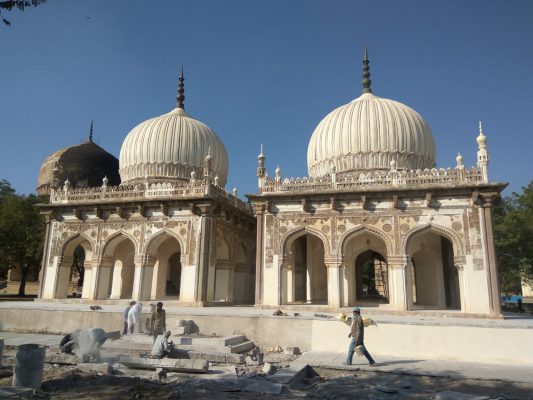
Workers giving final touches to the restoration work on Hakims’ tombs.— Photos: Mohd Azharuddin
The restoration work on Hakims’ tombs being done by the Aga Khan Trust for Culture (AKTC) is nearing completion and is expected to be thrown open for visitors soon.
Hyderabad:
A search for Hakims’ tombs in Google will take you to a monument in Pakistan! However, the little less known fact is that there are two such tombs in the heart of Hyderabad, located within the seven tombs complex.
The restoration work on Hakims’ tombs being done by Aga Khan Trust for Culture (AKTC) is nearing completion and is expected to be thrown open for visitors soon, said Ganesh Reddy, Manager Operations for AKTC.
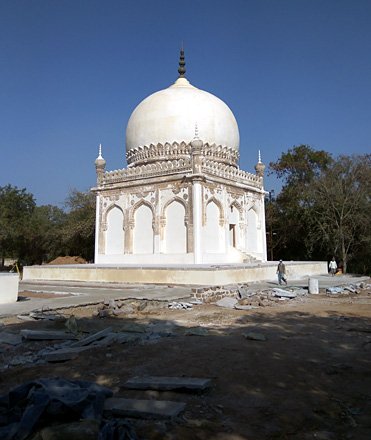
Nizamuddin Ahmed Gilani and Abdul Gaffar Gilani were the two favourite Hakims (Doctors) of Sultan Abdullah Qutb Shah. The twin tombs were built in 1651. The Commander’s tomb, which is also next to the Hakims’ tombs, will also be opened on the same day.
Architectural marvels
All the tombs, mosques, baolis (step wells) and other monuments in the seven tombs complex are the architectural marvels of Qutb Shahi dynasty, which was established in the 16th century. The Qutb Shahi rulers, whose dynasty survived till 1687, were great builders, whose structures include Charminar, Golconda Fort and several other monuments in Hyderabad, historians here aver.
The Qutb Shahi Heritage Park served as a necropolis to the dynasty. Monarchs and other prominent nobles were buried here during the 169-year rule of Qutb Shahis. The tombs complex has 80 monuments, which include 40 mausoleums, 23 mosques, seven baolis, a hamam, pavilions, tanks, wells, garden structures and enclosure walls.
Twin tombs
It is a twin tomb structure with both the structures identical and on the same platform. The square tomb covers an area of 10.35 m x 10.35 m and follows an open pavilion plan with three arched openings on each side. Internally, these have an arcaded octagonal grave chamber roofed with a bulbous dome raised on a 16-sided drum. Dome internal ceiling is decorated with merlon bands and flower bands.
Externally, all the facades are identical and have extensive stucco decorative in the form of medallions, floral bands and panels. Each facade has merlon shaped parapet wall over the stone brackets and chajja. The dome is extensively decorated with ribs and leaf pattern band at the base. The German Consulate based in Chennai has sponsored for the conservation of Hakims’ tombs, said Yoshowant Purohit, AKTC Project Manager.
Integration of Deccan Park
The Deccan Park is seen as the ideal entrance zone to the grand complex there by creating a suitable entry point to the heritage zones wrapped by ecological and formal landscape. The infrastructure development works such as amphitheatre and parking facility were also on track.
Restoration works
In January 2013, a MoU was signed between the Department of Archaeology and Museums, now Department of Heritage Telangana, the Quli Qutb Shah Urban Development Authority, Aga Khan Foundation and the Aga Khan Trust for Culture to undertake conservation works on all monuments with a holistic landscape development of the 106-acre Qutb Shahi Heritage Park.
The Tata Trusts also pledged its support to conserve 10 major monuments. The Ministry of Tourism (Govt of India) has announced its support for the development of the landscape.
On World Heritage Day, April 18, 2018, the first phase of conservation and landscape restoration works were completed. Prominent structures conserved in Phase-1, include the mausoleum of Sultan Quli Qutb Shah, Jamshed Quli Qutb Shah, Ibrahim Quli Qutb Shah, Muhammad Quli Qutb Shah. Other structures such as Idgah, Hamam, three baolis, mosques, grave platforms, chaukhandis were also developed.
The Commander’s tomb.
Under Phase-2, conservation works are being carried out on tombs of Muhammad Qutb Shah, Hakims, Commander, Premamati, and Taramati, Hayat Bakshi Begum and great mosque, while Phase-3 will focus on the entrance zone and few other structures.
Footfall
The Aga Khan Trust for Culture will also carry conservation works on Paigah Tombs and Ashoor Khana based in the old city. Footfall at Heritage Park has increased since the opening of Phase-1. The Telangana government’s extensive focus on introducing the history of Telangana and Hyderabad in school curriculum is also attracting students of all ages to the site.
source: http://www.telanganatoday.com / Telangana Today / Home> Hyderabad / by Mohd. Azharuddin / January 02nd, 2019
The emergence of artistic and cultural heritage of a country is a process that extends over centuries. Yet, sometimes, it can just take just a few days for it to vanish irrevocably. Care must be taken to preserve our heritage
Indian civilisation is one of the foremost in the world in terms of cultural wealth and the great works it produced. The indigenous people of India played a major role in the creation of the civilisation. However, people of diverse cultures from outside the peninsula have also doubtlessly contributed to the creation of this tremendous cultural wealth. One among such people are the Turks who led an amiable coexistence alongside the Indian people for decades.
In the first half of the 11th century, a great Turkish Sultanate was founded in northern India and subsequently Turkish influence extended further south. The foundation of this state had a notable impact on the history and culture of India. As a result of this impact, Delhi flourished to the point of competing with Baghdad, Cairo and Istanbul — the leading commercial and cultural centers of the world at that time.
Here onwards, the Turkish-Islamic influence began to shape all cultural areas from architecture and literature to arts and cuisine. Concrete examples of this impact can still be seen today. The centuries-long co-existence of both Indian and Turkish culture led to the exchange of words between the Turkish and Indian languages despite their vast structural differences. Some Turkish words were directly adopted as they were, while some words were transcribed according to their Indian pronunciations.
The most prominent aspect of the Turkish influence in India, however, is reflected in architectural works, with its myriad examples. One such example is the Quwwat-ul-Islam Mosque that was constructed by Qutab Ud-Din-Aibak, the founder of the Delhi Sultanate. It was the construction of this mosque that laid the foundation of the Indo-Islamic architecture in India. The famous ‘Qutb Minar’ minaret, which was constructed by Qutab Ud-Din-Aibak in 1500, is a 72.6 meter tall tower built of red sandstones, based on the Mamluk architectural style.
Following the Qutb Minar, many castles, palaces, tombs, granaries, bathhouses, ponds, mosques and even cities were built throughout India during the Mughal period. Akbar Shah’s rule was particularly marked by the mixed use of Persian style and Indian/Buddhist style architectural design, thus giving rise to a new and unique type of architecture. Humayun’s Tomb in Delhi, the Fatehpur Sikri Fortress, which was declared the capital of the Mughal Empire by Akbar Shah, and Akbar’s own tomb in Agra are some of the chief examples of this style. And, of course, let us not forget the exceptionally beautiful Taj Mahal.
Although the Indian state is seemingly responsible for the preservation of all these great works, there are examples reflecting the importance of personal initiatives. Esra Birgen Jah, the former princess of Hyderabad, is one such example. Born as the daughter of a family from the Ottoman Dynasty, and the first wife of Barkat Jah, the Nizam of Hyderabad, Esra Birgen Jah successfully restored the Chowmahalla Palace to its former glory after lengthy efforts.
A great many people from diverse disciplines such as architect, textile specialists, conservationists and historians took part in the restoration efforts. The palace, which was turned into a museum housing historical artifacts, costumes and documents, was presented with a UNESCO award.
Whether their origins date back to Turkish or other cultures, all historical monuments in India should be recognised as ‘cultural heritage,’ and provided with the protection they deserve. For this reason, the great works in India, which have seen the rise and fall of the civilisations of the past, witnessed countless major events and developments in the history of humankind, and stood as a testament to ‘history’ itself, needs to be restored and conversed so that the human history can be preserved and passed down to the next generations.
Today, the Turkish heritage on the Indian peninsula is considered India’s own property. Their preservation should be viewed as a key factor that will help reinforce Turkish-Indian relations and friendship, and Turkey should provide the necessary support to the Indian Government in this regard.
The emergence of the artistic and cultural heritage of a country is a process that extends over the course of centuries yet sometimes, it can take just a few days for this cultural heritage to vanish irrevocably. Be it Indian or Turkish, all nations should take good care of the historical works within their domains and consider them as the common heritage of humankind.
Wherever this common heritage may be located in the world, it should be preserved to the utmost from ethnic and religious conflicts, exploitation, negligence and, of course, the destructive forces of time. This will awaken interest in different cultures among nations and render peace. In this way, the Indian and Turkish people, already linked by a historically strong bond of brotherhood, can usher in a new era that will recapture and consolidate the spirit of fraternity.
(The writer is a Turkish author)
source: http://www.dailypioneer.com / The Pioneer / Home> Columnists> OpEd / by Harun Yahya / April 02nd, 2018
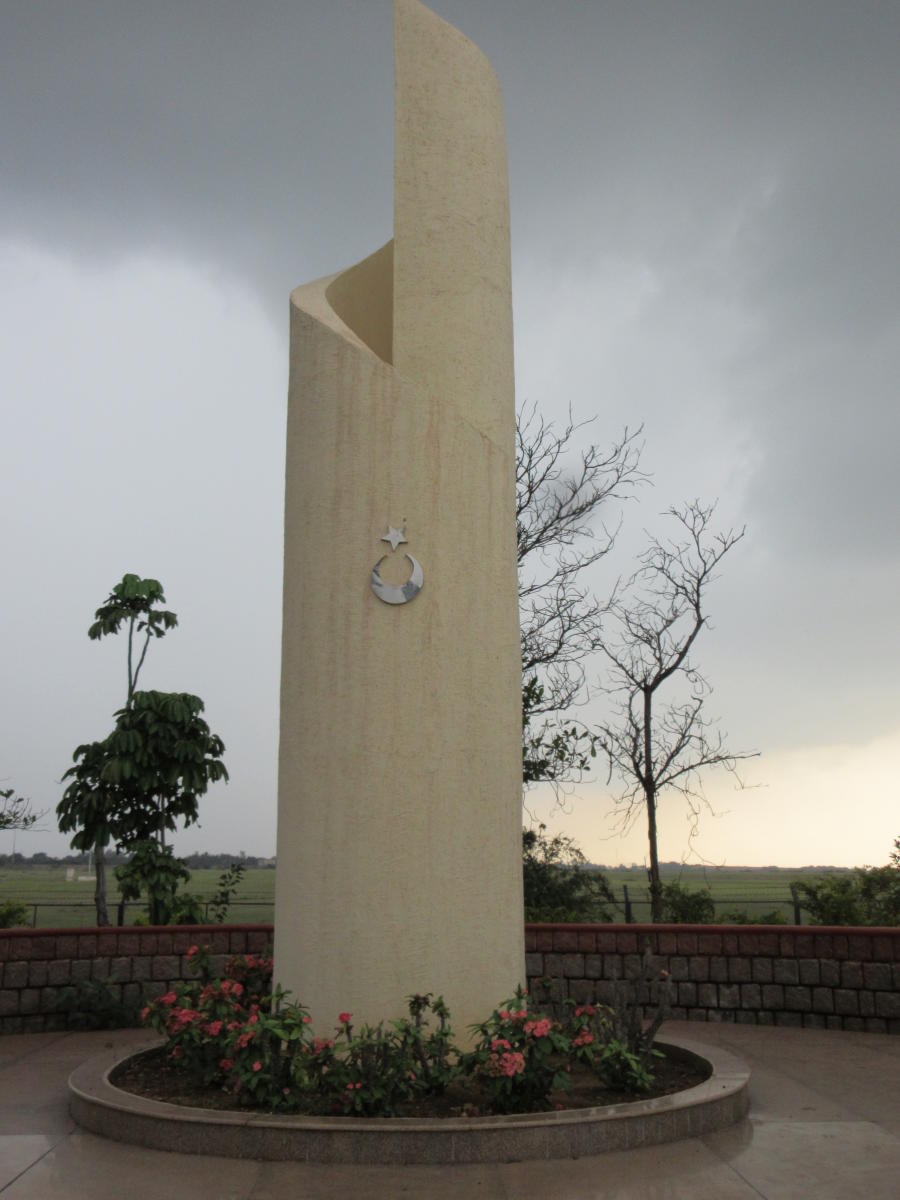
Before I set out on a journey to Turkey, I decided to visit the Turkish Martyrs Graveyard Memorial in Ballari, built in memory of Turkish Prisoners of War (PoW) of the First World War.
Turkish Memorial
The memorial is actually a spiral column built over a rectangular platform. Indian and Turkish flags flutter on both sides. The cylindrical spiral structure in white is surrounded by fountains, multi-coloured floral plants with Ashoka trees and rose plants on the border. The memorial is located close to the airport.
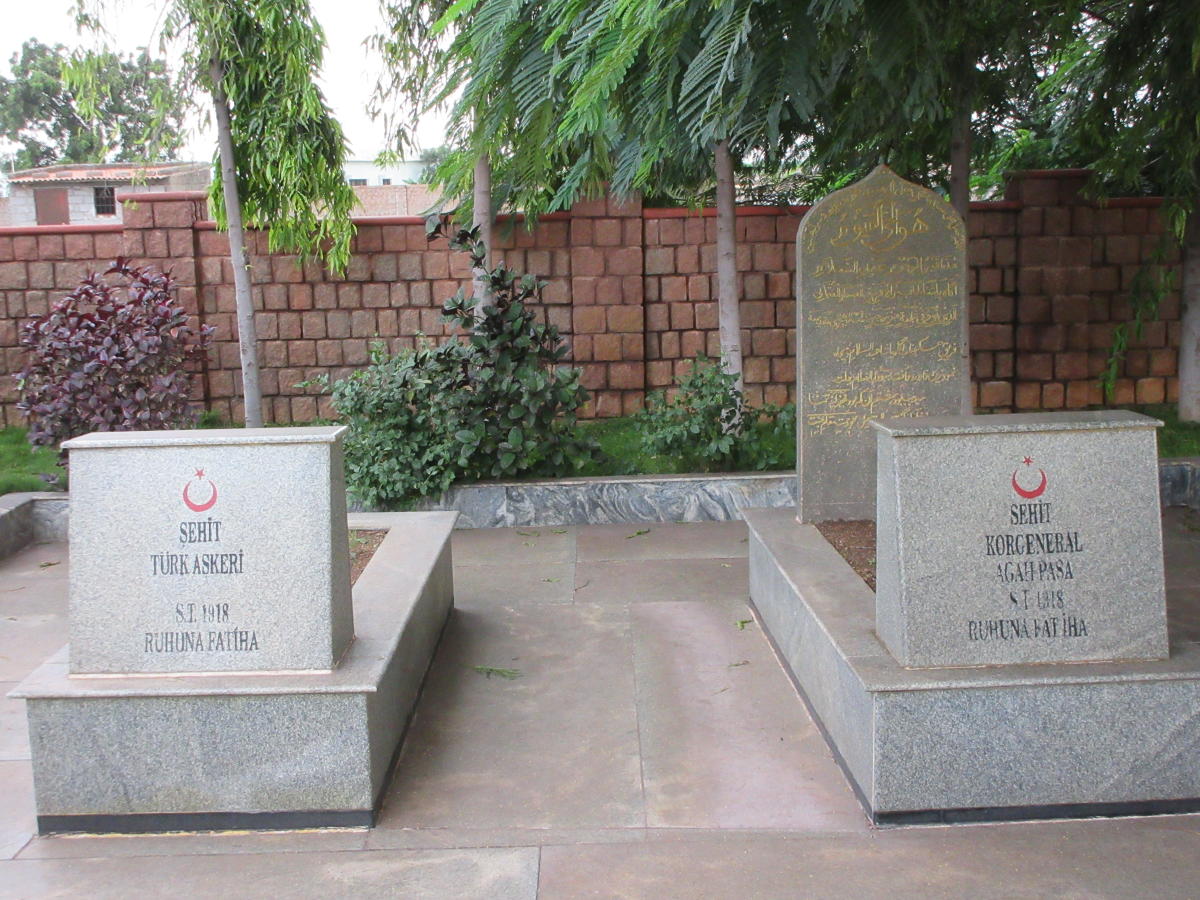
There are two marble-dressed graves on its left side. A memorial plaque on one of them refers to General Agha Pasha Abdussalam, the prince from the Ottoman ruling family of Turkey, buried there. The second one refers to Turk Askeri.
The epitaph on the memorial (it also has a Turkish translation) reads: “Here lie the Turkish martyrs brought to India in the year 1918 as prisoners of war during World War I from the Suez Canal front where they had fought. God bless them all.”
Turkey is a nation straddling eastern Europe and western Asia. Suez Canal is a sea-level waterway in Egypt connecting the Mediterranean Sea to the Red Sea through the Isthmus of Suez. And Ballari is in South India. These contradictions increased my curiosity to unearth the links.
A tale of tragedy and futility of war silently unfolded when I began digging deep into history. I realised that the memorial traces its roots to the brutal first world war.
Tale of tragedy
After about a century since the war ended, the memorial in Ballari stands tall silently reminding the greed of rich belligerents trying to get richer by inflicting large-scale violence, brutality and futility.
Austria and Hungary declared war on Serbia on July 28, 1914, over the assassination of a leader, triggering the first world war. A web of entangling alliances and the manoeuvrings of diplomats and generals dragged ambivalent nations into an unnecessary war.
The war pitted the Central Powers—led by Germany, Austria-Hungary and Turkey—against the Allies—led by France, Great Britain, Russia, Italy, Japan and the United States. The Allies won the war which claimed maximum lives in the history.
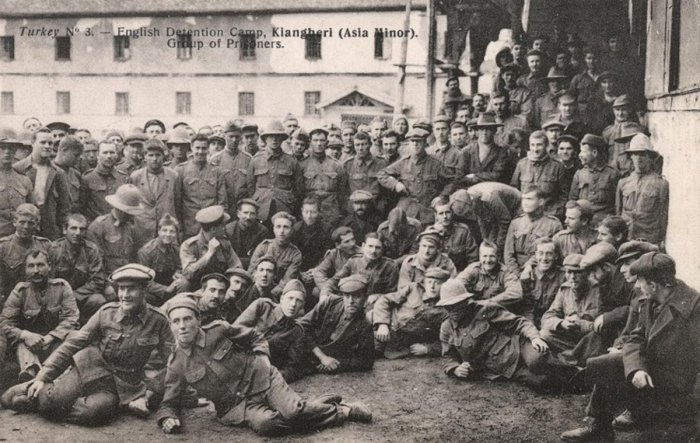
The Allies captured soldiers of rival forces, while soldiers of the Allies were taken captive by the Central Powers. About 1.5 lakh soldiers from Turkey were taken captive by the British forces. Turkey had detained 34,000 British soldiers.
The two sides had a common problem, lack of prisons to keep captive soldiers. And they were unwilling to keep rival soldiers in their motherland.
About 8,000 soldiers from Turkey, Germany and Austria, in British captivity, were placed in British colonies, in Egypt, India, Burma (now Myanmar).
Sumerpur in Rajasthan; Ahmednagar, Belagavi and Ballari in Bombay province; Kata Pahar in Bengal and Burma were chosen for the detention of prisoners.
Soldiers from Austria and Germany were interned at Ahmednagar, Christian citizens and women at Belagavi, and Turkey soldiers at Sumerpur, Ballari and Burma.
The British establishment shipped the prisoners from the port city of Basra in Iraq to Karachi and later sent them to Kolkata by train. One team was sent to Burma, while the second one to Sumerpur, Ahmednagar, Belagavi and Ballari.
The entire exercise was ironical and a large number of soldiers died on the way to Karachi from Basra. Hundreds of them were injured while being shipped. All these met with gory and gruesome deaths due to hunger, starvation and a lack of treatment.
Conflicting theories
Historians consider their journey as a procession of deaths. Many of them, who had survived starvation before reaching India, lost their battles against changing weather conditions and food.
Hundreds of them fell prey to infectious diseases as prisoners from different nations were housed collectively. In the Egyptian camps, a contagious eye spread relatively quickly blinding prisoners.
As many as 137 soldiers were kept at Allipuram Jail in Ballari. There are conflicting theories on how they died. One theory says a trigger-happy British officer massacred them en masse. The second theory quotes plague as the cause for the deaths.
Locals claim that there used to be hundreds of graves of Turkish soldiers in the area until the 1980s. A major part of the remains was erased during the expansion of the Bellari Aerodrome.
Commemorating sacrifice
The Turkish Embassy in Delhi negotiated with the Indian government for a memorial to commemorate the sacrifice made by the soldiers for the nation ten thousand miles away from their motherland. As a result, the Turkish Martyrs Graveyard came up in 1980.
Since then, the Indian and the Turkish flags are hoisted twice a year – on August 15 and January 26.
Details of Turkey soldiers in Ballari come from the lone report of Red Cross Society. A high-level committee at the Geneva convention in 1971 decided to send the Society teams for reports on charges of brutalities meted out to soldiers at camps.
A team visited Ballari, Egypt and Myanmar as part of the decision. The team members visited Ballari on March 17, 1971, and submitted a report regarding the medical facility, food, physical and mental health of the prisoners. The most common complaint from the prisoners was that they hardly heard anything from their family members.
Due to isolation, the futility of war and uncertain future, most of them became mentally ill. They had converted a hall meant for prayer to play games. They also used the hall as a coffee house, played Dice Chess Dominoes, consumed Turkish coffee without milk and demanded books in the Turkish language for reading.
In the end, the report expresses confidence that the Turkey soldiers would surely say that the British establishment took proper care of them in India once they reached their hometowns. However, it is not known even today if they returned to their hometown.
The ordeal of soldiers from England and India in Turkey prisons was no different. There are memorials all over the world commemorating sacrifices made by foreign soldiers. Most of these soldiers laid down their lives for the British imperialism.
These memorials never reveal why wars were fought; why soldiers were killed; why they were shipped and interned in different continents; what happened to their families after their deaths. These memorials also mirror inhuman acts of war.
(Translated by Jagadish Angadi)
source: http://www.deccanherald.com / Deccan Herald / Home> Spectrum> Spectrum Top Stories / by Rahamat Tarikere / December 19th, 2019
The British unleashed ruthless violence over Mappilas to quell the rebellion in south Malabar taluks
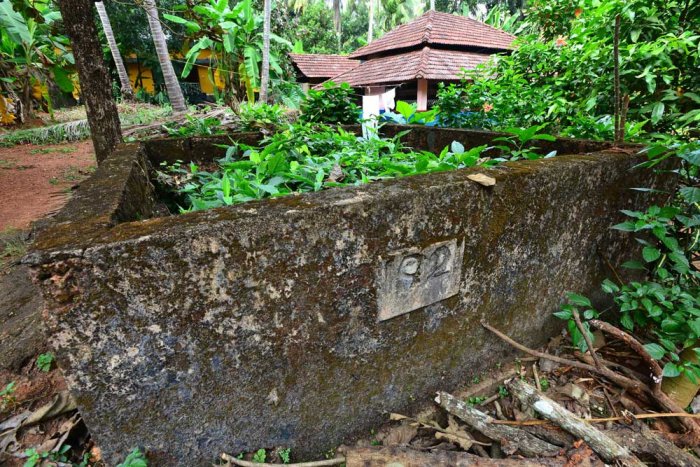
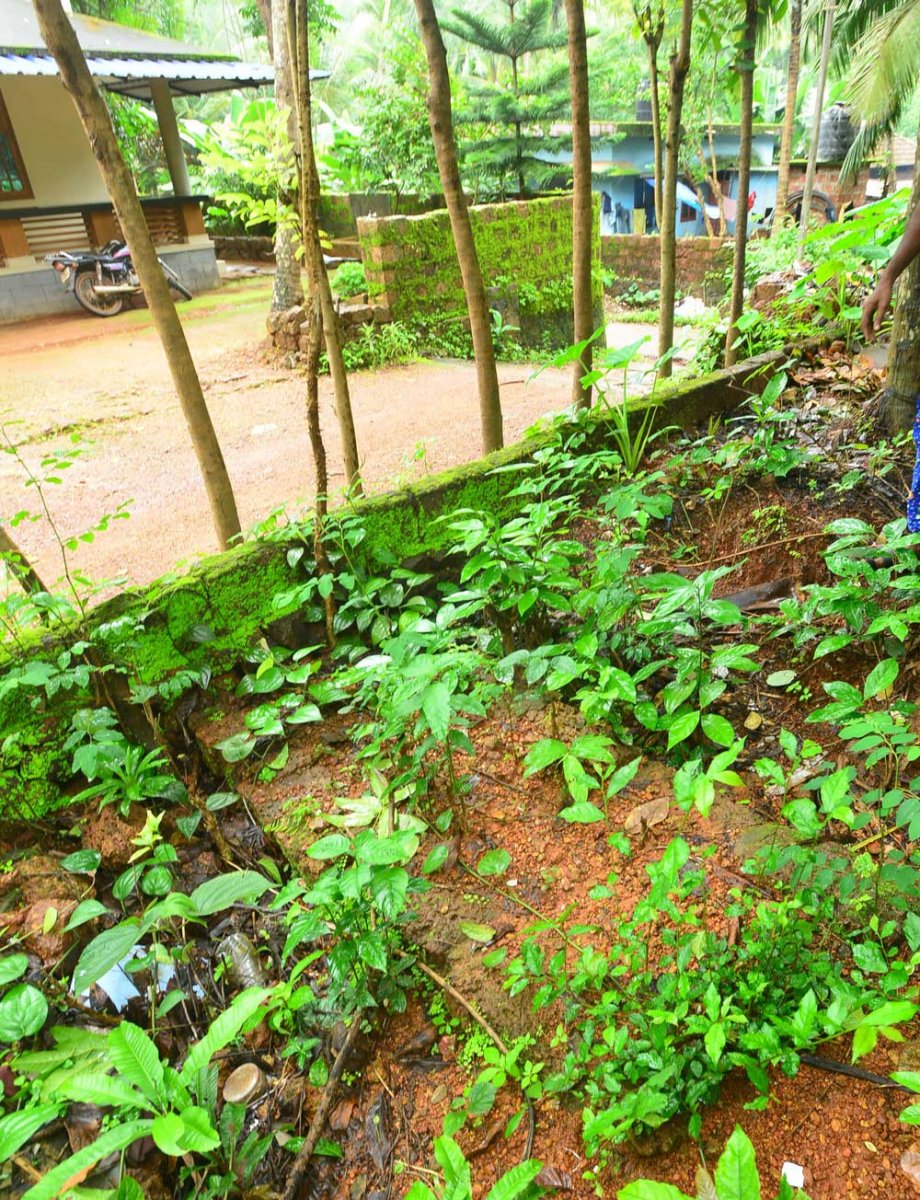
A mass grave in Adhikarathodi, Melmuri, where 11 bodies had been buried after the massacre. (Photo courtesy: Sameel)
Ninety-seven years ago on this day, the British army massacred 246 people in a small village in the Malappuram district of Kerala as part of a crackdown against the Mappila rebels.
The Mappila Rebellion was part of the non-violent Khilafat Movement led by Mahatma Gandhi and the Ali Brothers in 1921-22. The Mappila Muslims, who reside in the south Malabar region, had taken the movement seriously and engaged in combat with the well-equipped British army.
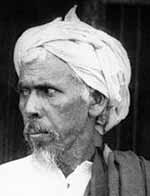
Ali Musliyar (Courtesy: Wikimedia)
The Mappila warriors, under the leadership of cleric Ali Musliyar and Variyam Kunnath Kunjahammed Haji (V K Haji), captured the taluks of Eranadu and Valluvanadu from the British and established their own rule.
After a short period, the British suppressed the rebellion savagely by letting loose the Gurkha Regiment, Dorset Regiment etc. According to official data, more than 2,300 people were killed and over 45,000 rebels were imprisoned in different jails across the country (the numbers are five-fold higher in unofficial records).
The rebellion had a huge impact on the region as well as the country. Mahatma Gandhi distanced himself from the rebels stating that the rebellion was just “an outburst of fanatics”. Several works, both critical and in support of the rebellion, have been published, but most of them are silent about the British crackdown on the rebels.
Two bodies were buried in this grave. (Courtesy: Sameel)
Unmarked graves
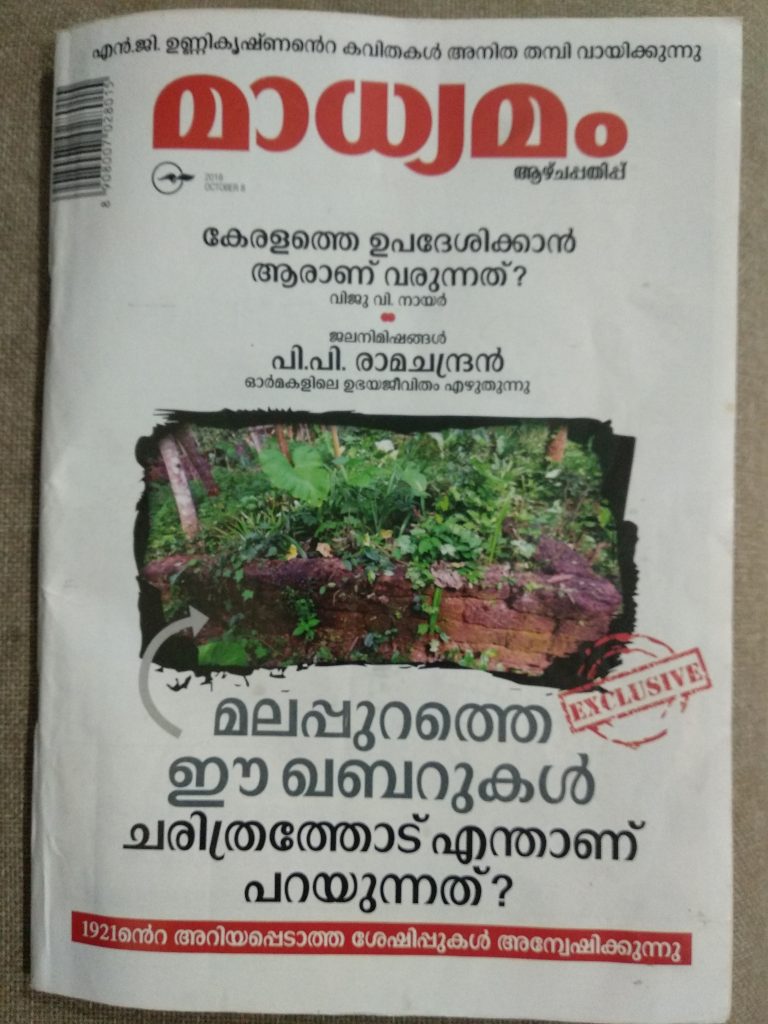
This bloodbath, which was largely forgotten, came to light after a three-year-long research by a journalist. Illikkal Sameel, who is with a Malayalam media organisation, spent four years documenting the history behind unmarked graves in a village located 3 km from the Malappuram district headquarters. In a detailed report published in Madhyamam Weekly, a Malayalam magazine, Sameel has illustrated the brutality of the British towards the Mappila, mostly innocents, including the old and the sick, to terrorise the rebels who had driven the mighty English force away from the region for months.
Cover page of Madhyamam Weekly.
In an ironic twist, Sameel, who resides in a nearby village, got to know about this forgotten historical episode four years ago from a friend, K Ashraf, who is pursuing his PhD from Johannesburg University, South Africa. Ashraf informed Sameel about the undocumented graves dating back to 1921 present in the area.
Initially, Sameel could find only five graves at Adhikarathodi in Melmuri village but nobody had any details about those buried there. After tracing the descendants of those buried, Sameel obtained information of 40 people from nine graves. All the graves had more than one body buried and among them one had upto 11 bodies.
“Malabar struggle is a well-researched topic from Kerala’s freedom movement and several scholars are still trying to explore more aspects. But I could find no trace of this particular massacre in any of those works,” Sameel said.
“In a casual conversation, a researcher in Malabar history mentioned Dorset Regiment and their involvement in suppressing the rebellion. I dug further to get details of the regiment and their expeditions, that was also futile,” Sameel explains.
From an octogenarian physician Dr Thorappa Muhammed, Sameel got to know that the number of people killed in the massacre was more than he could count. Muhammed told him that the number would go above 200 and challenged him to look at official British documents for more information.
Connecting the dots
“Most of the documents are not publicly available now, so I started flipping through the contemporary chronicles of officials. Among them, I went through a book of the Personal Assistant of Kozhikode Collector Mr Gopalan Nair’s ‘The Moplah Rebellion 1921’, which was published in 1924. In that book, he has just mentioned that the Dorset Regiment met some rebels near Melmuri and it led to the killing of 246 people on October 25, 1921,” said Sameel.
A book by the then police inspector of Malappuram, R H Hitchcock, describes every moment of his life as a British officer in Malappuram.
“The book is no more in print, hence, I got a photocopy of the book from one of my friends and a professor at Malappuram Government College, Dr Jameel Ahmed,” said Sameel.
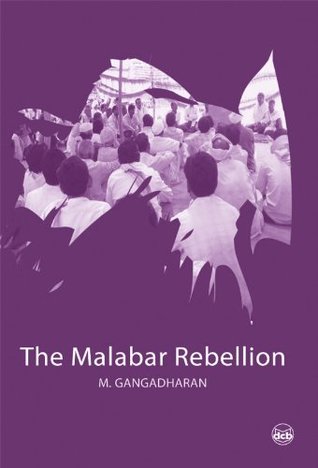
Another historian, Dr M Gangadharan, has cited British officials G R F Tottenham and C T Atkinson in his work on the Malabar struggle. Sameel found Tottenham’s book to be the most valuable as the author had added all the official communications, notes, commission reports etc., that were available during the rebellion.
“I stitched all these details together with the verbal accounts of various residents and stories of survivors to write this report. It was a painful effort,” said Sameel.
Earlier efforts
In the early 2000s, an article published in ‘Souvenir’ as part of the Pookkottur War anniversary had made some efforts to cover the massacre.
Some young enthusiasts and writers had also made videos regarding this massacre and related artefacts still available in the area. The information for these efforts led Sameel to more graves.
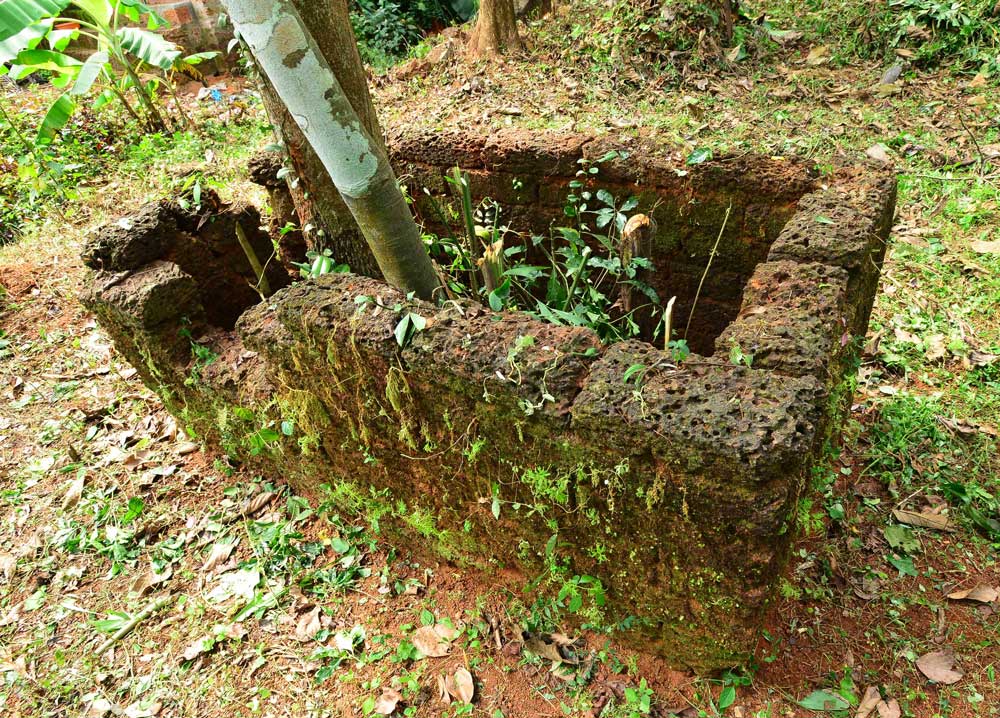
Two feet deep grave. (Courtesy: Sameel)
‘Girls were murdered’
“Dr Thorappa Muhammed had mentioned graves dug by Muslim women as men were unavailable to conduct the funerals,” elaborates Sameel. “I found two such graves in the latest expedition. Unlike the usual six-feet deep Muslim graves, these were only two feet in depth,” he said.
“As per some official documents and the accounts of descendants of the dead, a significant amount of the people killed in the massacre were innocent. Family members told me about men, including aged and sick, being forcefully dragged out of their home and shot. Two girls who were trying to protect their fathers were also shot by the army,” Sameel added.
Punished for links?
Apart from a telegram communication of the officials mentioning the short-engagement between Dorset and rebels in Melmuri after the Mappilas were attacked, there is no other evidence to lead us to the motive behind the massacre.
“A large gang reported last night four miles north-west of Malappuram. Operations are undertaken against them by Dorsets, Artillery and armoured cars. Enemy met in jungle west of Melmuri opposing our troops there and in the houses, refusing to come out when ordered to surrender and offering continued opposition resulting in 246 rebel casualties,” reads the telegram.
Sameel assumes the British unleashed violence in that particular place due to the presence of a big chunk of Ali Musliyar’s students and giving shelter to V K Haji when he was in underground.
He rules out any connections to the alleged Mappila brutality, including forceful conversion of non-Muslims. “In my research, I could not find any credible information about the forceful conversion. Rather, there are mentions of participation of lower caste people in the rebellion,” Sameel claims.
“If such forceful conversions had happened, where are the later generations of those people. But till now nobody came forward claiming as the descendants of ‘those people’,” says Sameel.
“The story of forceful conversion was to demonise Mappila warriors and justify the British brutality. Even the leaders in the freedom movement believed this story and ignored the ruthless suppression of the rebellion,” he added.
In his article, Sameel gives an account of assistance from Thiyya family, lower caste Hindus, to extinguish the fire set on homes of Muslim neighbours by the army.
The course of rebellion changes
The entire course of the rebellion changed after the massacre as more rebels surrendered. Also, the popular support to the rebellion had also diminished. The British created an impression among the people that none, despite being active or inactive in the rebellion, would be spared.
“This was the British strategy to terrorise the rebels as well as sympathisers of rebels to give a strong message: ‘either support British or die’,” Sameel added.
The British officials themselves accepted that all they killed were not rebels, but they cheered the increase in the number of submissions as a result of the army act.
“In the interval before they (Dorset Regiment) came into action, there had been several encounters with the rebels and on October 25th the Dorsets had killed 246 Mapillas in the Melmuri area. Not all of these probably were active rebels, and the encounter seems to have had a considerable moral effect, for shortly afterwards petitions began to be received from ‘amsams’ in the neighbourhood of Malappuram offering submission,” Under Secretary reported to superiors. (Tottenham, 39).
In the correspondence of F B Evans, I US, Special Civil Officer, he wrote that Malappuram Kazi with thousands of men and women pleaded for amnesty after the massacre. In continuation, he regrets about the bloodbath, saying, “I think this may be put down as the effect of the Melmuri show on the 25th when no doubt a certain number of comparatively innocent people were unavoidably killed.”
Complete cover-up
British and upper caste historians deliberately neglected this episode for their benefits, alleges Sameel.
British officials tried to cover up this brutality to suppress the rebellion as part of maintaining themselves from further reactions from Muslims from other parts of India and to avert the global scrutiny of the war crime.
Sameel demands an open apology and reparation from the British government for their brutality on innocent people.
“The massacres the British army unleashed as part of a crackdown on the rebellion in Malabar, including the one in Melmuri, was one of the deadliest violence in India when one looks at its intensity. There were families without men, as all men were killed or taken to prisons. Those families need both an apology as well as compensation. The Indian government should pressurise the UK for this,” Sameel said.
For generations to come
After publication of the article, Sameel received several calls from different corners detailing other similar massacres. He is planning to write a book with more descriptions and related events.
There is also a plan to produce a documentary on this. Malayalam filmmaker and director of hit movie ‘Sudani from Nigeria’, Zakaria Muhammed, has agreed to produce the documentary under the banner of his production house – Cross Border Camera.
Sameel hopes the history books will feature this episode in the coming days. “The episode of the massacre was known among the victims’ families, till the last generation. The present generation is not aware of this. I hope my work will instil curiosity among them,” Sameel added.
source: http://www.deccanherald.com / Deccan Herald / Home> Specials / by Ajmal V / DH News Service, Bengaluru / October 25th, 2018
The Punjabi festival of Lohri commemorates Dullah Bhatti for his act of defiance against the Mughal emperor.
Wikimedia Commons
Lohri in Delhi has bonfires, popcorn, peanuts, pine nuts, gur or jaggery and til and sundry sesame sweets. Around the bonfire, people gather to sing a popular Punjabi folk song , Sundar munderiye, about a certain Dullah Bhatti who helped to rescue poor Punjabi women from the rather cruel zamindar, landlord.
In the big city, cut off from folk legends, most of the people who sing that song are unaware of who Dullah Bhatti was. Bhatti, though, is a historical figure, a contemporary of Mughal emperor Akbar who lived in Pind Bhattian, a town about 50 kilometres west of Lahore.
Rai Abdullah Khan Bhatti – to use Dullah’s full name and title – lived in tumultuous times. Akbar was just beginning to consolidate the Mughal state, setting in process a new order that would ensure that his dynasty would rule Delhi for the next three centuries to come. The Mughal state proceeded to implement a system of land revenue devised by Akbar’s brilliant Rajput finance minister, Todar Mal, called the Zabt system. The Zabt revenue system made Mughal officers responsible for both the assessment and collection of revenue.
Punjab in chaos
What was victory from Delhi, though, often meant chaos and destruction on the ground, as old ways of life were overturned. The Zabt system underpinned the Mughal state but proved to be the end of the road for local power centres in the Punjab, as all authority was concentrated in the Mughal administration. One of those local power centres was Dullah Bhatti’s family, a Rajput landowning clan made powerless by the financial scheme of Mughal finance minister, Todar Mal. As a result, the Bhattis rebelled against Akbar – and lost. Both Dullah’s father and grandfather were executed – at the time, Dullah’s mother was pregnant with him.
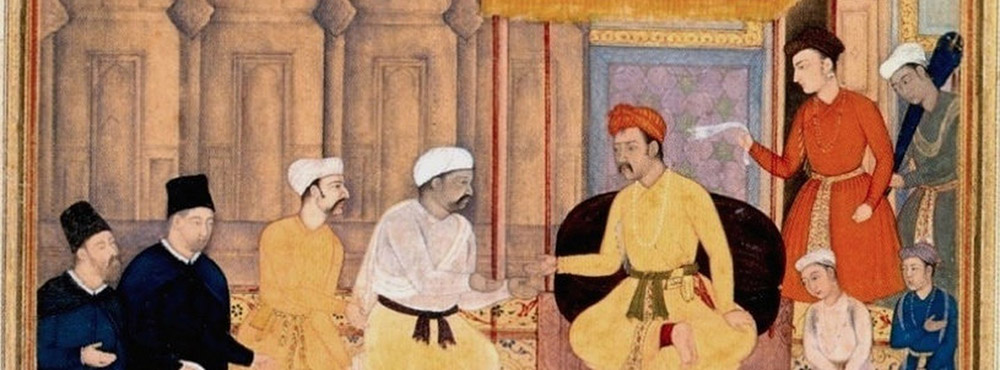
Legend now has it that Akbar’s son Jahangir and Dullah were born on the same day. To make Jahangir brave, Akbar was advised to have his son breastfed by a Rajput wet nurse who – in an incredibly filmy twist – happened to be Dullah Bhatti’s mother, in one version of the legend. A more prosaic explanation for this myth is that the Mughals initiated a policy of reconciliation with the Bhattis. By providing Dullah and his mother with royal patronage, the Mughal state hoped to assuage their hurt, win them over and – most importantly – prevent future rebellions.
Things, however, didn’t go according to plan. Bhatti grew up to swear revenge on the Chughtais, Mughals who had executed his father and grandfather. So fierce was this local resistance that, says historian Ishwar Dayal Gaur, Akbar had to shift his capital to Lahore from Delhi for two decades to try and get things under control. Gaur also adds that Akbar exempted the Bari Doab or Majha (the region between the rivers Beas and Ravi) from taxes and also made peace with the Sikh guru, Arjan Dev by visiting him in Goindwal – Bhatti’s revolt was so effective that the Mughals couldn’t afford to make any new enemies.
Dullah Bhatti becomes legend
Ultimately, though, Akbar prevailed, the Mughals capturing and beheading Dullah publicly in the main bazar area of Lahore. Till the last, though, Bhatti remained defiant and his final words as recorded by sufi poet Shah Hussain were, “No honourable son of Punjab will ever sell the soil of Punjab”. His grave still exists in Lahore, although interestingly, there is no official recognition of the spot. Pakistan – a country which is dominated by Punjabis – still takes much of its national mythos from the Mughal state, making its recognition of Dullah Bhatti’s revolt against Akbar a rather delicate matter.
Nevertheless, Dullah’s revolt passed into popular Punjabi legend and his feats as a Robin Hood are still celebrated today in the popular song Sundar munderiye, which talks of how he protected Punjabi girls from being abducted by the Mughal zamindar. The custom of giving money and sweets to children, who go from door to door singing the song, is said to honour Bhatti’s acts of generosity, of looting the tributes and taxes sent to the emperor and redistributing them among the poor.
In 2015, Bhatti’s tale was even made into a Punjabi pop number, although the video of the song, interestingly, portrayed him as a Sikh battling the Mughals, rather than the Muslim Rajput Bhatti historically was. Given that our histories rarely talk of the complex nature of Mughal India, and reduce most situations to a mirror of the communal conflicts of the modern age, this, perhaps, is an expected error.
source: http://www.scroll.in / Scroll.in / Home> Festival Celebrations / by Shoaib Daniyal / January 13th, 2016
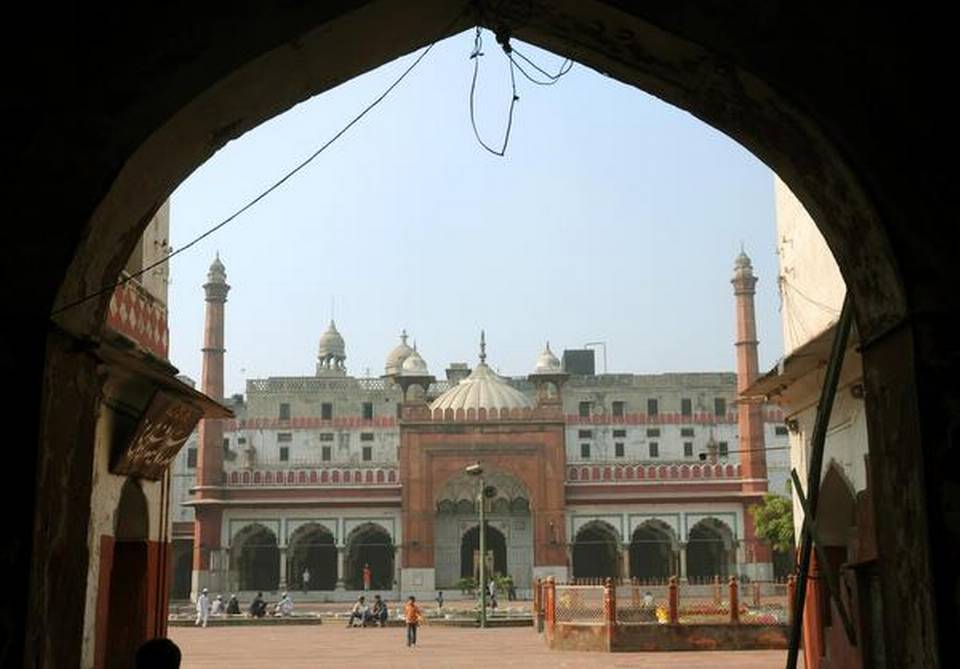
Grand design: A view of Fatehpuri Masjid | Photo Credit: V_V_Krishnan
From Haji Begum to Qudsia Begum, there is a a long list of women who contributed to the city’s grandeur
Women who patronised Delhi and converted it into a centre of art and culture, besides making it verdant and floral by laying parks and gardens, can be traced right from the time of Bega Begum or Haji Begum who built the beautiful tomb for her husband in Nizamuddin, which became the model for the Taj Mahal. After her, the daughters of Shah Jahan made it a paradisiacal city (just as Nur Jahan had done so earlier in Lahore and Kashmir). They were followed by Qudsia Begum and in recent times, in a small way though, by Lady Willingdon, Aruna Asaf Ali, Indira Gandhi and Sheila Dixit, among others. From the mid-17th century, the social and cultural fabric of Shahjahanabad has borne the stamp of women as during the Mughal era they acquired considerable wealth and influence. Much of what survives in Shahjahanabad reminds us of them and their contribution, compiled from different sources.
The imperial city was given overall shape under the supervision of Shah Jahan himself. His diktat determined the encircling of the city wall and the two main streets, running north-south and east-west, respectively at their junction of the palace complex (Red Fort) and the congregational Jama Masjid. “Within the limits of this centralised plan, it was mainly individual enterprise that led to the creation of commercial, religious, public spaces and homes.” Among the landmarks of the city were its mosques, three of which were commissioned by the wives of Shah Jahan after the death of Mumtaz Mahal – Akbarabadi, Fatehpuri and Sirhindi masjids named after the three. Akbarabadi Begum of Agra built a grand mosque to the south of Red Fort which was demolished by the British after the Revolt of 1857. Akbarabadi Begum was gifted a garden by Shah Jahan to the north-west of the city which came to be known as Aizzabad or Shalimar Bagh. The Begum then built a sarai within it. It was in this garden that the coronation of Aurangzeb took place on the July 31, 1658, after he had deposed Shah Jahan and also the place where Gen Ochterlony caught a chill that led to his death. Another wife of the emperor, Fatehpuri Begum built a mosque at the western end of the street that led from the Red Fort, which is known after her name. The Sirhindi Masjid, just outside the city wall, was built by the third wife, Sirhindi Begum.
Women of influence
Shah Jahan’s elder daughter, Jahanara commanded great influence and resources. She was well-educated and also had leanings towards Sufism. Jahanara’s wealth enabled her to patronise works of learning, like commentaries on Rumi’s Masnavi and for commissioning architectural projects, in which the pride of place was taken by the moonlight square, Chandni Chowk.
Mughal ladies who continued the tradition of Jahanara and Roshanara were Aurangzeb’s wife, Aurangabadi Begum who built a mosque near the Lahore Gate. The emperor’s two daughters, Zinat-un-Nissa and Zeb-un-Nissa, were also great patrons. Zeb-un-Nissa is the author of poems composed under the alias ‘Makhfi’. A skilled calligraphist, she patronised many writers, poets and learned men and commissioned several important books and tracts. She was buried in the Tees Hazari Bagh, inherited from Jahanara, but her tomb is hard to find.
Her sister Zinat-un-Nissa built a grand mosque beside the Yamuna in 1700 which is called Ghata Masjid now, her tomb, north of the mosque, was demolished in the aftermath of 1857 while the mosque was used as a bakery for British troops.
Story of Sunehri Masjid
Qudsia Begum laid Qudsia Bagh to the north of the city in 1748 whose grand buildings and a mosque were badly damaged during 1857. She also constructed Sunheri masjid near the southern gate of the Red Fort in 1751, whose dome were originally gilt-covered. A noted Shia, she constructed a number of buildings in Jorbagh, at the Dargah of Shah-e-Mardan, the shrine of the footprint of Hazrat Ali. Fakhr-ul-Masjid, near Kashmeri Gate, was built in 1728-29 by Kaniz Fatima in memory of her husband, Shujat Khan, a commander of Aurangzeb’s time who was killed during a military campaign in Kandhar.
Rabia Begum built a palatial house south of the Jama Masjid in the 18th Century. She was the wife of Muhammad Khan Bangash, the Governor of Farukkhabad, Agra and Allahabad. Rabia also commissioned a number of other structures, including Pul Bangash. Some buildings are named after unknown women such as Burhiyas’ (old women’s) mosques, two other anonymous ladies built Mir Afzal’s mosque in the Lal Kuan area in 1806. In fact, there were a large number of mosques and temples built by women at that time. These included three mosques, a Kali temple and several Shiva temples. Mubarak Begum, a dancing girl, built a mosque in Lal Kuan which came to be known as “Randi-ki-Maszid”. But now it is known after her name. She was the chief mistress of Gen Ochterlony. Better known than her and other 18th Century women was Begum Samru, a Kashmiri dancing girl of Chandni Chowk who had married the European military adventurer, Walter Reinhardt ‘Sombre’. His nick name, Sombre, or ‘dark’ was corrupted to Samru. After his death, his begum inherited the estate of Sardhana. She also successfully led military expectations and made astute political alliances.
Zinat Mahal was the wife of Bahadur Shah Zafar who became a powerful influence within the palace, and controlled a good deal of wealth. In 1846, she built a mansion in Lal Kuan Bazar. Her aim was to establish herself in the city, so that when the emperor died, her property and person would not be under the jurisdiction of the new emperor, who might be one of his older sons. So how can one overlook the contribution of women (royal or not) to Delhi’s grandeur?
source: http://www.thehindu.com / The Hindu / Home> Society> History & Culture / by R.V. Smith / December 10th, 2018
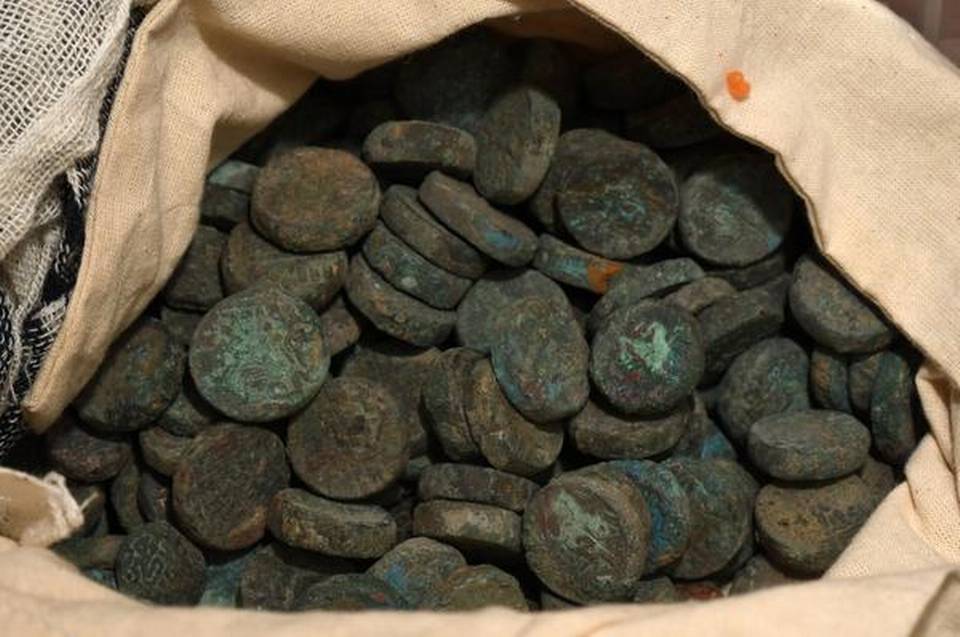
The style of writing on the coins indicates that they might be from the Lodi dynasty. Photo: V.V. Krishnan | Photo Credit: V.V. Krishnan
The discovery of over 250 copper coins at Khirki Mosque is expected to throw light on Delhi’s medieval period
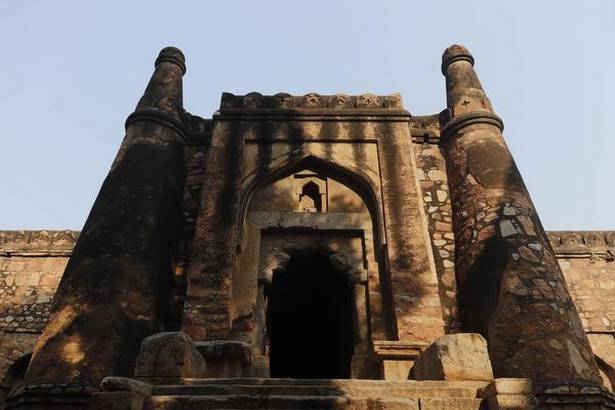
Khirki is crowded, with narrow roads and tall buildings bundled together like Lego bricks stacked precariously. Smack in the middle of this chaos is Khirki Mosque, a 14th century fortress-like structure built during the Tughlaq dynasty.
The mosque is fenced in by high compound walls and the uneven ground is lower than the houses that surround the structure. It is deathly quiet inside, with its myriad archways partially lit by Delhi’s smoggy sunlight. Standing there, it is easy to imagine a priest, or a trader, furtively hurrying along the walls of the mosque to find a spot to bury treasure.
Treasure is what the Archaeological Survey of India (ASI) found two months ago in this complex — a hoard of small copper coins vaguely resembling those bite-sized Britannia biscuits from the 90s.
Happy chance
A team from ASI’s conservation wing was levelling the ground in early September as part of ongoing conservation work when one of the workers’ pickaxes landed on a mud pot. Work was halted and ASI archaeologists were called.
The office was abuzz when they learned about the discovery, says N.K. Pathak, superintending archaeologist, ASI-Delhi circle. “As soon as the coins were discovered, there was a big halla. For archaeologists, discoveries like this are always exciting, no matter the value. Everyone said, Khazana mil gaya!” he says, laughing.
The style of writing on the coins indicates that they might be from the Lodi dynasty. | Photo Credit: V.V. Krishnan
The discovery of these coins is what those in the field call a ‘chance discovery’, as opposed to a planned dig. The mosque is also the site of an earlier discovery of 63 coins in 2003, which was also a chance discovery. There is a possibility that both sets of coins might be from the same era.
Preliminary investigations of the 254 coins reveal that they are from Delhi’s medieval period — 13th to 16th century — the latter part straddling the early modern period. Proper identification can happen only after they are cleaned and studied, says Pathak. “However, some of the coins belong to the reign of Islam Shah Suri.”
Inscriptions on the coins
Islam Shah Suri is the son of Sher Shah Suri, who founded the Sur dynasty and ruled Delhi for seven years from 1538 to 1545. “Most Islamic coins have inscriptions (what we call legends) on them — the name of the ruler and their father’s name. In this case, some of the coins had ‘Islam Shah Suri, son of Sher Shah Suri’ inscribed on them,” says Shahmoon Ahmad, Assistant Archaeologist, ASI-Lucknow circle, who will be studying the coins further.
Notably, it was Sher Shah who introduced the precursors to the modern rupee and paise — the silver rupaiya and the copper paisa. The gold coins issued by the Sur dynasty were called mohurs. “Discoveries of gold and silver coins are rather rare. Copper coins are not that much of a surprise,” says Pathak.
That’s because copper coins were reused by the general populace; the gold and the silver ones had to be re-minted with the names of current rulers, adds Ahmad.
He suspects that this might be true for this hoard as well. There are several paleographic indications — the style of writing — that indicate that some of the coins might be from the Lodi dynasty, which fell less than two decades before Islam Shah’s reign.
However, any discovery, even something as small as a copper coin hoard, is quite significant. “The monument is of the Tughlaq period, but the coins are from the Lodi and the Sur periods. Once we date the coins, we can establish that people used money regularly from the earliest date on the coin to the latest,” says Ahmad.
Interestingly, the fact that there are coins from two different dynasties might mean that this was not the hoard of a single person. “It could be the savings of one or two generations of a family,” he adds.
These coins can also establish other things. “They tell us this area was populated, the jurisdiction of the particular ruler, the prosperity of his rule, the money usage patterns, and so on,” says Pathak.
The coins also show that the mosque was in use during the reign of that particular ruler.
If they were indeed minted during the time of Islam Shah, it would mean the mosque was in use even 200 years after it was built.
Khirki’s secrets
More than half a millennium later, however, the Khirki Mosque is in bad shape. The buildings that flout ASI’s 100-metre-rule is the least of the concerns. There are broken pillars, loose bricks, decaying stones, a decades-old bat infestation, and more. The boundary wall around the monument came up only in 2003, according to an earlier report in The Hindu.
Conservation work, which began roughly mid-August, started with clearing the debris to bring the lower plinth of the monument to an even level, says deputy superintending archaeologist, Sanjay Kumar Singh. “It was also to make the movement of water on the ground smoother, especially in the monsoon. So work began with levelling the ground,” he says.
When the coins were found, the area around the discovery was carefully cordoned off, while all the debris and mud excavated so far were sieved thoroughly for more surprises from the past. “There is possibility to get anything, even pot shards, at any important site in Delhi. Workers, supervisors, and other staff are trained to be vigilant. We tell them this work is different from what the Public Works Department might do,” says Pathak.
Conservation work will go on for another six months, during which time the broken pillars and the decayed chajja stones will be replaced. “We will also undertake ‘pointing and underpinning’ work to fix the loose bricks and mortar. We will be using the lime mortar mix that was originally used,” adds Pathak.
Detailed information on the coins, however, will roll in before work on the monument is finished. “We will first send them to the science branch for cleaning, after which our numismatics branch will come in to decipher the writing. It will take three to four months,” says Pathak.
What are the possibilities of finding more antiquities here? “That’s just it,” he says. “You can never predict what you can find in Delhi and when. What is beneath the earth, you never know.”
janane.venkatraman@thehindu.co.in
source: http://www.thehindu.com / The Hindu / Home> Society> History & Culture / by Janane Venkatraman / December 08th, 2018