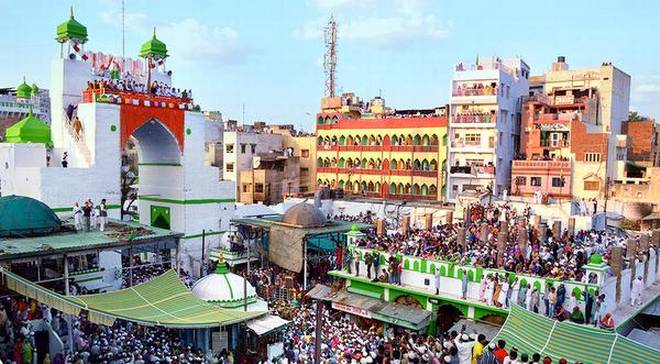
A visit to what some call the Taj Mahal of the south
What comes to your mind when you think of Hyderabad? Sumptuous haleem and biryani, perhaps? Or the beautiful icon of the city, Charminar? Or maybe the unique khada dupatta and its accompanying necklaces, if you love clothes and handicrafts. All of these are understandable connections. Few would relate Hyderabad to an exquisite necropolis that is hidden away in the heart of the city, which I discovered recently thanks to a friend.
Dilapidated graves
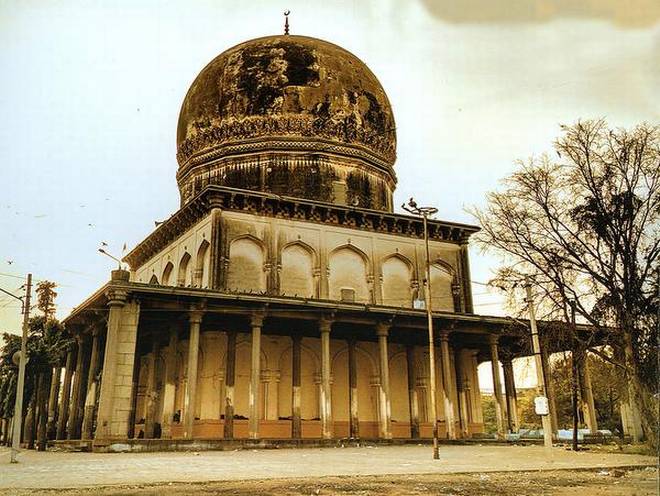
At the entrance of the Pisal Banda suburb in Santosh Nagar, I stopped at a small café and asked for directions to this necropolis. No one seemed to have a clue. As I was following the GPS, I decided to trust it and ventured deeper into the crowded alley. Soon I saw a modern grave enclosure with the words ‘Paigah Tombs’ written on it there. I felt a little cheated, but then to my delight, just behind the grave enclosure was a white gateway which I entered.
On my right lay many dilapidated graves inside a rectangular enclosure. Some were as new as 2009, while some others were at least a century old and reminded me of verses on the dismaying finality of death and the futility of gathering wealth.
With my loud sighing at this state of disrepair, I managed to attract the attention of a caretaker of the Archaeological Survey of India (ASI), Rahmat, who then gave me a conducted tour.
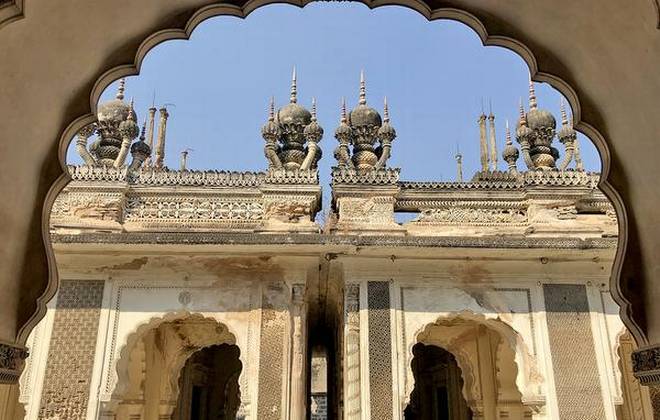
In the courtyard were intricate work on the walls and small cupolas with Grecian horns on the roof, which were not only breathtaking but also striking in their originality. I had never seen work like this before. There were limestone trellises, ornamented pillars and roundels on the façade of the tombs. “You won’t find such work anywhere in the south or north,” Rahmat said proudly.
And how can it be that we speak of a tomb and someone hasn’t already compared it to the Taj Mahal? This is called the Taj of the south, Rahmat said, which I frankly think is gross injustice. There is no similarity in the architectural styles of the two tombs and this one is beautiful in its own right.
Origin of the name
The Maqbara Shams-ul-Umara, now better known as the Paigah Tombs, belongs to a family which was ranked only second to the Nizam of Hyderabad and to whom it was allied through matrimony. The family members were fierce loyalists of the Nizam and maintained an army to fight for the Nizam.
The word Paigah, which means pomp and rank in Persian, was a title given by the second Asaf Jahi Nizam of Hyderabad to the estate of Nawab Abul Fateh Taig Jung Bahadur in appreciation of the royal services rendered by him. The nawab was also conferred with the title of Shams-ul-Umra, which gives the tombs their name.
The first tomb, built in the 18th century and of Makrana marble, is that of Shams-ul-Umra, or the Sun of the Nobles, himself. It is delicate, with limestone and stuccowork on its enclosures. Twenty-seven members of the Paigah family, including the famous Nawab Sir Vicar-ul-Umra, are buried here.
The tombs all lie in a row under a foliated arched gallery with ornamented pillars and spectacular limestone jaalis on the façade of the buildings.
There are a number of open double storey enclosures that mostly hold several tombs inside. Each enclosure has limestone jaalis on the walls and exquisite carved teak doors as entrances. Each jaali is unique — some have motifs of fruits and flowers; others have drums, serpents, and vases.
The crypts are made of marble with intricately designed qalams (pen made of dried reed) or takhtis (slate) and headstones. A qalam or small raised mound on the cenotaph denotes that the grave belongs to a man, and a flat design of a slate denotes that a woman is buried here.
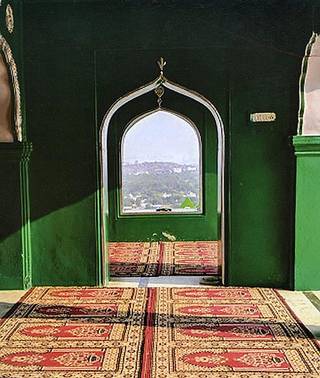
The architectural style inside the tombs and galleries is a mix of Rajasthani, Deccani and Persian, while the design on the roof is Moorish. The 30-acre compound also includes a mosque. Prayers are still held here. The sounds of the azaan and namaz waft over the graves. The Paigah family has handed over this architectural marvel to the ASI as part of our national heritage for safekeeping.
source: http://www.thehindu.com / The Hindu / Home> Opinion> Columns> Where Stones Speak / by Rana Safvi / January 21st, 2018
This Mughal-era artwork — geometric and floral motifs in an 80-metre-long vaulted arcade called Chhatta bazaar — was hidden under multiple coats of whitewashing applied casually over the years as part of Red Fort’s maintenance and structural conservation work.
New Delhi
An almost a year-long exercise by the Archaeological Survey of India (ASI) to restore a mural serendipitously discovered while cleaning the ceiling of a historic marketplace in Delhi’s Red Fort is on the verge of being completed and will be ready for visitors to see from next month, according to three senior officials familiar with the restoration work.
This Mughal-era artwork — geometric and floral motifs in an 80-metre-long vaulted arcade called Chhatta bazaar — was hidden under multiple coats of whitewashing applied casually over the years as part of citadel’s maintenance and structural conservation work. The ASI had forgotten about the mural’s existence, and discovered it last October when it began restoring the corridor that is lined by souvenir shops on both sides.
In addition to the mural, visitors to the Red Fort will be also have access to buildings constructed by the British during its 90-year-long occupation of the monument between 1857 and 1947. Four British-built barracks, which were under the control of the Indian Army since Independence and were inaccessible to visitors,are being converted into themed museums, said one of the officials cited above.
“The conservation of the painting on the roof of Chhatta bazaar may take another month. People coming to the fort after that will see Mughal-era art that was lying concealed for decades,” said the official, who asked not to be named because he is not authorised to speak to the media. “We will hand over all four barracks by end of this month,” he added.
The four museums proposed to be set up at the barracks will be dedicated to the first war of independence in 1857, the Indian National Army led by Subhas Chandra Bose, India’s soldiers who participated in World War I, and the Jallianwala Bagh massacre of 1919.
NK Pathak, ASI’s superintending archaeologist, Delhi circle, said that nearly 70% of mural has been restored and the remaining work will be completed in a few weeks. “Lime coats are being manually scraped of with precision, which is a time-consuming process. This is to ensure that the original design is not damaged. Once entire artwork is exposed, we will take measures to protect it. Hopefully, by mid-October, we will be able to finish the work,” Pathak said.
A third official said that around 30-35 experts from ASI’s science branch have been working tirelessly to restore the designs. “Chhatta bazaar’s passageway has bitumen, which is being replaced with red stone. We are also asking shopkeepers to remove encroachment and metal shutters. The shops will now have sliding glass doors. We will not allow any extensions. All efforts are being made to restore the market’s original look,” said the ASI official on condition of anonymity.
There are 32-arched two-storeyed bays on either side of the arcade. The shops, dating back to when the Red Fort was completed by emperor Shah Jahan in 1648, were meant for common people coming to the Mughal Durbar and the setting is a replica of a bazaar in Peshawar, according to historian Swapna Liddle.
The author of Chandni Chowk: The Mughal City of Old Delhi, Liddle said that the market once had shops selling clothers and jewellery. It still draws buyers visiting the fort, but the shops now sell handicraft items, wooden articles, and other souvenirs.
source: http://www.hindustantimes.com / Hindustan Times / Home / by Parvez Sultan, Hindustan Times,New Delhi / September 19th, 2018
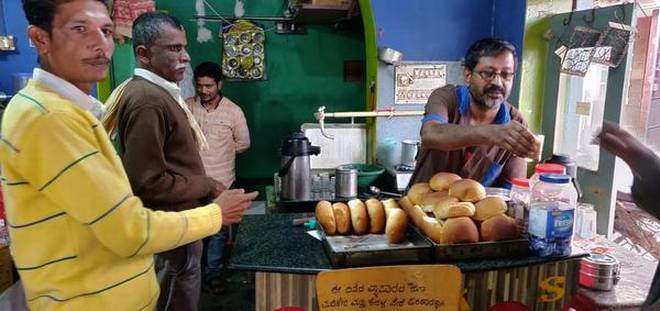
Shaik Ahmed, a roadside tea seller, plans to contribute his earnings on Saturday for rain relief works in Kodagu. | Photo Credit: Special Arrangement
A tea seller at Channarayapatna has contributed his day’s earnings towards the relief works in flood-affected Kodagu. Shaik Ahmed, 60, opened his shop on Bagur Road at 5 a.m. on Saturday with a board stating that whatever he got on the day would go to the flood relief funds.
Till 6 p.m., he had collected a little over ₹7,000. “My aim is to collect at least ₹10,000 for the relief work. I will keep the shop open till 9 p.m. and will hopefully reach the target,” he said.
Mr. Ahmed, a native of Sakleshpur taluk, has been living in Channarayapatna for the past three decades. For years he worked in hotels, but about six months ago he decided to open a tea stall of his own.
Mr. Ahmed, a father of three, was moved by the plight of the victims on news media. “I felt bad for the people affected. My wife and children also supported my decision. We have decided to make Bakrid a simple affair this year,” he said. He added that the business on the day was better than most days. On a normal day, he requires 25 litres of milk, but on Saturday he needed 40 litres.
“I did not give tea or coffee to any customer on credit today.My customers obliged. Many of my friends came to my shop just to give me some business,” he said. He plans to hand over the money to the authorities on Sunday.
Many organisations, including the Hassanunit of Red Cross, have collected donations from people for relief works in Kodagu and Kerala. Members of Prakruti Seva Samudaya, which works for the welfare of transgenders, have also raised funds for flood victims.
source: http://www.thehindu.com / The Hindu / Home> News> States> Karnataka / by Special Correspondent / Hassan – August 18th, 2018
The booklet edited by Department of Culture chronicles the dargahs of Hyderabad and sets right some of the preconceived notions about them
How many Dargahs does Hyderabad have? It is easy to remember. There is the Yousufain Dargah, Jehangeer Peer Dargah, Shah Khamoush Dargah, Husain Shah Wali Dargah, Shah Raju Qattal Dargah… And there ends the list for an average citizen of Hyderabad. The list, in fact, is quite substantial.
In an age where religious lines are hardening, the dargahs in India remain comparatively open spaces where the faith of the person is not questioned while entering. The people who come to find solace range from men sitting in corners in a forlorn way to women who come with their families and friends and sit outside, and then there are couples who pray for the intercession of the saints buried in the dargahs. Said dargahs also keep the social and spiritual life thrumming as they become epicentres for local festivals dictated by the lunar calendar. Urs, sama, chiragaan, sandal are few of the events inside dargahs that people living in the area wait for.
“Telangana is a confluence of different cultures, religions and beliefs. From the very rustic and rural Bonalu to the newer faiths like Christianity, people in the region have accepted and adopted all streams of beliefs. This book is a tribute to that,” says Mamidi Harikrishna, head of the Department of Culture who has edited the booklet called Culture of Amity being distributed free. The booklet lists 51 dargahs scattered across the city. “The list is exhaustive and we have discovered more. We will be listing 81 dargahs in the next edition of the book,” says Vasanta Sobha Turaga, an architect, who has edited the book along with Harikrishna.
Between the pages
Without delving into each specific religious space the booklet has information about the dargahs and what goes on in them and how they shape beliefs. “The earliest and the oldest are from the 13th to 14th centuries: the Pahadi Shareef (1266) and Jehangir Peer Baba (1318). And the latest is less than 15 years-old.” The booklet also tracks the progression and change in architectural style. “We have looked at the architectural style of the buildings. But we have also tried to look at the rituals and traditions. There is a lot of intermingling of practices and colourful rituals,” says Turaga who has plans to expand the work into something more substantial.
The booklet also sets right some of the beliefs which people have about the various dargahs. It calls out the belief that the structure atop Moula Ali hillock is a dargah while in reality, it is an ashoorkhana with a few practices of a dargah like the urs that is celebrated in the Islamic month of Rajab.
sources: http://www.thehindu.com / The Hindu / Home> Society> History & Culture / by Serish Nanisetti / September 10th, 2018
Explore a little-known facet of Goan history with our Quick Guide to the Safa Masjid
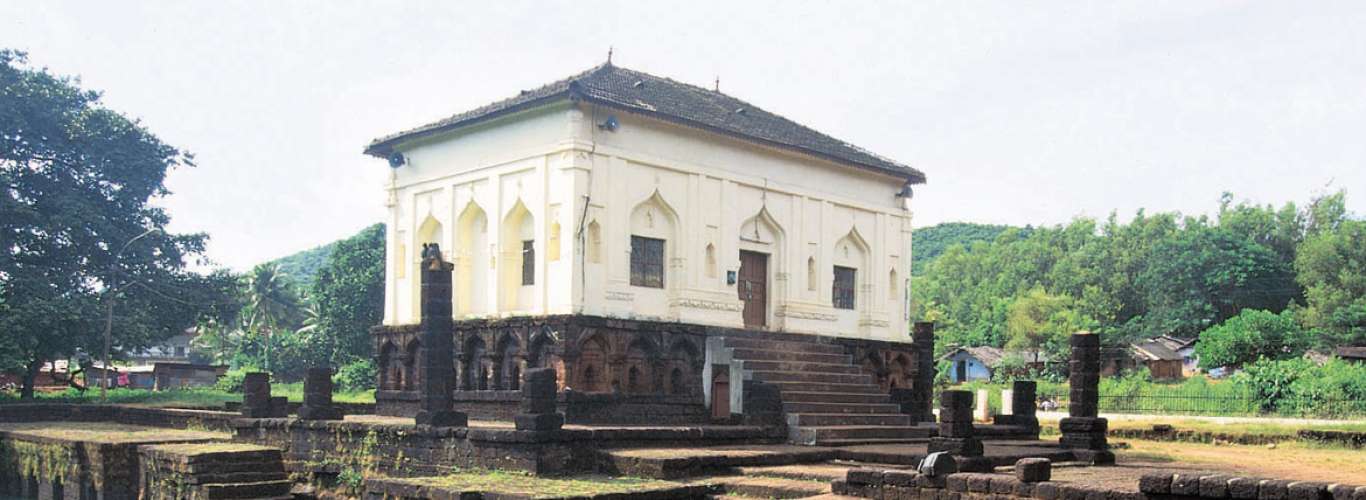
Set on the edge of a large tank just outside Ponda town, the Safa Masjid, built in 1560, is the only surviving mosque of the 27 shrines that Ibrahim Adil Shah of Bijapur constructed. Broken columns surround the mosque, which once graced a garden with laterite walkways. It’s among the few ancient Muslim monuments left in a state that has a long association with Islam and its solitude is evidence of the energy with which the Portuguese battled Muslim rulers.
Muslims – who now form just over five per cent of the state’s population – have lived in Goa since at least the 10th century CE, when the Kadamba rulers urged merchants from East Africa and Arabia to settle in the state.
But the kingdom’s affluence soon brought it to the attention of raiders. The raids, which started in the 10thcentury, reached a crescendo with strikes by Allauddin Khilji in 1294 and Muhammad Tughlaq in 1325. After briefly being held by the Vijayanagara Kingdom, Goa in 1358 came under the sway of Alla-ud-din Hasan Shah of the Bahmani family. When the Bijapur sultans took over from the Bahmanis in 1490, Yusuf Adil Shah started a construction campaign, building a mosque and a palace.
Ismail Adil Shah’s defeat in 1510, at the hands of the Portuguese Commander Alfonso de Albuquerque, had disastrous consequences for Goa’s Muslims. Angered that Muslims had helped Adil Shah’s defence, Albuquerque’s soldiers hunted them down viciously.
source: http://www.outlookindia.com / Outlook Traveller / Home> Explore> Story
This sleepy and now maligned town on the Karnataka coast boasts of a unique cuisine embracing Konkan and Middle-Eastern influences
Bhatkali biryani is topped with fried onions, curry or mint leaves.
Bhatkal is a small port town on the Arabian Sea, near Mangaluru. Between the 8th and 15th centuries, it was one of the chief ports on the western coast, specializing in the trade of rice, sugar, spices and horses. Yemeni horses would be brought from the port of Hormuz in Iran to Bhatkal, and traded across the country. Over the centuries, traders from Iraq, Iran and Yemen settled in Bhatkal and formed the Navayath (newcomers) community. Some of them intermarried with the locals, many of whom belonged to the Jain community, and were influenced by their customs, languages and culture. This, in turn, led to a unique and multicultural food practice.
In recent times, however, whenever Bhatkal shows up in the news, it is with reference to radical Islamist elements and polarization between religious communities. As a result, the spotlight is rarely turned on this unique cuisine. Other than the Bhatkali biryani, little else is known and even less represented in mainstream restaurants, even in its home state of Karnataka.
The Alibaba Cafe and Restaurant on Bengaluru’s busy MM Road in Fraser Town is one of the few places that is changing this trend. The décor seems straight out of an Arabian Nights tale. Coloured glass lanterns hang from the ceiling and the mud-plastered walls are reminiscent of a Yemeni village home. There are Indian references too. The restaurant’s heavy wooden door has a lotus motif and large copper cooking pots in the corner look curiously Mangalurean. Shaad Hassan Damudi, the owner, greets visitors while taking orders on the phone in rapid-fire Konkani.
Damudi is from the Navayath community and his restaurant’s menu reflects his heritage. “What you see on the menu here is centuries of cultural amalgamation between the various communities, resulting in a very unique cuisine,” Damudi explains. The meat-heaviness is also reflected in the star dish on the menu—the Shaiyyo biryani, made from vermicelli (shaiyyo) instead of rice. The vermicelli adds a uniquely Konkani touch to the distinctly Middle-Eastern flavours of the dish, featuring layers of delicately spiced meat and a generous helping of browned onions. Shaiyyo is sun-dried in vast quantities in early summer, so it can be prepared and enjoyed throughout the long west-coast monsoon. “Navayath cuisine tends to have milder flavours than traditional south Indian coastal cuisine,” says Damudi. “We use local Byadagi red chillies, known for their bright red colour and slightly sweeter taste.”
Any conversation about Bhatkali food always turns to Bhatkali biryani, made with basmati rice flavoured with saffron and whole garam masala. Tender pieces of mutton, chicken, fish or prawns are cooked separately with spices. Some even describe it as a korma and rice dish which is assembled in layers and finally topped with fried onions, curry or mint leaves.
Seafood is a staple of Bhatkali cuisine. Fish, prawns, mussels, clams, oysters and squid, available in plenty along the Konkan coast, are combined with local spices to create preparations like the laun miriya mhaure, where sliced fish (typically seer) are cooked in a traditional salt and red chilli paste, or shinonya nevri, steamed mussels stuffed with a spicy rice and coconut mixture.
Aftab Husain Kola, a Bhatkal native and a food and travel writer, says that although modern influences have crept into traditional Navayath cuisine, many of the old traditions of seasonal food have been preserved. He also throws light on some of the other Navayath home specialities like haldi pana nevri, rice pancakes steamed in turmeric leaves, and mudkuley, tiny steamed rice-flour balls in a delicately spiced curry. The community also gets together during weddings and festivals, for dawats or feasts which celebrate Navayath fare.
The wide range of Bhatkali desserts reflects the cultural intermingling of communities. Shaufa pana (dill leaves) feature in a variety of desserts, from poli (bread) to appo (pancakes), even puddings. Saat padra navariyo, a baked, layered dessert, reminiscent of Goa’s bebinca, and tariye khawras, a semolina, coconut and cashew pudding, are unique to the region. Some of the desserts have interestingly Middle-Eastern hybrid names too. Al basra poliand aflatoon poli are two such delicious concoctions—baked pancakes made with combinations of milk, coconut, egg and sugar. The Bhatkal version of kheer is godan—it has various manifestations, but the base always comprises coconut milk and jaggery.
The culinary diversity of this little coastal town is quite mind-boggling and more conversations about this and other aspects of Bhatkal’s rich culture could present an alternative narrative to those of terror and violence.
Aflatoon poli
Serves 4
Ingredients
2 tbsp refined flour
2 cups milk
4 eggs, beaten
1-2 tbsp sugar
1 tbsp broken cashews
1 cup coconut milk
K cup condensed milk
2 tbsp ‘ghee’
Method
Add the refined flour to the milk and stir over a low flame until it thickens. Leave aside to cool. Add in eggs, sugar, nuts, coconut milk and condensed milk, and mix thoroughly.
Grease a baking tin with ‘ghee’ and pour the mixture into it. Bake at 160 degrees Celsius for about 20 minutes. Check if it is done by inserting a toothpick into the pancake; it should come out clean. Remove from the baking tin and serve warm.
source: http://www.livemint.com / LiveMint / Home> Leisure / by Sriram Aravamudan / September 02nd, 2018
To clean and manage the 13th-century shrine, a Swachh Iconic Place, ₹5.68 crore to be spent
The historical dargah of Sufi mystic Khwaja Moinuddin Chishti in Ajmer is all set to get a facelift as a memorandum of understanding has been signed by the Dargah Committee, the Ajmer Municipal Corporation and Hindustan Zinc for spending ₹5.68 crore to clean and manage the shrine.
The 13th-century dargah has been included among the Swachh Iconic Places, a clean-up initiative focused on iconic heritage, spiritual and cultural places through a multi-stakeholder approach model. The campaign was initiated under the Swachh Bharat Abhiyan in 2016.
Select 100 SIPs across the country will be cleaned and developed at a higher level of sanitation and facility management in collaboration with corporates and leading public sector units as part of the initiative.
In Ajmer, the Collector will act as the project’s nodal agency with the Dargah Committee and ‘khadims’ (workers) being the primary stakeholders. An amount of ₹5.68 crore will be invested in the project’s first phase for establishment of two flower compost making machines, cleaning and basic repair of the Jhalra pond, re-flooring in select areas, procurement of machines for cleaning the floors, risk management system plan, conservation of Shahjahani Gate and initial plans for Nizam Gate.
More amenities
The MoU was signed in Ajmer on Saturday in the presence of Union Minister for Minority Affairs Mukhtar Abbas Naqvi. Mr. Naqvi said the project would help in the dargah’s upkeep and provide more facilities to the pilgrims coming during the Urs and in other seasons.
Two flower compost machines have already been installed in Kayad at a cost of ₹27 lakh for churning out about 25 kg of compost from 100 kg of flowers offered at the dargah. A vision document for the shrine has been prepared by a team of architects and building plan and design consultants.
source: http://www.thehindu.com / The Hindu / Home> News> States> Other States / by Special Correspondent / Jaipur – September 04th, 2018
In the two volumes of ‘Asar-us-Sanadid’, Sir Sayyid combined anecdotes with rigorous measurements and descriptions.
IntroducingAsar-us-Sanadid
by Rana Safvi
Asar-us-Sanadid by Sir Sayyid Ahmad Khan is an important book for many reasons. It was the first time that a book on this scale describing Delhi’s monuments had been written. The first volume was published in 1847 and a second volume in 1854. Though both had the same name and were about Delhi, they were very differently written. The first was an anecdotal description of the buildings, while the second took a more scientific approach with historical references, and the dimensions of the monuments.
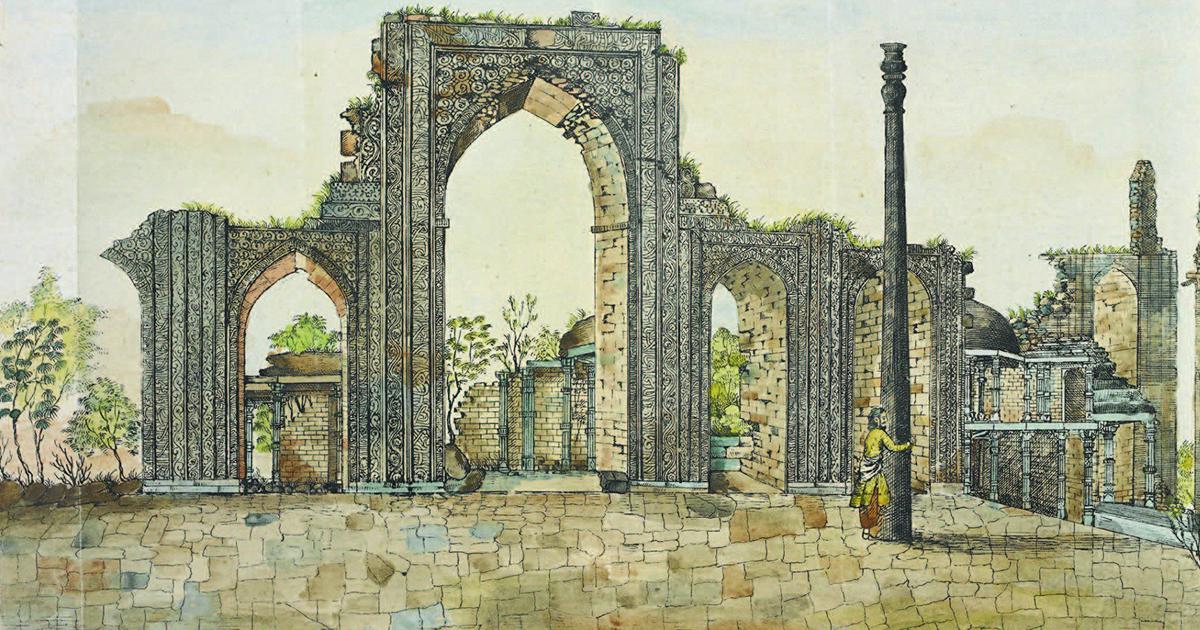
It was also the first time in India, that a book had lithographically produced illustrations. As many as 130 illustrations of Delhi’s monuments were drawn by Faiz Ali Khan and Mirza Shahrukh Beg. The drawings were probably based on rough sketches provided by Sayyid Ahmad Khan himself. He made many sketches – a fact he mentions in the book – and also copied the inscriptions on each of the monuments, often at great risk to life and limb, as in the case of the Qutub Minar, where he hung down from the top of the minaret in a basket held by ropes. It was the first time that inscriptions on the buildings were noted down.
Asar-us-Sanadid is an invaluable work. Both editions – Asar-1 and Asar-2 (published in 1847 and 1854, respectively) – were written before the Uprising of 1857. As is well known, much of Shahjahanabad changed during and in the aftermath of the events of 1857. The British broke down many structures to make governance easier and there was massive restructuring, in particular, of the Red Fort.
Later, when Lutyens’ Delhi was being built, many more changes were brought about, not to mention the changes that are still taking place today. Thus, in his descriptions of the buildings and monuments of Delhi prior to 1857, Sayyid Ahmad Khan gives us a glimpse of lost glory. For students of history and heritage this is where its greatest importance lies.
The partition and transfer of population in 1947 meant that the landscape of medieval Delhi was changed further. Today urban development has resulted in encroachment and destruction or alteration of many more monuments.
Mehrauli is the first documented city of Delhi and it was from here that the Tomaras, Chauhan and early Delhi Sultans ruled. As it was a hilly and wooded area it become a favourite of the Mughals too, with the last two emperors shifting here during the monsoons. The last Mughal building is the Zafar Mahal, situated in Mehrauli, which was the royal residence during those months.
A unique festival called Phool Waalon ki Sair was also celebrated in the monsoons under the last two Mughal emperors.
The excerpt below describes some of the buildings in Mehrauli.
The Bagh e Nazir is now Ashoka Mission. According to some monks I spoke to there, the family of Nazir Roz Afsun fared very badly in the riots which took place during the partition of India in 1947, and the lone survivor, a young boy, migrated to Pakistan.
In 1948 Prime Minister Jawaharlal Nehru gave the land as a gift to the famous Cambodian monk Dharmvara Mahathera on behalf of the Indian state for the purpose of opening a Buddhist institute. It was he who founded the Ashoka mission there. It is now the Official Buddhist Mission in Delhi, known as Ashoka Mission.
The Hauz e Shamsi is a poor reflection of what it was, and though the pavilions of the Jharna still stand forlorn, they are desolate. The water is a dirty and stagnant pool and gone are the diving competitions or sliding stones. The mango orchard has disappeared and there are only residences in the area. One can only thank Sir Sayyed for a glimpse into that era when emperors and their consort picnicked here.
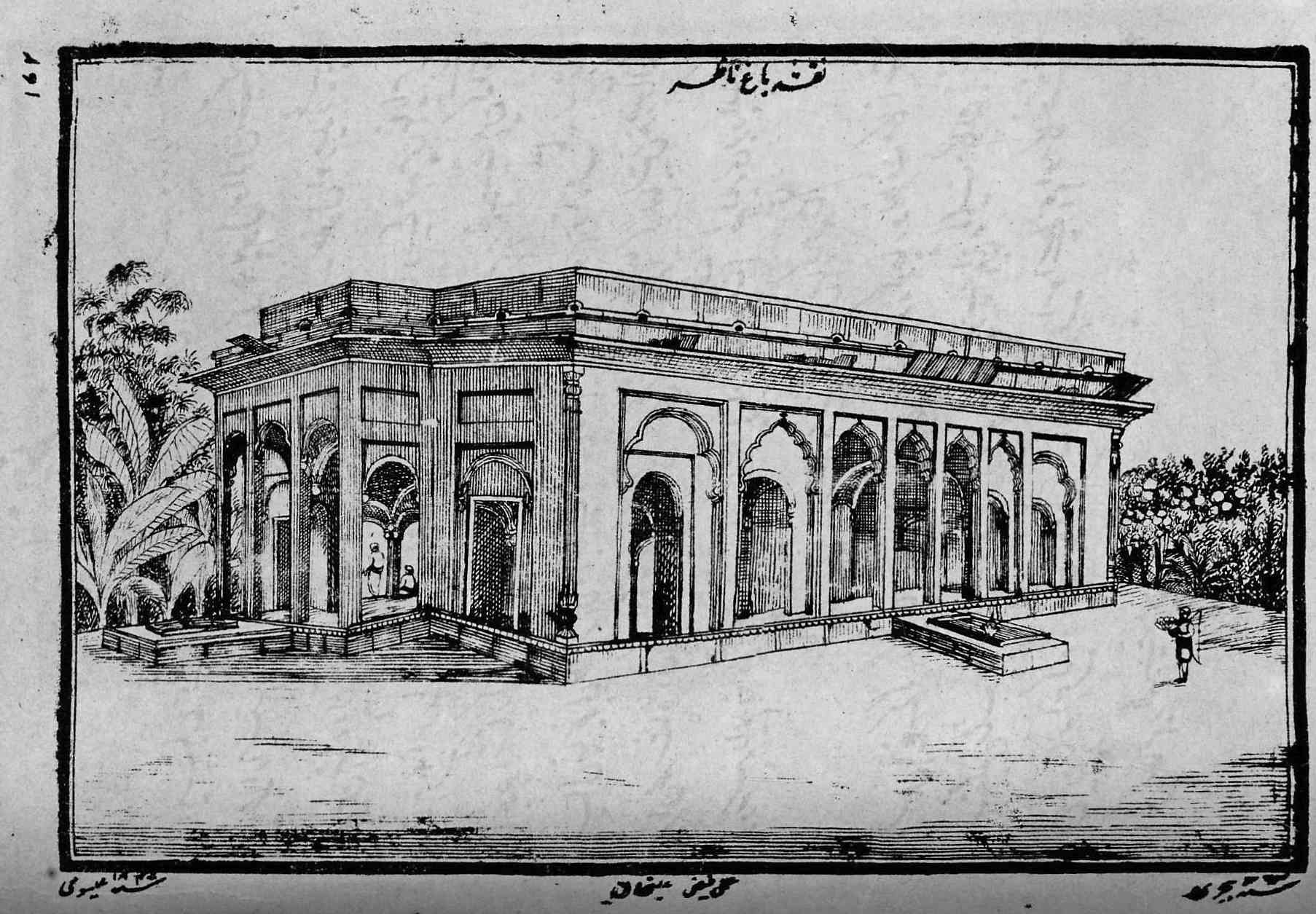
Bagh-E-Nazir
This is a beautiful, attractive, verdant and luxuriant garden near the waterfall of Qutub Sahib [in the Mehrauli area]. It is still very well maintained, with blooming flowers and green trees. The buildings around it are still intact and thousands of people come here during the Phool Walo’n ki Sair procession, to enjoy its beauty. The spectacle is as entertaining as though one were at a fair. This garden was built by Nazir Roz Afzun during the reign of Muhammad Shah Badshah. I will write down the verses inscribed on the entrance as they give the date of the construction and name of the builder:
By the orders of Muhammad Shah Adil,
Whose head bears the sacred crown.
He founded this garden near [the shrine and tomb of] Qutub Sahib,
And has adorned it with the flowers of paradise.
It should remain green till the Day of Judgment,
By the Grace of the Holy Quran.
The year of its construction,
Was found to be the blessed date,
AH 1116 in the thirty-first regnal year of Muhammad Shah.
Bagh-e-Nazir | Courtesy: National Archives of India, New Delhi
A wall surrounds the garden and there are red sandstone buildings of great attraction built all around, within the wall. There is one building in the middle of the garden that is the biggest and best of all the buildings there. Thus I am attaching its sketch here.
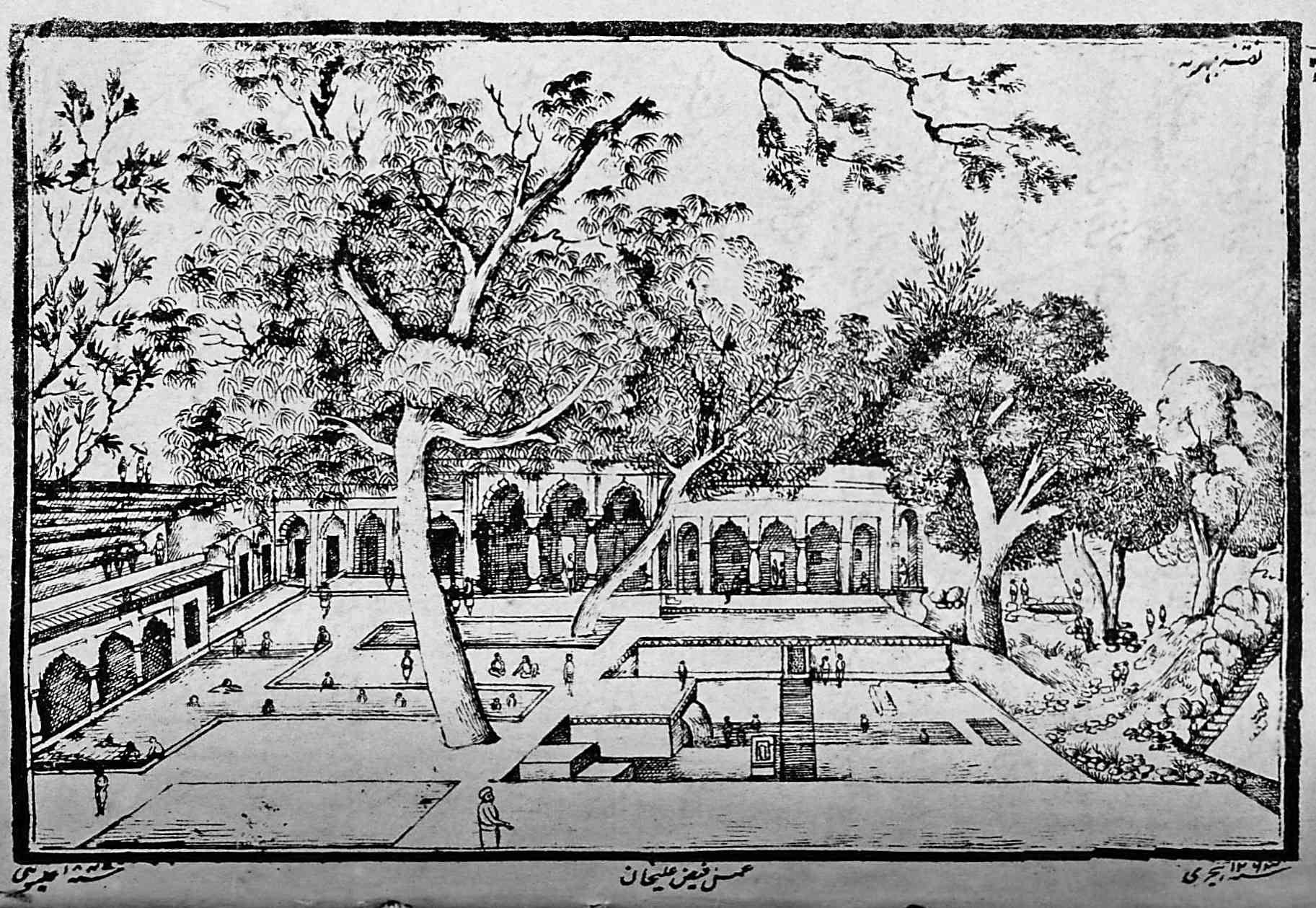
Jharna This is a place for recreation and pleasure; it is exotic and unearthly, elegant and refined, interesting and delightful, happiness-bestowing and heart-pleasing. Qutub Sahib’s waterfall [jharna] is famous for its verdant green trees and reminds one of heaven. Initially, Sultan Firoz Shah had constructed a dam here and the wall of the waterfall is that dam. It is still intact.
He had diverted the excess water of Hauz-e-Shamsi reservoir into Naulakh canal [nala] towards the moats of Tughlaqabad Fort. After some years however, the fort was abandoned and water stopped going to that area. The excess water from the Hauz-e-Shamsi then started flowing into the jungles from this dam and was wasted. Nawab Ghazi-ud-Din Khan Firoz Jung built a tank, water channels, and chutes for the water to flow through. The waterfall is an awesome spectacle and pleases the heart, causing the spectator to involuntarily exclaim in delight. There are various buildings around this waterfall which I will describe here.
Jharna | Courtesy National Archives of India, New Delhi
Pavilion on the western side On the western side, adjoining the wall of the dam stands a pavilion at an elevation of 11 feet and 5 inches. It has three arches, and the waterfall cascades down on it. There is an attractive tank in front of it, into which people jump from the roof of this building. During the Phool Walo’n ki Sair festivities people diving into this tank and swimming in it, make for a huge spectacle. They use various diving styles including somersaulting into the water, they also make a pyramid by climbing onto the shoulders of men standing below until the man at the top of the pyramid reaches tree-branch height. Then those at the bottom dive into the tank and all those on their shoulders plunge into the tank. This is called a “tree dive” [darakht kakudna] or a “wild growth dive” [jhad-jhankar ka kudna].
There are thirteen small water pipes under the roof of this building and water from the waterfall flows down through these, via the pavilion, and into the tank. There is a 3.2-feet wide water chute inside the pavilion which falls from a height of 4.3 feet into the tank. There are niches built under the chute in the pavilion wall, and water flows over lighted lamps that are placed within the niches.
This 25-feet square tank has an opening of 1.7 feet for water to flow into it and is 7.6 feet deep. There is a 22 feet long, 6 feet wide and 3.6 feet deep water-channel, which flows out of this tank in a 5.6 feet cascade and is joined by two smaller cascades from the north and south. There are beautifully carved stone chutes [salami pathar] measuring 3 feet 7 inches, to receive the cascade. The water winds its way down the carvings on the chute creating a mesmerising effect.
The water channel in front of this pavilion is 26 feet long, 6 feet wide and 2 feet deep, while the water channel in front of the smaller cascades is 15.3 feet wide, 2.9 feet wide and 8 feet deep. All the water collects at this point and flows into the jungle. The waterfall passes over all these pavilions and the water channel, and in reality it is a truly spellbinding sight. The sound of the flowing water mingles with the singing of the nightingale, the chirping of doves, peacocks dancing and the sounds of merriment of finely attired men and women. It is a mesmerizing scene, which could put Raja Indra’s assembly in the shade.
Pavilion on the northern side There is a very attractive double pavilion on this side. Muin-ud-Din Muhammad Akbar Shah Badshah built the double pavilion in his reign, around three years ago. These are the most attractive buildings in the place.
Pavilion on the southern side There is a three-arched pavilion in this area, with two smaller pavilions on its sides which gives it the impression of being five arched. In addition to this there are two doors next to it, thus making it seven arched. This pavilion was built around 50 years ago in the reign of Shah Alam by Shahji’s brother, whose name was Sayyid Muhammad.
Pavilion on the eastern side There are only mountains on this side and no buildings, but Muhammad Shah Badshah built a stone slide [phisalna pathar] 18 feet 3 inches long and 7 feet 7 inches wide.
The mango orchard There are many mango trees in this area. People tie swings to the branches and have fun swinging on them. Numerous dancing and singing girls gather here to enjoy themselves. In short, this place is magical and the mind boggles at its attractions. There is also a grave here with the following verse inscribed on it:
Abid who was wise, learned, pious and man of intellect,
Was martyred by a dishonest robber.
The invisible crier told me the chronogram of his death,
The soul of Abid, the martyr entered paradise [in] AH 1209.
Hauz-E-Shamsi This reservoir [hauz] was one of a kind. Sultan Shams-ud-Din Altamash built it during his reign and that is why it is famous as Hauz-e-Shamsi. Once upon a time this reservoir was made of red sandstone but now all the stone has been torn off and it is just a simple reservoir and that’s why people call it Qutub Sahib’s reservoir, while some still call it Hauz-e-Shamsi. The water from here feeds the waterfall and also fed the moats of Tughlaqabad in olden days.
It is difficult to imagine there is a reservoir of this size on the face of earth. It is spread across 276 bighas [a land measurement] and its water reaches eight provinces [subahs]! The pavilion has been built around the mark of a hoof which people call the hoofprint of the Prophet’s celestial steed Buraq, but to me it seems a made-up story. God alone knows the truth.
Auliya Masjid On the eastern side of the Hauz-e-Shamsi is a platform and on it another smaller platform about a gaz or so with a small wall. According to legend, Hazrat Khwaja Qutb-ud-Din Bakhtiyar Kaki and other Sufi saints undertook their spiritual retreat/penance [chillah] on it. They built the mosque with their own hands, bringing baskets [of mud from the reservoir] and that’s why it is called Auliya [The Saint’s] Mosque. Now people have plastered it with mortar and lime.
Excerpted with permission from Asar-us-Sanadid, Sayyid Ahmad Khan, translated and edited by Rana Safvi, Tulika Books.
source: http://www.scroll.in / Scroll.in / Home> Book Excerpt / by Sayyid Ahmed Khan & Rana Safvi / August 31st, 2018
Royal spread:The ‘Khwan Nemat-e-Asafia’ lists 15 types of biryanis such as Biryani Rumi, Biryani Mahboobi, Biryani Nargis, Biryani Hazar Afreen.
The world knows them for fabulous jewels and splendid palaces. But not many know that the erstwhile Hyderabad rulers had a weakness for a rich diet as well.
Sample this: Biryani Dulhan, Yeqni Palou Shirazi, Khorma Murgh, Qhalia Chamkura, Kabab Gul Khatai. A ‘shahi’ spread any which way. If your mouth is doing a tango, you are not to be blamed.
Now, one can try out these dishes. Urdu daily Siasat has stumbled upon a dog-eared copy containing a list of 680 formulae used by the royal kitchenette of the 6{+t}{+h}Nizam, Mir Mahboob Ali Khan (1866 – 1911). The newspaper plans to publish the recipes in Urdu and English on art paper shortly. The book, titled Matbaqe Asafia, is expected to hit the market in the next two months.
“It will be in time for Ramzan, the month of fasting,” Siasat ’s Editor Zahed Ali Khan says.
Tell me what you eat and I will tell you what you are. A look at the recipes and the ingredients that go into making these sumptuous dishes give an inkling of the royal taste — cuisine that is never clichéd. Every formula differs from the other in the set of instructions and ingredients.
The ‘Khwan Nemat-e-Asafia’ lists 15 different types of biryanis such as Biryani Rumi, Biryani Mahboobi, Biryani Nargis, Biryani Hazar Afreen. As the name suggests, the ‘Dulhan Biryani’ is highly decorated with a fried banana in covering of ‘warq’ (silver foil).
Besides, there are 18 kinds of pulav , 16 of khichidi , 48 of do-pyaza , 21 variants of khorma , 45 of kabab and 29 types of naan . Besides, there are 25 varieties of chutneys (condiments) and 33 types of achaar . Apart from an assortment of spices and dry fruits, the ingredients also include a generous sprinkle of perfumes and sandal.
But some of the formulas could be a recipe for sickness, given the heavy doze of ‘pure ghee’ suggested. There are also some recipes, which, if tried now could land one in trouble. For instance, the book contains formulas for cooking animals which now attract provisions of the Wildlife Act. “But we don’t propose to include such recipes since they are banned now”, Mr. Khan says.
So gourmets, get ready for a royal repast.
Come Ramzan and the Siasat daily plans to publish a list of 680 formulae used by the royal kitchenette of the sixth Nizam, Mir Mahboob Ali Khan
source: http://www.thehindu.com / The Hindu / Home> National> Andhra Pradesh / by J.S. Ifthekhar / Hyderabad – May 13th, 2013
In 1859, Delhi’s most famous poet, Mirza Asad Ullah Ghalib, was asked what Delhi was like these days. He replied: “My friend, what a question to ask! Five things kept Delhi alive—the Fort, the Chandni Chauk, the daily crowds at the Jama Masjid, the weekly walk to the Jumna bridge, and the yearly fair of the flower men. None of these survives, so how could Delhi survive?” Ghalib’s despondency notwithstanding, the fair celebrating the monsoon, known as the Phulwalon ki sair or the Sair-e gulfaroshan, started again soon after the turmoil of the Revolt had died down and has survived until the present day.…
What makes the Phulwalon ki sair such a fascinating topic for the exploration of monsoon feelings is the density and variety of commentary it brought forth over the last two hundred years. These sources range from colonial reports to the no less matter-of-fact newsletters from the Mughal court. They include memoirs and essays recalling the world lost in 1857, and texts which depicted contemporary experiences up to the present day. Songs and poems were often included in other texts, but we also have a printed poem from 1876, which praises the joys of the Phulwalon ki sair and was probably meant to be performed during the festival. Together they present a rich image from which we can reconstruct many of the basic facts of the festival, such as who the people were who went to Mehrauli and what they did there. But the sources go further. They allow us an insight into the meaning different participants ascribed to the festival, and even into their emotions. Together they help us understand why Ghalib deemed the festival so important, not only for the identity but for the very survival of Delhi.
Procession with flower fans and musicians playing nafiri trumpets and drums. Illustration by an unknown artist in Mirza Hairat Dihlavi’s Phulwalon ki Sair, 1889.…
The earliest references to the processions can be found in the newsletters from the royal court for 1830. Akbar Shah and his entourage moved to Mehrauli in late July and instructed the flower-sellers to get the pankhas ready for the ceremony at Qutb ud-Din’s dargah. Every day, “His Majesty went to the jharnawith the ladies. He sat in the barahdari, enjoyed the view of the jharna and the bathing of the ladies. They sat on the swing and sang.” Akbar Shah also enjoyed sitting on the platform above the gate of his palace, from where he could watch the bustle of the bazaar and the performance of acrobats. It is from there that he watched the procession of the flower-sellers and the fair, for which numerous crowds of people had gathered.
…
Fazl ud-Din described the traditional references to shringararasa, the clouds, the peacocks, and the koyals, the lushness of the hills and trees that had recovered their greenery, the flowers that burst into bloom, the mangoes and jamuns which were so abundant that they fell from the trees before people could pluck them. This revelry brought together the nobility and the common people, Fazl ud-Din pointed out, the rich and the poor, the owners of shops and the bazaris: no one was left behind in the empty city of Delhi. All the houses were decorated and the food was rich and plenty, while the rain continued to drizzle softly. The emotional experience was mediated through the senses of sight, of touch and of taste, but equally important were the sounds of the festival, the calling out of the shopkeepers, the songs of the ladies, and the musicians accompanying the processions, mainly nafiri trumpets, shahnais and a large variety of drums. Other texts also invoked the presence of an entire naubat, travelling on an open platform.
In Fazl ud-Din’s account, the emotions came to a culmination during the procession, which moved to the temple of Jogmaya on the first day and to the dargah of Qutb Sahib on the second day. The procession was led by the royal musketeers, followed by different professional groups. At the centre, right next to the elephants of the princes, were the flower-sellers and their pankhas, ornamented with a thousand flowers:
Look how packed the street is! People are falling over each other. A sweet drizzle is falling, and a cool wind is blowing. The bleating sound of the nafiris blares loudly. The pleasant forest and the crowd of people! In the evening the pankhas reach the royal palace with a lot of commotion.
…
By the beginning of the twentieth century, the tone of the writings changed. The new generation of authors no longer had a personal experience or even memory of the festival, even before it was discontinued after the first non-cooperation movement. In 1906, we find one Saiyid Bunyad Husain from Aligarh College, writing an article for the ladies’ magazine Khatun. He praised the Phulwalon ki sair as an extraordinary festival without equal, except perhaps for one festival, which takes place every year in Paris, but his knowledge is sketchy. He mused about possible origins of the festival: as it symbolised luxury and pleasure, ‘aish o ‘ishrat, he rules out the later Mughals, as theirs was a period of decline, and finally settled on Muhammad Shah as the probable initiator, as he was known for being inclined to sensual pleasures.
…
The festival at Mehrauli lost its specific anchoring in a time and place and became a symbol for a world that had been lost. The emotions that matter were no longer those of the participants in the procession and the revelries, but the communion of sentiment created between the author and his readers. This changed the tone.
…
A Symbol of National Unity
Nostalgia might have had a critical potential, but a nostalgia that was looking back to the last days of the Mughals and was geared towards a critique not only of colonialism but of modernity seemed increasingly out of tune, certainly with Jawaharlal Nehru’s vision of what independent India would stand for. And still, it was Nehru who in 1961 suggested the revival of the festival, which had been stopped in 1921. He called together a group of influential citizens and public figures from Delhi, who inaugurated the first festival after independence in 1962. What had changed?
The beginning of the 1960s was the period when the new nation increasingly faced the challenges of poverty, internal disruptions and conflicts, between religious communities but also between language groups and states. In this situation “emotional integration,” a felicitous phrase created by Nehru, became the rallying cry:
Political integration has already taken place to some extent, but what I am after is something much deeper than that—an emotional integration of the Indian people, so that we might be welded into one, and made into one strong national unit, maintaining at the same time all our wonderful diversity.
As a festival that was jointly celebrated by Hindus and Muslims, which had already been read as a symbol of Delhi’s tolerance and cosmopolitanism, the Phulwalon ki sair offered vast symbolic potential, and has been patronised by almost all prime ministers since Nehru. Many are the presidents of the republic who have come to deliver speeches at its inaugural function or at least sent messages of support, while the administrative elite of Delhi has always been involved in the planning of the festival and many have participated in some function or other during its three days.
Left: A flower fan carried in the Phulwalon ki sair. Right: Children of qawwals at Quutb Sahib.
The festival, especially during its heyday in the nineteenth century, was an intensive experience for those who participated, involving all the senses at the same time. The eyes saw the beauty of the blossoms and the greenery of the forest, the alluring sight of the ladies and courtesans displaying their fineries and frolicking around the jharnaand the lakes, the decoration of the bazaars, the lights in the evening and the fireworks. The ears heard the calls of the birds associated with the monsoon, the koyal and the peacock foremost among them, but also the songs of the ladies, the blaring of the nafiris and the resounding drums. The skin felt the relief of the cooling drizzle of rain, the embrace of the beloved, the closeness of other bodies during the procession; the tongue relished the abundance of mangoes and the delicacies prepared in the bazaar; the nose took in the smell of rain on the scorched earth, the perfume of the flowers, and the aroma of the food.
…
Looking at the procession over a time span of almost two hundred years also brings out the close relation of emotions and politics—even in this case, which at first sight involved nothing more than coming together to enjoy the rainy season. The Phulwalon ki sairalways was (also) a political statement, though these of course changed through time.